During spring break last week, George Washington’s Ferry Farm hosted to Grandparent-Grandchild Archaeology Camp. Campers, young and old, got a crash course on the entire archaeology process at Ferry Farm and the importance of archaeology to history. From recording information and digging up artifacts to a behind-the-scenes lab tour and creating an artifact diorama, campers left with a new-found knowledge of what is beneath their feet! Here are some photos of the camp.
Preparing to dig.
Archaeologists have to record everything they do.
Taking soil depth measurements before digging.
Determining the soil color.
Digging.
“I found something!”
Screening to separate artifacts from dirt.
Carefully checking for artifacts after screening.
Artifacts get bagged.
Viewing Mary Washington’s punch bowl during an Archaeology Lab tour.
Learning about the glass mending project now happening in the lab.
Mending an ‘artifact’.
At the end of the day, campers were given an object that they used to create a diorama telling the story of the object.
A few weeks ago at George Washington’s Ferry Farm, painters finished painting the exterior of the Washington house. They used a red color known as “Spanish brown.” The paint is linseed oil-based and actually behaves more like a stain. Modern oil-based paint can, in a way, be thought of as a plastic that laying atop the surface and coating the wood. The historic pigment we used actually seeps into the wood itself and essentially stains the wood the deep red.
River-facing side of the Washington house at Ferry Farm.
Falling snow against the new paint on the Washington house.
Why did we choose Spanish brown as the Washington house’s exterior paint? Well, we have evidence, both documentary and archaeologically, that suggests the original Washington home was this very color.
First, our archaeologists recovered fragments of plaster with Spanish brown on them, which demonstrates the color was available and used at Ferry Farm.
Finally, when paint analysis of colonial houses is done, Spanish brown is frequently encountered. The color was extremely popular during the 1700s. Here in Virginia paint analysis found it used at William Randolph’s Tuckahoe and in Williamsburg at Nathaniel Walthoe’s storehouse, Bruton Parish Church, and, most notably, the Peyton Randolph House.[1]
The Peyton Randolph House in Colonial Williamsburg. Credit: Wikipedia / Jrcla2
[1] Susan Buck and Willie Graham, Chap. 15 “Paint” in The Chesapeake House: Architectural Investigation by Colonial Williamsburg, ed. by Cary Carson and Carl R. Lounsbury, Raleigh, NC: University of North Carolina Press, 364.
The roof of the rebuilt Washington house at Ferry Farm was recently completed. The work was done by tradesmen using a mix of 18th century building methods and 21st century equipment. The roofing was done by Peter Post Restorations.
Learn more about the Washington House here and view other videos, photos, and blog posts about the project here.
As we saw in this blog post, Harriot Washington lost both of her parents by the time she was five years old. Her childhood was spent shuffling from one relative’s household to another. Finally, she came into the care of her uncle George Washington, who along with aunt Betty Washington Lewis, provided stability and support throughout Harriot’s teenage years. She lived with Betty for many years at Kenmore. By the age of 19, Harriot had matured into respectable young woman. Marriage was at hand.
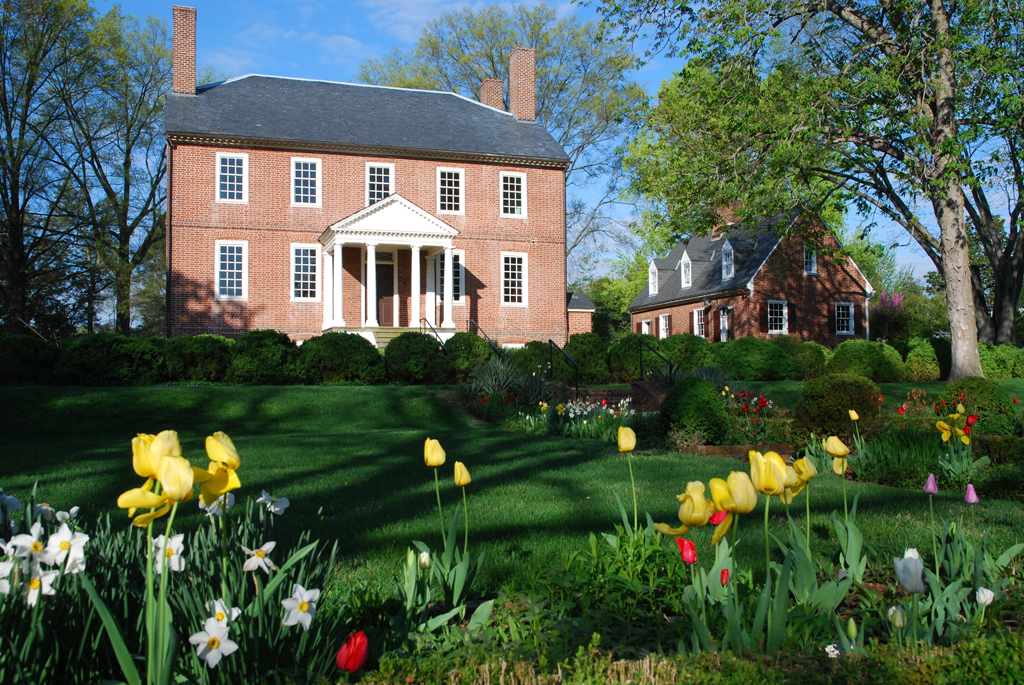
Kenmore in Spring
On April 1, 1796, Washington received a letter from Andrew Parks of Fredericksburg. Andrew had asked Harriot to marry him. Harriot referred him to Washington for his consent and had told Andrew that she would not marry him unless her uncle approved. Andrew wrote a letter promoting himself, with details on his life in town as a mercantile businessman. He frankly revealed that his fortune did not “exceed three thousand pounds.” He believed that he was a hard enough worker to make up for his lack of current money and that he had hopes of improving his situation. He mentioned relations in Baltimore and offered to provide a complete accounting of these family connections, if Washington desired.
Washington replied on April 7. He noted the proposal was a “serious one” that deserved “serious consideration” and that he would take time to ponder it. He warned Andrew that, while Harriot had “very little fortune of her own,” fortunes were not the only factors to consider when contemplating marriage. Harriot’s guardian desired to see her happy and believed only a “gentleman of respectable connexions, and of good dispositions,” who made money, instead of spending it, and who could “support her in the way she has always lived” was an acceptable match.
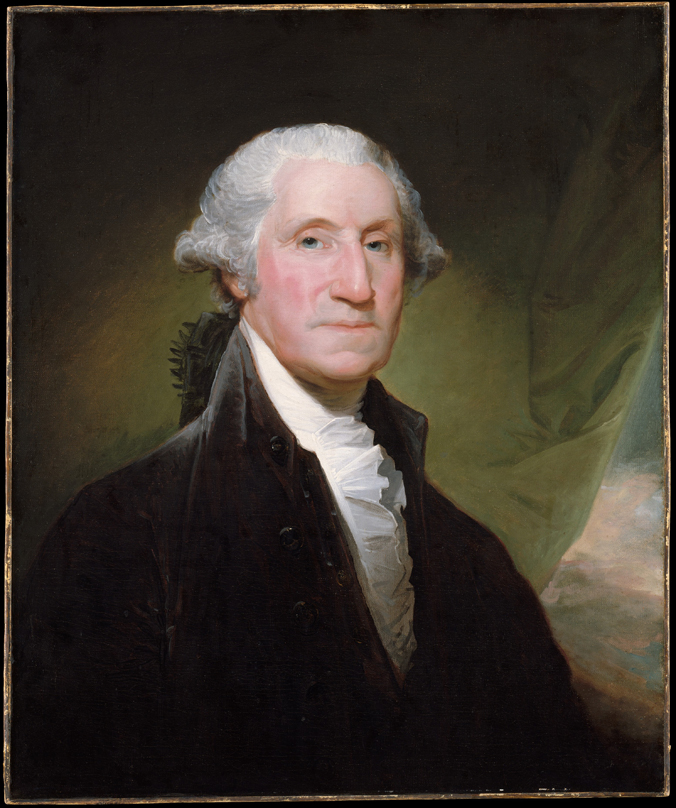
Portrait of George Washington (1795) by Gilbert Stuart. Credit: Public Domain / Metropolitan Museum of Art
Of course, Betty also contacted Washington to inform him of Andrew’s proposal. Her letter seems not to have survived but his response, also dated April 7, basically requested more information about Andrew. Harriot’s uncle acknowledged that “having very little fortune herself,” Harriot had “no right to expect a great one in the man she marry‘s; but if he has not a competency to support her in the way she has lived, in the circle of her friends, she will not find the matrimonial state so comfortable as she may have expected when a family is looking up to her & but scanty means to support it.” Though a great one was beyond possibility, he still believed Harriot ought to “expect one whose connexions are respectable, & whose relations she could have no objection to associate with.” What really troubled Washington was “How far this is, or is not the case with Mr Parks.” He worried, “I know not for neither his own letter, or yours give any acct of his family nor whether he is a native or a foreigner—& we have his own word only for his possessing any property at all altho’ he estimates his fortune at £3000. A precarious dependance this when applied to a man in Trade.”
Although he had no desire to impede the marriage, Washington indeed was anxious for information, which he immediately endeavored to collect. Secretary of War James McHenry wrote Thomas McElderry, Andrew’s brother-in-law and business partner, on behalf of the president. McElderry replied that, after the death of Andrew’s father, he had made Andrew his partner, allowing his brother-in-law to be well set up in business. McElderry also reported that Andrew was a hard worker, gentlemen, and generally well-liked in the community. McElderry judged him “much more promising than many of the Virginia Gentlemen with their large landed Estate and Negroes.” One wonders how helpful this final statement might have been in convincing Washington – the first among Virginia’s landed and slaveholding gentlemen – of Andrew’s good connections!
Betty also made inquiries about Andrew and notified Washington that she had “heard nothing to his disadvantage” and that “he is respected by all his acquaintance.” She revealed that Andrew was “A Constant Visitor here and I believe Harriots Affections are plac’d intirely on him.” Indeed, Harriot, in Betty’s opinion, was sick with “anxiety for fear of offending and not gaining your consent.” Betty then admonished her brother that his “long Silence has given her much uneasiness.”
George Lewis, Betty’s son, examined Andrew’s background and concluded the match, at least at the moment, “to be madness in the extreme.” He suggested waiting until Washington returned to Mount Vernon after his presidency ended, so that he could attend the matter personally and better investigation of Andrew could be made. Still, he believed Andrew “a young Man of good talents” and noted that none of his initial inquiries revealed major problems.
Betty again wrote George about the matter on July 5, 1796. She told George that Lawrence Lewis, another of her sons, had made inquiries and seemed “well pleased” while Harriot’s own brother told Betty that he thought the marriage would be a “very happy one.” Ultimately, Betty herself concluded that Andrew bore “the Best caracter of any young Person that I know” and that Harriot was “Old Enougf now to make choice for her self.” It was high time she was married and that is exactly what happened. On July 16, 1796, Harriot Washington, aged 20, married Andrew Parks.
The day after her wedding, Harriot wrote to her uncle, hoping he was “not offend’d at my Union.” She expressed, with some finality, that “my heart will ever with the liveliest gratitude most gratefully acknowledge and remember your’s & Aunt Washington’s great goodness and attention to me.”[1]
“Far from being displeased at the event,” Uncle Washington responded, “I offer you my congratulations thereon; and sincerely wish it may prove the source of continual happiness to you.” Washington closed the letter with an invitation for his niece and her new husband to visit Mount Vernon whenever Andrew’s business might allow it.
I need not repeat to my dear & Honord Uncle, the infinite pleasure I experienced on reading his kind, & affectionate letter… Mr. Parks and myself return our most grateful thank’s, to you and Aunt Washington for your congratulations and also polite invitation, to visit you which no circumstance whatever could afford us more satisfaction…
My love to Aunt Washington & Nelly Custis. I am my dear & Honord Uncle Your ever affectionate Neice
Painters recently finished painting the exterior of the Washington house at Ferry Farm. The house was painted a red color common to the 18th century and known as “Spanish brown.” The paint was linseed oil-based just as it would have been in the 1700s. We’ll have a more detailed blog post in a few weeks explaining how we came to choose Spanish brown as the color to use. In the meantime, here are a few photos of the painters working as well as of the finished job.
Getting started.
First coat.
Painting the dormers.
North and east side of house complete.
Dormers complete.
Falling snow against the new paint.
Learn more about the Washington House here and view other videos, photos, and blog posts about the project here.
Over the last week on Lives & Legacies, we’ve been talking a lot about the Washington house corner cupboard! We’re obviously excited because not only is the cupboard beautiful and a beautifully-made piece but because it also represents a shift from building the structure of the Washington house itself to an increased focus on the interior details as well as the start of the furnishing process.
As you learned in last week’s video and written post, talented joiners from Colonial Williamsburg built the corner cupboard. They also painted it and, recently, shared a quick timelapse video of the painting on the Historic Trades & Skills of Colonial Williamsburg Facebook page. We wanted to share the video too!
Learn more about the Washington House here and view other videos, photos, and blog posts about the project here.
As construction of the Washington house at Ferry Farm continues, our attention is turning to the furnishings of the house. Our goal is to furnish the house entirely with reproductions of 18th century pieces, so that our visitors can fully interact with them, without fear of damage to an irreplaceable piece. Guests will be able to sit on the chairs, open drawers, pick up the utensils on the table, smell the smoke from real fires in the fireplaces, and feel the breeze coming through open windows. In short, the interior of the house will be as close to what the Washington family would have known as we can make it both in design and experience.
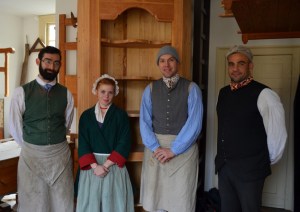
The joiners at Colonial Williamsburg (l-r): Peter Hudson, Amanda Doggett, Scott Krogh, Ted Boscana.
Fully furnishing the house will take several years, but the first piece in the process is already on its way to Ferry Farm! It is a corner cupboard, made for us by the talented craftsmen in Colonial Williamsburg’s joiners’ shop and based upon an original 18th century corner cupboard in the CW collection. The story of our corner cupboard is an interesting one, and embodies the work solving mysteries with both history and science that we do at Ferry Farm every day.
The story of the corner cupboard begins with Augustine Washington’s 1743 probate inventory, but not because the corner cupboard is listed in the document. Rather, the fact that it wasn’t listed in the inventory is what caught our attention. In the Parlor, the inventory lists a variety of furnishings, including 3 chairs, a table, a desk, a mirror and a set of window curtains. A value is given for each of these line items, as expected.
The document also lists a value for “lumber in the room and cubbord.” This phrase tells us several things. First, in the 18th century, “lumber” was the term used for what we might call junk today. Lumber was a group of odds and ends or a mish-mash of objects, none of which had much value, and usually lumped together and appraised as a group. “Lumber” did not mean wood. The Washingtons were not storing piles of wood in their Parlor.
Page from Augustine Washington’s probate inventory showing the “Lumber in the Room & Cubbord” as recorded by the inventory takers in 1743.
“Lumber in the room and cubbord” tells us that there was an assortment of junk in the room – not overly useful info, although maybe it does help us all relate to the family a bit since most of us have a junk drawer or closet somewhere in our homes. The important info that the phrase reveals is the existence of a “cubbord” (phonetic spelling for cupboard) in the room. The fact that the cupboard is only mentioned as a container for the lumber and not as a piece of furniture (it is not given a line item, and is not given a value of its own in the inventory) tells us that the people conducting the inventory felt that the cupboard was not a free-standing piece, but rather a part of the architecture of the house itself. In other words, it was what we would call a built-in.
In the 18th century, built-ins were not exactly common, but they were popular among the upper gentry, and usually took the form of corner cupboards. These corner cupboards served as storage places usually in the a cabinet section in the lower half of the piece covered by a pair of doors. More importantly, they were a place to display luxury goods, like fine ceramics or important silver pieces on the open shelves in the top half of the piece. Through this research, thorough knowledge of 18th century material culture, and some logic, we concluded with strong certainty that the Washington house had a corner cupboard in the Parlor.
Because corner cupboards were built in to the structure of a house in the 18th century, they usually were not constructed by the same furniture makers who produced the chairs and tables for a house. Instead, they were crafted by joiners, who specialized in more architectural work. It was decided to have our corner cupboard constructed off-site at Colonial Williamsburg, so that the historically trained craftsmen there would have ready access to the piece we were trying to reproduce. This original piece dates to approximately 1745 and was probably from the James River Basin region of Virginia.
Conservators at Colonial Williamsburg performed paint analysis on the remnants of original pigments still embedded in the wood of the original cupboard and determined that it was painted a light gray. As the purpose of corner cupboards was often to display fine ceramics, they were usually painted in subdued colors that would contrast with any bright or heavily-painted ceramics.
Unfortunately, most of the best ceramics found archaeologically at Ferry Farm are white or lightly-painted. Gray would not have done much for them. So, research was done by architectural historian Mark Wenger into the paint analysis of the trims and moldings in other Virginia homes of the time period. In the end, it was decided that the cupboard will be painted a dark red color, with a dark gray interior.
The finished reproduction corner cupboard for the Washington house at Ferry Farm.
A quirk of 18th century construction methods dictates that all the decorative trims and moldings in a house would be in place before plastering, and then plaster would be applied up to those trims, rather than the trim being applied over finished plaster. So, the corner cupboard will need to be in place inside the house before the plaster can be applied. The day when this special corner cupboard will take its place in the Washington house is fast approaching!
Meghan Budinger
Aldrich Director of Curatorial Operations
In this video, we learn from Curator Meghan Budinger about how we will furnish the Washington house reconstruction, we see a corner cupboard for the house being built, and talk with Master Joiner Ted Boscana from Colonial Williamsburg about making the cupboard.
Learn more about the Washington House here and view other videos, photos, and blog posts about the project here.




 Over the last week on Lives & Legacies, we’ve been talking a lot about the Washington house corner cupboard! We’re obviously excited because not only is the cupboard beautiful and a beautifully-made piece but because it also represents a shift from building the structure of the Washington house itself to an increased focus on the interior details as well as the start of the furnishing process.