In this video, we see how stonemasons Ray Cannetti, Robert Hall, and Kevin Nieto laid the handmade Aquia sandstone foundation stones around and on top of the Washington house’s concrete cradle foundation, which protects original architectural remains underground. Watch these videos about the concrete cradle and the oyster burning process.
Learn more about the Washington House here and view other videos, photos, and blog posts about the project here.
For the past year or so my focus here at George Washington’s Ferry Farm has been determining what types of ceramics were owned by the Washington family. Once we have this information we want to acquire accurate examples to place in the reconstructed house for all to see. From door hardware to teacups, most of the details of the house will be informed by archaeology or historic documents. If a visitor asks “Why do you have these plates on the table?”, we can say “That’s an excellent question! Because we’ve dug up pieces of it right over here!” Our most recent focus has been on the white salt glazed stonewares, which have been featured in previous blog posts. In this post, we talk about fragments that have been identified as a patch stand and a porringer.
First of all, identifying whole vessels from tiny sherds involves a lot of research. This is made all the more difficult when you’re working with a ware-type such as white salt glazed that is defined by its plain white color. So, it’s always a thrilling moment when you’re paging through a huge book with a tiny but distinctive fragment of pottery in your hand and you manage to spot the fragment’s whole object.
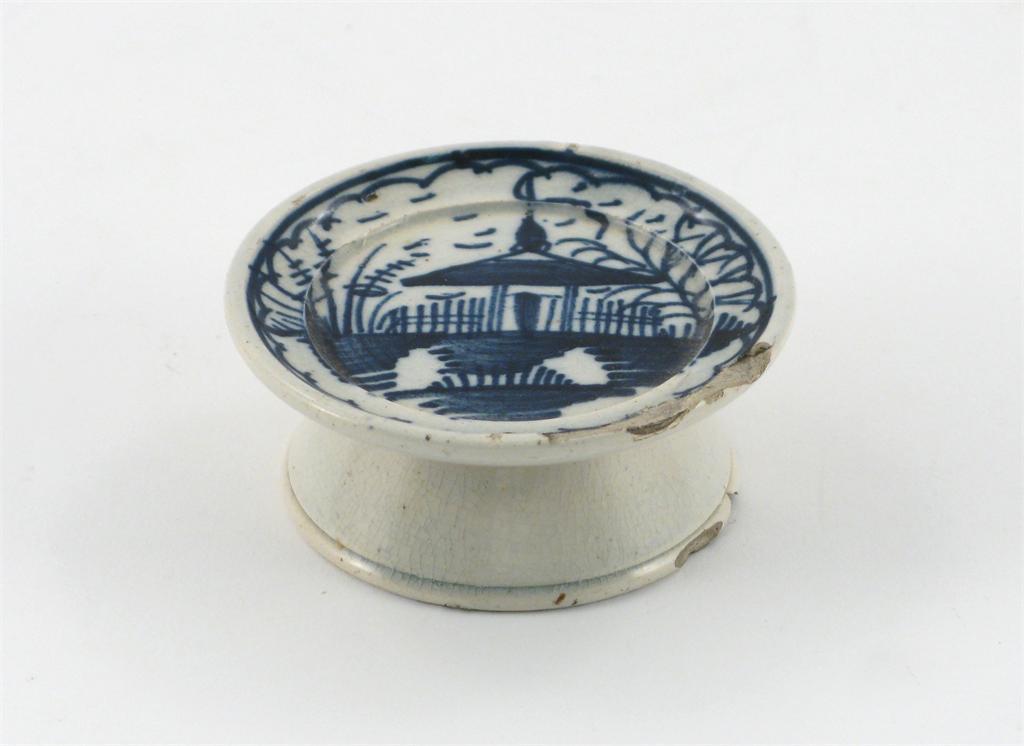
My most recent ‘Eureka!’ moment involved both a patch stand and a porringer. You’ve likely never heard these terms but you may own modern day equivalents. A patch stand is a teapot stand, designed to elevate a teapot, arguably the most important object in a tea set, above the other tea wares. It also serves the practical purpose of keeping the hot pot off of the table surface.
18th century pearlware blue and white patch stand. Credit: Woolley & Wallis.
At Ferry Farm, archaeologists found four small fragments from just such a patch stand. The fragments all have evidence of ‘piercing’ or the cutting out of wet clay before it was fired to form a pattern. The pattern created through piercing also promoted air circulation under the stand. Patch stands are not common in the archaeological record so we’re very happy to have identified the sherds. Now we’ll be able to furnish the new Washington house replica with a patch stand.
Fragments of the patch stand excavated at Ferry Farm.
A profile view of one of the patch stand fragments.
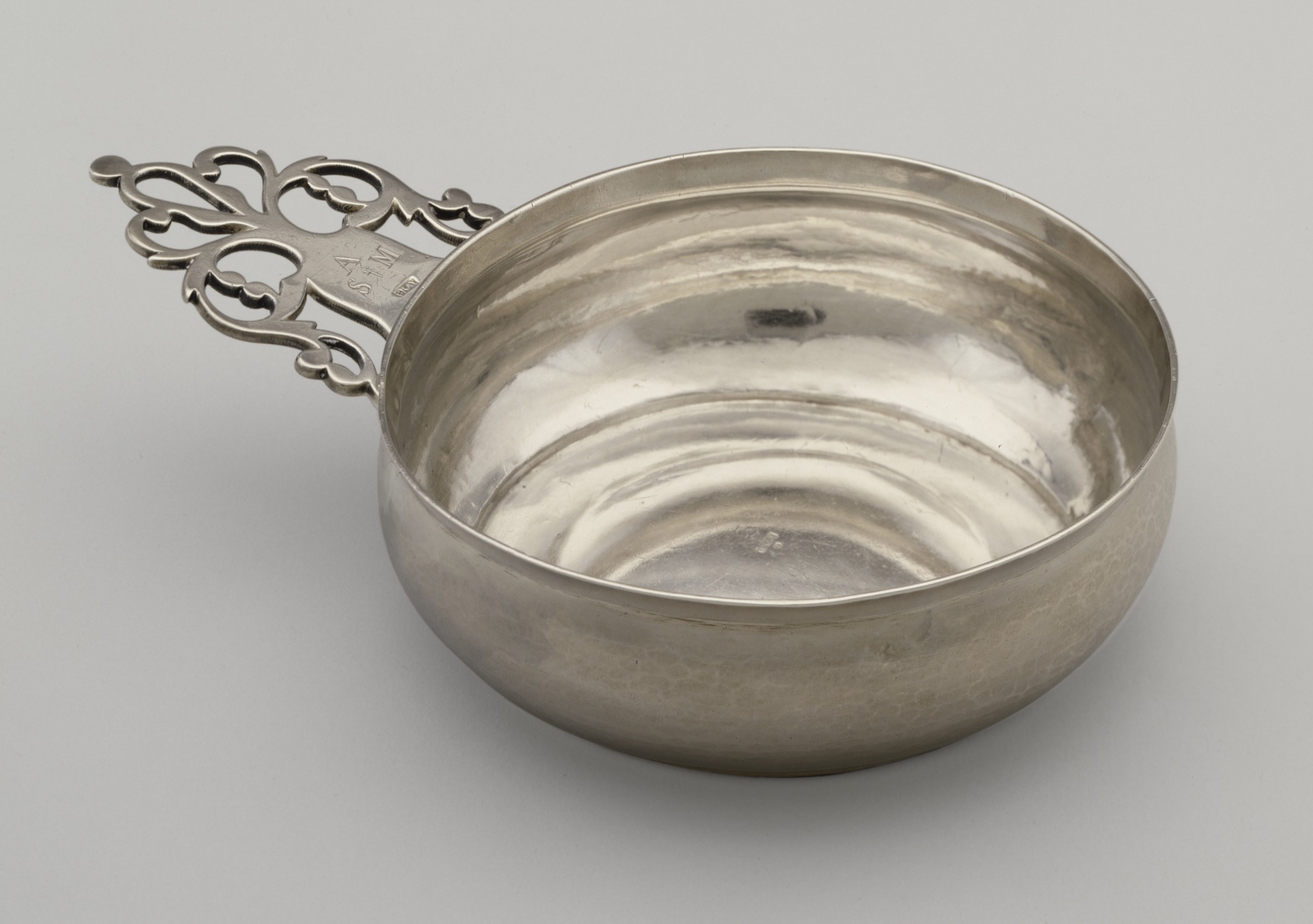
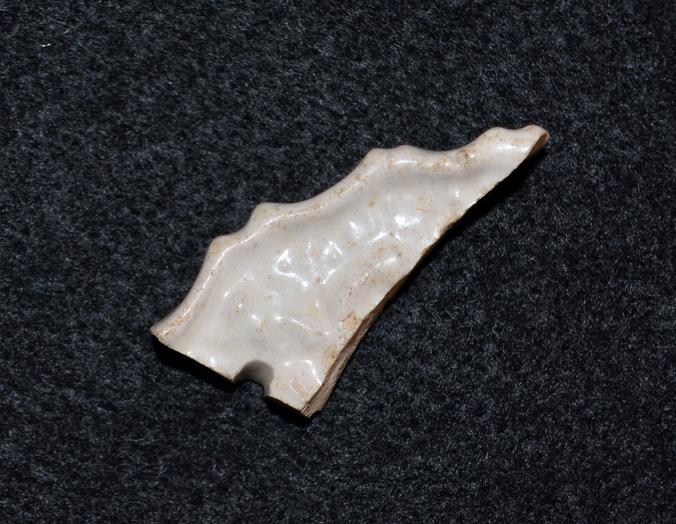
The other vessel is a porringer. Although kind of a weird name, porringers were really handy and ubiquitous in every colonial household. A porringer was simply a bowl with a handle for eating soups, porridges, stews, and the like. You may have some equivalent in your house, like those oversized coffee mugs you can also use to eat soup or cereal.
A silver porringer dating from 1742 and made in Boston by Samuel Gray II. Credit: Los Angeles County Museum of Art.Fragment of a ceramic porringer handle excavated at Ferry Farm.
Stay tuned and keep your eyes out for a sweet patch stand and a nifty porringer once the Washington house is finished!
Mara Kaktins, Archaeologist
Ceramics & Glass Specialist
Recently I was contemplating Augustine and Mary Washington’s family bible. Like many families at the time, the Washingtons recorded the births of their children on their bible’s end pages. As I casually perused the handwritten notes that I had read so many times, I discovered something that I had never noticed before: each of Mother Washington’s labors, while carefully recorded, was only done so to the nearest hour. No minutes, no “…quarter after…,” no “…5:38…” were detailed. I quickly realized two things at once: 1) the Washingtons owned a timepiece, and, 2) that timepiece only possessed only one hand for determining the hour.
Page in the Washington family bible listing births and deaths.
These times were clearly not chronicled using a sundial, given the arrival of George’s younger brother Samuel Washington on November 16 at three in the morning. Clearly, at 3 am, there was no sunlight from which to read the early-hours culmination of Mary’s labor on a sundial! The timepiece used to record these births had to be a pocket watch, case clock, table-clock, or a wall clock.
Page from the Sarrett family bible
Compare the Washington family’s biblical records with that of the Sarrett family. John and Mary Sarrett recorded deliveries in their mid-eighteenth century bible as well. However, recording the specific time was not deemed important during these happy occasions, or was perhaps not possible because they may not have owned a timepiece.
Page from the Kings family bible
In Worcestershire, England, the mid-eighteenth century Kings family did record birth times. Carefully written
among the pages of their New Testament, the deliveries of their children were noted, with the day, month, date, and the nearest hour of their birth. Sometimes, if the birth was not especially close to an hour, they improvised: daughter Anne was delivered “…between 4 and 5 in the afternoon….”
Solar Time Versus Clock Time
Luxuries such as watches became popular in England starting at the end of the seventeenth century, when advancements in manufacturing and technology made timepieces smaller and more accurate. A social climate that fostered the ownership of such elegant accessories and scientific instruments (such as sundials, compasses, scales, barometers, and clocks) evolved and thrived at this time (Priestley 2000:7; Shackel 1987:156-165). Their high cost, luxurious status, and the knowledge needed to read and understand scientific instruments limited their ownership to well-off, educated consumers. This began to change during the mid-1700s.
With their increased accuracy, consumers of these timepieces soon realized that standardized time did not match solar time: due to the earth’s tilted axis and elliptical orbit the days were not of equal length throughout the year. At the height of winter, the solar day is almost a quarter hour slower than the clock, but by mid-December the clock is that much faster than the solar day.
Some one-handed timepieces featured incremental marks that allowed minutes to be recorded with some degree of precision. Though the mechanical clock had existed for several centuries (Stephens 2002:20), most colonists had little need for measuring time to the nearest hour, much less to the minute. People organized the activities of their day according to the rising and setting of the sun and around the exigencies of weather and light that favored some tasks over others. In the United States today, we continue to tell time in relation to the middle of the day, noting whether the hour is a.m. – ante meridiem (before the middle of the day)- or p.m. – post meridiem (after the middle of the day). Since daylight provided the best conditions to do most tasks in an era when expensive candlelight, ethereal firelight, or moonlight provided the only other options, it made sense to arrange one’s tasks according to this crucial reference point. (That said, people in the 18th century were surprisingly active at night as we explored in this blog post last year.)
Although from the 1500s instead of the 1700s, this tambour cased timepiece from Germany is a fine example of a pocket watch with only a single hour hand. Credit: British Museum, (No. 1958, 1201.2203)
At Monticello, Jefferson installed a clock at the entrance to the mansion house. It was simultaneously visible from both the yard and the entrance hall with one significant difference: from the yard, the clock had a single, hour hand but the interior, household face featured three hands. This interior clock allowed time to be segmented to the nearest hour, minute, and second. While outdoor tasks were sufficiently general that timing to the hour was appropriate, indoor tasks could be scrutinized to the nearest second.
Augustine Washington’s Pocket Watch
There was no a wall clock, table clock, or a case clock like Jefferson’s in Augustine Washington’s 1743 probate inventory. Either the probate assessor missed the clock during his survey, or the times noted in the Washington family bible reflect the use of a pocket watch. Pocket watches were especially popular among those who invested in timepieces, outselling furniture, or ‘case,’ clocks throughout the 1700s.
Indeed, a splendid watch was noted in Father Washington’s probate inventory under the heading “plate.” The “plate’’ category represented items plated in silver, and included things such as teaspoons, soup spoons, and a sword. At £5, Augustine’s watch represented the single most expensive item of plate recorded in their home: over four-and-a-half times more expensive than Father Washington’s sword!
Augustine’s pocket watch allowed him to check the time and document the births of his and Mary’s children’s to the hour. By checking the time, he demonstrated his pride in the ownership of a timepiece and in the esoteric knowledge needed to properly read it..
George may have taken this very timepiece with him in the late winter/early spring of 1748 when he joined a team of surveyors hired by Fairfax to transform parts of the Shenandoah Valley into farm-sized lots (Flexner 1965:34-38). During his March travels, Washington noted:
George recorded all of the times only to the nearest hour, indicating a single-handed timepiece. I considered that he used a pocket sundial. However, since some of the times were recorded during rain events, and given the nature of backwoods surveying, it had to be a pocket watch: no member of the surveying team could have carried a bulky case clock around the valley and across swiftly-flowing rivers.
There’s a good chance that this pocket watch was the same elegant, silver-plated timepiece that his father proudly used to record George’s own birth. Surely George enjoyed showcasing his graceful, refined pocket watch amongst the more experienced backwoodsmen and surveyors with whom he traveled in 1748. It otherwise seems difficult to justify recording such trivial details to the nearest hour. The piercing gleam of the weak winter sun against his magnificent silver-plated pocket watch distinguished George as a sophisticated gentleman, despite the rustic conditions in which he was surrounded.
With their watches and clocks, Augustine, George, and others living in the 18th century now measured the fruits of their labors in greater detail and that labor became commodified, helping to usher in the modern era.
Laura Galke, Archaeologist
Site Director/Small Finds Analyst
Flexner, James Thomas
1965 George Washington: The Forge of Experience (1732-1775). Little, Brown and Company, Boston.
Priestley, Philip T.
2000 Early Watch Case Makers of England 1631-1720. National Association of Watch and Clock Collectors, Inc, Cornerstone Printing Services, Lititz, Pennsylvania.
Shackel, Paul A.
1987 A Historical Archaeology of Personal Discipline. Ph.D. dissertation, University of New York at Buffalo.
Stephens, Carlene E.
2002 On Time: How America has Learned to Live by the Clock. Smithsonian Institution Press. Little, Brown and Company, Boston.
Twohig, Dorothy (editor)
1999 George Washington’s Diaries: An Abridgment. University of Virginia Press, Charlottesville.
As 2017 begins, Lives & Legacies would like to hear from its readers! What would you like to know about George Washington’s boyhood, his mother Mary, his sister Betty, and his brothers? Maybe, you’re interested in the life of Fielding Lewis and the sacrifices he made to help the Patriot case. Perhaps, you’re wondering about the archaeological work we do and the artifacts we’ve discovered. Surely, some of you are curious about how we’re creating a replica of the Washington house. Send us your questions using the comment form below and we may just write a blog post to answer your question!
In the meantime, as we bring Lives & Legacies’ second year to a close, we thought it might be worthwhile to share several of our most read entries published in 2016. We hope you enjoy reading them for the first time or reading them again as we move into 2017.
#3 Introducing the New George Washington’s Ferry Farm – This blog post presents an overview of The George Washington Foundation’s effort to create a replica of the Washington house and outlines Ferry Farm’s transition to an outdoor living museum.
#1 Glue: The Coolest Thing I’ve Ever Found – Archaeologists are often asked “what’s the coolest thing you’ve ever found?” and for one of the Foundation’s archaeologist the answer to that question is the glue on Mary Washington’s punch bowl.
Each January, Historic Kenmore presents Twelfth Night at Kenmore, a dramatic theater presentation that imagines the first Christmas that Fielding and Betty Washington Lewis spent in their newly built home. The play is set in January 1776 and that year is not a time for the usual celebration. War brings fear, doubt, and frustration to the Lewis family and their friends.
The 2017 edition of Twelfth Night at Kenmore took place this past weekend. Here are a few photos from that performance.
Historic Kenmore in the snow on Saturday night.
Betty Washington Lewis (Barbara Cochran) welcomes her Twelfth Night guests and toasts the season while stepson John Lewis (Michael Taylor) looks on with a smile.
Lucy Thorton Lewis (left-Sarah Hall) persuades Nancy Alexander Lewis (right-Corinn Keene), who is worried about the war, to rejoin the party.
The Lewis Family sings a carol in the Dining Room.
Betty, Lucy, and Nancy talk in the Dining Room.
Fredericksburg merchant Henry Mitchell (left-Preston Simms) laments to Pompy (right-Marcus Salley) about how his neighbors whisper about Mitchell’s alleged loyalty to the crown.
Rachel (left-Gladys Perkins) argues with Hetty (right-Ashleé James) about the future that war might bring for the enslaved community and if that future will include freedom.
Editor’s Note: This Friday, Saturday, and Sunday, Historic Kenmore presents its annual production of Twelfth Night at Kenmore (click for event details). This dramatic theatre presentation imagines the first Christmas that Fielding and Betty Lewis celebrate in their newly built home. It is not the usual joyous atmosphere, however. The Revolutionary War brings fear, doubt, and frustration to the Lewis family and their friends. Among these friends is Henry Mitchell, whose support for the American cause is being questioned by his neighbors and by Henry himself. Mitchell is a new character for this year’s Twelfth Night but was also a real merchant living in Fredericksburg in the 1700s. To create this character, we researched the real Henry Mitchell. This blog post shares the fascinating story we discovered.
When we look back over two centuries, victory in the American War of Independence seems inevitable. Similarly, we often think that all of our ancestors chose the ‘right’ side and supported independence during the Revolution. Things were far more complex, of course. A sizable portion of the population — two historians say about 20% — living in British North America opposed revolution and fought against independence.
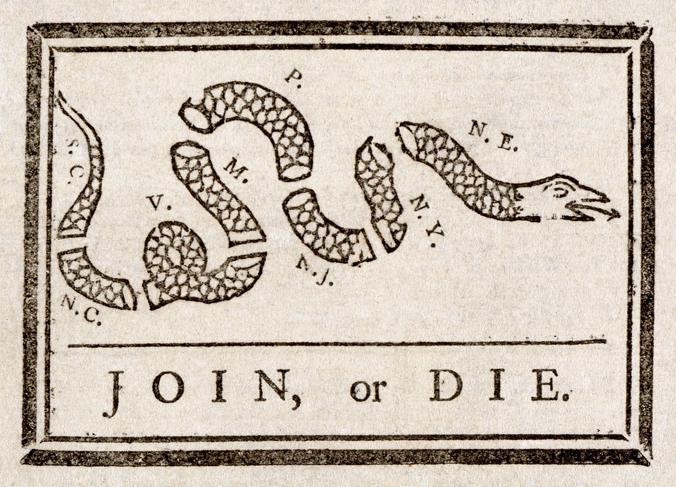
This political cartoon from the a 1754 edition of The Pennsylvania Gazette and believed to have been created by Benjamin Franklin originally appeared during the French and Indian War but was used again during the American Revolution to encourage the colonies to unite against British rule. Credit: Library of Congress
One such individual in Fredericksburg, Virginia was Henry Mitchell, a merchant born in Scotland who came to America, lived in Fredericksburg for nearly two decades, and worked as the Virginia-based factor (representative) for a trading house in Glasgow.[1]
Henry Mitchell participated in the community and, in the early days of tensions between the colonies and the mother country, took part in the anti-British non-importation movement known as the Virginia Association. Indeed, Mitchell was named an Associator on October 23, 1770, the same day Fielding Lewis was placed on the committee as noted in the Virginia Gazette. The Associators made sure the local populace did not purchase boycotted goods. The Association lasted a short-while before collapsing in 1771.[2]
Along with this political activity, Mitchell frequented George Weedon’s tavern and, on December 27, 1773, attended “dinner and club” with Fielding Lewis and several other Fredericksburg luminaries before Masonic services.[3]
Then, a strange incident took place in early 1775. In nearby Orange County, as reported in the Virginia Gazette, Rev. John Wingate was brought before the local patriot committee to answer for allegedly possessing “pamphlets containing very obnoxious reflections on the Continental Congress and their proceedings.” He was ordered to produce the pamphlets. Wingate refused, saying “that they belonged to Mr. Henry Mitchell of Fredericksburg” and that he could not show them to the committee without Mitchell’s “express permission.” The committee tried to persuade Wingate that since Mitchell “was well known to be an associator, and acknowledged by himself to be a hearty friend to the cause” that he would not mind if they looked at the pamphlets. Then, they noted ominously that “if Mr. Mitchell was not this hearty friend we hoped him to be,” then the committee would demand Mitchell himself come before them and show them the pamphlets. Wingate finally relented and no further discussion of Mitchell was recorded.
This incident raises all sorts of questions. Did the pamphlets really belong to Henry Mitchell? Was Wingate telling the truth or attempting to smear Mitchell for some reason? Was Mitchell undergoing some kind of change that had caused or was causing him to shift from supporting the anti-British Virginia Association to embracing loyalism? Were his earlier patriot leanings an act? If so, to what purpose? If you’re not careful, you can succumb to all sorts of wild speculation!
Mitchell continued his trade in Fredericksburg throughout 1775. Then, at the end of the year, he placed an ad in the December 8 edition of the Virginia Gazetteannouncing he would be leaving the colony in the spring and that he wished to settle his accounts before departing. Although loyalists often made their intentions to leave known in this way, Mitchell specifically noted his plans to return.
In July 1776, merchants in Fredericksburg suspected of loyalism were brought before the local committee and direct to either take a loyalty oath as required by the most recent Virginia Convention or, if they would not do so, to give up their arms. Henry Mitchell was among this group of, as the Virginia Gazette put it, “Sundry persons, supposed to be inimical to America” and refused to take the oath. Having refused to swear allegiance to the American cause, he and other loyalists they were ordered to be sent the governor so they could be expelled from Virginia.[4]
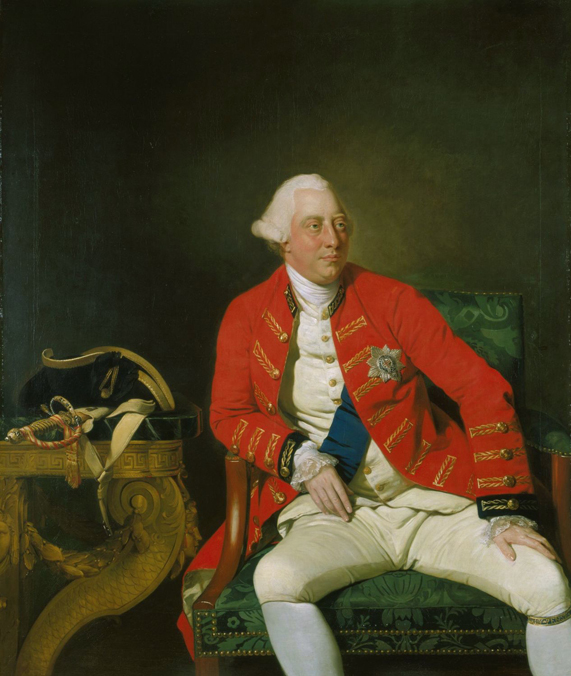
Portrait of George III of the United Kingdom (1771) by Johann Zoffany. Credit: Wikipedia/The Royal Collection.
This expulsion did not happen immediately, however. Mitchell finally placed an ad in the Virginia Gazette on February 21, 1777 announcing his intention “to leave this Country” permanently and notifying those to whom he owed debts and vice versa to settle them up. He also advertised his houses in Fredericksburg as available for sale or rent.
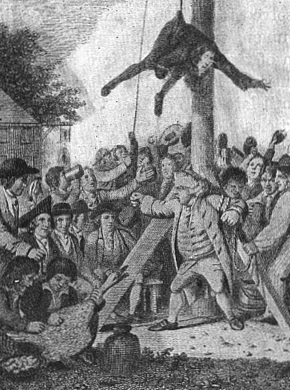
“Mobbing the Tories” illustration in History of the United States by Charles A. Beard and Mary R. Beard, New York: McMillan, 1921
Why did Henry Mitchell and vast numbers of colonists choose to remain loyal to the crown instead of supporting independence? The answer to that question really comes down to each individual loyalist whose motivations were often very personal and unique. Unfortunately, we do not know Mitchell’s particular reasons. People who found themselves held under suspicion by their patriot neighbors were often pushed to loyalism by the fear of mob rule or anarchy. The patriots’ use of loyalty oaths may have actually created many loyalists. People resented being forced to choose sides. Meanwhile, merchants and others whose livelihood depended on trade with Britain and the rest of the empire sometimes choose empire over independence for simple but powerful economic motivations.[5]
In 1777, Mitchell finally left Fredericksburg for H.M.S. Phoenix and went to New York, where he lived until 1781 and continued his trading activities. He then sailed to Scotland in 1781 and found his “partners had misapplied remittances” sent from Virginia. He was left bankrupt and dependent on relatives.[6]
Zac Cunningham
Manager of Educational Programs
[1] “Mitchell, Henry,” American Loyalist Claims, Washington, DC: National Genealogical Society, 1980, 351; Paula Felder, Fielding Lewis and the Washington Family: A Chronicle of 18th Century Fredericksburg, The American History Company, 1998, 238n.
On Friday, January 6, Saturday, January 7, and Sunday, January 8, Historic Kenmore will again present Twelfth Night at Kenmore, a dramatic theater presentation set in January 1776. It is the first Christmas that Fielding and Betty Washington Lewis celebrate in their newly built home. It is not the usual celebration, however. War brings fear, doubt, and frustration to the Lewis family and their friends. Immerse yourself in the experience the candlelight, music, and decorations of an eighteenth-century Christmas!
The George Washington Foundation wishes everyone a joyous holiday season! Enjoy these photos of holiday decorations created by wonderful volunteers! The George Washington Foundation Garden Guild decorated at Historic Kenmore and the Lake Anna Garden Club decorated at George Washington’s Ferry Farm.
Next week, there will still be time to see Kenmore and Ferry Farm adorned for the season as well as each site’s annual display of dollhouses, miniatures, and gingerbread creations. For details about these exhibits and our holiday hours, visit kenmore.org/events.
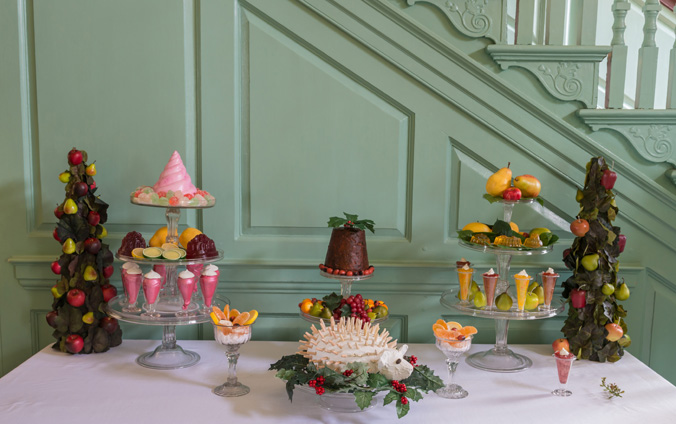
During the holidays, it’s the curatorial team’s job to festoon Historic Kenmore in period-appropriate holiday swag to celebrate the Christmas season. Greenery is brought in to cheer up the rooms and a table of special desserts is laid out as if ready for Christmas guests. These sweet treats are a pretty traditional fare but one particular dessert garners far more attention and questions than the others: the hedgehog sitting at the center of the table.
The Christmas dessert table complete with faux marzipan hedgehog in the Passage at Historic Kenmore.
“What is it?” and “Why a hedgehog?” are heard from visitors again and again. I decided to investigate to see if I could find out how and why this spiny confection graced Betty Lewis’s table during the holidays. Unfortunately, my research raised more questions than answers and ultimately lead me to an interesting but ambiguous conclusion based mainly on my own conjecture.
First, I have often heard the hedgehog referred to as a “cake” but it is not a cake. It is made out of marzipan; a sweet created using sugar or honey and ground almonds. Marzipan can be flavored, contain fruit and nuts, or even covered in chocolate …the possibilities are endless! It is often shaped into miniature fruits, vegetables, or animals and colored with dyes. The confection is usually eaten on special days or for special events.
A closer view of the faux marzipan hedgehog.
No one knows for sure where marzipan was first created but it likely originated in the Middle East around the ninth-century.[1] It made its way to Europe through trade and immigration. Each country personalized the candy by adding its own unique ingredients and traditions.
Regardless of which country has the honor of creating this particular delicious dessert, it became quite popular. Recipes for marzipan began to show up in various cookbooks dating from the sixteenth century onward. The two books most important to my investigation were The Compleat Housewife or, Accomplished Gentlewoman’s Companion by Eliza Smith published in 1727 and Hannah Glasse’s The Art of Cookery Made Plain and Easy published in 1747. We know Betty owned both of these books because they are listed in the 1781 probate inventory. [2]
In Mrs. Smith’s The Compleat Housewife, the chapter “All Sorts of Cakes” includes a recipe for ‘march-pane’ which is an old English word for marzipan.[3] The recipe is a traditional non-baked marzipan that includes ground almond, refined sugar and orange-flower water for flavoring. [4] Twenty years after Mrs. Smith published her book, Mrs. Glasse published The Art of Cookery and, by this time, the hedgehog had made its debut. The Art of Cookery does not list marzipan specifically but in chapter sixteen titled “Cheesecakes, creams, jellies, whipt syllabubs” there is a recipe “To make a hedge-hog”.[5] This is a cooked marzipan recipe that instructs the baker to form the almond paste into the shape of a hedge-hog with little slivered almond spines.
How did the hedgehog become associated with this almond dessert? The short answer is I’m not sure. I researched hedgehogs trying to discover any relation to the holiday season, to winter, or to the New Year. I was unable to find any.
Hedgehogs are native to England, where both cookbooks were published, but not to the Americas.[6] Colonial Americans would likely never have seen a hedgehog. There is not a lot of positive symbolism or folklore associated with the little creatures besides being industrious and cute.[7] They have been used medicinally for a variety of ailments and were a food source in many cultures.[8] None of this provides a reason why these little creatures were immortalized in almond meal and sugar at Christmas.
A photo of a real hedgehog because it’s so cute! Credit: Wikimedia/AlmaGz
I think the most likely development of this holiday treat was a combination of coincidence and novelty. Someone made the marzipan for the holidays,shaped it into a dome, and then decorated it with almonds. Eventually maybe someone else thought this resembled a hedgehog and added a little hedgehog face because it was clever and cute.
Why would Betty choose a marzipan hedgehog to sit on her holiday dessert table in colonial Virginia? As previously noted, marzipan was an established treat used to celebrate special days. The cost of the ingredients, which included two pounds of almonds, orange-flower water, canary wine, cream, butter and sugar, was substantial and illustrated to guests the effort and expense the family lavished on the party. While the table would probably have smaller bite-sized marzipan pieces in the more traditional fruit shapes, the novel hedgehog with the slivered almond spines created a visually appealing and attention-grabbing dish. The Christmas hedgehog was a great conversation starter then! The Christmas hedgehog is a great conversation starter now!
Heather Baldus
Collections Manager
[1] Habeeb Salloum, Muna Salloum, and Leila Salloum, Sweet Delights from A Thousand and One Nights: The Story of Traditional Arab Sweets, (London: I.B. Tauris & Co. Ltd, 2013), 168: Sidney W. Mintz, “Color, Taste and Purity: Some Speculations on the Meanings of Marzipan”, Etnofoor, Jaarg. 4, Nr.1 (1991): 103-108.
[3] Thomas Dawson, The Good Huswifes Jewell (London: John Wolfe, 1587), 23; Thomas Dawson, The good Huswifes Handmaide for the Kitchin. (London: Richard Jones, 1594), 37b.
[4] Eliza Smith, The Compleat Housewife or, Accomplished Gentlewoman’s Companion, (Williamsburg: William Parks, 1742), 73.
[5] Hannah Glasse, The Art of Cookery, Made Plain and Easy (London: A. Millar and R. Tonson, 1765), 288.
[6] Mazin B. Qumsiyeh, Mammals of the Holy Land (Texas: Texas Tech University Press, 1996), 63.
[7] Jacqueline Simpson and Stephen Roud, A Dictionary of English Folklore (Oxford: Oxford University Press, 2000); Tatjana Civjan and Dainius Razauskas, “Hedgehog in Cosmogonic and Etiological Legends of the Balto-Balcanic Area,” Tautosakos darbai, no. XXI (2004): 79-91.
[8] Mazin B. Qumsiyeh, Mammals of the Holy Land (Texas: Texas Tech University Press, 1996), 64; Vincent Nijman and Daniel Bergin, “Trade in Hedgehogs in Morocco,” Journal of Threatened Taxa, (2015): 7132-7136.