The timber frame – from floor joists to roof sheathing — of the rebuilt Washington house at Ferry Farm was recently completed. The work was done by tradesmen using a mix of 18th century building methods and 21st century equipment. The timbers were fashioned by Virginia-based Blue Ridge Timberwrights.
Learn more about the Washington House here and view other videos, photos, and blog posts about the project here.
In today’s electrically-lit world, we have very little notion of exactly how dark it can be in a house without any artificial light at all. In fact, our modern eyes have become so accustomed to bright lighting at all hours of the day and night, that we would probably have an even harder time adjusting to the candlelight of the 18th century, were we to magically time travel back to that period, than those who actually lived then. Our ancestors were used to it, though, and had a variety of ways to make the most of the light they had after the sun went down.
Sources of light after dark were the usual suspects – candles, fires in the fireplaces, maybe the occasional oil lamp. The best way to increase the light given off by each of these sources was reflection. Mirrors were placed behind candlesticks and lamps to double their light, and the lamps and candlesticks themselves were usually made out of reflective polished metal. Candelabra or girandoles, which were fixtures intended to hold multiple candles at a time, were often made of glass and decorated with quantities of hanging crystals or glass pendants, all intended to increase reflection of candlelight.
Candleabrum with glass pendants dating from the 19th century.
Being able to transport your source of light was also important. Without flashlights or anything else battery-operated, people in the 18th century had to find ways to carry flame with them when they moved from room to room or left the house after dark. Chamber sticks were candlesticks with handles on them, most commonly used to light a person’s way to bed (hence the name). Enclosed lanterns, made either of metal punched through with holes, or glass panes, were also used both indoors and outdoors.
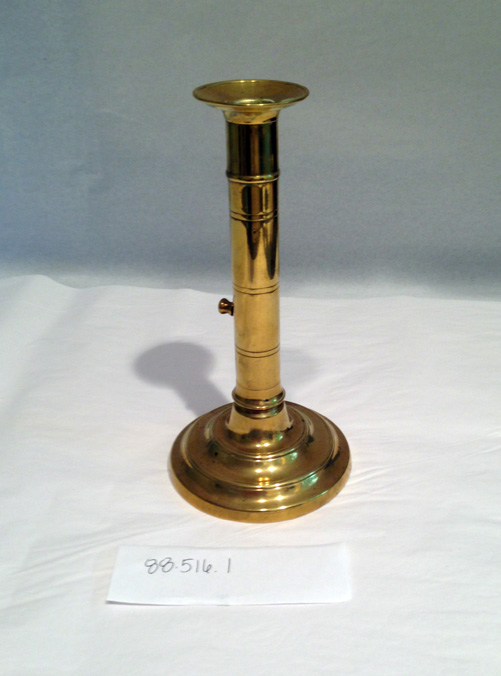
Of course, if most of your light is coming from candles, keeping those candles lit could be a challenge. Glass shades, or what we often call “hurricanes” today, were not simply decorative in the 18th century. They were intended to protect candles from drafts (and had the added benefit of providing another reflective surface). The beeswax or tallow candles most commonly used in the 18th century tended to melt quickly, and so candlesticks that could automatically push the candle up as it burned were invented. These candlesticks ensured that every last useable bit of candle was put to good use.
Brass push-up candlestick dating from the 18th century.
There were other secrets to bringing some light into a dark night during the 18th century. If you want to learn more about lighting, join us for Night in Washington’s Day, an evening program at George Washington’s Ferry Farm from 6:00-9:00p.m. on Saturday, November 12! For more details, visit www.kenmore.org/events
Meghan Budinger
Aldrich Director of Curatorial Operations
The use of folk magic may seem foreign and exotic to many of us in the 21st century. If we look closer, though, it is apparent that some modern Americans still practice it today – even if they don’t realize it. Have you ever hunted for a four-leaf clover? Have you ever hung a horseshoe over your door? If so, you’re participating in a kind of folk magic.
Folk magic is (and was) thought to be a way to influence forces, seen and unseen, for good or for ill. It is sometimes referred to as “low” magic, not because it was seen as evil, but because it was passed down generation to generation rather than learned from books or formal tutors. “High” magic has its own fascinating history, but this blog post focuses on the everyday magic that 18th century Virginians, both black and white, practiced. Hoping to ward off evil and bring peace, prosperity, and abundance into their homes, some of these early Americans used magical means to their ends.
Europeans and Africans in British North America brought with them the spiritual, religious, and magical traditions of their homelands. The blending of these traditions became the bedrock for future iterations of American folk magic. One modern archaeologist says that this blending process makes it hard to tell exactly who was using what folk tradition while creating some of the material culture of folk magic; it is not always clear from the archaeological record exactly who made an object and what that object’s intended purpose was.[1]
One of the things that may have contributed to the cross-cultural blending is the similarities between English and African folk magic traditions. Both groups recognized that there were some people who were “set apart” from the rest of the group. These individuals were believed to possess special powers that made them respected, feared, or both. African and English traditions also shared a belief in magical objects, even everyday objects, that could be imbued with power. And lastly, both groups believed in the power of burying magical objects for protection – or for malice.
People thought talented in the magical arts were known as “cunning folk” in the English/English-American tradition and as “conjurors” in the African/African-American tradition. Cunning folk were not witches, who were thought to inhabit the fringes of society, but rather “practitioners of magic who healed the sick and the bewitched, who told fortunes, identified thieves, [and] induced love.”[2] This description of cunning folk is very similar to W.E.B. Du Bois’s definition of the conjuror, “the healer of the sick, the interpreter of the Unknown, the comforter of the sorrowing, the supernatural avenger of wrong . . .”[3]
The rest of Du Bois’s quote, however, highlights an essential difference between white cunning folk and the enslaved conjuror. The conjuror was also “. . . the one who rudely but picturesquely expressed the longing, disappointment, and resentment of a stolen and oppressed people.”[4] Despite their many similarities, enslaved conjurors and cunning folk operated in very different realities. In Du Bois’s estimation, the conjuror did more than just take care of the physical and spiritual needs of the enslaved; he or she took on the weight of slavery itself.
Both conjurors and cunning folk created magical charms and charged objects with magical meaning. At George Washington’s Ferry Farm, we found an excellent example of an object charged with meaning. A carnelian bead excavated on the property may indicate that a powerful conjuror might have lived here during the Washington’s time. This bead is similar to two found in Barbados and Archaeologist Jerome Handler asserts that these carnelian beads were the product of Cambay, India and were indications of the status of the person with whom they were buried.[5] Dave Muraca, director of archaeology at Ferry Farm, describes “all three beads” as “generally reddish-orange color” with “tapered ends and cylindrical shapes. Each one has 8 longitudinal facets and 4 beveled facets at each end. The main difference between the Washington site bead and the Barbadian beads is size, with the Barbadian beads being almost twice as long as the one recovered at the Washington farm.”[6]
Multiple views of the Carnelian bead excavated at George Washington’s Ferry Farm.
Cunning folk also made objects with magical meaning. Written charms, or amulets, were popular since they were easy to make and could be worn on the body. These charms often served as protection for people and livestock against witches’ attacks. An example of these charms can be found in Colonial Williamsburg’s Special Collections. This small piece of paper, dating to about 1700, promised to protect the wearer from “any mannor [sic] of Witchcraft or Evle [sic] spirit.” The amulet invokes the power of faith and the intervention of Jesus Christ on behalf of the afflicted woman. It closes with “amen, amen, amen,” and “fiat, fiat, fiat;” “fiat” being the Latin translation of ‘amen.” “Fiat” and “amen” had been used together since the 2nd century, particularly when the prayer it ended was one of condemnation.[7]
Witchcraft amulet, circa 18th century. Credit: Special Collections, John D. Rockefeller, Jr. Library, The Colonial Williamsburg Foundation
It was not uncommon for black and white practitioners of magic, to bury magical objects for protection. The nature of these objects may have been different, but the intent was the same – warding off evil and restoring peace to the household. At Ferry Farm, archaeologists have discovered whole oysters deliberately buried in the stone-lined cellar of the Washington house. The act of burying the oysters, which were seen as magical objects in the African/African American community, was likely an effort to protect the home. They were often used in burial rituals and were associated with death and the afterlife; an association that makes the oyster shells found at Ferry Farm all the more intriguing.
Whole oyster shell excavated from the Washington house cellar at Ferry Farm.
English/English-Americans also buried objects for protection, but some of the objects they buried were man-made rather than a product of the natural world. Witches bottles, often glass bottles filled with pins, nails, and even human urine, were designed to cure the afflicted of his or her bewitchment. A witch bottle found near in Virginia Beach, Virginia, known as the Great Neck witch bottle, dates to 1690-1750. Archaeologist M. Chris Manning describes it as being, “[a] small, narrow, light green glass medicine vial was found buried in an inverted [upside-down] position” containing 25 brass pins and 3 iron nails. It may have also contained the urine of the bewitched at some point.[8] These bottles were designed to hurt witches; their pins and needles were thought to injure those who placed malevolent spells on the innocent. In both the African/African-American and the English/English-American tradition, these buried objects were tasked with banishing evil forces in an effort to bring in positivity and peace to the household.
These are just a few examples of the similarities between the African and the English folk magic traditions. There are significant differences, in part because “magic” was part of African cosmology, meaning religion and magic were tied together, sometimes to the point where it’s hard to tell where one ended and the other began. This is different from the English tradition, where religion and folk magic were seen as separate, at least officially. Religious and secular authority figures in colonial America condemned the use of folk magic, but this did little to stem the tide of magic’s popularity.
The next time you pick up a lucky penny or even cross your fingers, remember that you are participating in a tradition older than America itself. While we may not make witches bottles or bury oyster shells anymore, there are plenty of instances where we seek luck, protection, love, and other good vibes through essentially “magical” means.
Kelly Arehart
Manager of Interpretation & Visitor Services
[1] Christopher C. Fennell, “Conjuring Boundaries: Inferring Past Identities from Religious Artifacts,” International Journal of Historical Archaeology, Vol. 4, No. 4, pp.284.
[2] Owen Davies. Popular Magic: Cunning Folk in English History, (London: Continuum), 2007, p. VII.
[3] W.E.B. Du Bois, Souls of Black Folk, Essays and Sketches, (Chicago: A.C. McClurg & Co.), 1903, 211.
[5] Jerome S. Handler, “An African-Type Healer/Diviner and His Grave Goods: A Burial from a Plantation Slave Cemetery in Barbados, West Indies,” International Journal of Historical Archaeology, Vol. 1, No.1, (June 1997), 91-130.
[6] David Muraca, “Murder and Magic at the Washington Farm,” George Washington Foundation, Fredericksburg, VA, unpublished report, 9.
[8] M. Chris Manning, “Homemade Magic: Concealed Deposits in Architectural Contexts in the Eastern United States,” Master’s Thesis, Ball State, 2012, 114.
George Washington did not experience what we would now consider a normal childhood. Life at Ferry Farm was filled with excitement, sadness, intrigue, and tragedy for young George. Here we present a list of “Ten Pivotal Moments of George Washington’s Boyhood.” This is by no means an exhaustive list but each of these events definitely helped shape Washington into a man capable of commanding the Continental Army and serving as the new nation’s first president.
Moving to Ferry Farm
“View from the Old Mansion House of the Washington Family Near Fredericksburg, Virginia” (1833) by John Gadsby Chapman modified to depict the location and approximate appearance of the Washington family home, which was actually a complete ruin when visited and painted by Chapman in the early 1830s.
In 1738, Augustine Washington moved his family to Ferry Farm. He appears to have chosen this plantation situated across from Fredericksburg to be nearer to his iron ore interests located about seven miles away. Ferry Farm was very different than the other Washington properties. The proximity of Fredericksburg made it more urban. Ferry Farm was also surrounded by transportation routes including the Rappahannock River, and two roads that crossed the plantation. The bustling nature of Ferry Farm and its surroundings played a critical role in George’s development.
Announcement in the Virginia Gazette in April 1738 advertising “100 acres, lying about 2 miles below the Falls of Rappahannock . . . with a very handsome Dwelling house.” The property was being sold by William Strother’s estate, would be purchased by Augustine Washington, and eventually come to be know as Ferry Farm.
The Deaths of Mildred and Augustine George’s youngest sister Mildred was born shortly after the family moved to Ferry Farm. She lived only 18 months, and her death when George was just seven years old was the first significant death of his youth, but not his last.
Augustine Washington, George’s father, followed Mildred in death on April 11, 1743. George inherited Ferry Farm and ten slaves from Augustine. His mother, Mary, managed this inheritance until George turned 21 years old. Augustine’s death began a period of financial hardship for the family and probably prevented George from being educated in England, a lost opportunity he remained self-conscious about for the rest of his life. It also meant George had to scramble to find a mentor to introduce him to the complex requirements associated with gentry life.
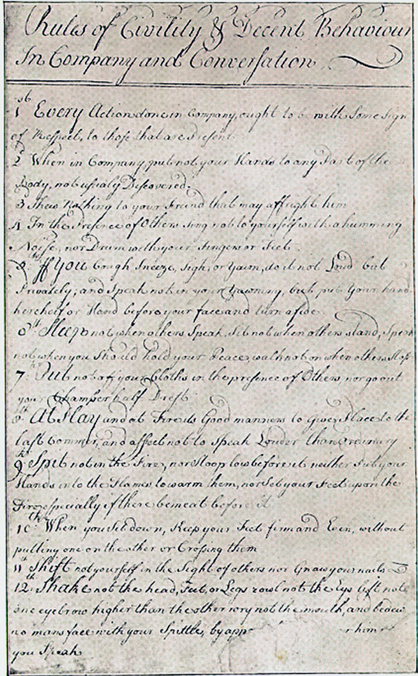
George Washington’s handwritten copy of The Rules of Civility and Decent Behavior in Company and Conversation.
The Rules of Civility and Decent Behavior Young George copied The Rules of Civility and Decent Behavior, a guide to gentlemanly behavior in polite society, probably as a school assignment. This combination etiquette manual and moral code taught young George how to interact with his powerful and influential neighbors. By strictly following its advice, young Washington molded his character into that of a wealthy Virginia gentleman.
His Gentry Education Washington’s diaries and accounts reveal how he mastered the pastimes of the gentry as a young man. He played for stakes at popular card games, took fencing lessons, and paid for his own dancing lessons. He frequented the theater in both Fredericksburg and Williamsburg. In a society obsessed with horse racing, equine bloodlines, and fox hunting, Mary Washington was well versed in horses and riding and appears to have been responsible for teaching George about riding. By the time George was an adult, he was renowned as a “superb horseman.” All of these skills, which remained with George for a lifetime, were acquired while he grew up at Ferry Farm.
The Royal Navy Episode Following Augustine’s death, George’s eldest half-brother, Lawrence, took an interest in his future. Lawrence conspired with Colonel William Fairfax, some of Augustine’s business associates, and George himself to convince Mary to allow 13-year-old George to join the Royal Navy. Mary eventually rejected the plan, a courageous act for a woman in male dominated colonial Virginia. George turned to a career as a surveyor instead. Imagine the future commander of the Continental Army serving on a King’s ship!
Portrait of Frederick Herman von Schomberg attributed to Adrian van der Werff. Public domain. Credit: Hampel Auctions / Wikipedia.
Introduction to Military Adventurers On September 10, 1747, George purchased 3 books from his cousin Bailey for the combined price of 4 shillings 12 pence. One of the books is listed as “Scomberg,” a reference to the 17th century German Protestant soldier of fortune, Duke Frederick Herman von Schomberg, who fought under the flags of France, Germany, Portugal, and England and died at the Battle of the Boyne fighting for William of Orange. Schomberg wrote about his adventures which would have been of great interest and fascination to a young man of fourteen. That George was willing to spend his hard earned money during a time of financial hardship reveals how enthralled he was by this subject.
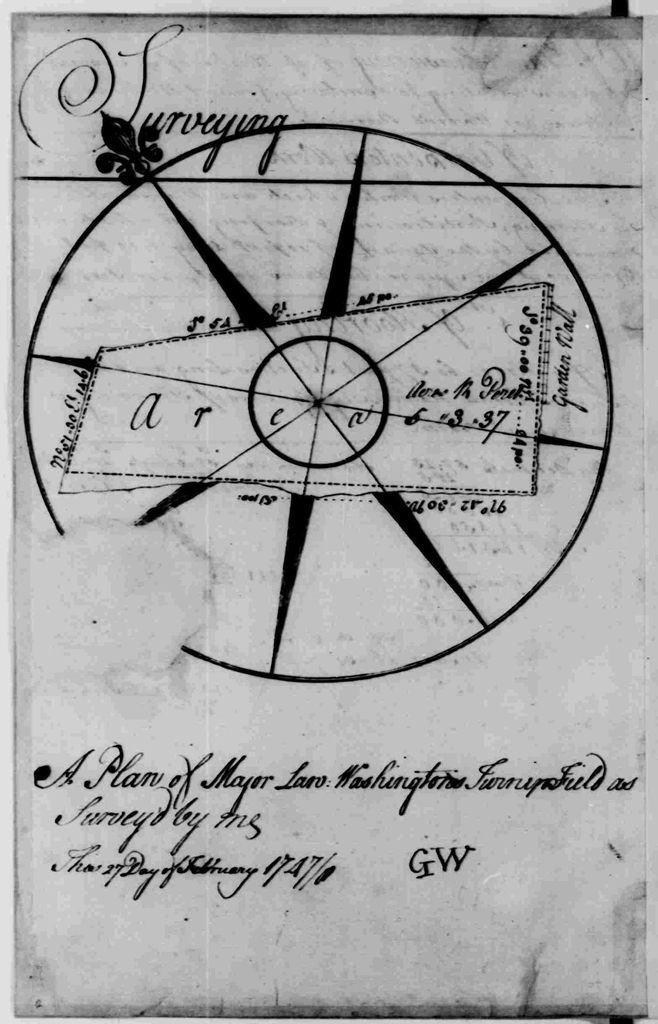
“A Plan of Major Law. Washington’s Turnip Field as surveyed by me this 27 Day of February 1747 GW” Credit: Library of Congress
Surveying: His First Job George Washington began surveying at about age 15. His father’s probate inventory included a set of surveyor’s instruments. In 1748, at age 16, George went with Lord Fairfax’s surveying party on his first expedition into the wilds of western Virginia. At age 17, George Washington was appointed to his first public office as surveyor of nearby Culpeper County. Surveying, like his skills in mathematics and keeping accounts, helped him manage his properties profitably throughout his life.
Trip to Barbados In 1751, George Washington made his only trip abroad, traveling with his half-brother Lawrence to Barbados. Lawrence, suffering from tuberculosis, hoped the warm climate would prove beneficial to his health. He died from the illness, however, just a few months after his return to Virginia. Lawrence’s death set up the eventual inheritance of Mount Vernon by George. The tropical island did little good for George’s health either. He contracted a severe case of smallpox that left his skin scarred for life.
GWs Request to be Appointed as the Virginia Militia Adjutant
Portrait of George Washington (1772) by Charles Willson Peale. The earliest authenticated portrait depicts Washington in the Virginia Militia uniform he wore during the French and Indian War. Credit: Washington and Lee University / Wikipedia
In 1752, George Washington wrote a letter from Ferry Farm requesting that the Governor of Virginia appoint him as the militia adjutant position vacancy created by his half-brother Lawrence’s death. The governor declined at this time, but one year later he did appoint George. The 21-year-old Washington had no military experience at the time of his appointment. This appointment eventually resulted in Washington igniting the Seven Years War between Britain and her colonies and France.
On rare occasions, Historic Kenmore offers special behind-the-scenes tours that take visitors into portions of the home not usually open to the public during regular tours. Additionally, Meghan Budinger, Aldrich Director of Curatorial Operations, leads the tour and shares her expert insights and knowledge into the mansion’s history, furnishing, and ongoing preservation. This past weekend, visitors once again got to go behind-the-scenes!
Visitors prepare to go inside Historic Kenmore.
The tour included familiar rooms like the master bedchamber.
Visitors entered spaces not usually open to regular tours. Enslaved people used this narrow passage to travel between the bedchamber, where Betty Washington Lewis ran the household, to the dining room and outdoor kitchen.
The slave passage features original paint and wallpaper. A message in chalk orders staff and future preservationists to save the 240-year-old wallpaper in place.
Meghan explained how archaeological excavations informed the choices of 18th century ceramics displayed on the dining room table.
The group visited the cellar that was used as storage during the Lewis’s days. Educational programs for visiting field trips take place, in part, in this space today.
Visitors in the attic heard about how dendrochronology, the dating of timber using tree rings, helped determine that Kenmore was built between 1770 and 1775.
In the attic there is a rowing scull left behind by late 19th century resident William Key Howard, Jr., who also repaired the house’s plaster ceilings after extensive damage during the Civil War.
Leaving the attic down a narrow staircase.
Descending a winding, narrow staircase into the underground HVAC control room.
Inside the geothermal HVAC ‘vault’, visitors learned how 21st century technology preserves and protects an 18th century home and its artifacts.
The George Washington Foundation held its annual Volunteer Appreciation Reception on Thursday, October 20 at George Washington’s Ferry Farm. Volunteers contributed over 11,000 hours of work at Ferry Farm and Historic Kenmore over the past year! Without them, we’d be history! If you’re interested in volunteering, click here.
Thank you!
The reception took place under Ferry Farm’s Great Oak Pavilion on a beautiful fall day!
Volunteers and staff visiting together before the reception program began.
Enjoying refreshments.
Susan Sherman, manager of special events, volunteer and community programs, thanks everyone for attending and for another year of hard work.
Bill Garner, president of The George Washington Foundation, thanks all of our volunteers and updates them on the progress of the Washington house interpretive replica.
Ben Wafle, board chairman and trustee, expresses his thanks to the Foundation’s volunteers.
Foundation volunteers sign and date shingles that will be added to the roof of the Washington house.
Since its transformation into a historic site, Kenmore has drawn its share of prominent and recognizable visitors including a vice president, a congressman, and numerous First Ladies of the United States. Indeed, the ladies of the Kenmore Association, who worked to save, restore, and operate the historic home during the 20th century, made it a point to reach out to First Ladies and, in turn, several of those First Ladies visited the auspicious brick home of Patriot merchant Fielding Lewis and wife Betty Washington Lewis, sister of George Washington. For that matter, even during the days that Fielding and Betty lived in the home during the late 1700s, important figures in colonial Virginia and of the Patriot cause occasionally came to Kenmore. Here is a list of “Ten Well-Known Visitors to Historic Kenmore.”
10. Louise du Pont Crowninshield (1877-1958)
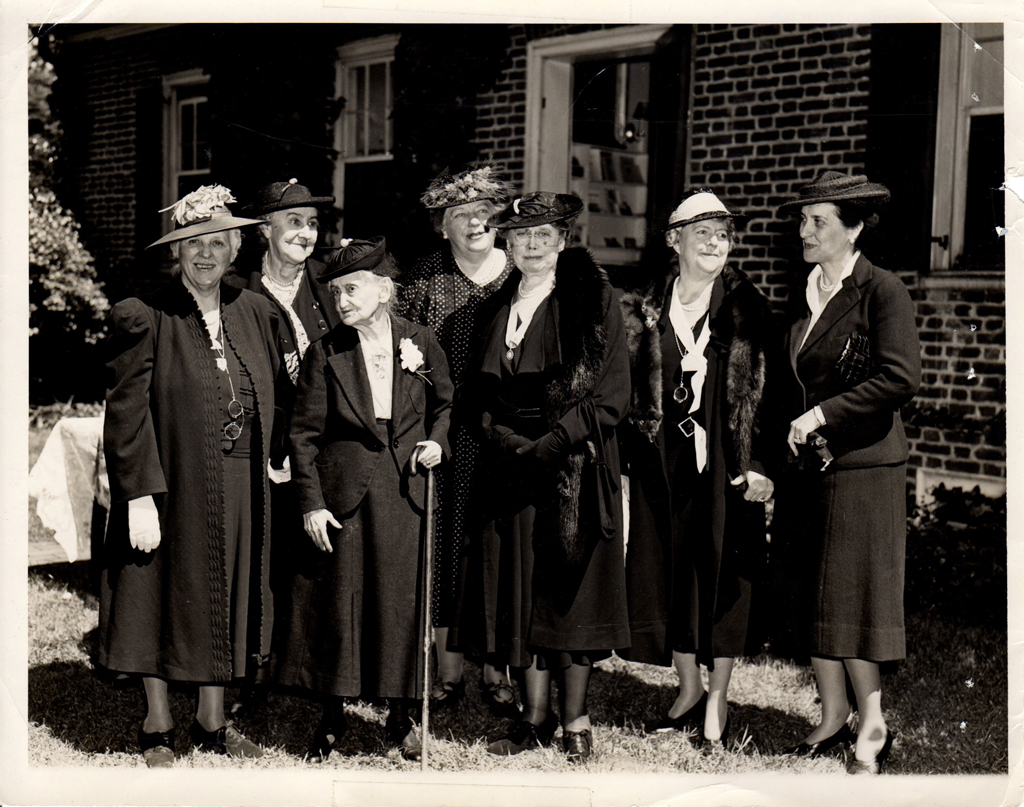
Louise du Pont Crowninshield surrounded by other members of the Kenmore Association.
Louise du Pont Crowninshield was president and chairman of the board of trustees of the Kenmore Association from 1940 to 1954. An active historic preservationist, she was also a founding trustee of the National Trust for Historic Preservation. Mrs. Crowninshield was born into the prominent Du Pont family and grew up at Winterthur, the family estate in Delaware. The home is now a museum and holds some of most important collections of Americana in the United States. She helped save and restore Kenmore and visited many times during her term as president.
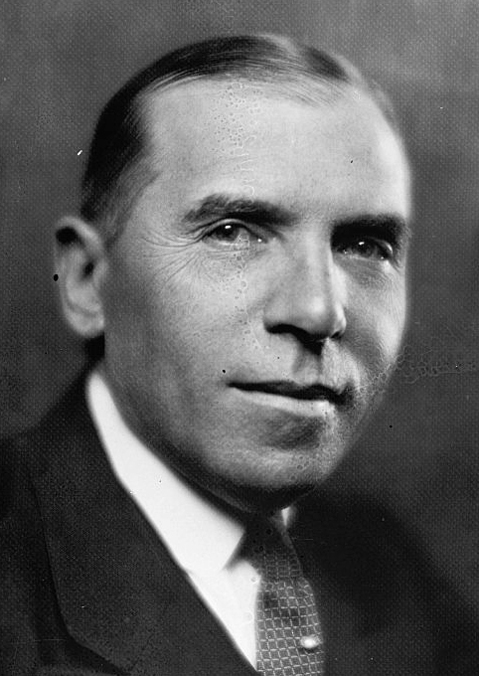
Sol Bloom in 1923. Credit: Library of Congress / Wikipedia
9. Sol Bloom (1870-1949) Sol Bloom was an entertainer, music publisher, and congressman from New York. He was the biggest producer of sheet music in the U.S. before taking up politics. Bloom was associate director of the United States George Washington Bicentennial Commission and came to Kenmore for a luncheon with Emily White Fleming and the Kenmore Association. In 1936, Bloom made a $10,000 bet with Walter “Big Train” Johnson, former Washington Senator’s star pitcher, that Johnson could not throw a silver dollar across the Rappahannock River as legend said George Washington had done. Bloom lost but refused pay the money.
Sol Bloom with Emily Smith Fleming, a driving force behind the Kenmore Association.
Walter “Big Train” Johnson poses for the press on the day he threw a silver dollar across the Rappahannock River… twice.
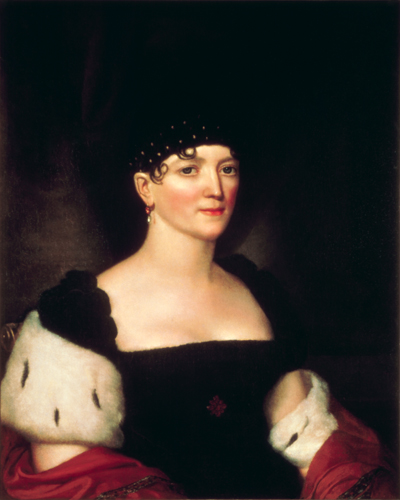
Elizabeth Monroe, unknown date and artist. Public domain. Credit: John Vanderlyn / Wikipedia
8. Elizabeth Monroe (1768-1830) Elizabeth Kortright Monroe was First Lady of the United States from 1817 to 1825. Elizabeth was born in New York City and married James Monroe in 1786. She spent time in France and Britain during her husband’s ambassadorship and was even invited to be part of the American delegation that attended Napoleon Bonaparte’s coronation. Mrs. Monroe actually lived at Kenmore shortly after her marriage to James. Her husband left town on business and, since they had not yet set up a home in Fredericksburg, she stayed with Betty Lewis until James returned.
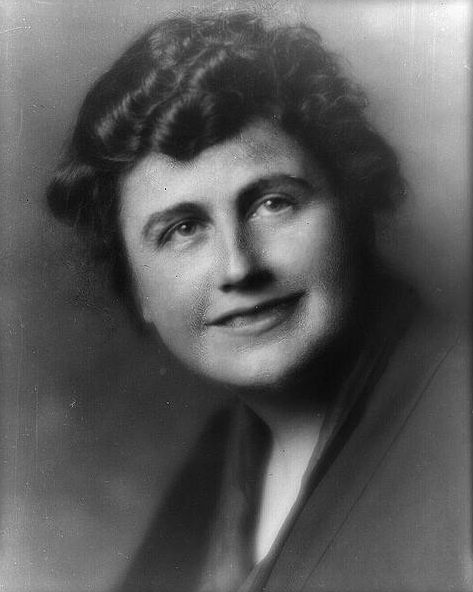
Edith Wilson. Credit: Library of Congress / Wikipedia
7. Edith Wilson (1872-1961) Edith Bolling Wilson was the second wife of President Woodrow Wilson and served as First Lady of the United States from 1915 to 1921. Some historians argue that Mrs. Wilson became the de facto president after her husband’s stroke in 1919. She did, it seems, act as the only conduit to and from the president and decided which matters important enough to bring to her husband’s attention while relaying his decisions to those who needed to know. Long after her time in the White House, Mrs. Wilson came to Kenmore for a luncheon in October 1946.
Edith Wilson accepts an invitation to lunch with the Kenmore Association.
6. Elizabeth Virginia “Bess” Truman (1885-1982)
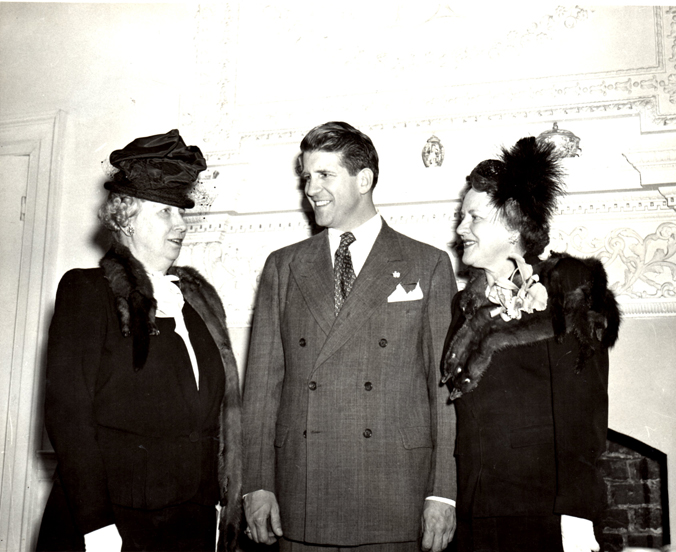
Bess Truman in front of the fireplace in Kenmore’s dining room with Robert Porterfield, founder of the Barter Theatre, and an unidentified woman.
Elizabeth Virginia “Bess” Truman was First Lady of the United States from 1945 to 1953. Elizabeth Wallace was born in Independence, Missouri and had known Harry Truman, her future husband, since they were children. They married in 1919. Mrs. Truman detested the lack of privacy and disliked the social and political scene of Washington, D.C. She was relieved to move back to Missouri. Mrs. Truman visited Kenmore multiple times and was pictured in front of the mantel in the Dining Room with Robert Porterfield, founder of Barter Theatre, the State Theatre of Virginia, in Abingdon.
Thank you note from Mrs. Truman praising her visit to Kenmore and promising to bring other family members in the future..
5. Lou Hoover (1874-1944)
Lou Hoover. Credit: Library of Congress / Wikipedia
Letter to Mrs. Hoover to thank her for visiting Kenmore.
Lou Henry Hoover was First Lady of the United States from 1929 to 1933. Lou Henry was born in Iowa in 1874 and married Herbert Hoover in 1899. She majored in Geology at Stanford University, was fluent in Chinese and Latin, assisted in the Belgian relief during WWI, and worked a great deal with the Girl Scouts of America. Mrs. Hoover, as First Lady, toured Kenmore in September 1930.
4. Colonel Sanders (1890-1980)
Colonel Sanders leaving the house after his tour.
Colonel Sanders in Kenmore’s drawing room.
Colonel Harland David Sanders founded the restaurant chain Kentucky Fried Chicken (KFC) in 1930. Sanders was born in Indiana in 1890 and, after a number of jobs, he started selling fried chicken at a roadside restaurant in Corbin, Kentucky during the Great Depression. The restaurant, Kentucky Fried Chicken, was a success and, in 1952, he started franchising across the country. In 1964, Sanders sold the company and used his stock holdings to create several charitable organizations. He promote these organizations as well as KFC by touring the country dressed as the Colonel. He came to Kenmore and took a tour in the summer of 1977.
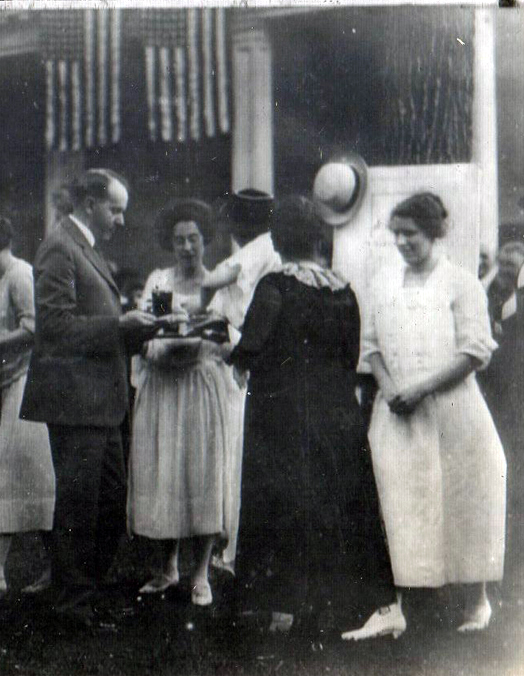
Calvin Coolidge (left) enjoys gingerbread at Kenmore.
3. Calvin Coolidge (1872-1933) Calvin Coolidge was born in Vermont in 1872. After college, he became a lawyer and went into politics becoming the governor of Massachusetts from 1919 to 1921. He was the 29th vice president under Warren Harding and the 30th President of the United States from 1923 to 1929. Vice President Coolidge came to Kenmore in July 1922 to launch a fundraising campaign aimed at raising money to purchase the house and make it a historic site. He enjoyed some gingerbread during his visit.
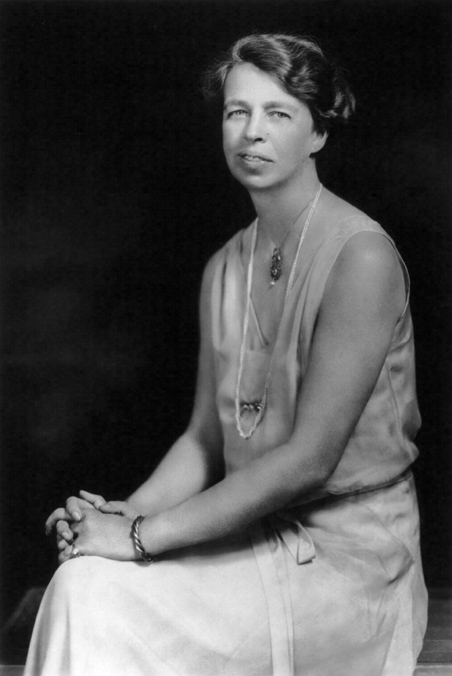
Eleanor Roosevelt in 1932. Credit: Library of Congress / Wikipedia.
2. Eleanor Roosevelt (1884-1962) Eleanor Roosevelt was First Lady of New York from 1929 to 1933 and First Lady of the United States from 1933 to 1945. She was born in New York City to the socially prominent Roosevelt and Livingston families and married Franklin D. Roosevelt in March 1905. After her time in the White House, she chaired the United Nations Commission on Human Rights in the late 1940s and early 1950s and John F. Kennedy’s Presidential Commission on the Status of Women. When she was First Lady of New York, Mrs. Roosevelt visited Kenmore on several occasions with various groups who came from the New York state capital of Albany.
Letter from Eleanor Roosevelt inquiring about bringing a group to visit Kenmore.
Thank you note from Eleanor Roosevelt in appreciation of her visit to Kenmore. She included a donation.
1. George Washington (1731-1799)
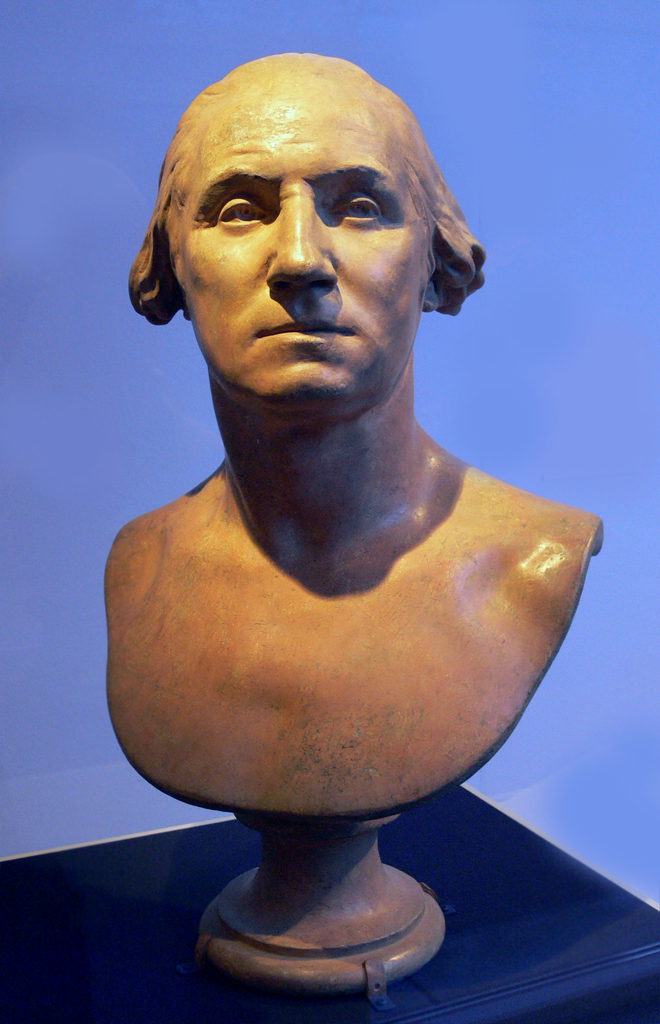
Bust of George Washington (c. 1786) by Jean-Antoine Houdon and based on a life mask of Washington. Public domain. Credit: Dallas Museum of Art / Wikipedia.
George Washington was the first President of the United States (1789-1797) and the older brother of Betty Washington Lewis. Construction of Kenmore was complete late in 1775. George would not stay in the house until 1784. Including this 1784 visit, Washington stayed at Kenmore at different times during the years 1785, 1787, 1788, and 1791. The final visits in April and June 1791 were the only times he stayed at Kenmore while serving as president.[1]
Heather Baldus
Collections Manager
[1] Paula Felder, Fielding Lewis and the Washington Family: A Chronicle of 18th Century Fredericksburg. The American History Company, 1998: 216.
Expert craftsmen from Blue Ridge Timberwrights recently completed constructing the timber frame of the Washington house interpretive replica at Ferry Farm. This collection of photographs documents the their work and begins a week into the process. You can see photos from the first week of work here. What’s next? Shingles!
Adding rafters.
Sunlight between posts.
Wooden pegs.
Chiseling a peg.
Tools.
Joists above and below.
Sawing.
Second floor rafters in place.
Visitors hear about the timber framing work.
Rafters and shed roof beams all in place.
Placing roof sheathing.
Framing and roof sheathing complete. Shingles will come next.
Learn more about constructing the Washington house interpretive replica here, here, and here.
When you enter a museum you’re surrounded by cool stuff. Be it paintings, fossils, or ancient artifacts, they’re all special items that you’d be hard pressed to find elsewhere. But what if I told you that the cool objects you see on display in a museum are a mere fraction of what most museums actually have in their collections? There is just never enough room, even for the biggest museums, to display everything. Additionally, some items are just too delicate to make available to the public. This is one of the reasons I love my job. My fellow archaeologists and I get a daily backstage pass to all the incredibly cool things excavated at George Washington’s Ferry Farm. Here’s our list of “Ten Cool But Rarely-Exhibited Artifacts Found at Ferry Farm.” Be sure to click on any of the photos for more detailed views of the artifacts.
Wine Bottle Seal Starting in the 17th century if you were a wealthy gentleman or tavern owner chances are you ordered at least a few custom wine bottles complete with your personal seal. The seals were stamped in various ways, such as with names, initials, symbols, crests, and dates. Archaeologists love them because they’re ‘talky,’ meaning the artifact yields lots of information. A fragmentary bottle seal was found here in 2004 and bears the incomplete name of its owner. The letters visible are either a capital “I” or “J” (the English used the letter I for J), and below that are the letters “-bin”. These few letters might refer to someone in the Corbin family, an extensive Virginia family with local ties. With a little investigation, perhaps we can flush out who was the mystery guest that brought his own bottle of wine for a visit to Ferry Farm!
Lead Whistle Instruments and toys tend to grab our imagination because they make us think about who used them and how the object got lost to time and archaeology. In our collection we have a simple lead whistle, measuring 1 7/8” long and 3/8” in diameter, with “U.S.A.” stamped on the side. It’s cheaply made out of lead, which was a very inexpensive material that has, for obvious reasons, been phased out of the toy industry. In the “Good Ol’ Days”, no one thought twice about making an instrument you put in your mouth out of lead. Maybe it’s a good thing that the person who owned the whistle lost it.
Chunkey Stone Fun to say. Fun to play. Basically a prehistoric rock doughnut, this hand-ground stone was used in a Mississippian Indian game called “Chunkey.” Warriors rolled disc-shaped stones across the ground and threw spears as close to the stone as possible. Similar to the Italian game of bocce, but unlike the Italians who threw wooden balls, Chunkey players threw spears, which is pretty awesome. It’s a bit of a mystery as to how it got to Ferry Farm because there is no evidence that Chunkey was played in eastern Virginia, however some of these gaming stones have been excavated in Maryland and Northern Virginia. It is also possible that one of Ferry Farm’s colonial inhabitants collected this exotic looking artifact for their cabinet of curiosities.
“Joseph” bottle fragment Normally broken bottle glass would have trouble finding its way onto any top ten list, but this fragment is one of a kind. Its owner inscribed his name “Joseph” and the date “174?” into the body of the bottle. That’s not an easy or common thing to do. The inscription is carved in an elegant and beautiful form indicating a gentry status for its owner. While no occupant of Ferry Farm was named Joseph, Mary Ball Washington’s older brother bore that name.
Joseph Ball, though living in England, was heavily involved with Ferry Farm. He absentee owned and operated a neighboring plantation. Joseph was lavish in both his gifts and advice to the Washingtons. He gave Betty, George’s sister, a beautiful silver tea set just before she married. He offered Mary advice on how to keep George out of the Royal Navy when a plan was hatched to put the then 13-year-old onboard a ship. And maybe, just maybe, he sent over a special bottle of wine with his name engraved on it for the Washington family.
Lead Toy Hatchet More lead toys? Yep. This little beauty has special significance to Ferry Farm because of the cherry tree myth. The 3-inch lead hatchet appears to be a souvenir made during the 20th century, possibly dropped during 1932’s anniversary celebration of George Washington’s birth. Keepsakes associated with George and the cherry tree abound in Fredericksburg. Previous private owners of Ferry Farm were known to capitalize on the history of the property, often selling fragments of the ‘original cherry tree’ and cherry seeds to visitors. This hatchet is an obvious symbol recalling the cherry tree story that is so closely associated with Washington’s childhood.
Milk Glass Darning Egg Recovered completely intact from an old burrow belonging to a groundhog, this artifact had multiple uses on a 19th and 20th century homestead. The glass egg was a darning aid used to fill out a sock while it was repaired or could be placed in a henhouse to encourage the ladies to lay eggs in a particular spot. There is also a persistent myth that these eggs were used to kill snakes. The snake would eat the glass egg, it was believed, which would then shatter inside them. This line of reasoning ignores the fact that snakes hunt by detecting chemical signatures of their prey and that snakes can’t really see the egg-like shape of our artifact because of their poor vision. But it’s a story that highlights the mythology that surrounds some objects once they fade into obscurity.
Tambour Hook The tambour hook falls into the category of artifacts that are a little too fragile to display. Made of carved bone and metal, this exceptional object was used by a gentlewoman, probably George’s sister Betty, to adorn fabric with elaborate embroidery. Recovered from the bottom-most soil level of the Washingtons’ root cellar where it was deposited sometime between 1741 and 1760, the carved designs that cover the bone handle feature a parrot, leaves, flowing vines, and numerous flowers and represent some of the most popular embroidery themes of the time. This hook helps demonstrates the fashionability of the Washington women, which contradicts the portrait painted by many modern biographers.
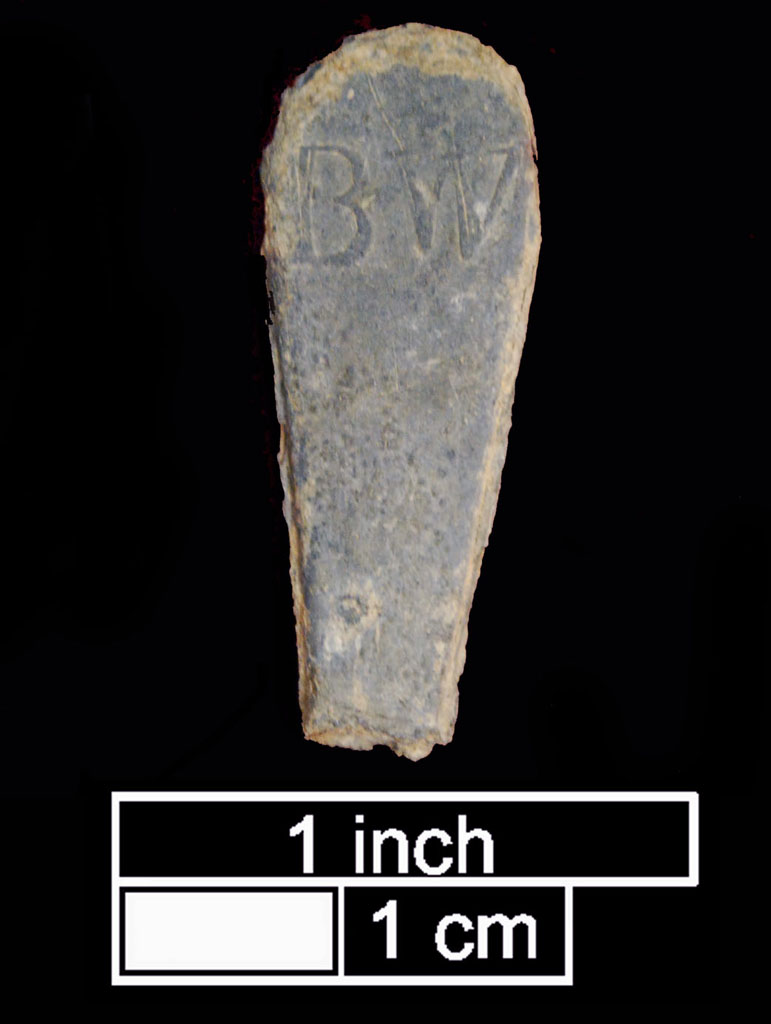
Pewter Teaspoon with Betty Washington’s Initials Betty had some of the coolest artifacts and this one literally has her name on it. It was customary for tea to be dispensed by the wife or by the oldest daughter in the house and Betty, as the only daughter, was clearly groomed in this ceremony as is evidenced by her own teaspoons. Pewter, an alloy containing a number of different metals including lead (yes, more lead), wasn’t as fancy as silver but the fact that it’s customized makes it special. This tea set appears to be part of a “practice” set that Betty used before her uncle gave her a silver tea set around her 16th birthday.
Bartmann or Bellarmine Jug/Bottle Who doesn’t want to drink out of a jug exhibiting the large face of a crazy bearded man? I do, and if you were a colonist in the 1700s and early 1800s, you did as well. Originating in Germany, these face jugs depicted a ‘wild man’ of the woods character popular in Eastern European folklore. By the time these vessels made it to the English market that aspect seems to have been forgotten. Subsequently, the English created their own story behind the bearded man revolving around their dislike for a similarly-bearded and unpopular anti-protestant cardinal by the name of Robert Bellarmine. For more about this artifact, read this blog post.
Repaired Creamware Cherry and Flower Punchbowl This artifact is cool for so many reasons. A beautiful bowl adorned with graceful hand painted flowers and cherries (remember, we love those here), it also exhibits a complicated and tortured use-life while highlighting the importance of punch drinking in the eighteenth century. Written about here, this bowl was owned by Mary Washington, George’s mother. Punch bowls vary in size and this one would have been called a ‘sneaker’, which denotes a bowl small enough for guests to take turns sipping out of it before passing it to the next person. Mary clearly loved the bowl so much that, when it broke sometime between 1765 and 1772, she had it repaired with glue. Although the hide or cheese-based glue used would not have resulted in a vessel capable of holding punch again, she could display it on her mantle or in her china cabinet…Oh, and the glaze? It has lead in it.
Laura Galke, Site Director/Small Finds Analyst
Judy Jobrack, Assistant Lab Supervisor
Mara Kaktins, Ceramics & Glass Specialist
Melanie Marquis, Lab Supervisor
Dave Muraca, Director of Archaeology
It is impossible for museums to exhibit the thousands of objects in their collections. Historic Kenmore is no exception. While each of our objects is certainly unique and interesting, not every piece fits within our current interpretation of the life and times of the Lewis family.
One reason museums might not display items is they are not from the time period being interpreted. Our curator selects each object shown to the public after exhaustive study of primary resources like wills, probate inventories, letters and diaries and making sure it illustrates 18th century life in a wealthy Virginian home. If we displayed pieces we have from the 1600s or 1960s, it would detract from the story of the Lewis family in the 1700s.
A second reason museums might not display items is preservation and conservation. Items that are two-hundred years old or more are very delicate and require special environments with proper temperatures, relative humidity, restricted lighting, and limited handling. Material like textiles and papers don’t do well on display for long periods of time. These items are better utilized in temporary exhibits in our visitors center or as digital content.
In this list, I present ten of my favorite objects from Kenmore’s collection not often exhibited because they don’t quite match the history we’re trying to share or because they are too delicate for display. Besure to click on any of the photos for more detailed views of the objects.
Ivory Silk Overdress and Petticoat
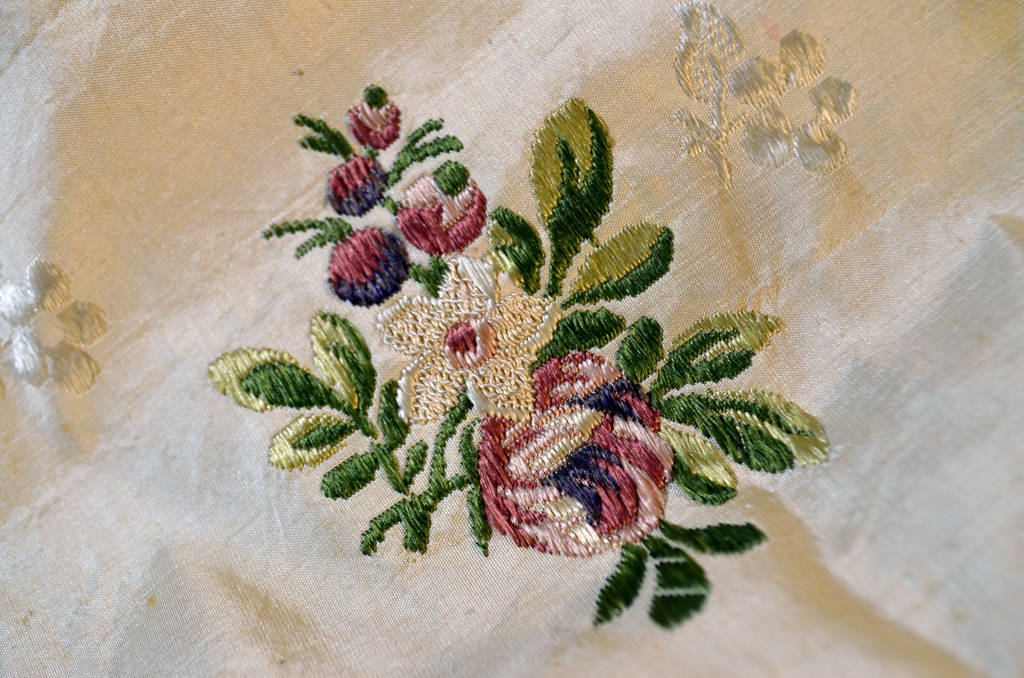
One portion of the floral embroidery on the dress in Kenmore’s collection. The gown’s material is so delicate in some areas that we felt it best not to try and photograph the complete gown.Robe à la Française, c. 1770, similar in style to the dress in Kenmore’s collection. Credit: Los Angeles County Museum of Art / Wikipedia
In Kenmore’s collection is an extremely delicate overdress and petticoat with a brocaded multicolor floral pattern in the open robe style that dates from about 1775-1785. The particular cut of the open robe style was also known as “a la francaise” or “sack-back gown”. This robe à la francaise is an illustration of the Rococo aesthetic that was popular during the eighteenth century. I find clothing to be some of the most personal historic artifacts in any collection. These pieces are not simply costumes but functional everyday garments that were used, stained, and mended by their owners. Being able to see and handle this tangible historic link is as close to time-travel as we will get but, at the same times, textiles are extremely fragile and must be handled only rarely.
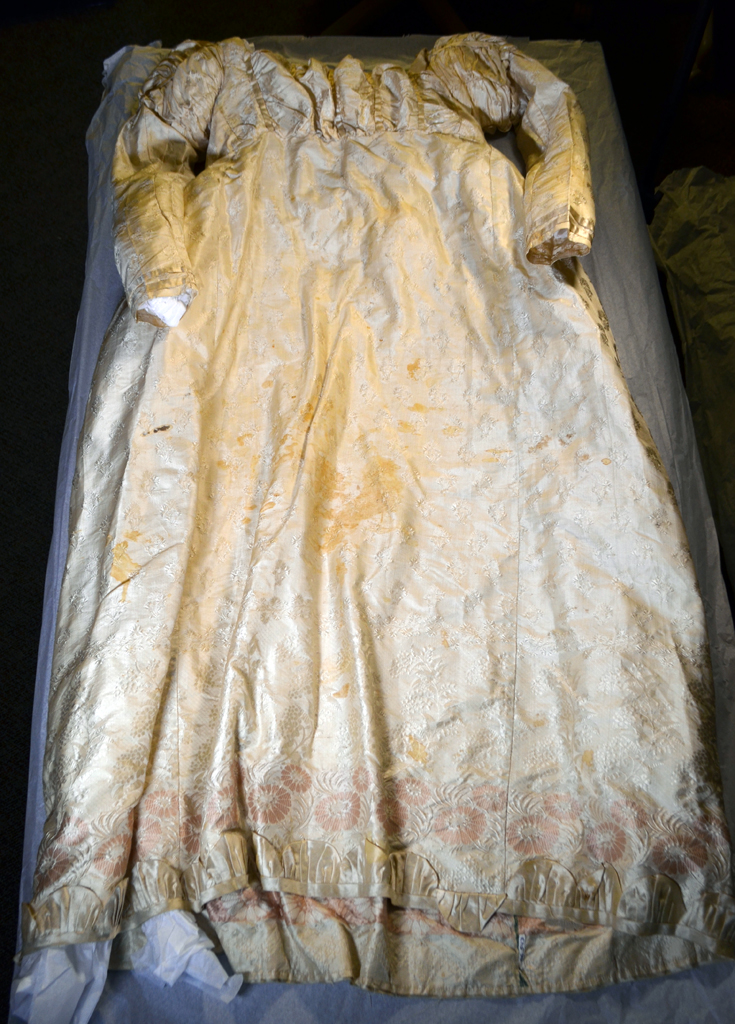
Empire-style dress in Kenmore’s collection photograph while still laying in its storage box.
Empire Waist Dress This cream-colored silk dress dates from between 1790 and 1820 and features a pattern of flower sprays and vines with row of pink brocaded flowers along bottom. Cut in neo-classical style popular in the early nineteenth century with an “empire-style” waist, square neck and loose skirt. Regency fashion is one of my favorite fashion epochs. I find the empire-waisted silhouette to be flattering and probably the most comfortable of all historic women’s styles. This piece doesn’t come out of storage much because it is a little too late for the Lewis era.
“A New and Exact Map of the Dominions” Drawn by London cartographer Herman Moll in 1715, this map shows a fascinatingly detailed view of the Atlantic coastline from present-day South Carolina to Newfoundland, Canada indicating counties, mountains, towns, Indian settlements, rivers and bodies of water. Insets along the bottom are maps of the Gulf of Mexico, the Carolinas, Charles-Town, and a small map of the “Principal Port of North America.” At right center is an inset showing a fully-colored view of Niagara Falls, with cute little beavers in the foreground building a dam.
“View of London”
Close-up of a portion of Frederick de Wit’s “View of London.”
This colored engraving done by Dutch cartographer Frederick de Wit shows a topographic view of the London with “The River Thames” across the center of map. In the upper right corner there is a key with 148 streets, churches, wharves, theatres, and monuments listed and identified on the plan with a corresponding number. As an Anglophile who went to graduate school in London and spent over a year exploring that city’s streets, I like seeing many familiar streets and sites on this map. It shows that London city’s center has changed very little across the centuries.
Bourdaloue This creamware bourdaloue is a smaller and more feminine version of a chamber pot circa 1780-1790. In an era without public toilets, the bourdaloue provided a lady with a portable and relatively clean means of relieving herself away from home. The vessel was oblong, rectangular, or oval in shape and a slightly raised lip at one end and a handle at the other and allowed usage from a squatting or standing position. The bowl would then be given to the lady’s maid who disposed of the waste discretely. Little everyday artifacts can get overlooked but they these fascinating little pieces give us a whole picture of colonial life. Plus, everyone loves chamber pots!
The Gentleman’s Magazine This March 1752 edition of The Gentleman’s Magazine includes articles on poetry, music, weather, gardening tips, criminal proceedings, history, and social services. It’s amusing to read the various articles today and reflect on how similar they can be to our current news. There is a riveting report on the trial of Miss Blandy for poisoning her father, an account of the history of the Incas, and birth, marriage, and death announcements for the upper-crust of London society. The Gentleman’s Magazine is digitized and can be read here. The Gentleman’s Magazine was founded in London in 1731 and remained in continuous print for 191 years.
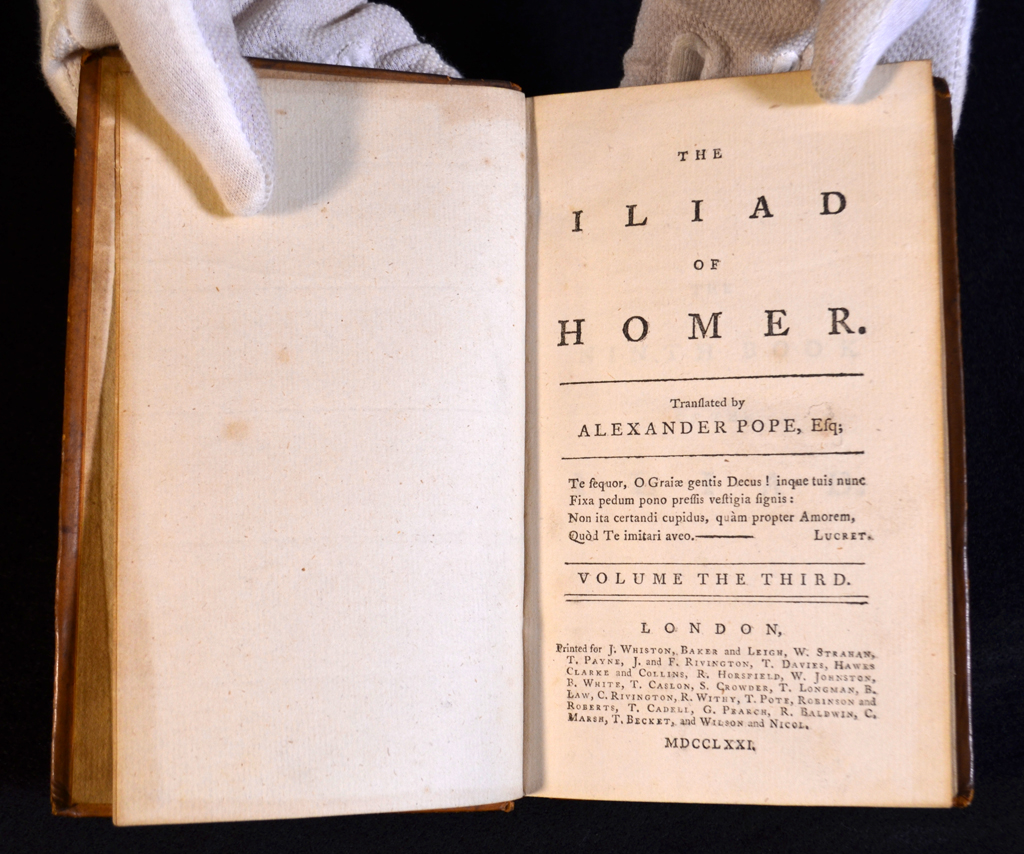
Homer’s The Iliad translated by Alexander Pope These five volumes of Homer’s The Iliad were translated into English by the poet Alexander Pope between 1715 and 1720. Written around the 8th century BC, Homer’s timeless story has influenced great artists for 2,000 years. Pope was one of those artists. He suffered from many health problems but was one of the few English poets able to earn a living from his literary works and I just think it’s cool that we have these special books in our collection. Pope translated the epic verse for the publisher Bernard Lintot and earned the significant sum of £210.
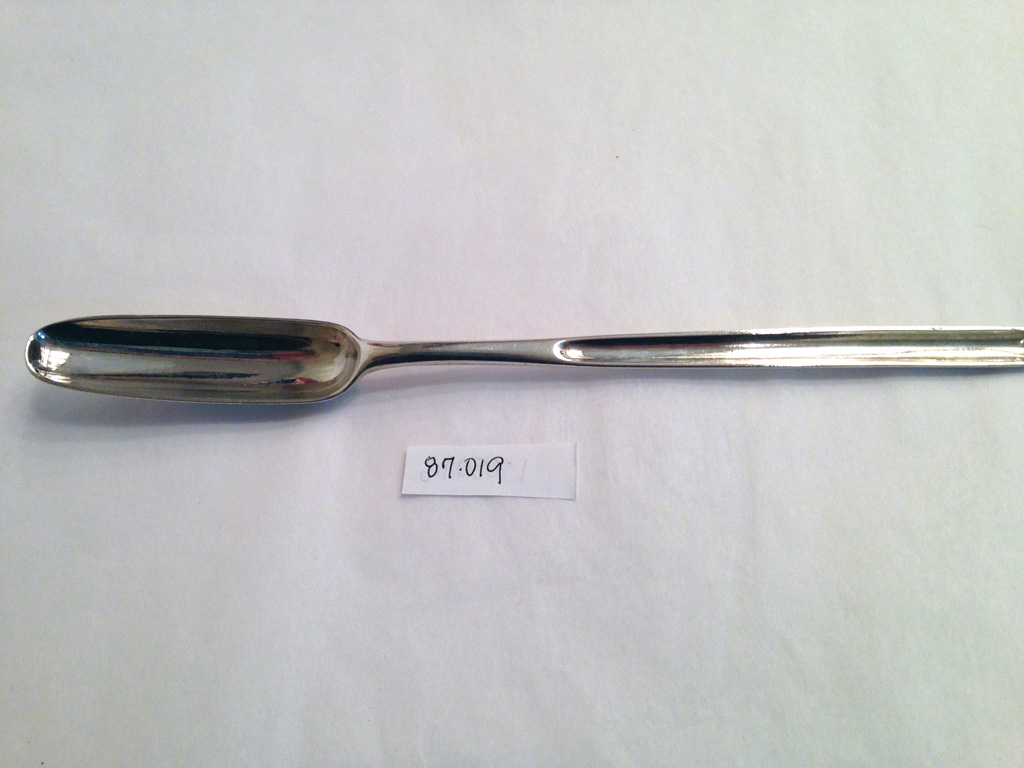
Marrow Spoon This silver marrow spoon, circa 1722, features a long narrow scoop at one end and a broader spoon at the other. Enjoying bone-marrow was so common that utensils were created to assist the diner in retrieving every morsel. These spoons were used at the table to get the tasty marrow out of the center of the bones without having to rudely gnaw, suck, slurp, bang, crack, or bite. The fashionableness of certain food can be traced through the evolution of dining implements. Today, our familiarity with the double scooped spoon and its purpose has waned just like roasted long-bone sprinkled with salt is no longer a prevalent dish on our tables.
Mary Washington Monument Stone
Painted on this view of the stone are the ‘new’ [current] monument and the Mary Washington House.This is an Aquia sandstone fragment from the original Mary Washington Monument that was started in 1833 when President Andrew Jackson laid the cornerstone. The monument was never finished and was heavily damaged during the Civil war. In 1892, in order to raise money for a new memorial, the Mary Washington Monument Association began to sell off the original pieces painted by local women as “relics”. While some felt this was desecrating Mary’s grave, the Association raised enough money for a new monument. In 1894, President Grover Cleveland dedicated the new monument, which still stands today. Although the way the group went about raising funds for the new memorial is not how it would be done today, these stones represent the beginning of the American preservation movement at the turn of the century.
The sampler’s poem has large faded from view. It read: “Learn to contemn all Praise betimes / For Flattery Is the Nurse of Crimes / With early Virtue plant thy Breast / The Specious Arts of Vice detest / Youth like softened Wax with Ease will take / Those Images that first Impressions make / If those be fair their Actions will be bright / If foul they’ll clouded be with Shades of / Night.”
Sampler by Betty Washington Lewis This sampler was embroidered, signed, and dated by Betty Washington Lewis on February 25, 1805. Betty was the daughter of Howell Lewis and the granddaughter of Fielding and Betty Lewis. Girls demonstrated or tested their needlework skills by making samplers and often included the alphabet, figures, decorative motifs and, usually, a name and date. This is one of the few textiles in our collection directly related to and created by a member of the Lewis family. When an item is clearly marked with the date and who made it, it really doesn’t get much better for a historian!