Lives and Legacies

Author: ferryfarmandkenmore

  • Meet the Lewis Family: John and Fielding Jr.

    Fielding Lewis was married twice.  He and Catharine Washington, his first wife, had three children: John, Frances and Warner.  Both Warner and Frances died leaving John as the sole heir from this first marriage.  After Catharine’s death, Fielding married Betty Washington, and not quite a year later Fielding Lewis Jr. was born in 1751.  Although just 4 years younger than his half-brother John, by rights at that time, Fielding Jr. could have supplanted his older brother as Fielding Sr.’s primary heir.  No personal accounts or letters tell us what Fielding Sr. thought about his two eldest sons’ status as heirs to his estate but his actions in the years after their births are telling.


    In 1775, Fielding Lewis commissioned five portraits by American artist Charles Willson Peale, for his newly completed home at Kenmore.  Only two have been located and they are of Fielding’s two eldest sons.  Peale scholars feel fairly certain that the works were painted as companion portraits, intended to hang side by side with the poses of the two sitters meant to complement one another.  Perhaps Fielding was making a visual statement that his two eldest sons were on equal footing and that neither took precedence.  Indeed, in his final will and testament, Fielding provides for both sons equally, giving his Spotsylvania lands to John and his Frederick County lands to Fielding Jr.  On the surface, it might appear that the two brothers had an amicable relationship, not marred by the usual 18th century family in-fighting over inheritance.  Well, that appearance might not tell the whole story.  The half-brothers couldn’t have been more different.

    As early as 1769, Fielding Sr. worried about Fielding Jr’s management of his finances.  The 18-year-old had recently married Nancy Alexander, the daughter of a prominent household in Alexandria, Virginia.  Nancy apparently came to the marriage with a sizeable fortune and Fielding Jr. immediately set about spending it.  In September, both Fieldings wrote to George Washington, to ask his assistance with the Alexander money.  Fielding Jr. wrote his uncle, “Inclos’d you have an Order on Mr. Robart [sic] Alexander for the Balance remaining…of my Wifes Fortune which I shall be Oblig’d to you to receive for me, and purchase Slaves to the amount thereof…” His letter is enclosed in one written by his father, in which we learn a little more about Fielding Jr.’s request to his uncle.
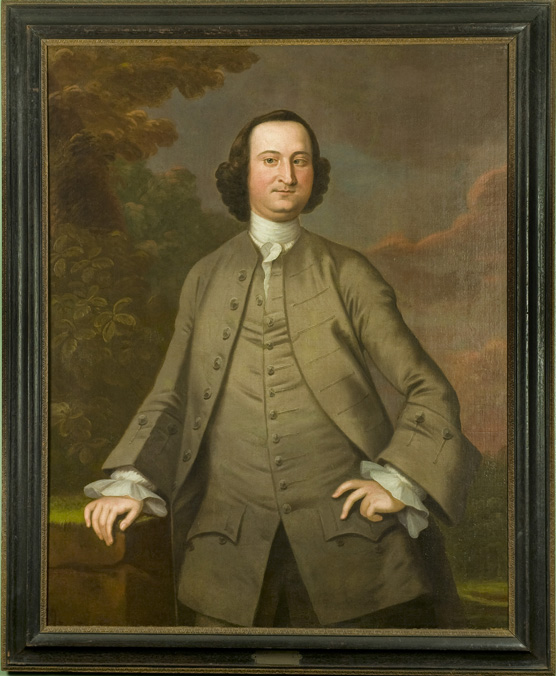
    fielding-lewis-sr-1750s-by-john-wollaston
    Fielding Lewis, Sr. (c. 1750s) by John Wollaston

    Fielding Sr. revealed that Mr. Alexander was concerned at the rate with which Fielding Jr. was spending the money, and has asked Fielding Sr. to take the remainder and use it for something that would help the couple in the long run.  Fielding Sr. went on to say, “I am allmost [sic] certain that he will in a year or Two spend every Shillg as I cannot perceive the least amendment since his Marriage, nor has he the least regard to any advice I give him.” This statement seems to indicate that Fielding Jr.’s spendthrift ways existed prior to marriage and worsened with the influx of his wife’s money.

    Unfortunately, Fielding’s prediction would prove true.  Over the next decade, Fielding Sr. paid his son’s debts time and again, while Fielding Jr. continued to make significant purchases on credit.  Eventually, Fielding Sr.’s burden would be passed to John Lewis.

    Fielding Lewis passed away in 1781.  John Lewis remained in the Fredericksburg area, acting as executor of his father’s estate, and seeing to its myriad debts and complicated business transactions.  He oversaw operations on the lands left to him, and assisted his step-mother, Betty Lewis, in maintaining Kenmore, which would become his upon her death.  He wrote on several occasions of tight finance, and frustrations with his father’s estate but managed to hold it all together.

    His brother Fielding (who dropped the “junior” from his signature following his father’s death), was not managing so well.  He, his wife, and their three children were living on the Frederick County property that he inherited.  His debts were so severe that, by 1784, he was in debtors’ prison and again turned to his famous uncle for help.  In order to bolster his case for being worthy of Washington’s assistance, he sent a collection of letters from his father prior to his death that outlined his plan to save his son from the debt of his “youthfull Folley [sic].”  Fielding wrote, “Since which it has pleased God to take him out of this transetorey [sic] life, before he had Completed his Intention, tharefore [sic] I have taken the Freedom and liberty, of beging you to Assist me…for what Evor Sum or Sums you will be Able to lend me…as Nothing I think in this life So disagreeable as to be drag’ed About by the Sherrifs [sic]…Which Situation I am in at present…”
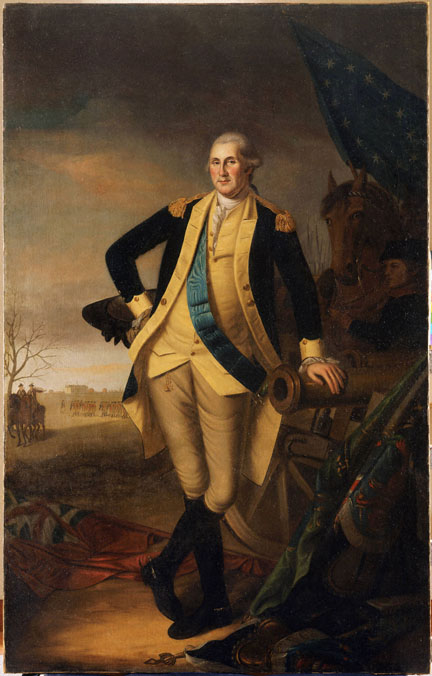
    george-washington-c-1779-by-charles-willson-peale
    George Washington (c. 1779) by Charles Willson Peale

    Washington gently rebuffed his wayward nephew, replying that he had his own debts and there was little money to spare.  He made a pointed statement at the end of his short letter, perhaps indicating that he didn’t fully believe Fielding was the victim of his own youthful folly. He wrote, “There was a great space between…when you were called upon by your Father for a specific list of your Debts and his death: How happened it, that in all that time you did not comply with his request?” Indeed, receipts in our archives show that Fielding commissioned a new carriage to be made for him in August of 1784, just one month before he was sent to prison.  He would not pay for the carriage until a suit was filed against him two years later.[1]

    As Fielding was seeking help from his uncle, John was planning one of many trips to “the Westward” as he called it – the Western frontier, and Kentucky in particular.  His first expedition to the Kentucky territory was on behalf of his father, before the Revolution, when Fielding Sr. was considering a land purchase there.  Apparently, John fell in love with the country, and returned many times in the coming years, making several land purchases of his own.  His uncle George asked him to act as his agent on several of these trips, to assess the state of Washington’s own property near Pittsburgh.

    While Washington was placing increasing trust in John, he had apparently lost faith in Fielding Jr.  By 1786, Fielding had been released from prison but had lost all of his inherited land in Frederick County.  He and his family were living on a lot in Fauquier County and were attempting to build a house.  Once again, Fielding asked for assistance.  Washington’s response was not as gentle this time, replying, “Altho’ your disrespectful conduct towards me, in coming into this country & spending weeks therein without ever coming near me, entitles you to very little notice or favor from me; yet I consent that you may get timber from off my Land in Fauquier County to build a house on your Lott…”  Despite his sharp words, he still agreed to help.

    Fielding’s improved situation was short-lived.  His wife Nancy died in 1788.  Fielding remarried to Elizabeth Dade, who apparently did not bring a fortune to the union, and so the 1790s would be a rough decade for Fielding.  He was returned to debtor’s prison in 1790, and found that there was no one in a financial situation to save him, with the exception of his brother John.  John, however, was not willing to give him money outright.  Instead, he required that Fielding mortgage everything – slaves, housewares, livestock – in exchange for £1200.[2]  One senses the family losing patience with Fielding.

    In 1792, Fielding was again incarcerated for debt, and this time there was no home for his wife and children, who went to live with Betty Lewis at Kenmore.  Betty wrote to her brother George about the situation, “I am sorry it will not be in my Power to advance any, haveing at this time three of my Grandchildren to support, and god knows from every Account but I may expect as many more shortly, Fielding is so distrest that his Children would go naked if it was not for the assistance I give him…”

    After this disastrous turn of events, Fielding’s whereabouts for the rest of his life become murky.  He never again owns property, and most likely stayed with various family members, including John.  His children remained with Betty at Kenmore.  There may have been little contact between Fielding and his children, as indicated in a letter written to him by his brother George informing him of Betty’s death in 1797. George wrote, “You will no doubt be anxious to know what is to be done with poor little Nancy (Fielding’s daughter), she is in good health, and at present with sister Carter…”[3] It is unknown where Fielding was when George sent him this letter.

    After Betty’s death, John moved quickly to sell Kenmore.  Although it would take several years, he did eventually save enough money to move his family to his land in Kentucky, where he spent the rest of his life.  Perhaps the family obligations and strain of his father’s estate made Kentucky a more appealing home than Fredericksburg.  While Fielding Lewis Sr. wanted very much for his two eldest sons to be seen and treated as equals, their lives played out in very different ways, and that’s the real story behind the portraits.

    [1] Fielding Lewis Jr. to Richard Simcock, 15 January 1786.  The George Washington Foundation Manuscript Collection.

    [2] Indenture Between Fielding Lewis Jr. and John Lewis, 20 March 1790. The George Washington Foundation Manuscript Collection.

    [9] George Lewis to Fielding Lewis Jr., 31 March 1797. The George Washington Foundation Manuscript Collection.

  • Photos: 3rd Annual “A Wee Christmas” at Kenmore

    Visit Kenmore this holiday season for an exhibit of highly detailed, replica dollhouses – including the mansion – and miniatures in the Crowninshield Museum Building. Share memories of your dollhouse with your family as you explore life in miniature! Put your mind and eye to the test with our “I Spy Miniatures” challenge – fun for young and old alike!

    Kenmore’s hours are Monday – Saturday from 10:00 a.m. – 4:00 p.m. and Sunday from 12:00 p.m. – 4:00 p.m. Kenmore is closed Christmas Eve and Christmas Day. Exhibit ends on December 30.  Admission to Kenmore and exhibit is $10 adults, $5 students, under 6 free while admission to the dollhouse exhibit only is $5 adults, $2.50 students, under 6 free.

  • Photos: 30th Annual Gingerbread Contest & Exhibit at Ferry Farm

    It’s the 30th year of a a long-standing holiday tradition: the Gingerbread Contest & Exhibit at George Washington’s Ferry Farm!  This year’s theme is “Home for the Holidays.” Read about Thirty Years of Gingerbread.

    Adults and children alike will enjoy the sights and smells of the festive creations displayed at Ferry Farm!  Ferry Farm’s hours are Monday – Saturday 10:00 a.m. – 4:00 p.m. and Sunday from 12:00 p.m. – 4:00 p.m. Ferry Farm is closed Christmas Eve and Christmas Day. The gingerbread exhibit ends on December 30.  General admission to Ferry Farm and the exhibit is $8 adults, $4 students, under 6 free while admission to the exhibit only is $4 adults, $2 students, under 6 free.

    For more information, call (540) 370-0732 x24 or email [email protected].

  • Mistletoe: More Than Christmas Kisses

    In the 17th and 18th centuries, colonial Virginians decorated their homes for Christmas with all manner of evergreens.  This greenery – holly, ivy, mistletoe, and more – were seen as symbols of everlasting life.  Each year at Historic Kenmore, we also decorate the house with greenery in this tradition.

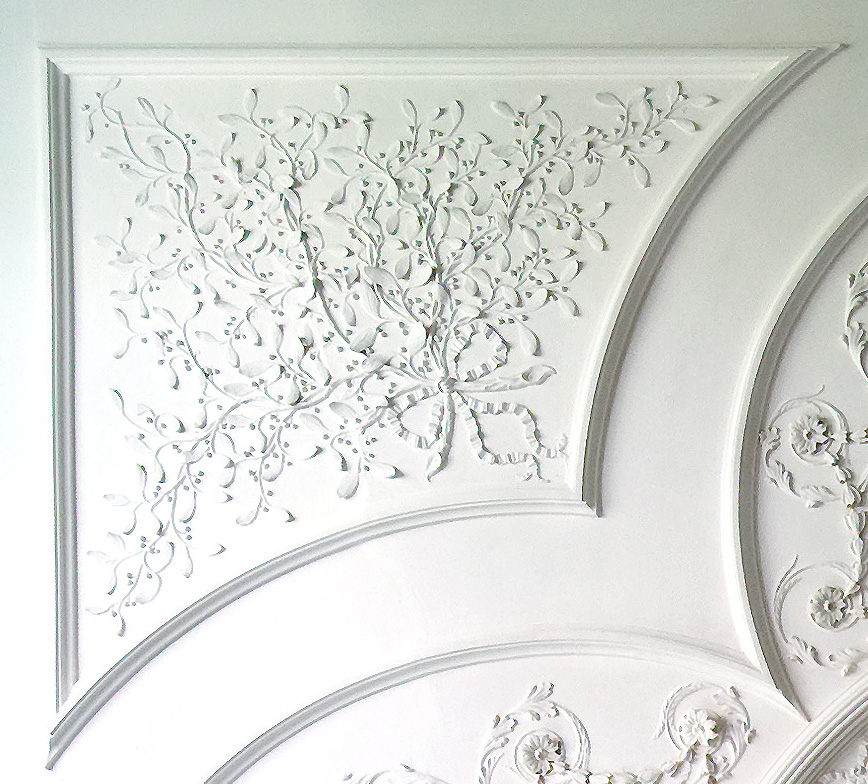
    Mistletoe actually adorns Kenmore year round. The elaborate plaster ceiling in the drawing room depicts the four seasons and mistletoe is used to represent winter.  The mistletoe depicted, however, is not American mistletoe; the craftsman based this part of the ceiling on European mistletoe instead. This makes sense given that the artist was probably European. Having never seen American mistletoe, he would not know how to sculpt it.

    mistletoe-on-kenmores-drawing-room-ceiling
    Mistletoe depicted in the ornate plaster ceiling of Kenmore’s drawing room.

    Regardless of whether American or European, how did mistletoe come to symbolize winter and hang in homes during the holiday season? How did these green branches with white berries become associated with the hope of a little fun and (possible) future romances? What is it about mistletoe that brings so much joy to the seasons’ festivities?

    Mistletoe (Phoradendron leucarpum) grows in the southern United States and is native to much of North America. It has more berries and shorter, broader leaves than English mistletoe (Viscum album). Like English mistletoe, the American plant is a semi-parasite; it digs its “roots” in the host tree and sucks sap and water from the tree, but it manufactures its own chlorophyll.  Mistletoe often grows in the tallest branches of the tree, making it very hard to harvest.

    The word “mistletoe” likely came from one of two sources.  Its origins may be from the Anglo-Saxon “misteltan;” “mistl” meaning different and “tan” meaning twig. Mistletoe is a very “different twig” indeed because of how and where it grows – something that would not have escaped the notice of the Anglo-Saxons.  The word’s other possible origin also translates “tan” as twig, but renders “mistel” as dung; making “mistletoe”  “dung twig.” This may have been because bird droppings contained the seeds that helped spread the plants to other trees.

    an-arch-druid-in-his-judicial-habit
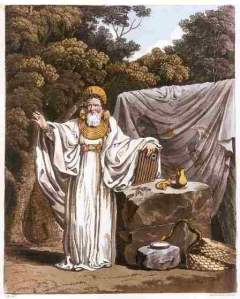
    Imaginative illustration of ‘An Arch Druid in His Judicial Habit’ from The Costume of the Original Inhabitants of the British Islands by S.R. Meyrick and C.H. Smith (1815) Credit: Wikipedia.

    Druids, who served as priests and the learned class for the ancient Celts, valued mistletoe almost as much as they valued oak trees. These men (there is little evidence that there were women druids) climbed to the top of mistletoe-laden trees and harvested the sacred plant with a golden sickle. Those on the ground were careful to catch the plant as it fell because they believed the mistletoe would lose all of its power if it hit the ground.  Druids then used it to cure disease and promote fertility in humans and animals. It may be that the custom of hanging mistletoe stems from a Druidic tradition. Enemies who met under the mistletoe would lay down their arms and greet each other as if friends.

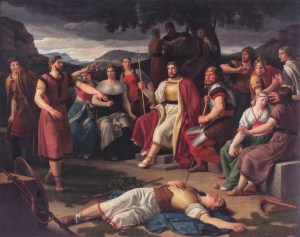
    Mistletoe also played a role in Norse mythology and some think that our modern views on mistletoe came from one particular Norse myth. Balder, a god of peace, was the son of Odin, chief of the gods, and the goddess Frigg.  Balder began to dream of his own demise and his father traveled to the underworld to learn of his son’s fate.

    baldr-dead-by-eckersberg
    Baldr’s Death (1817) by Christoffer Wilhelm Eckersberg. Credit: Royal Danish Academy of Fine Arts/Wikipedia.

    Odin returned and shared the bad news with Balder and the other gods and goddesses. Frigg went to everything in the cosmos and asked it to swear it would not hurt her son.  Everything swore loyalty but mistletoe.  Loki, the god of mischief, made some mistletoe into an arrow that killed Balder.  In the version of the story with a happy ending, Balder was brought back to life and Frigg makes mistletoe a symbol of love and kisses to those who pass under it.

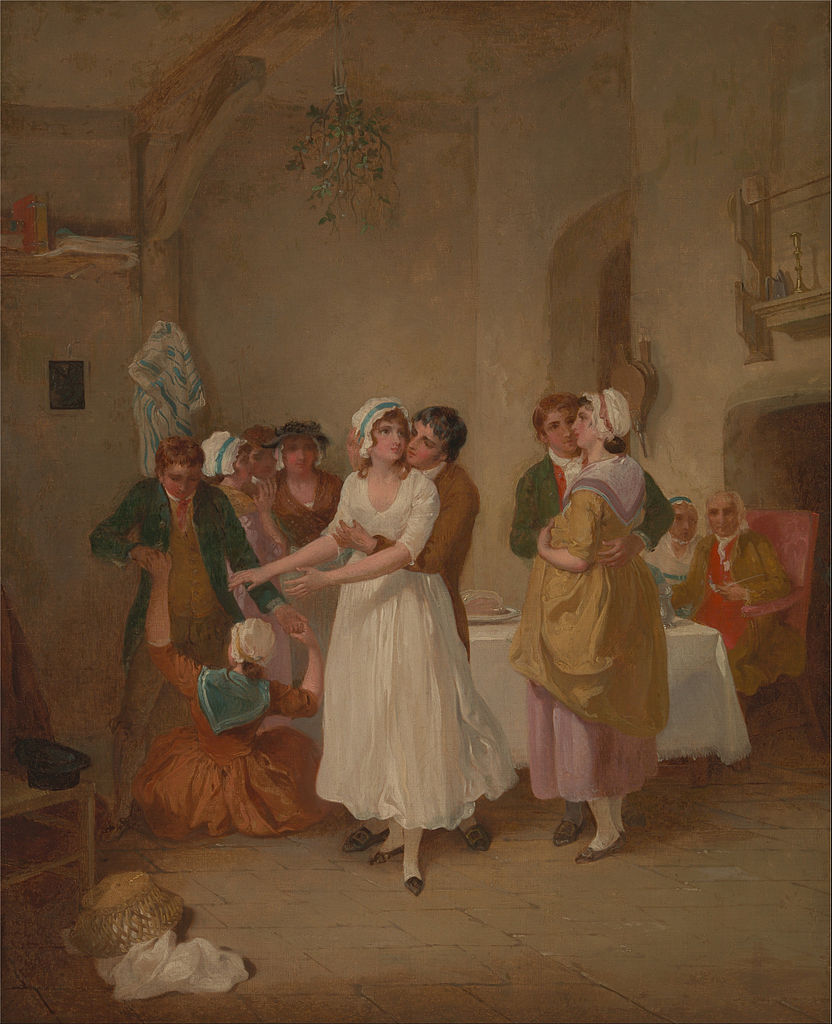
    The English origins of kissing under the mistletoe aren’t well known. Historical records indicate that this merriment became popular in England sometime in the 16th century, but we don’t know if it was commonplace before that.  English mistletoe etiquette had some hard-and-fast rules: women under the mistletoe were not to refuse kisses; men could only kiss women (or girls) on the cheek; after the kissing transaction, the man removed a berry from the mistletoe ball; after the last berry was plucked, the kissing ended.

    the-mistletoe-bough-by-francis-wheatley
    The Mistletoe Bough (c. 1790) by Francis Wheatley. Credit: Yale Center for British Art/Wikipedia


    Harvesting mistletoe is a challenge, but 18th century Virginians came up with an ingenious way to quickly and easily gather the plant.  Instead of climbing up into the tree’s canopy, Virginian men shot the mistletoe out of the tree.  They then took the good sprigs home, fashioned them into mistletoe balls, and enjoyed the merriment of the season.  This tradition harvesting mistletoe through gunfire still continues today all over the American south.

    Ancient Druids. Mythical Norse gods. 18th century Virginians. Over the centuries, these people, whether real or imagined, contributed to the myths and traditions that have made mistletoe a symbol of winter, friendship, and love.  When you share a kiss with someone special under the mistletoe this season, you might want to take a moment to share mistletoe’s long history with that someone too.

    Kelly Brennan Arehart
    Manager of Interpretation and Visitor Services

  • Video: Building George’s House – Timber Framing in the Shop

    In June, we visited Blue Ridge Timberwrights in Christiansburg, Virginia. We saw skilled craftsmen fashioning the timbers for the Washington house frame and talked with Sandy Bennett, president of Blue Ridge Timberwights.

    Learn more about the Washington House here and view other videos, photos, and blog posts about the project here.

  • Photos: Building George’s House – East Chimney

    building-the-east-chimney-18

    Brickmasons Ray Cannetti, Robert Hall, and Kevin Nieto recently finished building one of three chimneys for the Washington house at George Washington’s Ferry Farm. Located on the house’s east side and made from hand moulded brick by the Old Carolina Brick Company, this chimney is the smallest of the three.  The brick-laying work took about two weeks.


  • Thirty Years of Gingerbread

    It’s a long-standing holiday tradition. In fact, it’s so long-standing that this year, 2016, marks the tradition’s 30th year.  What tradition is that?  The annual Gingerbread House Contest and Exhibit at George Washington’s Ferry Farm!

    Since we are marking three auspicious decades for this event, we dug into the archives to present a look back here on Lives & Legacies.

    The contest began in 1987 and, for many years, took place at Historic Kenmore instead of Ferry Farm.  Our records are scant for the contest’s first year but we do know that the 2nd annual contest in 1988 saw middle schoolers Lisa Allen and Erika Paulson win best-in-show, according to a Free Lance-Star clipping in our files. Rev. Ed Boutchyard of Bowling Green’s Zion Full Gospel Church made a church with an ice cream cone steeple!

    1987-1
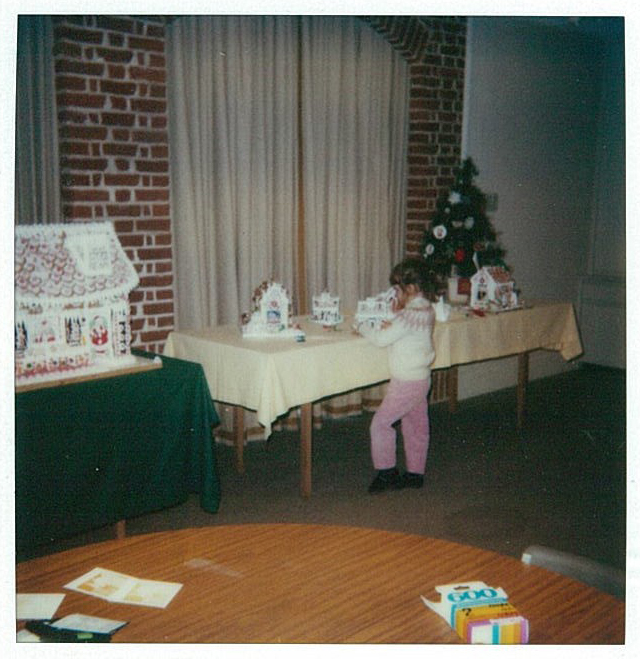
    A Polaroid from the first-ever Gingerbread Contest & Exhibit in 1987.

    Lisa Allen repeated her best-in-show victory in 1989 with the help of her sister Melanie and friends Theresa Stockdill and Courtney Lucado.

    In these early days of the contest, the German Club at James Monroe High School, one of the contest’s longest-running participants, began submitting regular entries and, in 1993, they won their first-ever best-in-show.

    In 1995, the Free Lance-Star (scroll up) profiled Claybourne, Emily, and Meredith Beattie, who, having entered the contest for nearly ten years, had only ever won a single 2nd place ribbon.  For this family, the “tradition of assembling and decorating the houses is far more important than winning prizes.” The kids, along with mom and dad, would visit their grandmother out-of-town over Thanksgiving break. They created their gingerbread houses there and then traveled the 300-miles back to Fredericksburg with the houses packed in the back of the car.  Clay explained that he entered year after year “because I like doing it with my sisters and my family.”

    1997-1
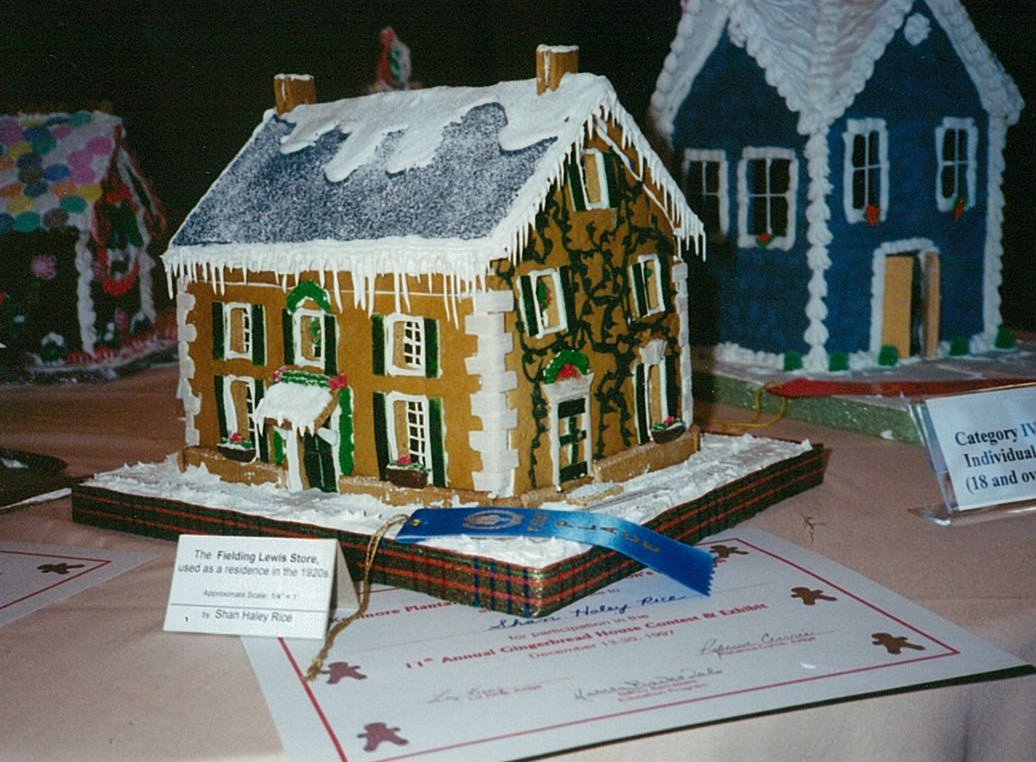
    A gingerbread version of the Fielding Lewis Store from 1997.

    In 2000, the contest and exhibit moved from Kenmore across the Rappahannock River to Ferry Farm, where it has been held every year since.

    There’s still time to enter a gingerbread house in this year’s contest and be a part of the tradition! Gather the family, start baking that gingerbread, and creatively decorate your house together. This year’s theme is “Home for the Holidays.”  Entries are being accepted now through Saturday, December 3 at Ferry Farm. Click here for rules and an entry form.

    The exhibit will open to the public on Sunday, December 4.  Ferry Farm is open Monday – Saturday from 10:00 a.m. – 4:00 p.m. and Sunday from 12:00 p.m. – 4:00 p.m.  General admission to Ferry Farm and the exhibit is $8 adults, $4 students, under 6 free. To view the gingerbread exhibit only, the cost is $4 adults, $2 students, under 6 free. For more details about this and other holiday events at Ferry Farm and Kenmore, visit kenmore.org/events.

    Zac Cunningham
    Manager of Educational Programs

  • Inside the Archaeology Lab: Putting Artifacts on Exhibit

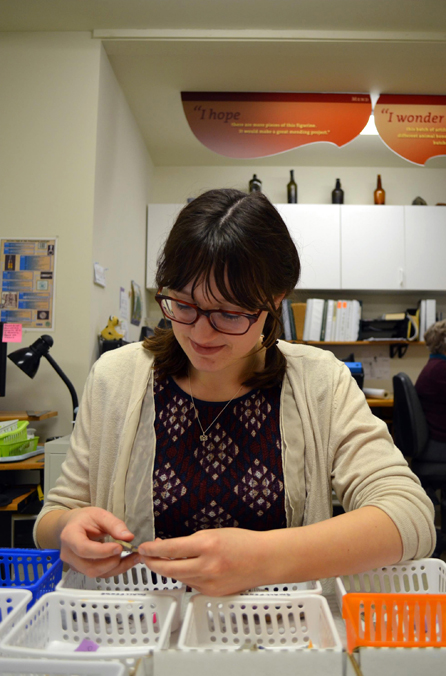
    Here on Lives & Legacies we’ve shown you a variety of important tasks that take place inside the Archaeology Lab at George Washington’s Ferry Farm. You’ve seen how we wash, catalog, label, and then mend vessels with archival glue. One goal of all this work is to piece together whole artifacts from the many broken bits found and share that whole artifact with our visitors as part of the exhibits in our museum gallery.  Right now, a new exhibit of white salt-glazed stoneware vessels is on display at Ferry Farm. It took numerous staff and volunteers working hundreds of hours to get the vessels on display ready to be exhibited. Here’s how we did it!

    Seven reconstructed white salt-glazed (WSG) stoneware vessels make up a new exhibit at Ferry Farm.  These pieces, which include two dinner plates, a fruit dish, three ointment pots (used for mixing medicines and cosmetics), and a tea ware or condiment pot lid, were all excavated from the Ferry Farm site. These ceramics were popular during the mid-18th century and most likely graced the tables of the Washington family.

    white-salt-glaze-fruit-dish
    White salt glaze stoneware fruit dish, 1740-1765. The dish is decorated with a molded “dot, diaper, basket” pattern and would have been displayed prominently in the Washington house at Ferry Farm. An almost identical dish has been excavated at Mount Vernon and additional sherds with a similar pattern were recovered across the river at Kenmore. This may signify a Washington family preference for the motif or indicate that someone within the family acquired multiple fruit dishes and gave them as gifts, something George Washington was known to do.

    In preparation for the exhibit, I spent the better part of three weeks in August and September finishing the documentation for the individual vessels and then meticulously gluing them together. This relatively small amount of time spent at the end of the project was only the tip of the iceberg – the total amount of time spent getting these pieces ready for exhibition encompassed a year and a half! Preparing these pieces to be displayed involved the hard work of numerous archaeology lab staff and volunteers.

    November 2014 – January 2015: Executive decisions are made…
    First, discussions were held within the archaeology department about studying Ferry Farm’s archaeological collection of white salt-glazed stoneware. Such a study would answer questions about the material setting of the Washington household and help with interpreting the forthcoming Washington house replica to the public. The project was given the go-ahead.

    January 2015: Getting the lists together…
    Using our searchable artifact database, we generated a list of every piece of white salt-glazed stoneware in our collection.  A total number of 1,623 artifact bags were on this list, representing over 2,800 actual sherds.

    database
    Screencap of the artifact database.

    February 2015: Puzzle-solving begins!
    We started pulling the 1,623 artifact bags from storage, and by my records, we were still pulling artifact bags in June.  Lab staff, volunteers, and, on rainy days, the excavation field crews helped with pulling the artifacts.

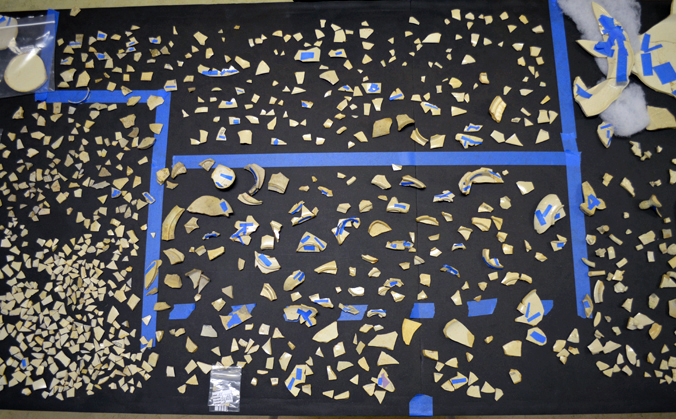
    After making sure the sherds were labeled correctly, we laid them all out on one of the lab tables, which had been covered in a black foam board to make it easier to see the all-white ceramics. The sherds were first separated by decorative variations, such as plain white salt-glazed, slip-dipped, scratch blue, or dipped with iron oxide, and next by vessel part, such as rims, bases, and bodies. Then the cross-mending began.

    white-salt-glaze-artifacts-on-table
    Sherds of white salt glaze stoneware waiting to be mended together.

    Over the next eleven months, countless hours were spent at the table looking for mends between the sherds.  Having identifiable vessel parts, such as rims and molded and decorative elements, helped in the matching process, but there were hundreds of plain white, non-descript sherds to try and fit together.  Pieces that mended were taped together with painter’s tape, which doesn’t leave an adhesive residue on the artifacts.

    A friendly competition began and whoever had the most mends at the end of each month won a free lunch!  In all, everyone spent countless, addictive hours each week scrutinizing the sherds and patiently putting together “puzzles” for which, unfortunately, the majority of the pieces were missing.

    lauren-mending
    “Do these match?”
    vessel-209-pot-lid-recto-before-treatment
    Puzzle solved!

    January 2016: Minimum Vessel Count…
    After eleven months, we cried “uncle” to the cross-mending and started the minimum vessel count by figuring out how many and what types of individual WSG vessels were represented in our collection.  Under the supervision of Mara Kaktins, The George Washington Foundation’s ceramic and glass specialist, the sherds were separated into what we believed were individual vessels using the bases and rim styles.  By late April, our choices were firm and over sixty white salt-glazed vessels were identified.

    July 2016: Putting the paperwork in order….
    Treatment reports were started on the most complete vessels, which would be included in the new exhibit.  Each report listed all the sherds that made up each vessel and their condition. Photographs were taken to help with the mending and gluing.  The remaining white salt-glazed sherds on the table were separated into bags according to decorative and body type, their contexts recorded in a spreadsheet for our records, and then returned in storage.

    August 2016: Finally, the fun part – gluing!
    I started gluing the vessels using a product called B-72, an archival glue that can be removed, if necessary, and that we mix ourselves in the lab.  The design of the upcoming exhibit, including the layout, mounts and signage, was created by Meghan Budinger and Heather Baldus, the Foundation’s curatorial team.

    lid
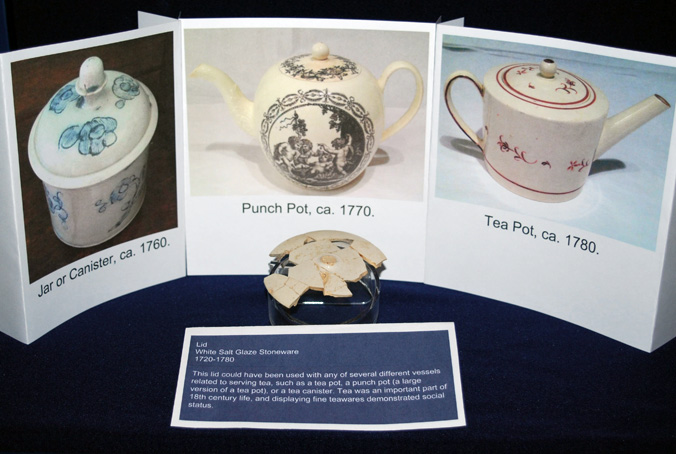
    White salt glaze stoneware lid, 1720-1780. This lid could have been used with any of several different vessels related to serving tea, such as a tea pot, a punch put (a large version of a tea pot), or a tea canister. Tea was an important part of 18th century life, and displaying fine teawares demonstrated social status.

    September 2016: Finishing touches…
    The white salt-glazed stoneware exhibit is now installed and ready for the enjoyment of our visitors to Ferry Farm. A total of 614 days from report prep to exhibition!

    Judy Jobrack, Archaeologist
    Assistant Lab Supervisor

  • Digging Up a Card Table

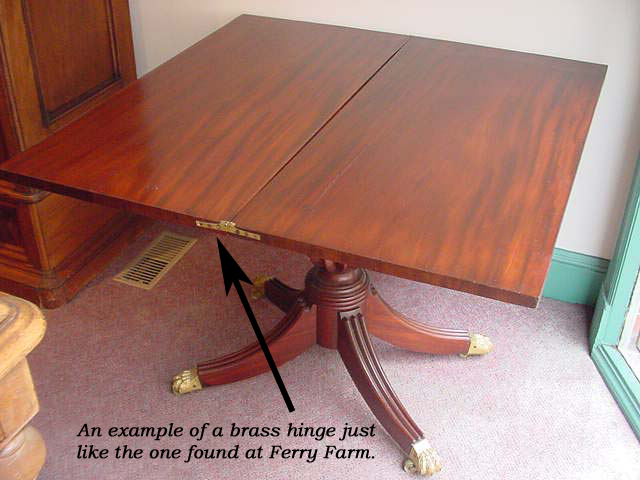
    Tantalizing evidence of historic furniture use exists within the soils of George Washington’s Ferry Farm and that evidence gives us a more complete view of how the Washington family lived in the 1700s. The hundreds of items archaeologists and students have uncovered represent the remains of furniture broken or embellishments lost. The ruthless outdoor elements leave scant vestiges of furniture’s former glory. Wood disintegrates into soil, so these relics typically include only iron and brass hardware, such as drawer pulls, casters, bolts, keyhole escutcheons, or hinges. Over half of the hardware found consists of brass tacks.  Such brass studs were often used in furniture upholstery, but were also popular for saddles, trunks, even antique wig stands: anytime a leather covering was added to a wooden frame or base.

    One particularly interesting brass hinge was unearthed in 2007 and boasts an exciting past. This hinge, part of a folding card table, was a crucial element in the popular Virginia domestic pastime of playing games such as backgammon, chess, and cards. Card tables provided a luxurious accessory for popular social entertaining and were part of a well-appointed home.  Providing guests with such pleasant amusements reflected well upon the Washington family.

    card-table-hinge
    18th century card table hinge excavated at George Washington’s Ferry Farm.

    Archaeological investigations sponsored by The George Washington Foundation have uncovered evidence that demonstrates that the Washingtons’ mid-1700s home was filled with fashionable accessories to enhance social bonding.  These tools included tea wares, stemmed drinking glasses, glass decanters, fashionable dining utensils, and smoking pipes. The recovery of a card table hinge provides another element of their well-equipped home.

    cardtable-hinge-on-table

    Gentleman often played card games together, but occasionally women joined the amusement as well (Porter and Porter 1782:466-467). Playing cards allowed ladies and gentlemen a refined form of amusement in a convivial atmosphere, without raising critical eyebrows from discerning social commentators in Virginia.  These games were occasions in which mixed company – men and women – could enjoy companionship and pass the time in a genial way. It was one of the few entertainments in which men and women could directly compete (Sturtz 1996:169-171). Lucy Byrd’s acumen prompted her husband William to cheat on at least one occasion (Sturtz 1996:172-173, 175-176).

    Such benign competition also allowed players to showcase their skills. William Byrd II thought that such games provided an effective antidote to “disagreeable” company, as it allowed the time spent with tiresome guests to pass quickly (Sturtz 1996:175). Tea or stronger beverages might lubricate such gatherings, which enhanced social bonds.

    hogarths-wanstead-house
    Card playing (group at card table in painting’s center) and tea drinking (group at table at painting’s right) provided elegant entertainment as depicted in The Assembly at Wanstead House (1728-31) by William Hogarth. Public domain. Credit: Philadelphia Museum of Art / Wikipedia

    If card games included a little wager, they were all the more thrilling.  Self-assured gambling and an indifference to losing money demonstrated a gentleman’s independence from monetary anxiety (Isaac 1974:352; Koda and Bolton 2006:100; Sturtz 1996:166). Such competitive confidence went a long way towards refuting any rumors of financial stress from which a gentleman might be suffering in the community.

    In the years leading to the American Revolution, these occasions were increasingly viewed as a source of social disorder (Isaac 1974:358-359), but such amusements remained popular social events in Virginia.

    Cards were a popular Virginia pastime and specific furniture such as folding card tables existed as luxurious accessories to support this pasttime (Isaac 1974:352). Hospitality was an important part of these occasions (Isaac 1974:352) and the folding card table made the game and the hospitality possible.  Applying knowledge of the past to particular objects like a card table hinge excavated at Ferry Farm gives us a more complete picture of the lives led by the Washington family here in the 18th century.

    Laura Galke, Archaeologist
    Site Director/Small Finds Analyst

    References Cited

    Porter, James and William Porter
    1782 Letters Addressed to Two Young Married Ladies, on the Most Interesting Subjects. The Critical Review, or, Annals of Literature.  British Periodicals.  Printed for J. Dodsley, London.

    Goodison, Nicholas
    1975 The Victoria and Albert Museum’s Collection of Metal-Work Pattern Books.  Furniture History 11:1-30.

    Issac, Rhys
    1974  Evangelical Revolt: The Nature of the Baptists’ Challenge to the Traditional Order in Virginia, 1765-1775. The William and Mary Quarterly 31(3):345-368.

    Koda, Harold and Andrew Bolton
    2006  Dangerous Liaisons:  Fashion and Furniture in the Eighteenth Century.  The Metropolitan Museum of Art, New York.

  • Election Day in the 1700s

    It’s Election Day! From early morning until after dark, voters in Virginia and across the United States are walking into libraries, schools, firehouses, community centers, city halls and, occasionally, even private homes. Once inside, they are given a paper ballot, punch card or, although still relatively rare, may be directed to a touch screen. The voter steps up to or into a voting booth walled off with some type of barrier. There is an atmosphere of quiet deliberateness.  The individual voter alone marks the candidates of their choice. When finished, they place their ballot into a secure ballot box. The ballot requires no signature nor is the voter required to make a public declaration revealing who they support.

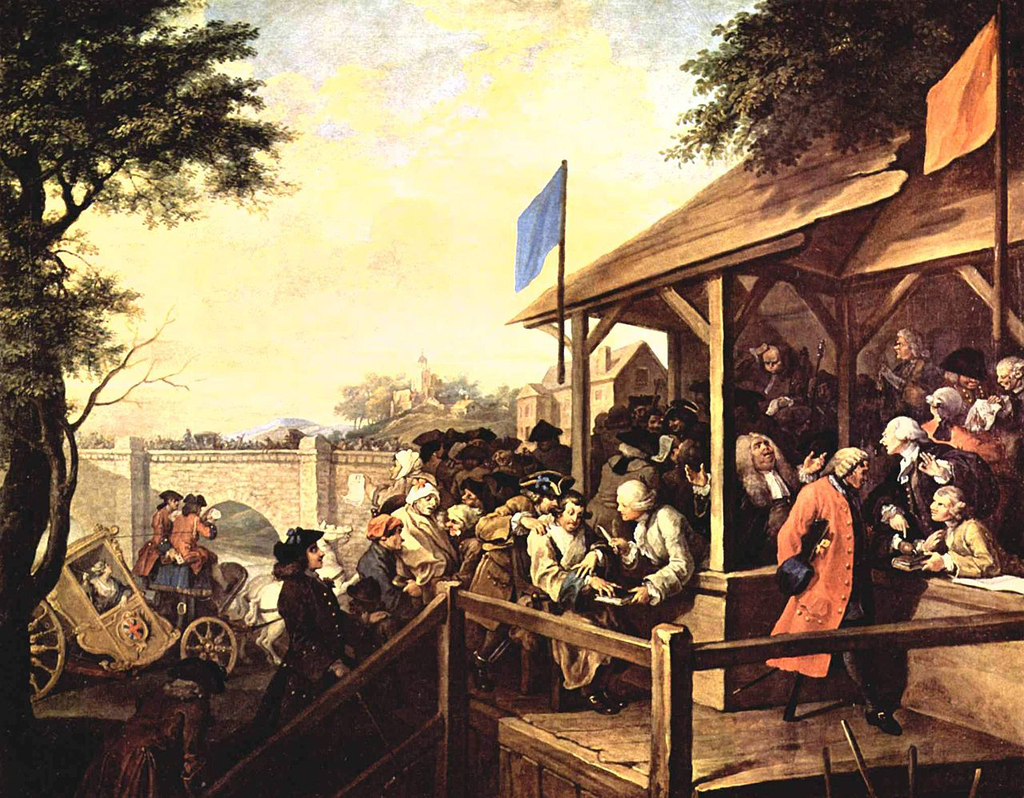
    White propertied men of the 18th century like Fielding Lewis, Augustine Washington, and George Washington would be surprised by our 21st century voting process. In early America, Election Day was an intensely public affair and oftentimes an excuse for everyone, whether permitted to vote or not, to travel to the county seat for the election. It was a chance to visit neighbors, conduct business, and simply have a good time.  There was a holiday atmosphere that could get quite uproarious!

    the-polling-by-william-hogarth
    “The Polling” by William Hogarth (1755), scene 3 in his Humours of an Election series. While Hogarth’s goal is to mercilessly satire English politics, his painting also hints at the festive atmosphere of an actual 18th century Election Day. Credit: Sir John Soane’s Museum / The Yorck Project / Wikipedia.

    The festival atmosphere was fueled by a common, although technically illegal, vote-getting technique: alcohol.  The law said that candidates could not provide drinks to voters from the time the election was announced until after votes were cast on Election Day.  To work around this restriction, candidates simply enlisted spouses, family, friends, or servants to distribute the spirits.

    George Washington first ran for a seat in the House of Burgesses in 1757. Each county sent two representatives to the house.  In this first election, Washington came in third in a field of three and garnered only 40 votes.  The next year, he stood again.  He won with 310 votes – the most of the four candidates.  While certainly not the sole reason for his victory, in 1758, Washington reimbursed friends £39 for 34 gallons of rum, 3 pints of brandy, 13 gallons of beer, 8 quarts of cider, and 40 gallons of rum punch served to voters.[1]  He wrote one of these friends, James Wood, saying “I am extreme thankly [sic] to you & my other friends for entertaining the Freeholders in my name—I hope no exception were taken to any that voted against me but that all were alike treated and all had enough it is what I much desird [sic]—my only fear is that you spent with too sparing a hand.”

    an-election-entertainment-by-william-hogarth
    “An Election Entertainment” (1755) by William Hogarth, scene 1 in his Humours of an Election series. The painting is a critical depiction of a candidate hosting a dinner for voters at a tavern. Credit: Sir John Soane’s Museum / The Yorck Project / Wikipedia.
    Although 18th century candidates couldn’t directly supply alcohol to voters, they were expected to be present during voting and were also expected to warmly greet all voters.  Today, in most states, there are restrictions against candidates or a candidate’s supporters from campaigning at or near a polling place while voting is taking place.  The candidate was present, in part, so that he could thank the voter for their vote.

    Voting in the 1700s was not secret. There were no ballots. Virginians practiced the long English tradition of a public voice vote. Before family, friends, neighbors, and the candidates themselves, a freeholder – a propertied white man allowed to vote – “came before the sheriff, his name was called out in a loud voice, and the sheriff inquired how he would vote.  The freeholder replied by giving the name of his preference.”  The freeholder’s name was recorded in the poll book in a column under the name of his choice.  “The candidate for whom he had voted, arose, bowed, and publicly thanked him.”

    While the secret ballot is sacred today, public voice votes of the 18th century and the poll books in which the votes were recorded provide historians with valuable knowledge about the elections of the time and about who voted for whom.  They also hint at personal connections within communities.  For example, we know that Augustine Washington, George Washington’s father, voted for William Fairfax, Esqr. and Colonel James Colvill for Prince William County’s two seats in the House of Burgesses in 1741.  We know that Fairfax won one seat with 246 votes and Colvill won the other seat with 175 votes.[2]  While we should be cautious about reading too much into Augustine’s support for Fairfax, George would go on to cultivate connections with William and other Fairfax family members.  After Augustine’s death, George aspired to be like William’s cousin Thomas Lord Fairfax, “socially prominent, well-connected, and involved in important affairs.”

    prince-william-county-polling-book
    Portion of a page from “The Poll for Election of Burgesses for the County of Prince William…” in 1741.

    Americans have been voting for an exceptionally long time. We were voting even before a United States of America existed.  The methods have changed over four centuries and although we no longer literally voice our vote, your vote is still your voice. Be heard today. Go vote!

    Zac Cunningham
    Manager of Educational Programs

    [1] Ron Chernow, Washington: A Life, New York: Penguin Press, 2010: 88.

    [2] Poll for Election of Burgesses in Prince William County, 1741, Deed Book E, pg. 524, Prince William County, Va.