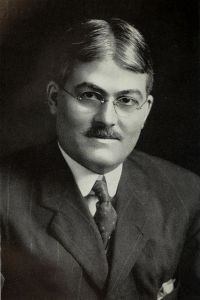
We have a unique situation here at the Ferry Farm Archaeology Lab. One of our volunteers, who has spent hundreds of hours washing, sorting and labeling excavated artifacts, is oddly enough, also partially responsible for creating some of those artifacts in the first place!
Robert Bailey
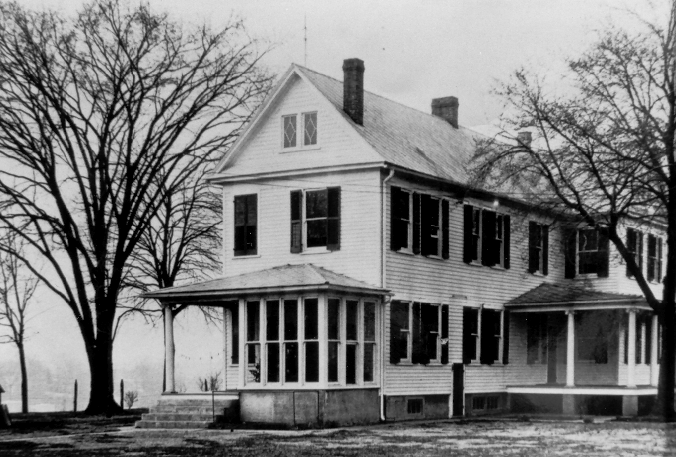
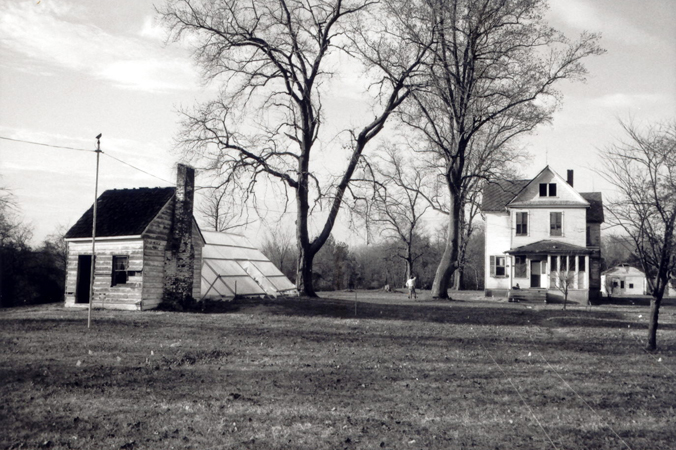
Robert Bailey, his father Ray, mother Peggy and older brother Ray Jr., lived here at Ferry Farm from the late spring of 1957 until August of 1959. His parents rented what was referred to as the “Colbert house,” a large three-story home built in 1914 by James Colbert, a farmer and businessman.
Colbert House
Robert was only five years old when he moved to Ferry Farm. He vividly remembers playing in the many barns, running through the fields and woods that surrounded the farmhouse, and swimming in the stream that runs alongside the historic Ferry Road on hot summer days. He and his brother also showed visitors stopping to see George Washington’s boyhood home around the property and invited them to sign the guest book located inside the small late 19th century building called the Surveyor’s Shed.
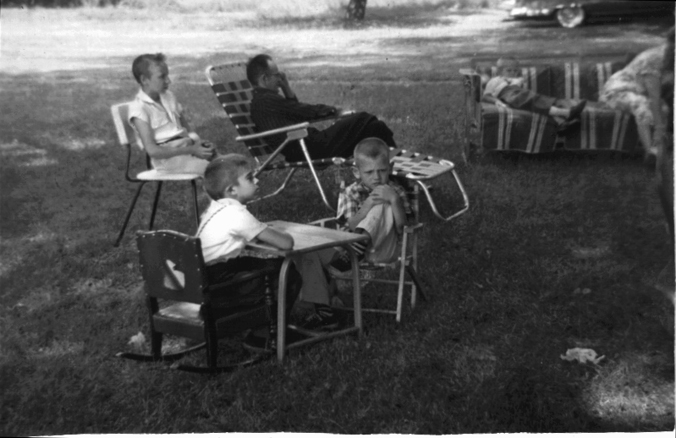
Robert as a child (foreground left in the rocker) in the Colbert House back yard.
He also remembers playing with lots of toys typical of the time, most notably glass marbles, plastic army men, toy cars and trucks, and especially a new toy called Play Doh, a wallpaper cleaner compound that had just been reinvented as a moldable clay product for children.
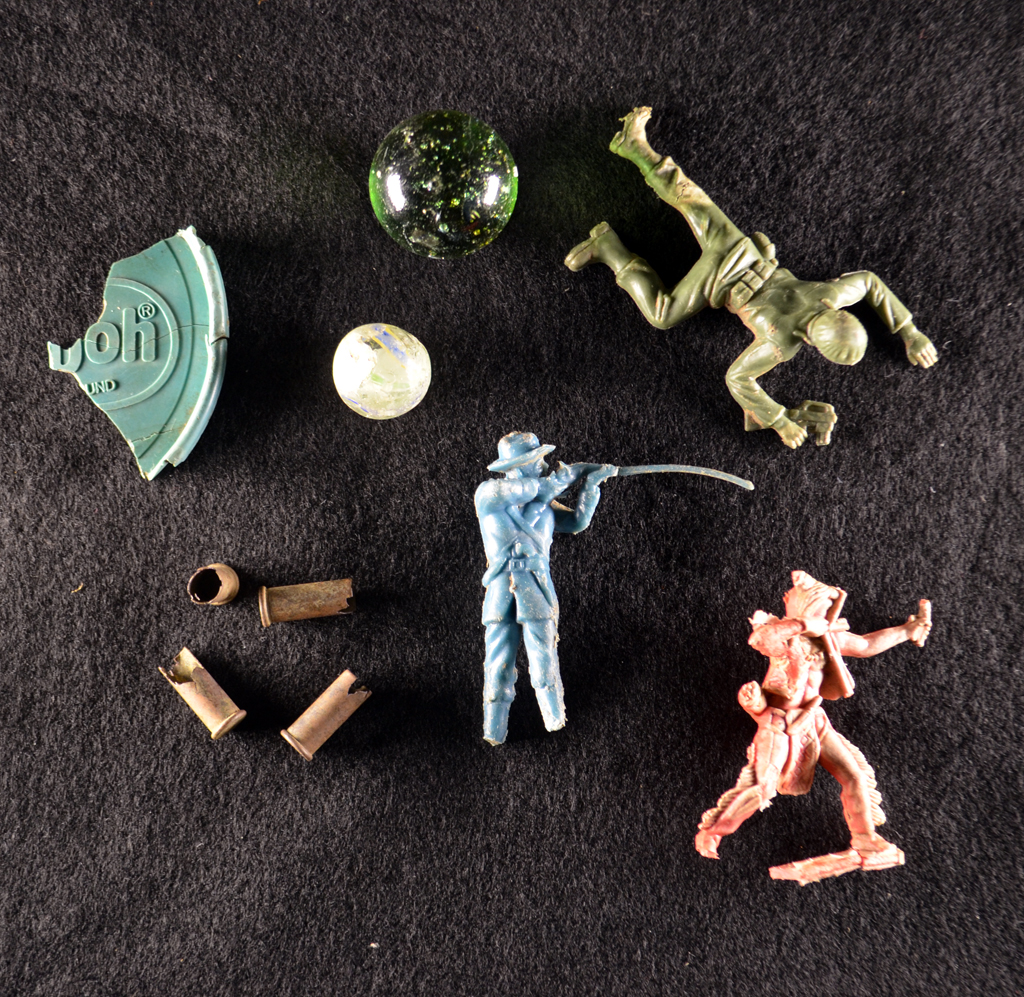
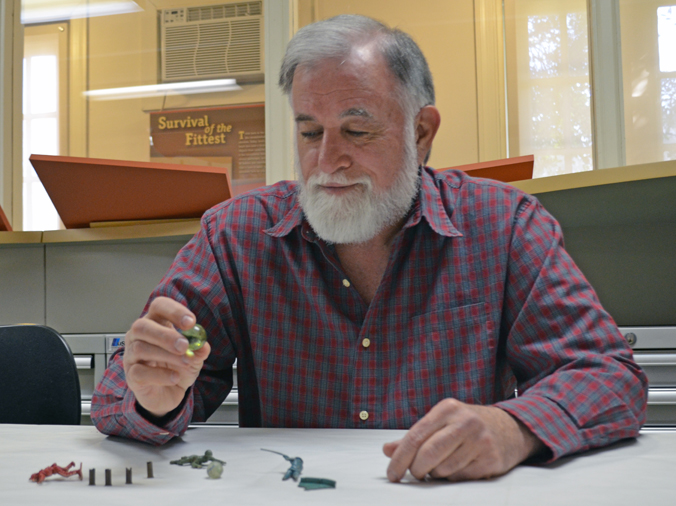
Collection of 20th century items excavated at Ferry Farm. Clockwise from left: portion of a Playdoh canister lid, marbles including a large green shooter, green plastic army man, red plastic Indian, blue plastic Civil War soldier, four .22 caliber shelling casings.
Over 800 toy-related artifacts have been excavated and catalogued in our artifact database. As a collection, these toys span all time periods, from colonial clay marbles, to Civil War-era dice, to a Cold War-era Sputnik ring, and most recently, Dora the Explorer sunglasses! We have also catalogued fragments of bicycle parts, dominoes, board game pieces, dolls, plastic figurines, toy guns and planes, toy cars and trucks, and dishes and tea sets.
Of course, Robert and his brother were not the only children who lived on or visited this site. Other children lived in the Colbert house before and after the Baileys resided there, and hundreds have visited the site on field trips and for special events, such as our annual Fourth of July celebration.
Robert cannot say with any certainty that any of the marbles he has washed in the lab once belonged to him, but the conversations that those marbles start are an important part of the oral and archaeological history of the site. Robert Bailey has participated in the Foundation’s oral history program with a detailed accounting of his memories of the house and grounds. Because he experienced living at Ferry Farm, he can tell us about not only the events and activities his family took part in, but also of the perceptions that visitors to the farm had about the importance of this site as Washington’s boyhood home.
Another vivid childhood memory that often comes to Robert’s mind is of his mother shooting at the black snakes that appeared in and around the house and yard. According to Robert, one day a snake came out of a hole in an old gnarled tree located near the Surveyor’s Shed. His mother dutifully brought out her rifle and proceeded to, as Robert says, “blast away” at the snake. Despite the countless number of bullets expended, she missed and the snake eventually slithered back into its hole.
Surveyor’s Shed in the foreground left with Colbert House in the background right.
While washing artifacts in the wet lab, Robert has come across a lot of .22 shell casings. Just this past week he washed seven. Each time one appears in an artifact bag, Robert chuckles and says “this shell casing might be one that my mom shot at the snake in the tree – and missed!”
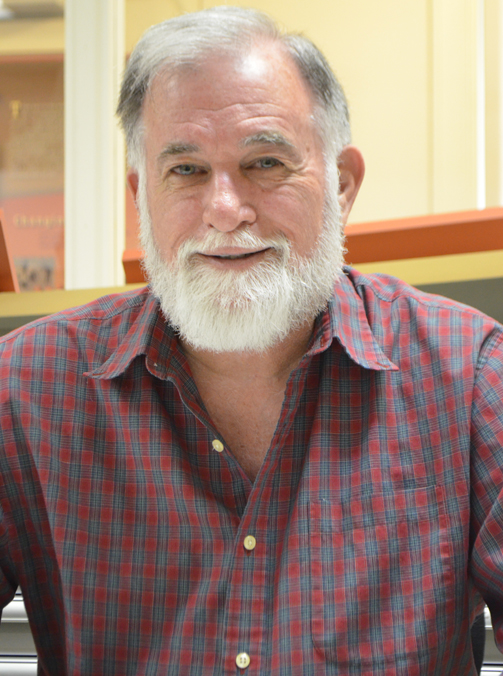
Robert looks over some of the 20th century items excavated at Ferry Farm that, who knows, might have belonged to him in his youth.
Sixty years have passed since the Bailey family first came to live at Ferry Farm, but the past certainly comes full circle and is alive again when Robert empties another artifact bag onto the tray and begins to sort its contents. His connection with our archaeological site provides staff with many opportunities to record and analyze more about Ferry Farm in the 20th century. Robert’s deep commitment to helping preserve George Washington’s boyhood history, combined with his own unique insights, creates a new understanding about Ferry Farm for Robert too.
Robert’s history lies mostly in the topmost soil layers of the site as not enough time has passed to deeply bury his things. Although Robert’s lost marbles and plastic army men are mixed in with excavated toys dropped by other boys and girls, it’s fun to hear him say “I wonder if this was mine?”
March 6, 2017 was the 286th wedding anniversary of Augustine and Mary Ball Washington, George Washington’s amazing parents. In addition to calling to mind how grateful we are for their role in raising the boy who would become our courageous General and first president, this anniversary also provides us with an opportunity to discuss the circumstances of Augustine and Mary’s marriage, their family, and their eventful lives here in Stafford and Spotsylvania Counties.
It was not Augustine Washington’s first time to the altar. His earlier marriage to Jane Butler in 1715 produced four children. Jane was likely 16 when she gave birth to their first son, Butler, who died in infancy. Butler was followed by Lawrence (b. 1718), Augustine Jr. (b. 1719 or 1720), and Jane (b. 1722). Their mother tragically passed away in 1729 just shy of her thirtieth birthday. This left young Lawrence (about 11 years old), Augustine Jr. (around ten), and Jane (about seven) without a mother. Their devoted father immediately began a judicious search for a proper wife for himself, a nurturing mother for his children, and an experienced household manager.
He discovered such a gem in the Northern Neck’s attractive and highly eligible maiden, Mary Ball. Mary’s family had thrived in the Virginia Colony’s tidewater region for generations. Mary gained valuable experience managing property from her mother, Mary Johnson Ball who oversaw the family’s substantial resources after the death of Mary’s father Joseph Ball when Mary was only three years old. Mary’s mother again wed, and was soon widowed with additional resources to manage, thanks to the generosity of her devoted husband. When Mary was only 13, her mother passed away, and Mary joined the household of her older, half-sister Elizabeth Johnson. Thereafter, childbirth and childrearing became second nature to Mary who, as a loving aunt, gained valuable experience helping to nurture her sister’s children and perfecting the lessons in household management first learned under her mother’s tutelage.
When it came to matrimony, anxious parents typically steered their children toward appropriate choices, especially among established and propertied clans as the Washington and Ball families. But death had robbed both Augustine and Mary of their respective parents and their wisdom. Some claim that Colonel George Eskridge, a prominent Northern Neck Lawyer and family friend, helped bring this destined pair together. While a parent’s concerns provided some guidance for young lovers, it was only one of several considerations for eager suitors. Ideally, the opportunity for social advancement, acquiring property (both land and enslaved labor), financial security, and – of course – affection were also carefully weighed.
Mistress Mary Ball rang all of these “bells:” She was experienced with children. She had been tutored in plantation management and household skills by her experienced mother. Mary Ball’s generous and enviable dowry had accumulated to include 1000 acres of Virginia land, enslaved laborers, horses, cattle, and sundry personal belongings. Notably, the majority of her acreage bordered Augustine Washington’s iron mine in Accokeek, just one of Mary’s assets that Augustine found irresistible.
On March 6, 1731, the pair joined. Mary was about 23 and her new husband Augustine was 37. Of Augustine’s three living children from his first marriage, Lawrence, Augustine Jr., and Jane, it was Jane who remained a daily part of their Westmoreland Plantation home. Mary continued the household training that young Jane started learning from her own mother. Lawrence and Augustine Jr. continued their education at the Appleby Grammar school in England where their father had attended school.
Before their first wedding anniversary, Mary and Augustine welcomed their first son, George, into the world. He was born on February 11, 1731 (Old Style) in Westmoreland County. In all, their happy marriage produced six children: George (1732), Betty (1733), Samuel (1734), John Augustine (1736), Charles (1738), and Mildred (1740). All but little Mildred survived to adulthood.
Just twelve years after their wedding, Augustine Washington passed away around the age of 48. Mary remained a widow throughout her long life, focused upon raising their children, and later playing an active and cherished role in the rearing and education of her grandchildren. Mary moved into the town of Fredericksburg in the spring of 1772, within easy walking distance of her daughter Betty’s household, headed by Fielding Lewis and known today as Kenmore. She was remembered fondly by her grandchildren and, at her request, was buried near Meditation Rock in Fredericksburg, Virginia.
Laura Galke, Archaeologist
Site Director/Small Finds Analyst
With one sister and three brothers, George Washington was uncle to numerous nieces and nephews. One niece was Harriot Washington was born sometime in 1776 to his brother Samuel and Samuel’s fourth wife Ann Steptoe. Harriot was orphaned by the time she was five years old, when her mother died in 1777 and her father in 1781. Harriot’s younger years were a hard life of shuffling between relatives’ households. She gained stability with her aunt Betty Lewis at Kenmore, where she spent her teenage years. Both George and Betty were constantly concerned about her financial well-being and development into a respectable woman of the gentry class.[1]
HARRIOT AT MOUNT VERNON, Late 1780s-1792
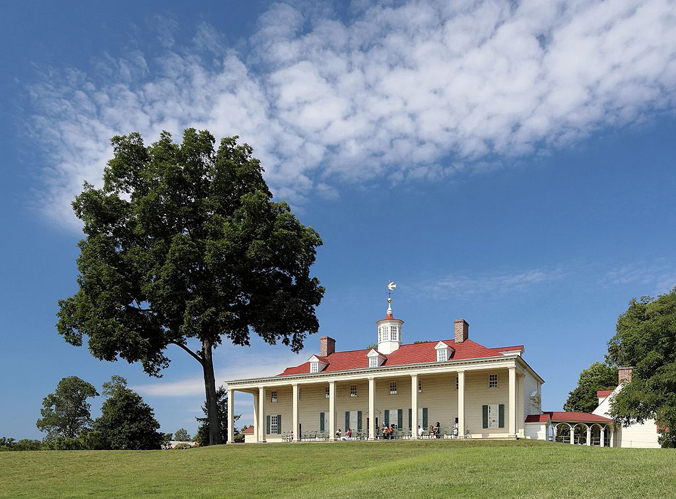
Mount Vernon. Credit: Wikipedia/Martin Falbisoner
After her parents’ deaths and living in the care of her mother’s relatives for four or five years, Harriot came to live with uncle George at Mount Vernon because, as Washington noted to nephew George Augustine Washington, he knew of “no resource that Harriot has for Supplies but from me.”
When George and Martha departed Mount Vernon for New York City and his presidency, however, Martha’s niece Fanny became Harriot’s de facto guardian. Washington lamented to Tobias Lear that Fanny was “little fitted” to the task of caring for her, however. The new president seemed perplexed by Harriot “who is almost grown” but “is not quite a Woman” and wondered, with some exasperation, about what to do with her. He judged that, while she was by no means too old to attend boarding school, any such school would have to “enforce good rules” since Harriot was “prone to idleness” and had been “under no control.”
Several letters between Harriot and her uncle survive. The first in the record was written on April 2, 1790. Harriot was 14-years-old and living at Mount Vernon while Washington was in New York. Harriot asked her uncle to send her a guitar since she wanted to take lessons for “all the young Ladyes are a learning musick.” Harriot was confident “that five or six lessons would be sufficient for any body to learn.” The records consulted reveal no response from Washington.
Harriot wrote a brief letter on October 24, 1791 with short comments about the dreadful weather and an illness plaguing Lund Washington. Harriot mentioned that she had waited until the last minute to write the letter before it had to be sent. This seeming laziness displeased Washington and, worried about his niece’s idle behavior, he took the opportunity to provide a lengthy letter of advice beyond admonishing her to not wait until the last moment to begin a task. He warned Harriot of the…
“delicacy and danger of that period, to which you are now arrived under peculiar circumstances—You are just entering into the state of womanhood without the watchful eye of a Mother to admonish, or the protecting aid of a Father to advise and defend you; you may not be sensible that you are at this moment about to be stamped with that character which will adhere to you through life.”
Washington assured Harriot that her cousins at Mount Vernon were “well qualified to give you advice” and he hoped that she was “disposed to receive it.” If she was “disobliging—self willed and untowardly,” however, her cousins would not “engage themselves in unpleasant disputes” but would likely leave her to descend into poor character. Washington encouraged her to “Think then to what dangers a giddy girl of 15 or 16 must be exposed in circumstances like these—To be under but little or no controul may be pleasing to a mind that does not reflect, but this pleasure cannot be of long duration.” Washington seemed to express concern about those with whom she was associating and that from them she “can derive nothing that is good.” This warning might have also been a general caution against keeping poor company. Regardless, he wanted her to “aid to your Cousin in the domestic concerns of the family.”
Harriot replied, “I was very sensible, of your kindness in giving me such good advice, and shall try to profit, by it as much as I can, I know very well, the obligations I am under, to you and I am very thankful for your care and attention to me.” She duly promised to assist more with the household duties. On May 28, 1792, Harriot requested a guitar again and this time, Washington bought her one for $17.
HARRIOT AT KENMORE, 1792-1795
Portrait of Betty Washington Lewis by John Wollaston, c. 1755.
In the fall of 1792, Washington determined it was necessary for Harriot to go live with his sister Betty Washington Lewis in Fredericksburg. He and Martha were to return to the new national capital of Philadelphia while Fanny and her ill husband were leaving for New Kent County. No one was left at Mount Vernon to care for Harriot.
Betty raised no objections to taking in Harriot “if she comes well cloath’d or Provided to get them, that she may appear tolerable.” She wanted to forestall any chance that the young lady “was prevented frequently from appearing in publick.” Betty reminded George of the Lewis family’s deep financial difficulties and that her grandchildren were living with her too.
Washington assured his sister that Harriot would arrive “very well provided with every thing proper for a girl in her situation.” He judged Harriot as having “sense enough, but no disposition to industry nor to be careful of her Cloaths.” He hoped Betty’s example and guidance would end the 16-year-old’s habit of always wearing her best things while also leaving clothing lying all over her room. Fanny had been too lenient with her, Washington suggested, but Betty’s firm hand could still yet “make a fine woman.”
Not long after getting settled in Fredericksburg, however, Harriot requested money from Washington for a dress or dress material so that she could attend the town’s ball celebrating the president’s birthday. She apologized for again troubling Washington and assured him that any money sent would be kept by Betty. Harriot promised to “properly care for the new dress.
At the end of January 1793, Betty confirmed receiving money sent by Washington for Harriot. She noted that living in town was “unfortunate” for Harriot “for many [of her] things that could be wore to the last string in a [country] Place, will not do here, where we see so much Company.” Betty took the opportunity to praise Harriot as well, noting that she “Payes the strictest regard to the advice I give her and really she is very Ingenious in makeing her Clothes and altering them to the best advantage.”
Time and a few other letters about money passed back and forth until September 1793 when Betty sent a letter to her brother asking when he might send for Harriot so that she could again live at Mount Vernon. Betty revealed that, while she knew “of none that I would sooner have to live with me,” her own dire financial situation was not conducive to Harriot staying. Betty expressed dismay over the small amount of her income and the small number of servants she had. To compound matters, she now only owned two horses, which kept her from visiting over any lengthy distance. All the while, Harriot and two grandchildren lived with her.
Washington perhaps agreed that the time had come for Harriot’s return to his household. It seems he told Betty that if Philadelphia’s yellow fever epidemic continued, Martha would spend the winter of 1793-94 away from danger at Mount Vernon. If this were the case, he would send for Harriot and she could stay with Martha. This plan, however, was not implemented. Instead, Harriot spent part of the winter of 1793-94 with a relative in Culpeper.
As Kenmore, life for Harriot seemed to settle into something of a routine. Her letters reveal a growing maturity and an understanding of her situation. Money was still an ever present matter but one gets the impression that her requests were for real needs. In 1794, requests for cash went to Washington on May 25, and June 27. A letter of thanks from Harriot to him is dated July 10. One further request for money came on January 4, 1795.
Betty and Harriot left Kenmore to live at Millbrook in November 1795. Harriot turned 19-years-old that year and the focus of her relationship with both her aunt and uncle shifted from an orphan girl who had lived a “hard knock life” to a eligible and mature young woman with a respectable suitor and marriage on the horizon.
To be continued….
Zac Cunningham
Manager of Educational Programs
[1] ; Frank E. Grizzard, Jr., “Washington, Samuel, (1734-1781),” George! A Guide to All Things Washington, Charlottesville, VA: Mariner Publishing, 2005, 337-338; Note accompanying “To George Washington from Harriot Washington, 2 April 1790,” Founders Online, National Archives, http://founders.archives.gov/documents/Washington/05-05-02-0199; “Samuel Washington,” Wikipedia,http://en.wikipedia.org/wiki/Samuel_Washington, [accessed September 8, 2014].
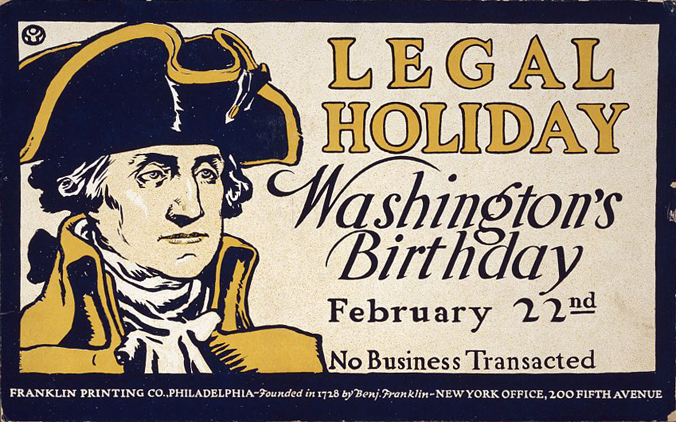
A poster from the late 1800s announcing that no business will be conducted on Washington’s Birthday, which was then celebrated on his actual birth date of February 22. Credit: Library of Congress
Happy Birthday, George!! Two-hundred and eighty five years ago today on February 22, 1732, George Washington was born. Americans have commemorating his birth and his life for centuries, since he rose to prominence as the commanding general of the Continental Army and the nation’s very first president. For centuries, his likeness has been added to plates, glasses, and bottles, carved in stone, etched on coins, used in advertisements, and printed on clothing to create unique memorabilia celebrating the man who was eulogized as “First in war, first in peace, and first in the hearts of his countrymen.”
The 1932 celebration of Washington’s 200th birthday especially led to increased demand for Washington memorabilia. The George Washington Foundation has a small collection of both this bicentennial and a few commemorative objects from even earlier. To mark George’s birthday in 2017, Lives & Legacies shares photographs of this memorabilia!
Amber glass hatchet from either the 1893 Chicago World’s Fair or the 1904 St. Louis World’s Fair. Made by the Libbey Glass Company at the World’s Fair Libbey Glass Demonstration Furnace where visitors could observe glass manufacture and then purchase the glass hatchets. They came in other colors such as opaque white, amethyst, green, and cobalt blue.
Medal featuring a right-facing bust of Washington that was awarded by the New York State George Washington Bicentennial Commission “in appreciation of Services generously Rendered to the Commission During 1932.” The accompanying card is signed by Charles Tobin, the commission’s chairman.
A pin dating from around 1900 that features a portrait of George Washington from the chest up and wearing a red coat. The image is printed on paper or fabric and is covered by celluloid, with a metal, goldtone rim. The pin could be attached to a piece of clothing and has a bar for hanging a ribbon or pendant. The Washington image of has “PAT. W.& H. CO. / NEWARK, N.J.” printed on either side.
A Washington Bicentenary Memorial Plate from 1932 made by Crown Ducal in Stoke-on-Trent, England. This ceramic plate with blue transfer-print was part of a series of 12 to commemorate the 200th anniversary of Washington’s birth. It imagines General Washington and Mary, his mother, strolling through a romanticized rural landscape.
A clear glass bottle from 1932 made by the Owens-Illinois Glass Company of Huntington, West Virginia. One side is a crude embossed profile of a Washington bust while the other side has embossed depiction of a cherry tree with the dates “1732” and “1932” on a scroll beneath.
A commemorative plate from 1932 with an elaborate floral gilded border and a transfer-printed bust of George Washington in the center and made by the Capital Souvenir Company.
A commemorative porcelain tray depicting George Washington, Martha Washington, and Mount Vernon. The vignettes were transfer-printed first and then hand-painted to add details. At the bottom of the Mount Vernon vignette is printed “Washington’s Home / Mount Vernon, Va.” The tray was made by Tressemann & Vogt in Germany between 1891 and 1907.
A green water bottle with a likeness of George Washington under the word “water.” The bottle reads “Washington / Bicentennial” with the dates 1732 and 1932 on either side. It was made by the Hemingray Glass Company in Muncie, Indiana.
Every February, Presidents’ Day weekend is a celebratory one at George Washington’s Ferry Farm! As always this year, George’s boyhood home marked his birthday on Saturday, February 18 and then held Archaeology Day on Monday, February 20. Here are some photos from both days.
Cake!
A selfie with George.
Making a birthday card for George.
Playing hoops.
Catching the Graces hoop.
George, one of The Washington Nationals’ Racing Presidents, stopped by the celebration.
Visitors lined up for the Stone Throw Challenge.
Trying to get that rock across the river.
Archaeology Dig Site tour with Laura Galke.
Laura talks about all the wig curlers that have been excavated at Ferry Farm.
Chatting with George (Greg Fisher).
John Jeanes, project manager for the Washington house construction, discusses the project with visitors.
Muraca the Magnificent (Dave Muraca, director of archaeology) glues an ‘artifact’ together with some much needed help.
Visitors learning how 18th century glues worked.
Theater scene in which a modern-day archaeologist travels back in time to question a Civil War soldier about his toothbrush.
Over the past several weeks, following the timber framing and while the shingling of the roof was taking place, The George Washington Foundation’s carpenters Steve Chronister, Tom Rainey, and Josh Schwenk installed the Washington house windows and the beaded weatherboard, enclosing the house and shifting most of the work from the exterior to the interior.
Read “Washington house replica rises on riverbank” from the past Wednesday’s edition of The Free Lance-Star and plan to attend George Washington’s Birthday Celebration tomorrow and Archaeology Day on Monday to see all the latest progress on the Washington house replica! Visit ferryfarm.org/events for event details.
Before the windows and weatherboard were installed.
Where the first window frame will go.
Carpenter Josh Schwenk notches out a timber where the frame will rest.
One frame installed and the next one ready to go.
Glass waiting to be installed in the frames.
View from inside the house through one of the windows down to the river.
View from inside through one of the windows on the house’s south side.
North side of the house receives its weatherboard.
A closer view of the weatherboard and a line of hand-forged nails.
Close up of a hand-forged nail.
Carpenter Tom Rainey hammers a nail into the weatherboard.
Nail head in the weatherboard.
Completed weatherboard on the house’s north side.
Weatherboard and the decorative rake board at the base of the roof beaded with dew.
Eventually, the house will be painted this color known as “Spanish brown.”
After all the windows and weatherboard were installed.
Parents, perhaps hoping to spur their offspring to similar greatness, have named their children George Washington ever since the most famous George Washington rose to prominence as commander of the Continental Army and the nation’s first president. Few other George Washingtons ultimately achieved the original’s stature, although a few perhaps came close. As we mark George Washington’s birth this month (Come to our Washington’s Birthday celebration at Ferry Farm this Saturday!), we share the compelling stories of five notable Americans named George Washington.
George Washington Vanderbilt II Credit: Wikipedia/Biltmore Co.
George Washington Vanderbilt II was born in 1862 into New York’s wealthy Vanderbilt family. At the age of 27, he began buying vast tracts of land near Asheville, North Carolina. He loved the mountains and wanted to build a grand home among the Blue Ridge. Working with architect Richard Morris Hunt, Vanderbilt planned the house and oversaw construction of the $3,000,000 mansion. He named the home and estate “Biltmore.” Vanderbilt used his vast acreage to help to pioneer scientific forestry and began a forestry school on his estate. His first superintendent of forests was Gifford Pinchot, who became the first chief of the U.S. Forest Service. Vanderbilt died in 1914 in Washington, DC.[1]
The Biltmore Estate near Asheville, North Carolina. Credit: Wikipedia
George Washington Gale Ferris, Jr. Credit: Wikipedia
George Washington Gale Ferris, Jr. was born in Galesberg, Illinois in 1859. He studied engineering at Rensselaer Polytechnic Institute in New York. He worked for a series of railroad and mining companies in West Virginia before focusing on bridge-building and structural steel construction. He started G.W.G. Ferris & Company in Pittsburgh and helped build bridges across the Ohio River in that city as well as in Wheeling and Cincinnati. For the Chicago World’s Fair in 1893, he designed the Ferris Wheel. “Rising 250 feet above the Midway, carrying thirty-six cars, each with a capacity of some forty passengers, revolving under perfect control, and stable against the strongest winds from Lake Michigan, it excited general attention.” He died in Pittsburgh in 1896.[2]
The Ferris Wheel at the 1893 Chicago World’s Fair. Credit: Wikipedia/New York Times
George Washington De Long was born in New York City in 1844. An American naval officer, he organized and commanded an attempt to reach the North Pole via the Bering Strait. His expedition left San Francisco aboard the Jeanette, a coal-burning steamer also equipped with sails, on July 8, 1879. The Jeanette became trapped in the ice for 22 months before being crushed and forcing the crew to abandon ship. The crew took to three lifeboats. One was lost, one made it to shore but all of its crew died of starvation and exhaustion, and one made it to shore where its crew was rescued. De Long did not survive, dying in Siberia on October 30, 1881. Three years later, debris from the Jeanette was found nearly 3,000 miles away off Greenland’s coast, proving the polar ice was in motion.[3]
George Washington Crile was born in Ohio in 1864. He received his M.D. from what is known today as Case Western Reserve University School of Medicine. He was a leading pioneer in surgical medicine during the first half of the 20th century. He dedicated much of his wide-ranging and groundbreaking career to studying the impact of shock on patients undergoing surgery and to developing pioneering ways to treat and combat that shock. He advocated for monitoring blood pressure during surgery and, most importantly, recognized the most effective way to stave off shock was through blood transfusions during operations. He is credited with performing the first direct blood transfusion. Surgical shock’s worst outcome was death so Crile developed resuscitation methods and, in the process, discovered the brain could be deprived of oxygen for only a very few minutes before resuscitation become impossible. In 1921, he and several colleagues founded the Cleveland Clinic, considered one of the world’s foremost medical centers. Furthermore, a pressure suit he developed to prevent surgical shock was adapted to prevent blackout in pilots during World War II. He died in Cleveland in January 1943.[4]
George Washington Carver Credit: Wikipedia/Tuskegee University Archives
George Washington Carver was born a slave in Missouri in the early 1860s. He attended a series of schools in Kansas and Missouri and graduated from Minneapolis High School in Minneapolis, Kansas. He was rejected from one college because of his race but became the first black student at Iowa State Agricultural College, where he received both his bachelor’s and master’s degrees. In 1896, Booker T. Washington hired Carver to chair the agricultural department at the Tuskegee Institute, where he remained for half-a-century. As a agricultural scientist, Carver created methods to revive soil exhausted from planting only cotton year after year. These methods centered on rotating cotton with sweet potatoes, peanuts, soybeans, and cowpeas, which restored nitrogen in the soil and provided income for farmers as well. He trained farmers to grow these alternative crops and distributed recipes using these crops to the public to spur demand. His efforts to promote the peanut especially sparked the public’s imagination. He died on January 5, 1942 in Tuskegee, Alabama.[5]
Zac Cunningham
Manager of Educational Programs
[1] “George Washington Vanderbilt.” Dictionary of American Biography, Charles Scribner’s Sons, 1936. Biography in Context, link.galegroup.com/apps/doc/BT2310001556/BIC1?u=crrl&xid=3822e021. Accessed 9 Feb. 2017.
[2] “George Washington Gale Ferris.” Dictionary of American Biography, Charles Scribner’s Sons, 1936. Biography in Context, link.galegroup.com/apps/doc/BT2310013691/BIC1?u=crrl&xid=3144ffeb. Accessed 9 Feb. 2017.
[3] “George Washington De Long.” Explorers & Discoverers of the World, Gale, 1993. Biography in Context, link.galegroup.com/apps/doc/K1614000095/BIC1?u=crrl&xid=e0125245. Accessed 9 Feb. 2017.
[4] “George Washington Crile.” Dictionary of American Biography, Charles Scribner’s Sons, 1973. Biography in Context, link.galegroup.com/apps/doc/BT2310015367/BIC1?u=crrl&xid=8dcc7fd9. Accessed 10 Feb. 2017.
[5] “George Washington Carver.” Contemporary Black Biography, vol. 4, Gale, 1993. Biography in Context, link.galegroup.com/apps/doc/K1606000443/BIC1?u=crrl&xid=3bdf1f8b. Accessed 10 Feb. 2017.
The timber framing of the Washington house is complete. In this video, we get a close-up view of the construction of the house’s timber frame. For a timelapse view of the timber framing, watch this video. To see how the beams in the frame were fashioned, watch this video.
Learn more about the Washington House here and view other videos, photos, and blog posts about the project here.
This past autumn, workers from Peter Post Restorations lead by Peter himself added the shingles to the roof of the Washington house at Ferry Farm. The handmade riven shingles were sawn from a tree trunk, smoothed on one side, and decoratively scalloped. Because they were handmade, each shingle was a different width. The roofers laid the shingles in a pattern to compensate for the different sizes and then nailed them into place.
The most challenging aspect of roofing the Washington house was shingling where the roof met the dormers. In the 18th century, roofers curved the wood from the roof to the dormers creating “swept valleys” that are gorgeous examples of historic craftsmanship.
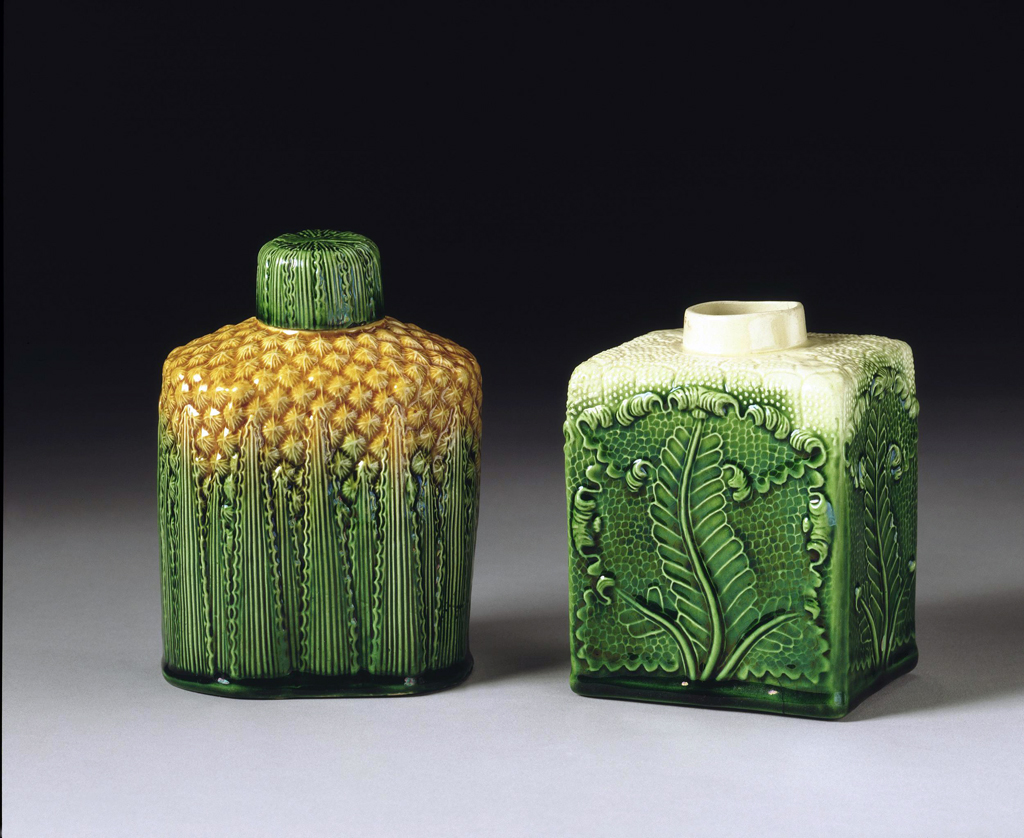
Fads come and go. Such is life. Eighteenth century colonists were not immune to flash-in-the-pan trends. However, given that information traveled a bit slower before the digital age, in the 18th century a ‘quick trend’ may have lasted 10 or 20 years, instead of 10 or 20 months. Such is the case with ‘vegetable ware’, a refined earthenware molded to look like produce. Imagine being the envy of all your colonial neighbors if you served them tea out of an elaborate ceramic cauliflower, pineapple, melon, or cabbage. As evidenced by the archaeological record, Mary Washington, George’ mother, was similarly taken with the prospect of displaying her very own veggie-themed teaware.
The advent of vegetable ware seems to coincide with the development of bright green and yellow pottery glazes by a young and upcoming potter named Josiah Wedgwood in 1760. He used these new flashy glazes for a number of applications, including coloring teaware molded to resemble produce. While some combinations of ceramics and decorations had previously enjoyed decades or even centuries of popularity in the past, the demand for the initially popular vegetable ware seemed to drop off after only ten years, around 1770. At that time, Wedgewood indicated he was glad to send a shipment of overstocked vegetable ware to the colonies – a popular dumping ground for out of fashion or slightly damaged English goods.
Mary seemed to prefer the pineapple form and owned at least one item, if not more, of this fruit-shaped tea equipage. Her preference for the tropical fruit design was not unique. In the 18th century, the pineapple was an incredibly sought after luxury item loaded with symbolism. Today, many of us, especially along the East Coast, associate the pineapple with welcoming guests into our home and as a decoration for the holidays. Colonial Americans considered it a Christian symbol as well as a display of status. They readily incorporated it into the architecture of their houses, decorated room interiors with the motif, and served food and beverages out of pineapple-shaped objects. These were all cheaper options than displaying an actual pineapple, which was well outside the price range of the average colonial American. In fact, there are accounts of people actually renting a real pineapple for a party rather than purchasing one outright. Rented fruit! Let that sink in for a second.
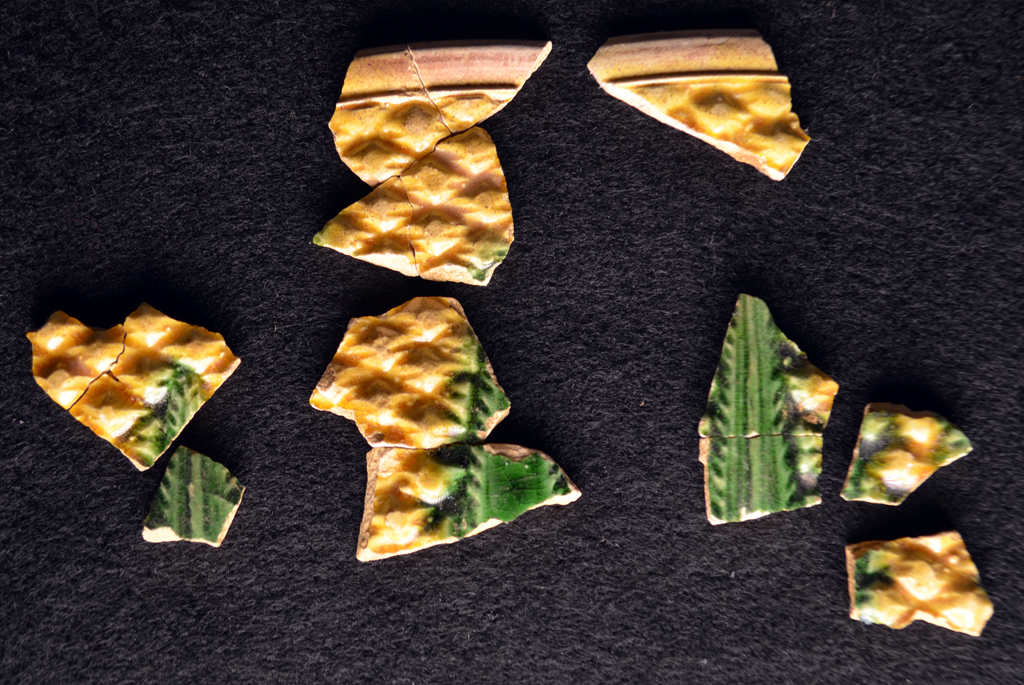
Returning to Mary’s ceramic pineapple, which is represented archaeologically by a dozen or so sherds. It is almost certainly some type of tea equipage, although we are not exactly
Vegetable ware sherds excavated at George Washington’s Ferry Farm.
sure which tea vessel it may be. The pineapple color and texture are unmistakable but we’ve yet to identify the specific object. A number of forms have been ruled out. It is not a tea or coffee pot because it appears to be relatively squat with a straight or very gently sloping body and a wide rim. What’s especially odd about this particular vegetable ware vessel is that the rim is unglazed. This would seem to suggest that it sported a lid of some kind or perhaps endured a defect during firing. Hopefully more of the vessel will come to light, we’ll be able to answer the question, and proudly display pineapple teaware in the newly recreated Washington house!
Mara Kaktins, Archaeologist
Ceramics & Glass Specialist