A carpet was recently installed in the Drawing Room at Historic Kenmore. In this video, Meghan Budinger, Aldrich Director of Curatorial Operations, tells us all about it.
Follow The Rooms at Kenmore blog for more about the drawing room carpet and the final stages of Kenmore’s refurnishing.
In 1996, the Trustees, Regents, and staff of The George Washington Foundation, known then as the Kenmore Association, were part of a large and vocal group of concerned citizens that banded together to save the site of George Washington’s Boyhood Home from commercial development. While all the Washington-era structures, yards, and fences vanished almost 200 years ago, it was critical to preserve this significant place in our nation’s history—where beginning in 1738 young George and his family called home.
After years of meticulous research and planning by historians, architects, archaeologists, and curators, the Foundation is fulfilling that goal. Up to this point Ferry Farm has been an archaeology park known for its grassy fields, beautiful views of the Rappahannock River, large-scale archaeology excavations, and an amazing and extensive collection of Washington artifacts. Today with the beginning of the construction of the interpretive replica of the Washington house and the surrounding landscape Ferry Farm is beginning its transition to an outdoor living museum.
George Washington lived at Ferry Farm from age 6 to around age 22. The Cherry Tree and the Stone Throw legends were set here. He learned to survey, joined the Masonic Lodge, read his first book on military adventurers, copied the Rules of Civility, and petitioned colonial Virginia’s British Governor for his first military office at Ferry Farm. This is the landscape that was formed by the Washingtons and their enslaved workers, and George Washington’s years on this ground were essential to his development into an extraordinary man.
An architectural rendering of front facade of the interpretive replica of the Washington house at Ferry Farm.
Starting with stone masons, who are now working on the site, the construction process involves a succession of skilled artisans, employing a mix of modern and traditional techniques, including brick masons, blacksmiths, carpenters, joiners, plasterers, and painters, who together will produce the rich detail and beauty of a colonial home.
Once the replica house is in place, the Foundation will reconstruct the support buildings, fences, and yards, informed by archaeology and historical research, that surrounded and served the house. To date, we have unearthed remnants of a kitchen, slave quarter, trash yard, work yard, hen yard, and storehouse from the Washington period. As archaeology continues to reveal additional structures and other elements, they will be added to the landscape until we create a place that evokes early Virginia and portrays what life was like for young George Washington. Because the house is a reconstruction, we look forward to presenting colonial America in ways not possible for most historic house museums. We will light fires in the fireplace, open windows, and invite visitors to sit in the chairs. This unique environment will let guests experience eighteenth-century life with all their senses.
Architectural floor plans of the interpretive replica of the Washington house at Ferry Farm.
As Ferry Farm transitions from grassy fields to construction site, please stop in and witness the making of history up close. George Washington’s Boyhood Home in Stafford County, Virginia, is open Monday through Sunday. We invite you to explore Ferry Farm with the self-guided iPad tour, “Uncovering George Washington’s Youth,” or participate in a dynamic educational program relating to archaeology, history, and the natural environment. The Foundation also offers special events and tours at its sister site, Historic Kenmore Plantation in Fredericksburg. You can follow the progress at Ferry Farm on this blog, as well as the Foundation’s Facebook page and website, where we will offer glimpses into eighteenth-century construction techniques and address historical issues. We hope you will visit George Washington’s Ferry Farm soon.
David Muraca
Director of Archaeology
Learn more about building George Washington’s boyhood home in Clint Schemmer’s article, “George Washington Really Did Sleep Here”, on the Fredericksburg Free Lance-Star’s website.
Pulling Down the Statue of King George III, NYC (ca. 1859) by Johannes A. S. Oertel. Painting in the mid-1800s, Oertel created a thrilling but historically inaccurate depiction of New Yorkers destorying a statue of George III after hearing news of the Declaration of Independence. The event did happen but much of Oretel’s painting is fanciful. Public domain. Courtesy: Wikipedia.org
Writing to wife Abigail following Congress’s adoption of the Declaration of Independence, John Adams famously outlined his vision for how future generations would celebrate the historic moment. “I am apt to believe that it will be celebrated, by succeeding Generations, as the great anniversary Festival,” Adams wrote in an oft quoted passage. “It ought to be commemorated, as the Day of Deliverance by solemn Acts of Devotion to God Almighty. It ought to be solemnized with Pomp and Parade, with Shews, Games, Sports, Guns, Bells, Bonfires and Illuminations from one End of this Continent to the other from this Time forward forever more.”
Adams’ prediction was borne out immediately. News of independence spread from Philadelphia across the new American states like a circle of ripples on a great lake. By July 10, 1776, the first word arrived in Fredericksburg, Virginia, hometown of General George Washington and where his mother Mary still lived. Indentured servant John Harrower, who served as tutor for Colonel William Daingerfield’s family at Belvidera plantation about seven miles downstream from Fredericksburg on a bluff overlooking the Rappahannock, recorded the moment in his journal. [1]
“Wednesday 10th. At 6 pm went to Mrs. Battaile’s & teach’d until sunset and then returned home & soon after hea[r]d a great many Guns fired towards Toun. About 12 pm the Colo. Despatc[h]ed Anthy. Frazer there to see what was the cause of [it?] who returned, and informed him that there was great rejoicings in Town on Accott. of the Congress having declared the 13 United Colonys of North America Independent of the Crown of great Britain.”[2]
Young members of the Continental Army recreate a charge during Fourth of July at Ferry Farm!
Some days later, on July 26, when the Declaration was officially read out in Williamsburg, Virginia’s capital, the proclamation was made “amidst the acclimations of the people, accompanied by firing of cannon and musketry, the several regiments of continental troops having been paraded.”
One year later, Adams prediction continued to bear fruit, as the infant nation celebrated its First Birthday. In Charleston, South Carolina, on July 4, 1777 “ringing of bells ushered in the Day” and “At sun-rise American colours were displayed from all the forts and batteries, and vessels in the harbour.” There was a parade of military troops and then “at one o’clock the several forts, beginning at Fort Moultrie on Sullivan’s Island, discharging seventy six pieces of cannon . . . and the militia and artillery fired three general vollies.” The new state’s leaders gave a banquet with thirteen toasts and “double the number [of guests] that ever observed the birthday of the present misguided and unfortunate King of Great Britain.” To end the day-long celebration, “the evening was concluded with illuminations, &c. far exceeding any that had ever been exhibited before.”.
Back north, in Philadelphia, Pennsylvania, ships were also “dressed . . . with the colours of the United States and streamers displayed.” The crews climbed into the rigging and stretched out across the yardarms to salute the day and each ship fired thirteen cannons. On land, a banquet was held for Congress during which “The Hessian band of music taken at Trenton the 26th of December last, attended and heightened the festivity with some fine performances suited to the joyous occasion, while a corps of British deserters, taken into the service of the continent by the State of Georgia, being drawn before the door, filled up the intervals with feux de joie.” A feu de joie, French for “fire of joy”, is the firing of guns into the air in quick succession. It is sometimes described as a “running fire of guns.”. The dinner also included many toasts. The late afternoon featured a parade of military troops and the ringing of bells. “At night there was a grand exhibition of firework, which began and concluded with thirteen rockets.”
After flying for a year over Washington’s boyhood home, one U.S. flag is retired replaced with a new flag during the Patriotic Flag Retirement Ceremony at Ferry Farm’s Fourth of July celebration.
Whether in Virginia in 1776 or South Carolina and Pennsylvania in 1777, all of these acts of celebration were quite traditional and had been used for decades to celebrate the monarch’s birthday each year. In 1727, Willliamsburg marked the king’s birthday.
“The colors were displayed at the Capitol and salvos fired from the cannon at the Palace, at the forts, and on board the king’s ships in Virginia waters at the time. In the evening the Capitol, the Palace, the College, and ‘most of the Gentlemen’s and other House of Note’ were illuminated and bonfires were sometimes set in public squares in the city. At the governor’s dinner the drinking of all the loyal healths consumed a great deal of time, a variety of choice wines and liquors, and a large store of gunpowder. The populace was sometimes treated to ‘plenty of liquor’ and drank the same healths outside the Palace or at one of the taverns. The day’s festivities closed with the governor’s ball for all the ladies and gentlemen in town.” [3]
More than two centuries later, we still celebrate the Fourth of July with decorations of red, white, and blue, ubiquitous American flags, military parades, cannon fire, large amounts of food, the enjoyment of spirited beverages, music, and fireworks. John Adams vision was far-reaching indeed!
Zac Cunningham
Manager of Educational Programs
Celebrate Independence Day where George Washington spent his boyhood years!
See more photos from last year’s Fourth of July at Ferry Farm here.
This year’s theme, “We The People” focuses on The Declaration of Independence with a variety of activities and entertainment for young and old alike. Learn about archaeology at Ferry Farm, enjoy a patriotic flag retirement ceremony,interact with colonial and Civil War re-enactors as well as members of the Patawomeck tribe, listen to patriotic music, and participate in educational programs, crafts and games, and hands-on activities for the whole family. Visit kenmore.org/events.html to learn more.
Cost: $1 per person Parking: Eagles Lodge – 21 Cool Spring Road Fredericksburg, VA 22405 Shuttles will run between the Eagles Lodge and Ferry Farm.
[1] John Harrower, The Journal of John Harrower: An Indentured Servant in the Colony of Virginia, 1773-1776, edited by Edward Miles Riley, Williamsburg, VA: Colonial Williamsburg, 1963: xvi.
Typically, when modern Americans think of summer barbecue food, they think of meat grilled over an open flame. While that would certainly appeal to an eighteenth century audience, it is not necessarily what they considered ‘typical’ summer fare. Large livestock like pigs and cattle were usually slaughtered and butchered in the late fall/early winter when the weather was far more conducive to task. This meant that large roasts (like mentioned in our earlier blog) were not the norm in the warmer months. Instead, people of the 18th century looked to the seasonality of ingredients to inspire their summer time fare.
Eighteenth century diets were very dependent on the growing seasons. Summer was a bounty of fruits, vegetables, greens, herbs, and anything else that could not be had in the dead of winter. Much like today, there were a variety of methods, styles, and recipes used to please the numerous palates.
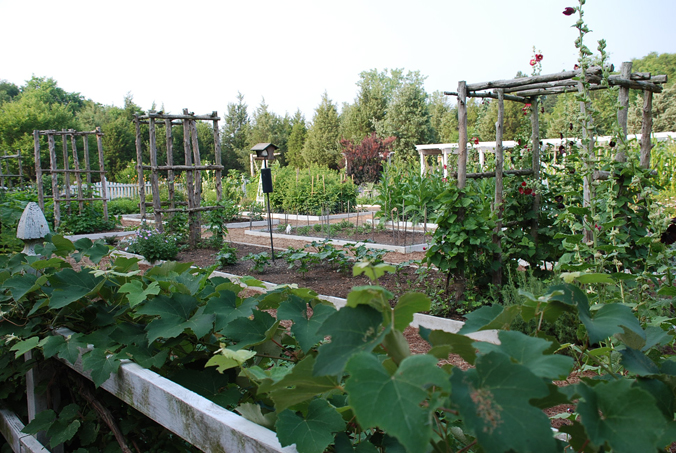
The demonstration garden at George Washington’s Ferry Farm.
With today’s weekend farmers markets and roadside stands, a salad seems the ubiquitous summer option. But what would our forefathers have thought of raw vegetables tossed in oil and vinegar? They certainly had all of the elements available to them but their tastes were different than ours. After all, we still have oysters and ice cream but most of us no longer enjoy oyster ice cream.
While the oldest references to salad come from ancient Rome (usually referred to as sallet) it was not ubiquitous in English summer cuisine. While there are some references in cookbooks and menus of the time that called for ‘salad herbs’ like lettuce and spinach to be served raw, most of their English recipes called for cooking the vegetables in some way.
The modern stereotype of English cooking insists that greens be boiled until no real flavor or texture remains. And while many of 18th century recipes for vegetables include boiling (and some for quite some time) there is also this warning in Hannah Glasse’s The Art of Cookery Made Plain and Easy.
Hannah Glasse cautions her readers not to “over-boil” fresh garden greens.
There was a clear appreciation for fresh vegetables even if they were prepared in some manner. An appreciation that extended into George Washington’s own household. One recipe included in Martha Washington’s cookbook was for a ‘Lettis Tart’ which called for ‘cabbage lettis’ and prunes to be put in a crust with cinnamon and ginger and then baked like a pie.
In addition to recipes calling for fresh fruits and vegetables, early Americans were very familiar with numerous preservation methods in order to enjoy vegetables and fruit out of season. In the summer they would pickle vegetables, dry herbs, and make preserves with fruits so they could enjoy them all year long.
In September 1784, George Washington traveled west of the Allegany Mountains. He recorded some of his supplies in his diary and includeed a canteen filled with ‘Chery Bounce’. This was a drink made from cherries preserved in brandy and was a way for Washington to take the taste of Virginia summer with him on his travels.
Cherries on the cherry trees in the Ferry Farm’s demonstration garden.
This summer when you are contemplating your patriotic picnic options for your July Fourth festivities, don’t pass up the greener options. They have far more in common with the summer options of our founding fathers than you may have originally believed.
Joe Ziarko
Manager of Interpretation & Visitor Services
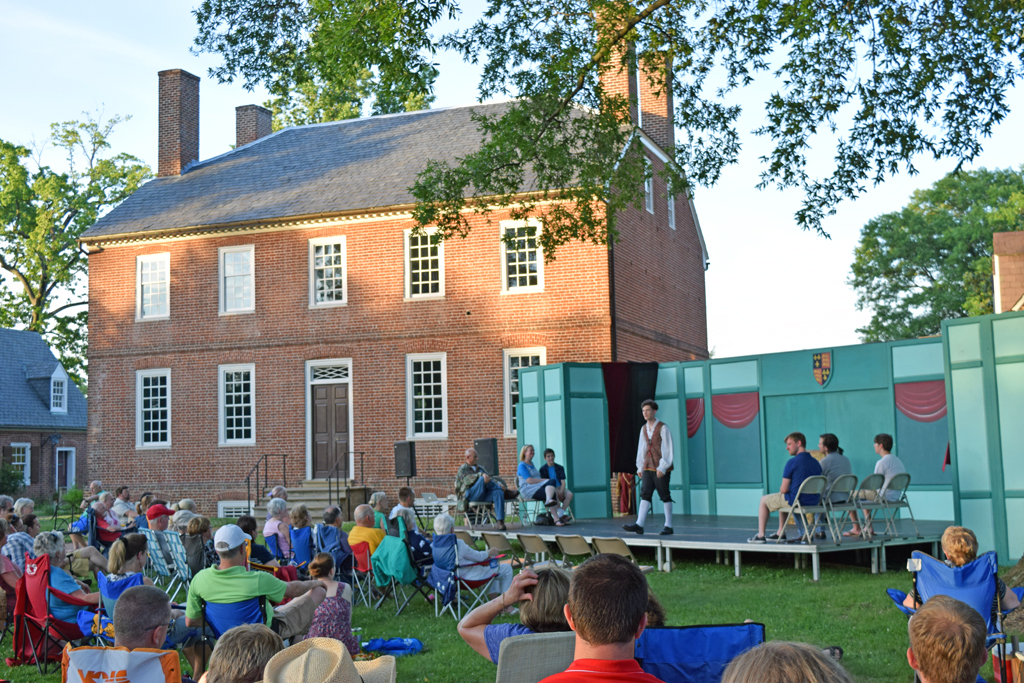
Shakespeare on the Lawn at Historic Kenmore returns this weekend with two more performances of Hamlet. Catch the one of the final shows at 7:00 p.m. on Saturday, June 18 or Sunday, June 19. Arrive early to tour the mansion and view the refurnishing. Bring folding chairs or a blanket and a picnic! Thank you to sponsor Lewis Insurance Associates! Learn more at http://www.kenmore.org/events.html. In the meantime, enjoy these scenes from last weekend’s performances!
In this video, we talk about how people, including George Washington, picnicked in the 18th century and take a closer look at one particular piece of furniture used while on a picnic 200 years ago.
You can read more about picnicking customs of the 1700s here.
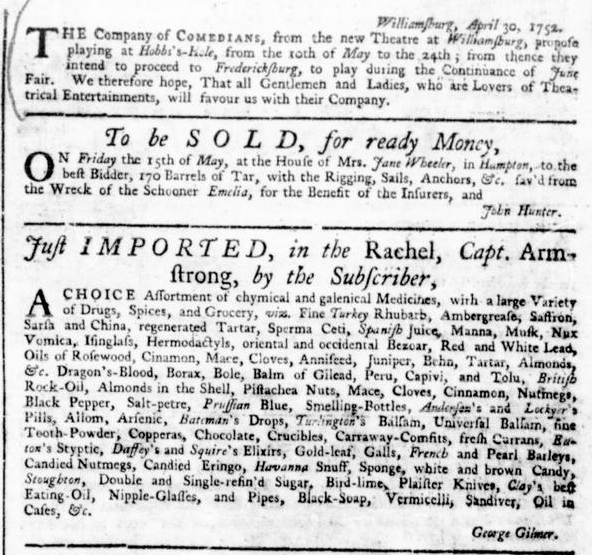
Ask someone to list traditional summertime activities and they will probably mention picnics, family reunions, beach vacations, mountain getaways, and baseball games. Their list is likely to include going to the fair as well. The fair as a summer pastime is a long tradition and like many American traditions can be traced back to the age of Washington.
Although this painting depicts a busy London agricultural market in the early 1700s, a similar hustle and bustle likely filled Fredericksburg during June Fair. Covent Garden (1726) by Pieter Angillis, 1685–1734, Flemish, active in Britain (from ca. 1715), Oil on copper. Pubic domain. Credit: Yale Center for British Art, Paul Mellon Collection.
Fairs were about more than agriculture, however. The importance of a summer fair was its ability to gather people from all over the surrounding counties to a single central location to conduct business and government and to offer social interactions and entertainments. In an agricultural colony such as Virginia, homes and plantations were very distant from one another and, for much of the year, people hardly saw anyone besides their immediate neighbors and family members. Most colonial Virginians traveled no more than fifty miles from home in their lifetimes. This made for an isolated existence focused on the constant attendance of crops. During natural seasonal breaks, however, farmers traveled to a town to sell those crops at the fair.
Fairs were not just for farmers to sell. Court sessions, also known as ‘Public Times’, often coincided with fairs. Soon merchants and entertainers saw opportunity in the large numbers of people gathered together at the fair. Many people got paid or, more likely, an increase in credit and ready money made the fair a natural time to celebrate, entertain, gamble, and socialize.
Among the amusements common to colonial-era fairs,
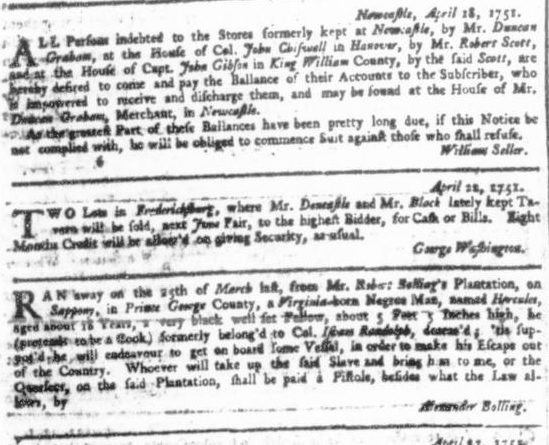
Announcement placed in The Virginia Gazette by George Washington announcing his intention to auction off two lots of his land in Fredericksburg at June Fair in 1751.
Gambling at the fair, mainly in the form of lotteries, even supported more noble pursuits. At June Fair in 1769, a lottery was undertaken to raise £450 for building a new church and for purchasing an organ for that church. The drawing was to take place on “the 7th day of JUNE next (being the first day of the Fredericksburg fair) at the town-house” and was supervised and supported by a host of the town’s luminaries including Charles Dick, Hugh Mercer, Charles Washington (George’s brother), George Weedon, and Fielding Lewis.
June Fair was a community event attended by Virginians from across the colony and brought George Washington back to his boyhood home on more than one occasion. At the fair, Virginians sold farm goods and land, settled debts and tried court cases, enjoyed a play and gambled on the horses. June Fair, much like today’s summer pastimes, was a moment in the year to enjoy the summer weather and the company of neighbors, friends, and family before returning to isolated plantations and farms and the unending work of plowing, planting, and harvest.
Zac Cunningham
Manager of Educational Programs
Joe Ziarko
Manager of Interpretation & Visitor Services
In the summer of 1770, George Washington came to Fredericksburg for an extended stay. His time here would seem familiar to anyone who has gone back to their childhood hometown. While in town he visited his mother, went to the tavern to play cards with old friends, and stayed with his sister and brother-in-law. But the most interesting moment of his stay was on August 4, 1770 when he records…
While it is difficult to understand what exactly he meant by ‘Barbicue’. It is safe to assume that it was a communal meal similar to a modern day cook-out. Going to a cookout, a barbecue or a picnic, in today’s parlance, all mean pretty much the same thing – eating well-known foods while outdoors, probably seated on the ground, in a casual atmosphere. Above all, it is a highly social gathering. We use these kinds of meals to celebrate national holidays, family occasions or just a beautiful day – it’s what Americans do. But where did this past-time come from?
In England, the idea of consuming light fare outdoors in the form of a picnic had been around since as early as 1748, when the word “picnic” first shows up in writing. The word was probably a corruption of the French “pique nique” which basically means “to pick at small foods,” but for the English a picnic meant a fully mobile meal and all the accoutrements necessary to eat it. Baskets of food were packed, equipment for entertainment (games of cricket or maybe some hunting or fishing) was gathered, and wagons were loaded (usually one for guests, and one or more for the provisions). Then, the party set off to a pre-determined picturesque location, where it was all unpacked and set up by servants. Although we might be amazed at the sheer volume of stuff these picnics required (everything from chairs and tables to cutlery and glassware), an 18th century English picnic was still considered a very informal affair by that time’s standards. Guests might even be asked to contribute dishes to the meal (a forerunner of our potlucks), making recipes for picnic food were all the rage by the late 18th century.
This painting shows chairs being provided for the ladies to use during lunch on a fishing trip. The Anglers’ Repast (1789) by George Morland, 1763–1804, British, Oil on canvas. Public domain. Credit: Yale Center for British Art, Paul Mellon Collection.
While picnic’s etymology is relatively easy to trace, ‘Barbecue’ is far more difficult to pin down in the 17th and 18th centuries. Even the term itself is nearly impossible to decipher. The earliest known recording comes from a Spanish explorer in 1526, who used it as a verb meaning to roast meat. In 1672, the first reference in English came from the writings of John Lederer, a German explorer of the Blue Ridge Mountains. Originally written in Latin, Lederer’s expedition reports were translated into English by Maryland’s Governor Sir William Talbot and published.
Many scholars believe the word “barbecue” most likely derives from the West Indian word “barbacoa” in the 16th century. Believed to be a Taino word (although this is still up to scholarly debate), it is a term for slow-roasting meat over hot coals, usually using plenty of green saplings that would have created a lot of smoke. The meat originally roasted in this style was probably not the ubiquitous pork barbecue. While Christopher Columbus did bring some pigs on his voyage, it is Hernando de Soto who is credited with introducing the pig into Central America and Florida in 1539.
The word, and the meat, was probably encountered by ships’ crews during the colonial period and eventually made its way to the American colonies. Slow-roasting meat and spicing it with various rubs and marinades was a familiar concept in a many parts of the world, and especially on the African continent, so enslaved Africans living in the colonies also helped to proliferate the cooking method. As happened with many traditions from around the globe that found their way to the New World, a true “barbecue” as George would know it quickly became a uniquely American concept, combining the English love of a good outdoor meal and the exotic foods and cooking methods of the West Indies and Africa.
While the first American barbecues were practical affairs, held among enslaved communities or farming populations during the slaughtering season so as to quickly cook and preserve as much meat as possible, they very quickly took on a much more social aspect. An entire town might gather for a barbecue, which might last for several days, perhaps to coincide with court days or a market.
Between 1769 and 1774, George Washington recorded his attendance at six such affairs in his diary, including one barbecue that he hosted himself, another that was probably held at Fielding Lewis’s house in Fredericksburg, and a third in Alexandria at which he stayed all night.
Meghan Budinger
Aldrich Director of Curatorial Operations
Joe Ziarko
Manager of Interpretation & Visitor Services
Fielding Lewis by John Wollaston, ca. 1765. This portrait has been in the Kenmore Collection for many decades. It was recently returned to the Drawing Room, where it would have hung when the Lewis family lived in the house 200 years ago. Watch a video of the hanging process here.
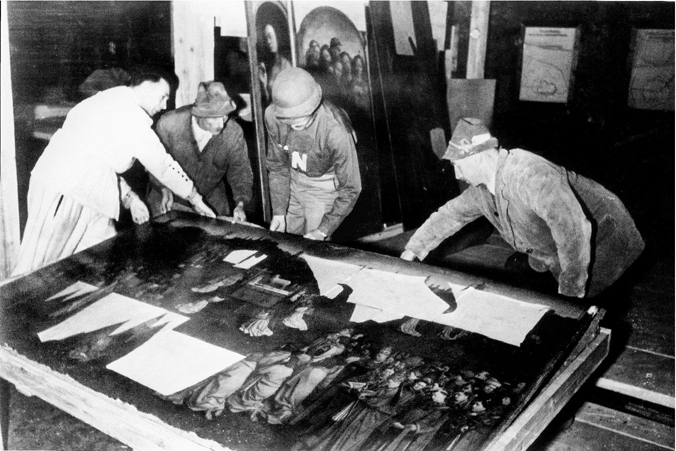
Editor’s Note: This Memorial Day, we again remember ‘The Monuments Men’ and their invaluable work to locate and save European art looted by the Nazis during World War II as well as their continued efforts to conserve and preserve art after the war, including art at Historic Kenmore. This post originally appeared on Lives & Legacies on May 20, 2015.
Recently, while flipping through old files of the Kenmore Association dating back to the 1920s and looking for anything related to our portrait of Fielding Lewis by John Wollaston (ca. 1765), I spotted a familiar name: George Stout. It took me only a moment to realize why the name was familiar. Those of you who read Robert Edsel’s book The Monuments Men: Allied Heroes, Nazi Thieves and the Greatest Treasure Hunt in History or saw the movie The Monuments Men starring George Clooney, Matt Damon, John Goodman, and Bill Murray may also recognize the name.
During World War II, George Stout was a member of the U.S. Army’s Monuments, Fine Arts, and Archives unit, nicknamed the “Monuments Men.” These soldiers volunteered to leave their jobs as curators, historians and conservators to travel the frontlines in Europe, documenting, cataloging and in some cases saving priceless cultural artifacts in harm’s way. Along with serving as a Monuments Man, Stout is widely considered the father of modern methods in art conservation in the museum world. He’s kind of a rock star to all of us who work in museums, as are all of the Monuments Men. It is not often that curators get to be the hero, but those men were.
Lieutenant George Stout, U.S. First Army and U.S. Twelfth Army Group. Age: 47. Born: Winterset, Iowa. A towering figure in the then obscure field of art conservation, Stout was one of the first people in America to understand the Nazi threat to the cultural patrimony of Europe and pushed the museum community and the army toward establishing a professional art conservation corps. As a field officer, he was the go-to expert for all the other Monuments Men in northern Europe and their indispensable role model and friend. Dapper and well-mannered, with a fastidiousness and thoroughness that shone in the field, Stout, a veteran of World War I, left behind a wife, Margie, and a young son. His oldest son served in the U.S. Navy. From the Walter Hancock Collection courtesy of the Monuments Men Foundation.ALTAUSSEE, AUSTRIA – JULY 10, 1945: Removal of priceless works of art from the salt mine at Alt Aussee posed problems for Monuments Man George Stout unlike any ever contemplated. Stout constructed a pulley to lift Michelangelo’s Bruges Madonna onto the salt cart to begin its long trip home to Belgium. Visible on the far left is Monuments Man Steve Kovalyak, an expert in packing art, who was a key assistant to Stout. National Gallery of Art photo courtesy of the Monuments Men Foundation.
After the war, many of the Monuments Men returned to their museum jobs where they continued to work together, revolutionizing the care and conservation of artwork and historic objects. They established standards for conservation practices, ethics for conservators, and tested new scientific methods for preserving all varieties of artwork. Perhaps their greatest legacy was that many of them established schools for training conservators, ensuring the future of the field. For the first time, American museums had a cadre of experts to turn to when masterpieces in their collections needed help.
Kenmore’s old files perfectly reveal the post-war story of George Stout and the Monuments Men. It’s a story that also involves numerous other luminaries of the art conservation world such as John Walker, Harold Cross, Sheldon and Caroline Keck, and Russell Quandt.
It all started in 1949, when John Walker, then Chief Curator of the National Gallery of Art, visited Kenmore. His visit moved him to write a letter to Kenmore’s own Louise DuPont Crowninshield, praising the Kenmore Association for its work in saving the property and for its fine collection, which included the Wollaston portrait of Fielding Lewis. Mr. Walker felt very strongly that the Wollaston portrait was in need of immediate conservation treatment. He recommended a young man named Harold Cross, the new restorer at the Corcoran Gallery of Art in Washington, D.C., for the project.
John Walker was not a Monuments Man but he was heavily involved in the complicated and tedious post-war effort to identify artwork looted by the Nazis. This brought him in close contact with many of the Monuments Men over several decades. He suggested the Kenmore Association contact George Stout, then at the Worcester Museum of Art, to get a personal testimonial as to Harold Cross’s abilities. Cross apprenticed under George Stout, receiving training in Stout’s scientific methodology. Mrs. Crowninshield contacted Stout, who highly recommended his former student. Cross performed the first ever restoration of the ca. 1765 Wollaston portrait. The post-war Monuments Men network had made its first mark at Kenmore by saving our only image of Fielding Lewis.
Lieutenant Sheldon Keck (kneeling), United States Army. Read Keck’s biography here. Courtesy of the Monuments Men Foundation.
The next involvement of the Monuments Men with the Wollaston portrait came in 1952, when the ladies of the Kenmore Association became concerned that the portrait was warping at an alarming rate. Through personal connections, they learned that Sheldon and Caroline Keck would be visiting Colonial Williamsburg in January. Sheldon Keck was a former Monuments Man and the chief restorer at the Brooklyn Museum of Art; his wife Caroline was also a restoration specialist at the same museum. Together, they trained more than 150 conservators before they retired.
Their presence in Virginia was fortuitous, and the decision was made to pack up the Wollaston and have Executive Director Mary Mason take it directly to Williamsburg. Mr. and Mrs. Keck agreed to take a look at the painting, and apparently performed their treatment of it in their hotel room, “re-keying” the wooden stretcher so as to tighten the canvas and reduce the warp. The Kecks did not charge for their emergency services “in the field”, rather they indicated that it was their pleasure to assist in the preservation of such an important work.
Finally, in 1957, the Wollaston portrait’s care was passed on to the capable hands of another heir to the Monuments Men legacy. When new preservation issues surfaced, the Kecks recommended a former student of theirs, Russell Quandt, examine the painting. Over the next decade, Mr. Quandt would be the primary conservator of the portrait, performing treatments on it both on-site at Kenmore, at his lab at the Corcoran, and eventually at his own private-practice studio.
1/2 – Initial letter from John Walker to Louise Dupont Crowinsheild, October 18, 1949, offering to assist in the conservation of the Wollaston portrait of Fielding Lewis. Kenmore Manuscript Collection.
2/2 – Walker recommends Harold Cross to do the conservation work and suggests contacting George Stout for a reference. Kenmore Manuscript Collection.
Letter from Sheldon Keck to Mrs. Alfred Bissell, February 11, 1953, reviewing the need for keying the paining and also recommending Russell Quandt and several others for any future restoration work needed on the Wollaston painting.
Letter from Russell Quandt to Mrs. Robert A. Adams, February 5, 1957, asking the painting be ready for him to examine during a trip through Fredericksburg. Kenmore Manuscript Collection.
All told, the Monuments Men were either directly responsible, or had trained those responsible, for the preservation of Kenmore’s Wollaston portrait for almost 20 years. It can be argued that they continue in that role today, as we hire conservators whose professional training has been a direct result of the methods, systems and institutions established by them. Many of today’s conservators are still inspired by the wartime service of the Monuments Men. As Memorial Day approaches, the museum world in both Europe and in this country owes them an immense debt of gratitude.