Each year, Historic Kenmore is the site of the Arbor Day Celebration for the City of Fredericksburg. This video shares sights and sounds from this year’s celebration held on Thursday, April 14, 2016.

Lives and Legacies
Each year, Historic Kenmore is the site of the Arbor Day Celebration for the City of Fredericksburg. This video shares sights and sounds from this year’s celebration held on Thursday, April 14, 2016.
Benjamin Franklin once wrote that “Nothing is certain except death and taxes.” And with the deadline to pay the federal income tax only days away it would be difficult to disagree with the founding father. However in the 200 years since the American Revolution, a few popular misconceptions attach themselves to that universal truth. This blog post will debunk two such highly-repeated but highly-inaccurate tax myths.
The Closet Tax
The misconception that early Americans were taxed for the number of closets in their homes has been repeated so many times that almost everyone has heard it somewhere at some time. The pervasiveness of a story, however, does not make it true. No records show any of the 13 colonies or early states had a closet tax.
How did this myth originate? There are two likely culprits. First, most historic homes seem to lack closets but that is simply a modern impression. In the 18th century, closets were not used to store clothes. That practice became popular after the Civil War. Instead, clothes were kept in a trunk or a clothes press and this leaves bedrooms woefully lacking in closet space to modern eyes. Despite our notions, 18th century homes, like wizards who arrive exactly when they mean to, had just as many closets as early American homeowners wanted.
The other culprit in creating the closet tax myth may be England’s window tax. From 1696 until 1851, England taxed the number of windows in homes as a way to tax individuals proportionately to their wealth because it was thought that more windows meant a larger home and more wealth. A similar logic – more closets meant more wealth – is said to explain the mythical closet tax. The window tax ultimately affected architecture in England and resulted in homes with fewer windows. The same thing is claimed to have resulted from the faux closet tax. Both Virginia (in 1781) and Pennsylvania (1798) tried a window tax, unsuccessfully, but there was never a closet tax.

The Boston Tea Party
It is sometimes claimed the Boston Tea Party was a protest against tea’s rising cost. Actually, the Tea Act made tea cheaper for colonists. In 1770, Lord North, the new Prime Minister, repealed all of the Townshend Duties, except for the one on tea. He also passed the Tea Act of 1773 which allowed the East India Company to sell tea directly to the colonies, dropping the price of tea well below that of smuggled Dutch tea even with the small tax included. To Parliament, repealing all the duties except the small one on tea seemed perfect. The action did away with measures the colonists disliked, enacted an alternative that was much cheaper, encouraged English/colonial shipping, and used something colonists already bought.
In spite of all of this, it was not a welcome measure with some colonists like the Sons of Liberty, a radical group of Boston merchants. Colonists were not forced to spend their money on tea and its tax. They could even refuse ships that held the tea from entering their ports. Most other colonies protested the Tea Act through boycott. Massachusetts’s Royal Governor Thomas Hutchinson, however, ordered a tea-filled ship be allowed into the harbor despite the insistence of Bostonians. This act by the governor speaks more directly to the motives of the Sons of Liberty on that evening in December 1773.

The governor’s disregard for the people’s wishes and the reaction of the Son of Liberty were indicative of a long-standing animosity between the two. While motives were varied, numerous, and complex; the Sons of Liberty were not protesting the oppressive cost of tea when they tossed it into Boston Harbor.
Joe Ziarko
Manager of Interpretation & Visitor Services
While living at Ferry Farm, Mary Washington, mother of George, owned a creamware punch bowl with beautiful hand-painted enamel depicting a floral motif and cherry accents. Archaeologists excavated pieces of this bowl from the cellar of the Washington home and subsequently discovered glue residue on the sherds.
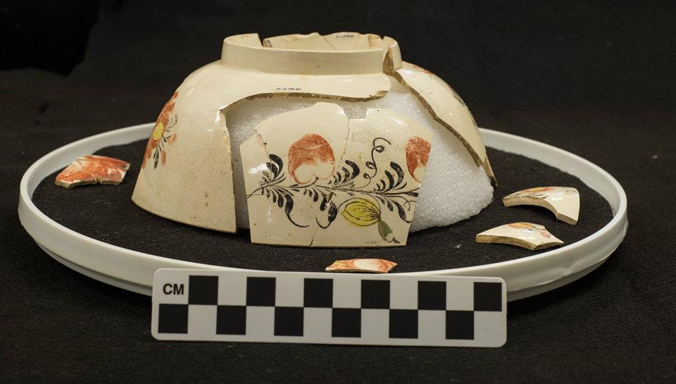
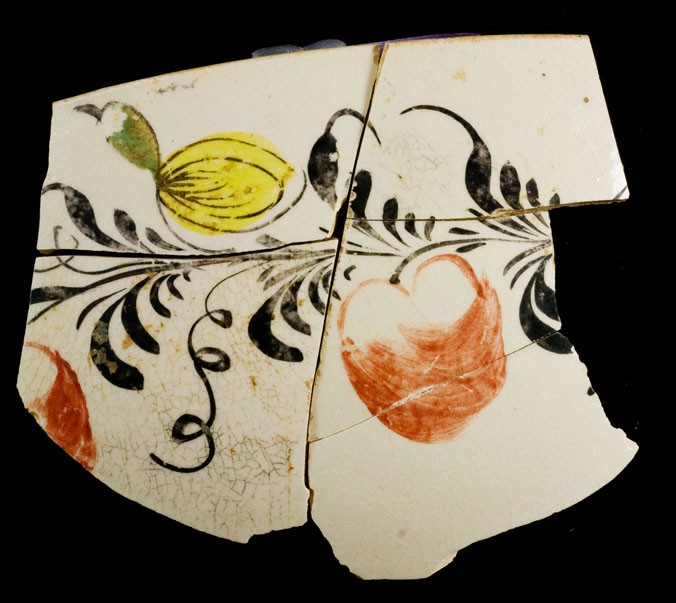
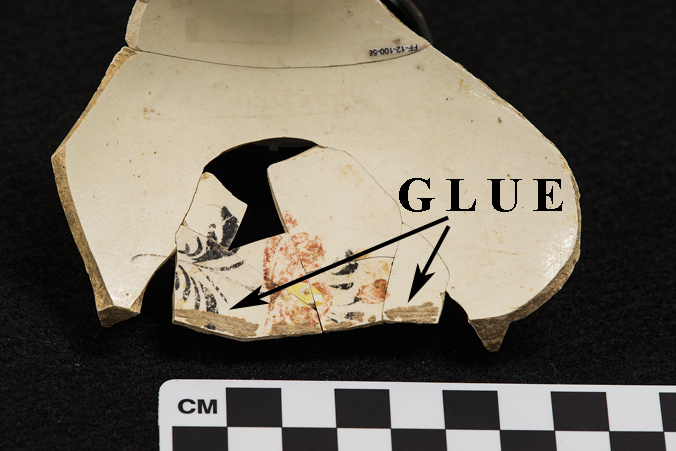
We’ve written about the importance of the bowl’s discovery here and even showed how we recreated a glue similar to the one used to repair the bowl here.
As part of our continuing efforts to learn as much as we can about the punch bowl and these glue residues, we took the sherds to the archaeology lab at Dovetail Cultural Resource Group here in Fredericksburg, where they took photos using a microscope.


Mara Kaktins, Archaeologist
Ceramics & Glass Specialist
Zac Cunningham
Manager of Educational Programs
Archaeologists are somewhat unique in their appreciation for all things broken, mostly due to the coveted information discarded items can tell us about those who died long ago. However, occasionally a fragment is unearthed which is both informative and beautiful. Such is the case with a lovely cobalt blue decanter stopper excavated on the grounds of Historic Kenmore. Made from leaded glass to increase clarity, it seems quite heavy when placed in the hand. Six carefully hand-cut flutes adorn each side and when held up to a light it exhibits violet-colored highlights that accent the piece perfectly. Just the stopper alone is beautiful. Imagine how striking the entire decanter would have looked! Conveniently enough, that’s my job!
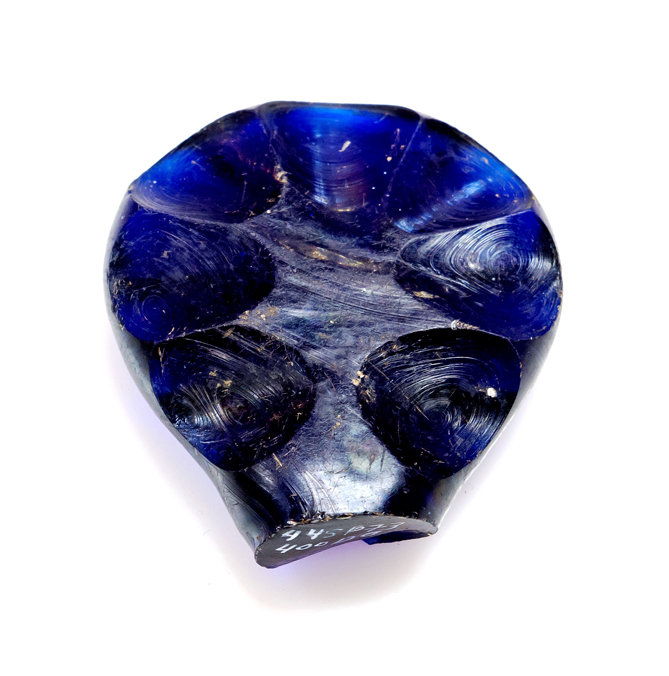
During the late 18th century, the decanter and its stopper graced one of the rooms at Kenmore and held either fortified wine like Madeira, Port, and Sherry or a stiffer spirit such as rum or gin. It may have been part of a set and adorned with gold gilding that spelled out which heady beverage was contained within. I picture the decanter being picked up by one of the Lewis family’s enslaved servants on a dark night and a glint of purple from deep within the cobalt bottle shining as it reflects off of a candle while dark burgundy Madeira is poured forth into a waiting cup.
All musings aside, however, the reality is that this stopper (which I am clearly obsessed with) also teaches us about how Fielding Lewis and his family lived. The decanter was a showy piece meant for display. It could be argued that, while it was a functional vessel, its primary purpose was to emphasize the wealth of the family and to impress guests.
For us today, the stopper has a practical use. Meghan Budinger, Kenmore’s curator, was able to locate a similar vessel using the excavated stopper as a guide. While the decanter on display in Kenmore’s dining room is clear instead of cobalt blue, its shape and design closely match the cobalt decanter and stopper owned by the Lewises. Meghan continues her search for a blue decanter.
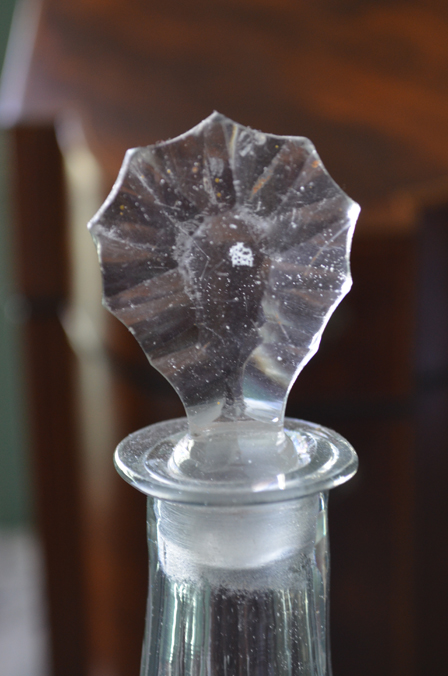
Still, visitors and obsessed archaeologists alike may marvel at its beauty. In fact, most of the ceramics and glass in that room have archaeological equivalents that have informed Meghan’s choices. Thus, when asked by visitors why we have selected the beautiful tablewares before them, we can confidently answer that it is not just because they are pretty (so very, very pretty!) but also because, thanks to the archaeological record, we know the Lewis family owned pieces like them!
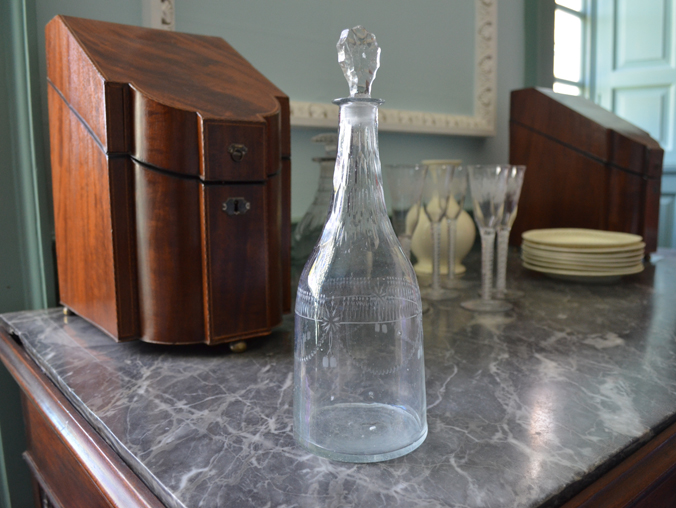
You can see the clear glass decanter that is based on the cobalt blue stopper while also learning more about their ceramic cousins and about how archaeology has informed the choices of objects displayed inside Kenmore on a new specialty tour of the house called “Posh Pots and Decadent Dishes: The Lewis Family Life through their Ceramics.” Learn more about this new tour here. If antique glass is more your style, you can read more about Kenmore’s “Beautiful Glass” on The Rooms at Kenmore blog here.
Mara Kaktins, Archaeologist
Ceramics & Glass Specialist
Ultraviolet light is an important and useful tool within the museum world. In this video, we show you how archaeologists and curators use UV light in their work with artifacts and historic objects.
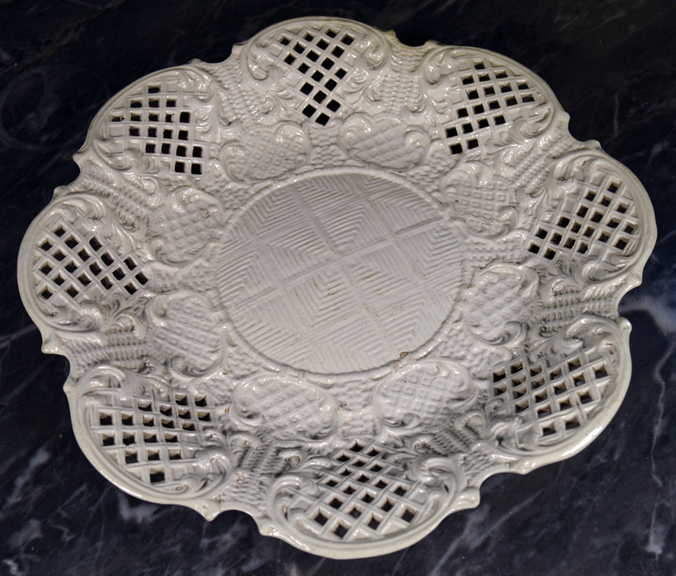
Want to see “in real life” the 18th century ceramic fruit dish we wrote about last August? You can see it and the matching sherds excavated by archaeologists on your next visit to George Washington’s Ferry Farm.
The dish sits inside the Ferry Farm visitor center in a museum display case now dedicated to Lives & Legacies. In this exhibit case, we will showcase some of the artifacts, objects, and stories that we write about on the blog for people visiting George’s boyhood home.

Along with taking the self-guided iPad tour “Uncovering George Washington’s Youth,” viewing the visitor center’s major exhibit “The Science of History at Ferry Farm,” and watching archaeologists at work at the dig site and in the lab, visitors can learn how archaeologists discovered fragments of the unique fruit dish and how the dish and its discovery connects three Washington sites – Ferry Farm, Kenmore, and Mount Vernon – together.
Future subjects for the display case include the glass base that may have been used as a spinning top, jewelry and personal accessories from the 18th century, and Westerwald ceramics found at Ferry Farm and Kenmore, among many others that you have seen on Lives & Legacies. The case will be rotated regularly – stop in to check it out!
For more information about visiting Ferry Farm, click here.
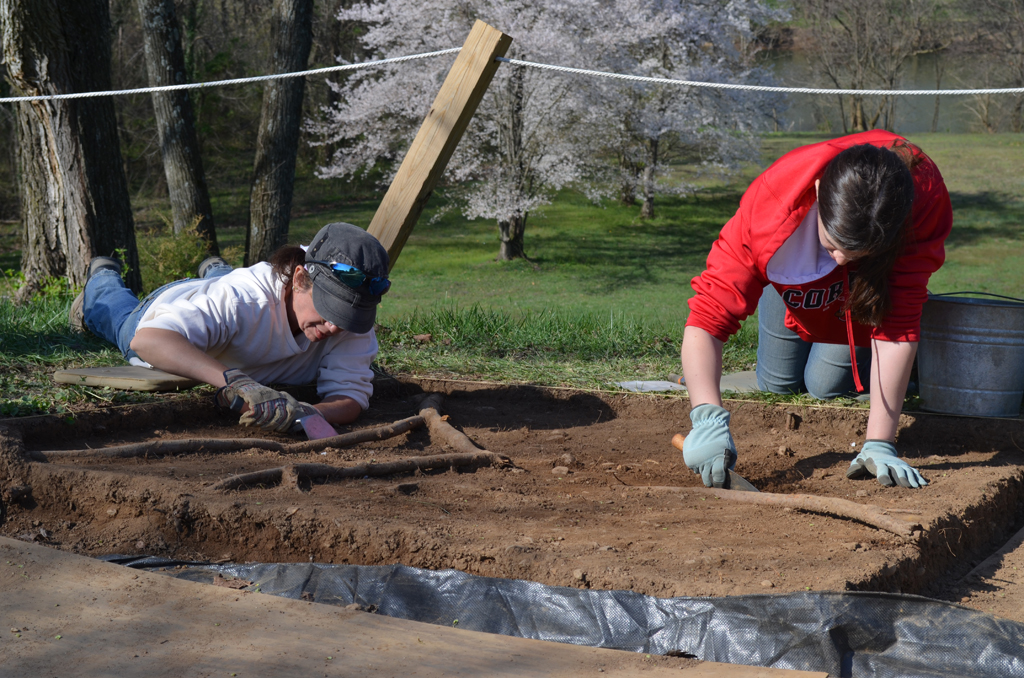
Last week, another archaeological excavation season began at George Washington’s Ferry Farm. Here are some scenes from the first week of digging.


On weekdays, see Ferry Farm’s archaeologists working at the excavation site from now through late-June or, if you can’t visit before June, spend a day on the dig site by watching the video below.
Learn more about Ferry Farm archaeology here.
In this day and age, it is easy to discover the particulars of someone’s life simply with the click of a button. Phone number, age, home address, professional resume and more can easily be obtained by searching through public records on the Internet or at the library. A treasure trove of current primary and secondary resources awaits the present-day researcher trying to uncover the facts of someone’s life in the 21st century.
But what do you do when the person lived over 250 years ago? What public and private historical records are available that will tell us who a person was, how they lived, when they died, and who their family was? Time, circumstances, and the natural decay of paper all take a toll on the sources we use to study the history of the people who came before us. But the amount and quality of available information about a person also depends on the status and role they played in their own time.
In 1750, an enslaved person living at George Washington’s boyhood home, now called “Ferry Farm,” was murdered. His name was Tame and he was killed by Harry, another enslaved man owned by the Washington family. These bare facts were recorded at a King George County Court of Oyer and Terminer, with no further explanations given of the crime or of the motives involved.[1]
What led to Tame’s death? For that matter, who was Tame? How old was he? Where did he come from? How long was he with the Washington family and how does his fateful story figure into the daily operations of the farm and household? Answers to these kinds of questions are hard to come by because the stories of the enslaved population in the historical record are limited, in many cases, to just a few documents spanning their lifetime.

Discovering Tame’s story begins with finding him in the written records. Augustine Washington, George’s father, died on April 12, 1743, seven years before Tame’s murder. His will, written a day before his death, lists by name some of the slaves that belonged to him and to whom he gave them. Tame is not among those mentioned.[2] The subsequent July 1, 1743 probate inventory of Augustine’s estate details the property and personal items he owned and their value, including a list of the enslaved population, but Tame, again, is not listed.[3]
Since he was not mentioned in either of these two historical documents relating to Augustine’s property, it’s possible that Tame was acquired after Augustine died, either by his estate, his heirs, or by his wife Mary and sometime between 1743 and 1750.
There is another scenario to consider, however. Perhaps Tame does not show up in the court documents surrounding Augustine’s death because Tame was actually the property of Mary, Augustine’s wife, instead.


Mary Ball, who married Augustine Washington in 1731, was born to Mary Johnson and Joseph Ball in 1708 in Lancaster County, Virginia. When her father Joseph died in 1711, he willed to her a young slave: ”Item: I give to my daughter Mary my negro boy Tame…” (Lancaster County Will Book 10:88). Since Tame is described as a “boy” in the document, he could be roughly any age between 5 and 16 years.
Is this boy, willed to Mary when she was but three years old, the same person who was murdered 39 years later in 1750 at Ferry Farm? As Mary’s property, the boy Tame would have been part of her household wherever she lived: with her mother in Northumberland County following her father’s death, with her as Augustine’s wife at Pope’s Creek, Westmoreland County, and then, finally, at Ferry Farm, where she lived mostly as a widow. As Mary’s property, Tame would not have appeared in the will or probate lists of her husband. What is also interesting is that both Tame and the man accused of murdering him were described in the 1750 court proceedings as “belonging to Mary Washington of this county widow.”
Exactly what role Tame played on the Washington farm and within their enslaved community is unknown. If Tame is the same boy Mary received when she was 3, he would be in his 40s or 50s when at Ferry Farm, and thus someone Mary had known well her whole life. Did he work in or around the main household for the family or as a field laborer? Did his age and long term relationship with Mary relate in any way to his unfortunate murder in 1750? What was his status within the slave community? Even Tame’s name adds an interesting aspect to his story that separates him from the other Washington slaves on the farm. “Tame” is a name of West African origin and is unlike the usual Anglicized names of contemporary Washington slaves, such as Jack, Ned, Tim, Steven and Adam, as recorded in Augustine’s will and probate inventory.

Tame’s existence in the historical documents is brief and mysterious. It may always remain a mystery but further research may yet illuminate this man’s story and his long association with Mary Washington. History is indeed an unending journey.
Judy Jobrack, Archaeologist
Assistant Lab Supervisor
[1] King George County Order Book 2, p. 670
[2] King George County Order Book 2, Part 1, p. 333
[3] King George County Inventory Book, 1721-1744, p. 285
I love stories. I mostly love true stories but I also love those stories that may not actually be true but are perceived by many to be true. It is in those perceived truths that one can make discoveries about how people and societies see history. Likewise, studying a collection of one’s own oral stories that have come down through generations in a family can help bring into focus how we view our own personal histories.
Have you ever played the game “Telephone”? A group sits in a circle and each participant takes turns whispering the same sentence into the ear of the person next to them. When the sentence has gone around to everyone, the person who started the game announces what the original sentence was and then, giggling, the last person reveals what the sentence morphed into as it passed along from person to person. Oral histories can be like “Telephone” as they pass through the generations. Nevertheless, they are important stories from which we glean cultural information. We should be keepers of them for future generations.
Stories about historical figures and historical places can be like that, too, as they pass through people, time, cultures, and ideologies. In my professional life, I am privileged to explore the narratives of a life well lived by the Virginian, George Washington. Most of these narratives are well known to the world and have inspired Americans for centuries. They are big, important stories that resonate with countless people young and old.
The two functions I serve in my work for The George Washington Foundation are as Archaeology Lab Supervisor and Oral History Project Coordinator. These two positions offer me the unique opportunity to “read” stories in excavated trash (archaeological artifacts) and to listen to and record oral stories collected from people associated with our sites like former residents, visitors, and employees. At first glance, one might seem more scientific and the other merely anecdotal. But these two jobs, even though they appear at odds, are not necessarily so opposing.
Both activities illuminate what we know about the history of George Washington’s Ferry Farm and Historic Kenmore and both can serve as interpretive tools for museum exhibit content. I often tell groups of school children who visit us in the Archaeology Lab that I would be able to tell a lot about them if I could look in their trash cans at home. This helps them to understand that looking at George Washington’s excavated trash is informative in the same way.
As an employee of an organization that relies on careful archaeological data, I feel very strongly about doing my part to provide the public with information that is as accurately interpreted as possible given the scientific techniques, processes, and experts used to gain the truths we seek. These truths reach far beyond the Washington years. The artifacts deposited at our active dig site at Ferry Farm also inform us about Native Americans who lived here, early settlers of this property when it was the frontier of Virginia, Civil War soldiers who were encamped here, and several families that lived here throughout the 19th and 20th centuries.
Our archive of oral histories works hand in hand with scientific archaeology to fill in the details of what we know to be true “from the dirt.” For example, one interviewee who had lived at Ferry Farm in the mid-20th century asked if any of the archaeologists had ever found metal army men on the site. He explained that he and his brother had a mold from which they would make lead soldiers. They had melted down Civil War minie balls they found in the yard around their house and used the liquefied lead to make their toy soldiers. They were simply recycling, as it were. So, if our archaeological team were to excavate such a soldier, it would speak to both the Civil War and World War II era histories of Ferry Farm.
Oral histories collected from people associated with Ferry Farm and Kenmore during the 20th and 21st centuries have made significant contributions to our understanding of the inhabitants and activities at both properties. These histories have also helped document important preservation initiatives aimed at protecting George’s boyhood home and the home of Betty Washington Lewis and her husband, Fielding. The GWF Oral History Project overall has created a community, however disparate, of citizens supportive of Ferry Farm and Kenmore and the stories they tell. If you have a story to share, please contact me!
Melanie Marquis
Archaeology Lab Supervisor
Oral History Project Coordinator