Lives and Legacies

Author: ferryfarmandkenmore

  • Photos: Posh Pots and Decadent Dishes

    New specialty tours at Historic Kenmore provide opportunities for guests to explore a deeper understanding of Kenmore by focusing on the topics that make us uniquely Kenmore.

    One such tour, “Posh Pots and Decadent Dishes: The Lewis Family Life through their Ceramics,” explores how everyday objects can teach us about how families lived. In the 18th century, ceramics were at the height of fashion and each piece can tell a fascinating story. While touring our collection, visitors learn what the objects pictured below and others reveal about the Lewis and Washington families.

    This new ceramics-focused specialty tour is available each Thursday at 11:00 a.m. and 3:00 p.m. and on various Fridays and Saturdays.

    Additional specialty tours also available and include:

    • This Old House: Preserving Kenmore

    When Kenmore was completed in 1775, it was the height of 18th century fashion and luxury. We are still able to enjoy its grandeur because it has been preserved. This tour delves into the multiple restorations the house has undergone throughout the years and illuminates the work that goes into bringing a 200-year-old home back to its original glory.  Available each Tuesday at 11:00 a.m. and 3:00 p.m. and on various Fridays and Saturdays.

    • Sacrificing for Liberty: Kenmore and the American Revolution.

    The Lewis family moved into their new home only months after the American Revolution began. Learn how the Revolution shaped the Lewis family and their new home. This tour talks about the events that lead to the revolution, how they affected the Lewis family, and how they moved one another forward to the country (and home) we now know.  Available each Wednesday at 11:00 a.m. and 3:00 p.m. and on various Fridays and Saturdays.

    To learn more about visiting Historic Kenmore, visit kenmore.org/visiting.

  • Petticoats and Pink Lightning

    This week, we delve into our collections to investigate some fascinating fashions from across the centuries. London Fashion Week took place late last month while today marks the final day of Paris Fashion Week.  Just as they do in the 21st century, those two cities represented cultures that helped determine the height of fashion in the 18th century. To us today, fashions of the past may consist of strange terms, foreign garments, or archaic customs. In this post, Lives & Legacies contributors come together to salvage some fashions from the pages of history in an appreciation of both them and of the people who wore them.

    Petticoats

    To most of us today, the term “petticoat” refers to a ladies’ undergarment – a fabric support for a skirt, intended to give the skirt more fullness or volume.  Petticoats have essentially disappeared from our modern wardrobes but, for 400 years, petticoats were a staple of female dress and weren’t always hidden under skirts.

    The earliest references to petticoats show up in the Middle Ages.  Only they weren’t worn by women.  And they weren’t skirts.  A “petty coat” referred to a short (“petty”) robe (“coat”) that was padded and worn under a knight’s armor or chain mail.  Eventually, the term “skirt” was used to describe the tails of men’s petty coats (“the skirts of his petty coat hung so long they touched the ground”), and was also used to describe typical women’s attire, just as we use it today.  By the 16th century, somehow women’s skirts and men’s petty coats became synonymous, and as time went by and men ceased wearing petty coats, the word “petticoat” referred entirely to a woman’s skirt.  Petticoats could be worn as stand-alone skirts, or under open-front robes, creating a two-part dress. By the mid-19th century, petticoats were no longer seen and became an undergarment worn under an all-encompassing dress, mostly to add structure to the voluminous skirts that had become popular by then.[1]

    In the 1700s, women often wore quilted petticoats under those open-front robes or as stand-alone skirts.  In either case, the quilted petticoat was intended to showcase intricate handiwork in the quilted pattern.  Geometric patterns, birds, flowers and even pastoral scenes were all common themes for quilted petticoats, which had an added bonus of providing extra warmth.

    One quilted petticoat dating to approximately 1760 survives in our collection.  Made of peach satin silk with wool batting between the two layers, it is quilted in a chevron pattern above an undulating band, below which is an assortment of flowers and leaves.  Although it appears that this particular petticoat was made over several times in its life, there are indications that it was originally intended be worn over a dome-shaped hoop skirt, which probably means that it was worn under an open-front robe for a more formal dress.[2]  The wearer would have been at the height of 18th century fashion!

    Meghan Budinger
    Aldrich Director of Curatorial Operations

    Busk Boards

    Corsets have been a fashion mainstay in women’s clothing throughout history.  Like petticoats, they have changed their shape, material and purpose but, unlike petticoats, they have always been a very personal and private garment.  From the 15th to the 18th century, corsets contained a small sliver of stiff material called a busk or busk board.  The busk was made of wood, ivory, or bone and measured between 12 to 16 inches long and 1 to 2 inches wide.  They were inserted into a special narrow pocket in the front of the corset to keep the garment straight and upright.

    Given the intimate location of the busk they were often given as tokens from lovers and contained elaborate carvings.   Hearts, cupids, and initials were favorite and common motifs inscribed on the busk.  The board in our collection is made out of wood in a long rectangle shape with round end.  On the surface are etched a pinwheel, a fleur-de-lis, six flowers petal enclosed in a circle, and a square with a diamond carved design all surrounded by a cross-hatched edging.  At the end is inscribed “B.L. 1785” with a sprig of leaves.

    Heather Baldus
    Collections Manager

    Shoes

    Perhaps, unlike pretty petticoats and busk boards, when we today think of footwear in the colonial era, we often think of pedestrian black leather. This might have been sufficient for the puritans of New England, who were typically adverse to bright colors and flashy clothes. Here in Virginia, however, where London fashions were king, the style conscience demanded something more. Much like today, there were shoes meant for work and shoes meant to impress. Linen shoes, like the ones in our collection, would have certainly impressed.

    In our collection we have three versions of 18th century ladies’ shoes: black shoes from the late 1770s which have a pointed vamp and an Italian heel; a silk and linen pair from the 1760s; and, finally, an embroidered linen pair with a white rand and leather-covered English heel. All were the height of fashion in the 1700s and perfect for showing off at a fine evening of dance, a Sunday at church, or even at home while company was visiting. Like all shoes in the 1700s, a trained shoemaker made them by hand.  Although there were journeyman and master shoemakers in the colonies, the finest worked in London and shipped their merchandise across the Atlantic. While certain elements of these shoes are ubiquitous such as the thin leather soles, wooden heels, straps for fine buckles, and a linen base, eighteenth century shoes were like the shoes of today varying in style, color, material, and purpose.

    Personally, my favorite aspect of these shoes is how contemporary they truly are. While they seem like a foreign footwear from a bygone era, anyone who has splurged on the perfect pair of boots, fashionable flats, or even stylish sneakers can relate to the original owners of these beautiful artifacts.

    Joe Ziarko
    Manager of Interpretation & Visitor Services

    Lipstick

    “Pink Lightning”!  Meteorogically speaking, it is a distinctive type of lightning that is exceptionally loud and generates a unique purple-pink color.  But in the world of fashion, “Pink Lightning” was the color name created by Revlon for a line of beauty products in 1944. Face powder, nail polish, and lipstick were available in this shade for women who wanted to sport a distinctive, high voltage color on their lips and nails.

    While most of this post has focused on 18th century fashion, both Historic Kenmore and George Washington’s Ferry Farm have long histories beyond the 1700s. We often unearth objects that span 300 years during archaeological excavations.  Indeed, during the summer of 2014, an intact tube of 20th century lipstick was excavated.  The product label – “Revlon – Pink Lightning”- was still legible on the base of the wartime-inspired bullet-shaped casing, and remnants of the crème lipstick still surprisingly survived inside the tube.  Someone, sometime, pulled out her lipstick tube, dabbed ‘Pink Lightning” on her lips, and promptly dropped it on the ground to be lost for nearly 70 years.

    Lipstick is the ultimate fashion accessory.  As the very last beauty product applied before heading out the door, it is usually the finishing touch to an outfit. The world of fashion is not only about clothing, but just as much about the hair and makeup created to complement and highlight fashionable outfits. Wearing “Pink Lightning” lipstick would certainly suggest a fashion image that was “electrifying!”

    Judy Jobrack, Archaeologist
    Assistant Lab Supervisor


    [1] https://whitepavilion.com/articles/petticoats Petticoats, White Pavillion Clothiers, 2014.

    [2] Baumgarten, Linda. Eighteenth Century Clothing at Williamsburg. The Colonial Williamsburg Foundation, 1986.

  • Video: Inside the Archaeology Lab – Labeling Artifacts

    Archaeologists spend much more of their time working to determine the significance of an object than actually finding the object through excavation. This analytical work is done in an archaeology lab, where t is vital to keep the artifacts organized. This video shows how artifacts are labeled to help make sure nothing gets lost.

    Learn more about archaeology at Ferry Farm at http://bit.ly/1Ob37in.

  • How Washington Relaxed: A Short History of Playing Cards

    As modern people, we tend to assume the past is a foreign land where residents’ lives are alien to our own. Would the founding fathers balk at how we dither away our time? Or would they recognize that life without its moments of levity is foolish?

    Eighteenth century America was a time of growing leisure activities. Colonists enjoyed playing games, watching horseraces, or going to an evening of theatre. But for anyone who has ever passed the time with solitaire or gone all-in with a pair of Kings, you have passed the time in a way George Washington would recognize immediately.

    The entire history of playing cards is massive and sometimes convoluted. Opposing origins, numerous legends, and the lack of definitive documentation make a ‘brief history’ all but impossible. But a few things are known.

    Playing cards used strictly for games have been around for thousands of years but the oldest recognizable relatives to our modern playing cards appeared in Europe in the latter half of the 1300s. At this time, France saw a rise in the popularity of expensive and elaborate fortune-telling  Tarot cards, not the everyman game familiar to modern audiences.

    Around the same time, we find references to card games in Italy that speak most directly to our modern notion of cards. Here their earliest decks contain familiar features: cards numbered one to ten, four royal court cards, and four suits including cups/chalices (coppe), coins(denari), swords (spade), and club/baton (bastoni).

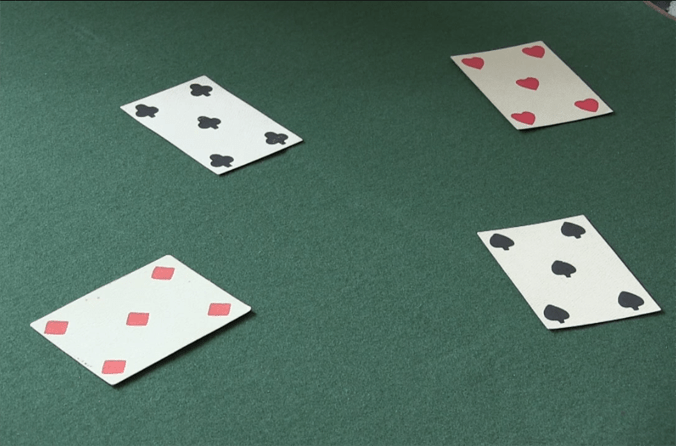
    Suits
    Suits in a reproduction set of 18th century playing cards seen in a screen capture from an upcoming Lives & Legacies video about how to play Whist, a game popular with colonial Americans.

    By the beginning of the new century, the 1400s, references to people playing ‘cards’ are seen all across Europe.  Card numbers, royalty, and suit continued to change across Europe for the next 200 years and featured plenty of regional differences.

    For the most part there were four suits, but what those suits were was debatable. Other suits in Europe (some even today) included roses, bells, acorns, shields, leaves, pikes, tiles, clovers, hearts, and of course diamonds.

    The royal cards varied from deck to deck, much like the royalty and ruling elite varied in the nations of Europe. Some decks had no queen, others included clergy, sometimes it was three royal cardsand other times there were four. There was one constant, however, there was always a King and he was the highest in the deck.

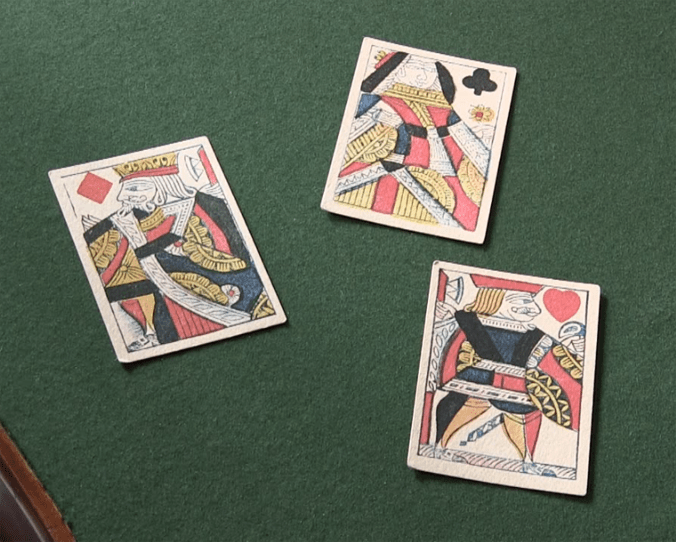
    RoyalCards
    The King, Queen, and Knave in a reproduction set of 18th century playing cards. When printed numbers and letters (K, Q, J) were added to cards, the Knave came to be called the Jack so it would not be mistaken for the King.

    By the early 17th century, England had a standardized deck (based on the ‘French’ deck) made up of the four suits we know, numeric cards one to ten, Knave, Queen, and King. This is the deck we still use today.

    By this time, cards even started to play a role in politics. In 1615, as an effort to cease the importation of foreign cards and raise revenue, King James I placed a duty on imported cards and appointed an office to inspect playing cards. Although initially unpopular with commoners who preferred the cheap foreign cards, ultimately the duty persisted. The King and Parliament tried to levy a similar duty with the Stamp Act 150 years later, which many credit with beginning American opposition to British taxation that ultimately led to Revolution.

    Those 150 years were incredibly important to the growth the Colonies and of Virginia. They grew from rugged outposts in a strange land to thriving cities and societies that weather the French and Indian War. The colonists earned their right to leisure and wanted to enjoy it!

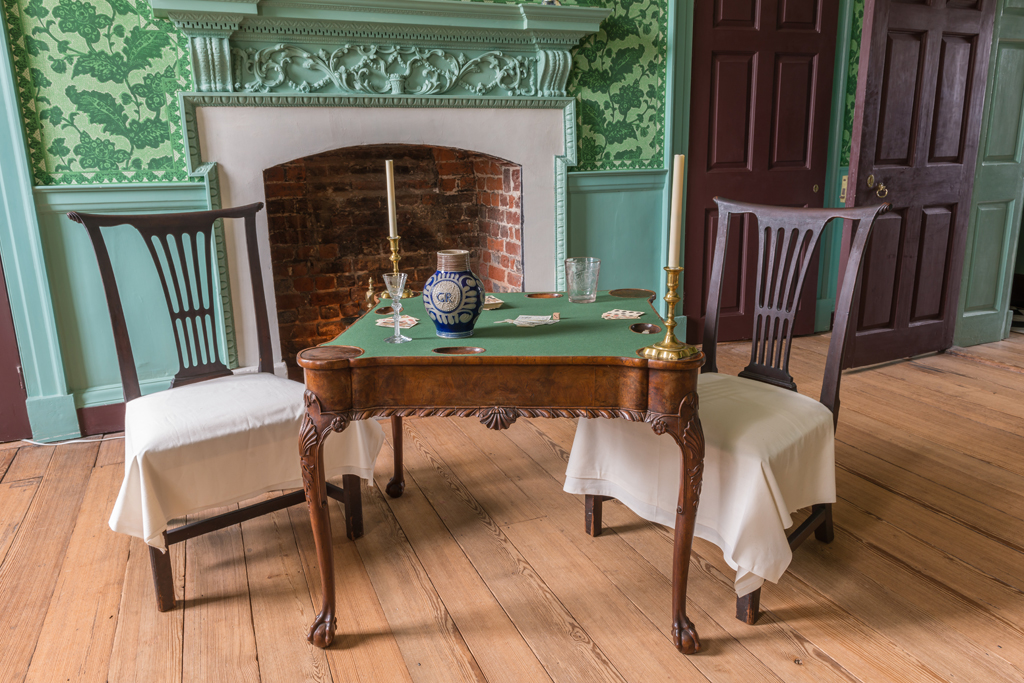
    Gaming Table (1)
    The walnut gaming table in Historic Kenmore’s drawing room was made in England around the year 1760. The table top is covered in green baize (felted wool, similar to what you find on modern billiards tables) with wells to hold gaming chips and “turrets” at the corners to hold candlesticks.
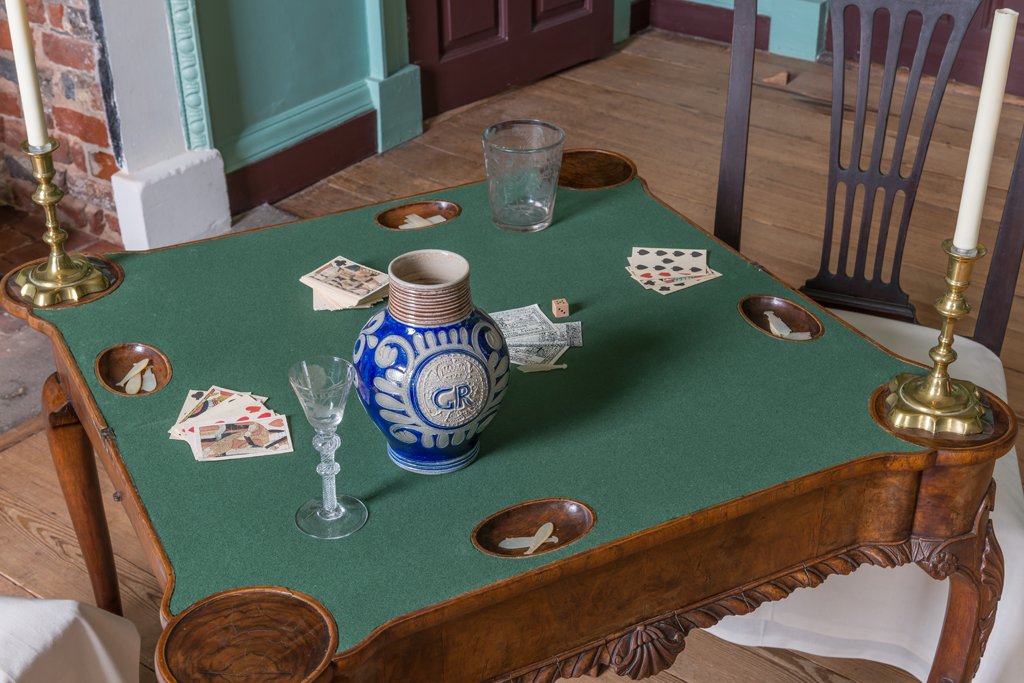
    Gaming Table (2)
    The table has a possible connection to the Washington family, in that it might have descended through George Washington’s younger brother Charles’s family. That connection is still the subject of research, and it may be a while before we are able to conclusively prove or disprove that provenance.

    Prior to the Revolution, Virginians prided themselves in being British! They enjoyed British rights, food, drink, and pastimes like horseracing, dancing, and of course, playing cards. It would not be uncommon to see cards being played at the taverns or at gaming tables in drawing rooms, by all members of Virginia society. We only need to look at the probate inventory of Fielding Lewis to discover what games they played for among the books included in his library it lists ‘Hoyl 1 Vol’.

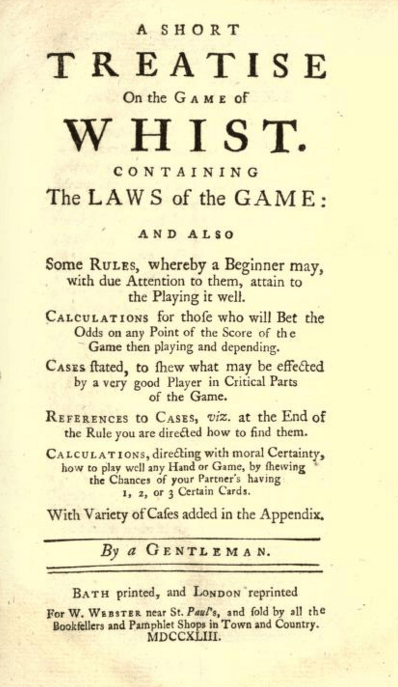
    In 1742, Edmond Hoyle published a Short Treatise on the Game of Whist. This pamphlet taught the rules to Whist as well as the best hands/plays  and was an immediate success! Hoyle continued to expand his Treatise to include other games such as back gammon and chess. Ultimately, the book’s 15 editions made it the standard instructional for card games in the English-speaking world. You can read a bit more about Hoyle and, more importantly, about gaming pieces used in the 1700s on The Rooms at Kenmore blog here.

    Hoyle
    Front page of Hoyle’s Short Treatise on the Game of Whist, published in 1743.

    And, finally, if there is any doubt to whether or not colonial men enjoyed the pastime of playing cards, we need only look at George Washington and Colonel Fielding Lewis. On December 23, 1769, George Washington stopped in Fredericksburg while returning home to Mt. Vernon. He would spend Christmas Day with his sister and brother-in-law and won ‘£2 5s at cards’. Whether George and Fielding both enjoyed that specific game may be lost to history, but how they spent that holiday is undeniable; they played cards.

    Whether for the game of Whist set out on Kenmore’s gaming table or the game of Hearts you play with your family at home, playing cards have a history that can be traced over the centuries and across the globe. It is a history that we share as directly with one another as well as with our founding fathers.

    Joe Ziarko
    Manager of Interpretation & Visitor Services

    Editor’s Note: Watch for an upcoming video about how to play the game of Whist coming soon!


  • Video: The Colonial Kitchen – Drinking Chocolate

    In this video, we taste three different chocolate drinks from across the centuries and discover what ingredients went in them to make each taste so differently.

    Read about “Sweet-Toothed Colonials and Their Chocolate” here.


  • Sweet-Toothed Colonials & Their Chocolate

    Ahhh Chocolate!  Now is the time of year when we consume even more than usual, often from heart-shaped boxes gifted by an admirer.  Probably one of the most universally loved foods, the average American consumes roughly 11 pounds of the stuff a year!  It is hard to imagine a world without chocolate and this love of the heavenly substance stretches all the way back to our country’s colonial roots.  However, banish the visual of George Washington chomping a chocolate bar while chopping down the cherry tree, chocolate bars are a fairly recent invention of the mid-19th century.  Before the mid-1800s, if you had a craving for the world’s favorite sweet, you drank it!

    Chocolate has its origins in South America where archaeological evidence indicates it was being cultivated and consumed over 3,000 years ago.  The Spanish were the first Europeans to try the spicy chili and chocolate beverage of the Aztecs.  They introduced it to Europe in the 1600s where, with the addition of sugar, it became the height of fashion.

    Drinking chocolate of the 18th century was different from our ubiquitous modern day cup of cocoa.  It was made with either cacao nibs or blocks of compressed chocolate that were then grated or ground to a paste and dissolved in a warm liquid inside a dedicated ‘chocolate pot’.  The chocolate was added to any combination of water, milk, cream, wine, or even brandy for an extra kick.  This mixture was combined with sugar, though less than we use because it was an expensive import in colonial America.  Other common ingredients included chili pepper, vanilla, nutmeg, or allspice.  This resulted in a rich, sweet, spicy, and bitter drink that the colonists couldn’t get enough of.

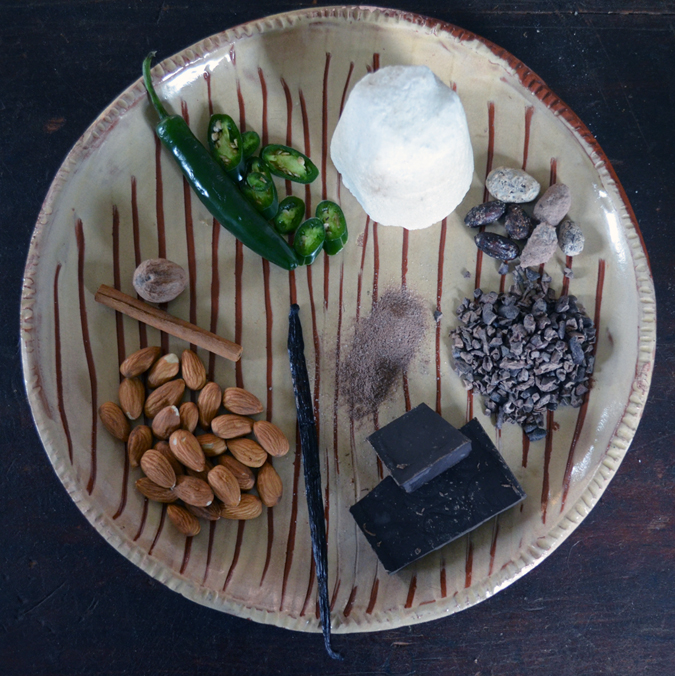
    Chocolate Ingredients
    Popular ingredients in colonial-era chocolate drinks included (clockwise from top) sugar; cocoa beans, chocolate nibs, or chocolate block crushed and melted to form the foundation of the chocolate drink; vanilla; almonds; cinnamon; nutmeg; and chilis.

    We know that many early Americans were fans of chocolate, but it wasn’t available to everyone.  In the 1700s, chocolate was still a fairly expensive drink, similar to tea or coffee, making it a beverage of the upper and middle classes.  It was seen as a nutritious and filling health food, commonly had with breakfast.  Chocolate was a well-known staple at the Washington breakfast table, often served alongside tea and hoecakes in honey and butter.[1]

    In fact, the Washingtons were such fans of chocolate that in 1757 George Washington ordered 20 pounds of chocolate from British merchant Thomas Knox.  While living at Kenmore Plantation, George’s sister Betty Washington Lewis ordered a gallon of chocolate.

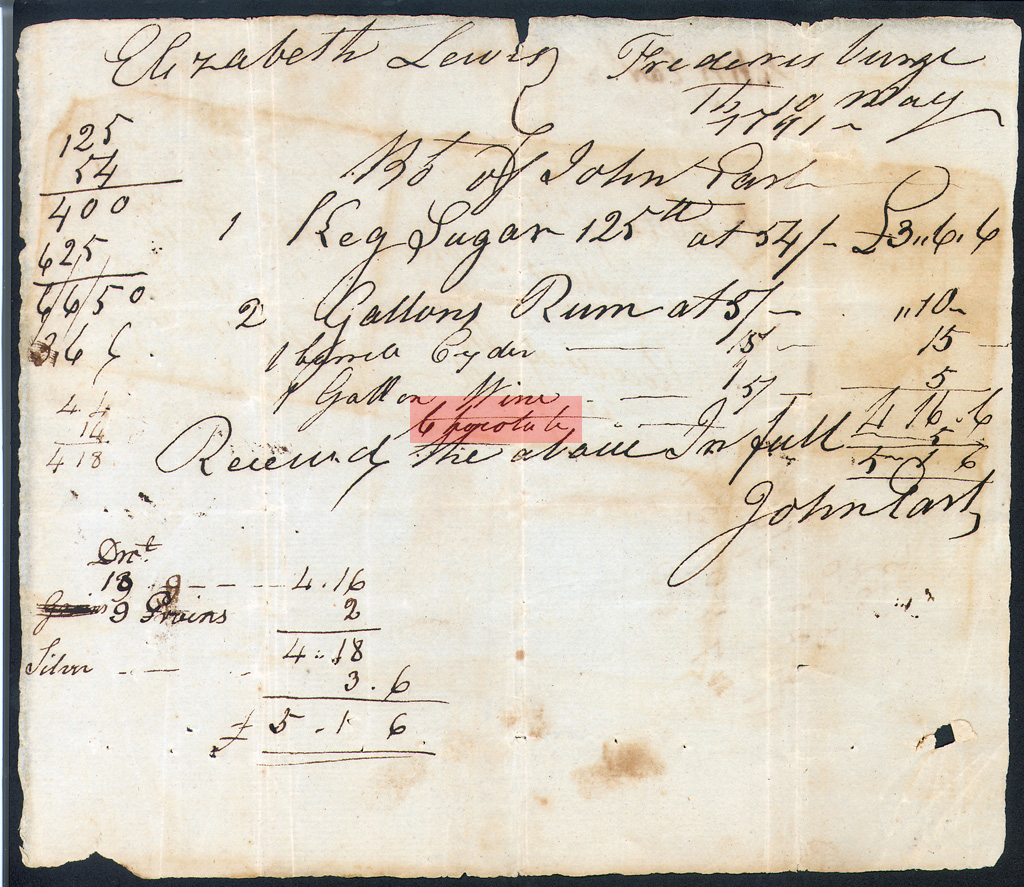
    Betty Orders Chocolate
    Although the handwriting is difficult to decipher, this receipt shows highlighted in red that Betty Washington Lewis ordered a gallon of chocolate in May 1791.

    This love of chocolate is also evident in archaeological artifacts found through excavations at Ferry Farm. Archaeologists recovered fragments of a porcelain chocolate cup.

    It may seem strange to us that there were special cups just for drinking chocolate.  However, since it was a luxury good enjoyed by the upper classes it had a specific set of objects associated with its preparation and consumption.  A teapot or teacup could have easily functioned for drinking chocolate but the purpose of this specialized material culture was to show off wealth and sophistication.  For this reason a  well-to-do colonial household would have separate sets of vessels for the making and consumption of tea, coffee, and chocolate.  Using the right one in the right way let your peers know you were a well-educated gentry woman or man.

    Chocolate cups and pots were often made of fancy material like silver or porcelain to show off the wealth of the owner and reflect the nature of the luxury ingredient.  The chocolate cup recovered at Ferry Farm was painted red and blue in what is known as an ‘Imari palette’ and gilded to enhance the cup’s extravagance.  Chocolate cups can be identified by their straight sides, unlike the gently sloping sides of a teacup.

    Fragments of a porcelain chocolate cup made in the mid-1700s, decorated in the Imari palette design, and recovered during an archaeological excavation at Ferry Farm.

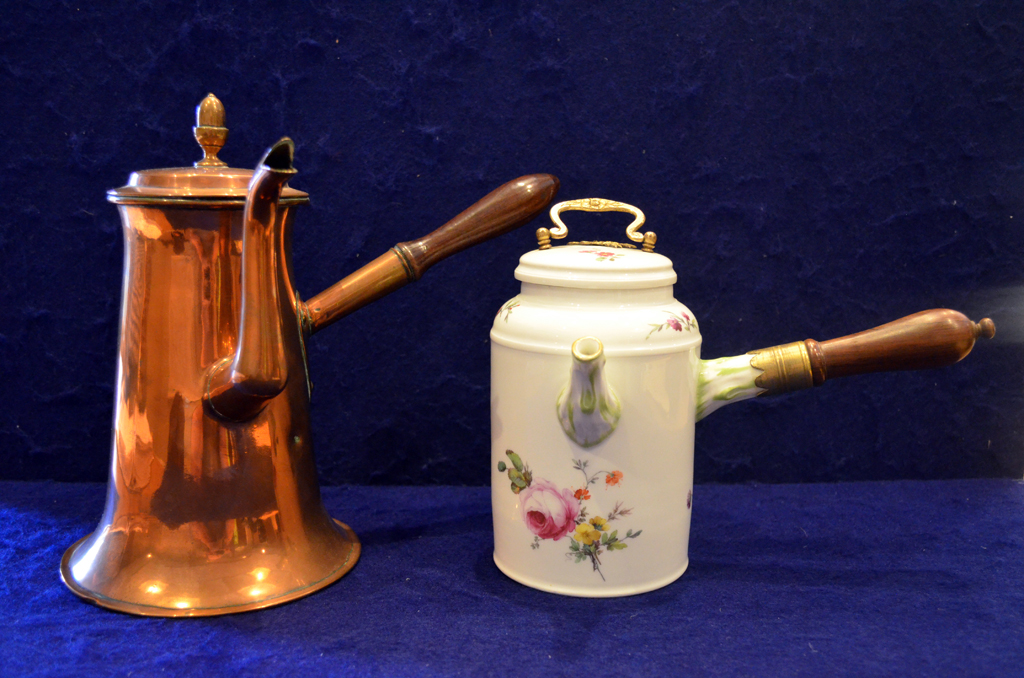
    Similarly, 18th century chocolate pots generally are taller and have straighter sides compared to contemporary teapots.They also have a shorter spout with no strainer and often have a straight handle that juts out from the body.

    Chocolate Pots 1
    Two 18th century chocolate pots in the collection at Historic Kenmore.

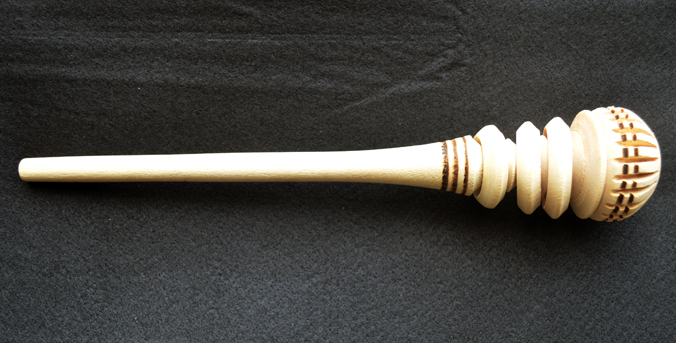
    The most recognizable feature of a chocolate pot however is a hole in the lid where the chocolate mill, or molinillo, would be inserted and rubbed between the hands to briskly stir the chocolate, creating a delicious froth on the top.

    Chocolate Mill
    Reproduction chocolate mill.

    Kind of makes you want to try eighteenth century chocolate drink, doesn’t it?  The next time you’re enjoying a bite of a candy bar or sipping your instant cocoa, think of the lofty origins of that treat and be grateful to the sweet-toothed colonials who so prized delicious chocolate!

    Lauren Jones, Archaeologist
    Archaeology Lab Technician

    Editor’s Note: Watch for a video exploring the topic of chocolate in colonial America coming soon!

    [1] McLeod, Stephen A. Dining with the Washingtons: Historic Recipes, Entertainment, and Hospitality from Mount Vernon. 2011: 37, 51.

  • Video: Tricks of the Trade – Archaeology Lab Edition

    Sometimes, it can be a challenge to precisely identify an artifact. When faced with this challenge, archaeologists working in the lab put their five senses to work and call upon some interesting ‘tricks of the trade’ to make those difficult identifications.

    Learn more about archaeology and being an archaeologist during Archaeology Day at Ferry Farm on Monday, February 15 from 10:00 a.m. – 4:00 p.m. Visit http://www.ferryfarm.org for event details.

  • Washington Birthday Wishes

    This month marks the 284th anniversary of George Washington’s birth. Americans have celebrated our first president’s birthday since long before it became an official national holiday in the late 1800s.  In fact, early Americans even marked George’s birth during his lifetime, most notably with “Birthnight Balls” that replicated the grand dances held in Britain to celebrate the monarch’s birthday.  In 1879, an Act of Congress made February 22 a holiday within the District of Columbia. Six year later, Congress expanded the holiday to all federal offices across the country.

    As with many American holidays, both officially recognized and otherwise, businesses created postcards and greeting cards to be used to send good wishes to family and friends on the holiday.  We have four such Washington Birthday postcards in our collection.  These cards date from around 1912-13, as a couple of the cards include cancelled postage stamps that note it being the 180th birthday of George Washington.

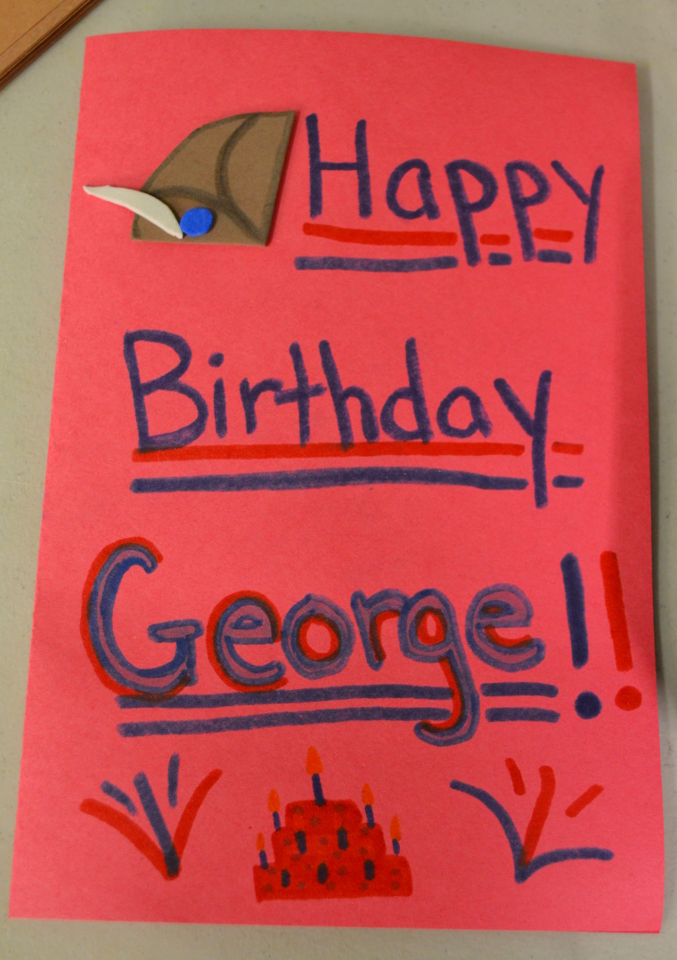
    This year, you can celebrate George Washington’s Birthday at Ferry Farm by making your own birthday card for George!

    Visitors even made birthday cards for George!

    Visit his boyhood home on Saturday, February 13 from 10:00 a.m. – 4:00 p.m. for family  fun, including games, crafts, exhibits, the Stone Throw Challenge (weather permitting), history theater, and birthday cake! “General Washington” will attend the Birthday Celebration to talk about his youth on the farm! You can see a short video of last year’s celebration here. $5 adults; 17 and under free.

    Additionally, on Presidents’ Day, Monday, February 14 from 10:00 a.m. – 4:00 p.m., learn about archaeology at George Washington’s Boyhood Home. Enjoy crafts, theater performances, presentations by Muraca the Magnificent – Guru of Glues, tours of the archaeology lab, a scavenger hunt, and the Archaeology Artifact Challenge.  Archaeology Day is a free event.

    For more information call 540-370-0732 x22 or email [email protected].

    Zac Cunningham
    Manager of Educational Programs

  • Video: George Washington’s Birthday at Ferry Farm

    Celebrate George Washington’s 284th birthday at his boyhood home with fun activities for the whole family, including games, crafts, exhibits, the Stone Throw Challenge (weather permitting), history theater, and birthday cake! “General Washington” will attend the Birthday Celebration to talk about his youth on the farm! The video below is a preview of the celebration.

    This year’s celebration is Saturday, February 13 from 10:00 a.m. to 4:00 p.m.

    For more information call 540-370-0732 x22 or email [email protected].

    $5 adults; 17 and under free.

  • Masonic Pipe in 3D

    139_Masonic_pipe_NO_SCALE.gif
    Click on the photo for to link to a 3D image the you can zoom, rotate, and manipulate.

    Recently, a 3D image of a smoking pipe was added to the Virtual Curation Lab, an online project of Virginia Commonwealth University.  You can view rotate, zoom, and manipulate the image by clicking the photo above or by clicking here.  The smoking pipe was discovered within the fill of the main cellar of the Washington family house at George Washington’s Ferry Farm, his boyhood home.  The pipe features the square and compass and twin pillars that distinguish this as a masonic pipe.  Such motifs were very popular.  The masonic symbols faced the smoker and fluting characterized that portion visible to surrounding friends.  The design elements used suggest that this pipe was likely made in the northeast of England sometime between 1770-1810, in places like Hull.

    George Washington was initiated as an apprentice mason on November 4, 1752, passed to fellow craft on March 3, 1753, and became a master mason on August 4, 1753. He achieved all of these masonic ranks at Fredericksburg Lodge No. 4.  While it is certainly possible the masonic pipe belonged to George, he was one of four notable masons associated with Ferry Farm.  The other three were Fielding Lewis, Hugh Mercer, and George Weedon, who each may also have left this specimen behind in the archaeological record.

    The Virtual Curation Laboratory (VCL) at Virginia Commonwealth University, headed by Dr. Bernard K. Means, scanned this pipe bowl in three dimensions.  3D scanning provides two types of digital models: a three-dimensional image to be viewed on a monitor and, with the use of a special 3D printer, a plastic replica of the item.  Replicas can be printed at a larger scale, allowing details to be viewed more easily.  VCL has used the technology to scan bones from extinct passenger pigeons, allowing researchers from around the nation to compare these known digital models to bird bones in their own assemblages so that they can identify passenger pigeons in their collection.

    Scanning
    The pipe bowl being scanned in 3D.

    Three-dimensional scanning allows The George Washington Foundation to provide greater public access to fragile artifacts both on the Internet virtually and as 3D printed copies that visitors can see and hold.  Making 3D images available online allows more people to see these artifacts than could ever visit Washington’s boyhood home.  We can even make these digital files available to researchers on the web, allowing others to 3D print them wherever in the world they may be.  In the field, 3D replicas allow staff to engage visitors, showing them (for example) a wig hair curler or tobacco pipe, then inviting them to guess how the object was used in the past.

    Lauren
    3D replicas allow Ferry Farm archaeologist Lauren Volkers to share rare and unique artifacts with visitors when the archaeological dig site is open.

    Fragile ceramic sherds can be printed in plastic, allowing visitors to mend the pieces together as an educational exercise.  Such access allows the original objects to be on exhibit while simultaneously allowing maximum access to the replicas physically and digitally.

    Vivian
    Archaeologist Vivian Hite uses a 3D printed plastic replica of the masonic pipe to engage young visitors.

    Laura Galke, Archaeologist
    Site Director/Small Finds Analyst