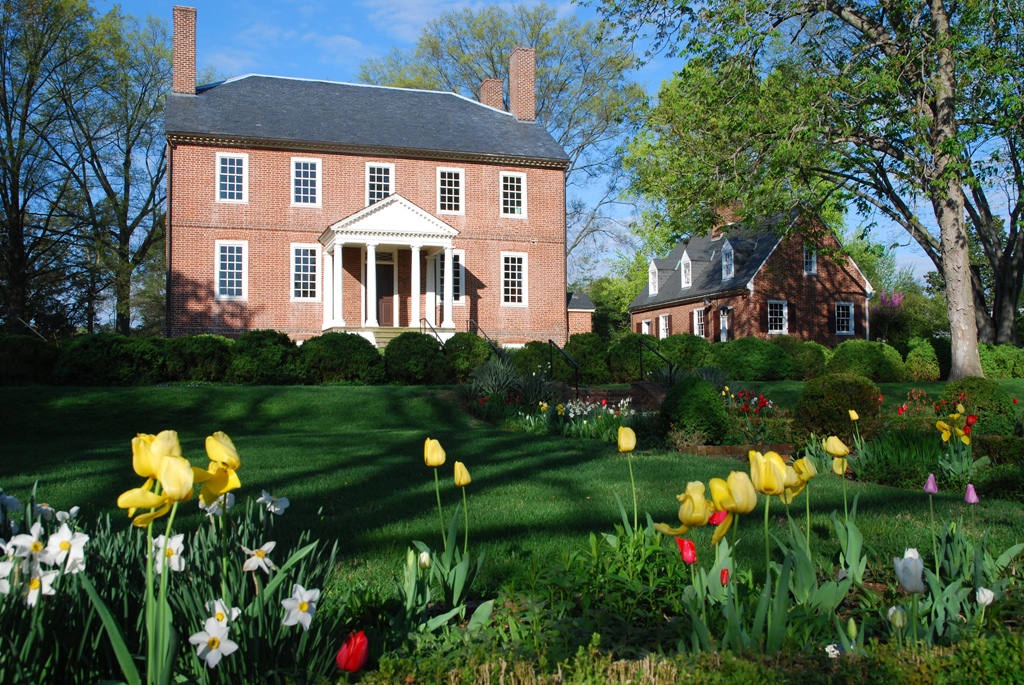
Lives and Legacies

Author: ferryfarmandkenmore

  • To See or Not to See? Portraying Hamlet in the 18th Century

    Editor’s Note: At the annual Shakespeare on the Lawn performances this June, Historic Kenmore will present Hamlet. The following blog post looks at the actors who played the most famous of Shakespeare’s roles during the 18th century. Details about attending the performances at Kenmore can be found at the end of this entry.

    Since the time when Richard Burbage of The Chamberlain’s Men first performed the role originally written for him by William Shakespeare, actors have long desired to play Hamlet.  As a character, Hamlet must convey both a flamboyant madness and a subtle deception, deliver long speeches of blank verse, and ultimately end the play with exhausting fight scene and tragic death. These highs and lows have made actors covet the complex role for centuries.

    In the 1700s, Hamlet was wildly popular in London in part due to famous portrayals by different actors. At the beginning of that century, Thomas Betterton was still portraying the young Prince of Denmark as he had first done on London stages back in 1661. Although his portrayal of the young Dane spanned 50 years, theatre-going Londoners still praised Betterton’s Hamlet into the eighteenth century.

    If there was one name to know on the London stage in the 18th century, it was David Garrick. As a writer and actor, he was synonymous with celebrity. Garrick’s portrayal of Hamlet in the 1740s was one of the performances that made him into that celebrity. He would go on to perform his own adaptation of Hamlet, which omitted Ophelia’s and Gertrude’s deaths, readjusted act breaks, and reintroduced much of Shakespeare’s original text. The original text had slowly been stripped away throughout the 1700s due to the play’s length. It was Garrick’s unique theatricality that inspired him to employ a striking feature.  During the scene when Hamlet first meets the Ghost he wore a special wig with hair that could stand on cue to signifying his terror.
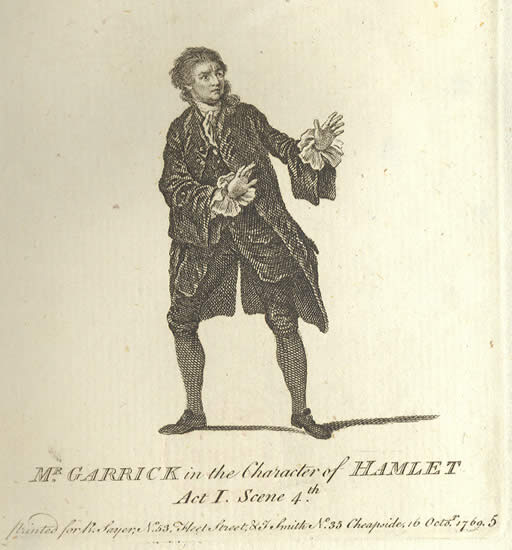
    Garrick as Hamlet
    Etching of David Garrick in Hamlet from Dramatic Characters, or Different Portraits of the English Stage, 1773. Public Domain. Credit: Wikipedia

    Not to be out done by men, actresses of the 18th century were also known to perform Hamlet on English stages. In what were known as ‘breeches roles’ at the time, it was common to see actresses step into men’s roles. However, this was far more common in comedies than in tragedies. Both Fanny Furnival (the first recorded female Hamlet) and Charlotte Charke (daughter of playwright and poet laureate Colley Cibber) played the role of Hamlet, albeit never on a London stage. The most famous eighteenth century female Hamlet to tread the boards was Sarah Siddons, who brought a respectability and gravitas to the role that raised the public esteem of actresses across England.

    Portrait of Mrs. Sarah Siddons (1755-1831)
    Portrait of Mrs. Sarah Siddons (1785) by Sir Thomas Gainsborough . Public domain. Credit: National Gallery, London

    While these different depictions of Hamlet are fascinating, they never crossed the Atlantic. In fact, the first group of professional actors would not perform in the colonies until 1752. At the center of this London Company of Comedians was the Hallam family. They came to the American Colonies in search of audiences seeking quality professional theatre. On September 15, 1752, their first performance was The Merchant of Venice in Williamsburg, Virginia. That evening would also be the debut performance of the young Lewis Hallam Jr., son of the company’s manger and leading lady. Lewis would go on to become the leading man of the company.  In the first recorded performance of Hamlet in the colonies in Philadelphia on July 27, 1759, the playbill lists 17-year-old Lewis in the title role.  He and his company would tour the colonies for the next 15 years until the American Revolution forced theatre from our shores.

    Company of Comedians - Va Gazette
    Hallam’s Company of Comedians announcing their intention to perform in Fredericksburg in The Virginia Gazette on April 30, 1752.

    Not all colonial Americans had the opportunity to see Hamlet upon the stage. Theatre was banned in Massachusetts throughout the colonial time period. Thus, Williamsburg was a frequent stop of Hallam’s company, which came to be called the American Company of Comedians. Of all the recorded performances in Virginia’s capital city, Hamlet is not listed, however. This does not mean that the likes of George Washington and Fielding Lewis could not have seen it.

    In fact, a playbill from May of 1771 reveals the American Company of Comedians performed in Fredericksburg, Virginia. This surviving playbill includes a handwritten addition of two performances, All in the Wrong and Hamlet. While the playbill does not include that evening’s cast, we can safely assume Lewis Hallam Jr. played the title role opposite Nancy Hallam as Ophelia.  We wrote about Nancy here last summer.

    If people are familiar with any words of Shakespeare, those words are most likely the beginning of Hamlet’s famous soliloquy: “to be or not to be?” But the real question for Shakespeare’s theatre going audiences has always been “to see or not to see?”  Ultimately, the decision was made based on the actor (or actress) playing the famous Dane named Hamlet.

    Joe Ziarko
    Manager of Interpretation & Visitor Services

    Hamlet Poster

  • May Flowers

    Beautiful flowers are in bloom in the demonstration garden at George Washington’s Ferry Farm!

  • Keeping Secrets, 18th Century Style

    In today’s world we keep our valuables, like money, important documents, jewelry, etc. locked safely in a bank vault or safety deposit box.  These options for safe-keeping of valuables were not available in 18th century America, and so our ancestors had to be a bit more creative in hiding their important items from would-be thieves or prying eyes.

    Probably the most romanticized method for securing valuables was the use of hidden or secret compartments in furniture.  There is no shortage of novels or plays that use a secret compartment to hide the key to the mystery.  In actuality, these secret compartments were fairly rare and usually reserved for only the wealthiest of people, those who could afford not only to commission custom furniture, and perhaps pay for the joiner’s silence about the location of the hidden drawer or concealed box.   Still, when a curator encounters an 18th century case piece, one of the first things they look for is any sign of just such a feature.

    Two candidates at Kenmore for hidden compartments have thus far revealed nothing.  Betty Lewis’s desk, now on display in the Chamber, is a likely suspect because of how it would have been used during it’s time in the Lewis household.  Betty’s desk was the hub of her “command central.”  She ran every aspect of the household from that desk, including the management of funds and the storing of expensive foodstuffs, like spices and sugar.  The spices were kept under lock and key and doled out to kitchen servants as needed, while money would have been kept under strict supervision.  Either could be a candidate for storage in a secret compartment in the desk.  Although the desk contains a multitude of tiny drawers and divided pockets, many with tiny key locks, we haven’t yet found a truly hidden space.

    Another, perhaps even more intriguing, possibility is the bookcase-on-desk currently displayed in Fielding’s Office.  This piece does not have a Lewis family provenance, but its history includes a span of time when it was used in the back room of a store, as the proprietor’s desk.  It, too, has a variety of drawers and doors, many of which were marked by the shopkeeper as to what went in each.  Surely, this piece must have at least one hidden compartment, a place for the shopkeeper to hide the day’s earnings or extra cash.  But sadly, nothing has surfaced yet, despite our best efforts.

    What Kenmore’s desks may lack in hidden compartments, is made up for by the house itself.  During Kenmore’s most recent restoration, a group of painters made an exciting find.  While stripping old paint from woodwork around a window on the second floor, a small section of paneling fell out of place.  At first, the painters were concerned that they had inadvertently broken original material, but upon closer inspection it quickly became clear that the small panel was intended to come loose from the surrounding woodwork.  Behind the panel was an open cavity between the decorative woodwork and the brick masonry of the wall.  And, to everyone’s astonishment, embedded in that masonry was a tiny drawer-front, with a little handle.  It turned out that during the original construction of the house, this small drawer had been built into the brick below the window in such a way that it could be accessed through a false panel in the woodwork.

    The drawer was empty when the painters found it, but there are a variety of theories about what it might have originally held.  Money or important documents are the most likely items, but suggestions have been made that Fielding might have concealed a gun there for personal protection, especially during the final months of the Revolution, when the Washington and Lewis family members were at risk of being kidnapped by the British for ransom.  Other theories have suggested that because Fielding was a frequent correspondent with General Washington, he concealed their letters in the drawer so that they wouldn’t fall in to enemy hands.

    Does the secret compartment’s location under a window that overlooks the town of Fredericksburg and all the way down to the riverfront where Fielding’s ships were docked provide a clue? And why would the compartment be placed in this particular room to begin with? It was simply a bedchamber, probably used by guests.

    While we may never know what secrets the hidden drawer contained in Fielding’s time, we do know that today it has become a time capsule of sorts and holds the business cards of anyone who has worked on Historic Kenmore.

    As with many aspects of Kenmore, there are many questions about this little drawer.  While we may never know the true story behind it, it allows for some imaginative possibilities!

    Meghan Budinger
    Aldrich Director of Curatorial Operations


  • Video: Inside the Archaeology Lab – Mending with Archival Glue

    In this video, we discuss the importance of using archival glue to mend artifacts and demonstrate the process used to make this special glue.

    For information about the safe use of these chemicals, visit http://www.collectioncare.org/MSDS/b72MSDS.pdf

  • Drinking Vessels and Their Drinks

    The goal of studying archaeological artifacts and, indeed, the goal of studying history more broadly is to understand the people who lived in the past both in the small moments and in the times of monumental change.  Something as ordinary as the beverages people drank and the objects from which they drank reveal what life was like in the past.  In this post, we examine three popular beverages, the vessels used to drink them, and their historical significance.

    Tea: In the 18th century English speaking world, tea was synonymous with high society. Not only was the tea itself expensive (since it was shipped from across the globe) but the entire culture around tea was costly. One could not serve tea without a proper tea service or equipage. The first English references to tea come from early 17th century English merchants abroad in Asia. However, tea wouldn’t enjoy universal English adoration until later in the century when Charles II married Princess Catherine of Braganza of Portugal in 1662 and brought the practice from Europe into England. From then on, tea represented wealth and high society wherever the English went, including across the Atlantic. Over a hundred years later, however, Parliament inadvertently changed tea’s beloved status amongst their North American colonists as colonists boycotted the drink to show their displeasure with the mother country’s rule. Even with that change, tea remained a highly-prized status symbol among many and even inspired some Americans to create ‘Liberty Teas’ from locally grown herbs and fruits.

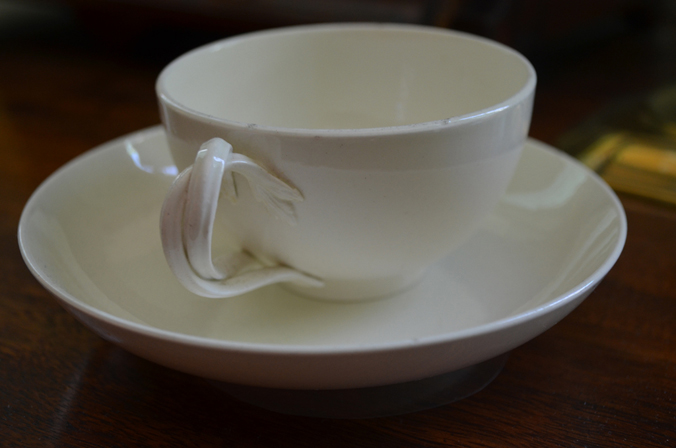
    Like the tea itself, teawares (the vessels in which tea was prepared and served) were fashionable and reflected societal trends.   Well-to-do families like the Lewises of Historic Kenmore exhibited their finest teawares and were expected to update their china cabinet with the most stylish wares they could afford.  Silver topped the list followed by porcelain. If those were lacking, elaborately decorated and finely potted stone and earthenwares would do in a pinch.  At the end of the Revolution, Fielding and Betty Lewis were reeling from wartime expenses so their teawares likely resembled this lovely creamware piece with a delicate strawberry flower at the base of the handle.  While not the most expensive teaware at the time, this molded creamware exhibited good taste and was suitable for the Lewis family to use while serving tea to their guests.

    Drinking Vessels (2)

    Punch: Much like tea, punch was also a status symbol in the 18th century. A punch’s different ingredients usually came from all over the world and were therefore quite expensive. Punch is first written about by 17th century English sailors. The word ‘punch’ is believed to come from the Hindustani word ‘paanstch’, meaning ‘five’, and may explain why historic punches have 5 parts: sweet, sour, strong, weak, and spice. Typically, the sweet was sugar, the sour was a citrus fruit such as lemons, limes, or oranges, the weak was water or tea, the strong was alcohols like rum or whiskey, and the spices could be nutmeg or cinammon. These 5-parts allowed punch to be made from any number of ingredients and to take on unique identities and flavors. Punches varied greatly between taverns and recipes (receipts) were closely guarded secrets. What was not flexible was the necessity of punch. Colonials could hardly have an elegant ball, a large celebration, or even a small get-together without the ubiquitous drink.

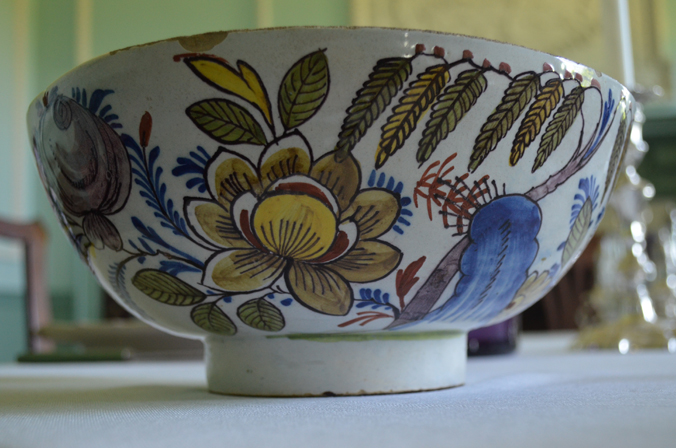
    As with tea, imbibing punch was a communal event requiring fancy equipage.  The bowls themselves ranged from elaborately decorated to elegantly simple and came in many sizes. The smallest served a single individual while grand bowls served lavish parties with dozens of tipplers.  Some bowls even conveyed political opinions or leveled jokes at members of society.  Suitable for a modest gathering of friends, this tin-glazed punch bowl displayed at Kenmore was owned by the family during their more prosperous pre-war days. By the time they moved to Kenmore, however, this cheerfully hand-painted bowl was falling out of fashion.  Tin-glaze was less refined than later wares and was easily chipped and cracked, making it less desirable.

    Drinking Vessels (3)

    Fortified wine:  In 18th century America, fortified wine reigned supreme.  Lacking our own wine industry, despite the best efforts of Thomas Jefferson and others to establish wine grapes in the colonies, we relied on imported wines from Europe.  Because of the ocean journey, fortified wines such as Madeira, port, and sherry became very popular.  These wines shared one thing in common:  The fermentation process was halted by the addition of brandy.   This upped the alcohol content considerably and made the wine portable over long distances.   Most wines prefer a quiet life in a cool environment.  Fortified varieties, however, thrive on chaos and age better when subjected to extremes of temperature, humidity, and constant sloshing around in the belly of a huge ship.  These choice wines even exhibited labels documenting their torturous journeys.  Wines that traveled south of the equator before eventually making their way up the coast to the colonies were especially prized.  Once a fortified wine found its way into a household, it was likely stored in an attic or on a portico, where it would continue to improve while battered by cold winters and sweltering heat.

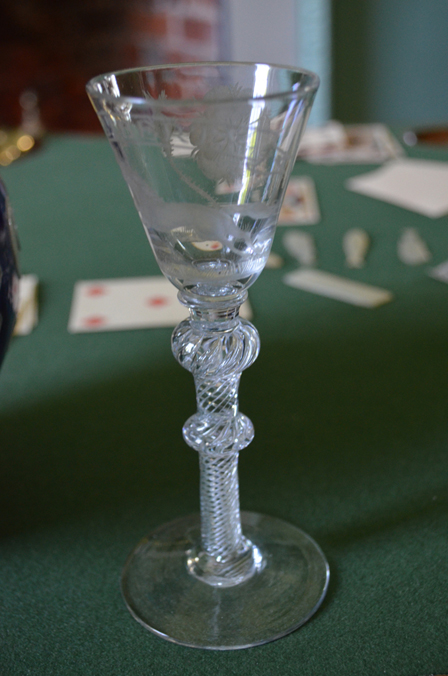
    Today, fortified wines are considered desert wines to be consumed after dinner.  The colonists, however, needed no such excuse to pop open a bottle of fine Madeira.  They did, however, traditionally drink these more potent wines from smaller glasses.    This lovely lead glass example is hand-blown and engraved using a copper wheel.  Probably manufactured in England in the late 1700s, one can only imagine the delicious wines it once held!

    Drinking Vessels (1)

    Mara Kaktins, Archaeologist
    Ceramics & Glass Specialist

    Joe Ziarko
    Manager of Interpretation & Visitor Services


  • Apple Cedar Rust: What on Earth is It and Why Does It Matter?

    Apple Cedar Rust (2).JPG

    Sometimes nature can be stranger than fiction.  At George Washington’s Ferry Farm, we are currently experiencing such a phenomenon:  Apple Cedar Rust.  Hideous in appearance, yet strangely fascinating, this fungus erupts on our cedar trees every few years when temperature and moisture are just right. It’s a monstrous growth with bright orange tentacles.  Like some bizarre alien fruit, they hang from the cedars after which they shrivel up and disappear until the conditions are just right for the fungus to become active again.

    But what are these odd gooey orbs, called ‘galls’, on the cedars and what do they mean in a greater context?  Well, what we are seeing at Ferry Farm and all around the Fredericksburg, Virginia area is actually only one stage in the life of the Apple Cedar Rust.  This fungus requires two trees to complete its two year life-cycle, as is evidenced by its name.  The gall on the cedar erupts with orange protrusions, called ‘horns’, during the spring and release millions of spores that will float on the wind for several miles trying to find an unsuspecting apple or crabapple tree in bloom.  At this point, the spores infect the leaves and blossoms of the poor tree, causing unappealing blemishes on the fruit and, occasionally, a total loss of the apple crop.  At the end of the summer, the fungus that developed on the underside of the apple leaves also releases spores that travel back to the cedars, where they lay dormant for over a year before eventually sprouting the orange jelly-like grows and starting the cycle again.

    Apple Cedar Rust (1)This disease had the potential to devastate colonial-era apple crops.  Although wild crabapple varieties were native to the Americas, European immigrants quickly introduced domesticated apples to the New World and widely cultivated the fruit.  Baked into pies and puddings, dried, turned into preserves, and even added to savory dishes, apples were very popular.  Not just prized as a food, the delicious fruit was also commonly converted into hard cider, which could be stored much longer than fresh apples and rivaled beer in popularity with colonials.  In years of abundant crops, excess apples could even be used to finish livestock prior to butchering.  As such, most colonial households grew at least a few apple trees. The loss of some or all of this fruit would have been tragic.  Native Americans also suffered the loss of indigenous crabapples, which provided food for them and for animals they hunted and relied on.
    It is unclear if the complex phenomenon of Apple Cedar Rust was understood by European settlers and Native Americans. Did they know that the strange orange masses on cedar trees signaled a drop in apple yields?  It is a question to ponder. Lacking the fungicides of today, early Americans’ only recourse would have been to destroy all the cedars within a few miles of their trees – not a very practical solution.  Most of us today do not grow our own food so Apple Cedar Rust is merely a gross curiosity, but to colonial farmers and past inhabitants of the early North American landscape, the ugly fungus may have caused real problems.

    Mara Kaktins, Archaeologist

  • Video: Inside the Archaeology Lab – ‘Vesselization’

    In this video, we show you how archaeologists piece together artifacts in order to learn about the object and, most importantly, the people who used the object.

  • “With Double Its Weight of Vermin”: Bugs in George’s Bed

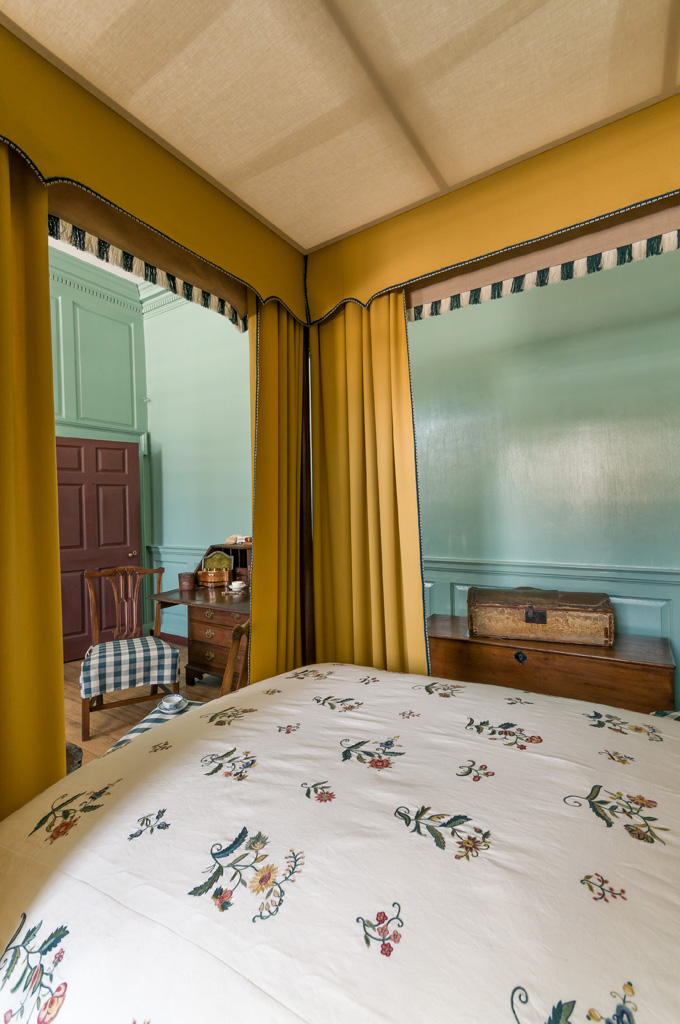
    Chamber (1)
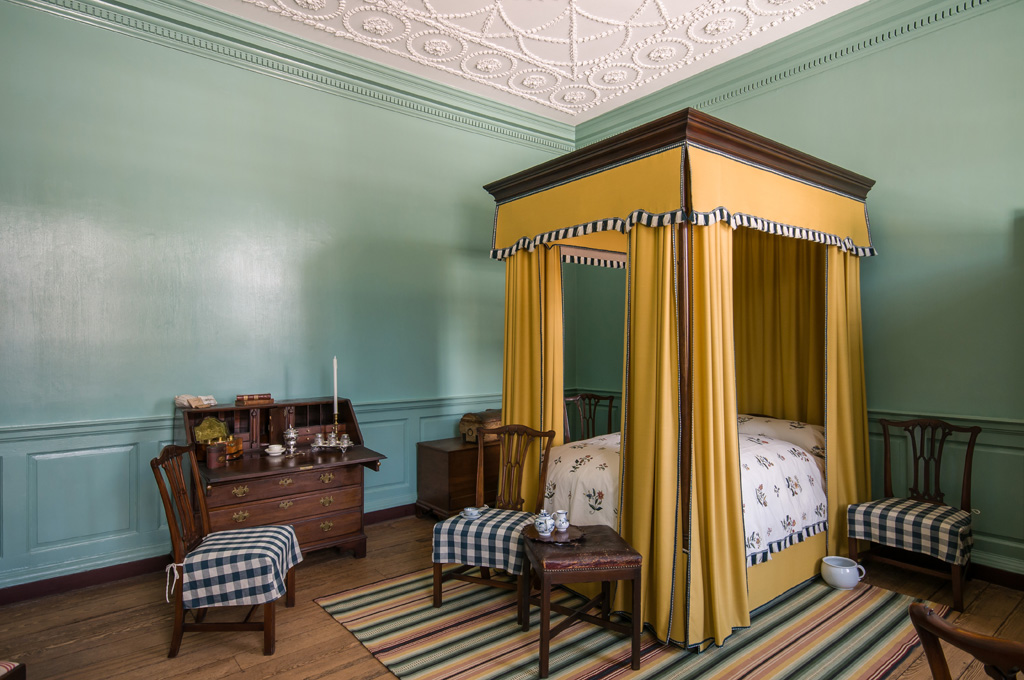
    The Bed Chamber at Historic Kenmore

    “I went in to the Bed as they call’d it when to my Surprize I found it to be nothing but a Little Straw—Matted together without Sheets or any thing else but only one Thread Bear blanket with double its Weight of Vermin such as Lice Fleas &c,” wrote 15-year-old George Washington in his Journal of my journey over the mountains kept during one of his earliest surveying trips to Virginia’s frontier.

    Furthermore, when young George copied The Rules of Civility and Decent Behavior as a handwriting exercise in school, one rule cautioned the aspiring gentleman to “Kill no Vermin as Fleas, lice ticks &c in the Sight of Others.”

    As these two instances from Washington’s life hint, the days of early Americans teamed with insects.  “Bugs were everywhere,” writes historian A. Roger Ekirch, “especially given the proximity of dogs and livestock.”[1]

    Except for maybe the lice on one’s own head and body, probably nowhere were bugs more problematic than in bedding and bed furniture.  “Bedding afforded notorious homes to lice, fleas, and bedbugs, the unholy trinity of early modern entomology,” Ekirch notes.  Bugs in bed was a significant problem indeed and “people in Britain often referred to bedtime pests in martial terms—for example, ‘troops,’ ‘detachments,’ ‘a compleat regiment,’ and ‘whole armies’”[2]

    These insect armies certainly had plenty of places to hide. Beds of the 18th century were constructed of wood frames lashed together with rope.  The humblest of beds contained numerous nooks and crannies that served as home to numerous creepy crawlies. Wealthier homes were not safe from infestation.  Large canopy-style beds frequently decorated with ornate cravings greatly increased the number of hiding places for vermin. Sheets, blankets, quilts, and bed curtains added more hiding places.  Finally, the mattresses themselves were usually filled with straw or, for the more well-to-do, with feathers that bugs found to be soft and enjoyable homes.

    Chamber (3)
    Bed furniture, curtains, canopy, and coverings could become infested with variety of insects common to an 18th century plantation in Virginia. Housekeeping guides of the time included instructions on how to make concoctions to eliminate bugs from one’s bed.

    The number of bugs in bed meant that before going to sleep, “families engaged in ‘hunts’ of furniture and bedding for both fleas (pulex irritans) and bedbugs (cimex lectularius)” while they also combed lice out of their hair and picked lice off their clothing and skin.  Ekirch recounts that “to keep gnats at bay, families in the fen country of East Anglia hung lumps of cow dung at the foot of their beds, whereas John Locke advised placing the leaves of kidney beans about a bed to avert insect bites.”[3]

    The Compleat Housewife, or, Accomplish’d Gentlewoman’s Companion by Eliza Smith and The Art of Cookery Made Plain and Easy by Hannah Glasse, two popular guides to proper housekeeping in the 18th century, included recipes for concoctions aimed at killing bugs in bedding and bed furniture.  Both of these books were in Fielding Lewis’ library at Kenmore.

    Glasse's 'Art of Cookery' frontispiece
    Title page and frontispiece to Hannah Glasse’s The Art of Cookery Made Plain and Easy (c. 1777).

    Glasse’s recipe for “How to keep clear from Bugs” advised closing up the room tightly by hanging blankets over shut windows, doors, and across the mouth of the fireplace.  Then, one opened any closets, cupboards, drawers, and boxes. Bedding and mattresses were pulled from the bed and hung over chairs and tables around the room.  In a broad earthen pan in the center of the room, one placed a chafing-dish full of lit charcoal to which was added brimstone (sulfur) and, if available, “India pepper.” This pepper was a source of capsaicin which served as an insect repellent. The sulfur suffocated the bugs and, frankly pretty much anything else in the room. The cautions within the recipe about leaving the room quickly and about reentering the room after several hours are lengthy.  The process left an irritating residue so, before it was safe to reoccupy the room, it had to be cleaned first.

    Smith’s The Compleat Housewife recipe for “destroying Bugs” essentially consisted of alcohol and pine resin.  Alcohol would kill any bugs on contact while the pine resin in the form of turpentine would act as a repellent to keep insects away.  One applied the liquid mixture to “the lacing, &c. of the bed, or the foldings of the linings or curtains near the rings, of the joints of holes in and about the bed, head-board, &c. wherein the bugs or nits nestle and breed.” The recipe advised pouring “some of it into the joinings and holes where the sponge or brush cannot reach.” This concoction was quiet unsafe as well for it also called for camphene, a high combustible mixture of alcohol and turpentine.  The Compleat Housewife warned to apply the mixture only “in the daytime, not by candle light, lest the subtilty of the mixture should catch the flame as you are using it, and occasion damage.”

    Lastly, both books included one other “Effectual Way to clear your Beadstead of Bugs” specifically for use on bed furniture. This recipe called for mixing quicksilver (poisonous mercury!) with eggs and then spreading the goo throughout the cracks, crevices, and joints of the bedstead and leaving it there.

    While all of these treatments would have been effective against the bugs, they were quite dangerous to humans as well.  The reprieve provided from infestation was probably relatively short-lived for the recipes all suggested repeating the process as needed.  Even with the help of Hannah Glasse or Eliza Smith, lice, fleas, and bedbugs were an ever-present and inescapable part of the 18th century life and could be found in the fine bed in Fielding and Betty Lewis’s chamber as well as in the dirty straw mat of the young surveyor George Washington.

    Zac Cunningham
    Manager of Educational Programs

    [1] A. Roger Ekirch, At Day’s Close: Night in Times Past, New York: W.W. Norton & Co., 2005: 270

    [2] Ekirch, 294-5

    [3] Ekirch, 270.

  • Shakespeare Day in Virginia!

    Title page of the First Folio, by William Shakespeare, with copper engraving of the author by Martin Droeshout. Image courtesy of the Elizabethan Club and the Beinecke Rare Book & Manuscript Library, Yale University
    Title page of the First Folio, by William Shakespeare, with copper engraving of the author by Martin Droeshout. Credit: the Elizabethan Club and the Beinecke Rare Book & Manuscript Library, Yale University

    Governor Terry McAuliffe has proclaimed today – Saturday, April 23, 2016 – as Shakespeare Day in Virginia!

    While we’re planning and preparing Shakespeare on the Lawn in June, our first-ever Shakespeare Camp in July, and Shakespeare by Candlelight in August as Historic Kenmore’s contributions to this year’s many commemorations across the Commonwealth, we want to take a moment on this auspicious day to celebrate Shakespeare’s countless literary achievements!

    Both the theater and Shakespeare were beloved by George Washington and that love began when he was young man living here in Fredericksburg.  For this reason, The George Washington Foundation has presented regular performances of Shakespeare’s plays for many years now.

    To mark Shakespeare Day, we’ve decided to share some photos from last year’s Shakespeare on the Lawn performance of King Lear.

    You can see an additional photo album of last year’s Shakespeare by Candlelight presentation of Cymbeline here as well as a collection of posters from a variety of other past performances here. Furthermore, read up on Shakespeare and theater history here, here, and here.

    Finally, here is the text of the Governor’s proclamation:

    WHEREAS, William Shakespeare, an English poet, playwright, and actor is widely regarded as one of the greatest writers in the English language and one of the world’s pre-eminent dramatists; and 

    WHEREAS, 2016 marks the 400th anniversary of William Shakespeare’s death and is an opportunity to celebrate his work and influence in English literature, film, poetry, and classics studies; and

    WHEREAS, the Virginia Shakespeare Initiative (VSI) is a statewide celebration of William Shakespeare’s work, and will host more than a dozen events across the Commonwealth on April 23, 2016; and

    WHEREAS, on this day, tourism councils, schools, college systems, libraries, and museums will open their doors to exhibits, activities, and celebrations focusing on the works of Shakespeare; and

    WHEREAS, Virginians are encouraged to participate in Shakespeare Day;

    NOW, THEREFORE, I, Terence R. McAuliffe, do hereby recognize April 23, 2016, as SHAKESPEARE DAY in our COMMONWEALTH OF VIRGINIA, and I call this observance to the attention of all our citizens.

    Zac Cunningham
    Manager of Educational Programs

  • Restoring Kenmore’s Gardens

    Kenmore's Gardens 1

    While the various restorations of Kenmore itself over the years are usually the star attraction for visitors to the site, there was another restoration, equally as important, that occurred on the property in its early years as a museum.  Kenmore’s gardens are well-known for their beauty now, but when the Kenmore Association acquired the property in the 1920s, the grounds were in a sad state.  It would take generations of work and ingenuity from a variety of people and groups to return the gardens to their former glory.

    Perhaps the most important moment in the history of Kenmore’s gardens was when the Garden Club of Virginia decided to tackle them as their first-ever restoration project in 1929.  The Garden Club established Virginia Garden Week specifically to raise funds for the project.  Their success in both completing the first restoration of Kenmore’s gardens, and in creating a significant annual event across the Commonwealth of Virginia lead to more than 50 historic garden restorations since, and the celebration of its 83rd Historic Garden Week next week.

    In 1940, the next phase of Kenmore’s garden restoration began when the Garden Club agreed to fund the implementation of designs by the renowned Southern landscape architect Charles Gillette.  His plans included the “secret garden” area in the northeast corner of the grounds, the brick wall that currently surrounds the property, and Kenmore’s iconic brick gate on Winchester Street. Gillette would continue his work at Kenmore into the 1950s.

    Garden Letter 1
    Page 1 of a letter from Hetty Harrison to Annie Fleming Smith dated June 26, 1940 informing the Kenmore Association that the Garden Club of Virginia had selected Kenmore as its restoration project and that renowned Southern landscape architect Charles Gillette would provide the design.
    Garden Letter 2
    Page 2 of the Harrison-Smith letter
    Tree Planting
    Ceremonial tree-planting on the Kenmore grounds, 1938.

    Most recently, the Garden Club of Virginia undertook another restoration of the gardens in 1992.  The Club remains a vital supporter of Kenmore’s landscape efforts to this day.

    During Historic Garden Week, enjoy Kenmore’s gardens and experience the house in a new way! On Tuesday, April 26, try a specialty tour highlighting one of three topics—the restoration of Kenmore at 11:00 a.m. and 2:00 p.m., American Revolution at Noon and 3:00 p.m., and ceramics at 1:00 p.m. and 4:00 p.m.  For more information and to view the specialty tours monthly schedule, click here.

    Meghan Budinger
    Aldrich Director of Curatorial Operations