Lives and Legacies

Category: George Washington

  • Ten Pivotal Moments in George Washington’s Boyhood

    George Washington did not experience what we would now consider a normal childhood.  Life at Ferry Farm was filled with excitement, sadness, intrigue, and tragedy for young George. Here we present a list of “Ten Pivotal Moments of George Washington’s Boyhood.” This is by no means an exhaustive list but each of these events definitely helped shape Washington into a man capable of commanding the Continental Army and serving as the new nation’s first president.

    Moving to Ferry Farm

    chapman_GW HOME_overlay3_day1
    “View from the Old Mansion House of the Washington Family Near Fredericksburg, Virginia” (1833) by John Gadsby Chapman modified to depict the location and approximate appearance of the Washington family home, which was actually a complete ruin when visited and painted by Chapman in the early 1830s.

    In 1738, Augustine Washington moved his family to Ferry Farm.   He appears to have chosen this plantation situated across from Fredericksburg to be nearer to his iron ore interests located about seven miles away.  Ferry Farm was very different than the other Washington properties.  The proximity of Fredericksburg made it more urban.  Ferry Farm was also surrounded by transportation routes including the Rappahannock River, and two roads that crossed the plantation.  The bustling nature of Ferry Farm and its surroundings played a critical role in George’s development.

    strother-ad
    Announcement in the Virginia Gazette in April 1738 advertising “100 acres, lying about 2 miles below the Falls of Rappahannock . . . with a very handsome Dwelling house.” The property was being sold by  William Strother’s estate, would be purchased by Augustine Washington, and eventually come to be know as Ferry Farm.

    The Deaths of Mildred and Augustine
    George’s youngest sister Mildred was born shortly after the family moved to Ferry Farm.  She lived only 18 months, and her death when George was just seven years old was the first significant death of his youth, but not his last.

    Augustine Washington, George’s father, followed Mildred in death on April 11, 1743. George inherited Ferry Farm and ten slaves from Augustine. His mother, Mary, managed this inheritance until George turned 21 years old. Augustine’s death began a period of financial hardship for the family and probably prevented George from being educated in England, a lost opportunity he remained self-conscious about for the rest of his life. It also meant George had to scramble to find a mentor to introduce him to the complex requirements associated with gentry life.
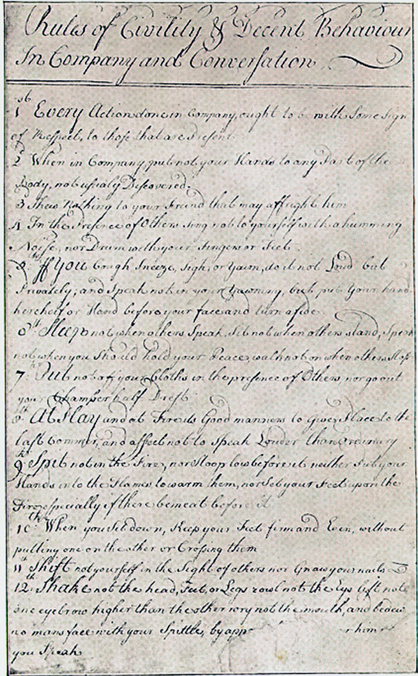
    rules-of-civility
    George Washington’s handwritten copy of The Rules of Civility and Decent Behavior in Company and Conversation.

    The Rules of Civility and Decent Behavior
    Young George copied The Rules of Civility and Decent Behavior, a guide to gentlemanly behavior in polite society, probably as a school assignment. This combination etiquette manual and moral code taught young George how to interact with his powerful and influential neighbors. By strictly following its advice, young Washington molded his character into that of a wealthy Virginia gentleman.

    His Gentry Education
    Washington’s diaries and accounts reveal how he mastered the pastimes of the gentry as a young man. He played for stakes at popular card games, took fencing lessons, and paid for his own dancing lessons. He frequented the theater in both Fredericksburg and Williamsburg. In a society obsessed with horse racing, equine bloodlines, and fox hunting, Mary Washington was well versed in horses and riding and appears to have been responsible for teaching George about riding.  By the time George was an adult, he was renowned as a “superb horseman.”  All of these skills, which remained with George for a lifetime, were acquired while he grew up at Ferry Farm.

    The Royal Navy Episode
    Following Augustine’s death, George’s eldest half-brother, Lawrence, took an interest in his future.  Lawrence conspired with Colonel William Fairfax, some of Augustine’s business associates, and George himself to convince Mary to allow 13-year-old George to join the Royal Navy. Mary eventually rejected the plan, a courageous act for a woman in male dominated colonial Virginia.  George turned to a career as a surveyor instead.  Imagine the future commander of the Continental Army serving on a King’s ship!

    schomberg-portrait
    Portrait of Frederick Herman  von Schomberg attributed to Adrian van der Werff. Public domain. Credit: Hampel Auctions / Wikipedia.

    Introduction to Military Adventurers
    On September 10, 1747, George purchased 3 books from his cousin Bailey for the combined price of 4 shillings 12 pence.  One of the books is listed as “Scomberg,” a reference to the 17th century German Protestant soldier of fortune, Duke Frederick Herman von Schomberg, who fought under the flags of France, Germany, Portugal, and England and died at the Battle of the Boyne fighting for William of Orange.  Schomberg wrote about his adventures which would have been of great interest and fascination to a young man of fourteen.  That George was willing to spend his hard earned money during a time of financial hardship reveals how enthralled he was by this subject.
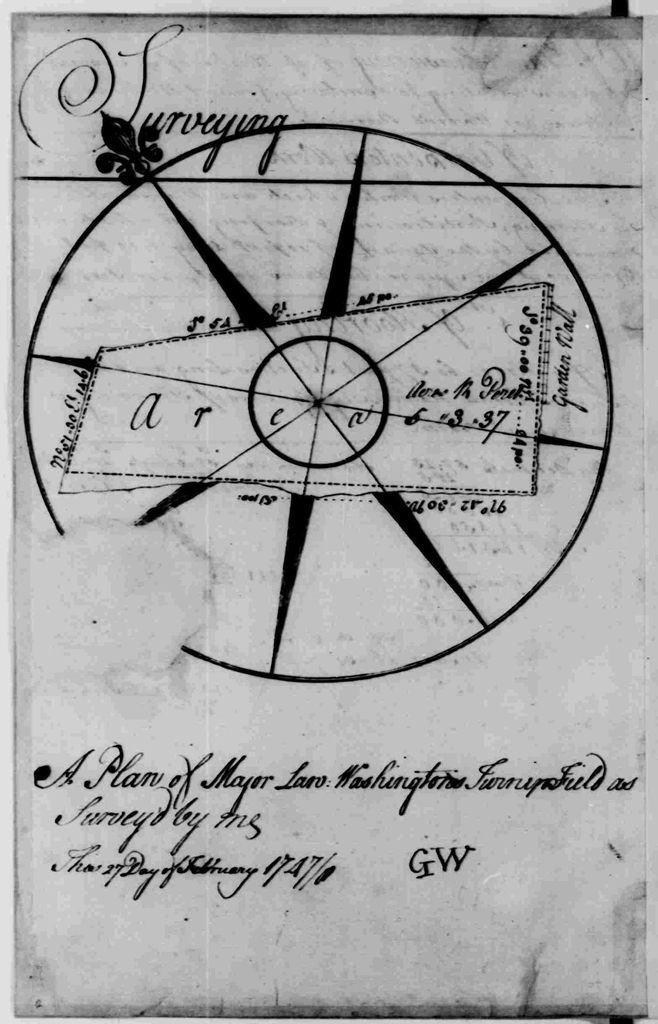
    turnip-patch-survey
    “A Plan of Major Law. Washington’s Turnip Field as surveyed by me this 27 Day of February 1747 GW” Credit: Library of Congress

    Surveying: His First Job
    George Washington began surveying at about age 15. His father’s probate inventory included a set of surveyor’s instruments. In 1748, at age 16, George went with Lord Fairfax’s surveying party on his first expedition into the wilds of western Virginia.  At age 17, George Washington was appointed to his first public office as surveyor of nearby Culpeper County. Surveying, like his skills in mathematics and keeping accounts, helped him manage his properties profitably throughout his life.

    1749 – More Hard Times
    The financial safety net set up for Augustine’s wife and minor children had almost completely collapsed by 1749.  Before the monetary struggles were over, half of Ferry Farm would have been sold, and Mary’s land near the Accokeek Iron Furnace had been lost for failing to pay taxes.  George Washington in a letter to his brother wrote “…my Horse is in very poor order to undertake such a journey, and is in no likelihood of mending for want of Corn sufficient to support him…” He remembered these hard times well into adulthood writing in 1788, during another period of financial stress, that “I never felt the want of money so sensibly since I was a boy of 15 years old as I have done for the last 12 Months.”

    washington-barbados-painting
    “George Washington” (1997) by Walter Kerr Cooper

    Trip to Barbados
    In 1751, George Washington made his only trip abroad, traveling with his half-brother Lawrence to Barbados. Lawrence, suffering from tuberculosis, hoped the warm climate would prove beneficial to his health. He died from the illness, however, just a few months after his return to Virginia. Lawrence’s death set up the eventual inheritance of Mount Vernon by George.  The tropical island did little good for George’s health either.  He contracted a severe case of smallpox that left his skin scarred for life.


     GWs Request to be Appointed as the Virginia Militia Adjutant

    washington-portrait-1772
    Portrait of George Washington (1772) by Charles Willson Peale. The earliest authenticated portrait depicts Washington in the Virginia Militia uniform he wore during the French and Indian War. Credit: Washington and Lee University / Wikipedia

    In 1752, George Washington wrote a letter from Ferry Farm requesting that the Governor of Virginia appoint him as the militia adjutant position vacancy created by his half-brother Lawrence’s death.  The governor declined at this time, but one year later he did appoint George.  The 21-year-old Washington had no military experience at the time of his appointment.  This appointment eventually resulted in Washington igniting the Seven Years War between Britain and her colonies and France.

    Dave Muraca
    Director of Archaeology

    Zac Cunningham
    Manager of Educational Programs
  • In Memory of Mother Washington

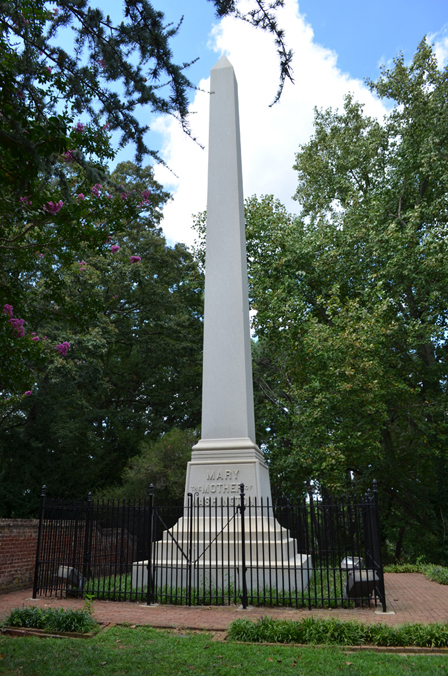
    2016MaryWashingtonMounment
    The Mary Washington Monument on Washington Avenue in Fredericksburg, Virginia.

    Today, August 25th, marks the 227th anniversary of the death of George Washington’s mother, Mary.   Mary lived to be 82 years old, and suffered from breast cancer during her final years.

    Few biographers have been neutral in their treatment of Mother Washington, a woman of great significance in George’s life.  Some writers have offered overly sentimental descriptions of this matron, whereas others have been critical, and even harsh in their evaluation of her role as George’s mother.

    Mary Ball married Augustine Washington on March 6, 1731.  Their marriage produced six children: George, Betty, Samuel, John Augustine, Charles, and Mildred.  When Augustine died twelve years later, a significant portion of the family’s property went to Augustine’s two oldest sons from his first marriage.  Mary raised their five surviving children at their Ferry Farm home, keeping the family together.  In 1772, at the insistence of her children, an aging Mary Washington moved into the town of Fredericksburg where she could be closer to her daughter, Betty.

    In the summer of 1789, Mother Washington’s health was rapidly deteriorating.  Betty wrote to her older brother George,

    “I am sorry to inform you my mother’s breast still continues bad.  …she is sensible of it and is perfectly resigned…  …the doctors think if they could get some hemlock it would be of service to her breast.”

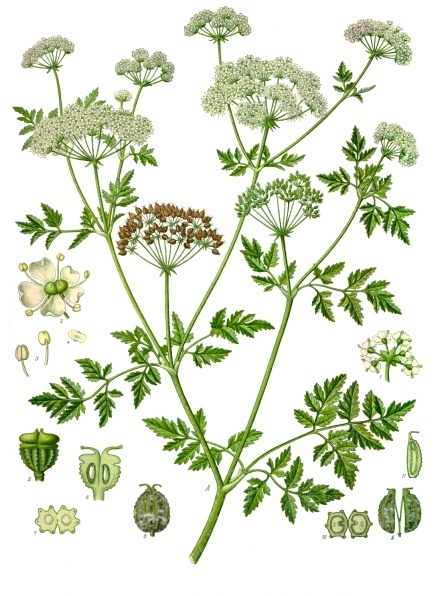
    Hemlock in Köhler's Medizinal Pflanzen
    19th-century illustration of hemlock or Conium maculatum (from Köhler’s Medizinal-Pflanzen). Public domain. Courtesy: Wikipedia

    Hemlock, an extremely poisonous plant that “affects the transmission of nerve impulses to muscle and causes death through respiratory failure,” was a traditional treatment for breast cancer in the early 1700s. Although doctors in England had largely abandoned this treatment by the late 1780s, when Mary Washington was suffering from this disease, it is evident that local doctors were not up-to-date on the most recent treatments.

    It seems likely that hemlock was indeed administered to Mary.  Burgess Ball wrote to George on the 25th of August, 1789:

    “The Cause of her dissolution (I believe) was the Cancer on her breast, but for about 15 days she has been deprived of her speech and for the five last days she has remained in a sleep.”

    These symptoms that Mary experienced in her final days, such as loss of speech and prolonged unconsciousness, seem consistent with hemlock poisoning, which attacks the nervous system and can cause comas.  Side effects include loss of speech (Steger 1972:71; http://www.webmd.com/).

    George publically recognized his mother’s role in his life at a 1784 event where he addressed the citizens of Fredericksburg, when he referred to her, “…by whose Maternal hand (early deprived of a Father) I was led to Manhood”.

    After his mother’s death, himself recovering from surgery to his left thigh (Abbot et al. 1992b, pp. 75-77), George consoled his grieving sister Betty Washington Lewis in a letter dated September 13, 1789:

    “Awful, and affecting as the death of a Parent is, there is consolation in knowing that Heaven has spared ours to an age, beyond which few attain, and favored her with the full enjoyment of her mental faculties, and as much bodily strength as usually falls to the lot of four score.  Under these considerations and a hope that she is translated to a happier place, it is the duty of her relatives to yield due submission to the decrees of the Creator….” 

    On August 28th, Betty Lewis and her children buried Mary Washington near a rock outcropping known today as “meditation rock” (Hetzel 1903:5).  The letter conveying the news of her death had still not reached her son George (Hetzel 1903:1), preventing him from attending the ceremony (cf. Rejai and Phillips 2000:15).  The burial site was part of the Lewis family’s Fredericksburg plantation.  This was a favorite spot of Mary’s, to sit, read the Bible, and spend time with her grandchildren.

    For some time, Mary’s grave had no permanent marker.  An attempt to move her remains to Mount Vernon stirred concerned local residents into action (NRHP 2002 Section 8, p. 21) and an effort was begun to place a marker on Mary’s final resting place in 1826.  While a cornerstone for a marker was laid in 1833, construction failed to materialize a suitable memorial before 1893 when the Mary Washington Memorial Association brought this effort to fruition (NRHP 2002 Section 7 p. 16, Section 8, pp. 22, 27).  In 1894 President Grover Cleveland, as well as his Vice President, the Governor of Virginia, the Mayor of Fredericksburg, a senator from Virginia, and thousands of citizens attended the dedication of the completed memorial (NRHP 2002 Section 8, p. 28).

    1903MaryWashingtonMonument copy
    The Mary Washington Monument as it appeared in 1903. Library of Congress photo.

    This Saturday, August 27th, you can commemorate Mary Washington’s death with the Washington Heritage Museums at the grave of Mary Washington.  A reception (cost $10) at the Mary Washington House on Charles Street follows.  For event details, visit washingtonheritagemuseums.org.

    Laura Galke, Archaeologist
    Site Director/Small Finds Analyst

    Further Reading

    Abbot, W. W., Dorothy Twohig, Philander D. Chase, Beverly H. Runge, Beverly S. Kirsch, and Debra B. Kessler
    1992  The Papers of George Washington, Confederation Series Volume 1.  University Press of Virginia, Charlottesville.

    Hetzel, Susan Riviere
    1903  The Building of a Monument Press of Wickersham Company, Lancaster, Pennsylvania.

    NRHP
    2002  National Register of Historic Places Form, Washington Avenue Historic District,
    http://www.dhr.virginia.gov/registers/Cities/Fredericksburg/1115262_Washington_Avenue_HD_2002_Final_Nomination.pdf (accessed August 11, 2016).

    Rejai, Mostafa and Kay Phillips
    2000  The Young George Washington in Phychobiographical Perspective.  The Edwin Mellon Press, Lewiston, New York.

    Steger, Robert E.
    1972  Native Plants Poisonous to Humans.  Journal of Range Management 25(1):71-72.

  • George Washington, My Grandfather, and the Noble Art of Fencing

    George Washington by Gilbert Stuart (1796). Public domain.
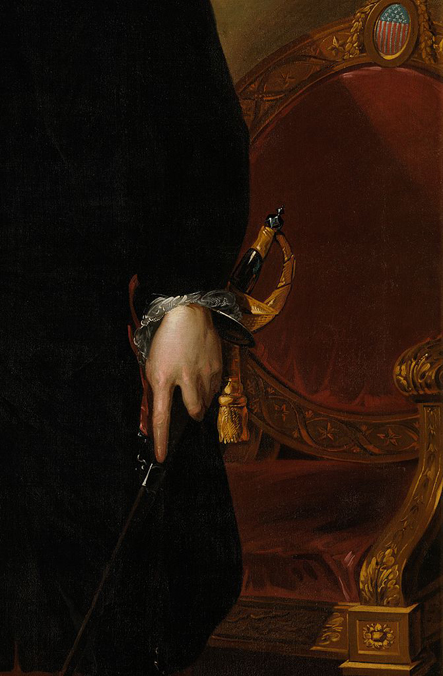
    George Washington by Gilbert Stuart (1796). In the portrait, Washington wears his ceremonial sword. Public domain.

    Editor’s Note: This is the second of two posts inspired by this year’s Summer Olympics. This week, Archaeologist Mara Kaktins reflects on the connection fencing has created between her family and George Washington. Read our first Olympics-inspired post here.

    At our monthly blog meetings, post topics are floated and people grab them up, usually when it aligns with individual research interests.  George Washington as an avid fencer seemed an appropriate subject with the Summer Olympics in full swing this month.  I am no fencer, nor am I an athlete, so why write about fencing?  The spirit to volunteer for this assignment came to me because of the recent passing of my father.  He, my uncle, and my grandfather were all fencers.  It led me to ponder our first president, my grandfather, and the modern Olympic sport of fencing.

    Let’s begin by examining the early history of fencing in the American colonies.  Long considered a ‘gentleman’s sport’, fencing was massively popular in Europe. Respect for the knowledge of sword play extended to the colonies, where masters from abroad set up schools to teach young men this ancient art.  These instructors did not just show their students how to fence.  Sword play was part of a larger artistic curriculum that could also include dancing, horseback riding, popular languages such as French, boxing, gentlemen’s games like cards, and knowledge of various musical instruments.   Fencing, or ‘short sword’ as it was sometimes called, was not seen as merely a sport.  It was referred to as an ‘art’.  With mastery, came not just dexterity, physical fitness, and strength but also good temperament, courtly manners, and a sense of restraint.  Teachers often emphasized that a gentleman well-versed in the sword was less likely to ever use one, having gained honor and discipline in addition to knowledge of a deadly weapon.  Sort of like the colonial equivalent of “With great power comes great responsibility”.

    George Washington by Gilbert Stuart Sword
    A closer view of Washington’s ceremonial sword.

    As a young man living at Ferry Farm, George Washington attempted to better himself learning all of the gentlemanly arts. It is no surprise he studied fencing.  Some evidence suggests that Lawrence Washington, his older half-brother who was a Captain in the Virginia Militia may have helped him in this regard.  Schooled in England, Lawrence learned all he needed to know of being a gentleman in the mother country, as was customary for gentry children.  George Washington never attended a real school, much less an English one.  He was determined, however, and sought his gentlemanly education where he could in Fredericksburg, Virginia.

    Ferry Farm Sword Fragment
    Fragment of a cooper-alloy hand guard from a sword dating to the late 1600s or early 1700s and unearthed by archaeologists at Ferry Farm.

    The closest dedicated fencing instructor was in far-away Williamsburg so George had to make do. The early George Washington biographer, Washington Irving, suggested that Lawrence and his military friends along with an adjutant known only by his last name of Muse probably instructed George in sword play.  There was also a rather mysterious Dutch mercenary and translator, Jacob Van Braam (all good stories should have a shadowy Dutchman).  Temporarily located in Fredericksburg, Van Braam was in between wars and supplemented his income by teaching young George how to handle a blade.  They later campaigned together and fought at Fort Necessity in 1754 where a mistranslation by Van Braam may actually have contributed to the conflict that is credited with helping start the Seven Year War.  Presumably the Dutchman was more skilled with weapons than in French and George Washington went on to become a famous general, often depicted carrying a sword, a symbol of his status and military skill.  Van Braam later fought in the Revolutionary War but for the British before retiring to France.

    Foil
    Fencing foil belonging to the late Uldis Kaktins, my father.

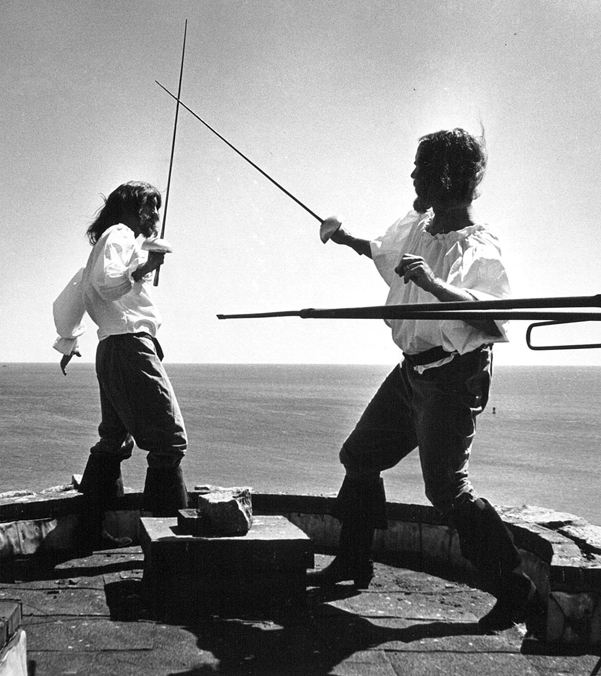
    Fast forward two centuries to a young man in Latvia named Zigurds, my grandfather.  Fencing remained a popular sport in Europe and a skill that educated men certainly looked to acquire.  Zigurds was tall, young, and handsome, had a law degree, and his father was a world famous opera singer.  Zigurds seemed to have a lot going for him and likely learned to fence for many of the reasons George did: physical prowess and a respected mental fortitude.  With the onset of the Second World War, Zigurds learned that the Soviets were going to deport him, his wife, and two young children to Siberia so he took his family and fled to the United States.  In America, his and his wife’s law degrees were worthless.  They moved into a rough but affordable neighborhood in Boston and worked blue collar jobs.  My grandfather’s life was completely different from what he had known in Latvia except for fencing.  He instructed fencing at the YMCA and headed a Latvian fencing club.  Normally a fairly stern figure, Zigurds once dressed as a ‘swashbuckler’ to be filmed fencing for a short film or commercial.

    Mara's Grandfather
    Zigurds Kaktins, my grandfather, (right) fencing in swashbuckler’s costume in the 1960s.

    Zigurds passed on fencing to my father and uncle.  My recently deceased father always had a grace about him.  He carried himself easily and with confidence but was quick and nimble when needed.  Perhaps not coincidentally, he was also an excellent dancer.  I think that his early instruction in fencing contributed to this grace.  A man of grace and confidence, an excellent dancer, and a fencer.  These words prove an apt description of my father, my grandfather, and the Father of my Country.

    Mara Kaktins
    Archaeologist

  • Video: Picnicking with Washington

    In this video, we talk about how people, including George Washington, picnicked in the 18th century and take a closer look at one particular piece of furniture used while on a picnic 200 years ago.

    You can read more about picnicking customs of the 1700s here.

  • “Dined at the Barbicue”: Washington Goes Picnicking

    In the summer of 1770, George Washington came to Fredericksburg for an extended stay. His time here would seem familiar to anyone who has gone back to their childhood hometown. While in town he visited his mother, went to the tavern to play cards with old friends, and stayed with his sister and brother-in-law. But the most interesting moment of his stay was on August 4, 1770 when he records…

    “Dined at the Barbicue with a great deal of other Company and stay’d there till Sunset.”

    GW BBQ Diary Entry (2)

    While it is difficult to understand what exactly he meant by ‘Barbicue’. It is safe to assume that it was a communal meal similar to a modern day cook-out. Going to a cookout, a barbecue or a picnic, in today’s parlance, all mean pretty much the same thing – eating well-known foods while outdoors, probably seated on the ground, in a casual atmosphere.  Above all, it is a highly social gathering.  We use these kinds of meals to celebrate national holidays, family occasions or just a beautiful day – it’s what Americans do.  But where did this past-time come from?

    In England, the idea of consuming light fare outdoors in the form of a picnic had been around since as early as 1748, when the word “picnic” first shows up in writing.  The word was probably a corruption of the French “pique nique” which basically means “to pick at small foods,” but for the English a picnic meant a fully mobile meal and all the accoutrements necessary to eat it.  Baskets of food were packed, equipment for entertainment (games of cricket or maybe some hunting or fishing) was gathered, and wagons were loaded (usually one for guests, and one or more for the provisions).  Then, the party set off to a pre-determined picturesque location, where it was all unpacked and set up by servants.  Although we might be amazed at the sheer volume of stuff these picnics required (everything from chairs and tables to cutlery and glassware), an 18th century English picnic was still considered a very informal affair by that time’s standards.  Guests might even be asked to contribute dishes to the meal (a forerunner of our potlucks), making recipes for picnic food were all the rage by the late 18th century.

    This painting shows chairs being provided for the ladies to use during lunch on a fishing trip. The Anglers' Repast (1789) by George Morland, 1763–1804, British, Oil on canvas. Public domain. Credit: Yale Center for British Art, Paul Mellon Collection.
    This painting shows chairs being provided for the ladies to use during lunch on a fishing trip. The Anglers’ Repast (1789) by George Morland, 1763–1804, British, Oil on canvas. Public domain. Credit: Yale Center for British Art, Paul Mellon Collection.

    While picnic’s etymology is relatively easy to trace, ‘Barbecue’ is far more difficult to pin down in the 17th and 18th centuries. Even the term itself is nearly impossible to decipher. The earliest known recording comes from a Spanish explorer in 1526, who used it as a verb meaning to roast meat. In 1672, the first reference in English came from the writings of John Lederer, a German explorer of the Blue Ridge Mountains. Originally written in Latin, Lederer’s expedition reports were translated into English by Maryland’s Governor Sir William Talbot and published.

    Many scholars believe the word “barbecue” most likely derives from the West Indian word “barbacoa” in the 16th century.  Believed to be a Taino word (although this is still up to scholarly debate), it is a term for slow-roasting meat over hot coals, usually using plenty of green saplings that would have created a lot of smoke. The meat originally roasted in this style was probably not the ubiquitous pork barbecue. While Christopher Columbus did bring some pigs on his voyage, it is Hernando de Soto who is credited with introducing the pig into Central America and Florida in 1539.

    The word, and the meat, was probably encountered by ships’ crews during the colonial period and eventually made its way to the American colonies.  Slow-roasting meat and spicing it with various rubs and marinades was a familiar concept in a many parts of the world, and especially on the African continent, so enslaved Africans living in the colonies also helped to proliferate the cooking method.  As happened with many traditions from around the globe that found their way to the New World, a true “barbecue” as George would know it quickly became a uniquely American concept, combining the English love of a good outdoor meal and the exotic foods and cooking methods of the West Indies and Africa.

    While the first American barbecues were practical affairs, held among enslaved communities or farming populations during the slaughtering season so as to quickly cook and preserve as much meat as possible, they very quickly took on a much more social aspect.  An entire town might gather for a barbecue, which might last for several days, perhaps to coincide with court days or a market.

    Between 1769 and 1774, George Washington recorded his attendance at six such affairs in his diary, including one barbecue that he hosted himself, another that was probably held at Fielding Lewis’s house in Fredericksburg, and a third in Alexandria at which he stayed all night.

    Meghan Budinger
    Aldrich Director of Curatorial Operations

    Joe Ziarko
    Manager of Interpretation & Visitor Services

  • Washington Birthday Wishes

    This month marks the 284th anniversary of George Washington’s birth. Americans have celebrated our first president’s birthday since long before it became an official national holiday in the late 1800s.  In fact, early Americans even marked George’s birth during his lifetime, most notably with “Birthnight Balls” that replicated the grand dances held in Britain to celebrate the monarch’s birthday.  In 1879, an Act of Congress made February 22 a holiday within the District of Columbia. Six year later, Congress expanded the holiday to all federal offices across the country.

    As with many American holidays, both officially recognized and otherwise, businesses created postcards and greeting cards to be used to send good wishes to family and friends on the holiday.  We have four such Washington Birthday postcards in our collection.  These cards date from around 1912-13, as a couple of the cards include cancelled postage stamps that note it being the 180th birthday of George Washington.

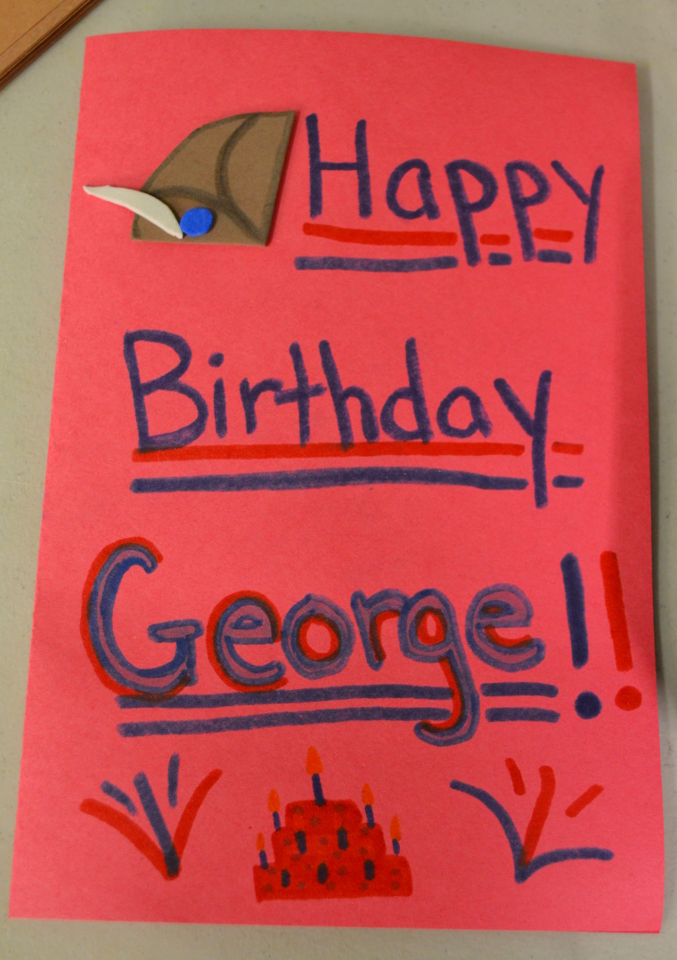
    This year, you can celebrate George Washington’s Birthday at Ferry Farm by making your own birthday card for George!

    Visitors even made birthday cards for George!

    Visit his boyhood home on Saturday, February 13 from 10:00 a.m. – 4:00 p.m. for family  fun, including games, crafts, exhibits, the Stone Throw Challenge (weather permitting), history theater, and birthday cake! “General Washington” will attend the Birthday Celebration to talk about his youth on the farm! You can see a short video of last year’s celebration here. $5 adults; 17 and under free.

    Additionally, on Presidents’ Day, Monday, February 14 from 10:00 a.m. – 4:00 p.m., learn about archaeology at George Washington’s Boyhood Home. Enjoy crafts, theater performances, presentations by Muraca the Magnificent – Guru of Glues, tours of the archaeology lab, a scavenger hunt, and the Archaeology Artifact Challenge.  Archaeology Day is a free event.

    For more information call 540-370-0732 x22 or email sherman@gwffoundation.org.

    Zac Cunningham
    Manager of Educational Programs
  • Video: George Washington’s Birthday at Ferry Farm

    Celebrate George Washington’s 284th birthday at his boyhood home with fun activities for the whole family, including games, crafts, exhibits, the Stone Throw Challenge (weather permitting), history theater, and birthday cake! “General Washington” will attend the Birthday Celebration to talk about his youth on the farm! The video below is a preview of the celebration.

    This year’s celebration is Saturday, February 13 from 10:00 a.m. to 4:00 p.m.

    For more information call 540-370-0732 x22 or email sherman@gwffoundation.org.

    $5 adults; 17 and under free.

  • Glue: The Coolest Thing I’ve Ever Found

    As an archaeologist, I am often asked “What is the coolest thing you’ve ever found?”  The answer is complicated.  Although I’ve unearthed 10,000 year old Paleoindian hearths, elaborate porcelains, coins, long lost jewelry, and ancient stone tools, I say that the coolest thing I’ve ever found is …. glue.  This proclamation always elicits questioning looks from well-meaning folks who expect something a little more glamorous.  Let me tell you why, to date, glue is the “coolest thing I’ve ever found.”

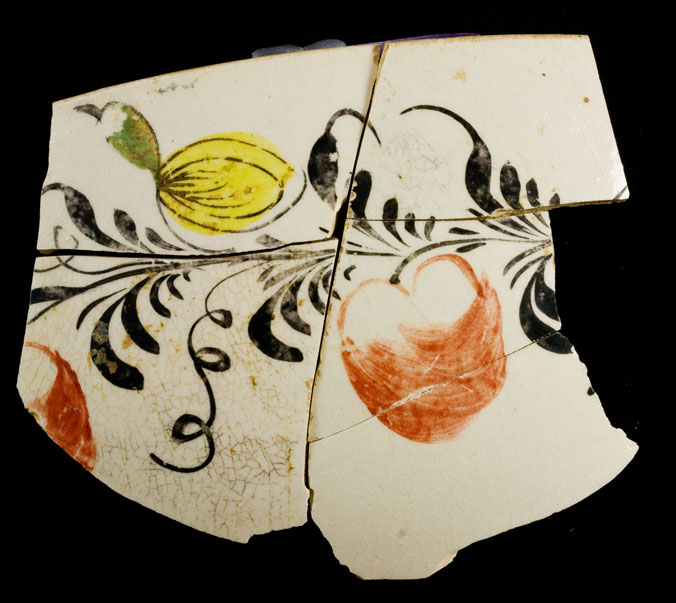
    It’s not just the glue itself that is incredible but also the object on which the glue was found.  When I started working at George Washington’s Ferry Farm, my first assignment was to examine creamware associated with Mary Washington, George’s mother, which was excavated from the cellar of the Washington home.  I focused on a lovely punch bowl with beautiful hand-painted enamel depicting a floral motif with cherry accents.  Obviously, we adore cherries at Ferry Farm, being the setting of the fabled chopping down of a certain tree by young George, and we wanted to learn more about it.

    PunchBowl

    cherry-sherds

    The punch bowl was manufactured in the 1760s or early 1770s.  It exhibited a lot of use wear, indicating it was obviously a favorite of Mary’s.  The punch bowl was of a size designed to be passed around at a gathering for each guest to take a sip directly from it.  This was a time before germs were well understood.  Thankfully, for health’s sake, 18th century punch contained a hefty amount of alcohol.  This also meant that punch was not cheap.  Actually, the production and drinking of punch was very much a ceremonial form of conspicuous consumption.  Mary chose this special bowl as much for its beauty as for its function.

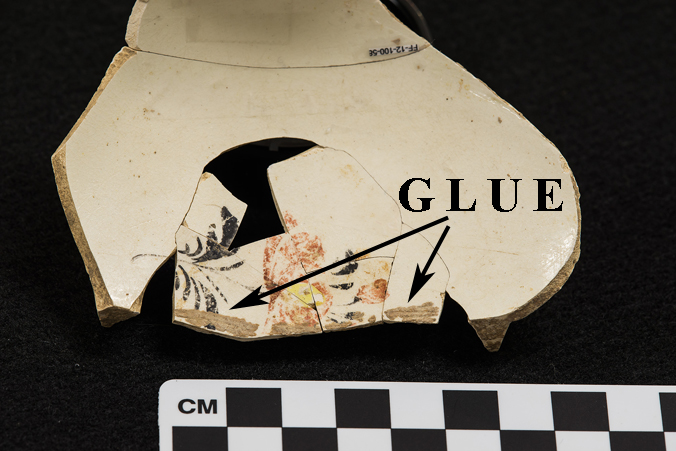
    After close inspection of the vessel, I noticed a strange substance adhering to many of the edges.  This unsightly brown stuff extended across the many breaks in the bowl and, upon microscopic examination, exhibited suspicious brush marks.  Furthermore, additional ceramics from the same cellar excavation revealed similar residues.  Could it be glue? If it were, this would shed light on a previously unknown behavior taking place in the Washington home – the breaking and subsequent repair of ceramics.  We had to know!  What followed was a multi-year study during which we tested the historic glue residue samples utilizing mass spectrometry courtesy of Eastern Michigan University. We spent months researching historic glues, replicating those glues, and then breaking and mending much thrift store pottery with the aforementioned glue in the name of science.  The conclusion?  We had indeed discovered eighteenth century glues!

    interior-glue copy

    While this may not seem like a ‘eureka’ moment, it was actually quite significant.  First of all, it’s amazing that 250-year-old glue survived in the ground for so long.  Second, the discovery improves our understanding of Mary Washington, a woman that gave birth to and shaped the young life of our first president.  By replicating period glues and mending modern pottery, we also learned that the vessels Mary had repaired probably were not used for anything other than display after mending.  They could not have held a liquid, which means that after it was broken and mended, the beloved punch bowl was probably relegated to mantle or shelf where the delicate hand-painted flowers and charming cherries could be admired but never used for its intended purpose ever again.

    We also concluded that Mary herself would probably not have made and applied the glues personally.  Turns out making eighteenth century glues involved a wide array of bizarre and often stinky ingredients including ox gall, animal hide, bull’s blood, garlic, eggs, cheese, isinglass (extracted from a fish’s swim bladder), and the slime from garden snails (yep). Watch the video below to see how colonial-era glue was made. You can also click here. It was a time consuming and messy endeavor that was likely undertaken by the enslaved people living at Ferry Farm rather than by the mistress of the house.

    To date, seven vessels belonging to Mary exhibit glue residue.  Interestingly, even though a professional mender was operating in the town of Fredericksburg just across the river from where she lived, Mary chose to have glue prepared at home with which to repair her ceramics. That, plus the fact that she had these pieces mended even though she could never use them again means Mary was a thrifty woman who saw the value in displaying the objects.  Perhaps demonstrating that she owned these highly fashionable ceramics took precedence over using them?

    What makes the glues even more exciting is that nowhere in the historic record does it mention that Mary was repairing ceramics at home.  Our only evidence for this activity is archaeological and it has revealed a previously unknown aspect of her life.  Perhaps now the question is not “Did George chop down the cherry tree?” but rather “Did George break the cherry punch bowl”?

    And all that is why glue is the coolest thing I’ve ever found.

    Mara Kaktins, Archaeologist
    Ceramics & Glass Specialist

  • Tallio! Fox Hunting at Christmas

    Although Fielding Lewis certainly built a home capable of hosting the elaborate Christmas celebrations popular in 18th century Virginia, Historic Kenmore probably never saw occasions on such a lavish scale, with the possible exception of the family’s first Christmas in the house in December 1775.  If the family hosted the traditional Christmas celebration, Fielding and Betty would have welcomed lots of friends and family, serving them fancy dinners and entertaining them with dancing and music. They and their guests might have enjoyed fox hunts as well.

    Virginians regularly included fox hunts as part of their Christmas celebrations.[1]  In an era long before environmental conservation, colonial Virginians viewed foxes as pests that endangered livestock, which is why they hunted them so relentlessly.[2]  Additionally, during hunts, gentry men like George Washington could show off their hunting dogs and their skill at horseback riding while chasing foxes through the countryside.

    George Washington loved fox hunting. In the year 1768, for example, he went on fox hunts 40 different times.  These hunts often lasted hours.  On a March day in 1768, he caught “a fox with a bobd Tail & cut Ears, after 7 hours chase.

    George owned numerous hunting dogs and “helped develop the breed known as the American Foxhound.”  These hounds chased the fox and hunters on horseback chased the hounds.  The chase required galloping horses to jump over streams, bushes, and fences and riders to duck under low-hanging tree limbs.  Fox hunting allowed wealthy Virginians to show-off their horse riding skills and George was widely considered an excellent horseman.

    Hunters also wore special clothes.  George went hunting in “a blue riding frock and scarlet waistcoat threaded with gold lace and topped by a black velvet cap.  He wore high boots and carried a . . . riding crop.”[2]    He wore cuff links that said “tallio” on them – that’s what hunters would shout when they found a fox.  These cufflinks were unearthed by archaeologists at George Washington’s Ferry Farm and their discovery hint at George’s interest in fox hunting even in his younger years.  He also hung paintings of fox hunts on the walls of his home at Mount Vernon.

    TallioCufflinks
    Cufflinks discovered in the parlor root cellar and yard of the Washington House at Ferry Farm show a fox running across grassy rolling hills with the word “tallio” engraved above. This is a popular 18th century motif.

    Like the George’s paintings at Mount Vernon, Fielding Lewis included foxes in the decor of his home. At Kenmore, the Lewis children were always reminded of the sneaky ways of foxes when they looked at a picture above the Dining Room fireplace.  The plaster image illustrates the Aesop’s fable known as “The Fox and the Crow.”

    Fox Crow Overmantle (1)
    This plaster over-mantle in Historic Kenmore’s dining room depicts the Aesop’s Fable known as “The Fox and the Crow.”

    One day a fox saw a crow flying with a piece of cheese in its beak and settle on a branch of a tree.  “That’s for me!’ said Master Fox, and he walked up to the foot of the tree.

    “Good-day, Mistress Crow,” he cried, “How well you are looking today; how shiny your feathers; how bright your eyes.  Your voice must be more beautiful than that of other birds.  Won’t you, please, sing me a song that I may know you are the Queen of Birds?

    The crow, quite happy to hear such praise, began to sing her best – “Caw, Caw, Caw”, but when she opened her beak, the piece of cheese dropped to the ground and was snapped up by Master Fox.

    Fox Crow Overmantle (2)
    A close-up view of the over-mantle shows Mistress Crow dropping her cheese to be scooped up by Master Fox.

    “Aha, Mistress Crow,” said he.  “That was what I wanted.  In exchange for your cheese I will give you some advice for the future: “Beware of false flattery.”

    This Christmas, some sneaky foxes have found their way into Kenmore.

    Fox in Kemore 2
    A sneaky fox hiding somewhere inside Kenmore.

    During the holiday season, younger visitors can help us look for them in a special scavenger hunt and learn about the colonial Christmas custom of fox hunting.

    Zac Cunningham
    Manager of Educational Programs

    [1] Philip Vickers Fithian, Journal & Letters of Philip Vickers Fithian, 1773-1774: A Plantation Tutor of the Old Dominion, ed Hunter Dickinson Farish (Williamsburg, Va., 1943), entry for Dec. 18, 1773: 44

    [2] Jane Carson, Colonial Virginians at Play, Williamsburg, VA: Colonial Williamsburg Foundation, 1998: 62-64

    [3] Ron Chernow, Washington: A Life, New York: Penguin Press, 2010: 124-5.

  • A ‘Link’ Between the Washingtons and William and Mary

    William III sleeve link
    Close-up of a mid-1700s sleeve link recovered at Ferry Farm. It features the image of King William III.

    This cuff link or ‘sleeve button’ – made in the mid 1700s – was recovered by archaeologists from George Washington’s boyhood home at Ferry Farm.  It is one of the earliest examples of the Washington family’s resistance to King George III.  What makes this sleeve button so interesting is the man depicted:  King William III, who ruled England with Queen Mary.  This sleeve link was made two generations after the death of this monarch.  Nonetheless one of the Washington brothers wore this politically provocative accessory.  What made William III, a monarch who died in 1702, an attractive choice for colonial apparel during the mid-1700s?  The answer resides in this sleeve link’s political dimensions and reflects the Washington family’s early resistance to Crown policy.

    November is an appropriate time to remember the polemical reign of William and Mary:  they were married on November 4, 1677 and William landed at Torbay, England, November 5, 1688 to begin battles against the supporters of King James II, then ruler of England.  When the unpopular James fled to France with his wife and young son (heir to the throne) parliament met and, after some deliberation, offered the monarchy to William and Mary.  Individual rights, representative government, and justified rebellion became associated with the rule of William and Mary and were part of annual celebrations held for this sovereign pair for generations.  Popular items such as coins, playing cards, plates, mugs, and pamphlets reinforced these connotations throughout their reign and beyond.

    Cuff links, such as the William III link from Ferry Farm, were popular fashion accessories throughout the 1700s.  Made from a molded glass ‘gem’ (see photo) originally situated within a copper-alloy setting (not shown), this sleeve button featured King William III’s silhouette.  It was modeled after coins that depicted the English monarch beginning in the mid-1690s (see image).  At that time, the king’s profile, along with his name “Gulielmus” (in Latin) followed by the initials “D. G.” – an abbreviation of the Latin dei gratia (by the grace of god [King]) – were prominently featured on currency.

    William III coin
    A 1697 sixpence featuring King William III. This silhouette (and text) inspired the design of the mid 1700s sleeve link from Ferry Farm.

    Beginning in the mid-1700s, when the Washingtons wore their William III sleeve link, tensions were growing between Britain and her North American colonies, incited by the colonists’ concern over the policies of King George III.  The Sugar Act and the Stamp Act taxed American colonists, even though they had no representation in parliament.

    Colonists asserted that this was a violation of their rights under the English Bill of Rights (enacted in 1689 under the reign of William and Mary).  Thanks to a popular campaign that originally began in the 1690s, William and Mary came to represent the right of subjects to resist a king who was abusing power, and this narrative proved to be enduring.  In fact, colonists supported this narrative with other figures in English history.  As the Washingtons were looking to William and Mary to legitimize their resistance to King George III, Thomas Jefferson took as his role model Oliver Cromwell, whose rebellion resulted in regicide and who was considered particularly militant by the colonists.  While the Washingtons owned cufflinks to celebrate William and Mary, Jefferson owned a miniature depicting the far more revolutionary Cromwell.

    Regardless, William III thus became a symbol for American colonists in general, and the Washington family in particular, as momentum grew to resist crown powers during the mid-1700s.  By wearing this sleeve link, the Washingtons proclaimed their enduring support for representative government.  And, we all know where that led—the American Revolution and birth of the United States, whose first president grew up at Ferry Farm.

    Laura Galke, Archaeologist
    Site Director/Small Finds Analyst

    Additional Reading

    Cofield, Sara Rivers
    2012  Linked Buttons of the Middle Atlantic, 1670-1800.  Journal of Middle Atlantic Archaeology 28:99-116.

    Greene, Jack P.
    1992  The Glorious Revolution and the British Empire 1688-1783.  In The Revolution of 1688-1689:  Changing Perspectives, edited by Lois G. Schwoerer.  Cambridge University Press, New York, pp. 260-271.

    McConnel, James Richard Redmond
    2012  The 1688 Landing of William of Orange at Torbay: Numerical Dates and Temporal Understanding in Early Modern England.  The Journal of Modern History 84(3):539-571.

    McConville, Brendan
    2006 The King’s Three Faces: The Rise and Fall of Royal America, 1688-1776.  University of North Carolina Press, Chapel Hill.

    Schwoerer, Lois G.
    1990  Celebrating the Glorious Revolution, 1689-1989.  Albion: A Quarterly Journal Concerned with British Studies.  22(1):1-20.

    1989  Images of Queen Mary II, 1689-95. Renaissance Quarterly, 42(4):717-748.

    1977  Propaganda in the Revolution of 1688-89.  The American Historical Review 82(4):843-874.

    Weil, Rachel J.
    1992  The Politics of Legitimacy: Women and the Warming-pan Scandal.  In The Revolution of 1688-1689: Changing Perspectives.  Cambridge University Press, New York, pp. 65-82.

    Wieldraaijer, Matthijs
    2010  Good Government and Providential Delivery:  Legitimations of the 1672 and 1688/89 Orangist Revolutions