Lives and Legacies

Category: George Washington

  • Ledger Book Zero

    Daily ledgers, journals, cash account books, letters, invoices – these are the kinds of documents an 18th-century plantation owner and businessman needed to manage his land and property successfully.   Tracking everyday expenses and the purchasing of items that couldn’t be produced on one’s farm was a necessary routine in daily life.  Dry good items such as clothing, dishes, and food stuffs, building materials, and medicines as well as doctor visits, cash loans to friends, tavern expenses, and money repaid for loans or for goods delivered were just a few examples of the financial transactions recorded in a daily ledger.

    George Washington was a meticulous record keeper throughout his entire lifetime.  Surviving financial papers detailed daily accounts, both public and private, from when he served as paymaster of the Virginia Regiment, during the Revolutionary War, as president of the new United States, and as the long-time owner of Mount Vernon. Washington’s published record books start with Ledger Book 1, when he was 18 years old, and continue on until his death in 1799.

    But George’s first effort at recording his expenses actually dates to 1747, when he was only fifteen years old and living at Ferry Farm.  “Ledger Book Zero,” our name for this document, is a personal cash account ledger in which George listed his credits and debits with family, close friends, and clients between the years of 1747 and 1750. (1)  It is organized in the double-entry accounting style, with debits listed on the left hand page and credits on the right hand page.  All of the cash monetary units are in pounds, shillings and pence.
    Ledger 1

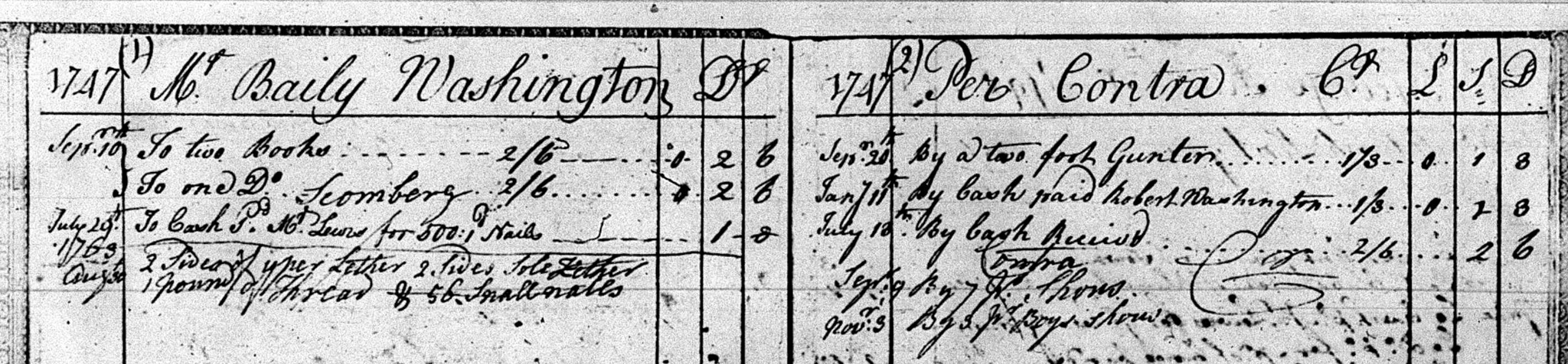
    His first entry (pictured above) was Mr. Bailey Washington, a cousin.  On September 10, 1747, George purchased 3 books (debit) from Bailey for the combined price of 4 shillings 12 pence.  One of the books is listed as “Scomberg,” a reference to the 17th century German  Protestant soldier of fortune , Duke Frederick Herman von Schomberg, who fought under the flags of France, Germany, Portugal, and England and died at the Battle of the Boyne fighting for William of Orange.  Schomberg wrote about his adventures which would have been of great interest and fascination to a young man of fifteen.

    Ten days later, George listed on the credit side of Bailey’s account “a two foot Gunter” with a value of 1 shilling 3 pence.  George’s purchase of a gunter scale, a two-foot long ruler specifically designed to help surveyors quickly solve trigonometry problems, is an intimation of his early interest in training to become a surveyor.

    Ledger Book Zero sheds light on many other interests and activities young George pursued in his teen years.  He won and lost money playing the card games of whist and loo with his half-brother Lawrence and sister-in-law Ann.  George also won 1 shilling 3 pence playing billiards with a Mr. Thomas Turner of King George County in June of 1748.  Earlier that same year, he lent money to his good friend George Fairfax while on an expedition to the South Branch of the Potomac.

    In addition to lending and winning cash from friends and family, George regularly purchased personal items such silk stockings, shirt buttons, knee bands and shoes, as well as food and liquor, such as limes, a bowl of fruit punch, and a “bottle of Rhenish” wine.

    Ledger 2

    In July 1748, George purchased ribbons from a Mr. Mitchell (see above), as well as a glass ring costing but 3 ¾ pence.  He also paid 3 shillings 9 pence to a “Musick Master for my entrance” in September of the same year.  We are unsure if this music teacher taught only music or, perhaps, dancing. Both were important skills for Washington to learn if he wanted to participate in the social life of Virginia’s gentry.

    What is interesting about these last three purchases is that they were all made on his mother Mary’s account, which means George paid for them but his mother later reimbursed him.  Mary repaid George in dubloon’s and pistole’s which were English slang words for different types of money.

    George’s blossoming profession as a surveyor is also represented in this ledger.  On July 23, 1749, he charged Mr. Richard Barnes of Richmond 2 pounds 3 shillings for surveying 400 acres of land in Culpeper County.  On September 26 of the same year, Mr. John West paid him 12 shillings for “copying 4 deeds out of the Proprietors’ [book]”, a preliminary clerical step to surveying land.

    Washington even practiced writing out an index for his ledger at the end of the book, listing all those people whose last name began with “W” and on what page their account appeared.  Handwriting samples and sums of numbers show up throughout the book, as George evidently used some individual pages as notepaper.  He later reused some of the ledger in the 1760s while residing at Mount Vernon.

    As a youth, George spent many hours copying lessons on such subjects as mathematical formulas, legal documents, geography, and codes of conduct.  These were subjects that would prove useful to him as he became a soldier, surveyor, landowner and politician.  Maintaining accurate and detailed financial records, a skill necessary for any successful gentleman, was one more habit a young man with aspirations needed to accomplish and master.

    As we study the contents of Ledger Book Zero, we expect to gain more insights into George’s relationships with family members, boyhood friends, and business contacts. By examining this earliest ledger, we will understand the activities Washington was pursuing during his passage to adulthood and gain a glimpse at what life was like for a young George growing up at Ferry Farm during the 1740s.

    Judy Jobrack, Archaeologist
    Assistant Lab Supervisor

    A copy of the ledger was obtained from the Morristown National Historic Park, Morristown, NJ., Lloyd W. Smith Archives, Microfilm Reel #63.
  • ‘Not Having Been Wett All Over at Once, for 28 Years Past’: Bathing in Early America

    Editor’s Note: Looking back in time, people’s personal hygiene, fashion choices, medical treatments, and more sometimes look, at the very least, bizarre, if not outright disgusting.  When confronted with these weird or gross practices, our first reaction can be to dismiss our ancestors as primitive, ignorant, or just silly.  Before such judgments, however, we should try to understand the reasons behind these practices and recognize that our own descendants will judge some of what we do as strange or gross.  Here at George Washington’s Ferry Farm and Historic Kenmore, we’ve come to describe our efforts to understand the historically bizarre or disgusting as “Colonial Grossology.”  This the second in a series of “Colonial Grossology” posts that we’re offering on Lives & Legacies.

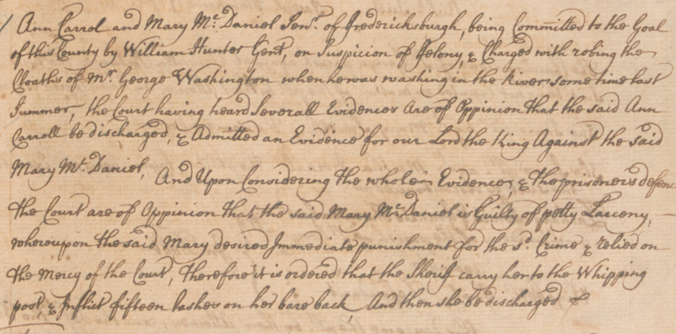
    At least once during his youth at Ferry Farm, probably in July 1750, George Washington went “washing in the river.”  We know this because Ann Carrol and Mary McDaniel were arrested and tried and one of them was even flogged for stealing valuables from his clothes while he was in the Rappahannock.  Of course, it seems quite safe to assume that young George swam in the river on many more occasions than this one moment chronicled in court records.

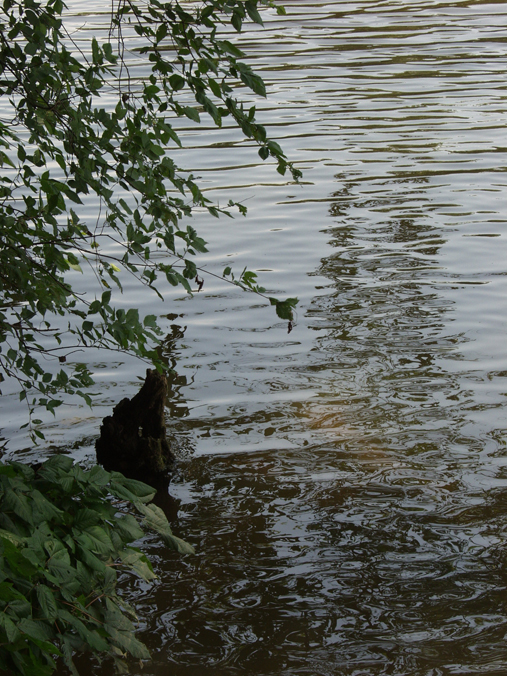
    The Rappahannock River at George Washington's Ferry Farm.
    The Rappahannock River at George Washington’s Ferry Farm.
    Document showing the outcome of a court case involving George Washington.  Ann Carrol and Mary McDaniel stole valuables from Washington's clothes while he was "washing in the river." Carol testified against McDaniel, who was convicted or petty larceny and "flogged fifteen lashes on her bare back."
    Document showing the outcome of a court case involving George Washington. Ann Carrol and Mary McDaniel stole valuables from Washington’s clothes while he was “washing in the river.” Carol testified against McDaniel, who was convicted of petty larceny and “flogged fifteen lashes on her bare back.”  Spotsylvania County Court Records, Order Book 1749-1755, Central Rappahannock Heritage Center.

    The court records say he was “washing in the river.” But was he bathing to get clean or swimming just for fun?  It’s hard to say.  In the 1700s, swimming was “rarely intended for hygienic purposes,” though, of course, it made a person clean.  Cleaning was not swimming’s intended purpose, however.  People went swimming largely to cool off during hot weather.  Still, the word “washing” in the court documents seems significant.  If Washington was bathing with the purpose of getting clean, his dip in the river was somewhat unusual for more than the fact that he fell victim to thieves.[1]

    How often did Washington and his fellow colonial Americans bathe to get clean?  The question’s answer is more complicated that you might imagine.

    First, the answer largely depends upon what we mean by the word bathing.  If we mean head-to-toe immersion in water and scrubbing with soap to get clean, then bathing was quite infrequent.  In the 1700s, many people feared immersing the body in water as a sure way to get sick.  American settlers came from Europe, where bathing occurred in public bathhouses for much of the early modern period.  Before the late 1800s, people did not understand that germs caused disease.  Instead, when they got sick, people sometimes blamed the bathhouses and bathing.  For much of the 18th century, this suspicion towards bathing “reflected medical theories about the dangers to a healthy body of extremes of heat, cold, wetness, and dryness.  Any extreme might disturb the delicate equilibrium of the body’s humors, temperature, and moisture.  Compared to the shock of immersion in water, dirt upon the skin seemed benign.”  In fact, some people believed dirt helped keep you healthy by “reinforcing the skin.”[2]

    Second, an immersive bath was simply a lot of hard work.  Unless you had servants or owned slaves to do that hard work, you carried water to the tub from your water source, perhaps a well, a spring, or a nearby stream, two buckets at a time.  Multiple trips would be necessary.  To warm the water, you had to use precious firewood to build a fire.  Building the fire and getting it started were not simple tasks either.  The incredible effort it took to bathe also explains why, when baths did actually occur, the same water was used by multiple people in the household.  The father bathed first, the sons next, then the mother and daughters, and finally the servants.[3]  To add to these practical difficulties, “tubs specifically made for bathing did not make an appearance in America” until the very late 18th century.[4]  As a result, daily cleaning for most of the colonial era was “accomplished by washing the face and hands . . . in one’s bed chamber, with a basin and a relatively small amount of water.”  We today might refer to this method as a sponge bath.

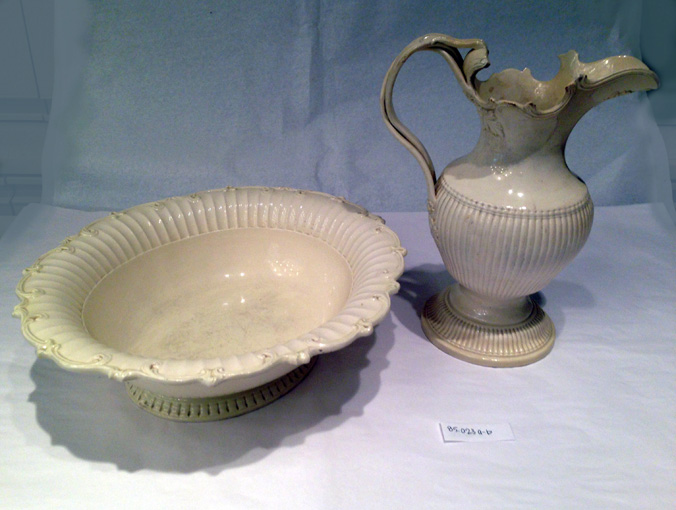
    Most early Americans washed daily using water from a pitcher and basin. Ornate sets similar to the one depicted would have been found in the homes of the wealthy like Fielding and Betty Lewis.
    Most early Americans washed daily using water from a pitcher and basin. Ornate sets similar to the one depicted would have been found in the homes of the wealthy like Fielding and Betty Lewis.

    “A bath in which the entire body was submerged, or showered with water, was generally taken for reasons of pleasure or preventive health maintenance, and in some cases, as a type of remedy for a particular affliction.”[5]  Immersive bathing for pleasure and health occurred in resort cities and towns at the sites of warm, mineral springs.  For example, George Washington, Fielding Lewis, and kin frequently trekked to Bath, Virginia (now Berkeley Springs, West Virginia) and both gentlemen owned property in the mountain resort.

    For most of the 1700s, washing from a basin remained the most common method for getting clean on a daily basis.  Indeed, it was so much the norm that when Elizabeth Drinker, a wealthy Philadelphia women, tried the new shower her husband built in the backyard, she wrote in her diary: “I bore it better than I expected, not having been wett all over at once, for 28 years past.”[6]

    Zac Cunningham
    Manager of Educational Programs

    [1] Dorothy A. Mays, Women in Early America: Struggle, Survival, and Freedom in a New World, Santa Barbara, CA: ABC-CLIO, 2004: 190

    [2] Kathleen M. Brown, Foul Bodies: Cleanliness in Early America, New Haven, CT: Yale University Press, 2009: 19-21.

    [3] Brown, 209.

    [4] Mays, 190.

    [5] “Bathing,” Thomas Jefferson Encyclopedia, Thomas Jefferson’s Monticello, www.monticello.org/site/jefferson/bathing [accessed February 10, 2015]

    [6] Richard L. Bushman and Claudia L. Bushman, “The Early History of Cleanliness in America,” Journal of American History, Vol. 74, No. 4 (Mar. 1988): 1214.

  • George Toasts George?

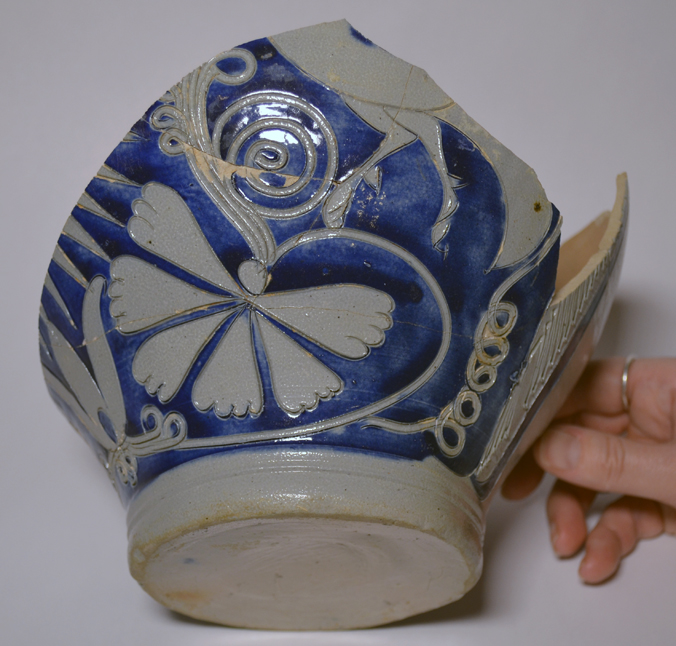
    At George Washington’s Ferry Farm we’ve just wrapped up a ceramic mending project.  We explain how and why we undertake these mending projects in this post.  Our most recent effort focused on Westerwald stonewares owned by the Washington family.  Stoneware is a high-fired, non-porous ceramic that is excellent for producing storage containers and drinking vessels.  But what is a Westerwald, you may ask?  Well, Westerwald stonewares were a ceramic produced in the Westerwald region of what is now Germany beginning in the 1500s.  Destined for the British Isles and British colonial markets, this particular ceramic is common to archaeological sites in the Chesapeake region.

    Westerwalds were salt-glazed, meaning that during the firing process large quantities of salt were introduced into the kiln.  The salt vitrified (converted into a glass-like substance) upon contact with the vessels, producing a shiny glaze and a characteristic ‘orange peel’ texture on the surface of the pots.  Decorated predominantly with molded and incised designs that are filled with bright cobalt blue and deep purple, Westerwalds are strikingly beautiful.

    Jug with a bird motif.

    We’ve learned a great deal from analyzing the Westerwalds used by the Washingtons.  Many of the vessels identified in the Ferry Farm assemblage were tankards, jugs, and other drinking vessels from which beverages such as ale and cider, a large part of the colonial diet, were consumed.  Some tankard handles we’ve excavated have small holes at the top, where a pewter lid — a distinguishing characteristic of German-made steins — was attached.  These lids often do not survive in the archaeological record because the metal had value.  Rather than being discarded, the pewter was often recycled.

    In addition to being aesthetically pleasing, Westerwald drinking vessels often served a political purpose.  An excellent example of this is to be found within our assemblage of Westerwalds in the form of multiple mugs emblazoned with the initials ‘G.R.’, meaning Georgius Rex, the Latin for King George.  During the time Westerwalds were produced in Germany, three British kings were named George.  Interestingly, however, all three came from the House of Hanover, a German royal family placed on the British throne in 1714.  For Americans, of course, the most famous of these Hanover kings was George III.

    Sprig decorated G.R. medallion on a jug fragment.

    Thus, a gentleman sporting a ‘G.R.’ on his tankard or jug advertised his loyalty to the Crown with every draught of ale.  A night of drinking involved numerous toasts “To the King’s Health!”  It was not unheard of for dozens of toasts to be recited for the king, his family, and anyone else of political interest the imbibers saw fit to honor.  Toasts and drinking vessels were also utilized to express disagreement with political powers.  Politics and drinking definitely went hand-in-hand in the colonies.  Once George Washington became a public figure, there were toasts such as “To General Washington, and victory to the American arms!” to honor him.

    The presence of these initialed Westerwalds at Ferry Farm show that until the Revolution the Washington family, like most Americans, viewed themselves as loyal subjects of the British Crown.  Indeed, many families in Fredericksburg would have owned such mugs and toasted their monarch prior to the war.  In fact, several ‘G.R.’ vessels have also been excavated at Historic Kenmore, the home of George Washington’s sister, Betty.  The people of Ferry Farm, Kenmore, and Fredericksburg found their daily lives governed by Britain’s global economy and imperial culture.  Colonial men – whether gentry, tradesman, or servants – pursued homes, professions, pleasures, and possessions that conveyed their status, wealth, and English identities.  One such possession that emphasized this identity was Westerwald drinking vessels.

    Hollowware fragments with an unknown motif.

    One has to wonder what became of these mugs once the Revolution began.  Did Loyalists quietly stash away some of their ‘G.R.’ mugs once the tide of war went against them?  Perhaps some tankards and jugs were smashed publically by Patriots in a ritual different from their intended purpose of toasting but no less a political act than those toasts had been.  Nevertheless, it is intriguing to picture a young George Washington drinking heartily from a ‘G.R.’ mug and toasting a king against whom he would lead a revolution.

    Mara Kaktins
    Archaeologist/Ceramics & Glass Specialist

  • George Washington’s Birthday Celebration

    The annual George Washington’s Birthday Celebration at Ferry Farm took place on Saturday, February 14.  Fun family activities included colonial-era games, crafts, the Stone Throw Challenge, theater performances, and birthday cake!  Here are some photos from the event.

  • George Washington, Baseball Player?

    I find that February, though it has the fewest days, can be the longest month of the year. The novelty of winter has worn off and, often, I simply seem to be enduring until the first glimpses of spring in March. I do, however, look forward with excitement to two moments in February: George Washington’s Birthday and the day that Major League Baseball’s pitchers start their spring training. In a way, these two events are connected by more than their close proximity to one another on the calendar.

    After the familiar cherry tree tale, the second most popular story about George Washington’s youth is the story of him throwing a rock the size of a silver dollar across a river. This legend has changed several times over the years but it may have some truth.

    The earliest version appears in The Life of Washington by Mason Locke Weems, who notes that George’s cousin remembered seeing him “throw a stone across [the] Rappahannock, at the lower ferry of Fredericksburg.”[1] George Washington Parke Custis, Martha’s son, provides a bit more detail for this toss, noting that the rock was actually “a piece of slate, fashioned to about the size and shape of a dollar, and which, sent by an arm so strong, not only spanned the river, but took the ground at least thirty yards on the other side.”[2] Archaeologist Phil Levy estimates “that could have been a distance of anywhere from a staggering 440 feet (professional baseball fields vary from 390 to 435 feet at the centerfield wall) to an impressive 340 feet.”[3]

    We’ll never have the evidence historians need to say with certainty that young George actually threw a rock across the Rappahannock. It is a plausible story, however. So, each February at Ferry Farm’s birthday celebration, visitors try and duplicate George’s feat, provided the day’s weather or any lingering snow on the ground doesn’t prevent us from traipsing down to the river.

    A visitor attempts to throw a rock across the Rappahannock River during the George Washington Birthday Celebration at Ferry Farm.

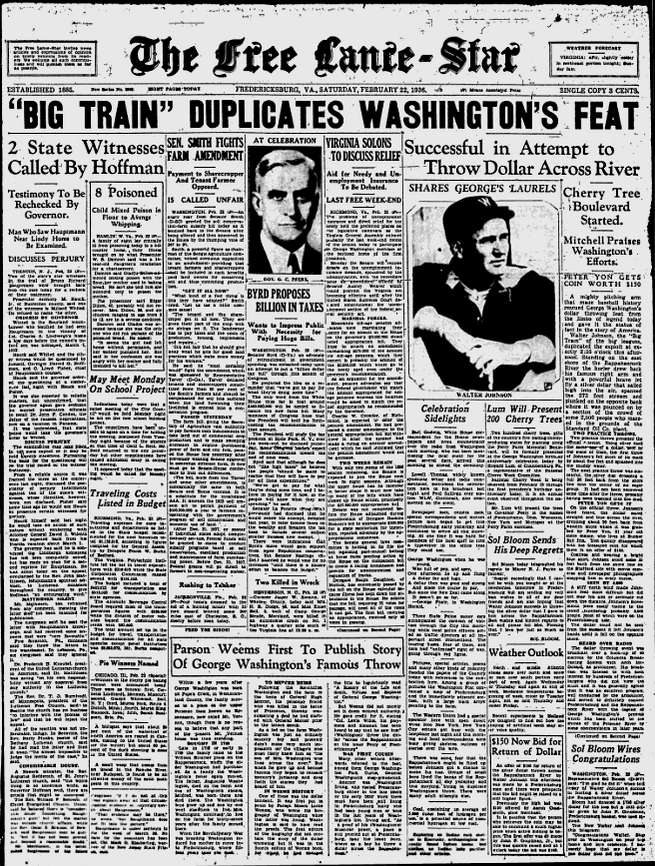
    The feat has actually been duplicated, most famously by Walter “Big Train” Johnson, celebrated pitcher for the Washington Senators, on a Depression-era February day in 1936. Officials in charge of that year’s birthday celebration at Ferry Farm challenged the retired Major League right-hander, raising the ire of Congressman Sol Bloom of New York, who believed the story of Washington’s toss, to be “preposterous.” Quoted in the February 18, 1936 edition of The Free Lance Star, Bloom felt the feat “physically impossible” because “Washington was about 10 years old when the miracle was supposed to have happened.” Perhaps, he forgot that George lived at Ferry Farm well into his late teens?

    A few days before the celebration, reporters found Johnson training for the toss by throwing a coin at the barn on his Germantown, Maryland farm. “‘Maybe I can’t throw that far,’ he drawled, ‘but there’s one thing certain—if George Washington did it, I can too.’”

    Walter Johnson poses as if in mid-throw on the icy bank of the Rappahannock.

    Finally, the day came. On the front page of the February 22, 1936 edition, The Free Lance Star’s banner headline trumpeted “‘Big Train’ Duplicates Washington’s Feat.” Standing on the Ferry Farm side of the river at 2:30 p.m. that day, Johnson took two practice tosses. The first plopped into the water just five feet short of the bank while the second made it across. Then, he attempted the official throw. Johnson “drew back his famous right arm and with a powerful heave let fly a silver dollar that sailed high into the air, spanned the 273 foot stream and plunked on the opposite bank.” Bloom graciously wired his congratulations and invited Johnson to stop in Washington and celebrate with him on his way back to Germantown.

    Front page of The Free Lance Star, February 22, 1936

    The attempt became something of a national sensation with newspapers in Michigan, Florida, Connecticut, Kansas, Missouri, and beyond reporting the story. A live radio program on the Columbia Broadcasting System beamed a description of the throw into countless homes across the nation.

    Although it doesn’t garner the attention it did in 1936, the Stone Throw Challenge remains a centerpiece of Ferry Farm’s annual Washington’s Birthday Celebration when the weather allows it. On that day, which is usually about the time that today’s aspiring Walter Johnsons are starting to prepare for their seasons, I think of a day during the Great Depression when a big league pitcher added to his own legend by duplicating the prodigious feat of the most legendary American of all. As I watch our visitors attempt their throws, I think of the “Big Train” and I also always wonder just what kind of ballplayer George Washington might have been.

    Zac Cunningham
    Manager of Educational Programs

    Join us at Ferry Farm on Saturday, February 14 for our George Washington’s Birthday Celebration, when – weather permitting – we’ll see if anyone else can throw a stone across the Rappahannock River. Along with the Stone Throw Challenge, enjoy crafts, games, exhibits, live history performances, and birthday cake! Visit www.kenmore.org/events.html for more details about the Birthday Celebration along with Archaeology Day on Monday, February 16!

    [1] Mason Locke Weems, A History of the Life and Death, Virtues and Exploits of General George Washington, Macy-Masius Publishers, 1927: 39.

    [2] George Washington Parke Custis, Recollections and Private Memoirs of Washington, Philadelphia, J.W. Bradley, 1861: 482.

    [3] Phil Levy, Where the Cherry Tree Grew: The Story of Ferry Farm, George Washington’s Boyhood Home, New York: St. Martin’s Press, 2013: 226.

  • Christmas in Fredericksburg with George Washington, 1769

    Six-year-old George Washington and his family moved to the land we call Ferry Farm late in 1738, perhaps even in time to mark Christmas in their new home.  If so, it was the first of many.  George lived at Ferry Farm into young adulthood.  Interestingly, the best documented Christmas he spent in Fredericksburg was actually in 1769, long after his boyhood years, and it paints a picture of the holiday as typically celebrated in Virginia, past and present.

    George Washington at age 40 in 1772, three years after the Christmas of 1769. By J.W. Paradise (engraving) from a picture by J.G. Chapman after Charles Wilson Peale [Public domain], via Wikimedia Commons.
    After the House of Burgesses recessed, 36-year-old George Washington left Williamsburg for home on December 21, 1769.  Instead of traveling all the way to Mount Vernon, he stopped in Fredericksburg on December 23 and stayed in town through Christmas.  He arrived at “4 Oclock in the Aftern.” and went to the home of his brother-in-law Fielding Lewis. In 1769, the Lewis family did not yet live in the brick home we call Kenmore.  Instead, they were located near the present-day corner of Princess Anne and Lewis Streets.  That evening, George “ding. [dined] at Colo. Lewis” and he and Fielding may have been joined by George’s sister Betty, his young nephews George, Charles, Samuel, Lawrence, Robert, and his niece Betty.  Christmas was a period of rest that Virginians used for long visits and large meals with family and friends.  The meals amounted to feasts and a Christmas meal at Mount Vernon once featured, for example, “an elegant variety of roast beef, veal, turkey, ducks, fowls, hams &c.; puddings, jellies, oranges, apples, nuts, almonds, figs, raisins, & a variety of wines & punch. . .”[1]

    On Christmas Eve, which was a Sunday, George “Went to Prayers, & dined afterwds. at Colo. Lewis.”  The prayer service he attended probably took place at St. George’s Church, an wooden structure located on the site of today’s St. George’s Episcopal Church. Many colonial Virginians combined the holiday’s religious nature with secular activities such as parties, much as we do today.  Washington was no different.  After his morning at church, he passed the evening in Julian’s Tavern with Edward Jones, the overseer of Ferry Farm, where George’s mother Mary still lived.  This tavern was located at the corner of Amelia and Caroline Streets.

    Christmas Day was spent with the Lewis family and George won 2 pounds and 5 shillings playing cards.  Card playing for money was another aspect of Christmas carousing enjoyed by Virginians, whether men, women, or children.  Popular games included whist (similar to bridge), and piquet (similar to rummy) and were great ways to pass the time when visiting family and friends during Christmas.

    On December 26, Washington prepared to continue his journey home by going to to the barber and paying for repairs to his carriage.  Before leaving, though, he again “Dined at Colo. Lewis” and then “went over the River and logd at my Mothers” for his final night in Fredericksburg.  After giving Mary 6 pounds in cash, George left Ferry Farm on the 27th and arrived home at Mount Vernon on December 28.

    The Christmas season of the colonial era lasted much longer than ours does, extending into January and concluding on Twelfth Night, a festive evening to mark the end of the Twelve Days of Christmas and celebrated much like our New Year’s Eve is today.  During the first days of 1770 at Mount Vernon, Washington and his family continued visiting friends and hosted two dinners, including one on Twelfth Night.  It appears to have been a relatively subdued affair with only immediate family and four or five neighbors.  Three years later, on January 6, 1773, he had at least fourteen guests, excluding his own family, at a Twelfth Night celebration.

    Christmas 1769 was one of many that George Washington spent in Fredericksburg.  It is the only one for which he recorded his activities, however.  He spent time with family, he enjoyed several good meals, he went to church, he drank at a local tavern, he won some money at cards, and he attended or hosted several celebratory gatherings.  All-in-all, his was a Christmas spent in ways not all that different from the ways many of us will spend our own holidays.

    Zac Cunningham
    Manager of Educational Programs

    [1] Theophilus Bradbury quoted in Laura F. Winner, A Cheerful & Comfortable Faith: Anglican Religious Practice in the Elite Households of Eighteenth-Century Virginia, New Haven, CT: Yale University Press, 2010: 130.