As George Washington’s Ferry Farm prepares to celebrate the reconstruction of the Washington house, we traveled around George’s hometown – Fredericksburg, Virginia – to visit a few places important in the transformation of George from boy to man.
George Washington’s education as a boy at Ferry Farm included copying The Rules of Civility and Decent Behavior in Company and Conversation to learn the correct etiquette and moral code of Virginia’s gentry class. By strictly following its advice, young Washington molded his character into that of a wealthy Virginia gentleman. Unable to attend school in England after his father’s death, George possibly studied with the Rev. James Marye, rector of St. George’s Parish across the river in Fredericksburg.
St. George’s Church built their first church building in the 1730s. The current church building (pictured) dates from 1849.
Join us at the Washington House Celebration on Saturday, October 7, 2017 from 12:00 p.m. – 4:30 p.m. to celebrate the construction of the Washington house! A special ribbon-cutting ceremony will begin at 1:30 p.m. featuring notable speakers. After the ceremony, guests will be invited to view the reconstructed Washington house! Parking for the event is off site at the VRE Fredericksburg Park and Ride Lot G at the corner of Prince Edward Street and Frederick Street. Limited handicap parking is available at Ferry Farm. Buses will transport guests to and from Ferry Farm. The Washington House Celebration is a free event and RSVPs are not required.
As George Washington’s Ferry Farm prepares to celebrate the reconstruction of the Washington house, we traveled around George’s hometown – Fredericksburg, Virginia – to visit a few places important in the transformation of George from boy to man.
George Washington lived at Ferry Farm from age 6 (1738) to around age 22 (~1754). At Ferry Farm, he copied the Rules of Civility and Decent Behavior, read his first book about military adventures, joined the Masonic Lodge, and petitioned colonial Virginia’s British Governor for his first military office. Two hundred forty-six years ago, on September 13, 1771, George recorded in his diary that he “Returnd to my Mothers to Breakfast and Surveyd the Fields before Dinner, returnd to Town afterwards.” The fields of Ferry Farm were pivotal to George Washington’s development into an extraordinary man.
Join us at the Washington House Celebration on Saturday, October 7, 2017 from 12:00 p.m. – 4:30 p.m. to celebrate the construction of the Washington house! A special ribbon-cutting ceremony will begin at 1:30 p.m. featuring notable speakers. After the ceremony, guests will be invited to view the reconstructed Washington house! Parking for the event is off site at the VRE Fredericksburg Park and Ride Lot G at the corner of Prince Edward Street and Frederick Street. Limited handicap parking is available at Ferry Farm. Buses will transport guests to and from Ferry Farm. The Washington House Celebration is a free event and RSVPs are not required.
We’ll have more from around George’s hometown over the next three weeks!
“There is no man who hates the power of the crown more, or who has a worse opinion of the Person to whom it belongs than I.” – Charles James Fox, letter to Edmund Burke, 24 January 1779. Quoted in L. G. Mitchell, Charles James Fox (1997:41).
“It is intolerable that it should be in the power of one blockhead to do so much mischief.” – Charles James Fox referring to King George III. From a letter to Mr. Fitzpatrick, 9 September 1781. Quoted in John Brooke, George III (1974:363-364).
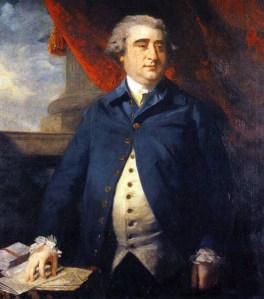
The Right Honourable Charles James Fox, MP, wore buff and blue apparel for this 1782 portrait by Joshua Reynolds. Credit: Wikipedia.
Charles James Fox was contrary. He gambled excessively, drank heavily, and he was generally irreverent. He enjoyed resisting powerful people, supported unpopular causes, and expressed his disdain for high society by adopting a disheveled appearance later in life. His colorful British Parliamentary career spanned decades. He was a champion of liberty: including the abolition of slavery, religious freedom, the colonists’ struggles with King George III, and he supported the French people in their quest for democracy.
Fox questioned King George III’s policies toward the American colonies and feared that the monarch was becoming tyrannical. It was parliament’s job to guard against such corruption. Fox and his supporters often wore apparel in the colors of buff and blue – the colors of Washington’s army – to show their support for American concerns. The Americans, in turn, honored their parliamentary champion with their own fashion accessory: they wore buttons that featured a fox, an obvious – and often used – stand-in for the controversial orator.[1]
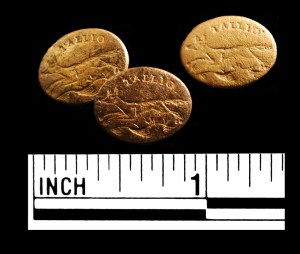
Buttons featuring a fox racing across the landscape with the word “TALLIO” were intensely popular from the 1770s through at least the first quarter of the 1800s and they are common discoveries at archaeological sites. “Tallio,” “talley-o,” “talley-oh,” “talleo” and “talley ho” were all acceptable spellings for the traditional huntsmen’s shout upon spotting the fox during a chase. But this exclamation dates from the 1770s: well over a century after the sport had been brought to the Chesapeake. [2]
A close-up of a “TALLIO” sleeve button from the Washingtons’ parlor cellar, c. 1766-1772.
Fox hunting enjoyed wide popularity among Chesapeake gentlemen. The English Brook family brought their foxhound pack to Prince George’s County, Maryland when they immigrated in 1655.[3] Fox hunting continued in the Brook family for generations, and the popularity of this privileged recreational activity spread. Fox hunting on horseback was an amusement of the leisure class and the chase was considered more important than the capture of the prey. By the late 1760s, Washington himself maintained a pack of fox hounds at Mount Vernon.
Additional TALLIO sleeve buttons from the antebellum-era plowzone at Washington’s boyhood home. They are notably more weathered from its increased exposure to the elements given its shallow soil burial environment.
Many who discover these buttons today attribute their imagery solely to the popularity of fox hunting as a sport. These buttons are often referred to as “hunt” buttons, a category that includes buttons which feature favored hobbies or athletic pursuits. Some assert that these sleeve links were widespread because fox hunting was so popular. And indeed, it was. These links – historically referred to as ‘sleeve buttons’ – enjoyed great popularity in the years surrounding the American Revolution, the Early Republic, and into the antebellum period.
I believe these buttons also achieved a deeper, political meaning, however, especially in the years around the American Revolution. Due to the support by Charles James Fox of the American cause, fox imagery came to represent resistance to tyranny. A number of contemporary British political cartoons used a fox to symbolize this politician. In addition to this documentary evidence, I believe the fox imagery used on these buttons came to symbolize the fight for liberty. For those recovered buttons for which we have context, it is evident that they are especially prevalent at sites associated with the Revolutionary War and with American patriots.
Colonial discord is represented in this 1776 image showing America (symbolized as a woman in a feathered headdress, center left) attacking a defenseless Britannia (symbolized by the woman at center right). Charles James Fox is represented as a fox in the background (see arrow). Courtesy of the Lewis Walpole Library, Yale University.
As the political difficulties between the British Crown and the American colonies intensified, Fox’s outspoken support of colonial concerns attracted attention on both sides of the Atlantic. In Britain, some called Fox a traitor for his disrespectful rhetoric against the crown. In Britain’s North American colonies, his stoic support for their cause provided colonists a crucial ally in an unexpected, but politically powerful position. Patriots and revolutionaries enthusiastically incorporated these fox hunting-themed buttons into a celebration of Fox’s ardent support.
A 1784 image of a fox, featuring the head of British parliamentarian Charles James Fox. Courtesy of the Lewis Walpole Library, Yale University
Tallio/fox buttons have been recovered from several American Revolution-era and Early Republic era forts in Tennessee and New York. Two domestic sites associated with George Washington have yielded these buttons as part of their archaeological discoveries. Signer of the Declaration of Independence, William Paca, proudly wore a tallio/fox button. Colonial towns such as Dumfries, Virginia and Jacksonborough, South Carolina have yielded these buttons from layers dating from the Revolutionary era.
Anthropologists – scholars who study people – make special efforts to identify such symbols in societies, both in contemporary studies and in analyses of past people.[4] Symbols are especially powerful because viewers do not need to be able to read, to understand language, to hear, or to speak, in order to comprehend a symbol’s message. These messages can summon strong emotional responses. Think about how you feel when you see an American flag and how your responses might change depending on how a flag might be used at a protest, funeral, or baseball game. During the last quarter of the eighteenth century, the fox symbolized resistance to tyranny, freedom, and the pursuit of liberty. Wearing a fox button proclaimed your support for American independence.
The die struck fox image on these buttons was not originally created as a political symbol for Charles Fox, however. The meaning of these buttons was adapted to that purpose after their initial manufacture. As we have seen, fox hunting was indeed a common pastime for gentlemen, and these fashionable buttons were popular among those who “chased the hounds.” As tensions between Britain and her North American colonies increased, beginning by the 1760s, the fox symbolism present on tallio buttons was malleable[5], and provided a gentleman with leeway in a politically volatile climate: its meaning could change according to a gentleman’s situation. Among unfamiliar company, such a multivocal symbol would allow an adroit – or perhaps even a vacillating – patriot some political latitude. Uncertain if the person with whom you’re dining is a Tory? Your innocent little TALLIO sleeve link merely celebrates a popular, recreational activity, whose roots in the Middle Atlantic region went back generations. But, at the same time, comrades in the struggle for American Independence recognized their solidarity in the symbolism of the fox: honoring their parliamentary advocate of colonial resistance to the King George III.
Along with the tallio sleeve button, another apparel item as evidence for the Washington family’s burgeoning resistance to the Crown has been found at Ferry Farm. As I wrote in an earlier blog post, the Washingtons wore a mid-1700s William III sleeve button to display their resistance to George III: a monarch that many colonists deemed tyrannical in his exercise of power. On more than one occasion, Charles Fox himself compared America’s Declaration of Independence to William and Mary’s “Glorious Revolution,” and (fairly or not) drew parallels between the monarchical abuse of powers exercised by George III and James II. British subjects had the right to replace a tyrannical king with another: an example set by William and Mary, and an important precedent for the American colonists. The Washingtons’ support for the Leedstown Resolves in February 1766 provides documentary evidence for their concerns with Britain’s rule and (at the time) their loyalty to the Crown.[6]
Close-up of a mid-1700s sleeve button recovered at Ferry Farm. It features the image of King William III and reads “Gulielmus D. G.” which translates as “William by the grace of God King.” This button is another demonstration of growing resistance to George III from Washington’s boyhood home.
Together, the symbolism on each of these buttons and the Washington brothers’ participation in the Leedstown Resolves demonstrates a long and growing frustration among Virginians with Britain’s colonial policies. The material expression of these sentiments can be traced back to the mid-1700s-era male apparel buttons at Washington’s childhood home. These discoveries were possible thanks to the preservation of this site, the thorough excavation of its layers, and a contextual understanding of the social and political landscape of this period.
This fox/liberty symbolism apparently endured well into the 1800s in the United States. Archaeologists recovered a “TALLIO” sleeve button from the root cellar of a quarter for enslaved laborers in South Carolina:[7] strong circumstantial evidence that this symbol of the struggle for liberty and freedom continued beyond the American Revolution. As previous mentioned, Fox was an ardent abolitionist. The layer from which this particular button was recovered dated no earlier than 1845. In this context, this symbol of liberty underwent another change and now represented a reproach displayed by enslaved Americans to highlight the paradox of slavery in what was supposed to be a democracy. Though Charles James Fox died in 1806, the use of the fox as a symbol for the struggle for freedom endured.
Laura Galke, Archaeologist
Site Director/Small Finds Analyst
Sites where such TALLIO links have been recovered Collectors and archaeologists have found TALLIO buttons from at least New York to South Carolina, and westward to Tennessee,[8] where they occur at a number of United States military forts, late 1700s-era towns, and at sites associated with patriots.
Bledsoe’s Station, Tennessee (1783-1795) – “civilian fort” (Context dates from c. 1783-1795).
British Officer’s Revolutionary War Hut in New York (Calver and Bolton 1950: 225, 227).
Fitts, Mary Elizabeth, Ashley Peles, and R. P. Stephen Davis, Jr.
2012 Archaeological Investigations at the Vance Site on the University of North Carolina Campus, Chapel Hill, North Carolina. Research Report No. 34. The University of North Carolina, Chapel Hill.
Hastings, Anne M.
1997 Fox Hunting: History and Change in a Mountain Sport. Appalachian Journal 25(1):30-46.
Mitchell, Leslie George
1997 Charles James Fox. Penguin, London.
Noël Hume, Ivor
1961 Sleeve Buttons: Diminutive Relics of the Seventeenth and Eighteenth Centuries. In Antiques 79(4):380-383.
Polhemus, Richard R.
1979 Archaeological Investigations of the Tellico Blockhouse Site (40MR50): A Federal Military and Trade Complex. Report of Investigations 26, Department of Anthropology, University of Tennessee, Knoxville.
Reich, Jerome R.
1998 British Friends of the American Revolution. M. E. Sharpe, Armonk, New York.
Smith, Kevin E.
2000 Bledsoe Station: Archaeology, History, and the Interpretation of the Middle Tennessee Frontier, 1770–1820. Tennessee Historical Quarterly 59(3):175–187.
Smith, Samuel D., and Benjamin C. Nance
2000 An Archaeological Interpretation of the Site of Fort Blount, a 1790s Territorial Militia and Federal Military Post, Jackson County, Tennessee. Tennessee Dept. of Environment and Conservation, Division of Archaeology, Nashville, TN
Smith, Steven D., Audrey R. Dawson, and Tamara S. Wilson.
2008 The Search for Colonial Jacksonborough (38CN280) Colleton County, South Carolina. South Carolina Institute of Archaeology and Anthropology Report, Columbia. Presented to Lowcountry Council of Governments, Yemassee, and Francis Marion Trail Commission, Florence.
Sprouse, Deborah A.
1988 A Guide to Excavated Colonial and Revolutionary War Artifacts. Heritage Trails, Turbotville, Pennsylvania..
Steen, Carl
2008 Archaeology on the Great Pee Dee River: The Johannes Kolb Site. http://38da75.com/professional.htm, accessed July 31, 2012. Diachronic Research Foundation, Columbia, SC.
Notes
[1] A generation earlier Fox’s father, Henry Fox – also a member of parliament – found himself represented as a fox on multiple occasions in political satire.
[2] The recovery of this artifact from a layer created between 1766 and 1772 indicates that “tallio” was a term popular before it first appeared in print in 1773 (“tally-ho, int. and n.” OED Online. Oxford University Press, March 2017. Web. 31 May 2017). Since this “TALLIO” button was deposited before 1773, perhaps the Oxford University Press might consider updating their “tally-ho” entry.
[3] A nice history of fox hunting is provided in Anne M. Hastings, 1997 article “Fox Hunting: History and Change in a Mountain Sport.” Appalachian Journal 25(1):30-46.
[4] Archaeology is a subfield of anthropology. Archaeologists study past peoples.
[5] Political sleeve buttons that said “Liberty” (revolutionary) or portrayed a Crown (Loyalist) provided their gentlemen no political leeway: they betrayed the political sympathies of their gentlemen quite directly. Did gentlemen who elected to wear TALLIO buttons lack commitment, perhaps coveting the ambiguous – and potentially innocent – message of the fox imagery?
[6] Samuel, John Augustine, and Charles Washington all signed the Leedstown Resolves which, though it expresses concern, is nonetheless effusive in its expressed respect for the monarchy.
[7] Carl Steen, Personal Communication, 15 April 2013.
“I heard Bulletts whistle and believe me there was something charming in the sound.”[1] — George Washington
Before his first brush with battle, three military adventures worked together to charm and inspire young George Washington’s fascination with the military and helped push him to pursue a career as a soldier in Virginia’s militia and then as commander of the Continental Army.
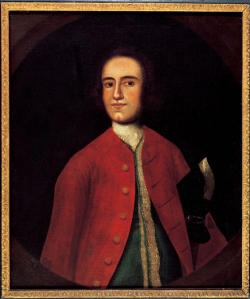
Portrait of Lawrence Washington attributed to Gustavus Hesselius (c. 1738). Credit: Wikipedia / Mount Vernon.
The boy Washington was first charmed by the military service of his older half-brother Lawrence. In 1739, the colorfully-named War of Jenkins’ Ear between Britain and Spain began. Ostensibly sparked by the Spanish coast guard boarding a ship captained by Robert Jenkins and cutting off his ear, the war was another one of those conflicts over trade, colonies, and the spoils of the New World so often fought between Europe’s empires in the 18th century.
In June 1740, a commission from George II arrived in Virginia for Lawrence. He was made a captain in one of four infantry regiments of colonial Virginians being raised for service in the war. On May 30, 1741, Lawrence wrote to his father Augustine describing his role in the Battle of Cartegena de Indias when the British launched an amphibious assault on the city of Cartegena de Indias in Colombia.
Lawrence reported to his father that the British “destroyed eight Forts, six Men of War, six gallioons and some Merchant ships” but “what number of Men they [the Spaniards] lost we know not; the enemy killed of ours about six hundred & some wounded, & the climate killed us in greated [sic] numbers.” In the end, the British suffered a crushing defeat but more because of disease than battle casualties.
“Defensa de Cartagena de Indias por la escuadra de D. Blas de Lezo, año 1741” by Luis Fernández Gordillo. Credit: Wikipedia / Naval Museum of Madrid.
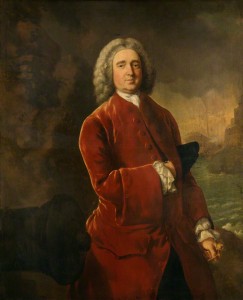
Virginia’s regiments suffered greatly. “Some are so weak as to be reduced to a third of their men,” Lawrence wrote but he also revealed that “vastly to my satisfaction” he had been serving “on board Admiral Vernon’s ship.” Vernon was the naval commander during the battle and was greatly admired by Lawrence. He was so admired, in fact, that Lawrence named the family’s Little Hunting Creek property bequeathed to him after Augustine’s death Mount Vernon.
Lawrence ultimately concluded that “war is horrid in fact, but much more so in imagination.” His experiences aboard an admiral’s flagship probably protected him some from the horrors of war. War did not turn Lawrence off of military service. He was awarded the post of Adjutant General for all of Northern Virginia’s militia along with the rank of major.
George was about 10-years-old when Lawrence returned home from war. How many war stories did his older brother share with him? We do not know but we do know that George and Lawrence were close, especially in the aftermath of their father’s death. It seems a safe bet to conclude that Lawrence’s military service also likely influenced his effort in 1746 to have fourteen-year-old George join the Royal Navy.
George’s captivation with military adventure was further strengthened by the exploits of Duke Frederick Herman von Schomberg. On September 10, 1747, fourteen-year-old George purchased 3 books from his cousin Bailey for the combined price of 4 shillings 12 pence. One of the books is listed as “Scomberg,” a reference to a 17th century German Protestant soldier of fortune, who fought under the flags of France, Germany, Portugal, and England and died at the Battle of the Boyne fighting for William of Orange. Schomberg wrote about his adventures, which would have been of great interest to a young man like Washington. That George willing spent hard earned money during a time of financial hardship reveals how enthralled he was with military exploits.
Portrait of Friedrich von Schomberg atrributed to Adrian van der Werff (c. 1600s) Credit: Wikipedia.
We do not know the impact, if any, of Schomberg’s exploits upon George’s military thinking. One incident does stands out, however. While in Ireland commanding the army of William of Orange, England’s new king, against supporters of James II, England’s old king, Schomberg decided that his raw and undisciplined troops would not fare well in battle. As a result, he held his army behind defensive works instead of confronting the enemy and their superior numbers. This much-criticized action bares notable similarities to Washington’s main strategy during the Revolutionary War. Washington defeated the British because, overall, he did not fight the British. Instead, he maintained his “army in being.” Washington wisely avoided confrontation, when possible, with the professionals who made up the best army in the world. The American army was inexperienced and initially amateur but as long as the army existed, the newly independent United States would also exist. The Continental Army had to survive even if that meant avoiding, instead of confronting, the British Army.
The final adventure that inspired a fascination with military things in young George Washington was his trip to Barbados. In 1751, nineteen-year-old George and his older half-brother Lawrence traveled to that Caribbean island in the hope that the tropical climate would relieve Lawrence’s tuberculous. This was George’s first and only trip away from the North American continent and to another part in Britain’s vast Empire.
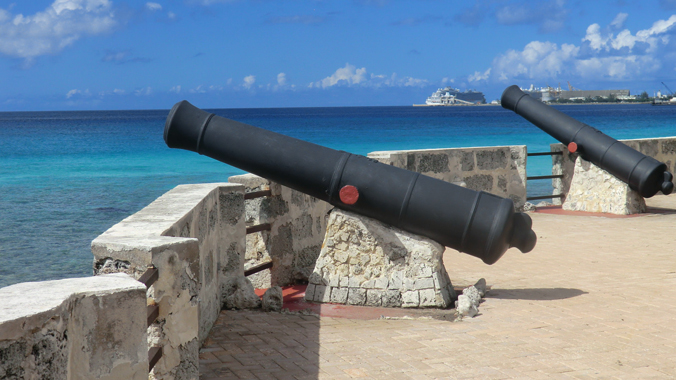
Early in their stay, Washington made the first of several visits to Needham’s Fort guarding the south side of Carlisle Bay. He met Captain Petrie, the fort’s commander, and dined with him at the fort more then once. The fortress seems to have impressed the teenage Washington for he recorded in his journal that it was “pretty strongly fortified and mounts about 36 Gunes within the fortifin and 2 facine Batterys.”[2]
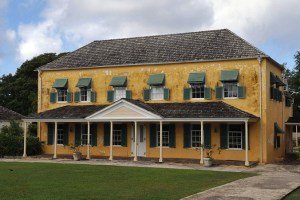
Furthermore, he and Lawrence stayed at the house of Captain Croftan, who commanded James Fort on the bay’s north side. Even Croftan’s house, Washington noted, “command[ed] the prospect of Carlyle Bay & all the shipping in such manner that none can go in or out with out being open to our view.”[3]
Home of Captain Croftan where Washington lived during the several months he visited Barbados in 1751. Credit: Wikipedia / Jerry E. and Roy Klotz
On the return voyage to Virginia and Ferry Farm, George judged that because Barbados had “large intrenchments cast up wherever its possible for an Enemy to Land” the island itself was essentially “one intire fortification.”[4]
As Jack Warren ably concludes, “George Washington’s encounter with the British military establishment in Barbados seems to have had a crucial impact on his aspirations . . . . After returning to Virginia, he dedicated himself to advancement in the military more completely than any of his Virginia contemporaries. And unlike most of the prominent colonial militia officers of the 1750s, he sought a commission in the regular British military establishment– an ambition that was probably prompted, and undoubtedly stimulated, by his experience in Barbados.”
Portrait of George Washington (1772) by Charles Willson Peale. The earliest authenticated portrait depicts Washington in the Virginia Militia uniform he wore during the French and Indian War. Credit: Washington and Lee University / Wikipedia
These three military adventures – Lawrence’s service in the War of Jenkin’s Ear, the written exploits of Schomberg, and George’s trip to the heavily fortified imperial outpost of Barbados – all worked to inspire Washington’s fascination with military matters and drove him to eventually pursue the life of a soldier in the French and Indian War and then, most importantly, in the War for Independence.
[2] Washington in The Daily Journal of Major George Washington in 1751-2 Kept While on a Tour from Virginia to the Island of Barbadoes, J.M. Toner, ed., Albany, NY: Joel Munsell’s Sons, 1892: 52.
It’s probably the myth that is more enduring and widespread than any other about George Washington. At some point from someone, you have heard that George Washington’s false teeth were made of wood. It is not true. In reality, his dentures and dental tribulations were more complex than the familiar myth says. The true story, even when it is uncertain, reveals much more about his life and about life in general in the 18th century.
George Washington by Gilbert Stuart (1798). Washington’s dental troubles are even apparent on his face. As the result of his dentures, he kept his mouth closed tightly and the false teeth caused the area around his lips, his lower jaw, and his chin to protrude slightly. Credit: Clark Art Institute
The causes of George’s dental problems will never be known with certainty. According to John Adams, Washington himself “attributed his misfortune to cracking of Walnuts in his Youth.” Furthermore, Adams hints at one additional potential factor: the common use of mercury in medicine during the 18th century. Adams described how his doctors gave him sizable quantities of mercury when he was inoculated for smallpox. The result was, he said, “that every tooth in my head became so loose that I believe I could have pulled them all with my Thumb and finger.” Adams complained that his doctors “rendered me incapable …of speaking or eating in my old Age, in short they brought me into the same Situation with my Friend Washington.”
Home of Captain Croftan where Washington lived during the several months he visited Barbados in 1751. Credit: Wikipedia / Jerry E. and Roy Klotz
For what it’s worth, nineteen-year-old Washington contracted smallpox in November 1751 during a stay in Barbados. Constantly attended by Dr. John Lanahan, he was sick for 25 days before finally fighting off the deadly disease. We have no records to tell us precisely how Lanahan treated Washington. If we consult pages 28-29 of A Rational and Mechanical Essay on the Small Pox published in 1735 by Dr. William Hillary, we find a three-phase course of treatment for pox sufferers. “The first, by bleeding in the first Stations of the Disease; when the Fever is violent: The second by introducing the Practice of Purging, (and Bleeding) in the most dangerous Circumstances attending the second Fever.” The third phase was employing all known methods to reduce inflammation. All phases were typical medical practice at the time.
The purging phase of smallpox treatment is when mercury may have become involved. The most popular concoction to induce purging in the 18th century was called calomel. It “was a white tasteless powder which consisted of mercury chloride. When taken in small doses calomel led to the evacuation of the bowels. If taken over time or in heavier doses, calomel induced heavy salivation, bleeding gums, mouth sores, tooth loss.” Again, in describing his own brush with smallpox, John Adams noted that his doctors “salivated me to such a degree” with “Milk and Mercury” that all his teeth became terribly loose.
Young Washington survived his smallpox attack but literally carried the scars of the illness for life. Back at Ferry Farm in January 1752, Mary Washington twice purchased some ointment from Dr. Sunderland (Sutherland?) to deal with George’s pox-caused facial scars. The same bill also included a “mercurial purging” for someone. [1] We should not definitively conclude that medicinal mercury caused George’s life-long dental troubles. Like most things in history, his difficulties probably had a mix of causes common to the 1700s, including diseases and “ poorly balanced diet . . . as well as genetics.”
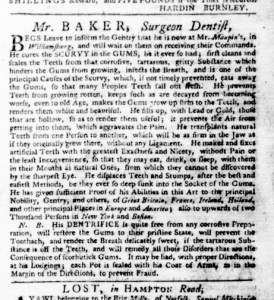
A set of Washington’s dentures as once owned by the Baltimore College of Dental Surgery, Dental School, University of Maryland. This older image shows both the lower and upper portions. Only the lower portion of these dentures is now present and on display at Baltimore’s Dr. Samuel D. Harris National Museum of Dentistry. Credit: National Museum of DentistryJohn Baker advertised his services as a Surgeon Dentist in the January 2, 1772 edition of the Virginia Gazette.
Accordingly, as he lost more teeth, George replaced them with partial dentures and then eventually full dentures. Surgeon Dentist John Baker, who we first wrote about here, became George’s regular dentist in 1772. Baker stayed at Mount Vernon in October 1773 and received two substantial payments of £8 total from Washington that same month. Baker was the first to make false teeth for George, creating a partial denture of ivory for wiring to his natural teeth.
The tooth loss continued, however. In 1783,Washington asked Baker “for some of the Plaister of Paris, or that white powder with which you take (in wax) the Model of the Mouth for your false teeth—and directions how to mix, & make use of it—When you have done this, I can then give you such a Model as will enable you to furnish me with what I want.” It seems it was time for another new set of dentures.
Washington definitely used human teeth in his dentures but we do not know if they were teeth from slaves. He probably did use his own in some dentures. Back in 1782, when John Baker was still his dentist, George wrote to Lund Washington instructing him that “In a drawer, in the Locker of the Desk which stands in my Study, you will find two small (fore) teeth; which I beg of you to wrap up carefully, & send inclosed in your next Letter to me. I am positive I left them there, or in the secret drawer in the locker of the same desk.” It is believed “Washington hoped that these original teeth could be used within new dentures that were being fitted for his use.”
George Washington suffered a lifetime of dental troubles. The causes of those troubles and the attempted solutions were typical of the 18th century and teach us much about both Washington’s life and the lives of his fellow early Americans. The real story of Washington’s false teeth, even when uncertain, reveals more about his life and his times than any stale wooden myth.
Zac Cunningham
Manager of Educational Programs
[1] Paula Felder, Fielding Lewis and the Washington Family: A Chronicle of 18th Century Fredericksburg, The American History Company, 1998: 103.
March 6, 2017 was the 286th wedding anniversary of Augustine and Mary Ball Washington, George Washington’s amazing parents. In addition to calling to mind how grateful we are for their role in raising the boy who would become our courageous General and first president, this anniversary also provides us with an opportunity to discuss the circumstances of Augustine and Mary’s marriage, their family, and their eventful lives here in Stafford and Spotsylvania Counties.
It was not Augustine Washington’s first time to the altar. His earlier marriage to Jane Butler in 1715 produced four children. Jane was likely 16 when she gave birth to their first son, Butler, who died in infancy. Butler was followed by Lawrence (b. 1718), Augustine Jr. (b. 1719 or 1720), and Jane (b. 1722). Their mother tragically passed away in 1729 just shy of her thirtieth birthday. This left young Lawrence (about 11 years old), Augustine Jr. (around ten), and Jane (about seven) without a mother. Their devoted father immediately began a judicious search for a proper wife for himself, a nurturing mother for his children, and an experienced household manager.
He discovered such a gem in the Northern Neck’s attractive and highly eligible maiden, Mary Ball. Mary’s family had thrived in the Virginia Colony’s tidewater region for generations. Mary gained valuable experience managing property from her mother, Mary Johnson Ball who oversaw the family’s substantial resources after the death of Mary’s father Joseph Ball when Mary was only three years old. Mary’s mother again wed, and was soon widowed with additional resources to manage, thanks to the generosity of her devoted husband. When Mary was only 13, her mother passed away, and Mary joined the household of her older, half-sister Elizabeth Johnson. Thereafter, childbirth and childrearing became second nature to Mary who, as a loving aunt, gained valuable experience helping to nurture her sister’s children and perfecting the lessons in household management first learned under her mother’s tutelage.
When it came to matrimony, anxious parents typically steered their children toward appropriate choices, especially among established and propertied clans as the Washington and Ball families. But death had robbed both Augustine and Mary of their respective parents and their wisdom. Some claim that Colonel George Eskridge, a prominent Northern Neck Lawyer and family friend, helped bring this destined pair together. While a parent’s concerns provided some guidance for young lovers, it was only one of several considerations for eager suitors. Ideally, the opportunity for social advancement, acquiring property (both land and enslaved labor), financial security, and – of course – affection were also carefully weighed.
Mistress Mary Ball rang all of these “bells:” She was experienced with children. She had been tutored in plantation management and household skills by her experienced mother. Mary Ball’s generous and enviable dowry had accumulated to include 1000 acres of Virginia land, enslaved laborers, horses, cattle, and sundry personal belongings. Notably, the majority of her acreage bordered Augustine Washington’s iron mine in Accokeek, just one of Mary’s assets that Augustine found irresistible.
On March 6, 1731, the pair joined. Mary was about 23 and her new husband Augustine was 37. Of Augustine’s three living children from his first marriage, Lawrence, Augustine Jr., and Jane, it was Jane who remained a daily part of their Westmoreland Plantation home. Mary continued the household training that young Jane started learning from her own mother. Lawrence and Augustine Jr. continued their education at the Appleby Grammar school in England where their father had attended school.
Before their first wedding anniversary, Mary and Augustine welcomed their first son, George, into the world. He was born on February 11, 1731 (Old Style) in Westmoreland County. In all, their happy marriage produced six children: George (1732), Betty (1733), Samuel (1734), John Augustine (1736), Charles (1738), and Mildred (1740). All but little Mildred survived to adulthood.
Just twelve years after their wedding, Augustine Washington passed away around the age of 48. Mary remained a widow throughout her long life, focused upon raising their children, and later playing an active and cherished role in the rearing and education of her grandchildren. Mary moved into the town of Fredericksburg in the spring of 1772, within easy walking distance of her daughter Betty’s household, headed by Fielding Lewis and known today as Kenmore. She was remembered fondly by her grandchildren and, at her request, was buried near Meditation Rock in Fredericksburg, Virginia.
Laura Galke, Archaeologist
Site Director/Small Finds Analyst
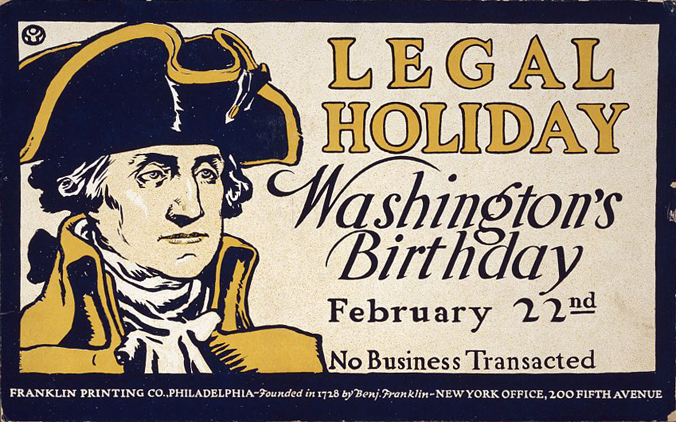
A poster from the late 1800s announcing that no business will be conducted on Washington’s Birthday, which was then celebrated on his actual birth date of February 22. Credit: Library of Congress
Happy Birthday, George!! Two-hundred and eighty five years ago today on February 22, 1732, George Washington was born. Americans have commemorating his birth and his life for centuries, since he rose to prominence as the commanding general of the Continental Army and the nation’s very first president. For centuries, his likeness has been added to plates, glasses, and bottles, carved in stone, etched on coins, used in advertisements, and printed on clothing to create unique memorabilia celebrating the man who was eulogized as “First in war, first in peace, and first in the hearts of his countrymen.”
The 1932 celebration of Washington’s 200th birthday especially led to increased demand for Washington memorabilia. The George Washington Foundation has a small collection of both this bicentennial and a few commemorative objects from even earlier. To mark George’s birthday in 2017, Lives & Legacies shares photographs of this memorabilia!
Amber glass hatchet from either the 1893 Chicago World’s Fair or the 1904 St. Louis World’s Fair. Made by the Libbey Glass Company at the World’s Fair Libbey Glass Demonstration Furnace where visitors could observe glass manufacture and then purchase the glass hatchets. They came in other colors such as opaque white, amethyst, green, and cobalt blue.
Medal featuring a right-facing bust of Washington that was awarded by the New York State George Washington Bicentennial Commission “in appreciation of Services generously Rendered to the Commission During 1932.” The accompanying card is signed by Charles Tobin, the commission’s chairman.
A pin dating from around 1900 that features a portrait of George Washington from the chest up and wearing a red coat. The image is printed on paper or fabric and is covered by celluloid, with a metal, goldtone rim. The pin could be attached to a piece of clothing and has a bar for hanging a ribbon or pendant. The Washington image of has “PAT. W.& H. CO. / NEWARK, N.J.” printed on either side.
A Washington Bicentenary Memorial Plate from 1932 made by Crown Ducal in Stoke-on-Trent, England. This ceramic plate with blue transfer-print was part of a series of 12 to commemorate the 200th anniversary of Washington’s birth. It imagines General Washington and Mary, his mother, strolling through a romanticized rural landscape.
A clear glass bottle from 1932 made by the Owens-Illinois Glass Company of Huntington, West Virginia. One side is a crude embossed profile of a Washington bust while the other side has embossed depiction of a cherry tree with the dates “1732” and “1932” on a scroll beneath.
A commemorative plate from 1932 with an elaborate floral gilded border and a transfer-printed bust of George Washington in the center and made by the Capital Souvenir Company.
A commemorative porcelain tray depicting George Washington, Martha Washington, and Mount Vernon. The vignettes were transfer-printed first and then hand-painted to add details. At the bottom of the Mount Vernon vignette is printed “Washington’s Home / Mount Vernon, Va.” The tray was made by Tressemann & Vogt in Germany between 1891 and 1907.
A green water bottle with a likeness of George Washington under the word “water.” The bottle reads “Washington / Bicentennial” with the dates 1732 and 1932 on either side. It was made by the Hemingray Glass Company in Muncie, Indiana.
Parents, perhaps hoping to spur their offspring to similar greatness, have named their children George Washington ever since the most famous George Washington rose to prominence as commander of the Continental Army and the nation’s first president. Few other George Washingtons ultimately achieved the original’s stature, although a few perhaps came close. As we mark George Washington’s birth this month (Come to our Washington’s Birthday celebration at Ferry Farm this Saturday!), we share the compelling stories of five notable Americans named George Washington.
George Washington Vanderbilt II Credit: Wikipedia/Biltmore Co.
George Washington Vanderbilt II was born in 1862 into New York’s wealthy Vanderbilt family. At the age of 27, he began buying vast tracts of land near Asheville, North Carolina. He loved the mountains and wanted to build a grand home among the Blue Ridge. Working with architect Richard Morris Hunt, Vanderbilt planned the house and oversaw construction of the $3,000,000 mansion. He named the home and estate “Biltmore.” Vanderbilt used his vast acreage to help to pioneer scientific forestry and began a forestry school on his estate. His first superintendent of forests was Gifford Pinchot, who became the first chief of the U.S. Forest Service. Vanderbilt died in 1914 in Washington, DC.[1]
The Biltmore Estate near Asheville, North Carolina. Credit: Wikipedia
George Washington Gale Ferris, Jr. Credit: Wikipedia
George Washington Gale Ferris, Jr. was born in Galesberg, Illinois in 1859. He studied engineering at Rensselaer Polytechnic Institute in New York. He worked for a series of railroad and mining companies in West Virginia before focusing on bridge-building and structural steel construction. He started G.W.G. Ferris & Company in Pittsburgh and helped build bridges across the Ohio River in that city as well as in Wheeling and Cincinnati. For the Chicago World’s Fair in 1893, he designed the Ferris Wheel. “Rising 250 feet above the Midway, carrying thirty-six cars, each with a capacity of some forty passengers, revolving under perfect control, and stable against the strongest winds from Lake Michigan, it excited general attention.” He died in Pittsburgh in 1896.[2]
The Ferris Wheel at the 1893 Chicago World’s Fair. Credit: Wikipedia/New York Times
George Washington De Long was born in New York City in 1844. An American naval officer, he organized and commanded an attempt to reach the North Pole via the Bering Strait. His expedition left San Francisco aboard the Jeanette, a coal-burning steamer also equipped with sails, on July 8, 1879. The Jeanette became trapped in the ice for 22 months before being crushed and forcing the crew to abandon ship. The crew took to three lifeboats. One was lost, one made it to shore but all of its crew died of starvation and exhaustion, and one made it to shore where its crew was rescued. De Long did not survive, dying in Siberia on October 30, 1881. Three years later, debris from the Jeanette was found nearly 3,000 miles away off Greenland’s coast, proving the polar ice was in motion.[3]
George Washington Crile was born in Ohio in 1864. He received his M.D. from what is known today as Case Western Reserve University School of Medicine. He was a leading pioneer in surgical medicine during the first half of the 20th century. He dedicated much of his wide-ranging and groundbreaking career to studying the impact of shock on patients undergoing surgery and to developing pioneering ways to treat and combat that shock. He advocated for monitoring blood pressure during surgery and, most importantly, recognized the most effective way to stave off shock was through blood transfusions during operations. He is credited with performing the first direct blood transfusion. Surgical shock’s worst outcome was death so Crile developed resuscitation methods and, in the process, discovered the brain could be deprived of oxygen for only a very few minutes before resuscitation become impossible. In 1921, he and several colleagues founded the Cleveland Clinic, considered one of the world’s foremost medical centers. Furthermore, a pressure suit he developed to prevent surgical shock was adapted to prevent blackout in pilots during World War II. He died in Cleveland in January 1943.[4]
George Washington Carver Credit: Wikipedia/Tuskegee University Archives
George Washington Carver was born a slave in Missouri in the early 1860s. He attended a series of schools in Kansas and Missouri and graduated from Minneapolis High School in Minneapolis, Kansas. He was rejected from one college because of his race but became the first black student at Iowa State Agricultural College, where he received both his bachelor’s and master’s degrees. In 1896, Booker T. Washington hired Carver to chair the agricultural department at the Tuskegee Institute, where he remained for half-a-century. As a agricultural scientist, Carver created methods to revive soil exhausted from planting only cotton year after year. These methods centered on rotating cotton with sweet potatoes, peanuts, soybeans, and cowpeas, which restored nitrogen in the soil and provided income for farmers as well. He trained farmers to grow these alternative crops and distributed recipes using these crops to the public to spur demand. His efforts to promote the peanut especially sparked the public’s imagination. He died on January 5, 1942 in Tuskegee, Alabama.[5]
Zac Cunningham
Manager of Educational Programs
[1] “George Washington Vanderbilt.” Dictionary of American Biography, Charles Scribner’s Sons, 1936. Biography in Context, link.galegroup.com/apps/doc/BT2310001556/BIC1?u=crrl&xid=3822e021. Accessed 9 Feb. 2017.
[2] “George Washington Gale Ferris.” Dictionary of American Biography, Charles Scribner’s Sons, 1936. Biography in Context, link.galegroup.com/apps/doc/BT2310013691/BIC1?u=crrl&xid=3144ffeb. Accessed 9 Feb. 2017.
[3] “George Washington De Long.” Explorers & Discoverers of the World, Gale, 1993. Biography in Context, link.galegroup.com/apps/doc/K1614000095/BIC1?u=crrl&xid=e0125245. Accessed 9 Feb. 2017.
[4] “George Washington Crile.” Dictionary of American Biography, Charles Scribner’s Sons, 1973. Biography in Context, link.galegroup.com/apps/doc/BT2310015367/BIC1?u=crrl&xid=8dcc7fd9. Accessed 10 Feb. 2017.
[5] “George Washington Carver.” Contemporary Black Biography, vol. 4, Gale, 1993. Biography in Context, link.galegroup.com/apps/doc/K1606000443/BIC1?u=crrl&xid=3bdf1f8b. Accessed 10 Feb. 2017.
Tantalizing evidence of historic furniture use exists within the soils of George Washington’s Ferry Farm and that evidence gives us a more complete view of how the Washington family lived in the 1700s. The hundreds of items archaeologists and students have uncovered represent the remains of furniture broken or embellishments lost. The ruthless outdoor elements leave scant vestiges of furniture’s former glory. Wood disintegrates into soil, so these relics typically include only iron and brass hardware, such as drawer pulls, casters, bolts, keyhole escutcheons, or hinges. Over half of the hardware found consists of brass tacks. Such brass studs were often used in furniture upholstery, but were also popular for saddles, trunks, even antique wig stands: anytime a leather covering was added to a wooden frame or base.
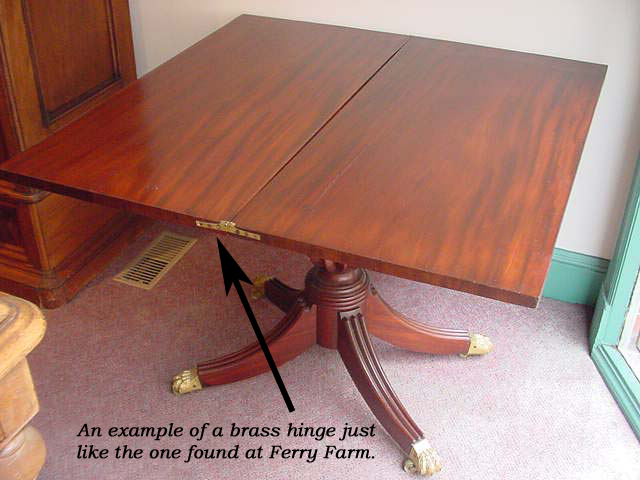
One particularly interesting brass hinge was unearthed in 2007 and boasts an exciting past. This hinge, part of a folding card table, was a crucial element in the popular Virginia domestic pastime of playing games such as backgammon, chess, and cards. Card tables provided a luxurious accessory for popular social entertaining and were part of a well-appointed home. Providing guests with such pleasant amusements reflected well upon the Washington family.
18th century card table hinge excavated at George Washington’s Ferry Farm.
Archaeological investigations sponsored by The George Washington Foundation have uncovered evidence that demonstrates that the Washingtons’ mid-1700s home was filled with fashionable accessories to enhance social bonding. These tools included tea wares, stemmed drinking glasses, glass decanters, fashionable dining utensils, and smoking pipes. The recovery of a card table hinge provides another element of their well-equipped home.
Gentleman often played card games together, but occasionally women joined the amusement as well (Porter and Porter 1782:466-467). Playing cards allowed ladies and gentlemen a refined form of amusement in a convivial atmosphere, without raising critical eyebrows from discerning social commentators in Virginia. These games were occasions in which mixed company – men and women – could enjoy companionship and pass the time in a genial way. It was one of the few entertainments in which men and women could directly compete (Sturtz 1996:169-171). Lucy Byrd’s acumen prompted her husband William to cheat on at least one occasion (Sturtz 1996:172-173, 175-176).
Such benign competition also allowed players to showcase their skills. William Byrd II thought that such games provided an effective antidote to “disagreeable” company, as it allowed the time spent with tiresome guests to pass quickly (Sturtz 1996:175). Tea or stronger beverages might lubricate such gatherings, which enhanced social bonds.
Card playing (group at card table in painting’s center) and tea drinking (group at table at painting’s right) provided elegant entertainment as depicted in The Assembly at Wanstead House (1728-31) by William Hogarth. Public domain. Credit: Philadelphia Museum of Art / Wikipedia
If card games included a little wager, they were all the more thrilling. Self-assured gambling and an indifference to losing money demonstrated a gentleman’s independence from monetary anxiety (Isaac 1974:352; Koda and Bolton 2006:100; Sturtz 1996:166). Such competitive confidence went a long way towards refuting any rumors of financial stress from which a gentleman might be suffering in the community.
In the years leading to the American Revolution, these occasions were increasingly viewed as a source of social disorder (Isaac 1974:358-359), but such amusements remained popular social events in Virginia.
Cards were a popular Virginia pastime and specific furniture such as folding card tables existed as luxurious accessories to support this pasttime (Isaac 1974:352). Hospitality was an important part of these occasions (Isaac 1974:352) and the folding card table made the game and the hospitality possible. Applying knowledge of the past to particular objects like a card table hinge excavated at Ferry Farm gives us a more complete picture of the lives led by the Washington family here in the 18th century.
Laura Galke, Archaeologist
Site Director/Small Finds Analyst
References Cited
Porter, James and William Porter
1782 Letters Addressed to Two Young Married Ladies, on the Most Interesting Subjects. The Critical Review, or, Annals of Literature. British Periodicals. Printed for J. Dodsley, London.
Goodison, Nicholas
1975 The Victoria and Albert Museum’s Collection of Metal-Work Pattern Books. Furniture History 11:1-30.
Issac, Rhys
1974 Evangelical Revolt: The Nature of the Baptists’ Challenge to the Traditional Order in Virginia, 1765-1775. The William and Mary Quarterly 31(3):345-368.
Koda, Harold and Andrew Bolton
2006 Dangerous Liaisons: Fashion and Furniture in the Eighteenth Century. The Metropolitan Museum of Art, New York.
It’s Election Day! From early morning until after dark, voters in Virginia and across the United States are walking into libraries, schools, firehouses, community centers, city halls and, occasionally, even private homes. Once inside, they are given a paper ballot, punch card or, although still relatively rare, may be directed to a touch screen. The voter steps up to or into a voting booth walled off with some type of barrier. There is an atmosphere of quiet deliberateness. The individual voter alone marks the candidates of their choice. When finished, they place their ballot into a secure ballot box. The ballot requires no signature nor is the voter required to make a public declaration revealing who they support.
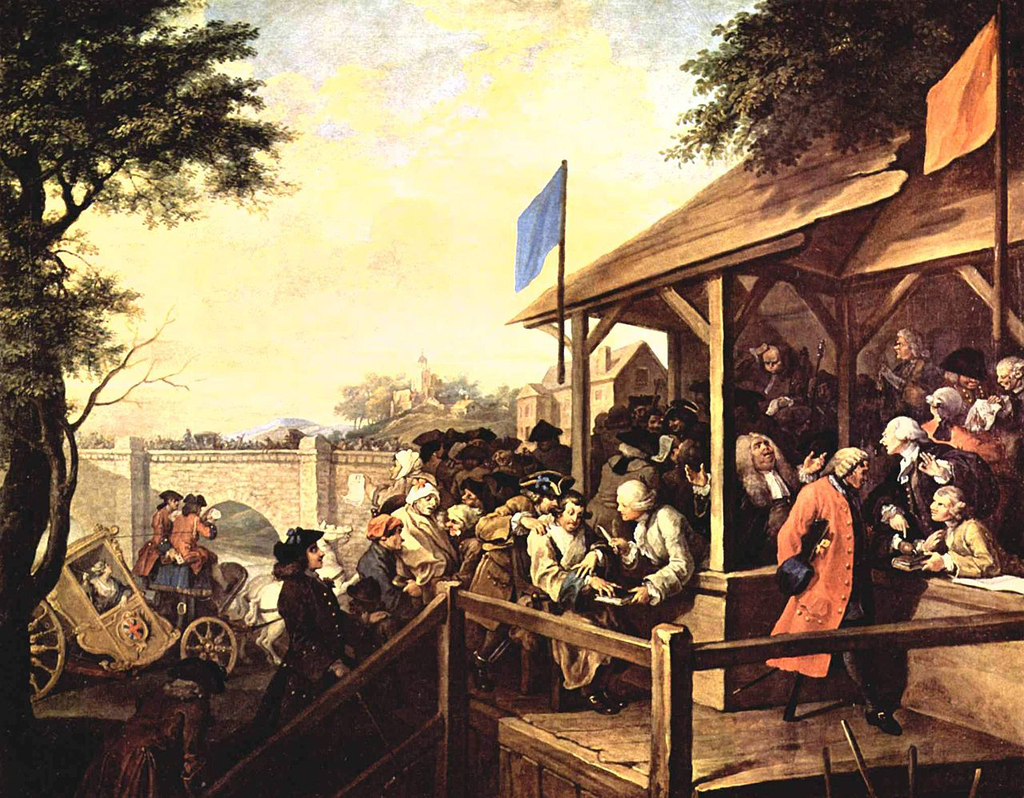
White propertied men of the 18th century like Fielding Lewis, Augustine Washington, and George Washington would be surprised by our 21st century voting process. In early America, Election Day was an intensely public affair and oftentimes an excuse for everyone, whether permitted to vote or not, to travel to the county seat for the election. It was a chance to visit neighbors, conduct business, and simply have a good time. There was a holiday atmosphere that could get quite uproarious!
“The Polling” by William Hogarth (1755), scene 3 in his Humours of an Election series. While Hogarth’s goal is to mercilessly satire English politics, his painting also hints at the festive atmosphere of an actual 18th century Election Day. Credit: Sir John Soane’s Museum / The Yorck Project / Wikipedia.
“An Election Entertainment” (1755) by William Hogarth, scene 1 in his Humours of an Election series. The painting is a critical depiction of a candidate hosting a dinner for voters at a tavern. Credit: Sir John Soane’s Museum / The Yorck Project / Wikipedia.
Although 18th century candidates couldn’t directly supply alcohol to voters, they were expected to be present during voting and were also expected to warmly greet all voters. Today, in most states, there are restrictions against candidates or a candidate’s supporters from campaigning at or near a polling place while voting is taking place. The candidate was present, in part, so that he could thank the voter for their vote.
While the secret ballot is sacred today, public voice votes of the 18th century and the poll books in which the votes were recorded provide historians with valuable knowledge about the elections of the time and about who voted for whom. They also hint at personal connections within communities. For example, we know that Augustine Washington, George Washington’s father, voted for William Fairfax, Esqr. and Colonel James Colvill for Prince William County’s two seats in the House of Burgesses in 1741. We know that Fairfax won one seat with 246 votes and Colvill won the other seat with 175 votes.[2] While we should be cautious about reading too much into Augustine’s support for Fairfax, George would go on to cultivate connections with William and other Fairfax family members. After Augustine’s death, George aspired to be like William’s cousin Thomas Lord Fairfax, “socially prominent, well-connected, and involved in important affairs.”
Portion of a page from “The Poll for Election of Burgesses for the County of Prince William…” in 1741.
Americans have been voting for an exceptionally long time. We were voting even before a United States of America existed. The methods have changed over four centuries and although we no longer literally voice our vote, your vote is still your voice. Be heard today. Go vote!
Zac Cunningham
Manager of Educational Programs
[1] Ron Chernow, Washington: A Life, New York: Penguin Press, 2010: 88.
[2] Poll for Election of Burgesses in Prince William County, 1741, Deed Book E, pg. 524, Prince William County, Va.





 Anthropologists – scholars who study people – make special efforts to identify such symbols in societies, both in contemporary studies and in analyses of past people.
 beginning by the 1760s, the fox symbolism present on tallio buttons was malleable