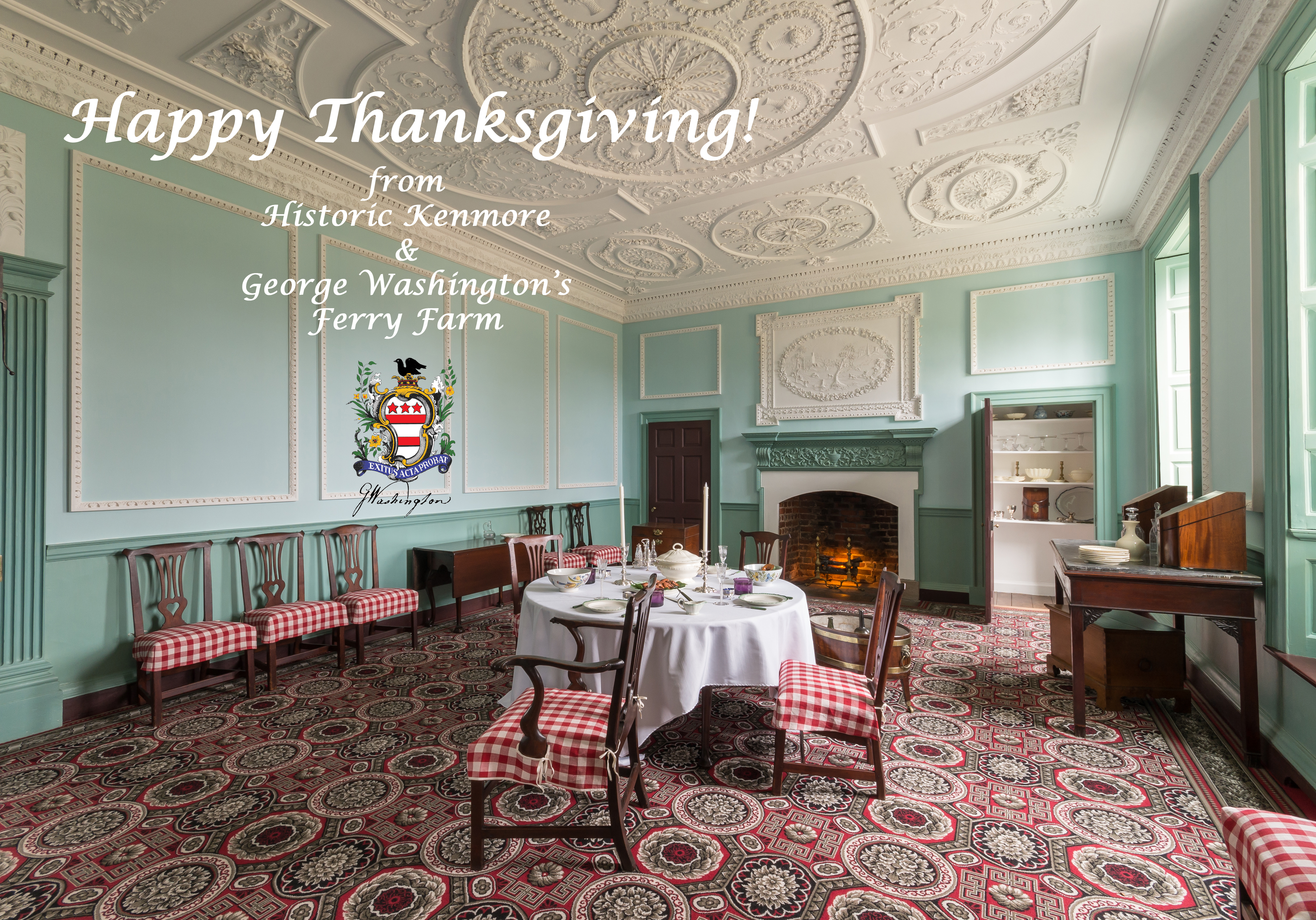
It’s the 32nd year of a a long-standing holiday tradition: the Gingerbread Contest & Exhibit at George Washington’s Ferry Farm! This year’s theme is “Cartoon Adventures.”
“Snoopy’s Christmas Love” by Gloria Tignor
“A Minon Christmas”
“Yabba Dabba Doo” by The Feeback Family
“A Charlie Brown Christmas” by Ni River Special Education
“Hobbit House” by Chancellor High German Club
“Cartoon Advent Calendar” by Ms. Redelman’s Class at Courtland High School
“Rapunzel” by Angela Saathoff
“Frosty the Snowman” by Samantha Wainwright
“Grinch’s House” by CJ Crocker
“Scooby Doo Miner 49er Chase” by Susan Dodson
“Transformer Making a Snow Angel” by Misha Sanborn
“Calvin & Hobbes” by The Szlyk Family
“Calvin & Hobbes” by The Szlyk Family
“Whoville” by Ms. Bekah’s ECSE 3 Class
“Calvin & Hobbes Winter Wonderland” by Jessica Kamuar
“Charlie Brown’s Christmas”
“A Christmas in WhoVille” by The Jackson 5
Adults and children alike will enjoy the sights and smells of these festive creations displayed at Ferry Farm! Ferry Farm’s hours are Monday – Saturday 10:00 a.m. – 4:00 p.m. and Sunday from 12:00 p.m. – 4:00 p.m. Ferry Farm is closed Christmas Eve and Christmas Day. The gingerbread exhibit ends on December 30. General admission to Ferry Farm and the exhibit is $9 adults, $4.50 students, under 6 free while admission to the exhibit only is $4.50 adults, $2.25 students, under 6 free.
For more information, call (540) 370-0732 x24 or email [email protected].
The moment anyone mentions trees and George Washington, you probably think of the famous Cherry Tree Story. However, this tale of young George taking a hatchet to his father’s cherry tree and, when confronted about the act, asserting “I cannot tell a lie” is probably just that — a story meant to demonstrate the integrity of the Father of Our Country. In reality, the trees of Ferry Farm have a much more fascinating history. Their story reflects, on a small local scale, vast environmental changes in eastern North America and shifting American attitudes toward the environment throughout the 18th, 19th, and 20th centuries.
Today, we see wilderness as a good thing that needs protected and preserved. But in the 1700s, Europeans settlers saw wilderness as a bad thing. Preeminent environmental historian William Cronon notes, Europeans described wilderness as “’deserted,’ ‘savage,’ ‘desolate,’ ‘barren’—in short, a ‘waste,’.” People did not look at forests, deserts, or mountains as places to protect and visit. Instead, they were places to be feared and tamed.
The opposite of wilderness was the managed landscape of Europe. In cities, towns, and farms, Europeans tried to control nature and make it follow humanity’s rules. These efforts to tame the wilderness were transplanted to colonial plantations in the Americas.
The first step in building a plantation and taming the wilderness was clearing the land for farming. Huge numbers of trees were cut down to do this. On top of that, trees were cut down to make almost everything people of the 1700s and 1800s used and owned. Furthermore, they were also cut down to do many everyday tasks.
Throughout the 18th and 19th centuries, the wood from trees was…
used as the main architectural building material in houses, most other structures, farm buildings, fences, and more
used to build ships, boats, ferries, bridges, carriages and wagons that moved people and things from place to place
used to make everyone’s furniture (beds, chairs, tables, desks, cabinets, and trunks) as well as many household items and farming tools
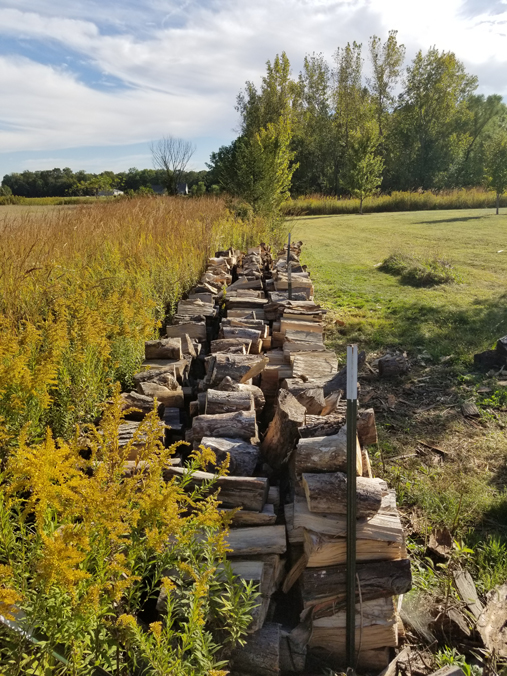
Five cords of firewood. A colonial home used 8 or 9 times this amount in a year for just heating and cooking. Credit: Chris StevensonCredit: Chris Stevenson
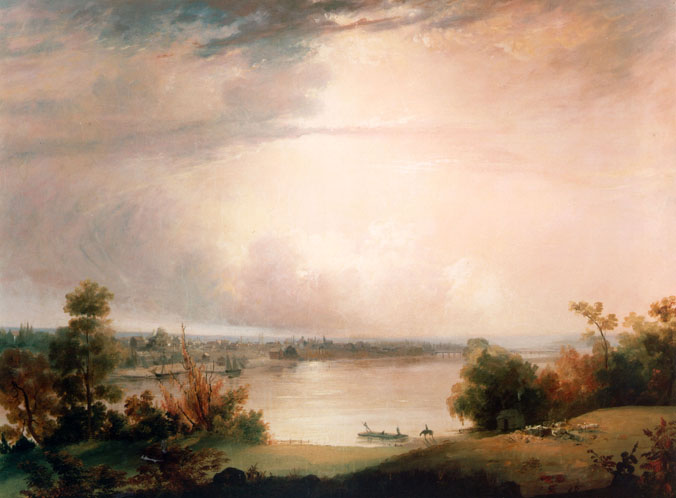
These large scale trends can be seen on a small scale at Ferry Farm. The European settlers who lived here, including the Washingtons, cut down a significant number of trees but not so many that there weren’t still quite a few standing when John Gadsby Chapman painted Ferry Farm’s landscape in 1833.
“The Old Mansion of the Washington Family” (1833) by John Gadsby Chapman shows the foundation stones of the house where George grew up at Ferry Farm and trees along the riverbank.
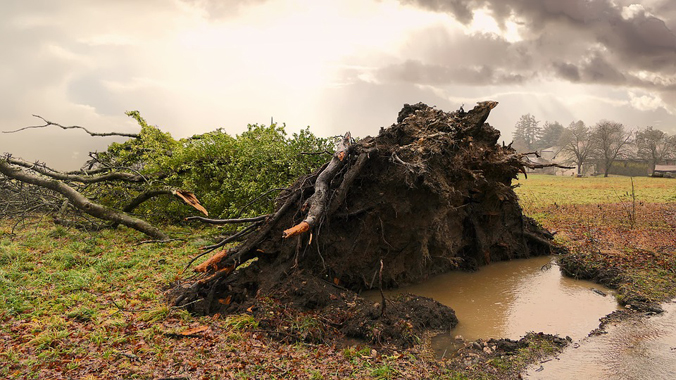
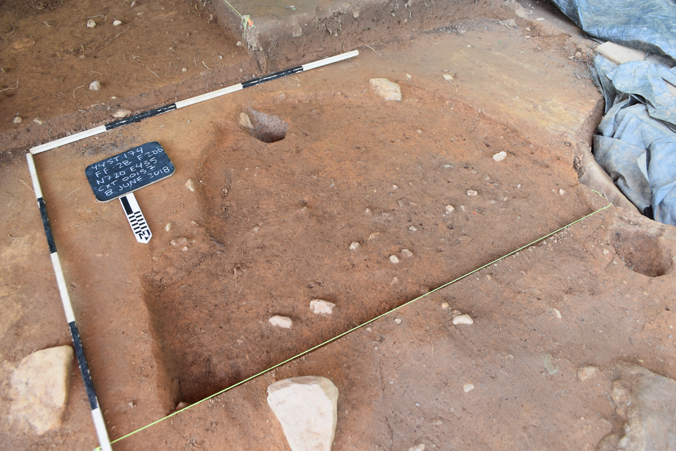
We also have archaeological evidence showing the locations of trees during the Washington era. This past summer in the yard north of the Washington house replica archaeologists uncovered “soil stains” left after trees fell in the past. Soil stains are where the soil is a slightly different color than surrounding areas and indicate where people filled in holes created by uprooted trees. In other words, such soil stains indicate that a tree once stood there.
In some cases, our archaeologists found that the holes were filled in multiple episodes, indicating that the soil settled and new dirt was later added or the person filling the hole borrowed different dirt of different colors from multiple locations. By excavating the soil from these soil stains and analyzing the artifacts, we can tell around when the holes were filled.
Soil stain marking the site of an 18th and 19th century tree on the landscape at George Washington’s Ferry Farm.
One very large tree left the sizable soil stain – almost 5ft x 5ft – pictured above. Based on artifacts found in its soil, the hole was filled during the mid-19th century. We can tell by the size of the stain that the tree was quite mature. Together, these facts are evidence of a tree that grew just 40 feet north of the original Washington house during the time George and his family lived at Ferry Farm. This discovery gives us another detail about the landscape so it can eventually be accurately recreated just as we did the main house.
Finally, Ferry Farm archaeologists learned from these tree features and from the lack of other features in this yard that the area was well-kept. In the 18th century, this portion of the landscape was probably well-maintained because it was visible from Fredericksburg across the river.
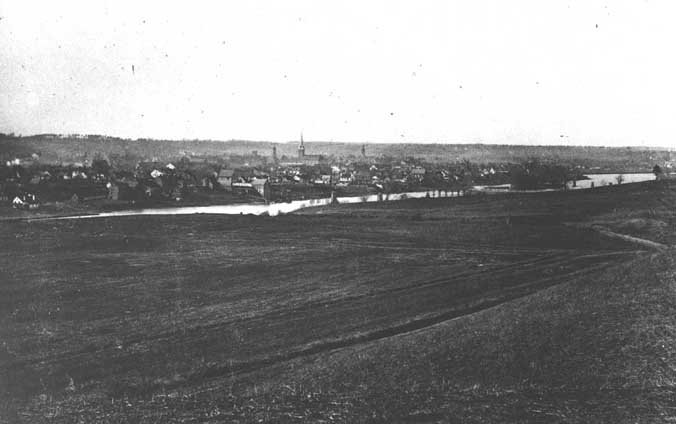
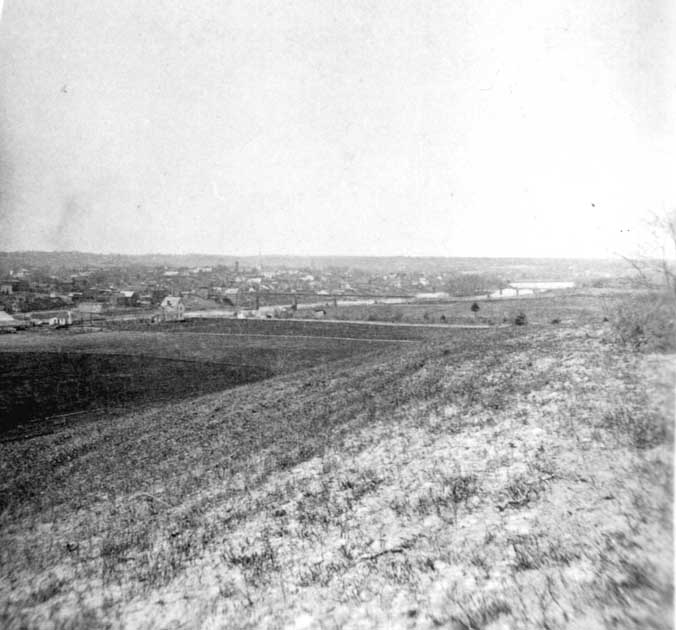
In the 1860s, the Civil War exacerbated deforestation at Ferry Farm and throughout Stafford County. Hundreds of thousands of Union Army soldiers radically altered the local environment to get the wood they needed for cooking and heating, to help build their fortifications and pontoon bridges, and even to build shelters. During winter lulls in fighting, 18th and 19th century armies did not camp in tents. The soldiers built small log cabins. By war’s end, Ferry Farm and Stafford County were nearly treeless as seen in the two photos of Ferry Farm below taken in the decades after the war ended.
View of Ferry Farm property in the 1870s.View of the Ferry Farm property in the 1880s
As the 19th century turned into the 20th, wilderness, nature, and the environment were increasingly seen as special and deserving of protection and preservation, sparking the creation of national and state parks, government agencies like the Forest Service, private conservation groups such as the Sierra Club, and, in 1872, the very first Arbor Day.
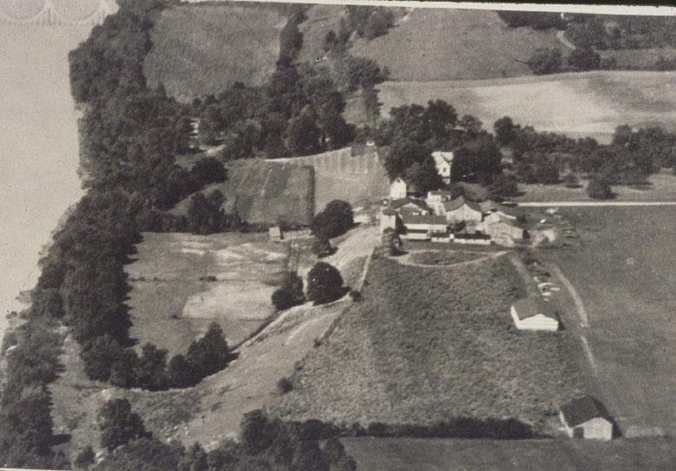
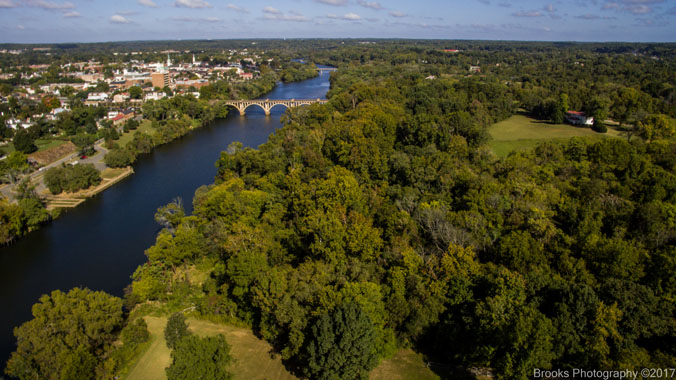
We can see the impact of new attitudes toward the environment at Ferry Farm in photos below. The top one from the 1930s, a period of intense conservation efforts nationwide, shows trees starting to appear once again while the other from 2017 shows trees on a portion of Ferry Farm stretching out as far as the eye can see to the north.
Aerial view of Ferry Farm taken in 1930.Aerial view of a portion of Ferry Farm and points north taken in 2017. Credit: Joe Brooks / Eagle One Photography
The early 20th century saw the nadir of American deforestation in 1910. But since that year, forest acres in the U.S. have largely held steady [PDF]. The new conservation ethic symbolized in the practice of planting trees to replace those cut down, the reduced use of wood as a building material and fuel source, the need for less farm land, and the movement of people from rural to urban areas (all of which present their own challenges to the environment) have provided a reprieve for America’s forests.
While George’s mythical chopping of the Cherry Tree is the most well-known tale about trees at Ferry Farm, the more important and fascinating story is how the 300 hundred year history of trees at Ferry Farm reflects broader post-settlement environmental changes in North America and how the Americans who made those changes grew to see the world differently.
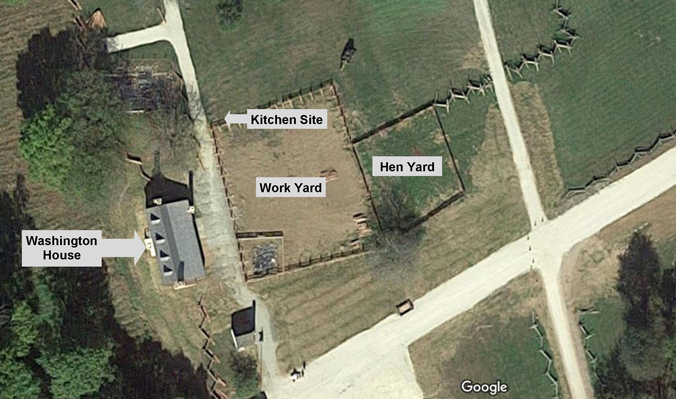
Twenty years ago, archaeologists digging at George Washington’s Ferry Farm unearthed the remains of a mid-eighteenth century kitchen. It was immediately obvious from the state of the artifacts that this kitchen had not simply fallen into to ruin and been abandoned – it had burned down. While this is fairly interesting in and of itself, a reexamination of the kitchen fire artifacts this year revealed surprising information about the intensity of the fire.
Overhead image of George Washington’s Ferry Farm showing location of the kitchen that burnt down in the 18th century. Credit: Google
What first struck us was the sheer density of artifacts in this kitchen. We recovered A LOT of artifacts. Furthermore, these broken sherds could be mended to form almost whole bottles, crocks, jugs, pans, and such. The number of artifacts and the fact they could be put together to form entire objects tell us that the Washington family and their slaves did not have much, if any, time to salvage what was inside the burning kitchen. Food, wine bottles, food storage and preparation vessels and utensils, furniture, and more all destroyed exactly where they stood. Think of this kitchen as a mini Pompeii or Titanic. Just about everything that the Washington’s had in their kitchen went down with the ship and was still there, just squished and burned.
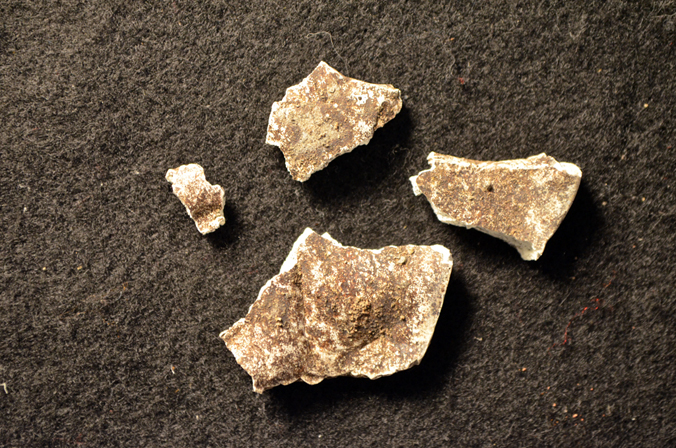
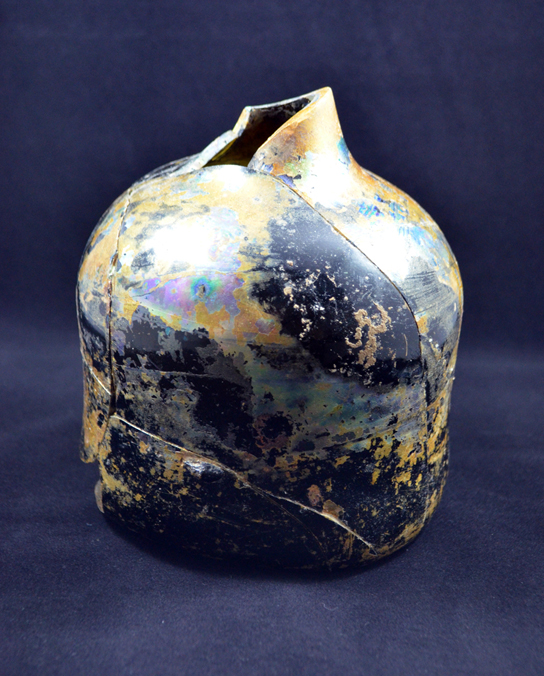
A preserved moment in time like this fire is a great opportunity for archaeologists to study the Washingtons but it comes with one big problem—most of the artifacts were totally cooked and absolutely toasted beyond recognition in some cases. Soft metal artifacts made from lead and copper, for example, were reduced to melted blobs by the fire. Ceramic vessels appear to have exploded from the heat and were reduced to blackened sherds. Some of the glass bottles survived with a minimal amount of warping from heat but the majority were melted or even burned in a process called ‘devitrification’. And oddly enough there was very little animal bone, which is usually ubiquitous in kitchens found archaeologically.
To put the intensity of this kitchen fire in context here are some quick statistics (in Fahrenheit):
Lead melts at 621.4 degrees.
According to the National Institute of Fire and Safety Training, the average modern house fire tops out at around 1,100 degrees.
1,400-1,800 degrees is the temperature at which bone will be destroyed
Copper melts at 1,984 degrees
Glass melts between 2,600 and 2,800 degrees.
Since the Washington kitchen fire was hot enough to actually burn glass, not just melt it, we’re looking at a fire that likely exceeded 2,800 degrees. That’s incredible! It also explains why there was so little animal bone recovered. Most bone was probably completely destroyed by the flames.
Extremely burned tin glaze ceramic recovered from the kitchen site at Ferry Farm.Devitrified glass from the burnt Washington kitchenMelted copper alloy excavated from the Ferry Farm kitchenBlobs of lead alloy recovered from the kitchen siteSlightly burned wine bottle from the kitchenA second slightly burned wine bottle
So, how on earth did the fire get that hot? We’ll probably never know, unfortunately. Some possible explanations may be the environmental conditions at the time of the blaze – a hot dry day with high winds could produce a perfect storm for a wooden kitchen to turn into an inferno. The fire also may have started at night when few people were awake to notice and try to put it out, although presumably the kitchen housed enslaved people, as was common for that time period. Another culprit may have been what was kept in the kitchen. There were dozens of wine bottles in there. While we call them ‘wine’ bottles today, they were actually all-purpose vessels that held any kind of spirituous liquid including harder alcohol like gin, whiskey, and rum, which are highly combustible. Animal products such as lard, tallow, beeswax, and even whale oil for lamps were likely stored in the kitchen and all burn quite well for long periods of time.
Regardless of the fire’s cause, it is clear from archaeological evidence that it happened quickly because not much within the structure could be saved, if anything. We also know that it burned extremely hot and for a sustained period of time in order to have caused so much damage to the items within.
Finally, perhaps, the last and the biggest mystery is where the replacement kitchen was located. Kitchens were almost all outbuildings because, as you may have deduced, they tended to catch on fire easily. A colonial household absolutely required a kitchen, however, and another would have been built almost immediately. Somewhere on the landscape at Ferry Farm, there is another kitchen waiting to be discovered archaeologically.
In the meantime, The George Washington Foundation plans to reconstruct the original Washington era kitchen so visitors can experience the sights, sounds, and smells of an eighteenth century kitchen, minus the blazing inferno, of course.
Mara Kaktins, Archaeologist
Archaeology Lab Supervisor
Ceramics & Glass Specialist
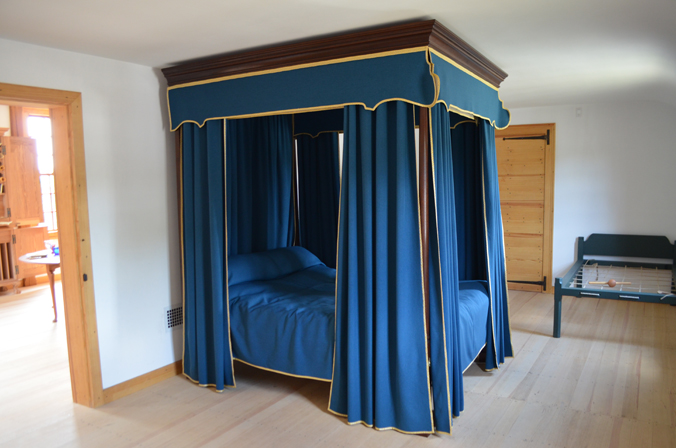
In July, we were very excited to see the culmination of at least a year’s worth of research and work when the “best bed” was installed in the Hall Back Room (the master bedchamber) of the Washington House. Between its imposing size (it nearly touches the ceiling) and it’s bright blue bed curtains in a house where there was very little color, the best bed is one of the most memorable pieces in the house, both today and when the Washington family resided at Ferry Farm.
The “best bed” in the Hall Back Room of the replica Washington house at Ferry Farm.
The “best bed” in a colonial gentry home like the Washington’s was intended to be a showstopper, and a visual statement to visitors about the prosperity of the family that owned it. It was one of the reasons that the bedchamber in which the best bed stood was usually considered a public entertaining room – all the better to have people see the bed.
But how do we know what the Washington best bed looked like? In this case, we had several clues from historic documents and archaeological finds that we pieced together with what we know about life in early 18th century Virginia households.
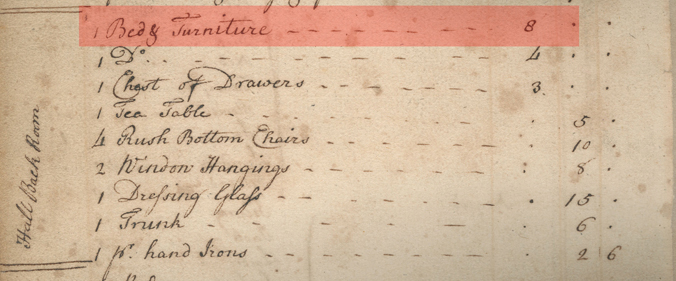
The first question we had to answer was what type of bed was it? Augustine Washington’s 1743 probate inventory describes the bed simply as “1 Bed & Furniture…..£8.” At first glance, this scant information doesn’t seem to tell us much (other than this bed is indeed the most valuable single item in the entire Washington household at £8). But, the mention of “furniture” along with the bed is actually quite useful.
“1 Bed & Furniture” valued at £8 listed on the probate inventory of Augustine Washington’s personal property done after his death in 1743.
In this context, “furniture” refers to all the textile accessories associated with the bed, including bed curtains. In order for a bed to have bed curtains, it must be an expensive tall-post bed, rather than low-post. While we refer to the Washingtons as being among the gentry class, meaning they were able to furnish their home with higher end furnishings, this was actually a question for some time. At this early point in the 18th century, being gentry might not actually mean living in the luxury that we associate with homes like Kenmore or Mount Vernon of the century’s later decades. Simply owning a bedstead – of any variety – put you well ahead of the vast majority of colonial Virginians. The traditional view of George Washington’s childhood is one of a very simple, primitive lifestyle. Our archaeological findings at Ferry Farm have begun to change that view. In actuality, the Washington family owned and used a wide variety of imported luxury goods in their home.
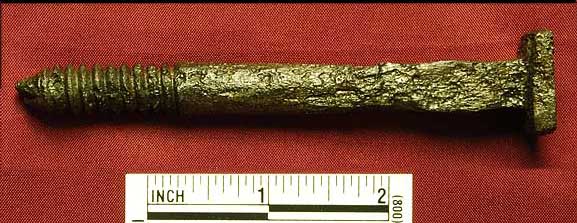
Bed bolts are one artifact changing the old view and pertain directly to the level of bed in the house. Bed bolts were long, heavy screws inserted through the lower ends of the tall bed posts to hold them to the side rails of the bed. Their presence at Ferry Farm proves the existence of tall-post beds. So, this line item in the probate inventory actually serves to bolster the idea that the Washingtons were living a relatively high lifestyle – they had a tall-post bed with curtains in the Hall Back Room.
Bed bolt excavated by archaeologists at Ferry Farm.
Once we determined the style of bed, we had to decide what the bed curtains and bed covering would look like. The probate inventory was not overly helpful on this front – almost no descriptive information of any textile in the house is given. However, there are several other documents related to Mary Washington’s estate that we could consult.
The first was her will, which was recorded in 1788, the year before her death. This document details a number of her household goods, and which of her family members they were to go to. While the list of items is not nearly as complete as a probate inventory, it does provide more descriptive information. Among other textiles, a blue and white quilt, a white counterpane, purple bed curtains and “Virginia cloth” bed curtains are mentioned.
In another document, a list of household items sold at vendu (a public sale of personal property, sort of like a yard sale today) after Mary’s death in 1789, reference is made to blue and white coverlets, a blue and white counterpane, and several blue or white bed coverings, one of which is called “ye best.” Several sets of bed curtains are mentioned, but they are not described.
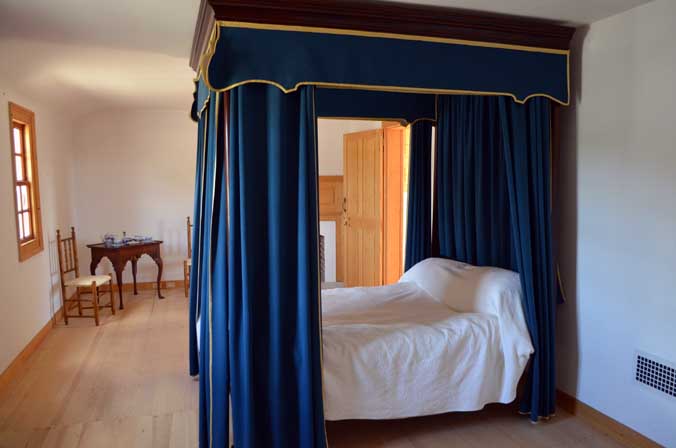
The best bed with its summertime white coverlet.
Although both of these documents date to more than 40 years after the time period that we are interpreting at Ferry Farm, we can surmise that much of Mary’s bed textiles were blue and white and that this color combination was a particular favorite of hers. As bed curtains and bedding such as quilts and counterpanes represented major financial investments in an 18th century household, it’s not unlikely that many of the finer textiles in the Washington house at Ferry Farm were still in use at the time of Mary’s death many years later, when she was living across the river in downtown Fredericksburg. Because of these documents, we decided to depict the best bed at Ferry Farm with blue and white bedcoverings (a quilt for winter, and a matelessé counterpane for summer) and blue bedcurtains.
As with all the furnishings in the Washington house, we hope that Mary would recognize her bed if she were set foot inside the room today.
Meghan Budinger
Aldrich Director of Curatorial Operations
The replica Washington house is open at George Washington’s Ferry Farm but furnishing is still ongoing. We traveled to Richmond to visit furniture maker Harrison Higgins and he told us about the furniture that he and his crew have made for the Washington house.
Watch other videos and read more about rebuilding the Washington house here.
This summer out on the dig site, one of our archaeology interns sometimes wore a t-shirt that read “archaeologist (n): one who digs history.” In this album, you’ll see this year’s excavation crew — field director Steve Lenik, assistant field director Elyse Adams, interns Reagan Andersen, Cheyenne Johnson, and Aileen Kelly, and field school students from Georgia Southern University and the University of South Florida — doing just that!
Read a summary of the work done during the 2018 dig at Ferry Farm here.
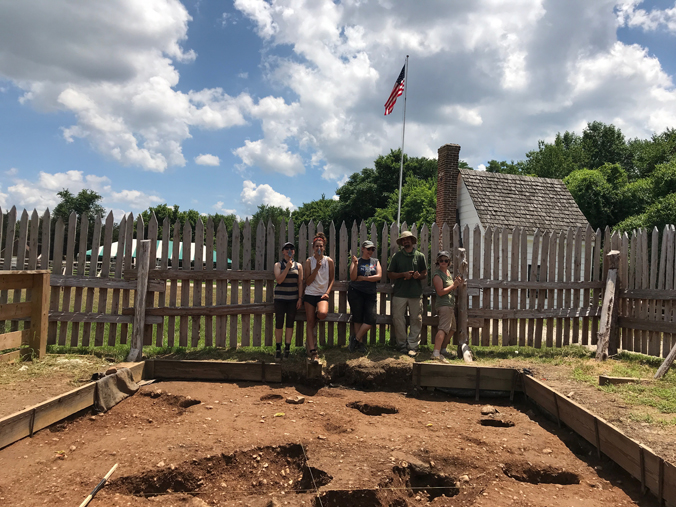
The dig team! (l-r) Reagan Andersen, Cheyenne Johnson, Aileen Kelly, Steve Lenik, Elyse Adams
Working in the Work Yard.
Steve about to take an overhead picture.
Shade is valuable.
Elyse and Alieen spray water on the excavation area. This helps them see archaeological features better.
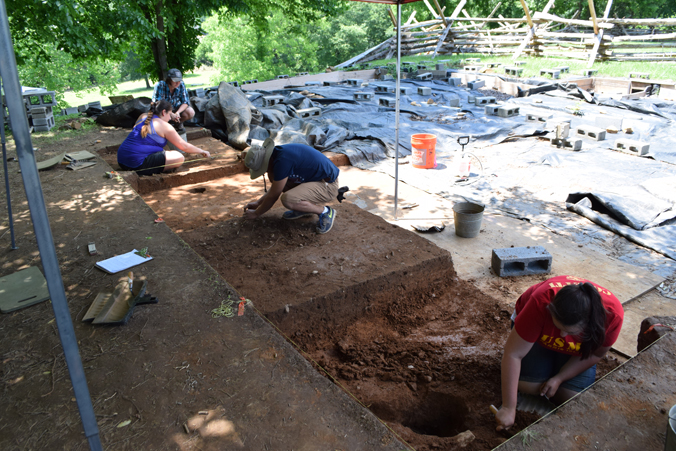
Field school students excavate the North Yard.
Sifting excavated soil.
A festive Aileen, Cheyenne, and Reagan celebrating the 4th of July at Ferry Farm!
Archaeological excavations at George Washington’s Ferry Farm have occurred nearly every summer since The George Washington Foundation purchased the property in 1996. The summer of 2017, when the majority of the replica Washington house construction was underway, was the major exception. The archaeological site was proved too close to ongoing construction so excavations were put on hold until the summer of 2018.
This year, a five person crew consisting of a field director Steve Lenik, assistant field director Elyse Adams, and interns Reagan Andersen, Cheyenne Johnson, and Aileen Kelly worked from April to July on the Ferry Farm property. For five weeks, an additional seven students from Georgia Southern University and the University of South Florida came to Ferry Farm for a field school, to learn the basics of excavation and lab work.
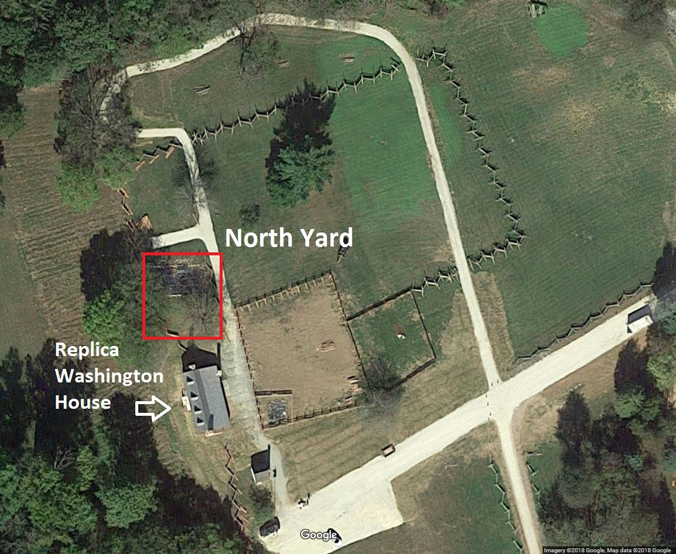
The North Yard
We investigated two areas. The first, an area at the crest of the ridge to the north of the replica house, was the North Yard. This yard lies between the Washington House and a slave quarter that was completely excavated in previous years. The purpose of digging in this area was to find evidence about who controlled this space. Was it the domain of those who lived in the Washington House or of the enslaved population who lived in the quarter?
Excavations are not yet complete in this area, but we discovered that this space was relatively clean compared to the Work Yard and areas immediately behind the Washington house, where a lot of trash and debris from daily 18th century activities were found during past excavations. The lack of trash and debris in the North Yard was likely because, in colonial times, this was part of the property visible from Fredericksburg and therefore was well-kept A public space like this one would have likely fallen under the control of those who lived in the Washington house.
Field school students excavating the North Yard.
We were also looking for evidence of any other outbuildings and gardens, in order to accurately recreate the landscape of the farm as it was in the 1700s. We discovered evidence of large trees that lived on the landscape during the 18th century in this area. This discovery will allow archaeologists to look even closer into the use of this space with the goal of re-creating it as it was in the time of the Washingtons.
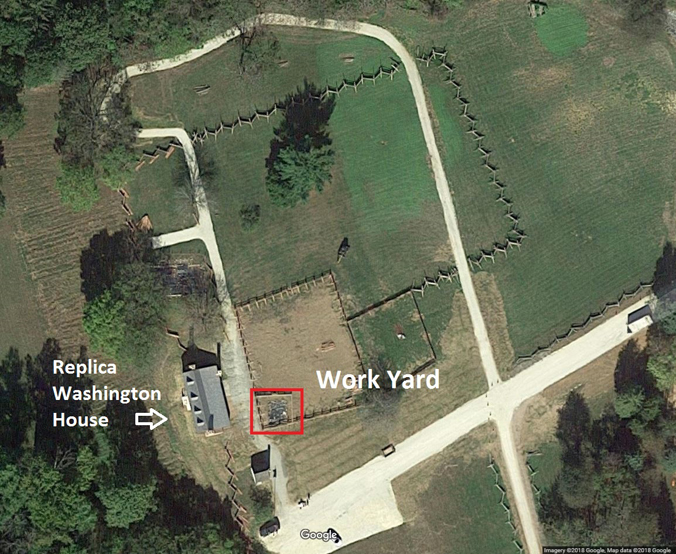
The Work Yard
The second area we investigated during this summer’s dig was behind the Washington house in the Work Yard, which is exactly what it sounds like—a space for work to be done on a farm in the 1700s. This space is special to our research here at Ferry Farm. Much of this space was excavated already in past years, yielded a treasure trove of artifacts and information, and was then filled back in once excavations were complete.
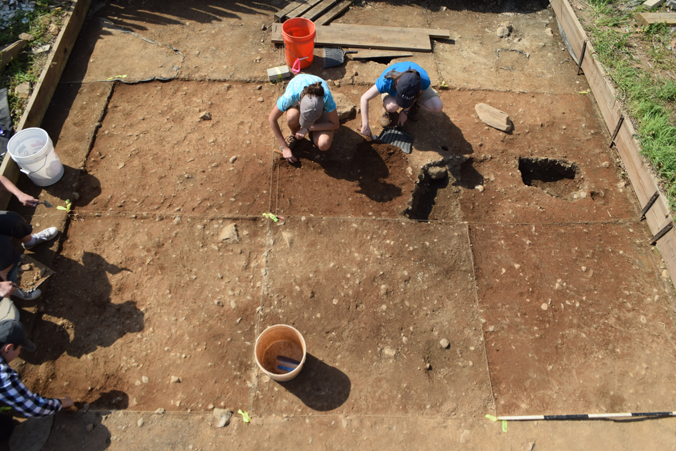
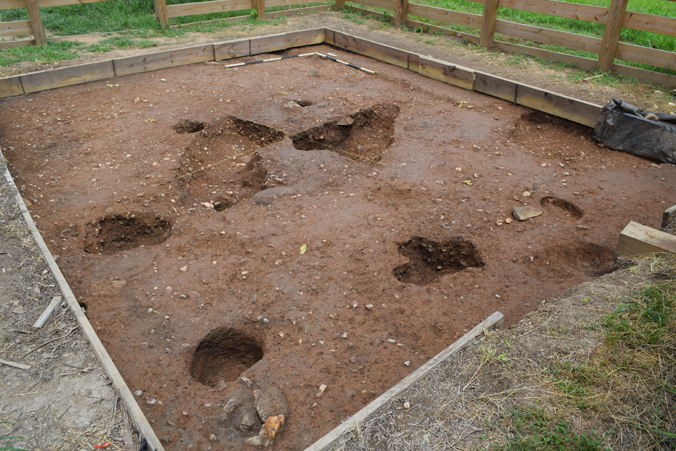
One small area just behind the house was left to excavate, however, and that’s where we worked this summer. We discovered large stains in the soil, very deep in the ground. They were made during the colonial era but, as yet, we do not know why. This area was originally thought to be a cellar, but as excavations continued, we began to notice a series of pits instead. Analysis is still ongoing and artifacts excavated in this space are still being processed so we don’t have answers to any of our questions yet.
Field crew exposing the large soil stain of possible cellar at the start of the 2018 excavations.Final photo of the Work Yard pits at the end of the 2018 excavations.
Nevertheless, our minds were racing with possible explanations of these pits and we couldn’t help but wonder if they were somehow related to Ferry Farm’s collection of at least 215 wig curlers—very unusual finds for a Virginia farm—that were excavated above or around this space.
It’s far too soon to tell, we don’t have any complete answers, and we still aren’t finished excavating the Work Yard, but this area already is proving important to the Ferry Farm story. Once we understand the landscape and complete the Work Yard excavations, the 18th century outbuildings that have been identified and that once stood in this space will be replicated just like the main house.
The dig team! (l-r) Reagan Andersen, Cheyenne Johnson, Aileen Kelly, Steve Lenik, Elyse Adams
Future excavations will continue to yield the information we need to replicate the entire boyhood landscape of George Washington’s home. Every bit of information, no matter how small the tree root or how tiny the artifact, is pertinent to the understanding and accurate interpretation of this important landscape, and to understanding the lives of all who have lived and worked here. We look forward to many more years of discovery, and many more summers of digging into the history of the Washington Farm.
Elyse Adams, Archaeologist
Assistant Field Director
Scenes from last week’s Independence Day celebration at George Washington’s Ferry Farm! Read “Celebrating the Fourth and what makes America great” by Kristin Davis for The Free Lance-Star about the Ferry Farm and other area celebrations.
Two young gentlemen meet General George Washington portrayed by Greg Fisher.
Visitors arrive to Ferry Farm on one of Fredericksburg’s iconic trolleys.
Adding their John Hancocks to the Declaration of Independence.
A group begins their tour of the Washington house replica.
Playing hoop and stick.
Militia drill.
Drumming with the Patawomeck.
Living historians ready to demonstrate butter churning and other foodways.
Navigating the horse maze.
Building a sand George Washington house.
Patriotic face painting.
Theater performance showing 18th century courting customs.
Archaeologist discusses artifacts recovered from an 18th century kitchen that burned down at Ferry Farm.
Before there were planes, trains, and automobiles, and other engine-driven devices, people of the 18th, 19th and early-20th centuries used horses, mules, and other four-legged draft animals to transport themselves, pull their wagons and carriages, and help manage the chores of farm and rural life.
Just like the time and expense we currently spend on car, truck, and small engine maintenance to keep those running smoothly, an equal amount of attention is essential to keeping horses healthy, clean, and physically fit so that they can perform the tasks we ask of them. The process of grooming a horse not only improves the health of their skin, coat, hooves, mane, and tails but it also allows the groomer to notice any health issues or problems that aren’t apparent until seen up close.
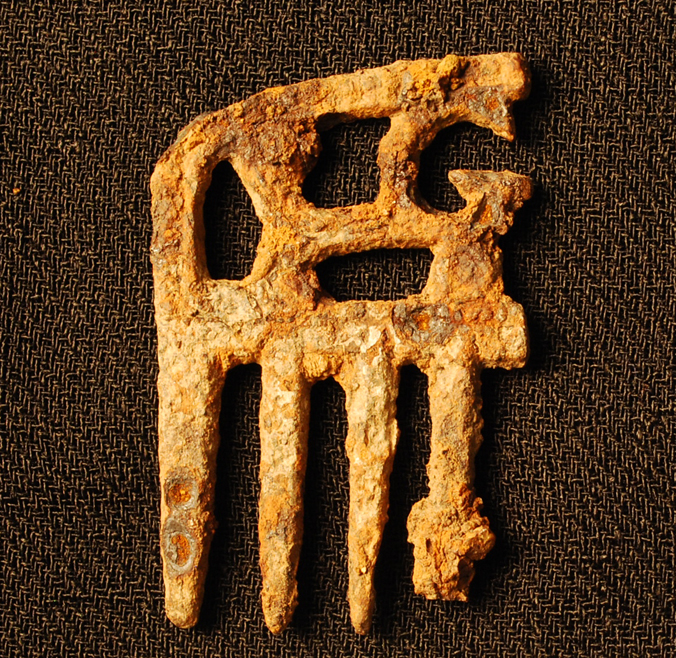
A mane comb, an essential horse grooming tool, was excavated at George Washington’s Ferry Farm from an early nineteenth-century context. This rusty iron alloy comb is incomplete, measuring two inches high with a broken width of 1 ¼ inches. The finished width might have been between 3 and 4 inches. What makes this find interesting is that there is a decorative “G” inset above the comb’s teeth. This letter was obviously followed by others, but what the complete word or initials indicate is a complete mystery. Was the word a favorite horse’s name or just the name of the comb maker? Was it actually a person’s name? And, of course, if it is a person name, could it possibly be George Washington’s name?
Mane comb excavated at George Washington’s Ferry Farm.
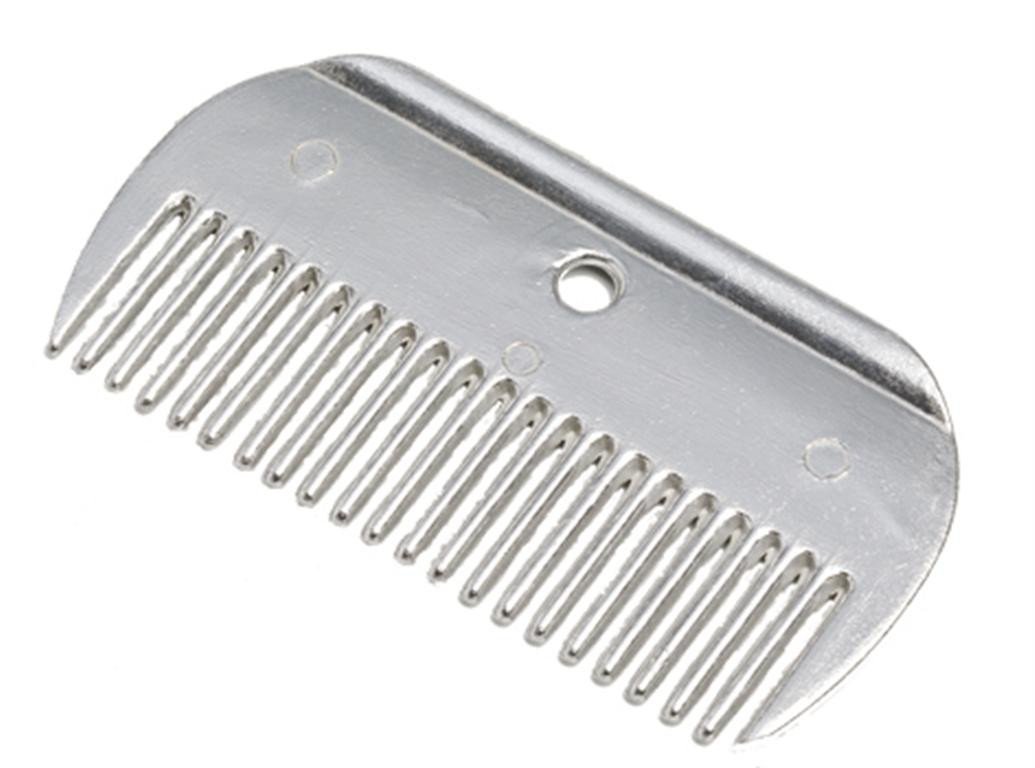
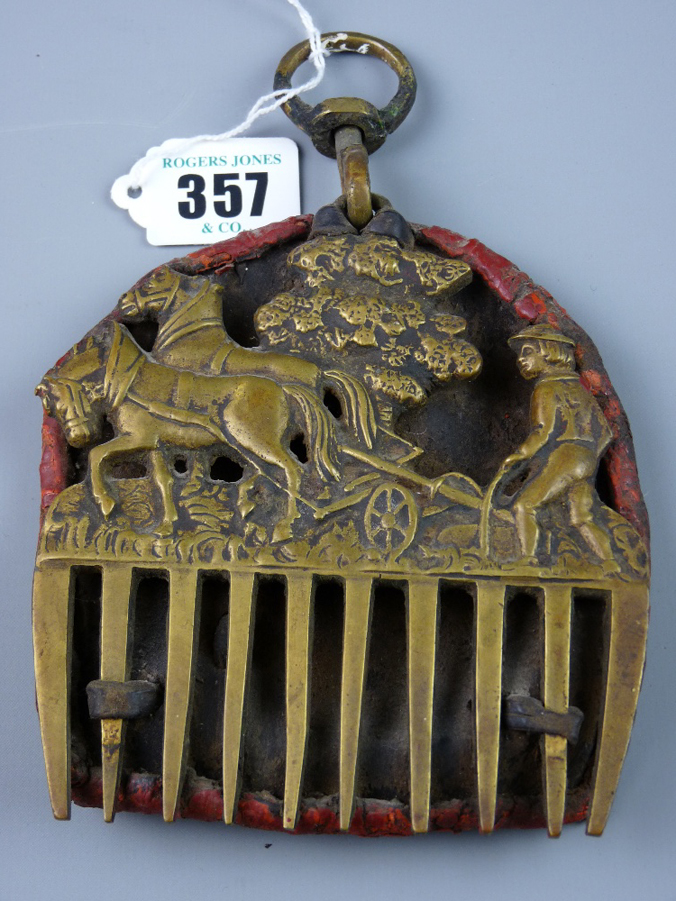
Mane combs are just one piece in any essential grooming kit for horses, which also includes curry combs, brushes, hoof picks, and grooming cloths. The mane comb is used to comb out the tangles and remove debris from the mane and tail of horses. It can be very simple and utilitarian in looks, similar to a common hair comb, or more ornate and decorative, such as this example that is stored on a leather backing. Our mane comb falls between these two extremes. It does not have an elaborative top but it is still decorated within the handle area with a swirled scroll, raised beading along the outer band, and the letter “G–”.
A simple modern mane comb. Credit: MyEquineStore.comA more ornate antique mane comb with decorative handle. Credit: Roger Jones & Co.A drawing of the mane comb excavated at Ferry Farm clearly showing the decorative inset “G”.
Ferry Farm archaeologists are curating a number of artifacts related to animal husbandry, an assemblage dominated by utilitarian buckles. Such buckles may have been part of harnesses but these fasteners had many uses around a farm. Horseshoes are the next most frequently recovered item, and they date from throughout the 1800s and 1900s. A few are of a style of manufacture that reliably derives from the colonial era. Bits, stirrups, curb chains, and harness rings were also lost or discarded by their owners. A mid-1800s iron alloy brace for a saddle was also discovered. Ferry Farm archaeologists found evidence for mules as well, as our collection includes a few mule shoes. A few bolts for carriages or wagons were recovered. Perhaps our favorite animal husbandry objects are the brass ornaments used to embellish leather horse tack. Several of these have been recovered and all date from the colonial period, when these early New World equestrians relished showing off their fine steeds.
So if there are any horse-loving readers out there who recognize this style of mane comb or have a clue as to what “G” could be the start of, please let us know. We may never know but we do hope that maybe the “G” is the beginning of the name of our site’s most famous horseman, George, who was certainly well known for his horsemanship skills!


 The moment anyone mentions trees and George Washington, you probably think of the famous Cherry Tree Story. However, this tale of young George taking a hatchet to his father’s cherry tree and, when confronted about the act, asserting “I cannot tell a lie” is probably just that — a story meant to demonstrate the integrity of the Father of Our Country. In reality, the trees of Ferry Farm have a much more fascinating history. Their story reflects, on a small local scale, vast environmental changes in eastern North America and shifting American attitudes toward the environment throughout the 18th, 19th, and 20th centuries.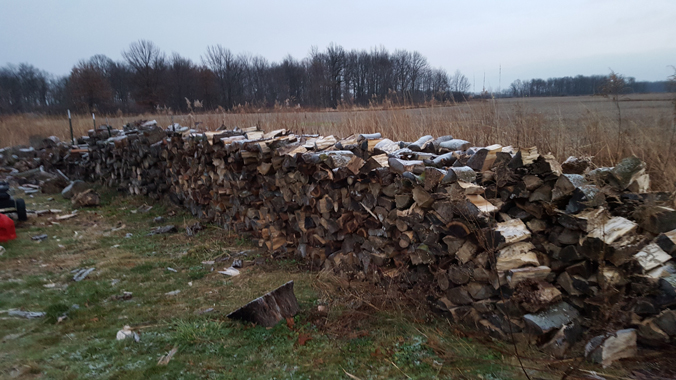



 In July, we were very excited to see the culmination of at least a year’s worth of research and work when the “best bed” was installed in the Hall Back Room (the master bedchamber) of the Washington House. Between its imposing size (it nearly touches the ceiling) and it’s bright blue bed curtains in a house where there was very little color, the best bed is one of the most memorable pieces in the house, both today and when the Washington family resided at Ferry Farm.