Lives and Legacies

Category: George Washington’s Ferry Farm

  • Surveying the Bird Life at George Washington’s Ferry Farm

    Recently, on a gray overcast March morning, four members of the Fredericksburg Birding Club bundled up against the unseasonable cold to trudge across the open fields and through the forests of George Washington’s Ferry Farm to conduct their latest bird survey. It was their fourth such survey in the past seven months.

    During these surveys birding club members spotted a total of 41 species.  They recorded each species observed and compared their observations to “A Checklist of the Birds at Ferry Farm,” a pamphlet available to visitors at Washington’s boyhood home. Club members noted that they saw all of the species listed on the “Checklist” as abundant or common.  They saw 13 uncommon species defined by the “Checklist” as “present, but not certain to be seen” as well as three species listed as occasional, meaning “seen only a few times during a season.” They spotted three rare species.  Most excitingly, they sighted the American Pipit, a species not yet included on Ferry Farm’s “Checklist.”  The pipit’s habitat is shorter grasses so it was probably attracted to a freshly mown field on the grounds.

    American Pipit
    American Pipit. Credit: Becky Matsubara / Wikipedia

    Club members also noted some early breeding activity as three tree swallows were inspecting some of the bluebird boxes in Ferry Farm’s wildflower meadow.

    Ferry Farm’s abundance of bird life is due to the many favorable micro-habitats available on the 80-acre property.  This includes native grasses and a wildflower meadow, hardwood bottomlands, fallow areas, open lawn, and the adjacent waters of the Rappahannock River.

    During the Fredericksburg Birding Club’s survey on March 27, club members spotted the species listed below in alphabetical order. The number following each species name represents the number of individuals seen.  This same data can also be found at ebird.org.

    American Crow – 6
    American Goldfinch – 6
    American Kestrel – 1
    American Pipit – 6
    American Robin – 33
    Bald Eagle – 2
    Black Vulture – 1
    Blue Jay – 3
    Canada Goose – 20
    Carolina Chickadee – 5
    Carolina Wren (heard only) – 2
    Cedar Waxwing – 9
    Common Grackle – 8
    Dark-eyed Junco – 14
    Double-crested Cormorant – 3
    Downy Woodpecker – 5
    Eastern Bluebird – 7
    Eastern Phoebe – 1
    European Starling – 23
    Hermit Thrush – 1
    Mourning Dove – 7
    Northern Cardinal – 20
    Northern Flicker – 1
    Northern Mockingbird – 2
    Osprey – 3
    Red-bellied Woodpecker – 3
    Ring-billed Gull – 15
    Rock Pigeon (Feral Pigeon) – 1
    Ruby-crowned Kinglet – 1
    Song Sparrow – 3
    Tree Swallow – 3
    Tufted Titmouse – 4
    Turkey Vulture – 6
    White-throated Sparrow – 4
    Yellow-rumped Warbler – 24

    American Kestral
    American Kestral with a freshly killed American Pipit. Credit: Gregory “Slobirdr” Smith / Wikipedia
    Northern Flicker
    Northern Flicker. Credit: Mike’s Birds / Wikipedia

    You can observe birds yourself at Ferry Farm during regular operating hours, which are from 10:00 a.m. to 5:00 p.m. on Monday-Saturday and from Noon to 5:00 p.m. on Sunday.  Pay your admission inside the Visitors Center and ask for a copy of “A Checklist of the Birds at Ferry Farm.”

    Furthermore, on Saturday, May 5, you can join members of the Fredericksburg Birding Club for a Birding Tour of Ferry Farm, a morning walk through the grounds during spring migration. Participants will see birds that are passing through, as well as those who have arrived at Ferry Farm for the summer.  Bring your own binoculars.  The cost is regular admission: $9.00 adults, $4.50 students.  Reservations required.  For more information and reservations, please call (540) 370-0732 ext. 24 or email hayes@gwffoundation.org.

    Zac Cunningham
    Manager of Education Programs

  • Video: Inside the Archaeology Lab – Why Does That Glass Look Funny?

    Mara Kaktins, archaeology lab supervisor at George Washington’s Ferry Farm, explains the weird patination on some glass artifacts excavated by our archaeologists.

    For other “Inside the Archaeology Lab” videos, visit the Archaeology at George Washington’s Ferry Farm playlist our YouTube channel.

  • Snow at George Washington’s Ferry Farm & Historic Kenmore

    Historic Kenmore and George Washington’s Ferry Farm experienced a snowstorm on Wednesday, March 21, 2018.  Our staff took these photos of the snowfall from around the Lewis and Washington homes.

    We also setup a timelapse camera at the Ferry Farm Visitors Center to capture the snowfall over the course of the storm. Closely watch the pine trees in the video below and you can see their branches droop down as the heavy wet snow weighs them down and then raise back up as the snow started to melt late in the day.

  • No Refrigerator? No Problem!: Preserving and Storing Meat in the 1700s

    It’s easy to take our refrigerators for granted.  There they sit in our kitchens quietly keeping our food safe to eat and making our lives quite easy.  It may be difficult to imagine but a large percentage of time on an 18th century homestead such as George Washington’s Ferry Farm was spent preserving food for long term storage.

    Before grocery stores and refrigeration, most foods were only available at particular times of the year – this is called seasonality.  Eggs, for instance, were not plentiful in the fall and winter when hens traditionally stop laying.  Certain fish, such as shad and herring, can only be caught during the few weeks a year when they spawn. And, of course, most crops were harvested in the fall.  So when food was available it needed to be preserved and stored properly if there was any hope of enjoying it in the future.

    Food preservation was especially important in the fall and early winter, which was butchering season for large animals.  Chickens and small game were enjoyed year round because they could be eaten in one or two meals. A larger pig or cow, however, would spoil in mere days when exposed to the humid and hot Virginia summers. Therefore butchering was left to the cold months.  Even the frosty temperatures were not enough to stave off decay and therefore long term preservation techniques were employed to guarantee a supply of meat throughout the year.

    To begin, preservation involved many people.  In my own household today, we butcher two hogs once a year and it’s a family event with our neighbors and friends helping out.  In the Washingtons’ case, a number of their slaves were put to this task and likely butchered dozens of hogs at once to ensure the family and the enslaved population had enough meat for the upcoming year.

    Pigs were the preferred livestock for meat in Virginia, as anyone who lives here knows well.  We love our pork.  This is not a coincidence as pork’s high fat content aids with preservation and helps the meat survive the nasty summers previously mentioned.

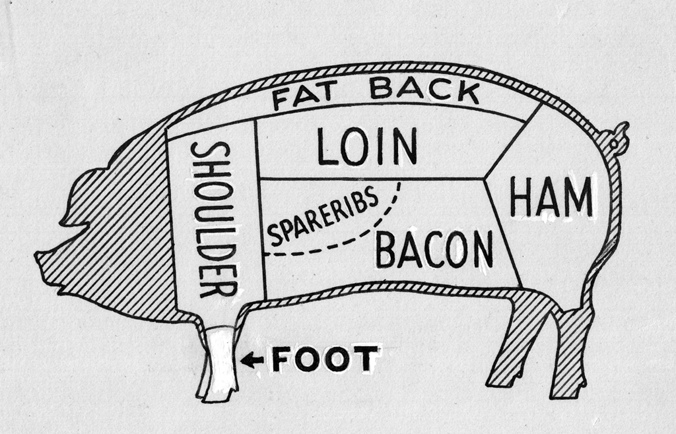
    Butcher Diagram for Pig
    A butcher’s diagram showing the main cuts of pork and from where the come on a pig. Credit: Wikipedia/Pearson Scott Foresman.

    After butchering, the next step in preservation was to treat the meat in a manner that would facilitate storage.  This usually involved drying, salting, or a combination of the two.  The idea was to reduce the meat’s water content, which promotes spoilage, and kill or inhibit bacterial growth.  Salting pork drew out moisture so small meat cuts could be rubbed down with salt and then stored in even more salt, which was relatively cheap in the 1700s and keeps the nasty bacteria at bay.  Furthermore, adding the chemical compound saltpetre (potassium nitrate) to the rub kept meat edible even longer and had the added benefit of ‘fixing’ the nice red color of the meat.  Saltpetre is still in use today for food preservation (and also makes great gunpowder and fertilizer, strangely enough).

    A technique that worked even better for long term storage was brining.  This process involved soaking the meat in a salt water mixture and was good for larger cuts, like hams.  Meat could be stored in the brine and packed tightly in covered jars or casks in a cool environment for months.  The Washingtons had cellars in their house ideal for this purpose and the archaeological record at Ferry Farm is full of fragments of stoneware and earthenware jars – the Tupperware of their day.

    Of course all this salted meat would need to be soaked in water before it was edible.  Even the salt-loving Virginians couldn’t palate it otherwise.

    Adding the extra step of smoking to the salting process preserved the meat even longer.  The smokehouse was ubiquitous on 18th century farms and, while we know the Washingtons had a smokehouse, we have yet to locate it archaeologically.  We have found evidence for a smokehouse that predates the Washingtons moving to Ferry Farm, however.

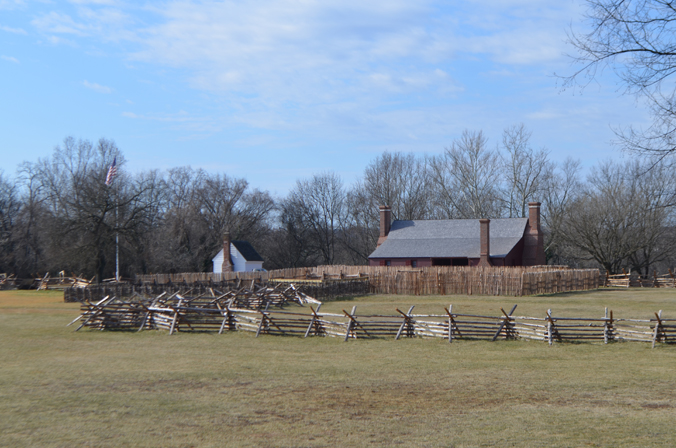
    Washington House and Work Yards
    Archaeologists have not located where the smokehouse stood when the Washingtons lived at Ferry Farm. Perhaps it stood among the fenced-in work yards behind the family home. More archaeological exploration will be necessary to place the structure on the landscape.

    Your basic smokehouse was a small, square, one room structure with a pyramid-shaped roof and rafters in the roof to hang meat on.  In the middle of the room was a fire pit or box where a fire was kept going for days at a low temperature. It dried the meat without cooking it and exposed the meat to a lot of smoke, which inhibits decay and is a deterrent for bugs and vermin.  Have you ever wondered why mosquitos don’t seem to bite much when you’re around a camp fire?  It’s the smoke.

    One final common preservation and storing technique was to pot meat.  This involved packing cooked meat tightly into a jar and capping it with a generous amount of butter, lard, or tallow (rendered beef fat).  An unappetizing as this may sound it kept meat safe to eat for weeks or months in the right environment.  Potted meat is still popular in certain areas, although you’ll find it in cans, nowadays.

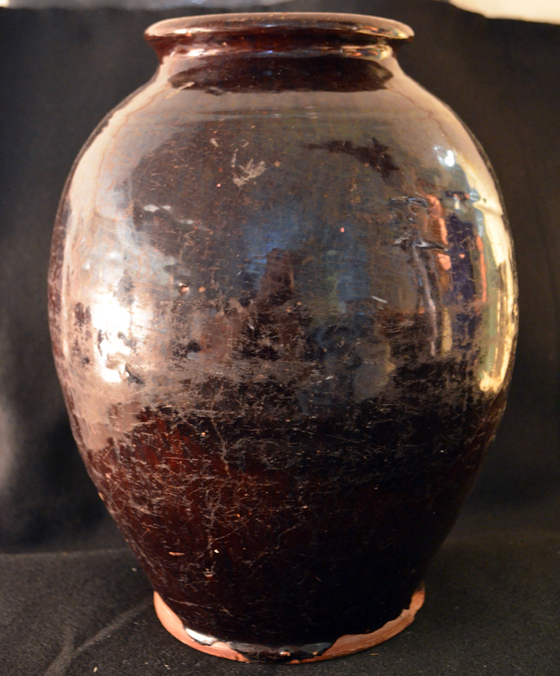
    Ceramic Storage Vessel (5)
    A complete redware storage jar.

    A variety of ceramic pots like the above redware jar were available for storage of preserved meat and other foodstuffs in the 1700s.  Below are photos showing four different types of storage vessel sherds excavated at Ferry Farm:

    All of the above mentioned preservation and storage techniques lend their own unique taste to meat, many of these flavors are now considered very desirable and the main reason these techniques are still employed for various foods, even though we don’t require them any longer thanks to refrigerators and freezers.  Think salted bacon, Spam, smoked barbeque, and delicious salty ham.  What originated as necessary methods for making food last have evolved into our own unique modern cuisine.

    Mara Kaktins, Archaeologist
    Archaeology Lab Supervisor

    Further Reading

    Oliver, Sandra L. Food in Colonial and Federal America.  Greenwood Press, Westport, Connecticut and London. 2005

    Olmert, Michael.  Kitchens, Smokehouses, and Privies – Outbuildings and the Architecture of Daily Life in the Eighteenth-Century Mid-Atlantic.  Cornell University Press, Ithaca and London.  2009.

    Root, Waverly and Richard De Rochemont.  Eating In America.  The Ecco Press, Hopewell, New Jersey.  1995.

  • A Thimble of My Love

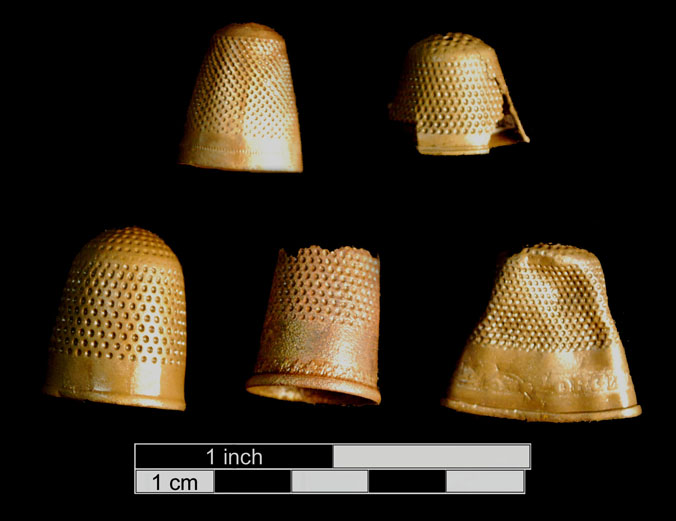
    FF06-Thimbles.copy
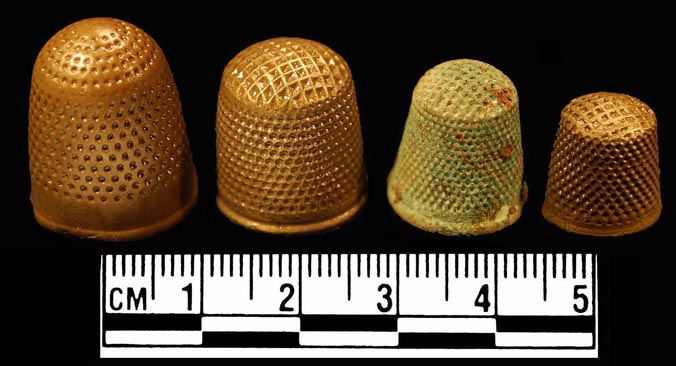
    A sample of the 30 historical thimbles found to date by archaeologists at George Washington’s Ferry Farm.

    Thimbles were once a popular token of affection given to ladies by family members, close acquaintances, or sanguine suitors. These essential tools formed an ideal gift for a beloved family member or an appropriate token of affection during those early, initial stages of a budding romance.  They were considered a less intimate gift than perfume or jewelry – all of which had more serious, romantic connotations. Gifting thimbles to cherished daughters or sweethearts developed as an esteemed tradition by the 1500s in Europe.

    Thimbles served as an emblem of female domesticity and skill.  Thimbles possessing a domed end were employed to protect the tip of the finger as a seamstress pushed a needle through cloth. Such thimbles typified domestic use, where tasks were dominated by sewing and mending. These duties were associated with a well-run home, and these skills grew to define womanhood.

    Thimbles came in a variety of graduated sizes to accommodate the young as well as the experienced. Accomplished girls were expected to produce elaborate samplers and embroidery by the age of seven. The products of these young artisans were ostentatiously displayed throughout the house, where prospective suitors and visiting families could appreciate the budding skills and diligence of their daughters. Thimbles were such essential tools in the daily lives of women that they were part of everyday dress, often worn on the body as part of a chatelaine or belt-hung tool kit that included scissors, needles, and a thimble (think of Downton Abbey’s Mrs. Hughes).

    FF-Graduated Thimbles-shoptSmall
    A variety of sizes accommodated a child’s growth to adulthood. These examples were uncovered by archaeologists at Ferry Farm.

    Commercially-used thimbles were typically open ended and known as thimble rings. They proved to be popular amongst tailors who used these special thimbles “sideways” to protect the side of the finger. An open ended, ‘thimble ring’ provided a better option for use with thicker materials, such as leather. Such sturdy fabrics were associated with upholstery manufacture. Products that employed leather, such as saddles and tack, also required thimble rings. Tailors were often male, and many assert that thimble rings were used by men exclusively. Like all assumptions, they should be made with care: no doubt women who worked in industries associated with thicker materials employed thimble rings, and men who needed to mend their clothes in the absence of female family members made ready use of thimbles (soldiers in camp, for instance).

    Archaeologists have recovered over thirty functional (not souvenir) thimbles from the soils surrounding the Washington home. The majority date from the 18th and 19th centuries and – given their context – likely represent those used by women and girls for sewing hems, mending tears, and stitching. These historical examples from Ferry Farm were typically made from brass, reflecting both the popularity of that metal for manufacture, but also its durability and stability over time. A few examples feature copper sides with steel tips. Iron thimbles were also popular, but they decompose quickly and are rarely encountered by excavators.

    Sometimes, when given as gifts, thimbles were enhanced with mottos, a tradition that was especially popular during the 1800s. They might be friendly, such as “Live Happy,” or didactic: “Pray and Work.” Slogans included “Remember Me,” “I Live to Die,” “A Friend’s Gift,” “Amor,” and “Pray and Prosper,” to mention a few. Two thimbles embossed with the sentimental idiom “Forget Me Not” were unearthed at Ferry Farm, each recovered from layers dating from the antebellum era (the time before the American Civil War). During this time, the ownership of the Ferry Farm lands was dynamic, and the property changed hands frequently.

    Chatham resident, and Commonwealth of Virginia Supreme Court of Appeals Judge, John Coalter purchased the property in 1829. However he never resided at Ferry Farm. Less than a decade later, in 1838, John Teasdale and Joseph Mann attained the property. Just five years after that, the land was transferred to Lewis G. Sutton. By mid-century, in 1846, John R. Bryan owned the farm and in December of that same year Winter Bray purchased Ferry Farm.

    FerryFarm20Dec1862
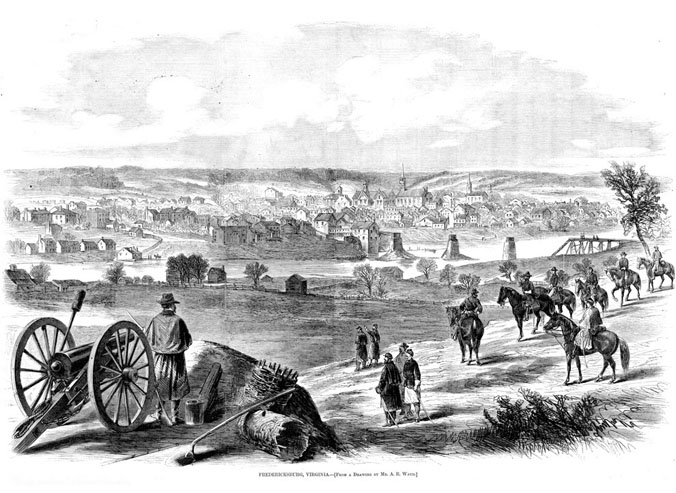
    “Fredericksburg, Virginia — [From a Drawing by Mr. A.R. Waud]” in the December 20, 1862 edition of “Harper’s Weekly.” This image was drawn on the Ferry Farm side of the Rappahannock looking across the river into Fredericksburg. Buildings of the Bray farmstead can be seen along the river bank in the image’s left middleground. Public domain.
    Bray engaged an overseer at Ferry Farm to manage the property. Importantly, they constructed a dwelling on the property in 1851, where the overseer resided. The George Washington Foundation’s archaeologists unearthed this structure as well as a kitchen related to this occupation in 2004. The construction of these dwellings is significant, since it demonstrates that people were residing on the land. Thimbles are more likely to derive from such a residential occupation as opposed to an absentee owner who devoted the land to pure farming.

    We know from their method of manufacture that the “Forget Me Not” thimbles date from the 1800s. Given the dynamic history of property ownership and occupation that characterizes Ferry Farm at this time, it might at first seem challenging to determine which land owner – or rather which land owner’s family of resident workers – purchased these touching thimbles. However one thimble was found in the center of one of the Bray era dwellings, from a stratum dating from sometime between 1800 and 1860. The other thimble was discovered in the yard east of the Bray era structures, recovered from a layer that also dated from the antebellum era. It’s possible that both of these thimbles relate to the Bray era of ownership, and specifically to the overseers who occupied the property on the Bray family’s behalf.

    FF.2794-NOT-2SmallLines
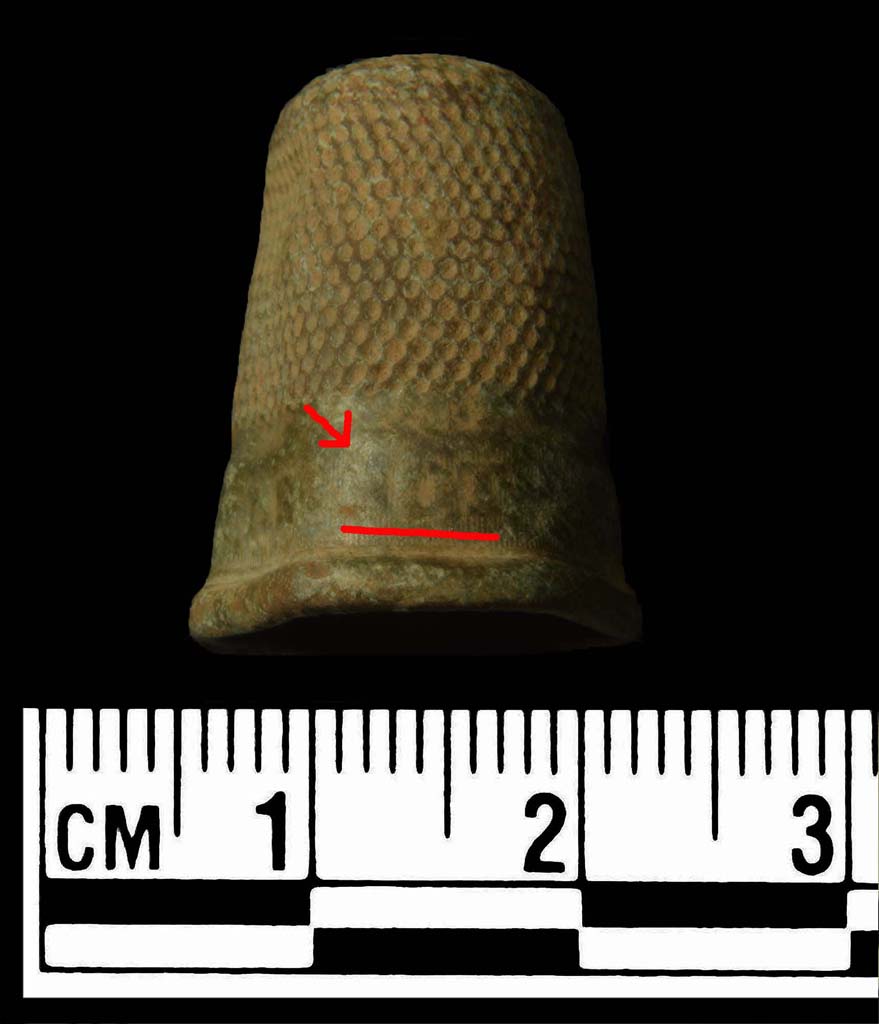
    Look closely and you can read the word “NOT” upon this unconserved “Forget Me Not” thimble found in 2014. It was found in the yard east of the Bray era structures in a layer dating from sometime between 1800-1860.
    FFForgetThimbleBlogLines
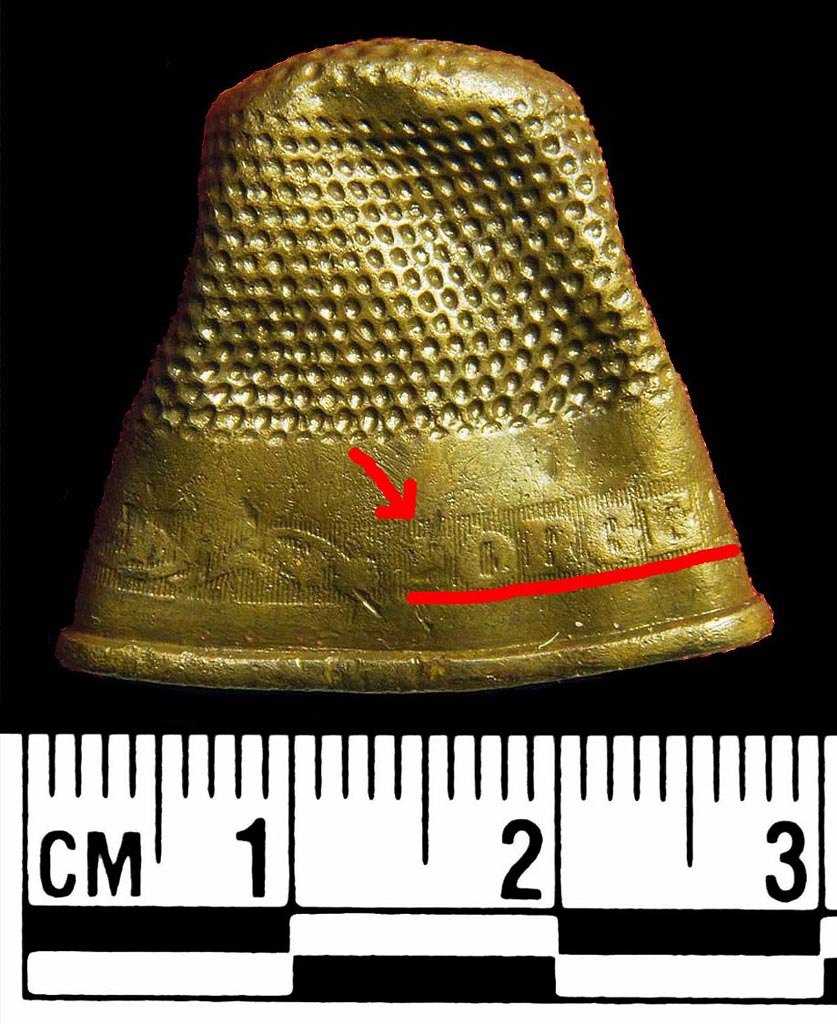
    It’s easier to see the letters “FORGE…” of the phrase “FORGET ME NOT” upon this conserved Ferry Farm thimble. It was found in 2004 in direct association with one of the Bray era dwellings.

    Over the centuries, sentimental tokens similar to the thimbles excavated from the Bray dwelling cemented relationships, expressed affection, and inspired diligence among sisters, daughters, and sweethearts.

    Laura Galke, Archaeologist
    Small Finds Analyst

  • Video: The Rooms at Ferry Farm – A Furnishings Update

    In this video, Curator Meghan Budinger shows us early arrivals among the reproduction furniture to go into the reconstructed Washington house at George Washington’s Ferry Farm.


  • The Lewis Ships That Sailed the Atlantic World

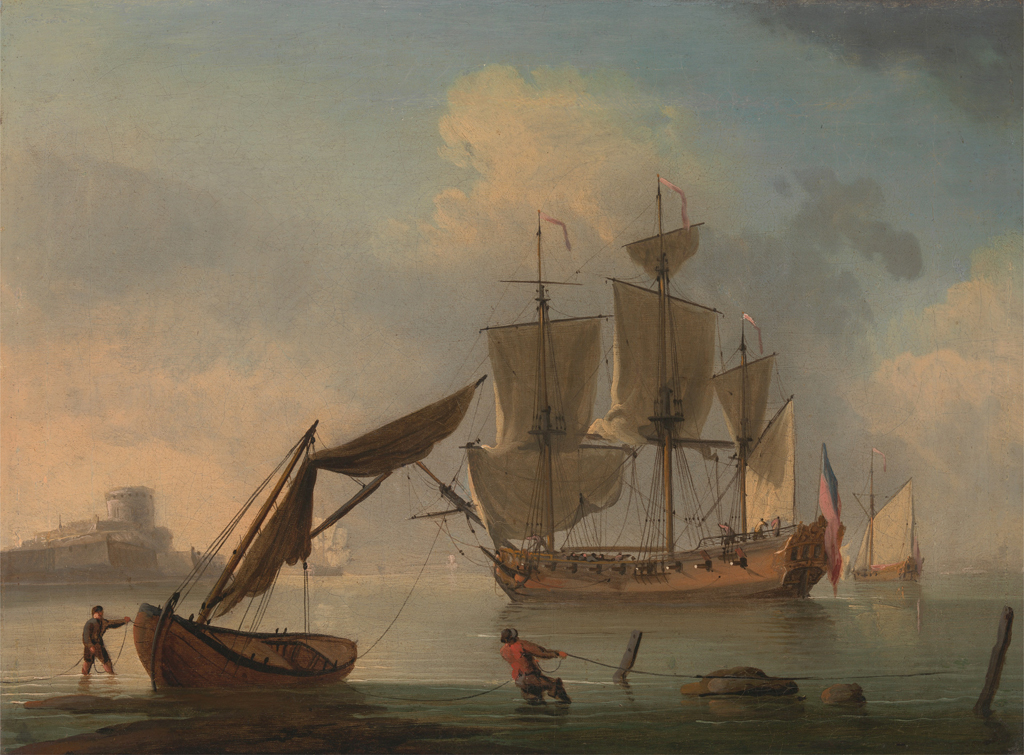
    B1981.25.623
    “An English Sloop Becalmed near the Shore” (mid-18th cent.) by Francis Swaine. Credit: Yale Center for British Art, Paul Mellon Collection

    George Washington’s Ferry Farm is located on a hill overlooking the Rappahannock River.  That river connects to the Chesapeake Bay and eventually the Atlantic Ocean.  When young George Washington lived at Ferry Farm, the Rappahannock was a gateway to the entire world.  Fredericksburg was a port town on the river’s opposite bank from the farm and small ocean-going sailing vessels traveled up the Chesapeake and into the Rappahannock to dock at the bustling town’s wharves.  Ships like the brigs Stanton and Priscilla as well as the schooners Grampus and Penguin brought goods to buy, news from the rest of the British Empire, and occasionally people to settle and work in the colonies.

    Growing up next to the river influenced the young Washington.  He got to experience life at sea first-hand when he left Ferry Farm and sailed to Barbados at the age of 17. Also, for a time, the family debated whether teenage George should pursue a career in the Royal Navy.  Moreover, at Ferry Farm, the Washingtons produced and consumed the goods that ships plied back and forth across the ocean.

    George Washington, his family, slaves and neighbors were members of what historians call “The Atlantic World,” a global community of many different peoples taking part in the trade that traveled back and forth across the Atlantic Ocean.  Washington, his brother-in-law Fielding Lewis, and other Fredericksburg residents saw sailing ships on the Rappahannock every day and interacted with the sailors from those ships every day.  They supplied the ships with goods to take to destinations far across the sea and then bought the goods these ships carried when they returned.

    In the 1600s and 1700s, tobacco was Virginia’s most important export but, at the same time, many planters along the Rappahannock chose to export things like wheat, foodstuffs, timber, and other raw materials used to manufacture goods.

    Broadly speaking, these manufactured goods were made in Europe using the raw materials exported from the Americas.  Europe then sent the manufactured goods to Africa as well as back to the Americas.  In Africa, they were used to buy slaves while, in the Americas, they were used to purchase more raw materials.  This movement of goods has long been referred to as the “Triangular Trade” because of the triangle shape that the goods traveled when traced on a map.  Of course, this is a very simplistic description of a very complex network of trade that really spread across the globe.  Still, a triangle is a useful way to imagine, understand, and remember the basics of the process.

    Washington’s brother-in-law Fielding Lewis and the Lewis family built and owned ships that transported goods throughout the Atlantic World. Records of these ships’ voyages help illuminate the Triangular Trade and also how Atlantic trade routes often did not look like a triangle at all.

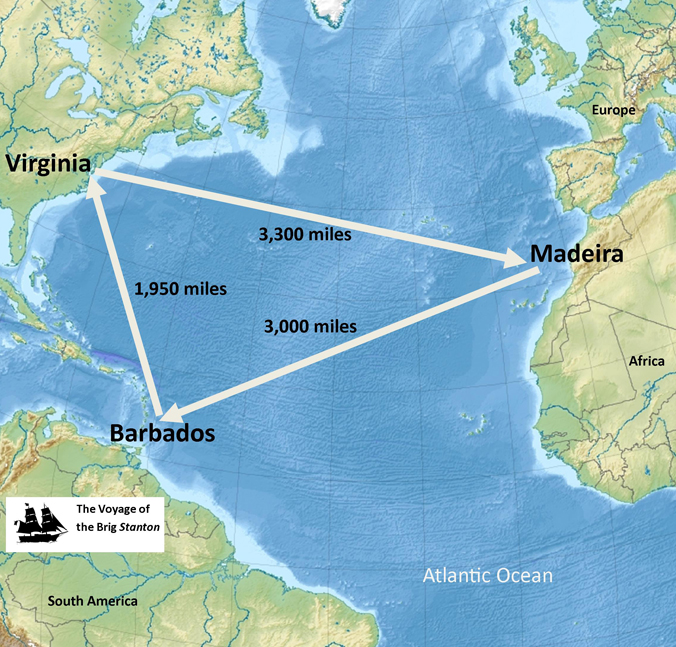
    Map of the Stanton's Voyage

    In one of the earliest voyages of a Lewis ship, the 80-ton brig Stanton – owned by Fielding’s father John Lewis and captained by Richard Williams – made a roughly six month voyage in the first half of 1732. The Stanton was bound for Madeira, an island off the coast of Portugal, and then Barbados, an island in the Caribbean Sea, before returning to Virginia. Its voyage is a perfect illustration of the Triangular Trade and we’ve written about it here.

    But the Atlantic trade was not always a triangular one.

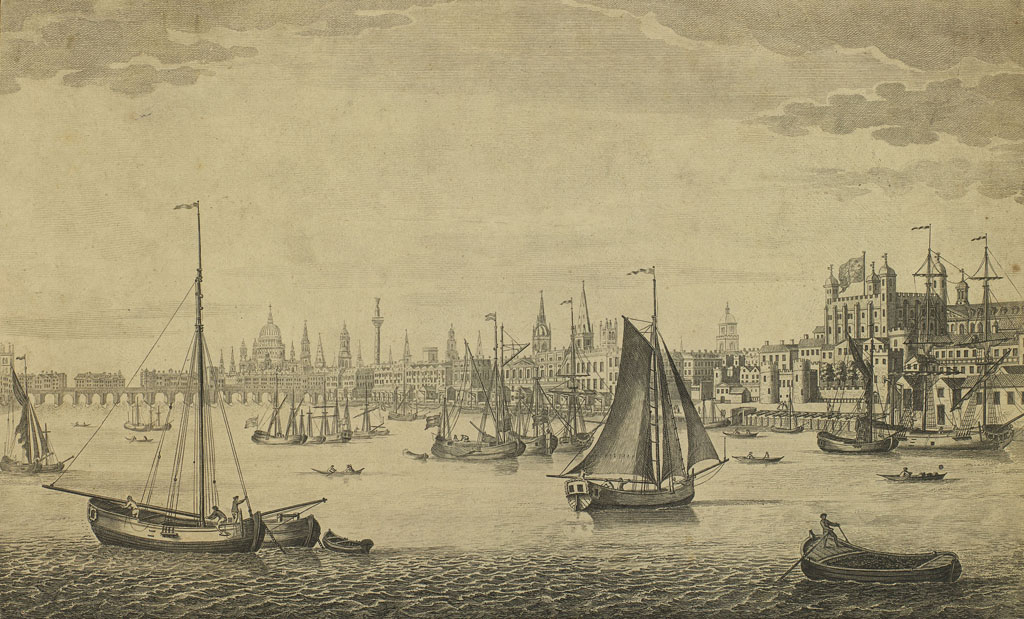
    During the first half of 1737, the Lewis brig Priscilla sailed directly to London and back under the command of Richard Williams and carrying 192 hogsheads of tobacco, six tons of iron, and 5,000 staves.[1] The ship returned to Virginia with “European goods” and, after a brief stop at Madeira, added some wine to its cargo.

    'The South East Prospect of London from the Tower to London Bridge' 1746 by John Maurer
    “The South East Prospect of London from the Tower to London Bridge” (1746) by John Maurer. Credit: Royal Collection Trust / © HM Queen Elizabeth II 2018

    The next year, the John Lewis-owned schooner Grampus mastered by John Briggs set sail with 300 staves, 600 bushels of corn, 900 bushels of peas, 180 bushels of wheat, 1 hogshead of wine, and 400 feet of walnut plank bound on a direct voyage to and from “New England.”  It returned with 5 hogsheads and 6 barrels of rum, some molasses, cider, oil, and “New England Ware.”

    Finally, about a decade later, we find another John Lewis-owned ship departing Virginia.  The Penguin, a schooner captained by Will Whitterong with a crew of six, set sail for Antigua in the Caribbean on March 1, 1745 carrying 100 barrels of pitch, 303 barrels of tar, 35 barrels of turpentine, 100 bushels of peas, 8 barrels of tallow, and 13,800 shingles.  The Penguin arrived at Antigua on May 17 and returned to Virginia on June 5 with a cargo of 30 hogsheads and 1 tierce[2] of rum, 27 barrels of sugar, and British goods.

    Did some of the items these ships brought back from across the Atlantic end up at Ferry Farm to be consumed or used by George Washington and his family (or the Strother family, the farm’s earlier occupants)?  It’s unlikely but not impossible.  Many of the items excavated by archaeologists at Ferry Farm definitely fit the descriptions “European goods,” “New England Ware,” or “British goods.”  Westerwald jugs, Bartmann bottles, white salt-glazed stoneware fruit dishes, and glass wine bottles all journeyed across the Atlantic to be used by Ferry Farm’s residents, then broken, thrown away, and buried, eventually to be recovered by archaeologists. No matter who actually used them, these recovered items represent the people and way of life of the 18th century’s Atlantic World made possible by the ships Stanton, Priscilla, Grampus, and Penguin.

    Zac Cunningham
    Manager of Educational Programs
    [1] Staves are the curved lengths of wood used to make barrels, buckets, or, in this case, pipes. Yes, wooden pipes.

    [2] Tierce is an archaic measure of wine that roughly equaled 35 gallons. The term was also used as a synonym for cask, which seems what is meant in this case.

  • Why Were There Weird Animal Feet on 18th Century Furniture?

    Furnishings posts logo finalAs more of reproduction furnishings for the Washington house get underway, I thought I might address one of the more notable characteristics of the pieces: their feet.  Anyone familiar with antique furniture has noticed the sometimes rather odd appearance of foot shapes at the end of table and chair legs.  We have a variety of feet among the Washington house furnishings, some more unusual to our modern eyes than others.  There are three furniture styles represented in the Washington house furnishings: William and Mary (the earliest, dating from the late 17th century to the very early 18th century), Queen Anne (early to mid-18th century) and a bit of Chippendale (mid-18th century onward).  Each of these styles had their own weird feet.
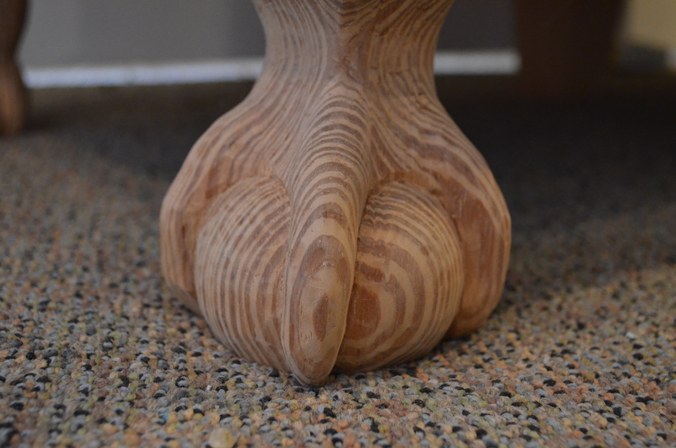
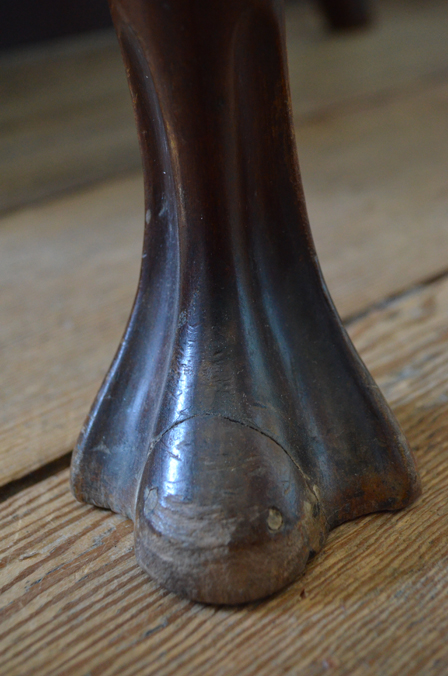
    Probably the most well-known type of furniture foot is the “ball-and-claw.” As the name suggests, the foot looks like the talons or claws of a large animal or bird gripping a ball.  The talons or claws could be quite detailed and realistic or a bit more stylized.

    Furniture Feet (1)
    An example of the ball-and-claw foot on a reproduction escritoire — a massive cabinet-sized desk — that will sit in the Hall of the Washington house.

    Why did these somewhat grotesque feet take hold in furniture design? In the early 17th century, design elements and decoration from the Orient began showing up in everything from ceramics to textiles to furniture all over Europe, as maritime trading vessels brought Asian goods to new markets.  The image of a dragon’s claw gripping a precious stone had been a common symbol in Chinese mythology for centuries, and was usually intended to symbolize the Emperor’s protection of knowledge.  As with many Chinese decorative elements imported to Europe at the time, the reason it was used in China was less important to European buyers than its exotic look.

    In England, the ball-and-claw style of foot was used primarily during the Queen Anne period and faded in popularity as the Chippendale style came into vogue.  In America, however, the ball-and-claw remained a popular decorative feature well into the 19th century.  As a result, American Chippendale style chairs will often have ball-and-claw feet, while English Chippendale chairs often do not.  During the height of its popularity, English furniture makers adapted the ball-and-claw style to other types of claws, often favoring a lion’s paw, to represent the King.  In America, eagle talons were the preferred model.  The level of detail portrayed was purely up to the desire and skill level of the furniture maker and carver.

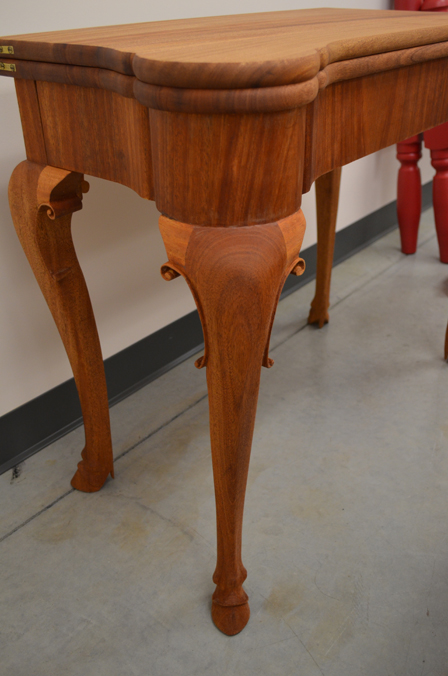
    Another animal-inspired foot found on furnishings in the Washington house is known as the “pied de biche” (literally translated from the French as “doe’s foot”) or hoof foot.  Much like a ball-and-claw, this style can either be an exact replication of a delicate deer’s cloven hoof, or it can be a shape inspired by the graceful curve of a deer leg and foot.

    Furniture Feet (3)
    An example of a “pied de biche” furniture leg on a gaming table that will be displayed in the Washington house.

    The reason for its popularity comes from two related trends in furnishings.  In the early 18th century there was a strong backlash against the bold, heavy, bulky style of the William and Mary period, which resulted in something completely opposite – the very graceful and delicate curves of the Queen Anne style.  This preference for lighter furnishings in the Queen Anne period also ushered in the beginnings of interest in classical themes, such as ancient Roman and Greek art.  Animal feet were featured prominently in classic Roman style, and the legs and feet of a deer just so happened to emulate the graceful, delicate curves that exemplified the Queen Anne style, so it was a perfect match.  Pied de biche feet are often found on Queen Anne furnishings in both England and America, but it was raised to a real art form by the French.

    The last weird foot that we’ll cover in this installment is probably the most mysterious, simply because we aren’t sure exactly why it came into being.  Known as the trifid foot in America, this style is found mostly on Queen Anne furniture.  In some cases it appears to be more of a three-toed paw, while on other pieces it looks like three webbed toes.  The webbed toes may have been its original iteration, because in Britain this style of foot is often referred to as a “drake” foot, drake referring to a male duck.  Interestingly, it was Irish furniture makers who began using stylized duck feet on their work, and so the trifid foot shows up in American in regions with high Irish immigration, like the area around Fredericksburg. As to why the Irish chose duck feet, well, that remains a mystery, nevertheless we can add the trifid foot to the list of unusual animal feet in the Washington house.

    Furniture Feet (2)
    A trifid foot on a chair at Historic Kenmore.

    So whether it was Chinese dragons or Roman deer, furniture designs of the 18th century were looking to the past for inspiration, although the actual reasons behind these choices are sometimes forgotten.  Visitors to the Washington house will have the chance to see a wide variety of homages to these ancient cultures, whether they know it or not.

    Meghan Budinger
    Aldrich Director of Curatorial Operations

  • The Fly …uh, Snail… in the Ointment …Pot

    It’s flu season again.  And for most of us who get sick that means a trip to the doctor, perhaps some prescribed medicines, and lots of rest.  But what did George Washington do when he got sick?  Although most of us likely think of our first president as perpetually healthy and strong, he was actually stricken by quite a few serious illnesses in his lifetime, many of which occurred while he was growing up at Ferry Farm.

    Mary, George’s mother, had a few options when caring for her sick children but a hospital was not one. They did not exist yet.  The most expensive solution was to call a doctor (Back then, they came to you. You do not go to them).  Most people could not afford a doctor’s visit, however, and many distrusted doctors as being worse than the diseases they cured.  This fear of doctors was somewhat justified given that George ultimately died of an illness he could well have survived had he not been bled to death by his doctors.

    An ill man who is being bled by his doctor. Coloured etching by J. Sneyd, 1804, after J. Gillray
    “An ill man who is being bled by his doctor. Coloured etching by J. Sneyd, 1804, after J. Gillray.” by James Gillray. Credit: Wellcome Collection. CC BY

    Option number two was to visit a pharmacy.  Now, we’re not talking Walgreens.  Think smaller and jars full of leeches.  Anyone could visit an 18th century pharmacy without any kind of prescription or referral. If you had the money, you could purchase whatever ‘cure’ you wanted.  The pharmacist was not necessarily a medical professional and may or may not have been good at diagnosing whatever illness you had. That didn’t mean you couldn’t walk out of a pharmacy with any and all manner of odd concoctions that cured you or did not cure you.  For instance, folks were awfully fond of self-treating with mercury tinctures until well into the 19th century, which we now know to be a colossally terrible idea.

    Michel Schuppach in his pharmacy examining a young woman's urine who is seated opposite him awaiting the result. Line engraving by B. Hübner, 1775, after G. Locher, 1774
    ‘Michel Schuppach in his pharmacy examining a young woman’s urine who is seated opposite him awaiting the result. Line engraving by B. Hübner, 1775, after G. Locher, 1774.’ by Gottfried Locher. Credit: Wellcome Collection. CC BY

    Another popular option was to make your own medicines at home.  Recipes for cures were passed down through word of mouth and many households had herb gardens containing medicinal plants, many brought with colonists from Europe.  There were also a number of books available that divulged the secrets of pharmacopoeia.  Many of the medicines described in these books sound like things a storybook witch might brew up.  One such tome available to Mary Washington was Thomas Fuller’s Pharmacopeia Extemporanea, published in 1710. It contains remedies such as ‘Pectoral Snail Water’, said to be good for “Erratic scorbutic Fevers, Flushings, flying Pains of the Joynts, hectic wasting of Flesh, and Night-sweats”.  The delicious-sounding ingredients were as follows:

    “Snails beaten to mash with their Shells 3 pound
    Crumb of white Bread new bak’d 12 ounces
    Nutmeg 6 drams
    Ground-Ivy 6 handfuls
    Whey 3 quarts; distil it in a cold Still, without burning
    One half pint brandy”

    One can only assume that the last ingredient was to help the mashed snails go down.

    We do have evidence showing the use of home medicines at Ferry Farm in the form of numerous ointment pots.  At least half a dozen have been identified thus far.  Ointment pots were used for holding various medical or cosmetic unguents likely made at home.  Generally, such pots were fairly plain with a rolled or flared lip used to secure a textile, hide, or paper lid with a string.

    Judging by their lack of use wear, the pots recovered at Ferry Farm were used for storage, not for actually manufacturing medicines.  The act of stirring or grinding substances in the pots would have resulted in microscopic striations or scratches in the glaze and these are absent in the Washington family ointment pots.  However, they do indicate the storage of medicines at Ferry Farm.  Given the nature of home remedies in the 1700s, one’s imagination can run wild thinking of all the interesting concoctions that they may have held!

    Mara Kaktins, Archaeologist
    Archaeology Lab Supervisor

    Further Reading

    Fuller, Thomas. Pharmacopoeia extemporanea : or, a body of prescripts. In which forms of select remedies, accommodated to most intentions of cure, are propos’d. London. 1710.

    Hume, Ivor Noel.  A Guide to the Artifacts of Colonial America.  University of Pennsylvania Press, Philadelphia.  2001.

    Hume, Ivor Noel.  Early English Delftware from London and Virginia.  Colonial Williamsburg Foundation, Virginia.  1977.

    Mellor, Maureen.  Pots and People that Have Shaped the Heritage of Medieval and Later England.  Ashmolean Museum, Oxford.  2000.

    Skerry, Janine E. and Suzanne Findlen Hood.  Stalt-Glazed Stoneware in Early America.  University Press of New England, Hanover and London.  2009


  • Photos: The GWF’s Delightful December

    Merry-Christmas-Ornamental-TypographyThe George Washington Foundation wishes everyone a joyous holiday season!  Enjoy these from our month of festive happenings and decorations at George Washington’s Ferry Farm and Historic Kenmore.

    There will still be time to see Kenmore and Ferry Farm adorned for the season and delight in each site’s annual display of dollhouses, miniatures, and gingerbread creations until December 30. For details about these exhibits and our holiday hours, visit kenmore.org/events.