Aerial footage shot Joe Brooks of EagleOne Aerial Photography: https://www.facebook.com/EagleOnePhotos.
To learn more about George Washington’s Ferry Farm, visit http://ferryfarm.org/.

Lives and Legacies
Aerial footage shot Joe Brooks of EagleOne Aerial Photography: https://www.facebook.com/EagleOnePhotos.
To learn more about George Washington’s Ferry Farm, visit http://ferryfarm.org/.
When visitors come to George Washington’s Ferry Farm, they can stand in what were once the fields of the Washington family’s farm, where they grew tobacco and other crops. While living here, Augustine Washington, George’s father, taught his sons – George, Samuel, John Augustine, and Charles – to see opportunity in land.
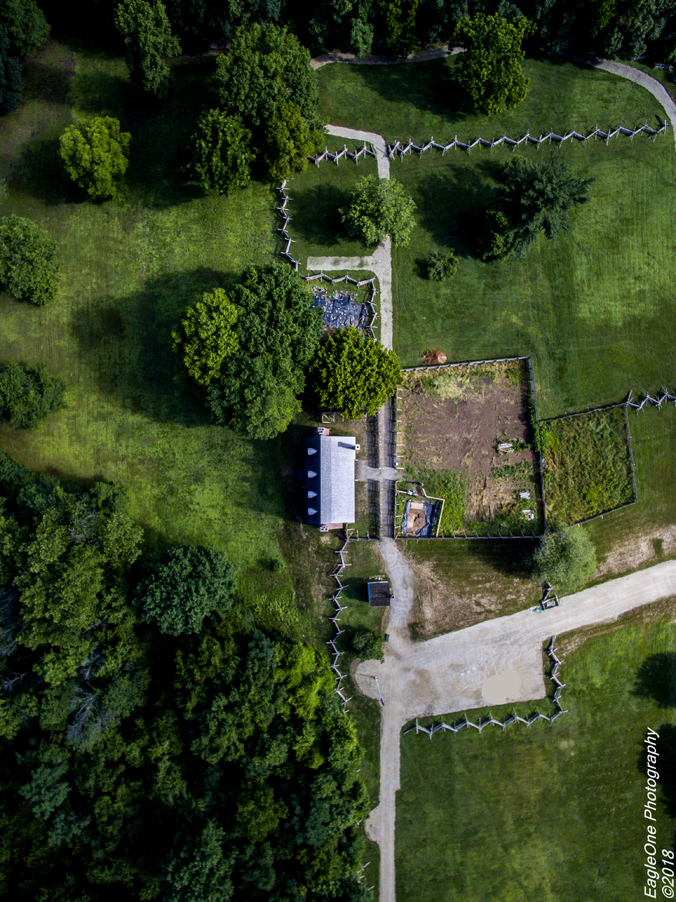
Growing up at Ferry Farm, George Washington learned that land was wealth. He learned how to run a plantation and to manage the enslaved workers who lived and toiled on his family’s farms. He learned what crops to grow and livestock to raise, how to care for them, and how to put them to use. George Washington was many things at different points in his life – diplomat, politician, general, president – but, throughout his sixty plus years, he was always a farmer.
To George and the other Europeans who settled in British North America in the 1700s, land and its natural resources were privately owned commodities or raw materials to be bought or sold. Land was used to create goods for market or was sold for profit. In other words, land was valuable and owning a lot of land made you wealthy.
Before growing anything on a farm, Washington and his fellow colonial-era farmers had to own land and the land they owned had to be defined legally. It had to have boundaries, so they and other people knew it belong to them. If land was wealth, it was vitally important to know how much land you owned.
Creating these boundaries was the job of a surveyor and being a surveyor was, after his lifelong work as a farmer, George Washington’s first job.
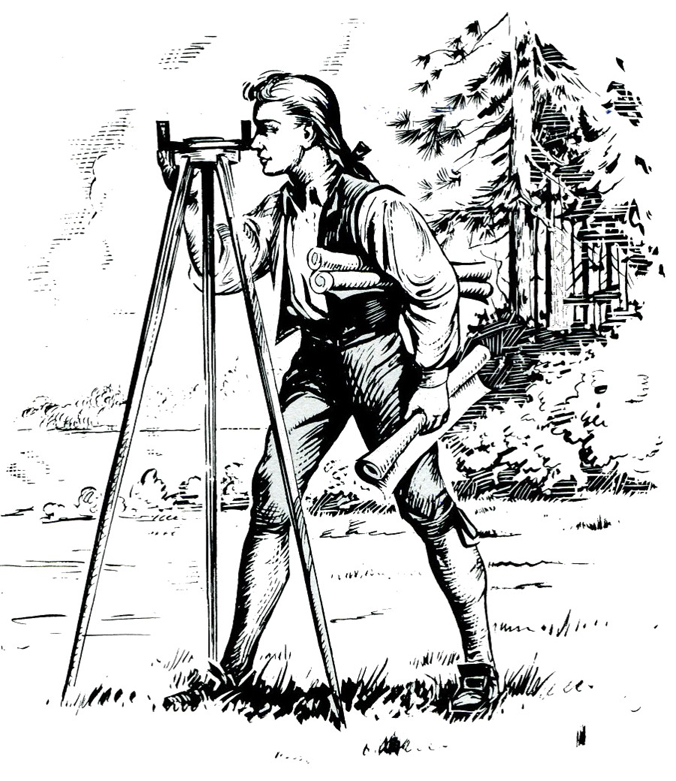
Merriam-Webster’s dictionary defines surveying as “determining the area of any portion of the earth’s surface.”
Today, surveyors use the Global Positioning System (GPS), satellite imagery, lasers, and other advanced digital equipment to do their work more quickly and more accurately. When George Washington was a surveyor, he used simple tools compared to today but, 200-years-ago, these simple tools were as advanced technologically speaking as today’s surveying equipment. Indeed, in the 1700s, surveying was relatively brand new. The word itself first appeared only in 1682.
Although a relatively new science, young George Washington was probably familiar with surveying from an early age. His father Augustine owned “1 Set Surveyors Instruments,” according to the probate inventory made of Augustine’s property after his death in 1743.
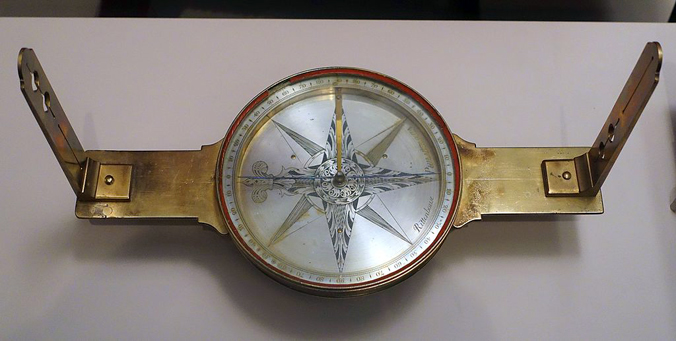
The state-of-the-art instruments of a surveyor in the 1700s included a surveying compass on a tripod used to figure out the bearing and direction of a proposed boundary line. A surveying compass included “sighting vanes” used to point “the compass by peering through the slit in one of the vanes and lining up the horsehair or wire in the oval of the other vane with a target or object” along boundary line. These targets were often just trees (sometimes marked in some fashion with a hatchet), boulders, steams, or any other landmarks.
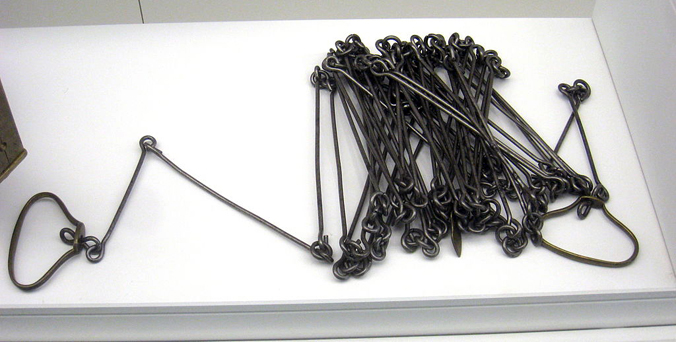
Measuring the distance between these targets set the property’s boundaries as well as its acreage. These distances were measured using chains carried by the surveyor’s assistants known as chainmen. A full surveyor’s chain was 66 feet long and 100 links and eighty of these chains equaled one mile. “Dragging a sixty-six-foot chain through the brush of colonial Virginia’s forests was impractical.” These long chains snagged on trees and other vegetation so surveyors in the colonies used a chain that was only 33 feet long with 50 links.
George Washington began a survey by choosing a starting landmark as well as a landmark to travel towards. He recorded the direction of the line using his surveying compass. Then, to measure the distance, the rear chainman held one end of the chain at the starting point while the lead chainman walked a straight line toward the ending target. As the surveyor, George constantly checked the compass to make sure the chainmen followed his line. Keeping the line straight sometimes meant the lead chainman hacked his way straight through brush and undergrowth. Once the he reached the end of the chain, the lead chainman pinned it to the ground and the rear chainman brought up the other end. They then repeated the process until the ending point of the line was reached. The rear chainman picked up the pins as they walked.
Fifteen-year-old George Washington made one of his first surveys on February 27, 1747 when he measured out his older half-brother Lawrence’s turnip field at Mount Vernon. According to Ledger Book Zero, Washington bought a Gunter scale, essentially a two-foot long ruler specifically designed to solve the trigonometry problems common to surveying, from his cousin Baily on September 20, 1747.
Thirteen months later, on March 11, 1748, George accompanied George William Fairfax and James Genn, the Surveyor of Prince William County, on a month-long trip across the Blue Ridge Mountains and into Virginia’s frontier to survey land for Thomas, Lord Fairfax. Young Washington kept a journal of his experiences.
In 1749, at age 17, George was commissioned the surveyor of the new county of Culpeper by the College of William & Mary, which appointed all county surveyors in Virginia This was unusual for someone this young to be appointed. A year later, he began a two-year period of off-and-on trips throughout Virginia’s Frederick County, which at the time encompassed a vast swath of frontier land that today makes up nine separate counties in two states. “By 1752, Washington completed nearly 200 surveys totaling more than 60,000 acres.”
In the later 1750s, George began to focus his work life more on soldiering (the French and Indian War) and farming. He never completely stopped surveying or acquiring land, however. In 1771, he surveyed Ferry Farm in preparation to sell the property and he surveyed for the last time in 1799, the year he died.
In the colonial age, land was wealth and was how many colonials, including George Washington, made their living. As such, early Americans wanted to know what land they owned as well as how much they owned. Surveyors, like George Washington, measured the land and created boundaries so ownership would be clear. “At one time, Washington owned nearly 70,000 acres between the Potomac and Ohio Rivers.” Surveying was Washington’s first job and allowed him to begin to build vast amounts of land holdings and thus wealth. This wealth, in part, propelled him to the heights of colonial American society and politics. He began this journey as a surveyor while living at Ferry Farm.
Zac Cunningham
Manager of Educational Programs
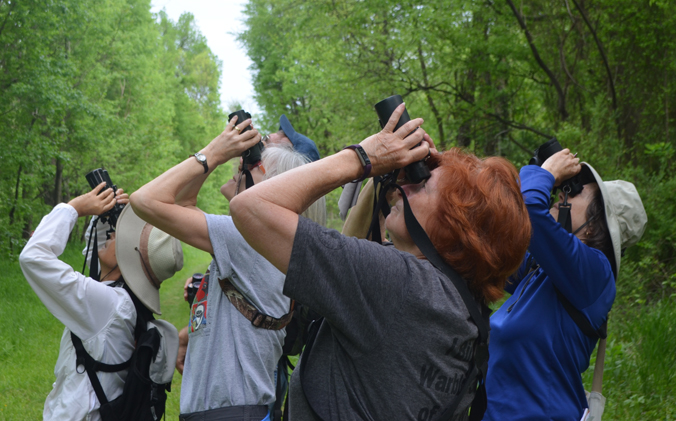
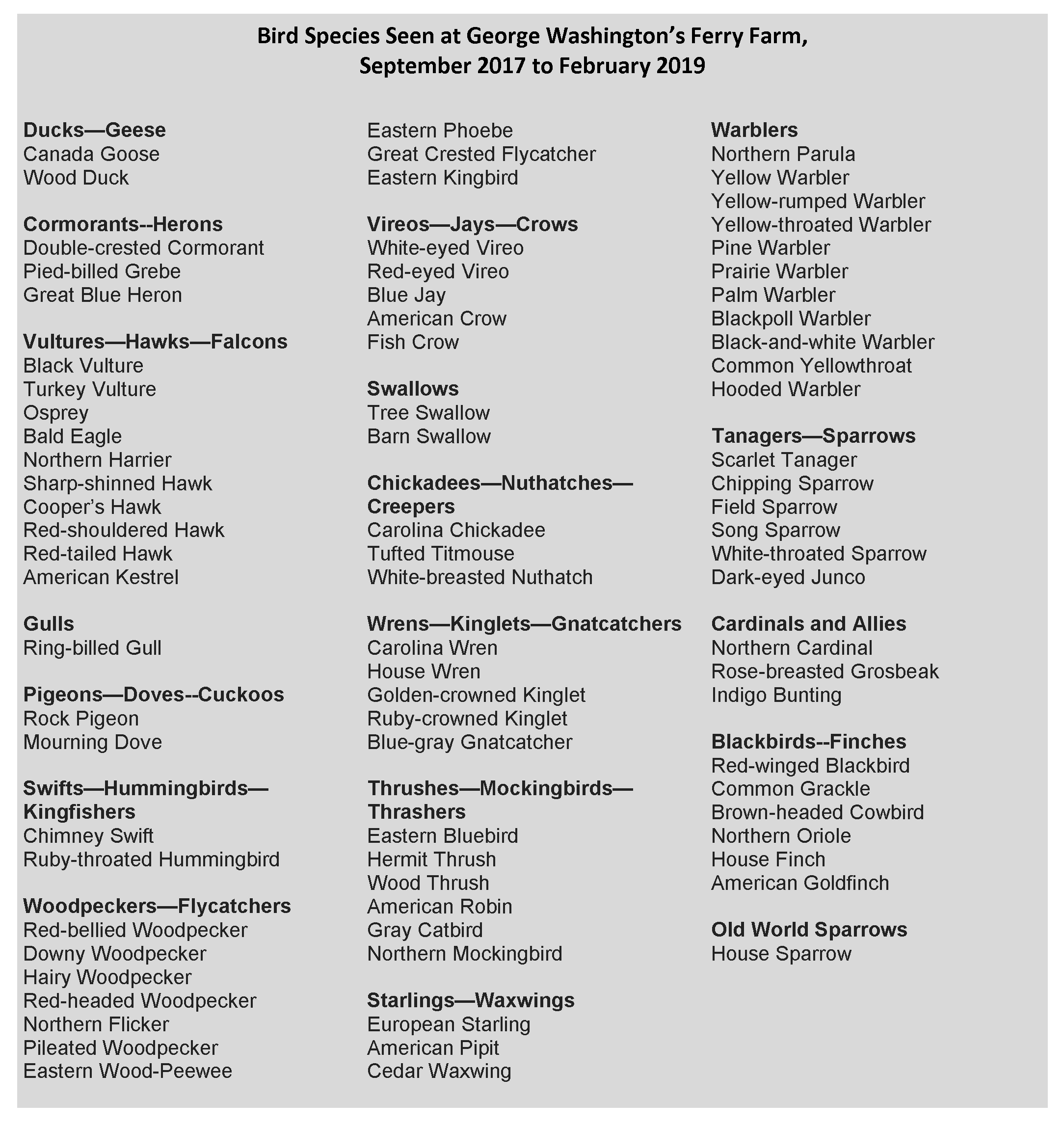
Between September 2017 and February 2019, the Fredericksburg Birding Club (FBC) conducted 12 bird surveys at George Washington’s Ferry Farm. We did three in spring, one in summer, three in fall, and five in winter. During that time, we saw 78 of the 136 species listed in the “Checklist of Birds at Ferry Farm” pamphlet and saw 3 new species for a total of 81 species spotted. All observations were recorded at ebird.org.[i] A full list of species observed by the FBC during this time follows.
The chart below compares species listed in the “Checklist of Birds” with those seen by the FBC by abundance designations. Some species vary in abundance with season and, in those cases, these species were given the designation used during their most abundant season. For example, Catbirds are uncommon in spring, common in summer and fall, and rare in winter. Nonetheless, in the chart, they were designated as common because summer and fall are when they are encountered most, spring sightings are the “earlybirds” anxious for warm weather, and winter sightings are out-of-habit occurrences.
| Designation | Definition | # of species on “Checklist of Birds” | # seen on FBC surveys |
| Abundant
|
Very numerous | 16 | 16 |
| Common | Likely to be seen or heard in suitable habitat | 23 | 23 |
| Uncommon | Present, but not certain to be seen | 44 | 29 |
| Occasional | Seen only a few times during a season | 40 | 8 |
| Rare | May be present but not every year | 13 | 2 |
| New | Not listed in checklist | (3) | 3
|
|
Total |
139 |
81 |
As you can see, we observed all birds listed as abundant or common. In addition, we saw 29 of 44 listed as uncommon; eight of 40 species listed as occasional; and two of 13 as rare. We also sighted three species not listed: the American Pipit, Red Headed Woodpecker, and Pied-billed Grebe. These sightings bring the total of rare birds at Ferry Farm up to 16 and the total number of bird species seen to 139.

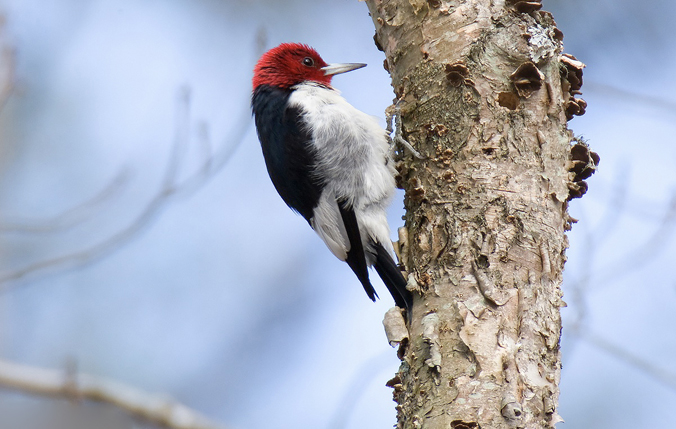

We don’t think the low numbers of uncommon, occasional or rare species indicate a trend as we are comparing 12 field days over 18 months with former Ferry Farm staff member Paul Nasca’s eight years of intense observation.
However, we noted two differences in frequency of sightings compared with the “Checklist of Birds.” We only sighted one Catbird and they are listed as common in spring and summer. In contrast, we have seen Bald Eagles on five of our 12 outings and they are listed as occasional. Again, at this point in our surveys, these are just interesting observations to follow, not necessarily trends. This year, we expect to pick up more uncommon species and hopefully some occasional species. We’ll see if any of rare ones show up.
Four of the surveys were conducted during the breeding season — spring through summer — and that data was entered into the Virginia Breeding Bird Atlas 2 (VABBA2) database. This atlas is the second for Virginia, the first being compiled from data collected between 1985 and 1989. VABBA2 will document breeding birds throughout the Commonwealth with data collected over five breeding seasons from 2016-2020.
The VABBA2 database notes specific behavior observations that indicate breeding. By those criteria, we confirmed breeding of four species: Tree Swallow, Northern Cardinal, Chipping Sparrow, and House Finch. We also observed probable breeding of four additional species: American Crow, Eastern Bluebird, Common Yellowthroat, and Carolina Chickadee. While we know these and other species breed at Ferry Farm, we have to observe behaviors or actual juvenile birds to document the breeding.
Highway noise from State Route 3 and the Blue-Gray Parkway at the south end of the property may be a factor in bird observations for both birds and birders. Studies have documented birds abandoning nesting areas or changing breeding songs so they can be heard. Additionally, highway noise makes it difficult for birders to hear songs, which affects observations of both bird presence and breeding activity.
The club’s major goal this year is to increase field days in the spring and summer both to document bird presence, particularly of uncommon and occasional species and to observe breeding behavior for VABBA2, increasing the number of confirmed breeding species at Ferry Farm.
Maureen Daly Hamm
Fredericksburg Birding Club
[i] During the non-breeding season, all birding data is entered directly into ebird.org at “George Washington’s Ferry Farm” hotspot. During the breeding season, the data must be entered through https://ebird.org/atlasva/home. VABBA2 has split Virginia into geographical blocks and the breeding data must be entered in the block where the birds are observed. Unfortunately, Ferry Farm falls into two different blocks. The southern field area is in block 0380277C4SW, and the remainder of the property is block 0380277C4CW. We submit data for the southern field area as “George Washington’s Ferry Farm 038077c4SW” The block 0380277C4CW data encompassing the majority of Ferry Farm property is listed simply as “George Washington’s Ferry Farm.” We will investigate ways to make the data simpler to access, but it may not be possible until the breeding bird survey is complete.
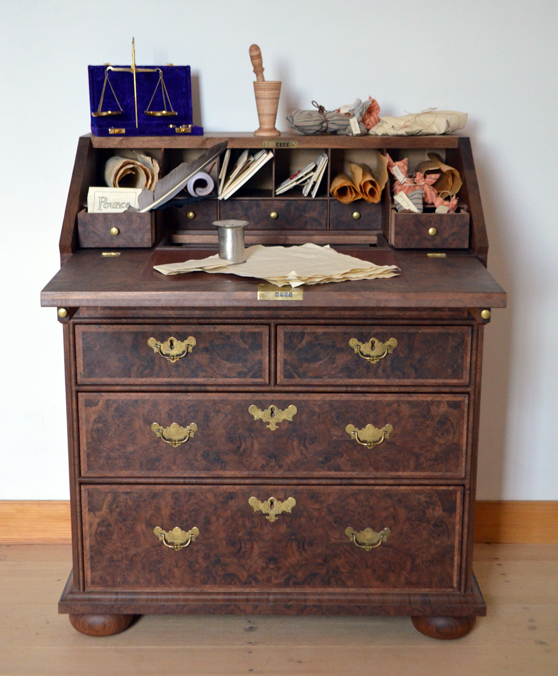
 Another new piece of furniture has arrived at the Washington house at George Washington’s Ferry Farm! Introducing the “Old Desk,” as listed in the “Parlour” on Augustine Washington’s 1743 probate inventory. This desk was copied from an original piece in the collections of the Colonial Williamsburg Foundation that dates to ca. 1710-1730, making it one of the earliest pieces represented in the house. So, why was it called the “old” desk in the inventory? And why are we now calling it “Mary’s desk?” And what are all those squiggly lines all over its surface? And does it have any secret compartments? Read on for the answers to these, and many other questions.
Augustine’s probate inventory doesn’t give us much description when it comes to the furnishings of his house, but what it does tell us can provide us with some interesting clues. For instance, the furnishings of the parlor are almost all described as “old” – an old table, 3 old chairs, and the old desk. Almost none of the furniture in the rest of the house is given this descriptor. It would seem to indicate that the parlor was filled with furniture that was already considered old by 1743.
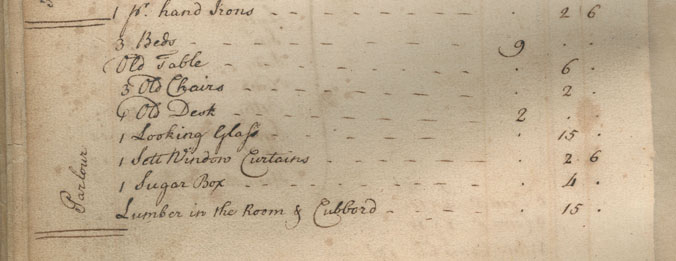
What do we consider “old” today? It can be a pretty broad category! For some of us, an object isn’t really old until it’s been around for hundreds of years. On the other hand, folks living in California might consider a house built in the 1920s to be pretty old. So what was considered old in the Washingtons’ day? Our best guess is that there was something about the furniture in the parlor that made the inventory takers think it was old – in other words, it looked different than the rest of the furniture in the house. It was probably of a style that looked so different that it was immediately recognizable as being from an earlier era.
As we’ve previously discussed, in 1743 most colonists were becoming familiar with the Queen Anne style of furniture – a lighter, more graceful style, that emphasized curves and less embellishment. Immediately preceding the Queen Anne was a style known as William and Mary, or early Baroque. Early Baroque furniture was heavier, and emphasized intricate decoration like inlays, veneers, and carvings with an emphasis on dark woods. Even to our modern eyes, William and Mary furniture looks very, very old. We think that the Washington’s parlor was filled with William and Mary style furniture, giving the room a very different feel than the rest of the house.
The original desk chosen for reproduction is from the William and Mary time period, and shows all the hallmarks of that style – dark wood, intricate inlays and veneer on every surface. The material used for all that veneer also explains those squiggly lines. The wood used here is walnut, but more specifically it’s “burled” walnut.

Burled walnut isn’t a species, but rather a condition of the wood. If you’ve ever seen an old tree with large, gnarled knots growing out of it, you’ve seen burled wood. Those knots are caused by a fungus that invades the tree and causes the usual wood ring pattern to grow out of control. Unfortunately, these gnarled knots of wood are very weak and can’t be used for any kind of structure, but they can be used for decorative purposes. A woodworker can thinly slice the knots, producing material suitable for veneers that are covered in beautiful whirled patterns like what you see on the desk.
In addition to all the inlays and burled veneer, the desk does indeed feature some secret compartments. This is everybody’s favorite part! In this post from three years ago, we discussed the importance of hidden compartments in 18th century furniture for keeping important documents or other valuables safe. They were usually hidden within the structure of the desk, such as boxes built into the case of a piece and concealed by a false panel or floor, but they could also be spaces concealed by decorative elements of the piece, like carvings or architectural elements.
Our desk has a particularly sneaky hidden compartment in that it’s not what you think it is. There is a panel in the center of the desktop that slides backward to reveal a large open compartment. To our modern eyes, this must be it, right? The secret compartment! But no, it’s a fake out. Our colonial ancestors would have recognized it as the storage compartment for the inkwells and stand necessary for proper letter writing – a fairly common feature of a formal writing desk at the time.
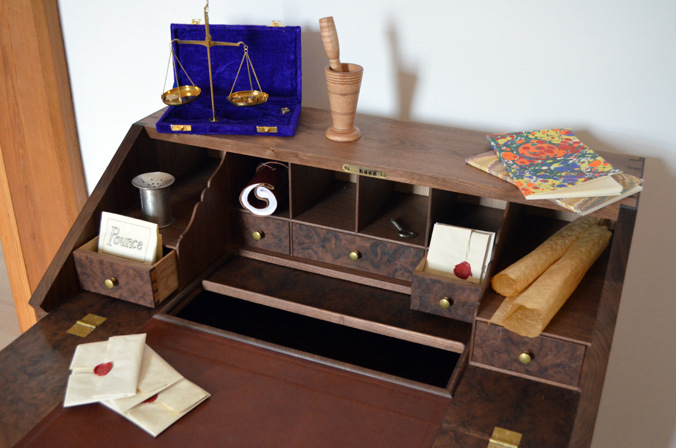
However, if you’ve gotten this far in an examination of Mary’s desk, then you’re pretty close to discovering the real secret compartment. In fact, it’s revealed in the video below but, when you visit Ferry Farm, you should keep looking in the desk. There are two more secrets hidden here!
And why do we call it “Mary’s desk” now? Well, that’s become a habit, but it’s one based in probability. As our regular readers know, there are two desks in the Washington house – the small one that we’re discussing today, and the scrutore in the Hall, which we previously discussed here. The scrutore is a very large piece of furniture, and was usually associated with shopkeepers or merchants, who often kept them in their back rooms to house account ledgers and financial papers. The fall-front writing surface was intended to be used while standing, rather than while seated at a desk chair, and you can see by how high that it was positioned that was intended for persons of some stature. Scrutores are generally associated with use by men, so in the Washington house, we tend to think of our scrutore as being “Augustine’s desk,” a place where he kept track of both his business accounts and matters related to the farm operation.
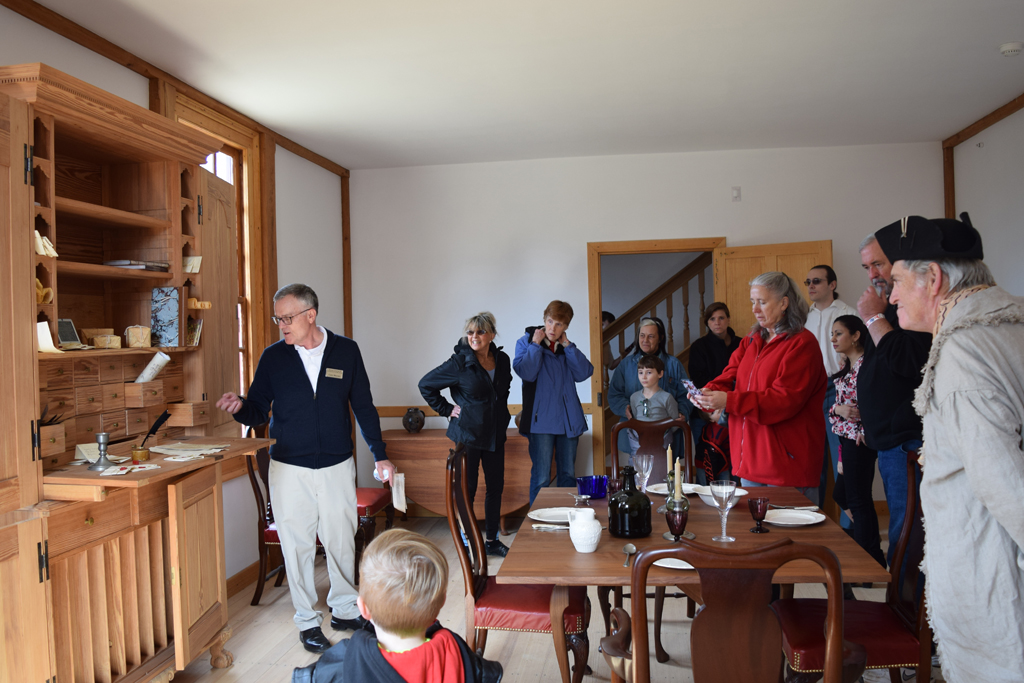
The old desk, on the other hand, is very small – what furniture scholars call “diminutive” – and is of a style that is usually associated with use by women. Contrary to popular belief, women were often in charge of the complicated business arrangements and contracts related to the running of a household, and in Mary’s case, a farm operation after Augustine’s death. So their desks were not simply for writing letters, but also for the storage and organization of all the associated papers and accounts needed to run their world. Additionally, as the “keeper of the keys” in a colonial household, the mistress of the house might also store costly spices and foodstuffs in locked drawers within her desk, so that she could monitor their use. Visitors to the Washington house will see that we have outfitted the old desk with all of the things Mary used on a daily basis, giving rise to the nickname “Mary’s desk.”
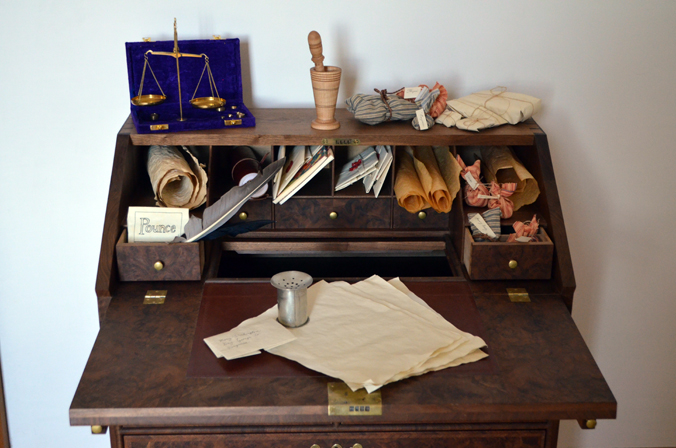
We hope you will stop in soon to see all of the new additions to the Washington house furnishings …and maybe figure out where Mary hid her secrets! Ferry Farm and Historic Kenmore both open for the season this Friday, March 1. Click here to plan your visit.
Meghan Budinger
Aldrich Director of Curatorial Operations
If you’ve been to Historic Kenmore, you’ve likely been awestruck at the beauty of the plaster ceilings throughout the first floor. Although the identity of “The Stucco Man” is lost to history, he left behind a lesson above the fireplace in the Dining Room. The plaster work inlay there depicts several stories from Aesop’s fables, easiest to recognize is “The Fox and The Crow.”

Fables are as old as time itself. A type of story passed down in folklore, the fable appears all over the world and is often the stuff of myth, legend, or flat out falsehood. When exactly people began telling fables can’t be pinpointed. They appear in ancient Egypt, India, Rome, Greece, and many other early civilizations.
Fables appear across religious boundaries too. They are prevalent in Christianity, Judaism, and Islam. These stories lend themselves to religious teachings because throughout history, fables were used to teach lessons and morals to children by pointing to a flaw or weakness in human behavior. These stories usually have characters who are not human; mainly animals that speak and behave like humans.
Aesop, one of the most famous authors of fables, came from Ancient Greece and his fables have become so widely published that the man himself has become sort of legend. Aesop lived sometime around the 6th century BCE. There are over 700 stories accredited to him today, but we can’t truly be sure if he actually wrote any of them.
Aesop has become a sort of fable himself. What little information about Aesop we have comes from an episodic called The Aesop Romance. According to this work of fiction, he was a Greek slave who was very clever. People like Aristotle wrote about Aesop’s cleverness being so great that he was able to overcome his enslavement and position himself in the company of kings.
The stories known as Aesop’s Fables have changed a lot over the centuries. They have been published countless times, each version a bit different than the last. Many editions have a completely different set of stories. This is because, again, no one is really sure what is or isn’t an Aesop’s fable.
That has not stopped his stories from being used by almost every generation since to teach children moral lessons. In fact, a lot of familiar phrases come from the morals of Aesop’s fables. Anyone who has listened to the soundtrack from the Broadway musical Hamilton might recognize the line “I swear your pride will be the death of us all. Beware, it goeth before the fall.” This is the lesson from “The Eagle and the Cockerels,” a fable about two roosters who fought constantly. When it looked as though one had finally beaten the other, he crowed to tell the world of his victory, but an Eagle swooped down and took him. The once defeated rooster was now the king of the farm. There are also stories that we all have learned that are attributed to Aesop that you may not realize, like: “The Tortoise and the Hare”; “The Ants and the Grasshopper”; and “The Wolf in Sheep’s Clothing.”
Aesop’s fables were used during George Washington life to teach children as well. In fact, Aesop’s Fables by Sir Roger L’Estrange appears in two different inventories of Washington’s books, once in 1759, and again in 1764. Moreover, when doing the inventory in 1759, the book is listed twice meaning that George Washington owned a copy as did his step-son John “Jacky” Parke Custis.
When inventory was done again in 1783, both copies are gone. Jacky’s copy was probably at his own estate, Abingdon, which was destroyed but would have rested on the property of Reagan National Airport today. Jacky died in 1781 from a camp disease he contracted at Yorktown and his probate inventory lists his copy of the fables, showing it was still part of his library at his death. Conversely, we do not know where George Washington’s copy went.
While George learned much of his genteel behavior from his famous penmanship exercise of The Rules of Civility and Decent Behavior, we can also guess the lessons of Aesop’s fables impacted his life. Certainly, these fables were read and taught throughout his childhood in school and at home. The Rules of Civility focused more on proper physical behavior whereas the fables focused on moral behavior.
Later in his life, as Washington grew from boy to man to legend, he too became inspiration for myths and parables that would teach lessons to others. The most famous of these stories was created by Parson Mason Weems about young George cutting down a cherry tree. Even today visitors to Ferry Farm are sometimes surprised to hear this story is a made up tale to teach children not to lie.
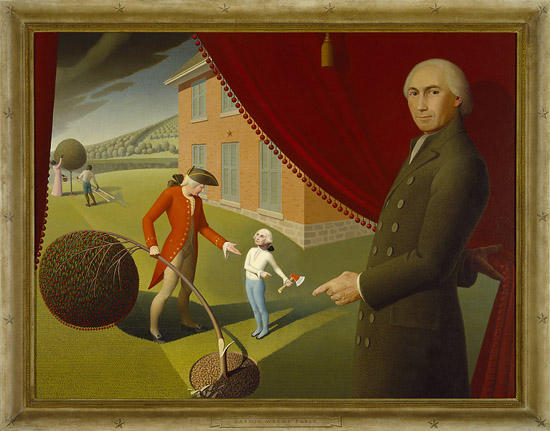
Interestingly, an Aesop’s fable entitled “Mercury and the Woodman” has the same lesson. In this story, a woodman loses his axe in a pool of water. The Greek god Mercury comes and pulls a golden axe from the water, but the Woodman tells the god that it is not his axe. Mercury then pulls a silver axe from the water; again the Woodman denies owning such an axe. Finally, Mercury pulls the ordinary axe from the water and the Woodman takes the axe as his own. Mercury is impressed with the Woodman’s honesty and lack of greed, so as a reward; he gives the Woodman the gold and silver axes.
The Woodman’s story spreads through town and several others attempt to summon Mercury by losing their axes. When they all greedily claim the golden axe, Mercury hits them over their heads and refuses to give any of them their own axes back. As you can see, not only does this fable have the same moral (honesty is the best policy) as the cherry tree myth, Weems even used the same hand tool! Perhaps, this Aesop’s fable was the real muse for writing the cherry tree tale?
Elizabeth Hosier
Manager of Interpretation and Visitor Services
References and Further Reading:
“19 Everyday Expressions That Came from Aesop.” Mental Floss. September 03, 2014. Accessed January 18, 2019. http://mentalfloss.com/article/58530/19-everyday-expressions-came-aesop.
An Ornate, 1551 Edition of Aesop’s Fables. Accessed January 18, 2019. https://wlu.edu/office-of-lifelong-learning/online-programs/from-the-collections/aesops-fables.
Carlson, Greg. “Fables.” Creighton University. Accessed January 18, 2019. https://www.creighton.edu/aesop/.
Clayton, Edward W. “Aesop’s Fables.” Internet Encyclopedia of Philosophy. Accessed January 18, 2019. https://www.iep.utm.edu/aesop/.
“Custis, John Parke of Fairfax, VA 2/20/1782 — Elite.” GUNSTON HALL PLANTATION PROBATE INVENTORY DATABASE. Accessed January 18, 2019. http://www.gunstonhall.org/library/probate/wbvaxxtl.htm
“Founders Online: Appendix D. Inventory of the Books in the Estate, C.1759.” National Archives and Records Administration. Accessed January 18, 2019. https://founders.archives.gov/documents/Washington/02-06-02-0164-0026#GEWN-02-06-02-0164-0026-fn-0002
“Founders Online: List of Books at Mount Vernon, 1764.” National Archives and Records Administration. Accessed January 18, 2019. https://founders.archives.gov/documents/Washington/02-07-02-0216#GEWN-02-07-02-0216-fn-0008.
“Search Results for Aesop.” Library of Congress. Accessed January 18, 2019. https://www.loc.gov/search/?in=&q=Aesop&new=true&st=
Weems, Mason Locke, and Peter S. Onuf. The Life of Washington. Armonk, NY: M.E. Sharpe, 1996.
Presidents’ Day is always a celebratory one at George Washington’s Ferry Farm! Once again this year, George’s boyhood home marked his 287th birthday this past Monday, February 18. A special thank you to the sponsor of the George Washington’s Birthday at Ferry Farm event: Peoples Community Bank.


Happy Holidays! George Washington’s Ferry Farm & Historic Kenmore are closed today for Christmas Eve and tomorrow for Christmas Day. Both houses will reopen for tours for five more days this year before closing on New Year’s Eve and beginning their annual two-month closure during the months of January and February. If you are unable to visit this holiday season, please enjoy these photos giving you a festive glimpse inside each home.


To learn more about visiting Kenmore and Ferry Farm, click here.
Our Archaeology team reveals how they are creating replica 18th century glass and ceramic objects that visitors may touch during tours of the Washington house replica at Ferry Farm.
Learn more about the Washington house replica here.
In a post several months ago, we discussed a piece of furniture listed in Augustine Washington’s 1743 probate inventory that gave us some interesting insight into the daily life of the Washington family – the sugar box. Recently, our reproduction sugar box arrived and is now on display in the Parlor, just as the probate inventory indicated. It’s been popular among our visitors, most of whom had probably never given much thought as to how colonial Virginians used and stored sugar. It also began to raise some questions among our staff. Turns out, there’s a lot more to the story of sugar in the 18th century than we thought!
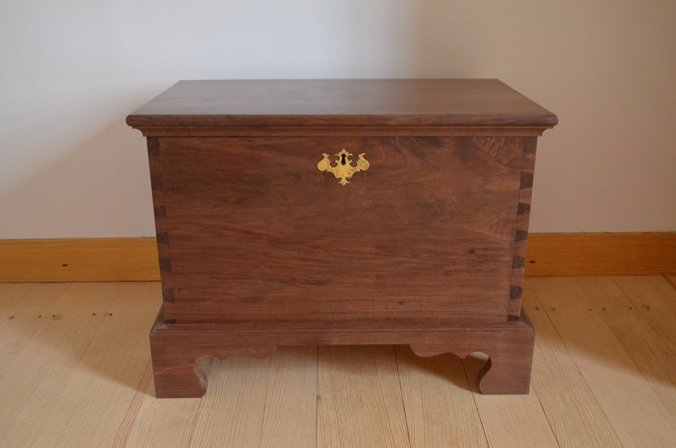
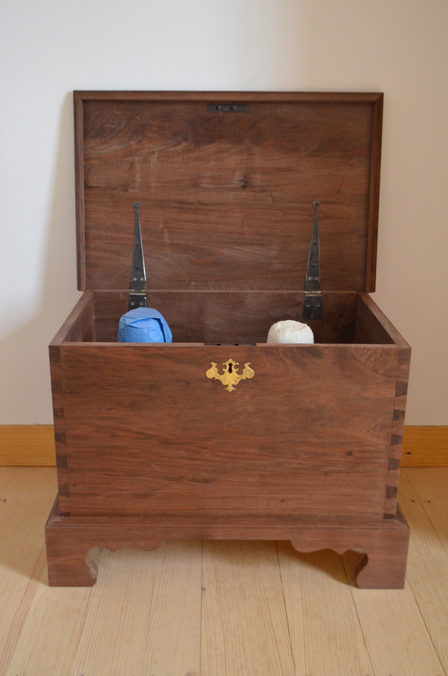
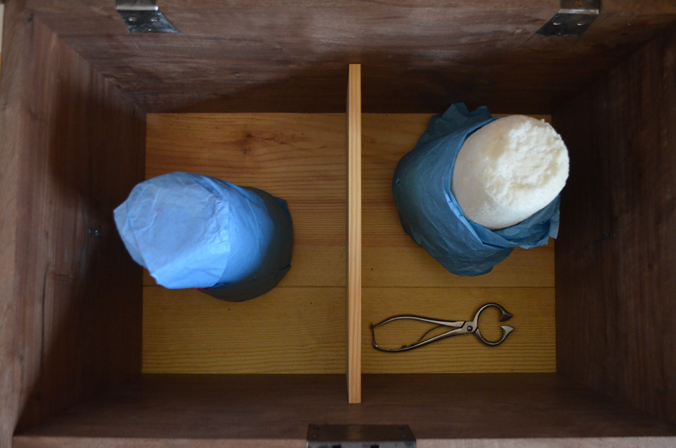
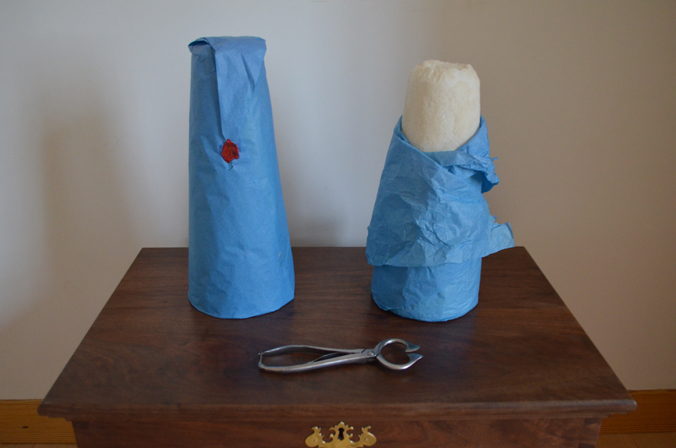
By now, most history buffs know that refined sugar was sold by 18th century merchants in the form of cones, usually called loaves, which were wrapped in bright blue paper and sealed with red wax. You can even buy souvenir sugar cones in any number of historic site gift shops. Perhaps because we’re accustomed to seeing these small souvenir sugar cones, and because we hear it reiterated time and again that refined sugar was such a precious commodity in the 18th century, we tend to think that colonial Americans kept one of these dainty cones safely under lock and key in a little chest, carefully rationing out tiny portions as needed. That notion, however, is quickly squashed when you see the sugar box in the Washington house. The interior compartments of the box – there are two of them – are quite wide, and very deep, too, measuring 14 inches deep, 14 inches long, and 11 inches wide.. If the box was intended to hold two loaves of sugar, how big were these cones?? As often happens in our line of work, one question leads to another, and sometimes you discover some interesting and little-known facts.
The Kenmore historic manuscript collection came in handy in addressing these questions. This document collection includes more shop accounts and receipts for purchased goods than any other type of document, and it was an easy task to do a quick search for records relating to the purchase of sugar.
Betty and Fielding Lewis made regular purchases of “loaf sugar,” “sugar loaves,” “white sugar,” “brown sugar,” and sometimes “brown sugar loaves.” The prices they paid ranged all over the place, probably indicating a fluctuating market or scarcity at any given time. On occasion, the account records gave size and weight information on the loaves being purchased, and they were impressive! The smallest loaf mentioned weighed 5 pounds, 9 ounces.[1] The largest? It came in at 50 pounds![2] Interestingly, that 50 pound sugar loaf cost £3, 15 shillings whereas the 5 pound loaf was valued at roughly 7 shillings, meaning the 5 pound loaf was worth significantly more per pound than the much larger cone. Even taking a fluctuating market into account, that’s an enormous difference. What would cause that?
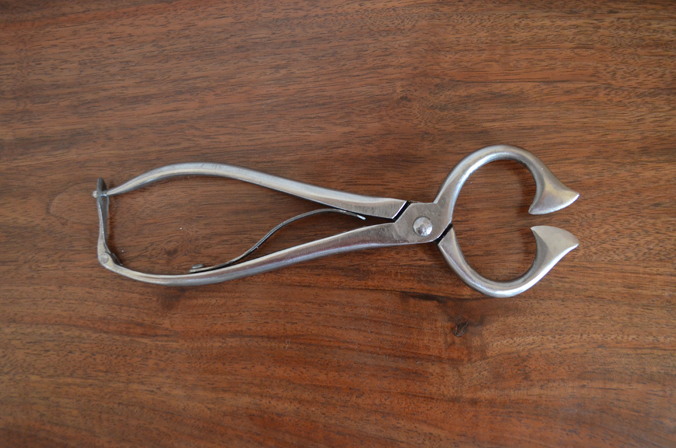
The answer to both the questions of why sugar cones varied in size so much, and why their value could be so wildly different lies in how refined sugar was produced. Get ready – you had no idea this was how sugar was made! First, raw sugar from sugar cane was boiled with lime water to remove impurities (yep, lime!). The resulting liquid was mixed with egg whites, ox blood or sometimes charcoal to further purify the liquid (yep, blood!). This step produced a layer on top of the sugar liquid that was scraped off and put aside – it was known as the scum (more about this later).[3]
The sugar liquid was then alternately re-boiled and allowed to evaporate a few times before it reached the optimal thickness, and was then left in a vat to cool. As it cooled, the liquid began to crystallize, at which point it was poured into cone-shaped molds. The pointed end of the mold had an open hole in it, but this was initially plugged with a twist of paper. Once the sugar began to harden, the paper plug was removed so remaining liquid could drain out.[4] This liquid was also saved and set aside – it was called the bastard (more about this later too).
Sounds pretty straight forward, but that’s not the end. The process up until this point produced a more refined, light-color sugar…but it’s still not the pure, bright-white sugar that was so highly coveted. How did they get the sugar to that final state? Well, a layer of white clay slip was poured over the large end of the cone, and slowly the clay percolated down through the sugar cone, adhering to particles and pushing out any remaining molasses. This process might be repeated two or three more times to make the most valuable refined sugar.[5] In the end, those 18th century folks who wanted the good stuff were actually ingesting quite a bit of lime and dissolved clay in their daily cup of tea. Delicious!
Anyway, once the whitening process was complete the dried cones were carefully tapped out of their molds and the hardened lump of clay that had formed at the nose of the cone was broken off, giving the sugar cone its distinctive bull-nose shape. These cones were then wrapped in blue paper, which enhanced the bright white color.
Now, back to those scums and bastards. Both of these bi-products could be recycled again and again to make increasingly inferior sugar, each batch being less refined and less white (and requiring more lime, clay and blood to make it look good). Eventually very little of either was left, and the resulting “rubbish scums” were simply thrown out. The inferior sugar liquid produced in this recycling process didn’t crystallize as easily as pure sugar liquid did, and so larger and larger cones were needed to form it. Therefore, the larger a sugar cone, the lesser the quality of its sugar. And thus, larger cones were cheaper than smaller ones. The best sugar came in cones about 5 inches tall, while merchants could acquire mid-range sugar in cones up to 3 feet tall and 14 inches in diameter.[6] But any level of refined sugar was still a luxury. Betty and Fielding Lewis’s accounts show that when white sugar was scarce or expensive, they resorted to cheaper molasses (which was actually itself a bi-product of the bastards) to sweeten their foods.
So, now we know why the compartments in the Washingtons’ sugar box were so large. For general, daily use, they probably purchased medium-grade sugar cones at about 2 feet tall, 7 inches in diameter. One of those cones might last them for the better part of a year, assuming they could keep the bugs away and keep the sugar relatively dry in Virginia’s summer humidity (no easy task, and likely meant that they simply didn’t use sugar in the summer).
As we know from teawares recovered archaeologically [PDF], Mary Washington was an avid tea drinker and collector of fine teawares. We can also surmise that she may have invested in the occasional small cone of truly fine sugar to serve guests to her tea table in the Hall Back Room, where she did her entertaining.
Meghan Budinger
Aldrich Director of Curatorial Operations
[1] Lewis, Betty in Account with John Legg, 20th January 1794. Kenmore Manuscript Collection, MS 365.
[2] Account, undated. Kenmore Manuscript Collection, MS 1099.
[3] Porter, George Richardson. The Nature and Properties of the Sugar Cane: With Practical Directions for the Improvement of Its Culture, and the Manufacture of Its Products (London: Smith, Elder, 1843), 271-273.
[4] Magid, Barbara H. Sugar Refining Pottery from Alexandria and Baltimore, Ceramics in America 2005, Robert Hunter, ed. (Milwaukee, WI: Chipstone Foundation, 2005), 223-224.
[5] Silliman, Benjamin, Manual on the Cultivation of the Sugar Cane and the Fabrication and Refinement of Sugar (Washington, D.C.: Printed by Francis Preston Blair, 1833).
[6] David, Elizabeth. English Bread and Yeast Cookery (Middlesex: Penguin, 1977), 139.
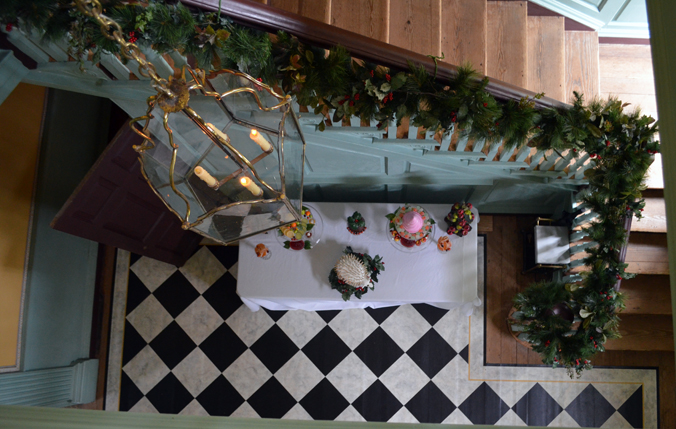
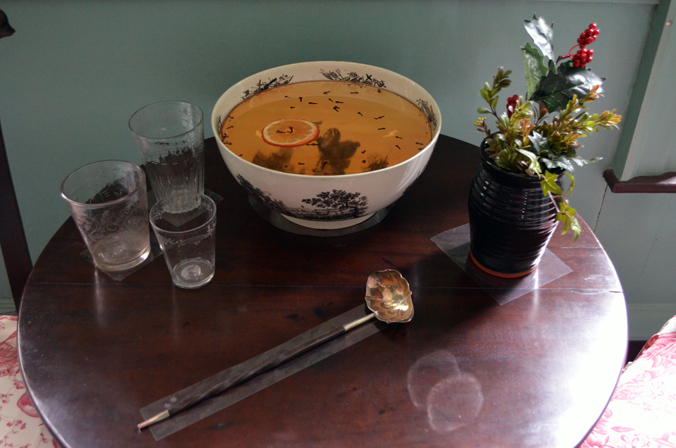
Over the years, we’ve often discussed how colonial-era Christmas celebrations and decorations were different from our own modern-day versions (read here, here, here, here, and here). Each year, throughout the month of December at Historic Kenmore, we depict the Twelfth Night festivities possibly enjoyed by the Lewis family because, in the 1700s, the main holiday celebration took place in January at the end of the Christmas season, rather than on Christmas day. We show an elaborate dessert table, loaded with fanciful sugar creations and treats, waiting for midnight revelers to partake during a break from music and dancing. We place simple jars of greenery around the house, and show a large punch bowl at the ready to serve holiday visitors. There are no Christmas trees or mentions of Santa yet – those would come later, in the 19th century.
This year at George Washington’s Ferry Farm, we have a new challenge: how do we show the Christmas season in the Washington house? The Washington family lived at Ferry Farm in the 1740s when Colonial Virginia was a more rustic place. While the Washington family was living in a far better situation than most of their neighbors, they still couldn’t imagine the luxuries that the Lewises would know at Kenmore 40 years later. So what was Christmas like for the Washingtons?
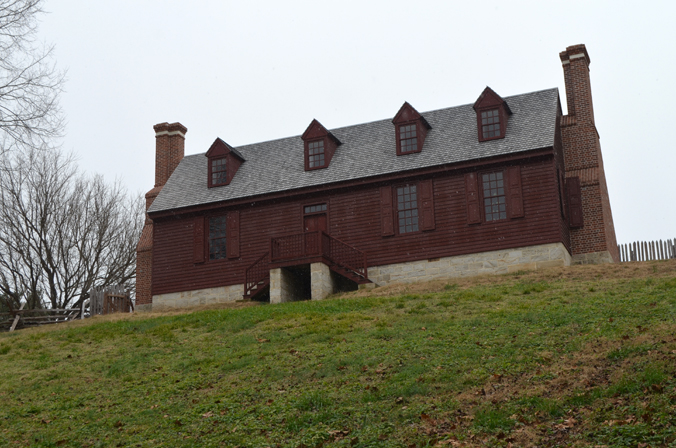
Unfortunately, we don’t have a lot of information from that early part of the 18th century to give us much detail. The Christmas season was rarely mentioned in correspondence or journal entries, and so we can surmise that the lack of mention means that the holidays weren’t an especially unusual time in the lives of most early Virginians.
Interestingly, we actually know more about the seasonal happenings of an even earlier time – that of the very first colonists to arrive in the New World during the 1600s. Because those early colonists were religiously devout, they observed the sacred aspects of the season strictly, even in the harsh environment they found themselves in after crossing the ocean. There are a number of holy days, feasts and saints’ days that occur throughout the Christmas season, and marking each of them with church services, large meals or simply readings and recitations comprised the holiday period for those early Virginians. With a few exceptions, decorations, special foods, small gift-giving, music, parties and the other secular trappings of the holiday would be largely confined to the late 18th century celebrations known to places like Kenmore. The Washingtons at Ferry Farm probably fell somewhere in between these earlier and later extremes.
Although the Washingtons probably decorated even less than the Lewises, we do have the opportunity at Ferry Farm to show one aspect of early 18th century Christmas that we cannot show in a traditional antique-filled house museum – the use of fragrant herbs.
Early in the 18th century, it was common practice not to decorate one’s home for the holidays, but rather to put the effort into decorating the sanctuary of the local church (if you had one). Clergymen urged local parishioners to ensure “the church be swept, and kept clean without dust, or cobwebs, and at great festivals strewed, and stuck with boughs.”
For most colonial era churches, incense was an expensive and not easily obtained luxury. To mimic its pleasant smell during holy days, parishioners strew fragrant dried herbs on the floors of the sanctuary. As the herbs were crushed under foot, they added a pleasant holiday aroma to the room. Sage, rosemary, and thyme were the most commonly used herbs but lavender and rose petals might also be added.
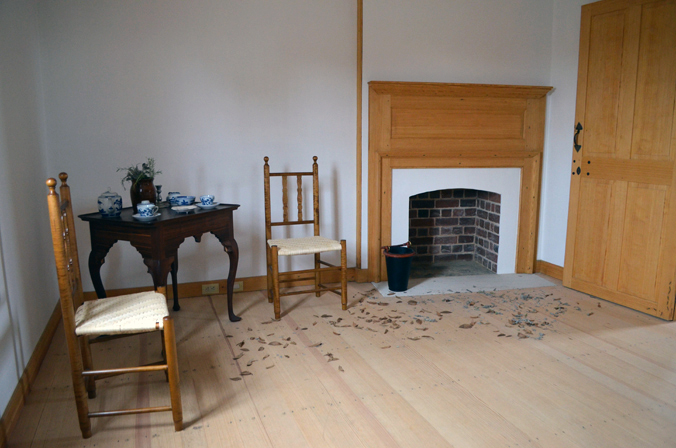
This practice of strewing herbs on the floor was adopted in private homes, too, especially when a household didn’t have a church nearby and services were conducted at home. Sachets of herbs might also be hung from doorways and windows, and small bundles of herbs might be occasionally tossed into the fire to add to the scent. The practice served to sanctify the house, but also gave people a break from the never ending parade of bad smells they encountered on a daily basis.
Another common practice among parishioners in decorating their churches was to place sprigs of holly and mistletoe in the muntins of the windows. Like the strewing of herbs, sprigging the windows found its way into the home and likely was the only greenery early 18th century colonial Virginians like the Washingtons used to mark the season.
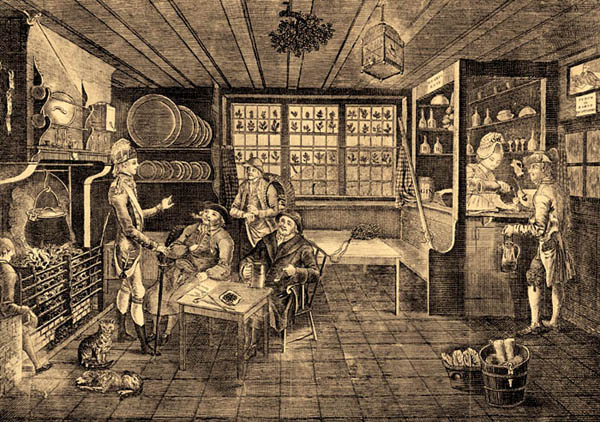
At Ferry Farm, because the Washington house is filled with reproduction furnishings, we can use both real herbs on the floors and real sprigs of greenery in the windows. It may be much less than our 21st century eyes are accustomed to, but the Washingtons would have recognized these signs of the season right away.


This holiday season, we invite you to visit both Ferry Farm and Kenmore to experience these sights and, for the first time this year, the smells of the 18th century’s evolving Christmas celebrations as marked by the Washingtons, the Lewises, and their fellow early Americans. To learn about visiting Ferry Farm and Kenmore during the holiday season and to see a list of special holiday events, click here.
Meghan Budinger
Aldrich Director of Curatorial Operations

