It’s the 33rd year of a a long-standing holiday tradition: the Gingerbread Contest & Exhibit at George Washington’s Ferry Farm! This year’s theme is “Holiday Songs.”
“Deck the Halls” by King George Country Schools Preschool: Ms. Rachel, Ms. Cindy, and Ms. Becky’s Class
“Deck the Halls” by King George Country Schools Preschool: Ms. Rachel, Ms. Cindy, and Ms. Becky’s Class
“How Many Songs” by Carol Glick and family
“How Many Songs” by Carol Glick and family
“I Saw Mommy Kissing Santa Claus” by Valerie Jackson & Debbie Hicks
“I Saw Mommy Kissing Santa Claus” by Valerie Jackson & Debbie Hicks
“Jingle Bells Rock the House Down” by RAAI-RACSB
“Let It Snow” by Samantha Wainwright
“Marshmallow World” by the Baldwin Family
“Melekalikimaka” by Daniel Jackson & Noah Stusse
“Poor Grandma” by Hunt Family
“Santa Clause is Coming to Town” by the Fleming Family
“Santa’s Musical Workshop” by Chancellor High School German Club
“Santa’s Stable” by Moriah Webster’s 7th & 8th grade students, Walker Grant Middle School
“Sleigh Ride” by Ryan Jackson & Henry Stusse
“To RAAI House we go!” by RAAI-RACSB
“Winter Wonderland” by Maggie Jackson
Winners
Level 1: Age 2-5 First Place Ribbon ~ “Let it Snow” by Samantha Wainwright
Level 3: Age 11-14 First Place Ribbon ~ “Melekalikimaka” by Daniel Jackson & Noah Stusse
Level 3: Age 11-14 Second Place Ribbon ~ “ Sleigh Ride” by Ryan Jackson & Henry Stusse
Level 4: Age 15-17 First Place Ribbon ~ “Winter Wonderland” by Maggie Jackson
Level 4: Age 15-17 Second Place Ribbon ~ “Santa’s Musical Workshop” by Chancellor High School German Club
Level 5: Age 18 & Over: First Place ~ “I saw Mommy Kissing Santa Claus” by Valerie Jackson & Debbie Hicks
Level 6: Family Made: First Place ~“How Many Songs” by Carol Gick & Family
Level 6: Family Made: Second Place ~ “Poor Grandma” by Hunt Family
Level 7: Special Needs: First Place Ribbon ~ “Deck the Halls” by King George Country Schools Preschool: Ms. Rachel, Ms. Cindy, and Ms. Becky’s Class
Level 7: Special Needs: Second Place Ribbon Tie ~ “To RAAI House we go!” by RAAI/RACSB
Level 7: Special Needs: Second Place Ribbon Tie ~ “Jingle Bells Rock the House Down” by RAAI/RACSB
Best in Show Award Ribbon: First Place ~“How Many Songs” by Carol Gick & Family
People’s Choice Ribbon: To Be Determined on Dec 30
Please come visit the exhibit and vote for your favorite! Ferry Farm’s hours are Monday – Saturday from 10:00 a.m. – 4:00 p.m. and Sunday from 12:00 p.m. – 4:00 p.m. Ferry Farm is closed Christmas Eve and Christmas Day. The gingerbread exhibit ends on December 30. General admission to Ferry Farm and the exhibit is $9 adults, $4.50 students, under 6 free while admission to the exhibit only is $4.50 adults, $2.25 students, under 6 free.
The holiday season is beginning! No matter how you celebrate the next several weeks, you’re likely spending extra time thinking about food. We archaeologists are no different, only we also want to know what the Washingtons and their enslaved laborers ate, whether at the harvest, the holiday season, or simply a regular meal. Historians know about the past because people wrote things down in diaries, letters, receipts, legal records, and other documents. Of course, not everything was written down, especially when the things as mundane as what people ate for dinner. To find out more about the diets of those living at George Washington’s Ferry Farm in the 18th century, along with research in historical documents, we also turn to archaeological analysis.
We previously published a blog post detailing floral remains excavated in 2015 from a storehouse cellar abandoned in the mid-1700s. This cellar feature contained floral remains (seeds and wood) which were analyzed by a microbotanical expert. We are currently using this information to recreate the Washington era landscape and to plant in our garden examples of what the Washingtons grew.
Historical documents, namely the probate inventory of Augustine Washington compiled in July 1743, show that the livestock owned by the Washingtons included 6 oxen, 29 cattle, 19 pigs, and 11 sheep. Rather than consume this livestock themselves, however, the Washingtons most likely raised most of these animals for market. Many of them would be butchered by enslaved workers, the meat loaded onto small ocean-going vessels ported at Fredericksburg, and then shipped to the British West Indies or even to England.
“The Residence of David Twining, 1785′ by Edward Hicks. Although Twining’s farm was located near Newtown, Pennsylvannia, this painting includes great example images of livestock typically found on a colonial farm or even on a plantation like Ferry Farm. Credit: The WikiArt Visual Art Encyclopedia
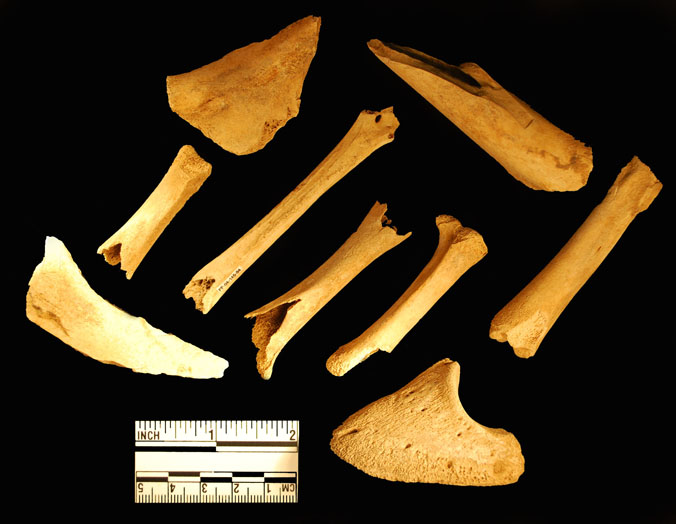
To add to the probate inventory’s livestock picture, we also explored a root cellar feature under the Washingtons’ house as well as a root cellar feature associated with a nearby enslaved laborer’s dwelling. In these cases, we hoped to determine what kinds of animals – or fauna – each group actually ate. These diets would be revealed by archeologically recovered animal remains, usually bones, called “faunal remains.” Then, we had an expert in faunal remains analyze what came out of these two root cellars.
Archaeologist excavating an animal bone at George Washington’s Ferry Farm.An assortment of faunal remains excavated at Ferry Farm.
The results for Ferry Farm were unusual compared to other 18th century sites. The Washingtons weren’t only dining on typical domestic livestock like cows and pigs, they ate a variety of wild game and in much higher amounts than expected. Results from other studies show that typical 18th century Virginia households consumed a little under 4% wild game on average. Another study of planter households in Maryland and Virginia showed faunal remains only ranging from 4-15% wild game. The percentage of wild game recovered from the Washington house root cellar was a whopping 25%.
Mammal remains recovered from the Washington family root cellar include cows, pigs, sheep, rabbits, raccoon, white-tailed deer, fox squirrels, and grey squirrels. Birds that were prepared and eaten include chicken, turkey, Canada geese, mallards and other ducks, bobwhite, and the now-extinct passenger pigeon. Fish eaten include longnose gar, stripped bass or rockfish, white perch, yellow perch, and carp. Shellfish consumed include oysters and crabs. The Washingtons also ate turtles, which were 18th century delicacies.
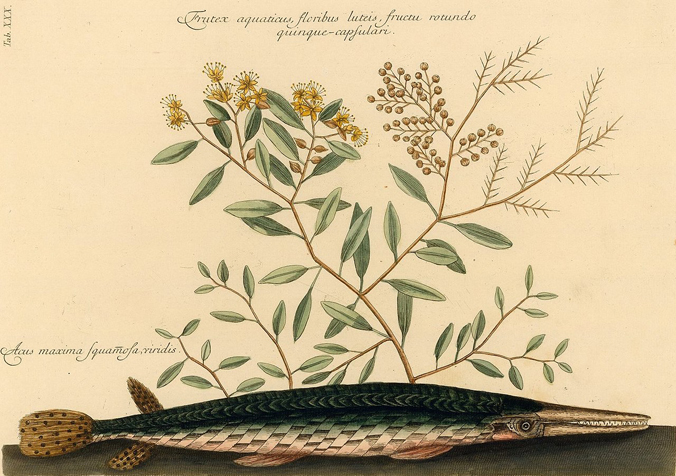
Passenger Pigeon by Mark Catesby from his famed Natural History of Carolina, Florida and the Bahama Islands published 1729-1747. Credit: WikipediaLongnose Gar by Mark Catesby from his famed Natural History of Carolina, Florida and the Bahama Islands published 1729-1747. Credit: Wikipedia
The species recovered from the slave quarter root cellar include cow, pig, chicken, possum, four types of fish, and an unidentified bird. Beef and pork account for almost 78% of the faunal remains. What meat Ferry Farm’s enslaved people consumed came in the form of mostly beef, pig, and chicken. The relative absence of wild animals, with the exception of fish, shows that the occupants of the slave quarter did not significantly supplement their diet using hunting or trapping. No lead shot, gunflints, or fish hooks were recovered in the slave quarter, the lack of which supports this conclusion. The enslaved laborers however were providing food for themselves by raising chickens, which account for over 7% of the meat recovered in the slave dwelling.
The prevalence of wild animals being served on the Washington table may be related to the makeup of the four Washington boys: George, Samuel, John Augustine, and Charles. The youngest Washington male, Charles, left home around 1761, meaning that the Washington boys hunted, fished, and trapped for up to 23 years at Ferry Farm. Farm life meant there were also frequent opportunities requiring the dispatching of varmints. At the time, hunting and fishing were considered fun and great practice for adult gentry life. There was also an economic benefit to provisioning one’s table with game. This supplemental meat source replaced domestic animals that could be steered toward the market, increasing the profits of selling livestock and poultry.
Elyse Adams, Archaeologist
Co-Field Director / Archaeology Lab Technician
On Saturday, November 19, George Washington’s Ferry Farm and Historic Kenmore both presented their annual holiday workshops devoted to teaching attendees either how to build a gingerbread house or to create a holiday themed “room box.” Here are some photos from both workshops…
These two workshops are presented in preparation for Ferry Farm’s annual Gingerbread House Contest & Exhibit as well as Kenmore’s annual A Wee Christmas Dollhouses and Miniatures Show.
The 33rd Annual Gingerbread House Contest & Exhibit at George Washington’s Ferry Farm is a long-standing holiday tradition and, this year, runs from December 8th through the 30th. This year’s theme is “Holiday Songs.” For all the details about entering the contest or visiting the exhibit, click here. Adults and children alike will enjoy the sights and smells of the festive creations displayed at Ferry Farm!
A Wee Christmas Dollhouse & Miniatures Show at Historic Kenmore runs from December 8th through the 30th. Adults and children alike will enjoy this exhibit of highly detailed, replica dollhouses – including a Kenmore dollhouse – and miniatures in the Crowninshield Museum Building. Share memories of your dollhouse with your family as you explore life in miniature! Put your mind and eye to the test with our “I Spy Miniatures” challenge – fun for young and old alike! For all the details about visiting the show, click here.
Both Ferry Farm and Kenmore are closed on Christmas Eve, Christmas Day, and New Year’s Eve.
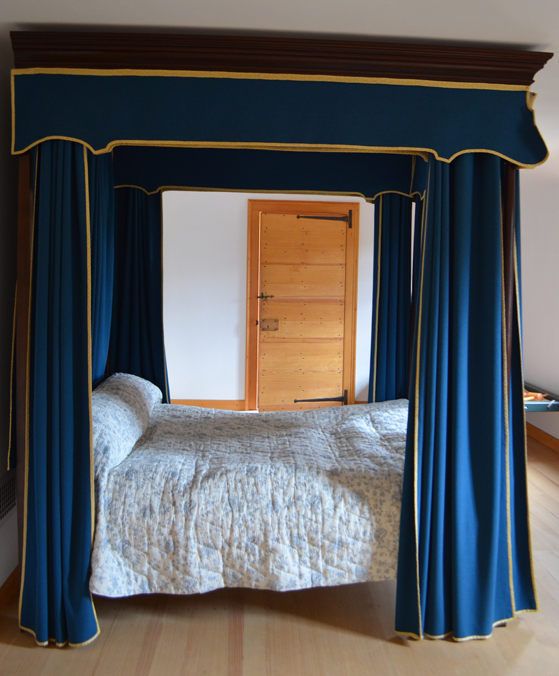
The summer of 2019 was an especially hot one here in Virginia, but we managed to add some cool crispness to the Washington house interior. It came in the form of some new textiles for the “best bed” in the Hall Back Room, in a refreshing blue and white color scheme. As we’ve previously discussed here, blue and white bedroom textiles seemed to be a favorite of Mary Washington’s, throughout her life. Both her will, written in 1788 many years after she had moved away from Ferry Farm and taken up residence in a cottage in downtown Fredericksburg, and the list of her belongings sold at vendu following her death in 1789 contain references to blue and white quilts, coverlets, counterpanes and curtains.
The “Best Bed” in the Hall Back Room of the Washington house at Ferry Farm.
After the “best bed” arrived in 2018, we decked it out in blue wool bedcurtains and a white matelesse summer counterpane. But for winter use, we really wanted to show the bed with the blue and white quilt that is mentioned several times in Mary’s documents, including a reference to it being willed to George Washington himself following Mary’s death. Finding such a quilt turned out to be much more of a challenge than we anticipated, though. The challenge was due to the increasing difficulty in finding ready-made period-appropriate fabric in our modern world. And to understand that difficulty, we need to understand what Mary’s blue and white quilt (probably) looked like.
The description of the quilt as being “blue and white” was not overly specific, but it was actually more descriptive detail than we have for most items in Mary’s household. What could “blue and white” mean? First, it’s important to understand that a “quilt” in the 18th century is almost certainly NOT a patchwork quilt, or an appliqued quilt, both of which came into fashion much later. Instead, an 18th century quilt was usually comprised of a solid piece of decorative fabric, on a layer of filler and a backing fabric, all of which was then quilted, or stitched with decorative patterns. Sometimes the decorative fabric was a solid color, and the intricate stitching patterns were the real decoration, and sometimes the fabric itself had a pattern which was enhanced by the quilting. The ‘blue and white” reference obviously indicates that the quilt was multi-colored, which indicates that the decorative fabric was patterned. So what kind of blue and white patterns were available to Mary Washington in the mid-18th century?
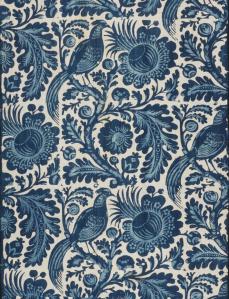
By the mid-1700s, printed cotton textiles had become all the rage in England, and were being heavily imported into the American colonies.[1] The technology for producing printed textiles at that point included resist dying, block printing with mordants and dyes, and copperplate printing (and combinations of all three).[2] Resist dying (in which wax or some kind of dye-resistant substance was applied to sections of fabric meant to stay white, and then the entire fabric was submerged in dye) could produce bold colors and sharp contrast between dyed and undyed sections of fabric, but detail was hard to achieve. Block printing improved the level of detail in patterns, but was still slow and tedious. Copperplate printing allowed for great detail and eventually sped up the process of producing repeated patterns on yardage considerably. Incorporating more than 1 color in the process was still hard to achieve, and so patterns are often monochromatic, with multiple layers of printing being used to create shades of color. Most patterns, no matter the method of printing, involved floral and natural themes, sometimes including birds and other animals, and eventually entire landscape scenes.
ResistBlock printedCopperplate
So, Mary’s blue and white quilt was most likely similar to one of these styles. Our challenge was to find a modern fabric that accurately depicted one of these processes. Unfortunately, not many modern fabrics are made using the same 18th century technologies, and are more likely to be machine printed using digital images. As a result, these modern patterns usually look too perfect, without the minor imperfections of handmade textiles which actually reveal to us what type of historic process was used to make them. The imperfections are a part of the overall look and feel of the pattern, and make the final product more authentic. It’s a hard thing to achieve these days!
The American textile industry is greatly reduced from what it once was in the early 20th century, and even in Europe, many of the textile factories that once created the patterns that Mary and her contemporaries used in their homes, are gone. Most printed fabrics produced using historic methods these days are produced in small runs and come from small artisan shops – finding both the makers, and enough yardage (and at a price that isn’t prohibitive) of period-correct patterns, can be difficult.
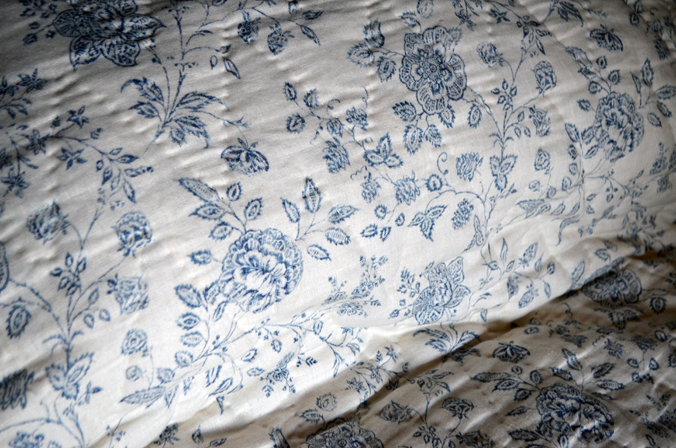
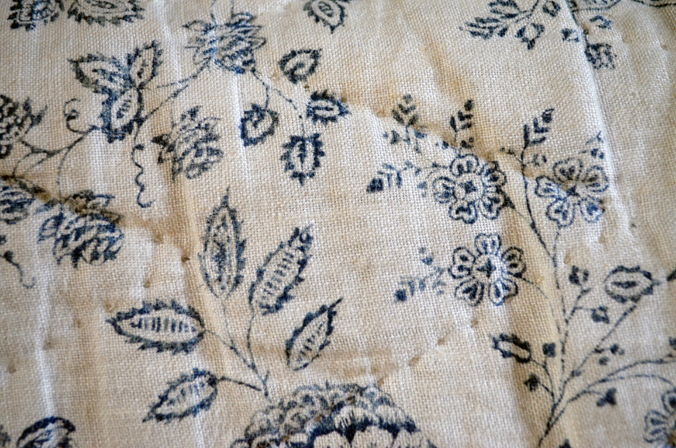
Quilt on the “best bed” in the Washington house.Close-up view of “best bed” quilt.
After months of searching, we were lucky enough to locate a blue and white printed cotton, reproduced from a mid-18th century French pattern by Chelsea Textiles in New York. The original version was block printed, but also used wax or paste in the resist method. The result was a detailed repeated floral pattern that also had the rounded edges of resist dying. It was perfect for our uses. The fabric was quilted onto filler and backing, and the entire quilt was cut in a T-shape, to fit around the bedposts of the Washington “best bed”, creating a fitted look which was also typical of the time. Visitors to the Washington house can now see Mary’s favorite blues on display in her bedchamber.
Meghan Budinger
Aldrich Director of Curatorial Operations
[1] Eaton, Linda. Printed Textiles, British and American Cottons and Linens, 1700 – 1850. The Monacelli Press, New York. Pg. 65.
In this video, Fredericksburg, Virginia-based furniture maker Steve Dietrich discusses two of the techniques he used to create a blanket chest for the reconstructed Washington house at Ferry Farm.
Watch other videos and read more about rebuilding the Washington house here.
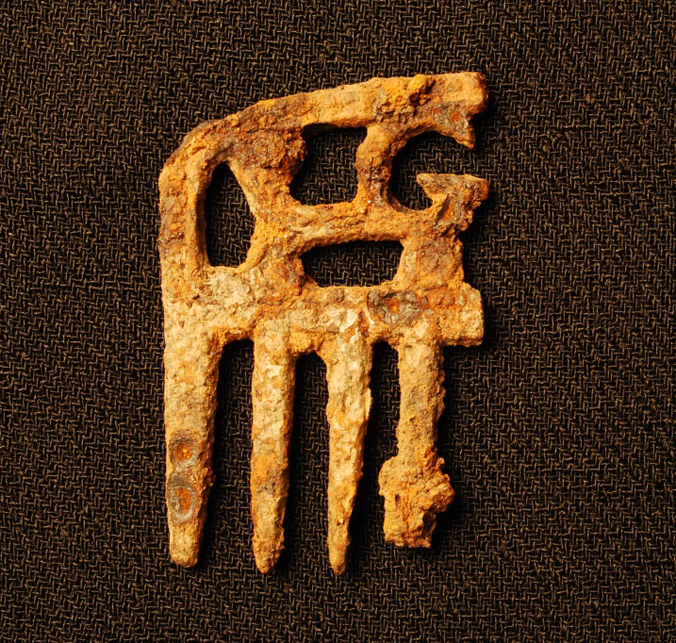
A little more than a year ago we published a blog post highlighting a horse’s mane comb excavated years ago at George Washington’s Boyhood Home at Ferry Farm. Though the rusty iron mane comb was incomplete, a lone, decorative “G” located along the top of the comb hinted at a longer name we hoped might be “G.[eorge] Washington.”
Mane comb excavated at George Washington’s Ferry Farm.
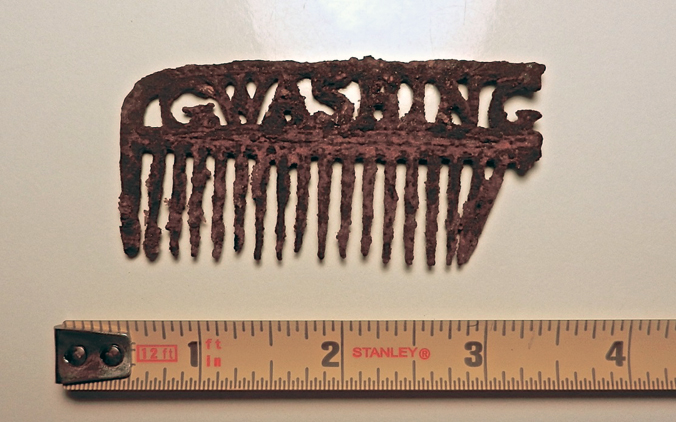
Fortunately, two outside sources soon came to our attention that confirmed our suspicions. A reader of the blog sent a note disclosing his family has a mane comb very similar to ours. This comb is more complete than ours but more importantly, it has “G.Washing” inset above the teeth!
Blog reader’s family mane comb.
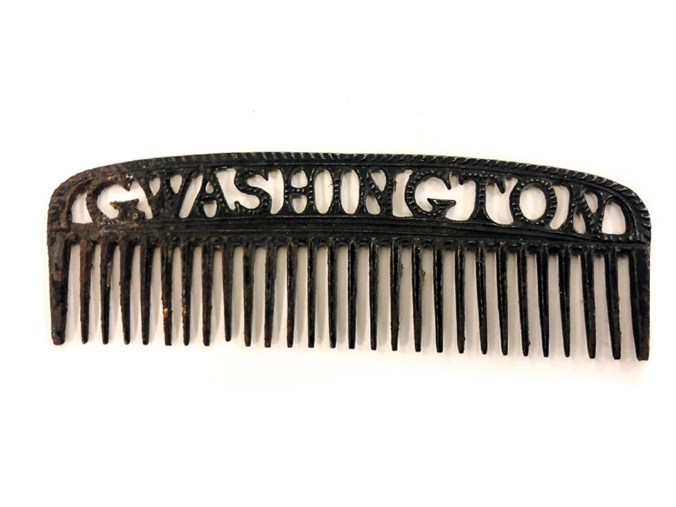
A second source turned up in an online auction in which a horse mane comb was listed for sale with other early 19th century items. This comb is a wonderfully complete specimen with “G. WASHINGTON” clearly inset with hollow cut lettering in the upper section of the comb above the teeth.
Our blog reader was not sure how old his mane comb was, and the auction listed theirs as “Federal Period” (early 19th century). All three examples have similar rope molded decoration along the upper edge of the comb and on the lettering, and only our comb has a slightly different spacing in front of the first letter. Considering everything, we think that’s enough proof! “G.WASHINGTON” it is!
Washington memorabilia is ubiquitous, commemorating everything including his birth, his death, and his Revolutionary War and Presidential experiences. Statues, medals, buttons, paintings, ribbons, and hundreds of other products have been made to honor our first president over the last 220 years since his death in 1799. It makes sense that these mane combs are part of that heritage, made as homage to his memory. Why there aren’t more of them out there, I don’t know. But I love the fact that one of these combs made its way back to the farm on the Rappahannock River where George grew up. Ferry Farm is where he spent his formative years learning not only how to ride his horses, but also developing those leadership skills he would need to one day lead the Continental Army and eventually the United States of America.
Ferry Farm’s tens of thousands of years of human habitation has provided archaeologists with nearly 800,000 artifacts to date, consisting of discarded items left by the people who lived on, worked, or visited this land. A question we often receive from visitors is where are graves of the PEOPLE who left behind these discarded items?
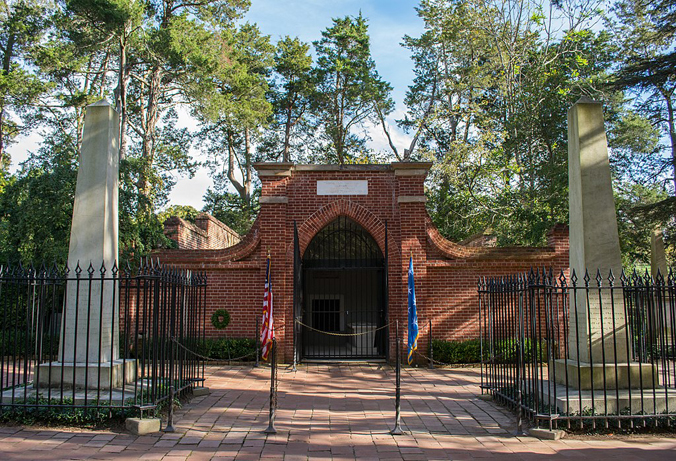
Well, nearly all of the Washington family, who lived at Ferry Farm from 1738 to 1772, are buried elsewhere. George is in a burial vault at Mount Vernon, where he died 220 years ago. If you are a Fredericksburg local, you likely know George’s mother Mary is buried on Washington Avenue near Kenmore, her daughter Betty’s home. Although he died at Ferry Farm, George’s father Augustine is buried at Pope’s Creek where George was born. A Washington family cemetery had already been established there years before. George’s brothers Samuel, John Augustine, and Charles and sister Betty are accounted for in various other cemeteries in both Virginia and West Virginia.
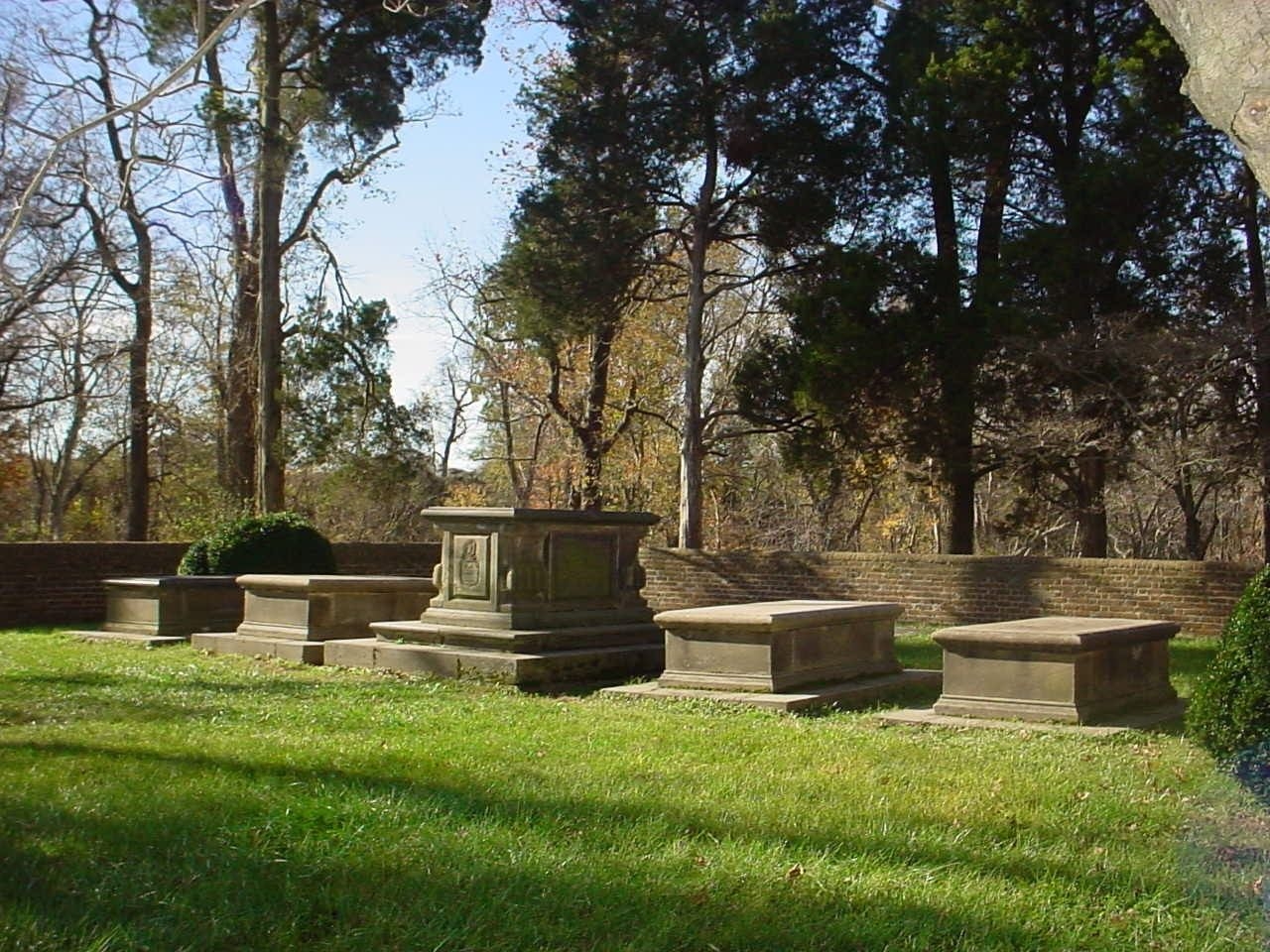
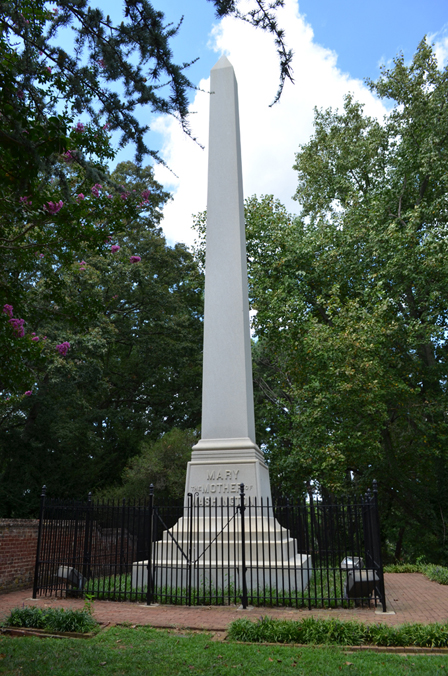
George Washington’s Tomb at Mount Vernon. Credit: Tim EvansonAugustine Washington, George’s father, is buried in the Washington Family Burial Ground at Popes Creek, where George Washington was born. Credit: National Park ServiceMary, George’s mother, is buried near The Mary Washington Monument on Washington Avenue in Fredericksburg, Virginia.
So, are any Washington family members buried at Ferry Farm? The only Washington buried here is George’s youngest sister Mildred, who was born shortly after the family moved to Ferry Farm in 1738, and died at only 16 months old. Her cause of death is unclear, but the infant mortality rate in the 18th century was far higher then it is today.
The topic of burials at historic sites like Ferry Farm can be both exciting and panic-inducing for archaeologists. In general, we are pretty well-versed in identifying grave shafts long before we reach actual human remains and measures are always taken to know as much as possible about where we are going to dig before we actually initiate an excavation.
Human burials leave telltale signs when they are accidentally disturbed if you are paying attention. When soil is removed from the ground and then returned during the digging of a grave, the now mixed composition of the soil doesn’t look the same as the undisturbed soil surrounding it.
In any case, how to approach the care of a burial site is a serious subject and a legal subject too. In Virginia, if archaeologists discover human remains, a permit or court order is required to continue the excavation. Once permits are in place, forensic archaeologists who specialize in excavating human remains are called in. They must determine if the burial is old or new, and whether or not we may have stumbled into a possible crime scene. Usually (thank goodness), there is no crime scene but a whole new can of worms is opened in determining what to do next.
We don’t know exactly where the remains of Mildred Washington are located on the Ferry Farm property. All we have to locate the burial site is a survey of the property conducted by George himself in 1771, where he uses “the little gate by the tombstone” as his beginning reference point to lay the boundaries of what George called “the fields where my mother lives”.
George Washington’s Map of “The Fields Where My Mother Lives” As Surveyed September 13, 1771 and Platted in 1932
“The Old Mansion of the Washington Family” (1833) by John Gadsby Chapman
Along with the survey is an 1833 painting by John Gadsby Chapman of the Washington property facing the Rappahannock River that shows foundation stones where the Washington House stood and, in the approximate location of the grave on George’s survey, the silhouette of an object that resembles an arched headstone.
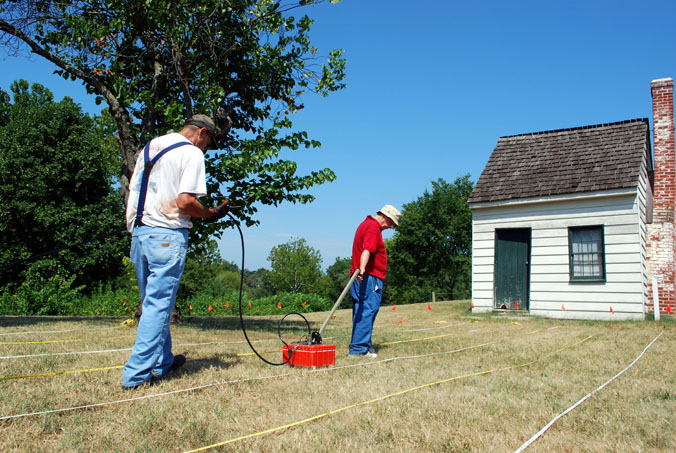
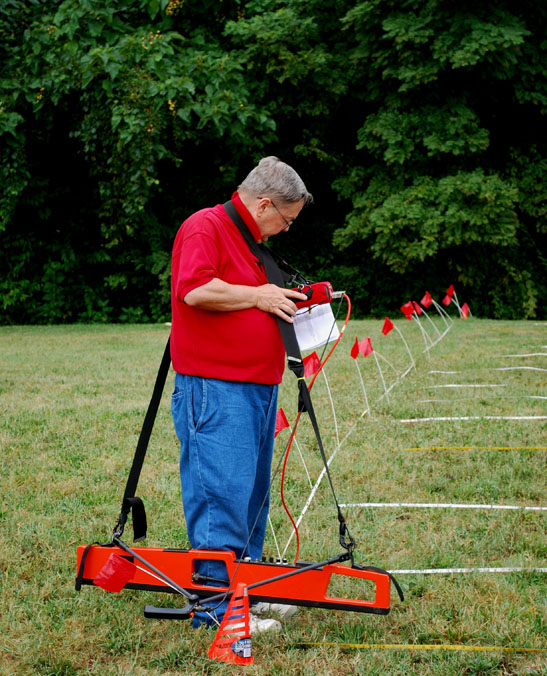
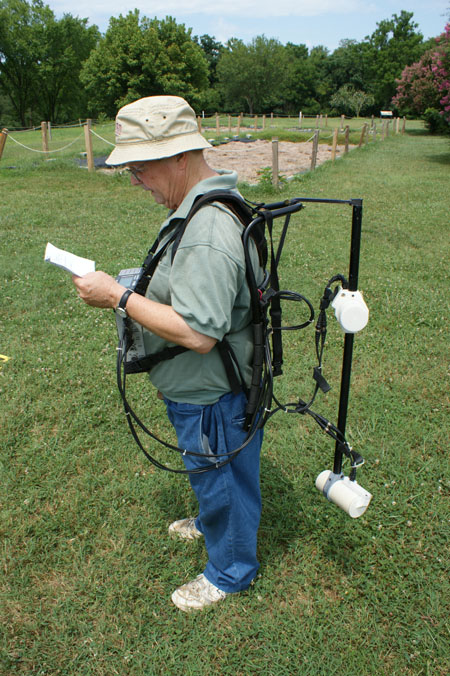
In 2009, we brought in experts to conduct a geoscientific study to assist in locating but not excavating the grave of Mildred. It would help the foundation planning effort if we knew where this important grave was located. William Hannah, Claude Petrone, John Imlay, and Dale Brown conducted non-destructive remote sensing surveys in and around the area identified in George’s 1771 survey. These remote sensing surveys included ground-penetrating radar (GPR), electromagnetic induction (EMI), and vertical magnetic-gradiometry.
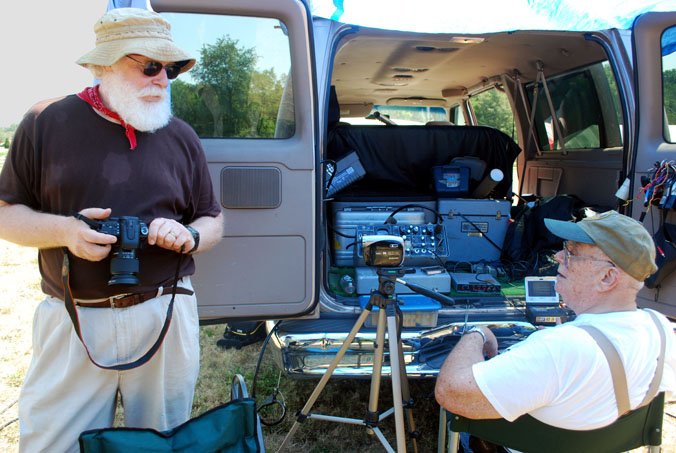
Ground-penetrating radar (GPR) survey of a portion of George Washington’s Ferry Farm conducted by Bill Hannah (R) and John Imlay (L).Dale Brown (L) and Pete Patrone (R) assisted with the GPR survey.
The researchers kept in mind that while finding Mildred’s grave was like searching for a needle in a haystack, there were some clues to hold onto while conducting the search. First, they considered the 1771 survey and the Chapman painting, and then they focused on the probable size of the grave. To prepare themselves for what kind of anomalies to look out for on their equipment, they looked at a modern growth chart for a 16 month old child. The composition of the container holding the body was also considered. It was determined the size of the anomaly should be around 29.25 to 33.25 inches in length, and though it had been 270 years, any iron elements such as coffin nails might be detected with these methods.
Ground-penetrating radar (GPR) uses electromagnetic radiation in the radio spectrum to reflect signals off of anomalies below the surface. In short, radar waves bounce off of objects of different densities in the ground, providing an image of differences in the surrounding area. You can see voids as well as objects. The image created comes back like this:
Electromagnetic induction (EMI) measures changes in electromagnetic fields, and the magnetic susceptibility of both metal and non-metal materials to provide a sub-surface image (below). The resulting image maps areas of more and less resistivity, revealing patterns and shapes that archaeologists can use to identify any possible features.
Bill Hannah begins an electromagnetic induction survey at Ferry Farm.
Vertical magnetic-gradiometry senses total magnetization of ferrous (iron) materials and produces imaging similar to EMI, but using just magnetization instead of electrical conductivity. Patterns and shapes that archaeologists recognize are still present.
Bill Hannah conducted a magnetic gradiometry survey of Ferry Farm.
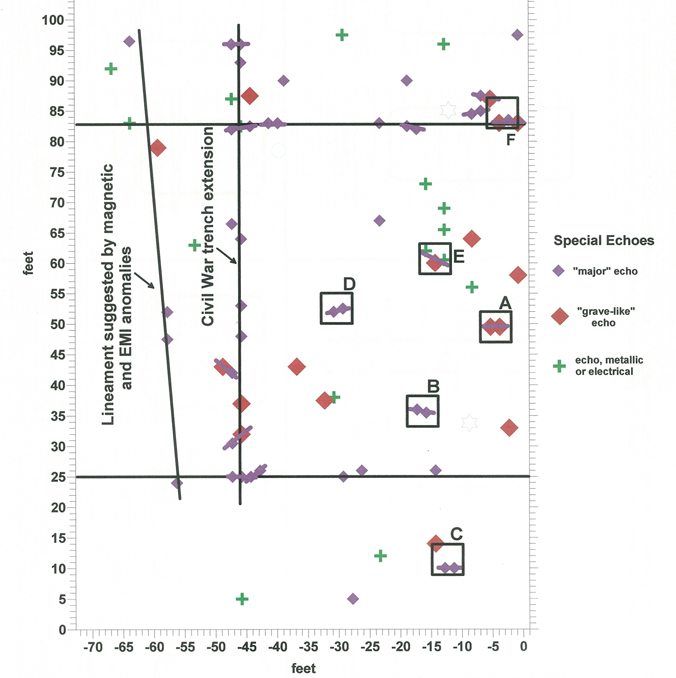
Once plotted on a map, there were a few areas in the expected region that had “grave-like” qualities based on the 2009 remote sensing survey.
Diagram from remote sensor survey report shows “grave-like” echoes.
Armed with evidence from surveys old and new, we theorize that this area is the possible location of Mildred Washington’s grave. But without a full excavation, we can’t be certain if this is Mildred’s gravesite, or if this area even contains a grave at all. Conveniently shaped anomalies can throw off researchers, but these geophysical surveys provided useful evidence. There are indeed a few anomalies that are the right length, width, and depth of a grave for a young child. We have not conducted any ground-truthing, or surveys that involve coring or probing the ground, nor have we dared to move dirt in this area for fear of disturbing Mildred’s final resting place. The area remains undisturbed, even while the surrounding excavations and the construction of the replica Washington House took place from 2016 to 2018. Due to the destructive nature of archaeology, avoiding the grave site is best for now, and there are no plans to disturb or excavate the area.
Elyse Adams, Archaeologist
Co-Field Director / Archaeology Lab Technician
Fredericksburg is famous for its colonial and Civil War history – but what about before that history? Decades of archaeological excavations at George Washington’s Ferry Farm have revealed millennia of human development and technology from pre-historic Native American Clovis spearpoints to 18th-century wig curlers and beyond. While our main focus rests on young George Washington’s story, nearly 25% of all artifacts ever found at Ferry Farm have actually been Native American in origin with many dating thousands of years into the past. Here are five cool ancient artifacts found at Ferry Farm…
Jasper Drill: The above is the tip of a jasper drill. It may have been adapted from a spear point, which was not uncommon. When a spear point broke or became too short from re-sharpening sometimes they were turned into other tools. This particular drill likely dates to around 8,000 BCE to 6,000 BCE.
Clovis Point: Also, jasper, this spear point (shown above) is our oldest artifact and dates to between 13,500 BCE – 11,000 BCE. To learn more about it, visit our previous blog post here.
Ground Stone Axes: These two axes (depicted above) were found together. They’re made of Catoctin metabasalt, which is also often called ‘greenstone’. They were in use from 3000 BCE – 1000 BCE.
Mystery Bead: This large partial bead (shown in the two photos above) is a bit of a conundrum. It’s made from non-local sandstone and is heavily weathered. To further the mystery, it was found with the stone axes discussed above and the chunkey stone discussed below, leaving us to believe these artifacts were part an amateur archaeologist’s collection and may not have been brought here by people indigenous to Virginia.
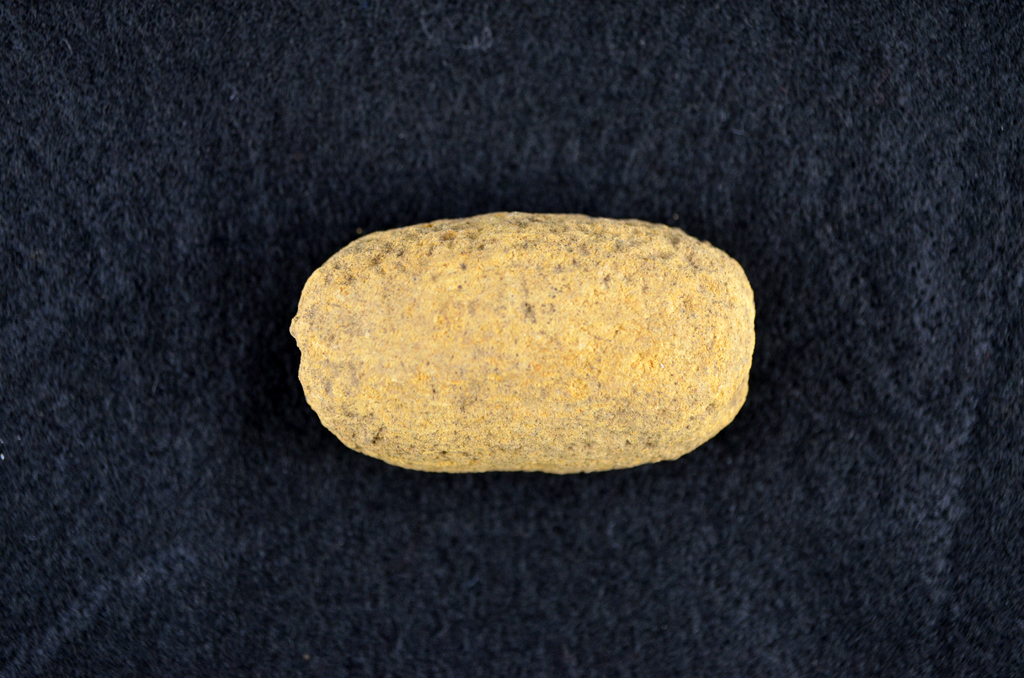
Chunkey Stone: The doughnut-shaped stone (in the above photo) is made from quartzite and is part of a game called chunkey which was invented around 600 CE. To learn more about our chunkey stone, check out our recent blog post here.
See these and other artifacts during ArchaeoFest: Exploring Ancient Techology at Ferry Farm this Saturday, October 26 from 10am-4pm. Enjoy a family-friendly day focused on early human technology! Scheduled demonstrations by members of EXARC, a global network of experimental archaeology professionals and other experts, include flint knapping, throwing spears using atlatls, making Viking glass beads, 18th century stone carving, and much more. Experimental Archaeology demonstrations begin at 11am. Dive into hands-on activities like an archaeological dig, see a sampling of the thousands of Native American artifacts excavated at Ferry Farm, and visit with members of the Patawomeck tribe. Admission is $9 for adults, $4.50 for students, and free for under age 6. To learn more, visit ferryfarm.org.
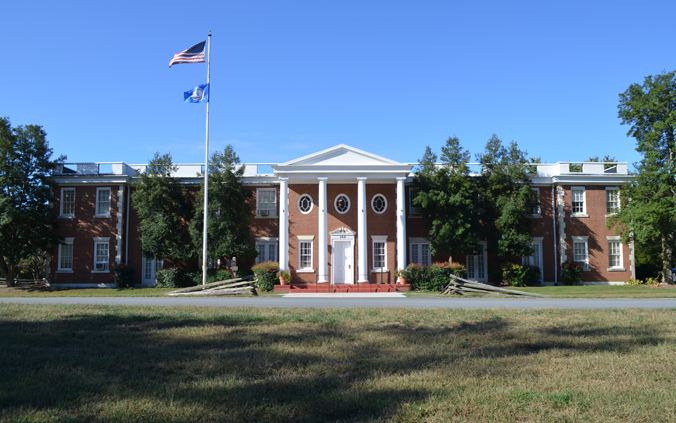
The Visitor Center at George Washington’s Ferry Farm is a lovely red brick colonial revival building with towering white columns and cool architectural details built in the 1960s. What’s not to love? The only problem with having a 20th century building that looks like it could be from the 18th century is that people who visit sometimes assume our visitor center is actually Washington’s boyhood home, a mistake that’s easy to make. Even though our building dates from just 50 years ago, it does have its own fascinating history. Here is the tale of this often misunderstood yet beloved structure.
The Colonial Revival-style exterior of the Visitor Center at George Washington’s Ferry Farm.
In the 1950s, The George Washington’s Boyhood Home Restoration, Inc. (GWBHR) owned Ferry Farm and was dedicated, as many groups had been before, to transforming the property into nationally-renowned historic site dedicated to the young life of the first president.[1] By the end of the decade, the group’s hopes had dimmed and, in 1961, board member “Joe Zenker . . . brought Ferry Farm to the attention of Youth for Christ International” (YFCI).[2]
Youth for Christ emerged out of a series of Christian youth rallies centered in Chicago during the Second World War.[3] By the 1960s, the organization’s Lifeline ministry was working with social welfare services to help children deemed troubled, disadvantaged, or as having difficulties living in foster homes.[4]
Youth For Christ was interested in Ferry Farm as the location of a boys home and initially hoped to purchase the site from GWBHR but that was not to be. Instead, a YFCI majority was placed on the GWBHR’s board and they launched their plan to build the home.[5] It was hoped that by living where Washington grew up the young men would “develop character . . . and become leaders in our country.”[6]
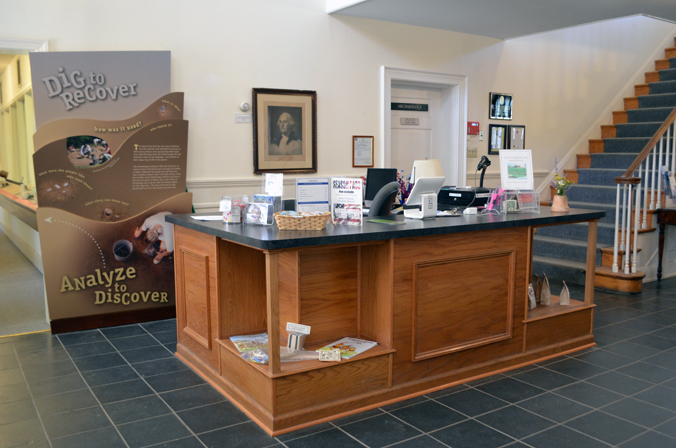
A visit to Ferry Farm begins at the welcome desk inside the Visitor Center.
By 1962, Youth For Christ was using an existing farm house on the property called the “Colbert House” after the family who built it in 1914. Paul Millikan was placed there to curate the George Washington Museum on the first floor and to function as YFCI’s on-site representative while a suitable boys’ home was constructed.[7]
The architects hired to design the boys’ home were Robert Sully and Stephen Oppenheim. They envisioned a large Colonial Revival structure with a formal symmetrical garden on the grounds. Construction of the home was started in fall of 1965 by Nice Brothers Inc. of Newport News, Virginia and was completed by January 1966.[8]
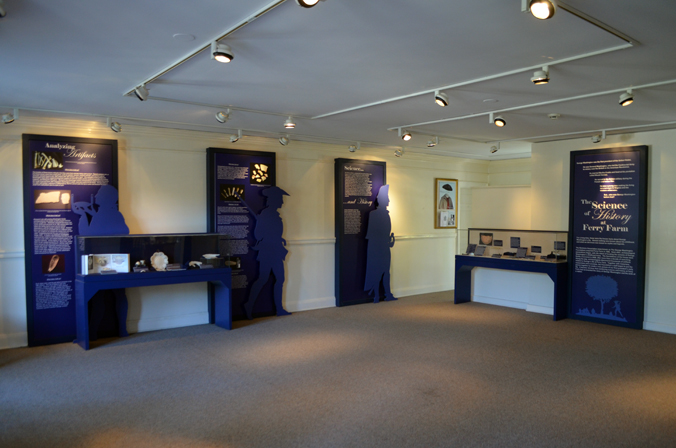
A museum gallery in the Visitor Center displays artifacts excavated by archaeologists at Ferry Farm and panels chronicling George Washington’s boyhood and the construction of the Washington house replica.
By the fall of 1966, boys were living in the house and spent time “taking meals, being bussed to local schools for class, performing chores, working on homework, and participating in recreational activities.”[9] There was time for play as well. Archaeologists have excavated toys and game pieces such as “Hi-Ho Cherry-O” cherries throughout the property. Whether or not these games were provided as a reminder of Washington’s youth and the myth of the cherry tree is unknown, but it is certainly possible that this game was part of YFCI’s plan to evoke Washington ideals even through play.[10]
While the local community donated food, gasoline, and household items, these gifts did not provide funds to address the house’s mortgage payment. The live-in house parents at the time, Gilbert and Kathe Nichols, were critical of this lack of involvement as seen in The Free-Lance Star on February 16, 1968:
Frankly disappointed in support the home has received here, the Nichols say their critics are honest in wanting to know why the home needs money and how it can expect local aid when it refuses to take local boys into its care…. All monetary contributions must, in the home’s financial arrangements, go toward the mortgages, [Gilbert] Nichols says. Support money from the court and a small income from the George Washington Boyhood Home shrine go toward operating expenses. . . . Nine of the 10 boys living at GWBH now are from Virginia, but not from Fredericksburg or nearby counties. And the fellows are mainly ones who need a new environment to get on the right track in society. This is why local boys aren’t accepted. Too close to home and old peer groups, boys wouldn’t feel the impact of the normal, yet professionally guided life.
As former director of the home Gary Foss recalled, Fredericksburgers probably expected a large, well-funded national group like Youth for Christ to fully fund the house. The sizable mansion-like building itself surely exacerbated this feeling.[11] Moreover, its appearance confused visitors, who mistakenly thought it to be George Washington’s actual boyhood home.[12]
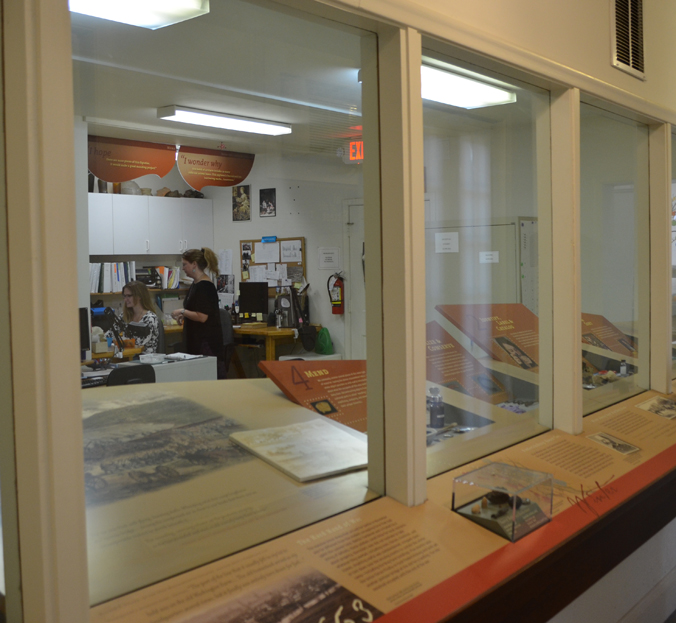
Visitors may watch archaeologists analyze artifact findings through these windows that look into the Archaeology Lab in the Visitor Center.
Faced with growing debt on the new building as well as day-to-day costs, YFCI sold access rights to the southern portion of Ferry Farm to be used to quarry stone for gravel to form the roadbed of I-95.[13]
Operations at the boys’ home ceased in the summer of 1968 because a fundraising drive by Youth For Christ to keep the home open was not successful. On August 2, 1968, The Free-Lance Star reported that “The George Washington Boys’ Home in Stafford County is being closed after more than two years of operations. . . . The phase-out marks the end of a dream for Youth for Christ, Inc.”[14] By 1969, there were no longer any boys living at the George Washington Boys’ Home.
The office of a member of the museum education staff in Ferry Farm’ s Visitor Center.
On March 27, 1969, Samuel and Irma Warren bought the property containing both the historic area and the closed Youth for Christ boys’ home.[15] The Warrens rented out the boys’ home building to a variety of religious groups.
The first tenant was the Fredericksburg Bible Institute and Seminary and the related Crossroad Baptist Church. The institute, founded by Dr. George Albert Brown, Jr., moved into the building on the first day of January 1970 while, later in the decade, Brown’s newly formed Crossroads Baptist Church met for three years in the building. In 1981, the church and institute vacated the property to move into a new building in Fredericksburg.[16]
The Warrens’ next tenant was Calvary Chapel starting in 1985. Three years later, Calvary tried to use the building once more as a foster home for teenage boys. Six boys, ranging in age from 12 to 18 years, were placed in the home called Samuel House. This effort lasted only two years and was the final attempt by anyone to make Ferry Farm into a residential youth home. Calvary Chapel did continue using the building for church services until 1995.[17]
Today, the boys’ home building serves as the Visitor Center for George Washington’s Ferry Farm and houses the Archaeology Lab and staff offices for The George Washington Foundation, which has operated Ferry Farm as well as Historic Kenmore as historic sites together since 1996. This is the building where your visit to Ferry Farm and the newly built Washington house replica begins and we hope to see you soon!
Sasha Erpenbach, UMW student
Fleming Smith Intern
[1] Rebekah K. Wood, “History of the Visitors Center Building, George Washington’s Boyhood Home at Ferry Farm,” The George Washington Foundation, October 15, 2010: 1.
[2] Philip Levy, Where the Cherry Tree Grew: The Story of Ferry Farm, George Washington’s Boyhood Home, New York: St. Martin’s Press, 2013: 169; Wood, 1.
[4] Oral History with Gary Foss, January 18, 2008. Interviewers: Melanie Marquis and Rebekah Wood. The George Washington Foundation Oral History Project, The George Washington Foundation, Fredericksburg, VA: 2, Deyo, 8.
[7] Wood, 3; Oral History with Paul Millikan, Jay Kessler, Bruce Love, and Gary Foss, July 1, 2008. Interviewers: Melanie Marquis and Rebekah Wood, The George Washington Foundation Oral History Project, The George Washington Foundation, Fredericksburg, VA: 22.
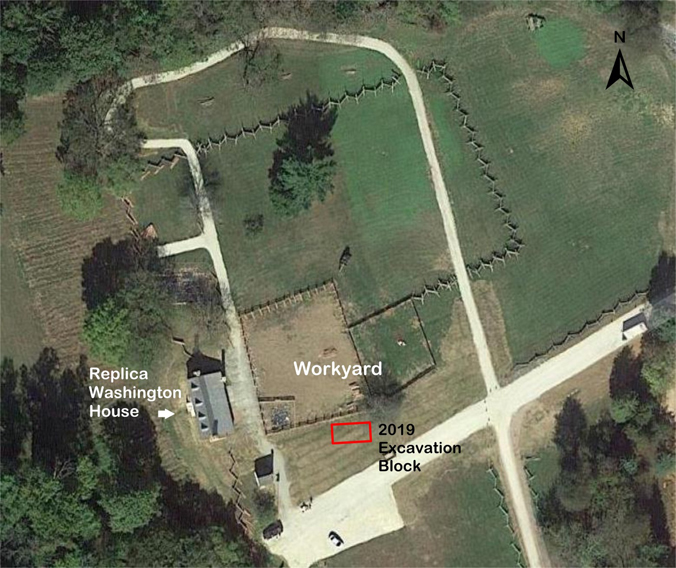
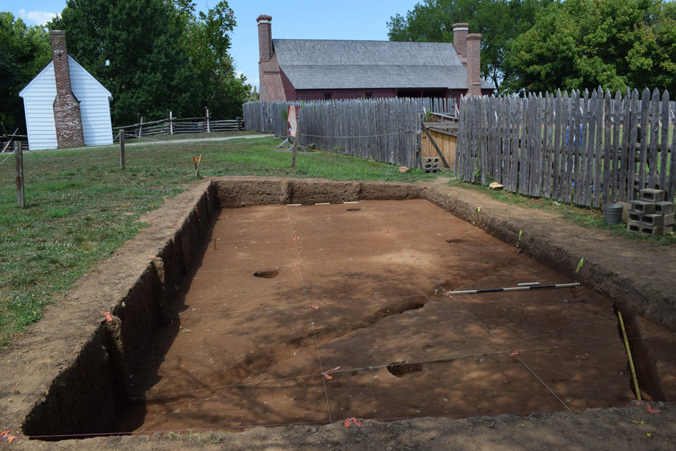
From late May through early August of 2019, archaeologists at George Washington’s Ferry Farm were busy working in the field again, excavating a block of 18 5’x5’ units located on the east side of the Washington house. It’s not obvious today, but the area directly to the south and west of our 2019 block had previously been excavated between 2008 and 2018 down to sterile subsoil and back-filled with dirt. The grass grew back, leaving no signs of this previous activity, but the concentration and variety of artifacts found indicated something was going on in this area of the site when the Washington family was living here in the 18th century. This didn’t surprise us all that much though, as this area was the “workyard” of the Washington house, where most of the daily activities related to the running of the household were taking place.
Location of 2019 excavation block near the Washington house site.
You might remember from last season’s dig blog, that we excavated the “north yard” of the house, which was visible from Fredericksburg, the river, and the ferry landing during the 18th century. Our excavations last year concluded that the north yard was actually quite clean of artifacts (garbage) and features, suggesting people valued the aesthetic look of this area and kept it very orderly and free of daily activities – likely because it was visible to the entire town across the river. In direct contrast to this clean space is the workyard – the fenced areas located behind the house. The workyard is where the daily household-related activities such as cooking, laundering, and dairying took place. Corresponding structures such as a kitchen, storage sheds, smokehouse, and temporary work spaces, were located here and doubled as living quarters for the enslaved people who worked in these spaces. With all these activities happening within this outdoor space, it’s not surprising that archaeologists have found an abundance of 18th century artifacts in this area over the years.
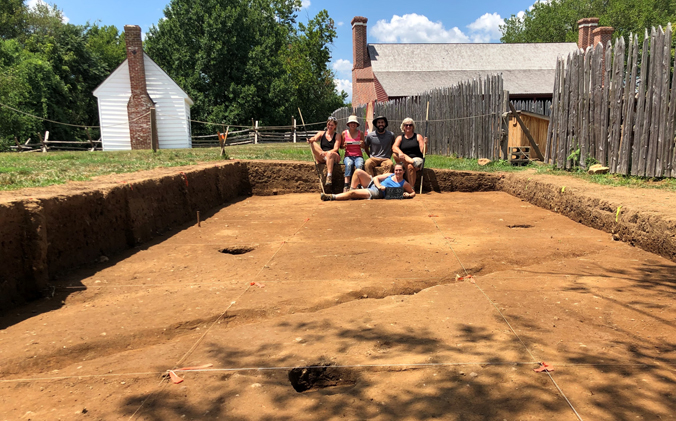
The 2019 dig crew: (L-R) Elyse Adams, Sarah Perdue, Frank Amico, Judy Jobrack and (front) Lizzie O’Meara.
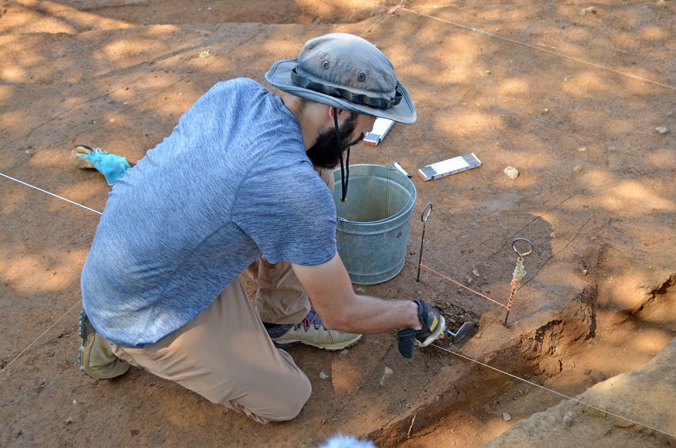
The 2019 dig crew consisted of two field directors — Judy Jobrack and Elyse Adams — and three archaeologists — Frank Amico, Lizzie O’Meara, and Sarah Perdue. For a total of 11 weeks our five-person crew slowly excavated thin layers of dirt in the 15’ x 30’ block in search of evidence of activity areas and outbuildings related to the workyard. Our approach to excavating the area was to take down all the units in the entire block at the same time — removing all the 20th century layers, then the 19th century layers, and so on — instead of taking each individual unit down to the subsoil. This would allow us to view any related features, such as building foundations or post holes, at the same time.
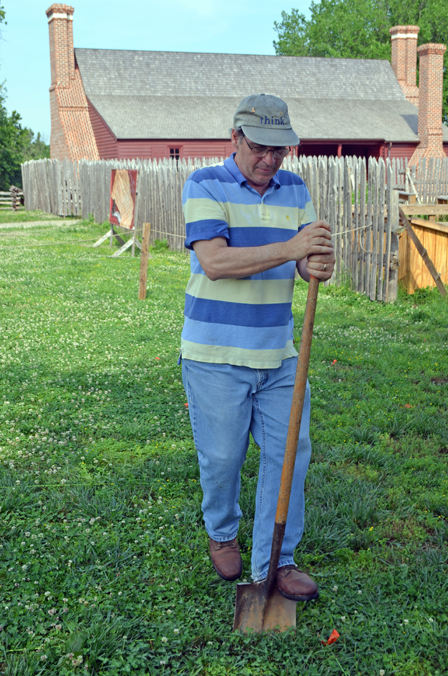
Dave Muraca, director of archaeology at Ferry Farm & Kenmore, lends a hand in getting the excavation block started.
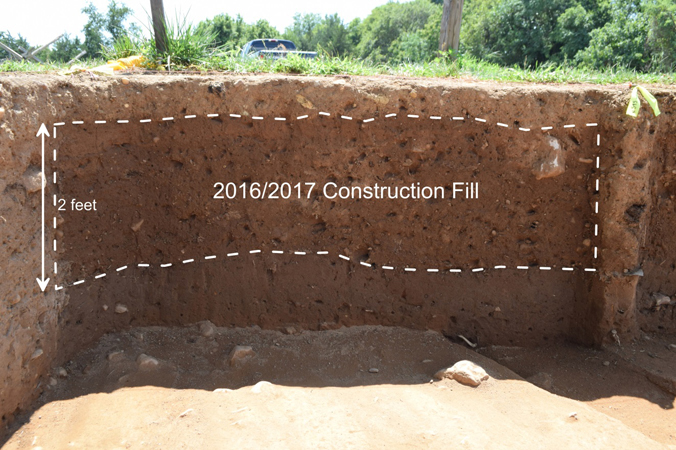
The dig started with the removal of the grass and topsoil layers from all eighteen units. To our surprise, we were greeted with an obstacle that measured between 6 inches and 2 feet deep across the entire block. Remember the 2016-2017 construction of the Washington house? Well, as with any large project, there was a lot of disturbance to the surrounding lawn by vehicles and construction activities. A significant layer of dirt and gravel had to be laid down to grade the landscape and gravel access road leading up the house. It happened only two years ago, and yet we completely forgot about this fill activity! We dug this disturbed layer out with shovels and pick axes without screening the dirt until we revealed the 2016 grass and topsoil layers. Two weeks after starting, the real dig began.
Two feet of construction fill layer as seen in the sidewall of an excavated unit.
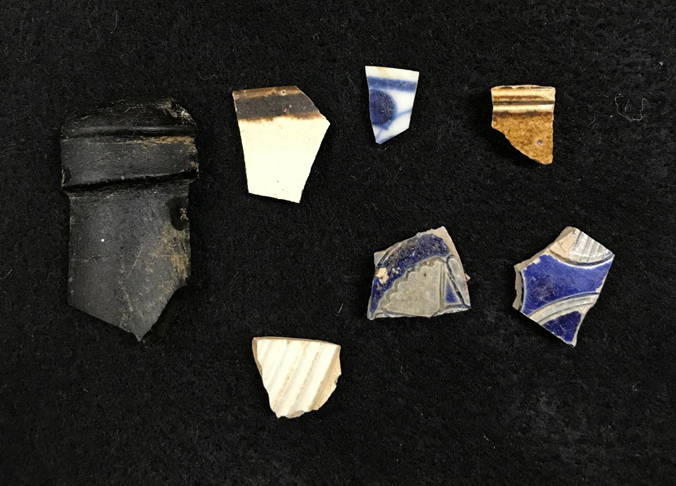
The number of artifacts we found, especially those dating to the 18th century, was not disappointing. Ceramics such as Whieldon, tin-glazed earthenware, Westerwald, and white salt-glazed stoneware were abundant in the area, as were various types of redwares and stonewares typical to food storage and other utilitarian purposes. Other colonial-era artifacts included wrought nails, tobacco pipe stem fragments, and a total of 12 wig hair curler fragments. The amount of 18th century-dated artifacts definitely overshadowed the number of 19th and 20th century artifacts in the area.
FF30 block during excavation.
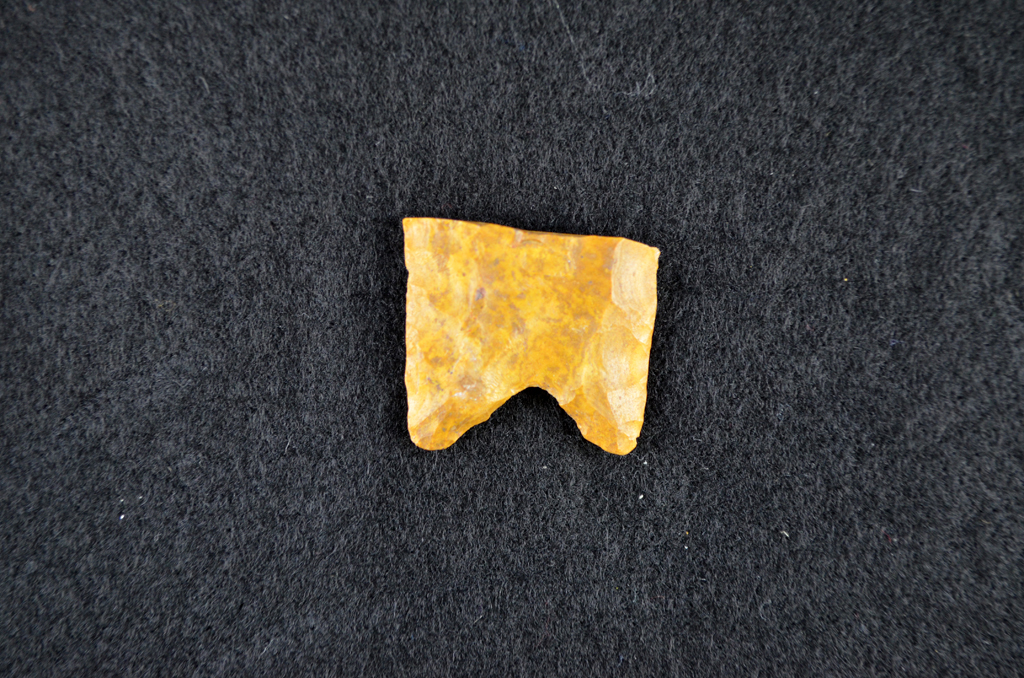
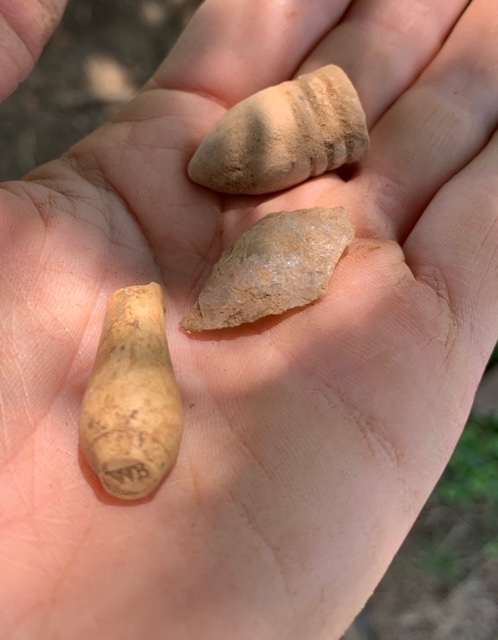
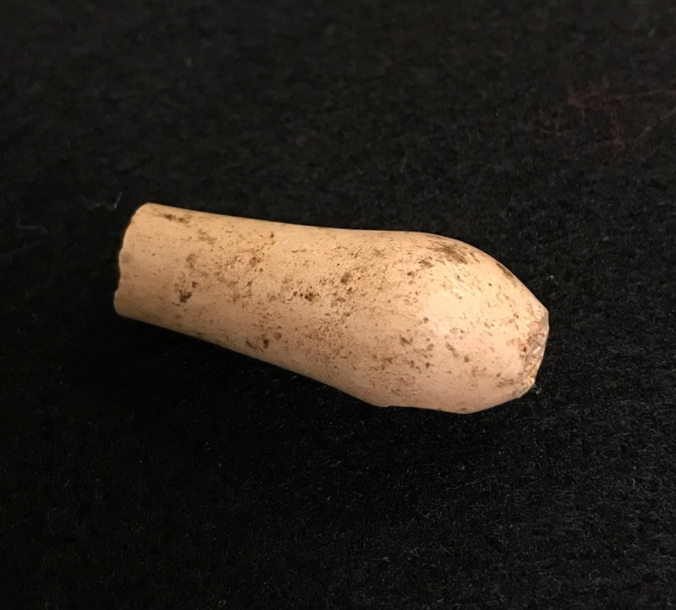
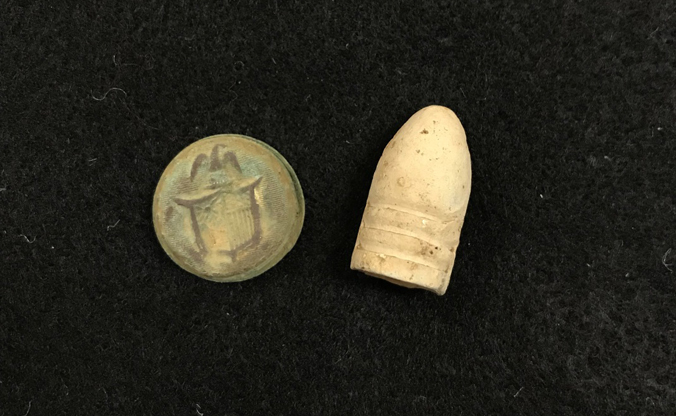
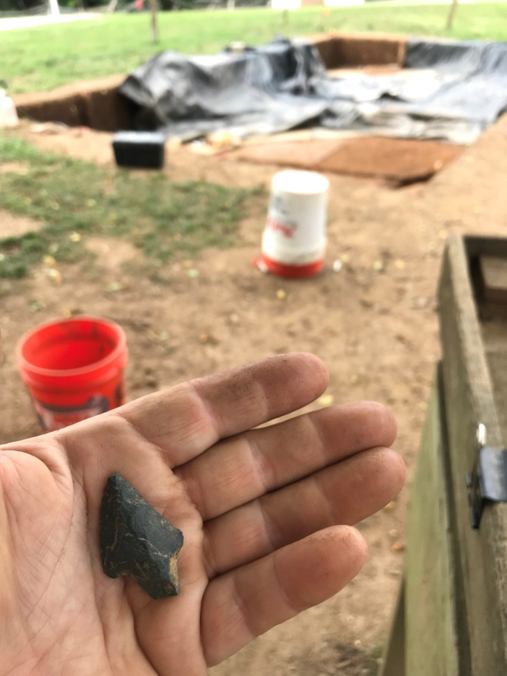
18th century ceramics and a wine bottle neck found this summer.Wig curler fragment found this summer.Civil War uniform button and Minié ball found this summer.Projectile point found this summer.
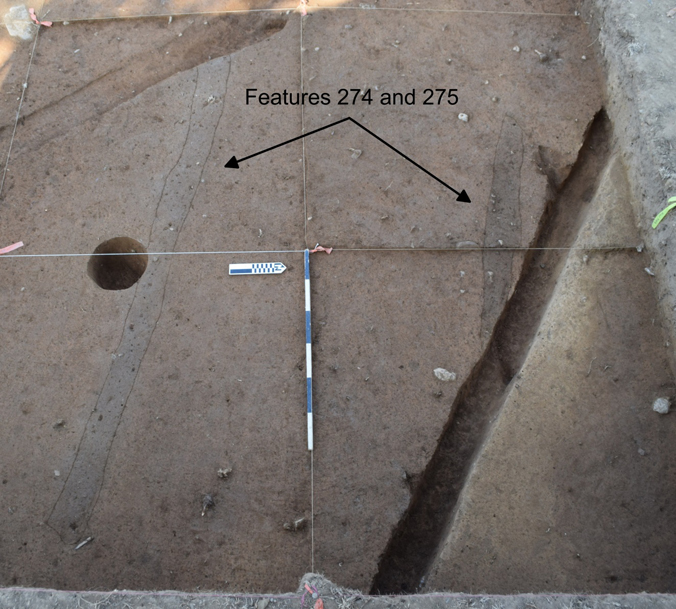
In addition to artifacts, a number of 18th-century features were uncovered, including the “rut-like” parallel linear features (F274 and F275) in the photo below. Figuring out what these and other features found in the 18th century layers may be will take place over the coming months.
Two parallel, linear 18th century features.
The excavation ended on August 9th within the 18th century level, and the site was covered by a tarp until next year. The 2020 season’s dig will continue excavations in this block until subsoil is reached, but will also expand by opening more 5’ x 5’ units to the north. After washing, researching, and cataloging the thousands of artifacts recovered this season, our staff will have a clearer idea of what activities were going on in this part of the work yard, so that we can reconstruct these areas accurately as we did the Washington house itself. It’s going to be a busy winter for the lab staff while we put together the pieces of the workyard puzzle.
Judy Jobrack, Archaeologist
Co-Field Director / Assistant Archaeology Lab Supervisor





 The summer of 2019 was an especially hot one here in Virginia, but we managed to add some cool crispness to the Washington house interior. It came in the form of some new textiles for the “best bed” in the Hall Back Room, in a refreshing blue and white color scheme. As we’ve previously discussed