Lives and Legacies

Tag: Fielding Lewis

  • Meet the Lewis Family: John and Fielding Jr.

    Fielding Lewis was married twice.  He and Catharine Washington, his first wife, had three children: John, Frances and Warner.  Both Warner and Frances died leaving John as the sole heir from this first marriage.  After Catharine’s death, Fielding married Betty Washington, and not quite a year later Fielding Lewis Jr. was born in 1751.  Although just 4 years younger than his half-brother John, by rights at that time, Fielding Jr. could have supplanted his older brother as Fielding Sr.’s primary heir.  No personal accounts or letters tell us what Fielding Sr. thought about his two eldest sons’ status as heirs to his estate but his actions in the years after their births are telling.


    In 1775, Fielding Lewis commissioned five portraits by American artist Charles Willson Peale, for his newly completed home at Kenmore.  Only two have been located and they are of Fielding’s two eldest sons.  Peale scholars feel fairly certain that the works were painted as companion portraits, intended to hang side by side with the poses of the two sitters meant to complement one another.  Perhaps Fielding was making a visual statement that his two eldest sons were on equal footing and that neither took precedence.  Indeed, in his final will and testament, Fielding provides for both sons equally, giving his Spotsylvania lands to John and his Frederick County lands to Fielding Jr.  On the surface, it might appear that the two brothers had an amicable relationship, not marred by the usual 18th century family in-fighting over inheritance.  Well, that appearance might not tell the whole story.  The half-brothers couldn’t have been more different.

    As early as 1769, Fielding Sr. worried about Fielding Jr’s management of his finances.  The 18-year-old had recently married Nancy Alexander, the daughter of a prominent household in Alexandria, Virginia.  Nancy apparently came to the marriage with a sizeable fortune and Fielding Jr. immediately set about spending it.  In September, both Fieldings wrote to George Washington, to ask his assistance with the Alexander money.  Fielding Jr. wrote his uncle, “Inclos’d you have an Order on Mr. Robart [sic] Alexander for the Balance remaining…of my Wifes Fortune which I shall be Oblig’d to you to receive for me, and purchase Slaves to the amount thereof…” His letter is enclosed in one written by his father, in which we learn a little more about Fielding Jr.’s request to his uncle.
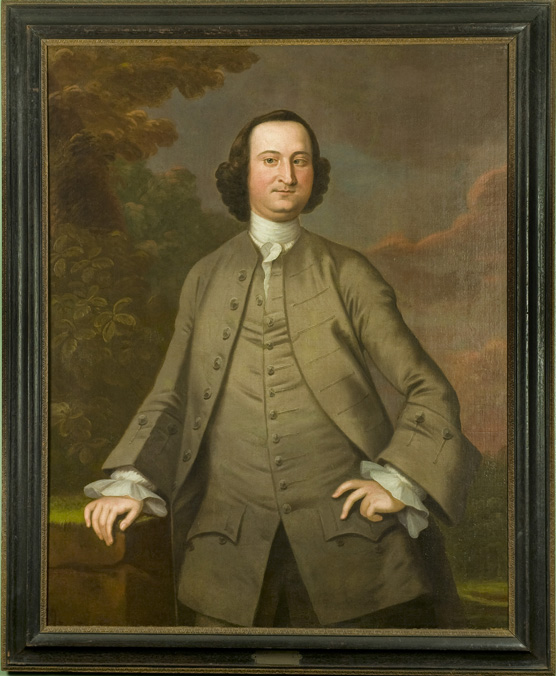
    fielding-lewis-sr-1750s-by-john-wollaston
    Fielding Lewis, Sr. (c. 1750s) by John Wollaston

    Fielding Sr. revealed that Mr. Alexander was concerned at the rate with which Fielding Jr. was spending the money, and has asked Fielding Sr. to take the remainder and use it for something that would help the couple in the long run.  Fielding Sr. went on to say, “I am allmost [sic] certain that he will in a year or Two spend every Shillg as I cannot perceive the least amendment since his Marriage, nor has he the least regard to any advice I give him.” This statement seems to indicate that Fielding Jr.’s spendthrift ways existed prior to marriage and worsened with the influx of his wife’s money.

    Unfortunately, Fielding’s prediction would prove true.  Over the next decade, Fielding Sr. paid his son’s debts time and again, while Fielding Jr. continued to make significant purchases on credit.  Eventually, Fielding Sr.’s burden would be passed to John Lewis.

    Fielding Lewis passed away in 1781.  John Lewis remained in the Fredericksburg area, acting as executor of his father’s estate, and seeing to its myriad debts and complicated business transactions.  He oversaw operations on the lands left to him, and assisted his step-mother, Betty Lewis, in maintaining Kenmore, which would become his upon her death.  He wrote on several occasions of tight finance, and frustrations with his father’s estate but managed to hold it all together.

    His brother Fielding (who dropped the “junior” from his signature following his father’s death), was not managing so well.  He, his wife, and their three children were living on the Frederick County property that he inherited.  His debts were so severe that, by 1784, he was in debtors’ prison and again turned to his famous uncle for help.  In order to bolster his case for being worthy of Washington’s assistance, he sent a collection of letters from his father prior to his death that outlined his plan to save his son from the debt of his “youthfull Folley [sic].”  Fielding wrote, “Since which it has pleased God to take him out of this transetorey [sic] life, before he had Completed his Intention, tharefore [sic] I have taken the Freedom and liberty, of beging you to Assist me…for what Evor Sum or Sums you will be Able to lend me…as Nothing I think in this life So disagreeable as to be drag’ed About by the Sherrifs [sic]…Which Situation I am in at present…”
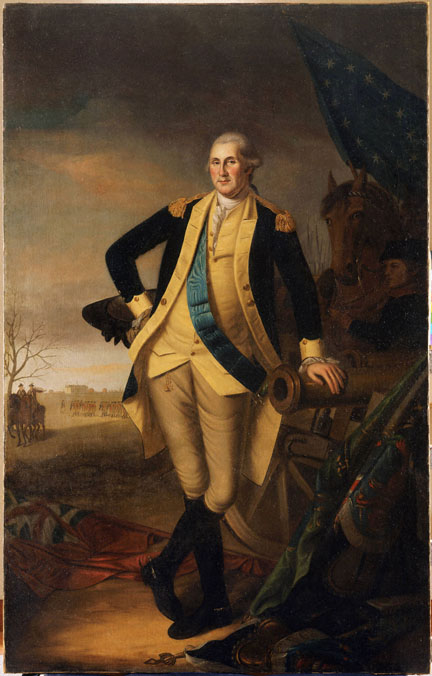
    george-washington-c-1779-by-charles-willson-peale
    George Washington (c. 1779) by Charles Willson Peale

    Washington gently rebuffed his wayward nephew, replying that he had his own debts and there was little money to spare.  He made a pointed statement at the end of his short letter, perhaps indicating that he didn’t fully believe Fielding was the victim of his own youthful folly. He wrote, “There was a great space between…when you were called upon by your Father for a specific list of your Debts and his death: How happened it, that in all that time you did not comply with his request?” Indeed, receipts in our archives show that Fielding commissioned a new carriage to be made for him in August of 1784, just one month before he was sent to prison.  He would not pay for the carriage until a suit was filed against him two years later.[1]

    As Fielding was seeking help from his uncle, John was planning one of many trips to “the Westward” as he called it – the Western frontier, and Kentucky in particular.  His first expedition to the Kentucky territory was on behalf of his father, before the Revolution, when Fielding Sr. was considering a land purchase there.  Apparently, John fell in love with the country, and returned many times in the coming years, making several land purchases of his own.  His uncle George asked him to act as his agent on several of these trips, to assess the state of Washington’s own property near Pittsburgh.

    While Washington was placing increasing trust in John, he had apparently lost faith in Fielding Jr.  By 1786, Fielding had been released from prison but had lost all of his inherited land in Frederick County.  He and his family were living on a lot in Fauquier County and were attempting to build a house.  Once again, Fielding asked for assistance.  Washington’s response was not as gentle this time, replying, “Altho’ your disrespectful conduct towards me, in coming into this country & spending weeks therein without ever coming near me, entitles you to very little notice or favor from me; yet I consent that you may get timber from off my Land in Fauquier County to build a house on your Lott…”  Despite his sharp words, he still agreed to help.

    Fielding’s improved situation was short-lived.  His wife Nancy died in 1788.  Fielding remarried to Elizabeth Dade, who apparently did not bring a fortune to the union, and so the 1790s would be a rough decade for Fielding.  He was returned to debtor’s prison in 1790, and found that there was no one in a financial situation to save him, with the exception of his brother John.  John, however, was not willing to give him money outright.  Instead, he required that Fielding mortgage everything – slaves, housewares, livestock – in exchange for £1200.[2]  One senses the family losing patience with Fielding.

    In 1792, Fielding was again incarcerated for debt, and this time there was no home for his wife and children, who went to live with Betty Lewis at Kenmore.  Betty wrote to her brother George about the situation, “I am sorry it will not be in my Power to advance any, haveing at this time three of my Grandchildren to support, and god knows from every Account but I may expect as many more shortly, Fielding is so distrest that his Children would go naked if it was not for the assistance I give him…”

    After this disastrous turn of events, Fielding’s whereabouts for the rest of his life become murky.  He never again owns property, and most likely stayed with various family members, including John.  His children remained with Betty at Kenmore.  There may have been little contact between Fielding and his children, as indicated in a letter written to him by his brother George informing him of Betty’s death in 1797. George wrote, “You will no doubt be anxious to know what is to be done with poor little Nancy (Fielding’s daughter), she is in good health, and at present with sister Carter…”[3] It is unknown where Fielding was when George sent him this letter.

    After Betty’s death, John moved quickly to sell Kenmore.  Although it would take several years, he did eventually save enough money to move his family to his land in Kentucky, where he spent the rest of his life.  Perhaps the family obligations and strain of his father’s estate made Kentucky a more appealing home than Fredericksburg.  While Fielding Lewis Sr. wanted very much for his two eldest sons to be seen and treated as equals, their lives played out in very different ways, and that’s the real story behind the portraits.

    [1] Fielding Lewis Jr. to Richard Simcock, 15 January 1786.  The George Washington Foundation Manuscript Collection.

    [2] Indenture Between Fielding Lewis Jr. and John Lewis, 20 March 1790. The George Washington Foundation Manuscript Collection.

    [9] George Lewis to Fielding Lewis Jr., 31 March 1797. The George Washington Foundation Manuscript Collection.
  • The Man on the Ceiling: Neoclassical Decorating at Kenmore

    As with many things at Historic Kenmore, the reasoning behind the choices Fielding and Betty Lewis made for their masterpiece of a house remain a mystery to us.  Why are Aesop’s Fables the subject of the decorative plaster overmantel in the Dining Room? Why is there an old-fashioned paneled wall in the Chamber? Why did they cover the expensive Drawing Room wallpaper with artwork but didn’t hang any art in the Dining Room? We’ll probably never know why they made most of these choices…but it’s pretty fun to speculate!

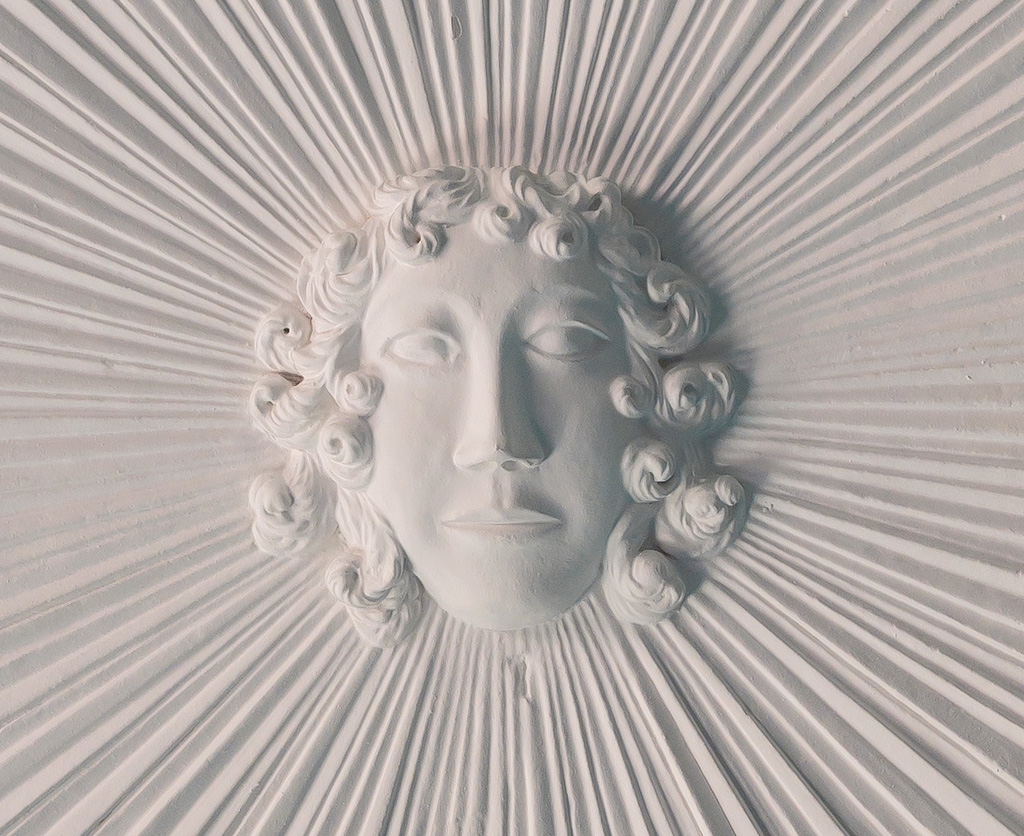
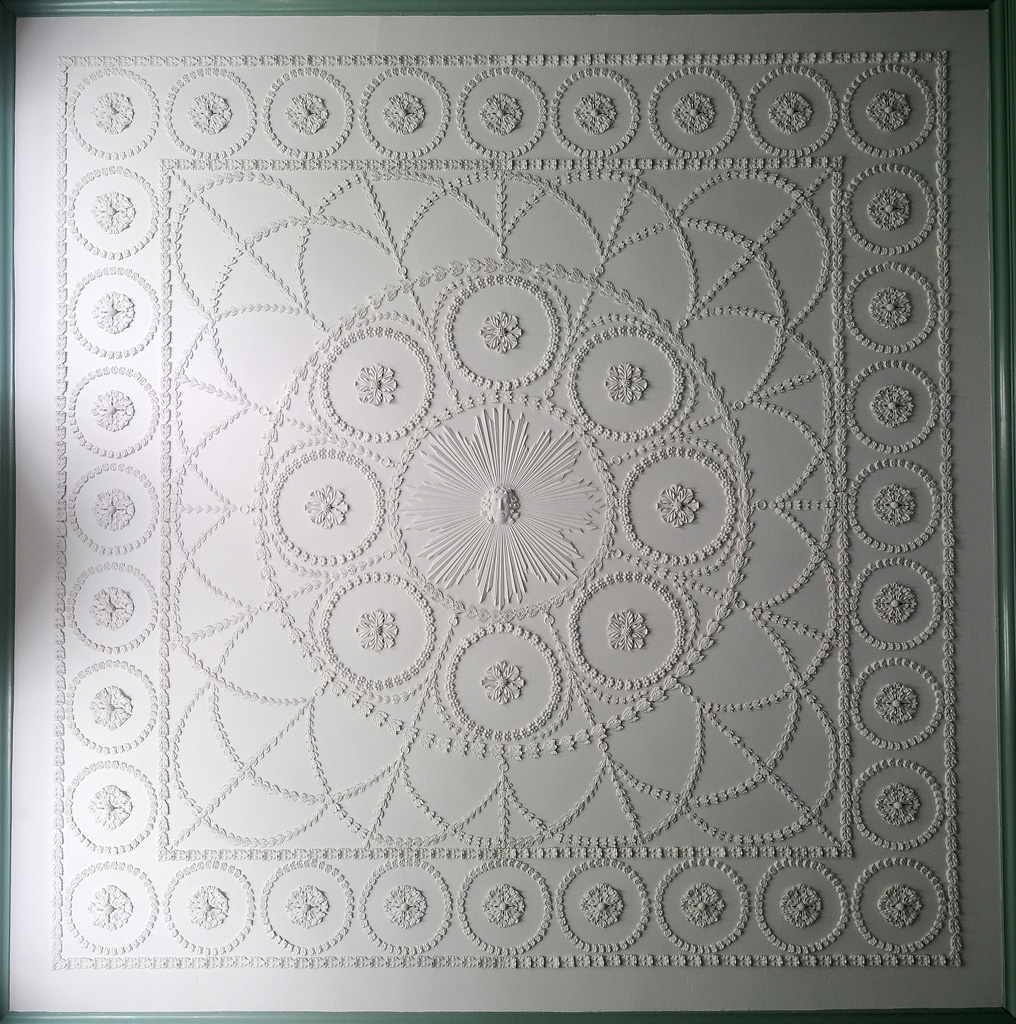
    One such stylistic choice is at the center of the plasterwork ceiling in the master bedchamber.  Visitors to Kenmore may recall the man’s face surrounded by rays or beams of light depicted there.  It is believed that this man is Apollo, the Greek god, and that the light beams emanating from his head, in this case, indicate that he is being depicted as Apollo the Sun God (one of many titles attributed to him).

    apollo-on-chamber-ceiling
    Apollo on the ceiling of the master bedchamber at Historic Kenmore.
    chamber-ceiling
    The entire bedchamber ceiling with Apollo at the center.

    When asked, we usually give visitors a fairly simple explanation for his position on the ceiling, something along the lines of “Apollo was a common symbol of the neoclassical style which was a popular decorating theme at the time.” That’s very true.  In the mid to late 18th century, the neoclassical style was all the rage throughout England and France, and much of the rest of Europe, as well.  As the story goes, the discoveries of the ruined ancient cities of Herculaneum and Pompeii created a fascination with the ancient world that showed up in everything from window curtains to tea pots.  Although the fashion arrived in the American colonies a bit later than in Europe, and despite far fewer options for incorporating it into their homes, the gentry tried to bring the neoclassical flare to their houses, as well.

    However, this explanation for Apollo’s presence in the Kenmore bedchamber may be a bit oversimplified.  After all, Apollo’s face is really the only identifiable neoclassical symbol in the entire house.  Why would Fielding and Betty choose to place this one symbol in this one room, and then completely ignore the neoclassical esthetic in the rest of the house?

    Much has been made of the mysterious craftsman who created Kenmore’s famous plaster ceilings – could the Stucco Man simply have chosen Apollo imagery at random for the bedchamber? Or, could there be another, less obvious, meaning behind the depiction? Maybe we should be looking at the 18th century concept of Apollo himself, rather than his use as a decorative motif.

    raleigh-tavern
    Exterior of the reconstructed Raleigh Tavern in Colonial Williamsburg. Credit: Maggie McCain/Wikipedia
    apollo-room
    Raleigh Tavern’s Apollo Room in Benson Lossing’s The Pictorial Field-Book of the Revolution published in 1860. Lossing visited the tavern in the late 1850s just prior to a renovation (thus the depiction of tools in the room’s center). The tavern was destroyed by fire in 1859. Public domain. Credit: Wikipedia.

    Kenmore’s bedchamber isn’t the only place that Apollo shows up in 18th century Virginia.  In fact, Apollo’s name is fairly common in the colony…especially in taverns.  Many inns and taverns had a room known as the Apollo Room.[1]  The most famous of these Apollo Rooms is probably the one at the Raleigh Tavern in Williamsburg, which was a well-known meeting space and the scene of large public gatherings, like balls or dinners.  When the House of Burgesses was disbanded by the royal governor in 1773, the burgesses simply moved themselves down the street to the Raleigh Tavern and conducted their business in the Apollo Room, drafting the non-importation act and other “treasonous” acts.  There is some thought that the Apollo Room in Williamsburg, and the other various Apollo Rooms in Virginia taverns, were named in honor of the Apollo Room at Hercules Pillars (or Pillars of Hercules, depending on who you talk to) in London.

    pillars-of-hercules
    The Pillars of Hercules pub as it appears today in Soho, London. Credit: Ewan Munro/Wikipedia

    The Hercules was a tavern established sometime before 1709, and is actually still in business today.  The Hercules was a leader among the several taverns in London that catered to the gentlemen’s “clubs” that were so popular at the time.  Much like modern-day college fraternities, these clubs were often known for one thing or another – some focused on scientific discourse, some were patrons of the arts, some met to read poetry, some were political in nature, some were more raucous than others, but they were all essentially drinking clubs.  For their monthly dues, members could meet at their club’s tavern and imbibe or enjoy a good meal, and take part in good conversation.  At the Hercules, the club met in the Apollo Room.[2]  Although it was a bit of a disconnect, Apollo was used in this case as a symbol of refined culture and knowledge, as opposed Bacchus, a god who symbolized wild partying and debauchery.  Whatever the reality, the Apollo Room was intended to be a place for polite discourse and companionship.

    Now, in a previous post on this blog, we discussed some archaeological evidence that Fielding may have had ties to a fraternal organization (that was essentially a drinking club, too) in England known as the Right Honorable Society of Bucks, and we know definitively that he was a member of the Fredericksburg masonic lodge, another fraternal, social organization.  Could that be the idea that Fielding was trying to express in putting Apollo’s head on the ceiling in the bedchamber – Apollo as a symbol of fraternity and knowledge? It would make sense, especially in light of the fact that Fielding was clearly trying to create the household of a proper English gentlemen when designing Kenmore.  Membership in these social clubs was probably prevalent among Fielding’s business associates in England, and certainly masonic membership was important for businessmen in Virginia.  Perhaps Fielding was subtly creating his own “Apollo Room.”

    chamber
    Kenmore’s master bedchamber

    Alas, there is a glitch in this theory.  If Fielding is trying to create his own Apollo Room, or at least convey the idea of an Apollo Room, why did he choose the bedchamber for it? As visitors to Kenmore have no doubt learned on tour, the master bedchamber in an 18th century household was considered an entertaining space, so that’s not the issue – people other than Betty and Fielding spent time there.  It’s more that the bedchamber is typically the domain of the lady of the house.  It was Betty’s command central, she spent most of her day there, running the household, keeping tabs on the enslaved servants and tending to her children.  If there were visitors to be entertained there, they were most likely Betty’s visitors.  The bedchamber tends to have a feminine connotation.  If Fielding wanted to make his business associates and social guests aware of his culturally refined and knowledgeable status, wouldn’t he put the Apollo symbol in the Dining Room or the Drawing Room?

    As I stated at the beginning of this post, there are many aspects of Kenmore that we might never fully understand, and the man on the ceiling is one of them.

    Meghan Budinger
    Aldrich Director of Curatorial Operations

    [1] Study of Taverns in Virginia in the 18th Century. Department of Research, Colonial Williamsburg Foundation, 1990.

    [2] Club Life of London with Anecdotes of the Clubs, Coffee-Houses and Taverns of the Metropolis, During the 17th, 18th and 19th Centuries, Vol. II. John Timbs, 1866.

  • A Christmas of Uncertainty, December 1775

    Kenmore in Snow.JPG

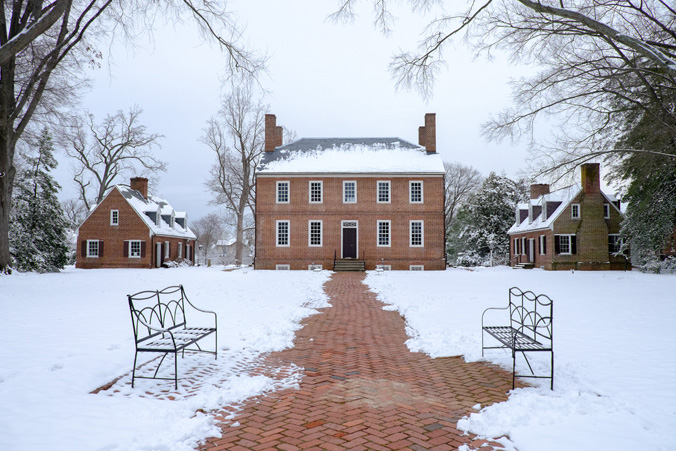
    When Fielding Lewis moved his family into their new home – the magnificent brick house we call Kenmore – in late 1775 it was the culmination of years of hard work and planning. It might seem as though that year’s holiday season should have been one of continual joy. Unfortunately, the Lewis family’s first Christmas inside Kenmore was far from joyful. December 1775 was an extremely difficult time in their lives and for the American Revolution.

    That December, the Revolution was in a frustrating state of limbo. Although declared to be in open rebellion by the King and Parliament, few colonies had yet to see any armed conflict. Fighting outside of Boston started in the spring but fizzled into stalemate following the Battle of Bunker Hill in June.  Independence may have been discussed in taverns but was still far from being discussed at the Continental Congress in Philadelphia.

    The colonies were still suffering economically and had been suffering for some time. In 1774, Congress passed the Non-Importation Agreement. These measures stopped all trade with Great Britain and other British-owned ports. The Association, as it came to be known, remained in effect in December 1775.  Colonists lacked numerous supplies and goods.  Fielding Lewis experienced a significant drop in his shipping business and the family’s finances began to suffer.

    Even though it was the holiday season, the Non-Importation Agreement also discouraged…

    every species of extravagance and dissipation, especially all horse-racing, and all kinds of gaming, cock-fighting, exhibitions of shews, plays, and other expensive diversions and entertainments. 

    To be loyal to the American cause, one could not delight in the revelries typically enjoyed during Christmas.

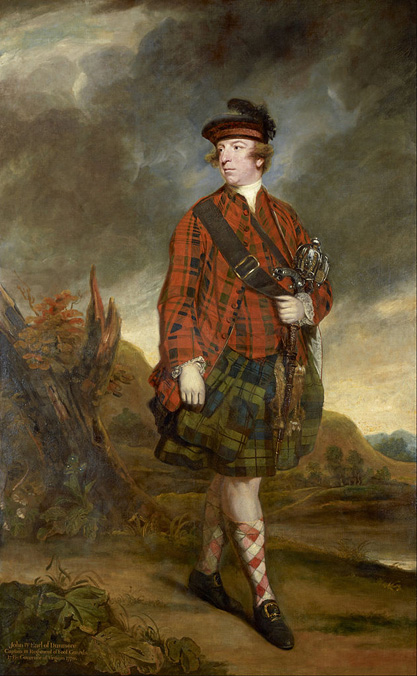
    All levels of Virginia society felt the strain of war’s uncertainty that fateful December. John Murray, 4th Earl of Dunmore and Virginia’s Royal Governor, had been at odds with his colonists since he removed portions of the public stores of gunpowder to a Royal Navy ship back in the spring. Lord Dunmore’s most recent action, however, hit much closer to home for Fielding Lewis and his fellow planters.  The Governor threatened to take their slaves, the precious private property, as they saw them, upon which they had built their livelihoods and wealth.

    Lord Dunmore.jpg
    Portrait of John Murry, 4th Earl of Dunmore by Joshua Reynolds (1765)

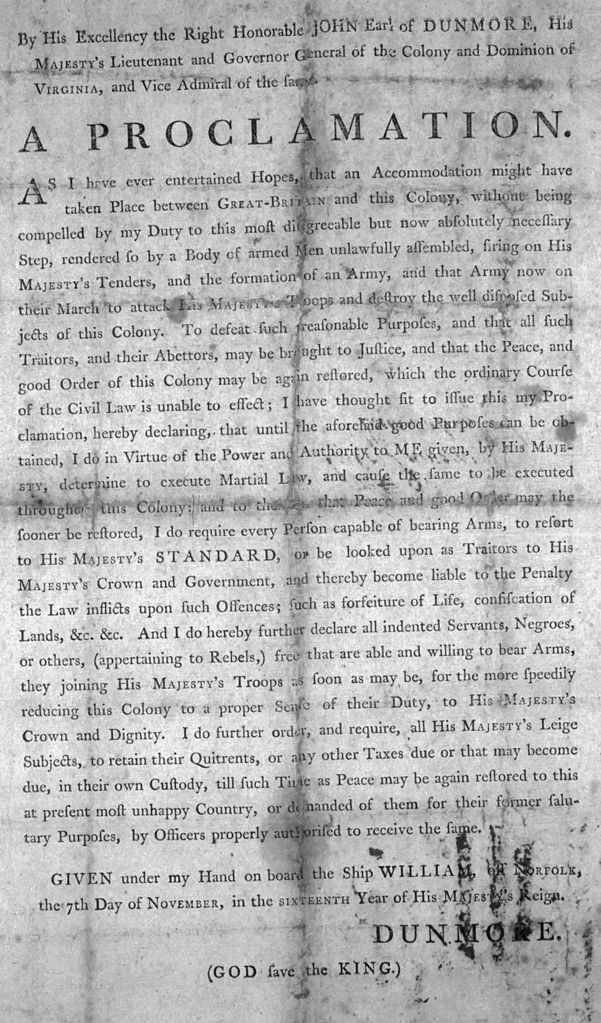
    In November 1775, Dunmore had issued a proclamation in Virginia intended to swell his ranks and cripple the so-called ‘rebels’ by imposing martial law, raising the King’s standard, and declaring, most significantly,

    all indentured Servants, Negroes, or others, (appertaining to Rebels,) free that are able and willing to bear Arms.

    DunmoresProclamation
    A copy of Dunmore’s proclamation. Library of Congress photo

    Dunmore’s Proclamation angered and frightened slave owners throughout Virginia and put the colony’s enslaved population in a difficult predicament. Achieving freedom was highly dependent on an enslaved person’s ability to get to Dunmore in Norfolk. Not surprisingly, the largest percentage of enslaved people who fled to the British came from the counties closest to that port city.  While it is uncertain if any Lewis slaves ran away to the British, at least one indentured servant perhaps did. Joseph Smith, an a painter who had worked for George Washington and presumably for Fielding Lewis, saw the political schism in Virginia as an opportunity to free himself from his servitude and fled in the summer of 1775. In November, Fielding wrote to George, saying “I have never heard of your Painter tho’ suspected he was gone to Ld Dunmore[.] I do not expect he can be got as Dunmore wants Men.” Smith’s successful escape may have been on the mind of the other indentured servants and enslaved people in the Lewis household when word of Dunmore’s Proclamation arrived in Fredericksburg.

    December 1775 in the Lewis family’s new home was an anxious one for many and yet for others it must have been a hopeful one as well. The American forces at Bunker Hill had proven to the British that the fight would not be easy or quick. The Fourth Virginia Convention met that December and ordered even more companies formed to support the Continental forces.  Most hopefully, Dunmore’s forces were defeated in the Battle of Great Bridge on December 9. The Governor would leave the shores of Virginia in the early part of 1776 never to return. His forces did include a portion of enslaved people who had dared to hope for their own freedom, a hope that would be denied for many Christmases to come. A large portion were captured and returned to slavery, many more died from disease or lack of supplies, and others perished in battle. Few actually gained their freedom.

    Back in Fredericksburg, the December of 1775 was most likely not what the Lewises had expected or hoped for. It was a Christmas of uncertainty, when war raged on Virginian soil.  Yet, the future was not solely bleak for Fielding, Betty, and the Americans. As 1776 began, it begged the hopeful question: what may the new year bring?

    Joe Ziarko
    Manager of Interpretation & Visitor Services

    Experience this Lewis family’s Christmas of uncertainty during Twelfth Night at Kenmore, a dramatic theater presentation at Historic Kenmore on Friday, January 8, Saturday, January 9, or Sunday, January 10. The year is January 1776. It is the first Christmas that Fielding and Betty Washington Lewis celebrate in their newly built home. It is not the usual celebration, however. War brings fear, doubt, and frustration to the Lewis family and their friends.  Immerse yourself in the experience the candlelight, music, and decorations of an eighteenth-century Christmas!

    Performance Times: 3:00, 3:45, 4:45 and 5:30 p.m.
    Reservations required. Call 540-370-0732 x24 or email
    hayes@gwffoundation.org
    Cost: $12.00 adults, $6.00 ages 3-17; free ages 3 and under.

  • Photos: Fielding’s Story, A Gentleman’s Sacrifice

    This past weekend, visitors to George Washington’s Ferry Farm and Historic Kenmore learned about Fielding Lewis in the dramatic presentation, Fielding’s Story: A Gentleman’s Sacrifice. They were able to step back in time and see colonial-era Fredericksburg through the eyes of Fielding Lewis—member of Virginia’s gentry, wealthy merchant and leading citizen of Fredericksburg, builder of Kenmore, patriot and supporter of the American Revolution, and husband of Betty Washington Lewis.

    In this historical drama, which spanned from 1750 to 1781, actors portrayed people and events from Fielding’s life in the settings where those events took place. Guests saw Fielding’s courtship and marriage to Betty Washington, visited his newly built home as the guest of Betty , eavesdropped as Fielding considered wartime plans, and witnessed the sacrifices he made for the Patriot cause.

    In certain scenes, dialogue was taken directly from historic documents including a 1750 edition of the Anglican Book of Common Prayer, a letter dated November 14, 1775 from Fielding Lewis to George Washington, and an authentic patriotic appeal in the Virginia Gazette.

    Here are images from Fielding’s Story: A Gentleman’s Sacrifice…

    The next theater production presented by The George Washington Foundation will be Twelfth Night at Kenmore in January 2016. As we approach the holidays, watch http://www.kenmore.org/events.html for details!

  • A Colonial Wedding

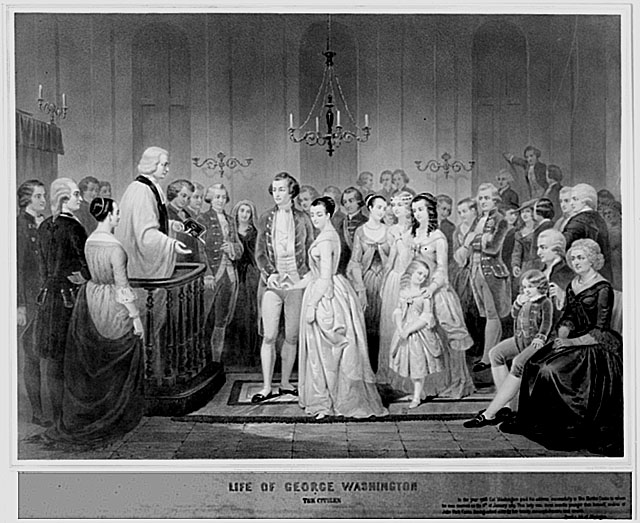
    An imagining of the “Wedding of George Washington and Martha Custis.” Lithograph from Prints and Photographs Division, Library of Congress. Paris: Lemercier, c1853.

    A wedding is one of the most monumental moments in a person’s life.  The celebrations that accompany the ceremony might range from simple to lavish but they are always highly anticipated and joyous.  In this enthusiasm for weddings, we share much with our early American ancestors.  Although there are extremely important differences between past and present, many wedding traditions of the 18th century would be quite familiar to 21st century Americans.  What did a colonial-era wedding look like?

    Today’s weddings can take place in any imaginable location – a church, dedicated wedding venue, cruise ship, beach resort, park, city hall, and on and on – but, in the 1700s, the large distances people often lived from an actual church building meant that the vast majority of weddings occurred at the brides’ home.[1]

    In another inverse of modern preferences for spring, summer, and fall weddings, many colonial-era marriage celebrations took place in the winter months when there was less to do on the farm or plantation agriculturally.

    That doesn’t mean there weren’t weddings outside the winter season.  Indeed, Fielding and Betty married on May 7, 1750.  We have no definitive evidence to say that their wedding occurred at the Washington family home on the land we now refer to as Ferry Farm.  Since Fielding and Betty lived relatively close to St. George’s Church in Fredericksburg, it is certainly possible that the ceremony took place there, though it would have been fairly unusual.

    If the ceremony did occur at the Washington home, an Anglican minister, perhaps from St. George’s, would have still read the marriage ceremony from the Book of Common Prayer.  An edition published in 1750 contains language that remains immensely familiar even today.

    “Dearly beloved, we are gathered together here in the sight of God, and in the face of this Congregation, to join together this Man and this Woman in holy Matrimony…”

    “Wilt thou have this Man to thy wedded Husband, to live together after God’s Ordinance, in the holy Estate of Matrimony? Wilt thou obey him, serve him, love, honour and keep him in sickness and in health, and forsaking all other, keep thee only unto him, so long as ye both shall live?”

    “With this Ring, I thee wed, with my body I thee worship, and with all my worldly goods I thee endow…”

    Along with these familiar words came familiar acts as well.  The father gave his daughter away, the couple exchanged vows, and the groom gave the bride a ring.  The bride, however, did not present a ring to the groom.

    Just as it does today, a party began after the ceremony.  This celebration also took place at the home of the bride’s family.  “The family might decorate a table with white paper chains and lay out white foods for a collation. It included two white cakes. The guests consumed the groom’s cake, and sometimes left the bride’s cake untouched for the couple to save (in a tin of alcohol) to eat on each wedding anniversary.”[2]

    There was much food, drink, and toasting along with games and plenty of dancing.  For Virginia’s gentry the party’s scale and length could be extremely lavish with the festivities continuing for days!

    If you want to learn more about colonial-era weddings, you can witness a re-creation of the marriage ceremony of Fielding Lewis to Betty Washington on either Saturday, October 10 or Sunday, October 11 during Fielding’s Story: A Gentleman’s Sacrifice, a dramatic theater production taking place at both George Washington’s Ferry Farm and Historic Kenmore.  Fielding’s Story recounts important moments and milestones in Fielding’s life as a member of Virginia’s gentry, a wealthy merchant and leading citizen of Fredericksburg, the builder of Kenmore, a supporter of the American Revolution, and the husband of Betty.  Reservations are required. Please call 540-340-0732 ext 24 or email hayes@gwffoundation.org.

    [1] Jane Carson, Colonial Virginians at Play, Williamsburg, VA: Colonial Williamsburg Foundation, 1989: 5-9.

    [2] Elizabeth Maurer, “Courtship and Marriage in the Eighteen Century,” http://www.history.org/history/teaching/enewsletter/volume7/mar09/courtship.cfm

  • Dining Room vs. Dining Room

    Several months ago, Historic Kenmore concluded the refurnishing effort in the Dining Room.  After painstaking research and scientific investigation, that room has been returned to a state that would be immensely familiar to Fielding and Betty Washington Lewis.

    It might look somewhat unfamiliar, however, to later occupants of Kenmore.  The first picture below was taken sometime between 1880 and 1902 when the Howard family occupied the house.

    When, in 1881, Kenmore was purchased by Mr. William Key Howard of Maryland, the place was in deplorable condition.

    Kenmore suffered considerable damage to its ornamental plaster ceilings during the Civil War. Young William K. Howard, Jr. urged his father to allow him to repair them. When scaffoldings were built, the artistic lad worked long and patiently making his own molds for replacement elements when needed.

    The Howards saved the ceiling but, naturally, their goal was not to return the building to its colonial-era appearance.  When Kenmore became a historic house museum, changes still had to be made over many decades to achieve a historically accurate décor that closely resembles the one the Lewises would have known in the late 1700s.

    The second picture shows the dining room as it appears today after meticulous restoration and refurnishing.  Comparing the two photos, we see the biggest architectural change to the room was the removal of the gothic arched niches on each side of the fireplace.  The arches were returned to the original square doors.

    The narrow oak flooring, which replaced the original floor stained with the blood of Civil War soldiers who received medical treatment at Kenmore, was itself replaced with heart pine flooring.  Late last year, the floor was covered with a beautiful replica 18th century carpet.

    Decorative coal grating and surrounding bricks were removed from the fireplaces making them larger.

    The wood molding put on the walls to create false panels was removed and replaced with plaster molding whose original location was found during removal of paint during restoration work.

    Those are just a few of the changes both large and small that can be seen when comparing these two photos.  The changes occurred over many decades and involved many dedicated people but each started, in many ways, with the Howards.  They and all the rest of us who have spent our days at Kenmore have taken something old and made it new again.

    Heather Baldus, Collections Manager
    Zac Cunningham, Manager of Educational Programs

  • Hanging Portraits in Kenmore’s Drawing Room

    The George Washington Foundation’s curators recently oversaw the hanging of portraits in Historic Kenmore’s Drawing Room. Portraits of Fielding and Betty Lewis painted by John Wollaston as well as of John Lewis and Fielding Lewis, Jr. painted by Charles Willson Peale were returned to the room where they hung originally. In this video showing the installation process, Meghan Budinger, Aldrich Director of Curatorial Operations, also explains the significance of these types of portraits to the Lewis family and the rest of Virginia’s gentry.  You can also read more about the portraits and the installation process on “The Rooms at Kenmore” blog at http://kenmore.org/wordpress.

  • Photos: “Twelfth Night at Kenmore”

    Today – January 6 – marks the end of Christmas or, at least, it did two centuries ago.   If we lived in the days of George Washington, Betty Washington Lewis, and Fielding Lewis and moved within their social circle, we would all be preparing for the grandest celebration of the Twelve Days of Christmas, which began on December 25.  This grand event, known as Twelfth Night, was celebrated much in the same way that many of us mark New Year’s Eve with family and friends gathered together for food, drink, sweets, music, dancing, games, and conversation.

    This past weekend, Historic Kenmore hosted just such a celebration in the form of a theatrical presentation titled “Twelfth Night at Kenmore.”  Set in January 1776, as Fielding and Betty Washington Lewis end their first Christmas in their newly built home, “Twelfth Night at Kenmore” depicted an unusual seasonal celebration, as the growing American Revolution brings fear, doubt, and frustration to the Lewis family, their friends, and members of the enslaved community.

  • Christmas in Fredericksburg with George Washington, 1769

    Six-year-old George Washington and his family moved to the land we call Ferry Farm late in 1738, perhaps even in time to mark Christmas in their new home.  If so, it was the first of many.  George lived at Ferry Farm into young adulthood.  Interestingly, the best documented Christmas he spent in Fredericksburg was actually in 1769, long after his boyhood years, and it paints a picture of the holiday as typically celebrated in Virginia, past and present.

    George Washington at age 40 in 1772, three years after the Christmas of 1769. By J.W. Paradise (engraving) from a picture by J.G. Chapman after Charles Wilson Peale [Public domain], via Wikimedia Commons.
    After the House of Burgesses recessed, 36-year-old George Washington left Williamsburg for home on December 21, 1769.  Instead of traveling all the way to Mount Vernon, he stopped in Fredericksburg on December 23 and stayed in town through Christmas.  He arrived at “4 Oclock in the Aftern.” and went to the home of his brother-in-law Fielding Lewis. In 1769, the Lewis family did not yet live in the brick home we call Kenmore.  Instead, they were located near the present-day corner of Princess Anne and Lewis Streets.  That evening, George “ding. [dined] at Colo. Lewis” and he and Fielding may have been joined by George’s sister Betty, his young nephews George, Charles, Samuel, Lawrence, Robert, and his niece Betty.  Christmas was a period of rest that Virginians used for long visits and large meals with family and friends.  The meals amounted to feasts and a Christmas meal at Mount Vernon once featured, for example, “an elegant variety of roast beef, veal, turkey, ducks, fowls, hams &c.; puddings, jellies, oranges, apples, nuts, almonds, figs, raisins, & a variety of wines & punch. . .”[1]

    On Christmas Eve, which was a Sunday, George “Went to Prayers, & dined afterwds. at Colo. Lewis.”  The prayer service he attended probably took place at St. George’s Church, an wooden structure located on the site of today’s St. George’s Episcopal Church. Many colonial Virginians combined the holiday’s religious nature with secular activities such as parties, much as we do today.  Washington was no different.  After his morning at church, he passed the evening in Julian’s Tavern with Edward Jones, the overseer of Ferry Farm, where George’s mother Mary still lived.  This tavern was located at the corner of Amelia and Caroline Streets.

    Christmas Day was spent with the Lewis family and George won 2 pounds and 5 shillings playing cards.  Card playing for money was another aspect of Christmas carousing enjoyed by Virginians, whether men, women, or children.  Popular games included whist (similar to bridge), and piquet (similar to rummy) and were great ways to pass the time when visiting family and friends during Christmas.

    On December 26, Washington prepared to continue his journey home by going to to the barber and paying for repairs to his carriage.  Before leaving, though, he again “Dined at Colo. Lewis” and then “went over the River and logd at my Mothers” for his final night in Fredericksburg.  After giving Mary 6 pounds in cash, George left Ferry Farm on the 27th and arrived home at Mount Vernon on December 28.

    The Christmas season of the colonial era lasted much longer than ours does, extending into January and concluding on Twelfth Night, a festive evening to mark the end of the Twelve Days of Christmas and celebrated much like our New Year’s Eve is today.  During the first days of 1770 at Mount Vernon, Washington and his family continued visiting friends and hosted two dinners, including one on Twelfth Night.  It appears to have been a relatively subdued affair with only immediate family and four or five neighbors.  Three years later, on January 6, 1773, he had at least fourteen guests, excluding his own family, at a Twelfth Night celebration.

    Christmas 1769 was one of many that George Washington spent in Fredericksburg.  It is the only one for which he recorded his activities, however.  He spent time with family, he enjoyed several good meals, he went to church, he drank at a local tavern, he won some money at cards, and he attended or hosted several celebratory gatherings.  All-in-all, his was a Christmas spent in ways not all that different from the ways many of us will spend our own holidays.

    Zac Cunningham
    Manager of Educational Programs

    [1] Theophilus Bradbury quoted in Laura F. Winner, A Cheerful & Comfortable Faith: Anglican Religious Practice in the Elite Households of Eighteenth-Century Virginia, New Haven, CT: Yale University Press, 2010: 130.