In this video, archaeologist Mara Kaktins shares bits of Mary Washington’s dishes excavated at Ferry Farm and explains their significance.
Read more about Mary’s dishes in this blog post.

Lives and Legacies
In this video, archaeologist Mara Kaktins shares bits of Mary Washington’s dishes excavated at Ferry Farm and explains their significance.
Read more about Mary’s dishes in this blog post.
There were exciting arrivals at Historic Kenmore at the end of March! Two new additions made their debut in Fielding Lewis’s Office – a reproduction map on hanging rollers, and a long-awaited floorcloth.
Fielding Lewis owned 6 maps, which we assume he stored in his office. One of those maps may well have been what we know today as the Fry-Jefferson map (first produced in 1755, and titled at the time A map of the most inhabited part of Virginia containing the whole province of Maryland with part of Pensilvania, New Jersey and North Carolina). The Fry-Jefferson map was considered the definitive depiction of the Virginia colony throughout the 18th century. The surveyors and cartographers who created its accurate depiction were Joshua Fry and Peter Jefferson (Thomas Jefferson’s father). The George Washington Foundation owns an original copy of the map.

Over the past several years, we investigated the possibility that Fielding Lewis’s Office had a floorcloth covering its floorboards, much like the Passage. Floorcloths were popular floorcoverings in colonial American households. They were far more affordable than carpet and durable enough to protect floors in high-traffic areas. These decoratively painted sheets of sail canvas could be mopped when dirty, re-varnished when they began to wear, and simply repainted with a new design to keep up with changing fashion.
Evidence shows, however, that floorcloths were sometimes used in less traffic areas of a house, as well. They are sometimes listed in probate inventories as being in chambers, and private rooms on a house’s second floor. Even in formal rooms, like the Dining Room, a floorcloth might be put under a dining table to catch food and spilled drinks. In areas where a floorcloth was seen by more than just family members, it was probably decorated in a more ornate pattern. Fielding’s office was both a utilitarian, working office and a space in which Fielding might meet with business associates and other gentry who needed to be suitably impressed. Would it have had a floorcloth?
Kenmore’s most recent restoration in the 2000s provided us with two clues as to the existence of a floorcloth in the Office. First, a small fragment of painted textile was found wedged under one of the baseboards in the room. Microscopic analysis of the fragment found that it was composed of hemp with some wool and cotton fibers mixed in. Although this was not the usual make-up of canvas from the 18th century, historic textile consultants suggested that it could represent the natural fibers of padding placed under floorcloths on occasion. The paint attached to the fibers represented at least 5 layers of paint and varnish. The textile had been painted, varnished, worn through, repainted and re-varnished multiple times, which is exactly what one would expect to find on such a fragment. Unfortunately, the fragment was so small and degraded that no determination to original color could be made. The existence of the fragment, however, strongly indicates that the Office had a floorcloth at one time.
The second clue found during the restoration was a group of larger floorcloth fragments under the attic floorboards. These fragments were large enough that we could see a pattern and color scheme. While obviously from a floorcloth, dating them was a little harder. Floorcloths were used in American households from the mid-18th century through the mid-19th century. Was this floorcloth old enough to have been used during the Lewis era at Kenmore? To narrow down the date range, samples from the green painted areas on the fragments were once again put under a microscope. Prior to 1816, green pigmented paint did not have chrome yellow in its composition. Analysis confirmed an absence of chrome yellow, meaning the floorcloth dated to before 1816. While not a conclusive date, it certainly moved the possible date range closer to the Lewis occupation of Kenmore.


After this initial analysis of the fragments recovered during Kenmore’s restoration, we progressed under the assumption that the fragments came from a floorcloth in the Office. The same studio that produced the Passage floorcloth (Black Dog Gallery in Yorktown) undertook the project. Their first task was to look at the fragments and reconstruct the pattern. We thought this would be easy, after all the fragments were large and showed a lot of clear decoration. Surely that was enough to piece together the original pattern!
In fact, the specialists working on the project began to doubt whether all of the fragments were from the same floorcloth. The decorative elements – namely medallions, scalloped shells and “basket weave” cross hatching – simply didn’t line up in any logical way, at least not like any typical floorcloth patterns from the time. But the paint analysis clearly showed the same generations of paint on all of the fragments, strongly indicating that they were from one floorcloth. Additionally, the way in which the fragments were found – all on top of each other, as if the floorcloth had been rolled up, then left to sit for a century and eventually cracked and broke at the rolled edges – strongly indicated one original unit, too.
In the end, the specialists turned to the only other pattern source from the period that might provide some clues – wallpaper catalogs. For some reason, the decorative elements on the fragments made much more sense when compared to 18th century wallpaper patterns. Perhaps the original floorcloth had actually been block printed, the way wallpaper was, with some handpainting done afterwards to highlight certain details. Perhaps the person who made the original floorcloth was simply more familiar with wallpaper than with floorcloths. Perhaps the Lewises requested a floorcloth inspired by some wallpaper. We’ll never know, but the wallpaper connection provided the bridge needed to recreate a reasonable pattern from the surviving fragments.
Once the pattern was determined, production began. The floorcloth was made in the same manner that floorcloths have been for hundreds of years. A sheet of canvas was cut to size, stretched out on the ground, painted with several base coats, handpainted with a “show layer” (the pattern) and then coated with clear varnish. It was left to cure for several weeks. Then, the entire thing was rolled up and transported to Kenmore for installation (which was relatively easy, in comparison to the huge floorcloths installed in the Passage years earlier).


The floorcloth and map have added the final touches to Fielding Lewis’s Office, making the room all the more like it was in 1775. Purchase your ticket to tour Kenmore now, and see these new additions for yourself!
Meghan Budinger
Aldrich Director of Curatorial Operations
In this video, curator Meghan Budinger updates us on the latest arrivals in the final steps of furnishing the Washington house replica at George Washington’s Ferry Farm and of re-furnishing Historic Kenmore.
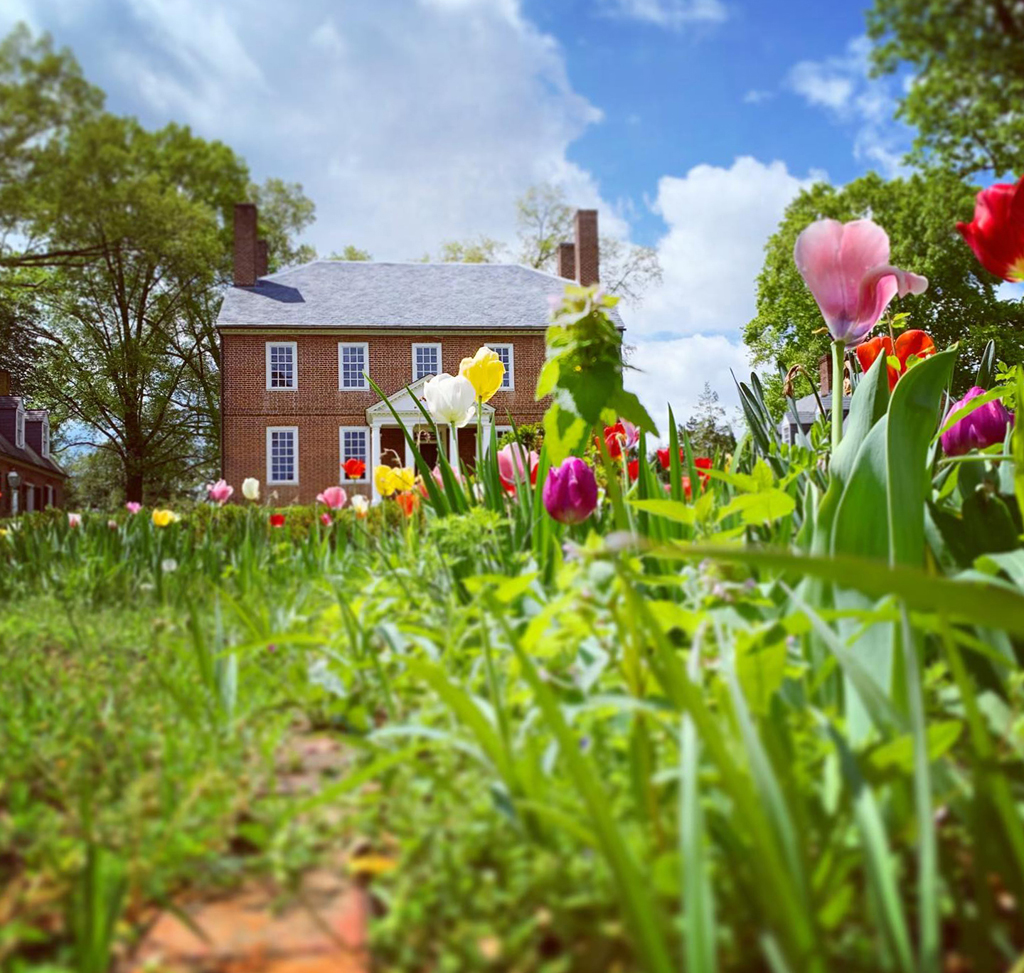
Historic Kenmore is known for many things; for being the home of Fielding and Betty Washington Lewis, for its Georgian-style brick architecture, its famous ornate decorative plaster ceilings, and, last but not least, for its beautiful gardens. Unfortunately, today only three out of Kenmore’s nearly 1300 original acres remain but with the help of The Garden Club of Virginia, dedicated volunteers, and generous donors, the remaining landscape surrounding the house was cared for over the last century.
There is a very exciting centennial celebration coming up for Kenmore. The Kenmore Association (presently known as The George Washington Foundation) was established in 1922 to save the historic home from destruction. Kenmore will celebrate its 100th anniversary as a historic house museum next year in 2022.
Similarly, The Garden Club of Virginia was established when eight garden clubs across the Commonwealth of Virginia were invited to attend a conference in Richmond on May 13, 1920. Last year was the club’s 100th anniversary.
Fielding and Betty Lewis, for whom Kenmore was built in the mid-1770s, left no historical records of what gardens they had or where they were located. Even though there is little archival or archaeological evidence of original garden plans or planting, we do know that tobacco, wheat, and corn were grown in Kenmore’s surrounding fields. Furthermore, the terraces on the river side of the house, which are still there today, were hand-built by enslaved laborers. Without precise archival and archaeological data, however, Kenmore’s gardens over the years were based on a general understanding of 18th century gardening styles.
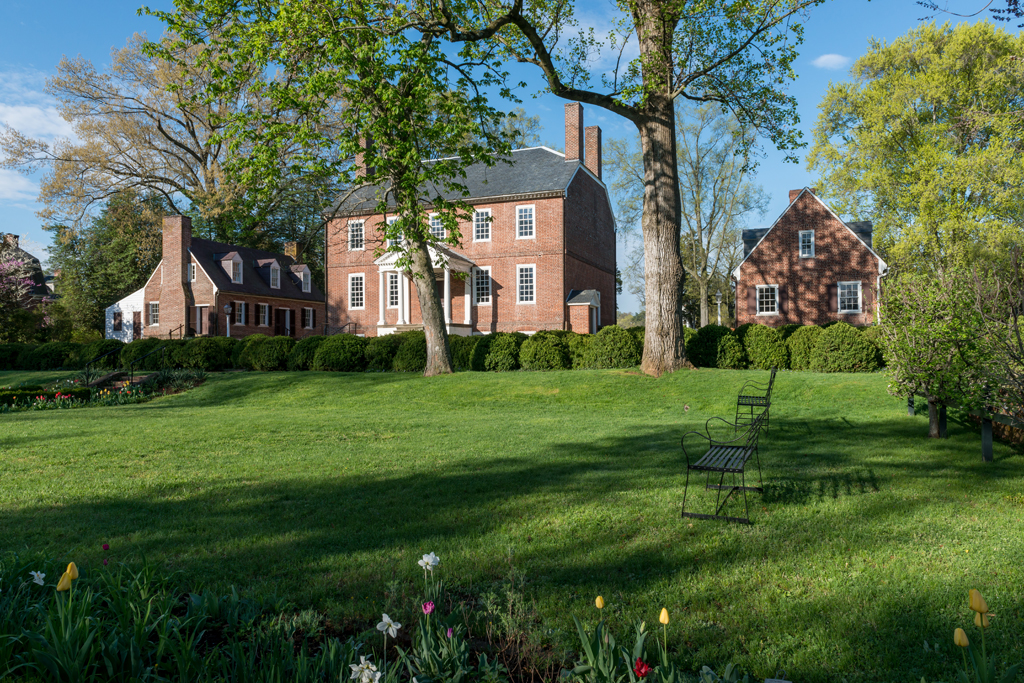
The creation of the present-day gardens began in 1929 when The Garden Club of Virginia raised funds for their organization’s first project, Kenmore’s gardens. Indeed, as written about previously, Kenmore inspired Historic Garden Week in Virginia, which was held for the first time that same year.
This initial establishment of Kenmore’s gardens was led by landscape architect Charles F. Gillette with contributions by James Greenleaf and Alden Hopkins. Colonial Revival-style gardens were planted with boxwoods around the foundation of the house, along paths, and on the terrace. The west lawn, which faces present-day Washington Avenue, was treated as the “front of house” since carriages entered from that side in the 19th century. This lawn was planted with stately trees. On the east lawn, at the rear of the property facing the Rappahannock River, a four-square garden edged in boxwoods was added.
In 1941, The Garden Club of Virginia brought back Gillette to create what was called Betty Washington’s Flower Garden and to add an enclosing brick wall around the property.
Kenmore’s gardens saw further changes throughout the 1980s and early 1990s, when a decision was made by the Kenmore Association to more accurately demonstrate general 18th century garden styles and ideas as well as to introduce more native plants. The boxwoods were removed from around the house’s foundation and from most paths.
On its 70th anniversary in 1992, The Garden Club of Virginia undertook another extensive redesign of Kenmore’s gardens with landscape architect Rudy Favretti. Included in this replanting was another revamping of what was called Betty Washington’s Garden, the creation of an Herb Demonstration Garden, the addition of the Wilderness Walk, and a refurbishment of the east terrace. A kitchen garden was added in 1993 and a redesign of the parterre was completed in 1994. A parterre, or four-square garden, means “on the ground” and indicates the geometrical arrangement of garden beds. The four-square arrangement is a reflection of the late 18th century move toward simplicity of design.
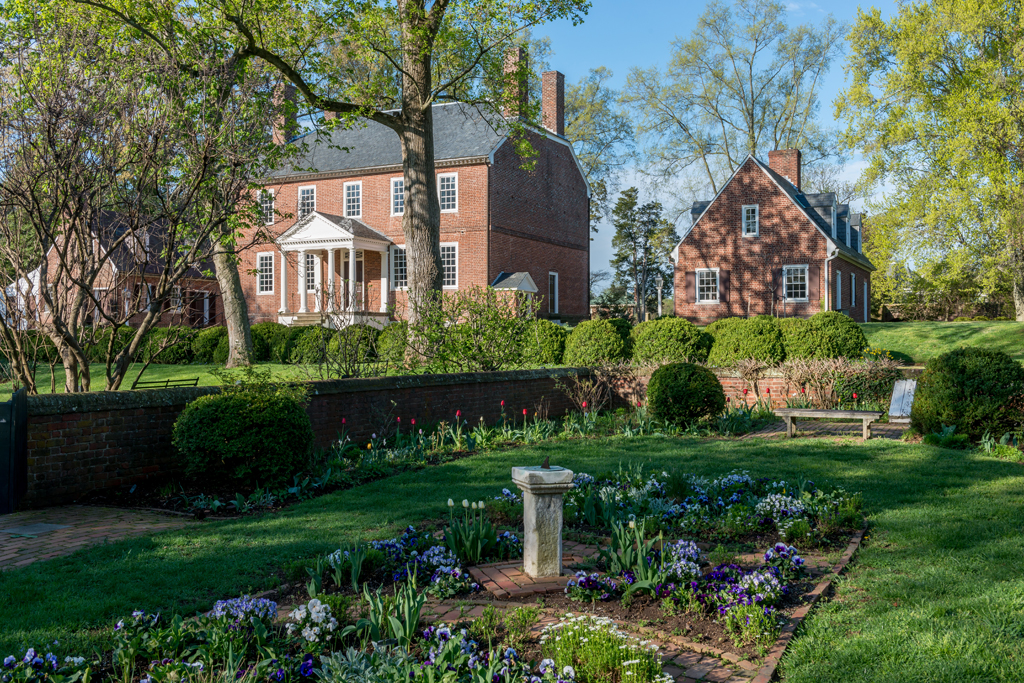
Come visit the gardens of Historic Kenmore today, Tuesday, April 20 for Garden Day in Fredericksburg, part of Historic Garden Week in Virginia hosted by The Garden Club of Virginia.
Jessica Burger
Manager of Marketing, Communications, and Technology
Colonial Faire, an 18th century music group, recently performed at Historic Kenmore. In this video, they play a medley of “Rakes of Mallow” and “Yankee Doodle.” Read about the history behind “Yankee Doodle” in this blog post.
On September 10, 1748, sixteen-year-old George Washington paid 3 shillings, 9 pence to a “musick master for my entrance.” Young Washington recorded these sparse details in Ledger Book Zero, a personal account ledger listing credits and debits with family, friends, and business associates between 1747 and 1750. This, as far as we can tell, is the first reference to music in the life of George Washington. By no means, would it be the last. Music was an important part of Washington’s life, just as it is with many of us today.

What was teenage age George paying for when he paid the “musick master for . . . entrance”? Well, the lack of details makes it impossible to say with certainty. The most obvious possibility is that he was paying for music lessons. However, letters written by George himself and a friend indicate that Washington had little to no musical talent. Francis Hopkinson, a colleague during the war, composed a series of songs for harpsichord or piano and dedicated them to Washington. In a letter to George dated December 1, 1788, Hopkins explained his dedication even though George could “neither play Musick nor sing Songs.” In a reply on February 5, 1789, Washington agreed, writing “I can neither sing one of the songs, nor raise a single note on any instrument.” Despite a professed musical inability, it is still possible young George was paying for music lessons in 1748. Often, you might pursue lessons only to discover that you do not have the aptitude.
Regardless, while apparently not musical himself, music surrounded Washington. As Mount Vernon research historian Mary V. Thompson notes, “Washington was the head of a household where his wife, her two children, and her four grandchildren (two of whom were raised by the Washingtons) all studied music.” In particular, granddaughter Eleanor (Nelly) Parke Custis became fairly skilled at the harpsichord, despite an apparent reluctance to learn. In the summer of 1798, a visiting Polish nobleman enthusiastically claimed that Nelly “plays the harpsichord, sings, draws better than any woman in America or even in Europe.”
Another Washington family member with an interest in music was George’s niece Harriot Washington, daughter of Samuel. The first letter in the record between Harriot and her guardian and uncle George was written on April 2, 1790. Harriot was 14-years-old and living at Mount Vernon while President Washington was in New York. The niece asked her uncle to send her a guitar since she wanted to take lessons for “all the young Ladyes are a learning musick.” Harriot was confident “that five or six lessons would be sufficient for any body to learn.” The records consulted reveal no response from Washington. Eventually, Harriot would come to Historic Kenmore to live with her aunt Betty Washington Lewis. She again asked uncle George for a guitar in May of 1792. About a month later, he paid $17 for one. Harriot’s capabilities with the instrument are unknown.
Besides family, another major source of music in Washington’s life was the Continental Army. Music was crucial to 18th century militaries. Fifes and drums issued commands during battle and put a spring in the step during weary marches. Much like the army’s initially amateur soldiers, its fifers and drummers (who were often boys serving with their soldier-fathers) took time to practice and professionalize.
On June 4, 1777, General Washington issued a set of orders. One order dealt with the army’s music, which the General bluntly lamented was “very bad.” He ordered “that the drum and fife Majors exert themselves to improve it, or they will be reduced, and their extraordinary pay taken from them: Stated hours to be assigned, for all the drums and fifes, of each regiment, to attend them, and practice.” Washington concluded, “Nothing is more agreeable, and ornamental, than good music; every officer, for the credit of his corps, should take care to provide it.”
A notable musical moment in the army’s history was the birthday serenade for General Washington on February 22, 1778 at Valley Forge. The musicians of Proctor’s Artillery played outside the General’s headquarters. Washington’s expense account lists a payment of 1 pound, 5 shillings to Proctor’s band. Joseph Lee Boyle, longtime historian at Valley Forge, explains that “Colonel Proctor commanded an artillery regiment, and this was one of the few, perhaps the only, unit to have musicians besides fifers and drummers. In 1779 ten ‘musicians’ are listed in the band, but not what instruments they played.” Mount Vernon scholars note that this was “the first public recognition of [Washington’s] birthday.”
We’ve seen that music was definitely a part of Washington’s life but it was played by others mostly. George could not play an instrument nor sing. He may have paid for music lessons only to discover his inability. Another reasonable theory, however, is that he paid the “musick master for my entrance” to dancing lessons. Later in life, Washington uses similar phrasing – “Mr McKay entrance to Dancing” – to record a payment of 10 shillings for lessons for stepson John Parke Custis.
Dancing was the leisure time obsession of most Virginians but especially those in the wealthy gentry. For the upper class, explains Amy Stallings, “ being a skilled dancer was an indication of good breeding” and allowed one to “put one’s gentility, accomplishment, beauty, and economic means on display in hopes of impressing—or, in some cases, intimidating—”others. As Philip G. Smucker adds, “Dexterity on the dance floor maintained social status.”
Maintaining social status and the appearance of good breeding skyrocketed in importance to George and the Washington family after the death of father Augustine in 1743. His death created financial hardship and jeopardized the family’s social standing. Without a father, George’s life changed radically. Assisted and supported by both mother Mary and half-brother Lawrence, George was forced to acquire the refined skills and customs of the upper class in Fredericksburg instead of in England while at boarding school.
One of those skills was dancing and the mystery “musick master” perhaps taught teenage George that skill. Over the course of the 18th century, as Stallings notes, “a market developed for professional instructors, or dance masters, who were expected to know the latest dances from Europe.” Virginia’s urban centers with their greater populations and high number of visitors “often boasted multiple dancing schools . . . Dancing masters operated in at least Yorktown, Williamsburg, and Hampton by 1739.” Traveling dance instructors served Virginia’s far-flung rural population. These masters usually “taught the sexes separately, at different hours or different days of the week.”
If Washington was schooled in dancing by the “musick master,” he probably learned the era’s popular minuets, allemandes, and hornpipes. These fancy dances typically began any ball and were the best opportunities to show off one’s dancing abilities and good breeding. The minuet was the most important. As Stallings explains, “A man’s prowess at the minuet—an especially complicated dance, requiring excellent balance and coordination with one’s partner—could buoy his social position, whereas a poor minuet might leave him out of favor.”
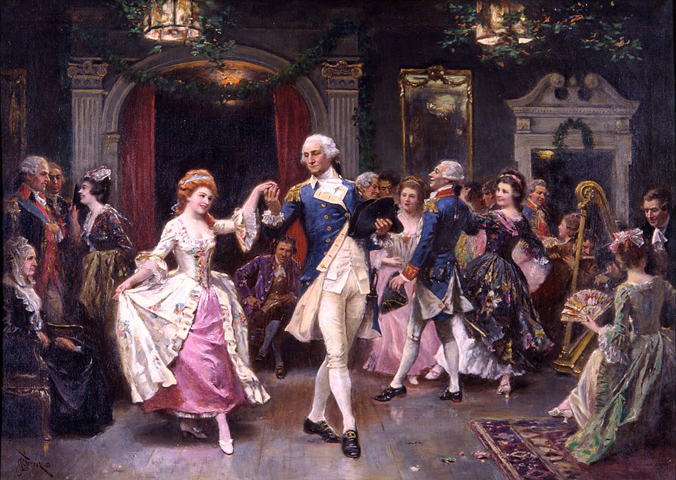
Whether he was paying for dancing lessons in 1748 or not, young Washington learned to dance in some fashion, discovering both an extraordinary natural talent and life-long passion for it. Numerous contemporaries recorded instances of Washington dancing and praised his abilities.
“His Excellency . . . and Mrs. Greene . . . danced upwards of three hours without once sitting down.” – General Nathanael Greene to Colonel Jeremiah Wadsworth, Middle Brook, New Jersey, March 19, 1779.
“His Excellency General Washington was unusually cheerful. He attended the ball in the evening, and with a dignified and graceful air, having Mrs. Knox for his partner, carried down a dance of twenty couples in the arbor on the green grass.” – General Nathanael Greene to Joseph Reed, Morristown, New Jersey, Tuesday, February 29, 1780.
“The General danced every set, that all the ladies might have the pleasure of dancing with him, or as it has since been handsomely expressed, get a touch of him.” – James Tilton to Gunning Bedford Jr., Annapolis, Maryland, December 25, 1783.
“He . . . attended the ball of the 22nd of February; opened it by dancing a minuet with some lady, and then danced cotillions and country dances; was very gallant, and always attached himself, by his attentions, to some one or more of the most beautiful and attractive ladies at the balls.” – Judge Francis T. Brooke (1784).
And finally a word on his dancing from George Washington himself, written on November 12, 1799, just a month prior to his death and turning down an invitation from to a grand function in Alexandria. He wrote,
Gentlemen
Mrs Washington and myself have been honoured with your polite invitation to the Assemblies in Alexandria, this Winter; and thank you for this mark of your attention. But alas! our dancing days are no more; we wish, however, all those whose relish for so agreeable, & innocent an amusement [emphasis added], all the pleasure the Season will afford them. and I am Gentlemen Your Most Obedient and Obliged Humble Servant
Go: Washington
George saw music and dancing both as “agreeable.” From the mostly taciturn Washington, this is high praise indeed.
Join us on Saturday, April 10 for The Arts at Kenmore: Music on the Lawn and hear 18th century music group Colonial Faire performs music from all walks of colonial society – the music of the taverns, the manor houses, on the streets and on the battlefields. The evening’s opening act will include a short talk exploring the importance of music to George Washington and a theater scene depicting Washington’s first dancing lesson. For more information and tickets, visit kenmore.org/events.
Zac Cunningham
Manager of Educational Programs
Most of us have heard of Phineas Taylor “P.T.” Barnum, founder of the Ringling Bros. and Barnum & Bailey Circus. During his life, P.T. Barnum was a businessman and politician but was most famously known for being an entertainer. His name became synonymous with circuses, sideshows, and showmanship.
Before he introduced bearded ladies and 800-lb men into his “freak show” circuit, Barnum’s first human “curiosity” in 1835 was an enslaved woman named Joice Heth. Surprisingly, the story of Heth is forever linked to young George Washington.
Joice Heth was advertised by R.W. Lindsay, one of a long line of owners and the last before Barnum, as the oldest living human at 161 years old. Lindsay also claimed she was the former nursemaid to the infant George Washington. As described in The Showman and the Slave: Race, Death, and Memory in Barnum’s America, the definitive account of Heth’s life and exploitation, Lindsay exhibited Joice in multiple American cities where she shared imaginative – yet convincing – retellings of her time on the Washington family farm.
According to her story told during these exhibitions, Joice was born in Madagascar in 1674. She was captured at the age of 15 by slave traders. Eventually, she found herself “in service of the Washington Family” on Virginia’s Northern Neck. The Northern Neck was where Augustine Washington, George’s father, spent his youth and where George was born at Pope’s Creek. R.W. Lindsay even possessed documentation supposedly proving that Joice was once owned by Augustine.
Joice was said to have married an enslaved man named Peter on a neighboring plantation and was baptized in the Potomac River in 1720. She later ran the kitchen and nursery (presumably at Pope’s Creek) and was the first to swaddle the newborn George, or “Georgy” as she affectionately called him. At this point in sharing her account, she recalled several stories of her role in George’s upbringing, enthusiastically recounting the future first president in many tall tales. Heth even told a version of Mason Locke Weems’s cherry tree tale. In her version, Joice said that George broke some branches on a peach tree with some playmates before confessing his part in the misdeed to Augustine.
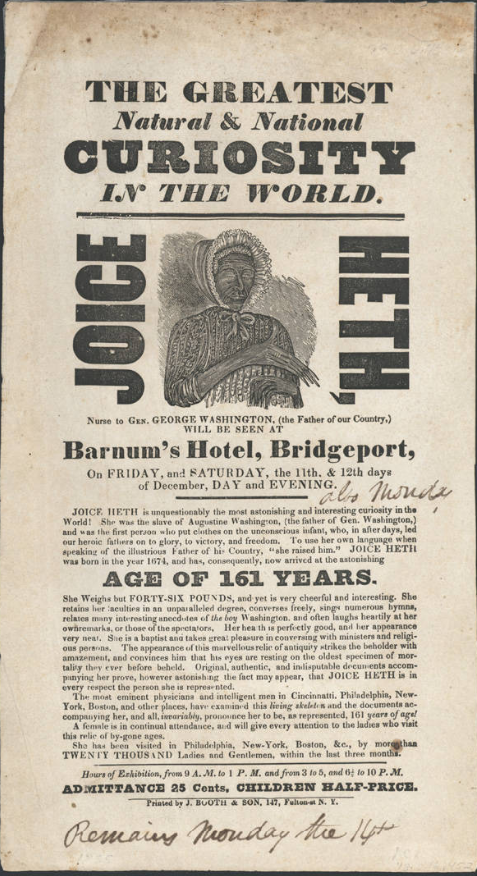
At the age of 54, Heth said she was sold to the neighboring Atwood Plantation home of the owners of her husband Peter. There she stayed with the Atwood family – who were cousins of the Washingtons – for several years, outliving most of her relatives. She presumably was then bought in old age to be shown as an exhibit of “living antiquity” and as the last living person to have personally known young Washington.
Astonishing? Yes. Completely fabricated? Yes. Historians agree that Joice was likely born around 1756 when George Washington was 24-years-old. She was never his nursemaid.
Still, her story compelled P.T. Barnum to purchase her in 1835. Barnum, who later became a staunch abolitionist, said in his autobiography that he purchased not Joice herself, but the rights to her story from R.W. Lindsay for $1,000.
Regardless, Barnum exhibited Heth at taverns, inns, concert halls, etc., allowing paying customers to see her in person and to listen to her fantastical stories of how she helped raise the first president. Joice was disabled, and quite old for the time. If she was born in 1756, then she would have been 79 years old in 1835. Blindness, paralysis, and unusually long fingernails added credibility of her claimed age to the curious observer.
Some credibility was lost however, when Joice didn’t remember certain facts or got key information wrong about the first president’s life. Yet, at the same time, she could remember historical events that occurred in her actual 80 years of life with reliability. Skeptics noted that Joice seemed to have a good memory, and keenly recounted many tales of young Washington, but just not with the accuracy her still-sharp mind would have had if she actually had been there.
Customers were allowed to touch Joice and to take her pulse to prove that she was a real human. A rumor spread that she was an automaton, a mechanical device made to imitate a human being. Barnum himself may have spread this rumor, as popularity of the exhibition dwindled and sales began to drop. He wanted to bring Joice back into the public eye and hoped that people would come back to see if this rumored robotic forgery was real. Barnum continued exhibiting Joice Heth until her death only one year later.
But the story of Joice Heth doesn’t end there. It gets even stranger.
Barnum, ever the entrepreneur, was not ready to let Joice go. Just as poor Joice was exhibited in life, she was exhibited in death. Barnum hired Dr. David L. Rogers, a respectable physician, to preform Joice’s autopsy in hopes of gathering scientific data about allegedly the world’s oldest person. Her autopsy was made public and gawkers were charged 50 cents per person to view the procedure. At least 1,500 people attended the macabre spectacle, only to be told that Joice Heth could not possibly be over 80 years of age, just as Dr. Rodgers had assessed during examinations before she died. Dr. Rogers had visited Joice during her lifetime, and reported her to have “none of the concomitants” of great age. He ruled that she displayed the health of a woman of around 75 years old, which she probably was, and that her blindness likely was a result of an illness experienced in early childhood. Embarrassed, Barnum yielded and stated the he, the great P.T. Barnum, had been swindled by this “Humbug” himself and was convinced of Joice’s authenticity by R.W. Lindsay.
Joice Heth, a real human being, experienced slavery’s dehumanization in both life and in death in a unique way. Historians can only learn so much about Joice because her enslavers – Barnum, Lindsay, and others – took great lengths to hide her actual identity and history in order to exploit her. Even if the story she told was a hoax, she was no doubt a fascinating individual. Why Joice went along with fabricating the story of nursing young George Washington, and what it meant to her to be regarded in this way, is lost forever. Historians note that an enslaved woman who was blind, paralyzed, and elderly would perhaps acquiesce to this way of life as a way to ensure her basic needs were met since she was physically unable to work as a domestic laborer, agricultural worker, or in some other trade. Given her condition and age, who would have bought her besides those seeking to capitalize on the story of her as George Washington’s supposed nanny? Ultimately, her motivations and view of her life are buried under a created identity. What could have been learned from this talented storyteller and incredible woman is lost to history.
Elyse Adams, Archaeologist
Co-Field Director & Lab Technician

Ferry Farm was a unique place to live in the mid-1700s. Situated where farm, frontier, city, river, and road converged on the edge of English empire, young George Washington, his family, and the farm’s enslaved community found their daily lives governed by Britain’s global economy and imperial culture. Ferry Farm, nearby Fredericksburg, and the colonies more broadly were international places made up of a host of different European, African, and Native American ethnicities and nationalities in the 18th century. Accordingly, we present a list of “Five International Influences on George Washington’s Youth.” This is by no means an exhaustive list but each influence helped shape young Washington into a man capable of commanding the Continental Army and serving as the new nation’s first president.


Young George could look from a window in the family home at Ferry Farm down the bluff to the Rappahannock River. He saw ocean-going, sailing vessels being loaded and unloaded at the wharves and warehouses of Fredericksburg. These vessels were part of a global trade network, which we’ve written about here and here, that stretched to Europe, Africa, the Caribbean, India and China. These vessels were not large but traveled the world nonetheless. They took the corn, wheat, and timber of places like Ferry Farm to Europe or the Caribbean and returned with Westerwald mugs from Germany, tea from India, porcelain from China, and enslaved laborers from Africa. The sailors on these ships probably represented numerous ethnicities and nations. One easily can imagine young George, so prone to a thirst for adventure, finding any excuse he could to visit the docks and ships down on the river and, by doing so, traveling the world without leaving the Rappahannock.
Those ships carried numerous manufactured goods from all over the world to Ferry Farm. Westerwald ceramics were one such import. Produced in the Westerwald region of what is now Germany beginning in the 1500s, archaeologists have excavated numerous bits of decorated stoneware tankards, jugs, and other drinking vessels used in the 1700s at Ferry Farm. Several of these excavated vessels sported the initials ‘G.R.’, meaning Georgius Rex, the Latin for King George. The three British kings of the 18th century were all named George and came from the House of Hanover, a German royal family placed on the British throne in 1714. A gentleman sporting a ‘G.R.’ on his Westerwald tankard or jug advertised his loyalty to the Crown with every draught of ale. The presence of these initialed drinking vessels at Ferry Farm show that, until the Revolution, Washington, like most Americans, viewed himself as a loyal subject of the British Crown (ironically worn by a German head).


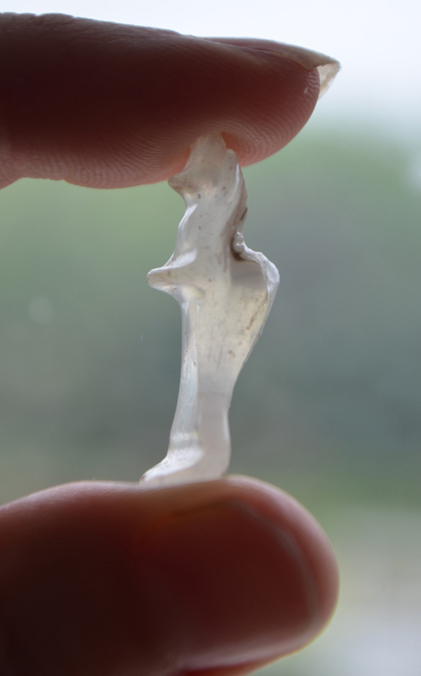
The vast majority of ceramics in the Washington household came from England. The same can be said about the family’s table glass, but the fanciest glassware owned by the Washington family actually came from Venice, Italy. Found by our archaeologists, this piece of a pincered and buttressed handle is likely part of an elaborate hand-blown Venetian piece, made of finely crafted colorless soda lime glass with a barely visible bead of opaque glass running through the center. A Venetian glass goblet such as this was a show piece displayed prominently within the house to emphasize that, despite their colonial location, the Washington family strived to maintain a level of European refinement appropriate to their gentry status.

In 1751, George Washington made his only trip off the North American continent, traveling with his half-brother Lawrence to Barbados. Visiting the island’s fortifications and meeting members of its military garrison fed George’s growing desire for a military career. As Jack Warren concludes, “After returning to Virginia, he dedicated himself to advancement in the military more completely than any of his Virginia contemporaries. And unlike most of the prominent colonial militia officers of the 1750s, he sought a commission in the regular British military establishment – an ambition that was probably prompted, and undoubtedly stimulated, by his experience in Barbados.”

Military service eventually took George into the frontier wilderness of the vast Ohio country. Tasked by Governor Dinwiddie with delivering a demand to the French to leave lands claimed by Virginia and the British Crown, young Major George Washington embarked on a thousand-mile, ten-week trek to and from Fort LeBoeuf on Lake Erie. He was accompanied by the Dutchman Jacob Van Braam, who served as his French interpreter, and by Tanacharison, known as Half-King, as well as other men from Native American nations. Along the way, he met several French officers and soldiers. Although confined to North America, this trip in late 1753 and early 1754 was, in reality, a foreign trip that exposed Washington to different peoples and cultures. It provided vital diplomatic, military, and intelligence gathering experience to the future Continental Army commander and first president. Washington, notes Paul Royster, “practiced diplomacy to keep the Native leaders allied to the English cause; he interviewed French deserters and reported on the extent of French military posts between New Orleans and the Great Lakes; he reconnoitered the Forks of the Ohio with an eye to the proper site for building a fort; and he inspected and reported on the construction of the new French forts and made estimates of their strength . . . .”


Although a fourth generation American, George Washington grew up in a time and place – 18th century Ferry Farm and British North America — where international economic and cultural influences on his life were quite numerous. Through the five international influences we’ve briefly examined, we’ve seen how these influences helped Washington maintain his gentry status, which ultimately set him on a path to military and political greatness.
Zac Cunningham
Manager of Educational Programs
Mara Kaktins, Archaeologist
Ceramics & Glass Specialist
Editor’s Note: Looking back in time, people’s personal hygiene, fashion choices, medical treatments, and more sometimes look, at the very least, bizarre, if not outright disgusting. When confronted with these weird or gross practices, our first reaction can be to dismiss our ancestors as primitive, ignorant, or just silly. Before such judgments, however, we should try to understand the reasons behind these practices and recognize that our own descendants will judge some of what we do as strange or gross. Here at George Washington’s Ferry Farm and Historic Kenmore, we’ve come to describe our efforts to understand the historically bizarre or disgusting as “Colonial Grossology.” The following is the latest installment in Lives & Legacies’ “Colonial Grossology” series.
Ear wax, also as known as cerumen, is a wax produced by the outermost bit of the ear canal, in conjunction with the thousands of oil (sebaceous) and sweat glands. It is a mixture of natural secretions and dead skin cells. Preferably, this cerumen makes it way out of the ear canal through talking, chewing or the otherwise moving of the jaw, where it then dries up and flakes away.
There have been many imaginative explanations for why humans produce ear wax. According to a 17th century The Resolver; or Curiosities of Nature Written in French, the accumulation of wax was to protect the ears from fleas, flies and other pesky insects that would like to curl up in your warm ear. This idea of creepy crawlies working their way into the ear is a long standing folklore that can be found in many European legends.
However, the actual reason we create this waxy substance is that it protects from dust, water and microorganisms entering the ear canal and causing problems. However, wax build-up can cause some its own annoying difficulties like reduced hearing as well as trapping bacteria that lead to itchy or painful infections.
Over the centuries, humans developed many creative ways to extract and utilize this sticky substance. From ear scoops to the modern swab, people have long gone against doctors’ recommendations, shoving things in to their ears to extract the golden wax.
Ear spoons, also known as ear scoops or ear picks, are a type of curette used to clean the ear canal of wax. They are made from a wide range of material including bamboo, precious metals, stainless steel and plastic. Ear spoons were commonly used throughout Eastern and Western history and many have been found at various archeological digs and are included in many museum collections. One of the more famous ear spoons was a golden pendant with a scoop it is believed, according to family tradition, that Henry VIII gave to Anne Boleyn during their courtship.
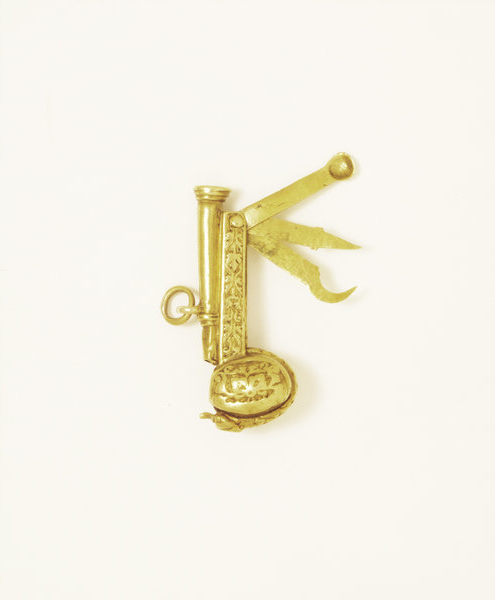

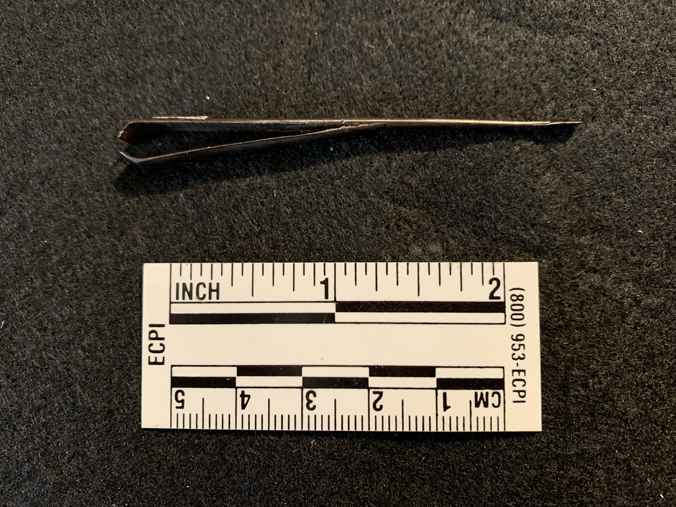

As seen by this ear spoon from our archeological study collection (meaning it wasn’t excavated at Ferry Farm), many spoons were far simpler than Anne Boleyn’s gold one. A more utilitarian, bodkin-style ear spoon in our own study collection dates from the 19th century and is made from steel and also functions as a set of tweezers.
A bodkin is a small sharp pointed tool for making holes in cloth or leather or a thicker needle used for hand-sewing. Some bodkins used by seamstresses were up to 7 inches in length and actually had an ear scoop on one end. The scoop was used to gather wax that was then applied to sewing thread to keep the cut ends from unraveling. People of means could afford to apply beeswax to their thread ends but the thriftier lady could just use the ready supply of wax from her ear.[1]
Additionally, monks and scribes used ear wax along with urine in the production of pigments for their elaborate illustrated manuscripts.
Finally, ear wax has many common medical uses. Many health manuals such as Pliny the Elder’s The Natural History recommended using the “filth from the ears” on scorpion stings or serpent bites. The Theatre of the World from 1663 stated every part the body is somewhat useful including ear wax, which “applied to the nostrils provoketh [sic] to drousinesse [sic] and sleep.” Further, medicinal recipes from history state that adding “as much ear-wax as can be got” to oil of walnuts was a speedy way of curing wounds and keeping away putrefaction.
Even as late as 1832, in The American Frugal Housewife still promoted ear wax as a way to protect wounds, stating “nothing was better than earwax to prevent the painful effects resulting from a wound by a nail [or] skewer.” Additionally, it was recommend as a remedy for cracked and dried lips.[2]
This historical medical uses of ear wax are not as bizarre as they sound. Recent studies show that ear wax has a bactericidal effect that can kill 99% of some bacteria strains. The wax contains around ten peptides that prevent bacteria and fungi from growing.
So, this winter when you have chapped lips and don’t have any lip balm handy, you can reach for some of that lovely golden wax in your ear to help solve your problems …or maybe not.
Heather Baldus
Collections Manager
[1] Mary C. Beaudry, “Bodkin Biographies” in The Materiality of Individuality: Archaeological Studies of Individual Lives, ed. Carolyn L. White, New York: Springer-Verlag, 2009, 97.
[2] L.M. Child, The American Frugal Housewife, New York: Samuel S. & William Wood, 1841, 116, https://books.google.com/books/about/The_American_Frugal_Housewife.html?id=D3AEAAAAYAAJ
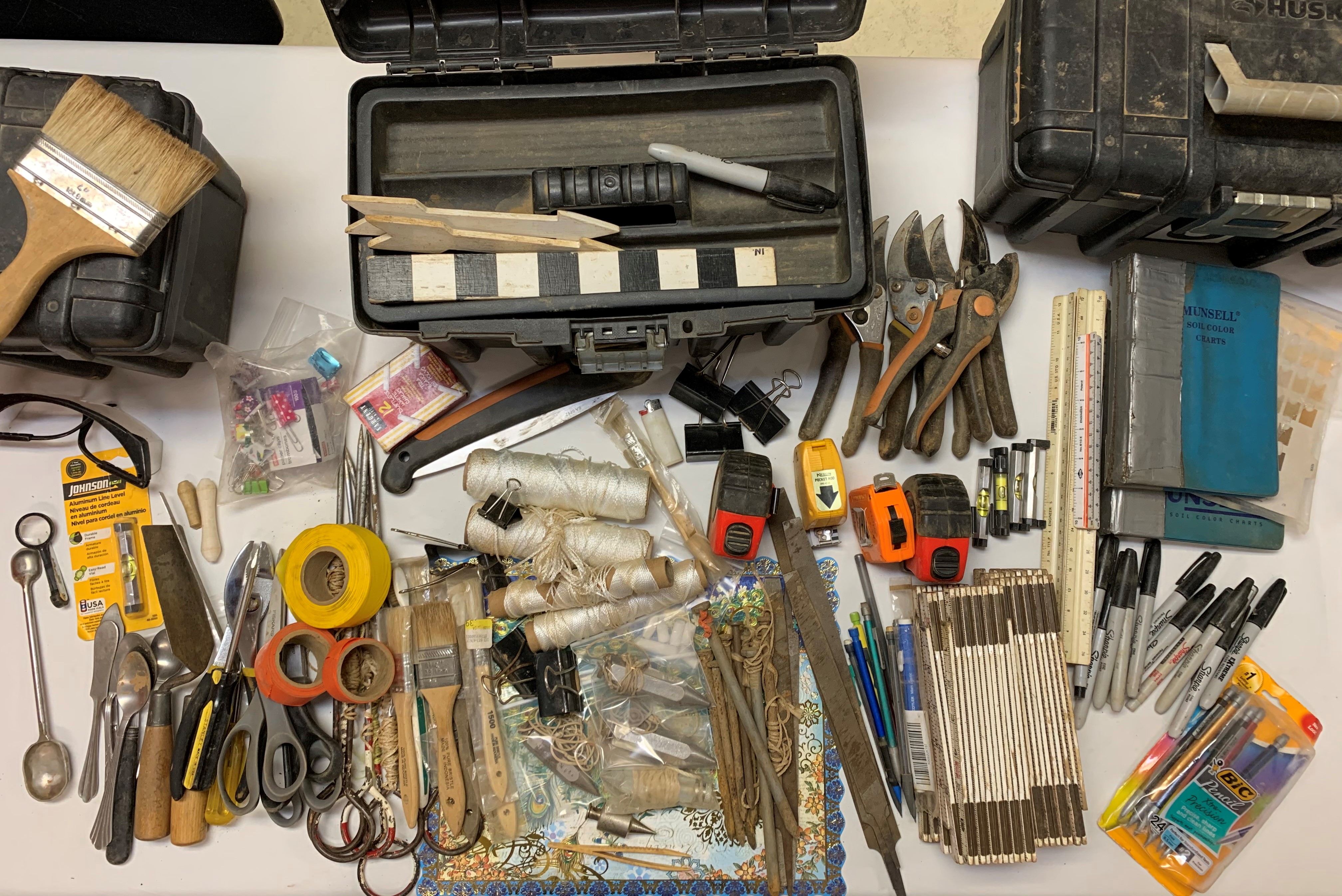
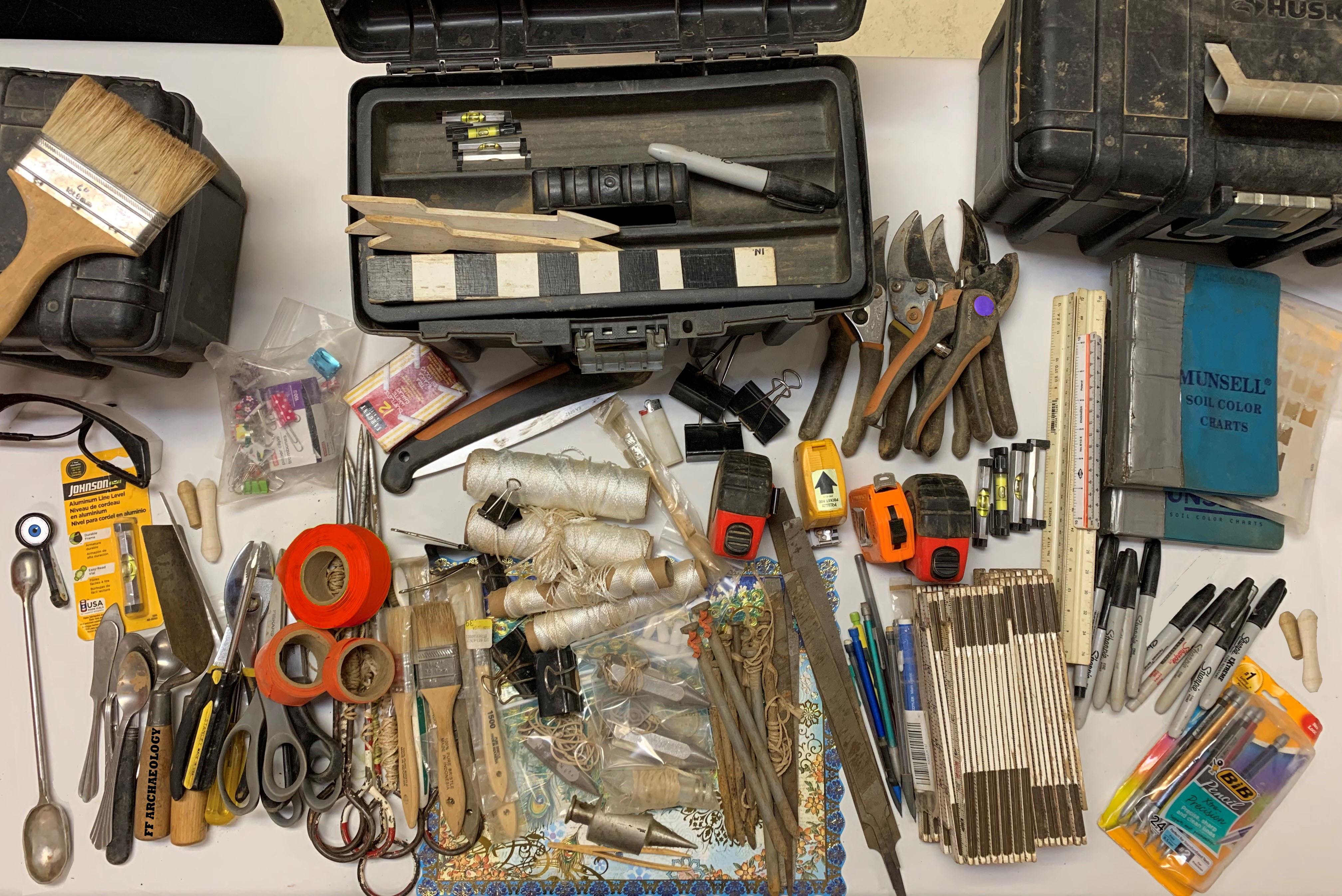
The end of the 2020 dig season at George Washington’s Boyhood Home at Ferry Farm last October required we tidy up of all our tools used during the excavation. We cleaned and stored away the multiple shovels, trowels, and wheel barrels used at the site and hauled the sifting screens back to the shed. We also securely covered the individual features and the overall site with tarp to protect them from the winter weather and roaming animals. The very last bit of cleaning was in the lab – sorting through all our toolboxes and restocking them for the next season.
Our photo illustrates the wide variety of tools we used every day in the field as we dug and recorded our findings. Can you spot fifteen differences between the two photos below? Click on each photo to enlarge it. The first photo is the original while the second photo has been altered in 15 ways.
See what changes were made here.

