Lives and Legacies

Author: ferryfarmandkenmore

  • “It is Indeed Bad to Eat Apples. It is Better to Make Them All Cider”: When Cider Reigned Supreme in America

    Happy-Thanksgiving-“It is indeed bad to eat apples. It is better to make them all cider” — Benjamin Franklin

    Name a beverage consumed by all age groups, men and women alike, the poor and the very rich, from sun up to sun down, that is touted as healthy and refreshing yet also contains alcohol.  If you were a colonial American, the answer was hard cider.  In America’s early days, cider reigned supreme and, even though the beverage is currently enjoying a resurgence in popularity, consumption of cider is nowhere near as high as it was during George Washington’s lifetime. To better understand early Americans’ obsession with cider, one must go back to the first European colonization of America (What a great idea! Let’s do that).

    It’s the early 17th century and colonists are trying to make their new home a bit more like their old home.  One sure way to do this is to bring over plants to grow the food you already like.  Sometimes, this doesn’t work very well (grapes, for example) but, sometimes, the introduced species thrive in their new environment.  Such was the case with apples.  Technically, there are already two varieties of crabapple native to the Americas but these are not especially good eating compared to domesticated apple varieties in Europe.  Ultimately, the apple became such a popular cultivar, some land grants stipulated that to claim legal ownership you had to plant apple trees to prove you intended to stay and improve the land.
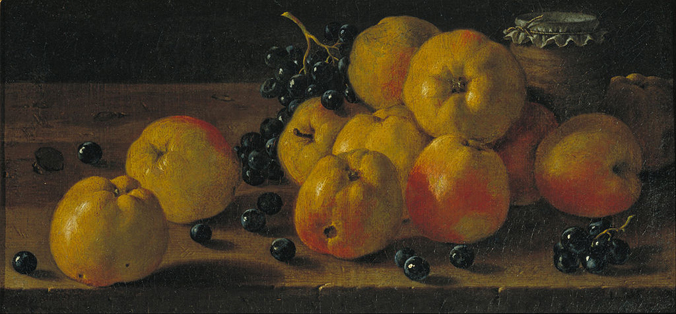
    Still Life with Apples, Grapes and a Pot of Jam (1700s) by Luis Meléndez
    “Still Life with Apples, Grapes and a Pot of Jam” (1700s) by Luis Meléndez. Credit: Museu Nacional d’Art de Catalunya / Wikipedia

    That North American climate and soil was well suited to apples was especially fortuitous since colonists were also looking for things to ferment into alcohol. Alcohol was a large part of their diet, and it just so happens that apples lend themselves very well to this end.  Think about it, in addition to providing fresh fruit, apples could be dried for storage, fed to livestock in the fall to fatten them before butchering, made into apple cider vinegar which is both useful for medicinal purposes but also a key ingredient for pickling, one of the most common preservative methods at the time, and finally turned into lots of yummy fermented beverages like, apple brandy, and applejack (we’ll talk about this interesting drink a bit later), and cider..

    Making apple cider is very simple, and it’s even simpler to make hard cider.  In fact, left to their own devices, apples practically ferment themselves since they are covered with wild yeast that loves to eat sugar and throw off alcohol as a pleasant byproduct.  So, colonists didn’t have to work very hard to turn perishable cider into hard cider, which could be stored longer.  Furthermore, if you expose hard cider to oxygen for too long, it will naturally turn into vinegar. What’s not to love?
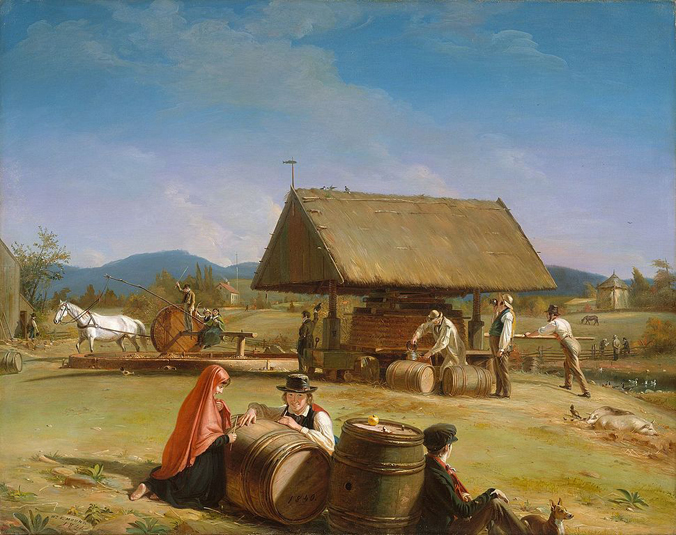
    Cider Making (c.1840) by William Sydney Mount
    “Cider Making” (c.1840) by William Sydney Mount. Credit: Metropolitan Museum of Art / Wikipedia.

    Did I mention how much cider was consumed during the colonial period?  It should be noted that even though it did contain alcohol it wasn’t necessarily considered an alcoholic drink.  John Adams drank a large glass of cider every morning (yep) and fancied himself an abstainer of strong drink.  Cider was described as healthy and a thirst quencher, likely owing to the slight carbonation which is also a byproduct of fermentation. Children regularly consumed hard cider, which isn’t nearly as horrific as it sounds when you take into account that it had a low ABV of around 3% and this probably made it safer to drink that most water available.

    However, children were not encouraged to partake of cider’s much bigger and somewhat brutish brother, applejack.  Applejack resulted when you allowed hard cider to freeze and removed the frozen water crystals, leaving the concentrated alcohol behind.  The more times this simple distillation process was repeated the stronger the applejack becomes.  This method also does little to remove impurities contained within the cider so the result can be a very high octane skull splitter, which was still much beloved of colonials.

    Although cider was a very common drink, it could also be elevated to gourmet status. Just as wine drinking has advanced to a fine art, with enthusiasts who obsess over the distinctive notes each grape produces under distinctive growing conditions, so did gentry colonists enjoy comparing fine ciders from different regions and varieties of apples.  Much was made of the ‘terroir’ of ciders, or the climate, soil, and landscape where the apples were produced.  Modern varieties of apples are much different than those available three hundred years ago so it’s interesting to ponder over the distinct flavors colonial ciders would have had, especially given that they had access to a wider variety of apples than we do today. There were thousands of varieties available across the colonies and early Republic producing thousands of distinct ciders.  So perhaps the saying should not be ‘As American as apple pie’ but rather ‘As American as apple cider’.

    Mara Kaktins, Archaeologist
    Ceramics & Glass Specialist

    Further Reading

    Brown, John Hull.  Early American Beverages. Bonanza Books, New York. 1966

    Grasse, Steven. Colonial Spirits. Abrams Image, New York. 2016

    Oliver, Sandra L.  Food in Colonial And Federal America. Greenwood Press, London. 2005

    Root, Waverly and Richard De Rochemont. Eating In America. The Ecco Press. 1995
  • Video – Historic Kenmore: An Aerial View

    Aerial footage shot and edited by Joe Brooks of EagleOne Aerial Photography.
    To learn more about Historic Kenmore and plan a visit, click here.

  • At the Kids’ Table …with George Washington?

    Happy-Thanksgiving-One of the first pieces of furniture that will arrive at the recreated Washington house at George Washington’s Ferry Farm will be the large, round dining table for the Hall.  It’s being made at a shop in Pennsylvania and we hope to have it before the end of the year.  With Thanksgiving just a week away, we wanted to take a look at the practice of dining and the furnishings it required in the early 18th century, before it became a formal ritual and before it had a dedicated room in the home.

    We’ve discussed the evolution of the dining room in colonial America in a video here on Lives & Legacies and in numerous posts on The Rooms at Kenmore. As you probably recall, dining rooms did not appear in American houses until the second half of the 18th century and then didn’t become common until the end of the century.  Prior to that point (and even for a long time afterwards), meals were taken in almost every room of the house.  Furniture was moved to wherever it was needed, to take advantage of a cool breeze on a hot summer day, or the warmth of a fireplace in the winter, or simply because the number of people to accommodate changed from day to day.

    What can be glossed over, however, is that early Americans didn’t need dining rooms because they really didn’t dine all that often.  They ate, yes, but not in any formal way, not at any set times of day, nor with set specific accessories.  Meals were simply brief breaks in the unending work of the day. Even in gentry families, everyone had a job or task that added to the family’s production.  Not everyone could break for a meal at the same time, so rarely did an entire family sit down together.  Meals weren’t considered a time to chat and catch up with family members, rather they were a perfunctory chance to refuel before moving on to the next task. The concept of the “family dinner” that we try so hard to maintain today is the product of a much later time period.

    In a household where there were fewer chairs than family members, the men got first dibs with women and children either standing to eat or sitting down after the men were finished.  There usually wasn’t a central table but rather several spots scattered around a room or rooms where a person might set their plate or bowl while eating.  Even in a household where seating could accommodate all members of the family, children were bumped from a table and chair whenever company came to visit.  They were left to find a spot to perch elsewhere.[1]

    The original Strother house at Ferry Farm was constructed during this early 18th century when meals were simply not an important part of life – none of its rooms were designated as eating spaces.   Tables and chairs that could be used for eating were found in both of the main rooms.  Even when the Washingtons enlarged the house after their purchase of it in 1738, specific rooms for dining were pretty much unheard of.

    The Washington house features a room called the Hall, which was usually the largest room in a house of the time.  The space was multi-purpose, being used for everything from sleeping space and entertaining purposes to keeping livestock warm on particularly cold nights.  As the 18th century progressed, gentry families became more refined and devoted more time to increasingly formal versions of dining and the Hall eventually morphed into the dining room (probably because of the commodious space).

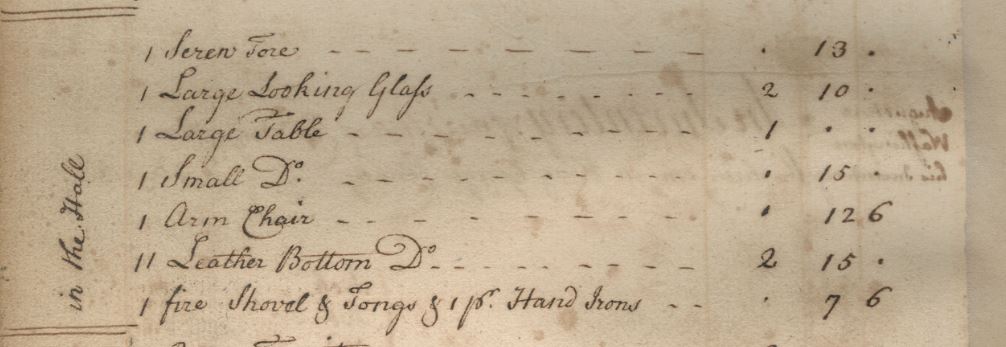
    Augustine Washington’s probate inventory gives us a glimpse into this transitional time period.  When the inventory is taken In 1743, the large room in the Washington house is still called a Hall, and it clearly has a variety of uses, but it is stocked with two tables of considerable value and 12 chairs. This indicates that more formalized meals are taking place in the room.

    Hall on the Probate
    Section of Augustine Washington’s probate inventory taken in 1743 showing the furniture and personal property listed in the Hall.

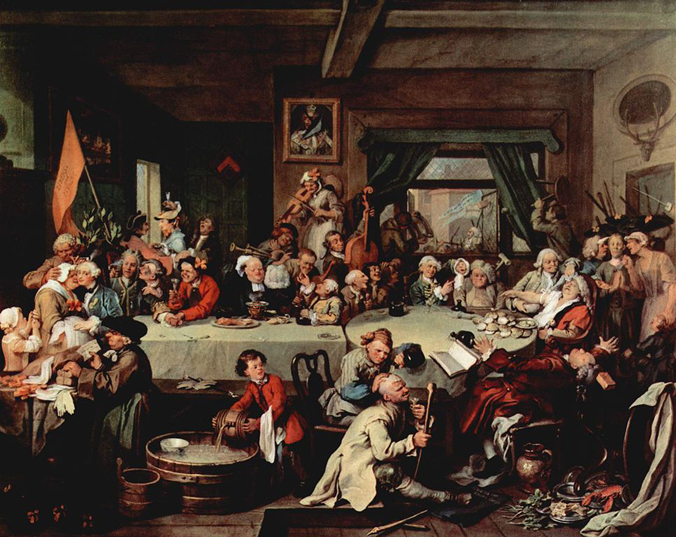
    The mention of two tables – one large and one small – in a hall or dining room pops up quite often in period inventories.[2]  The likeliest explanation for having two tables in a dining space is one that is pretty familiar to us modern Americans.  When it’s just the immediate family sitting down to a meal, you only need the one table.  But, when the house is full of visitors, perhaps for a holiday or special occasion, an extra table may need to be on-hand to seat…well, the kids.  Whereas the kids were bumped from the table to a spot on the floor to accommodate guests earlier in the century, by the 1740s, they were rating a place at a table, albeit an auxiliary one.

    An Election Entertainment Hogarth 1754
    “An Election Entertainment” (1754) by William Hogarth. The painting shows a Whig banquet thrown to win votes through food and drink, a common practice in both England and the Colonies. Two dining tables – a rectangular one and a round one – are visible. Credit: Sir John Soane’s Museum / The Yorck Porject / Wikipedia.

    Interestingly, the contents of the Washington Hall at Ferry Farm mirrors almost exactly the contents of the Dining Room at Kenmore nearly 40 years later: one large table (identified as oval-shaped at Kenmore), 1 small table (identified as square at Kenmore), a large set of chairs (15 at Kenmore, 12 at Ferry Farm), one large looking glass, and a desk (a bookcase-on-desk at Kenmore and an escritoire at Ferry Farm).  Even in a very formal, elite house like Kenmore, there were still two separate tables to accommodate an overflow of diners and a desk, indicating multiple uses for such a large room.

    We often find parallels between Kenmore and the Washington house in our research.  Betty Lewis learned her skills as mistress of the house under her mother’s tutelage at Ferry Farm, and so it seems logical that there would have been things that she did at Kenmore “just like mom.”  In furnishing the Washington Hall, we’ve decided to draw a visual connection between it and the Kenmore Dining Room, using one large round dining table and one small square table.  In fact, the reproduction table being made in Pennsylvania for the Washington house is based on the round table from our collection that is currently on display in the Kenmore Dining Room.

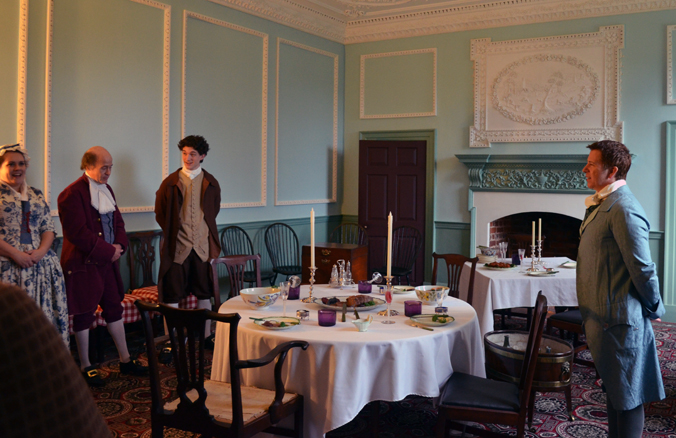
    Kenmore Dining Room on 12th Night
    Kenmore’s Dining Room with both the round and square tables displayed during a performance of the annual holiday theatrical drama “Twelfth Night at Kenmore” each year in early January.  This season’s performances will take place January 5, 6, and 7. Visit kenmore.org for details.

    So, as you make preparations for Thanksgiving, if anyone in your household grouses about being relegated to the kids’ table this year, just tell them to remember the Washingtons.  In their house, even George sat at a kids’ table and it was a pretty big step up!

    Meghan Budinger
    Aldrich Director of Curatorial Operations

    [1] Carroll, Abigail. Three Squares: The Invention of the American Meal.  Basic Books, 2013.

    [2] The Probing the Past database of probate inventories from Virginia and Maryland during the 18th and early 19th century is a wealth of information.  Here are links to just three inventories that show the table configuration discussed here:

    http://chnm.gmu.edu/probateinventory/document.php?estateID=287

    http://chnm.gmu.edu/probateinventory/pdfs/wshgtn43.pdf

    http://chnm.gmu.edu/probateinventory/document.php?estateID=122


  • When George Washington Almost Joined the British Royal Navy

    Not long ago, we explored Three Military Adventures that Inspired George Washington and the influence that Lawrence Washington and his wartime service played in stoking George’s interest in military matters.

    Lawrence fought with the British in the War of Jenkins’ Ear in the early 1740s and spent time aboard the flagship of Admiral Edward Vernon, who commanded British forces during the Battle of Cartegena de Indias.  Lawrence returned to Virginia with stories sure to spark his 10-year-old brother George’s imagination and desire for adventure.  Lawrence’s military service and George’s interest in military things had a fascinating, if perplexing, practical outcome when, late in 1746, Lawrence proposed for 14-year-old George to join the Royal Navy.

    Lawrence Washington attributed to Gustavus Hesselius (c 1738)
    Portrait of Lawrence Washington attributed to Gustavus Hesselius (c. 1738). Credit: Wikipedia / Mount Vernon.

    This is a relatively little known and rather mysterious incident in the life of young George Washington.  Few documents survive that address the matter directly.  There are no documents written by George, Lawrence, or Mary Washington that reveal their actions or motivations in the matter.  The three letters that do address the incident were all written by secondary figures involved.

    It all began in the fall of 1746 when Lawrence sent two letters — one each for George and Mary respectively – to Fredericksburg via Colonel William Fairfax.  George was to deliver Mary’s himself and keep the one to him a secret from her.  We do not know what either of these letters said.

    What we do know is only what William Fairfax told Lawrence in a report dated September 9, 1746 and sent to Lawrence at Mount Vernon.  Fairfax wrote:

    “The weather being so sultry, and being necessarily obliged to go about this town to collect several things wanted, I have not yet seen Mrs. Washington.  George has been with us, and says He will be steady and thankfully follow your Advice as his best Friend.  I gave him his Mother’s letter to deliver with Caution not to shew his.  I have spoke to Dr. Spencer who I find is often at the Widow’s and has some influence, to persuade her to think better of your advice in putting Him to Sea with good Recommendation.”[1]

    The Dr. Spencer mentioned may have been William Spencer, who often was involved as a witness for land transfers to Lawrence.  The secretiveness of George hiding his letter from Mary and of Lawrence apparently enlisting his business partners to argue in favor of the proposal for George to go to sea emphasize the conspiratorial nature of Lawrence’s efforts.

    It appears that, for a time, Lawrence’s manipulations may have worked.  On September 18, 1746, Robert Jackson, a Washington family friend, wrote to Lawrence that “I am afraid Mrs. Washington will not keep up to her first resolution.”  This seems to indicate that she wasn’t against the idea immediately but she did change her mind.  Jackson reported that Mary “seems to intimate a dislike to George’s going to Sea and says several Persons have told her it’s a very bad Scheme.”  He condescendingly dismisses her concerns as “trifling objections such as fond and unthinking mothers naturally suggest” and expresses frustration that “one word against [George’s] going has more weight than ten for it.”

    Jackson noted that William Fairfax was inclined to visit Mary and, moreover, Jackson noted that he himself would “take an opportunity to talk with her and will let you knew her result.”[2]  While Jackson may have let Lawrence know the result, no document has been found to let us know the result of these specific discussions two centuries later.

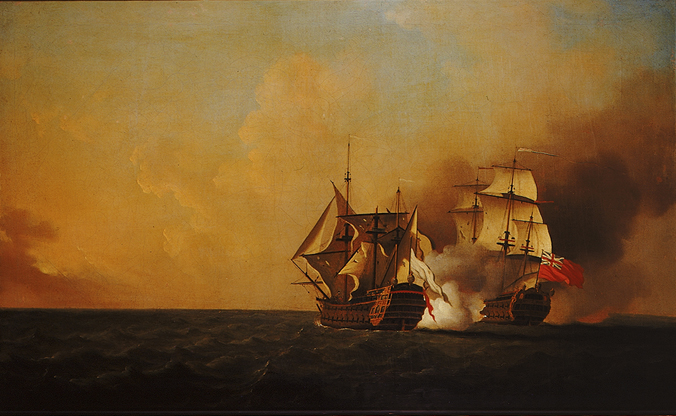
    Action Between Nottingham and Mars, 1746 by Samuel Scott
    “Action Between Nottingham and Mars” (1746) by Samuel Scott depicts a British-French naval battle in October 1746 when the Washingtons were debating whether George should join the Royal Navy. Credit: Wikipedia/National Maritime Museum.

    At some point, perhaps feeling outnumbered, Mary decided to solicit the advice of her brother Joseph Ball in England.  Dated May 19, 1747, his reply, which is a disdainful rejection of the entire proposal, is worth quoting at length.

    “I understand that you are advised and have some thoughts of putting your son George to sea.  I think he had better be put apprentice to a tinker, for a common sailor before the mast has by no means the common liberty of the subject; for they will press him from ship to ship where he has fifty shillings a month, and make him take twenty-three, and cut and slash and use him like a negro, or rather like a dog.  And as to any considerable preferment in the navy, it is not to be expected, as there are so many gaping for it here who have interest, and he has none.  And if he should get to be master of a Virginia ship (which is very difficult to do), a planter who has three or four hundred acres of land, and three or four slaves, if he be industrious, many live more comfortably, and have his family in better bread than such a master of a ship can . . .  He must not be too hasty to be rich but go on gently and with patience as things will naturally go.  This method without aiming at being a fine gentleman before his time, will carry a man more comfortably and surely thought the world than going to sea, unless it be a great chance indeed.”[3]

    Mary must have ultimately and definitely rejected Lawrence’s plan, a courageous act for a woman in male dominated colonial Virginia.  George, of course, did not pursue a career at sea but turned to surveying instead.

    Like many incidents in young George Washington’s life, the historical record is elusive and often raises more questions than it answers.  What prompted Lawrence to make the suggestion in the first place?  What were George’s views on the proposal and the debate?  What were Mary’s specific objections?  None of these questions may ever be answered.  Of course, the greatest question raised by the incident is the also unknowable counterfactual one.  Would history have unfolded differently if the man who was supposed to have been the commander of the Continental Army ended up spending his life on the King’s ships?

    Zac Cunningham
    Manager of Educational Programs

    [1] William Fairfax to Lawrence Washington, September 9, 1746, quoted in Moncure Daniel Conway’s Barons of the Potomack and the Rapphannock, New York, Grolier Club, 1892: 238, available at https://books.google.com/books?id=zDESAAAAYAAJ&dq=barons%20of%20the%20potomac%20and%20rappahannock&pg=PP1#v=onepage&q&f=false [accessed August 26, 2017].

    [2] Robert Jackson to Lawrence Washington, September 18, 1746, quoted in Moncure Daniel Conway’s Barons of the Potomack and the Rapphannock, New York, Grolier Club, 1892: 239-40, available at https://books.google.com/books?id=zDESAAAAYAAJ&dq=barons%20of%20the%20potomac%20and%20rappahannock&pg=PP1#v=onepage&q&f=false [accessed August 26, 2017].

    [3] Joseph Ball to Mary Washington, May 19, 1747 quoted in Marion Harland’s The Story of Mary Washington, New York: Houghton, Mifflin & Co, 1893: 79-80 available at https://archive.org/details/storyofmarywashi00harl [accessed August 26, 2017].

  • The Colorful Glass Tablewares of the Washington Household

    As work continues on the reconstructed Washington family home at Ferry Farm, we archaeologists are identifying items that were owned by the Washingtons so we can eventually fill the reconstructed house with plates, bowls, glasses, and many other objects based on artifacts we’ve discovered.  In a previous blog post, we looked at some of the fancy colorless glass that adorned the Washington family’s dining table.  While this clear glass definitely dominates our collection, we’ve also discovered quite a few vessels of colored glass including deep cobalt blue, amethyst, smoky quartz, and milky white.

    Glass is made from silica sand, soda ash, and lime. Its color is dictated, in part, by impurities in the silica sand such as iron which causes the glass to turn the dark shades of green seen in early colonial wine bottles.

    Early glassmakers found ways to reduce the amount of this iron and created colorless glass. Colorless glass was by far the most common used as tableware. Much of the clear glass on Mary Washington’s table was also made with a lead oxide additive, which achieved the desired “crystal clear” look and produced heavier and more refractive table glass.

    Early glassmakers also found that when other types of metal oxides were added to the silica sand, soda ash, and lime, the result was different colors of glass. This colored glass could still be infused with some amount of lead oxide to give it clarity.

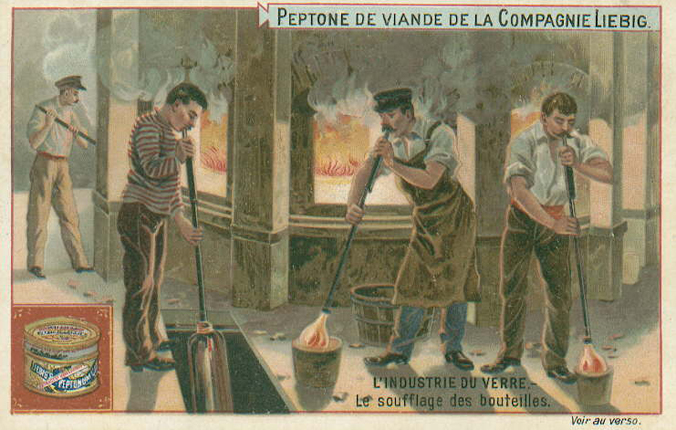
    Glassblowing
    French glass blowers at work. Credit: Bill Lindsey / Society for Historical Archaeology

    The glass belonging to the Washingtons discussed below was handmade in the 1700s, meaning it was mouth-blown by a skilled glass blower and, in some cases, hand decorated.

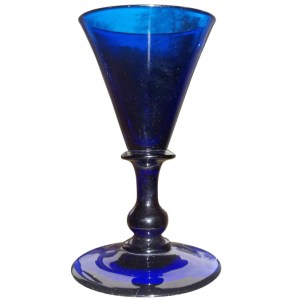
    Cobalt Blue Goblet or Wine Glass
    Our first piece is a base sherd with partial stem.  The beautiful sapphire color of this sturdy stemware was created using cobalt oxide as a coloring agent.

    Cobalt Blue Goblet Base
    Cobalt Blue Goblet Base

    Likely made in England, it has a rather hefty base compared to our other stemwares and belonged to a goblet or wine glass. Any number of beverages could have been held in this glass, although today we commonly associate goblets with water and wine glasses with, well, wine.

    Cobalt Blue Goblet
    Cobalt Blue Goblet

    Smoky Quartz Wine Rinser
    The wine rinser has passed out of use in modern society.  It was used on the formal gentry table for washing wine glasses between uses or meal courses. When a new wine was brought to the table, the glasses would be placed in the rinser to flush the previous wine from the glass.  The small spouts on either side are meant to support an upside-down wine glass by the stem in water.

    Wine Glass Rinser with Wine Glass
    Wine Glass Rinser with Wine Glass

    Not only did tableware like this reflect wealth enough to afford multiple wines and meal courses, it was also a colorful piece that stood out among the colorless wine glasses on the table. The smoky-colored lip fragments and the thin, blue green fragments in our collection are believed to be from two different wine rinsers.

    The smoky fragment is a rather unusual color but was created with similar metal oxides as the blue/green piece. Greys, greens, and colors-in-between are created using mixtures of iron, chromium, and copper. Adding cobalt to this mix created variations of blue/green.

    The amethyst rinser pictured below is from our own collection at Historic Kenmore. Amethyst glass was created using manganese and sometimes nickel.

    92.001.7
    Amethyst Wine Rinser from the Historic Kenmore collection.

    Enameled Milk Glass Tumbler
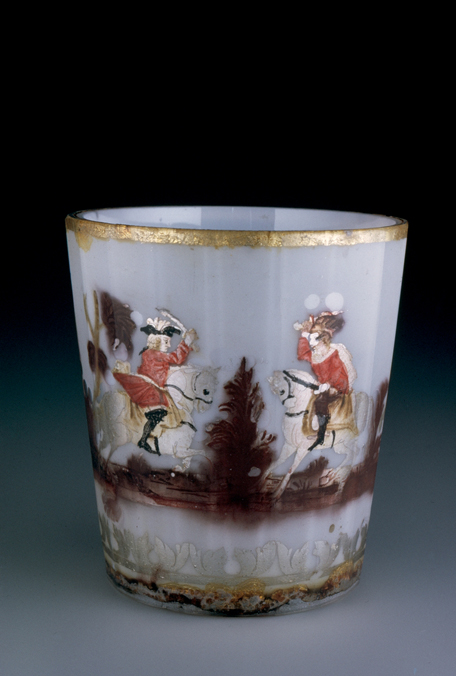
    This tumbler or beaker fragment is made from opaque white or ‘milk’ glass and was produced by adding tin or zinc oxides, fluorides, and phosphates to the glass.  Germany was known for its production of milk glass but it was produced in other parts of Europe as well. In general, tumblers were used for mixed alcoholic beverages and, like other table wares, reflected the status the owner wanted to present to visitors.  Although it is difficult to see, this vessel was hand-painted or ‘enameled’.  Centuries in the dirt were not kind to the decoration, however, and we are left only with a ghost of the original painting known as a ‘fugitive design’.

    Enameled Milk Glass Tumbler
    Milk glass with fugitive design recovered by Ferry Farm archaeologists.

    At one time, this glass was vibrant and colorful and was likely gilded with gold leaf like the German example pictured below.

    51.3.224-opt
    51.3.224, Collection of The Corning Museum of Glass, Corning, New York.

    Amethyst Glass
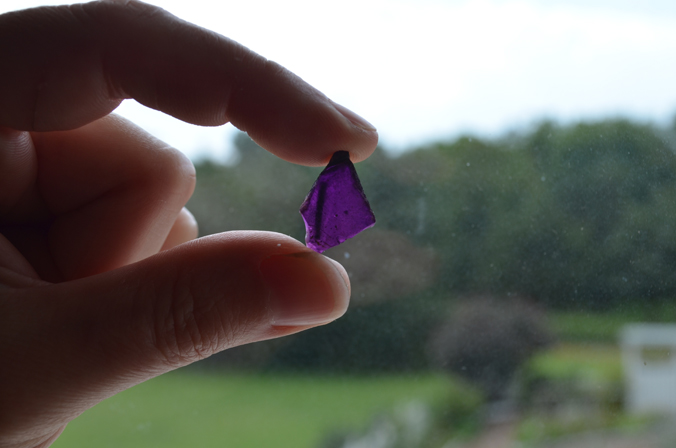
    We only have a small fragment of deep purple amethyst glass, and cannot determine a vessel form without a bigger piece.

    Amethyst Glass (2)
    Small piece of amethyst glass recovered archaeologically at Ferry Farm.

    Again, like with the other colored pieces of tableware, amethyst was for formal dining and a showpiece to visitors. The shape and faceting of this fragment may have resembled this circa 1800 amethyst goblet.One of the rarer table glass colors is Amethyst. As mentioned earlier, this color was created with the addition of manganese and sometimes nickel as a coloring agent.

    RS2010_3_13_500x
    2010.3.13, Collection of The Corning Museum of Glass, Corning, New York, Gift of Dr. Charles Lothridge

    Follow Lives & Legacies for updates on the Washington family’s glasswares we are identifying at Ferry Farm. More discoveries await!

    Elyse Adams, Archaeologist
    Artifact Cataloger & Field Monitoring Technician

    Mara Kaktins, Archaeologist
    Ceramic & Glass Specialist

    Source:

    Mackay, James. Antiques at a Glance: Glass.PRC Publishing Ltd. London. 2002. Print.

  • Video – Building George’s House: Oyster Slaking

    In this video, stone and brick mason Ray Cannetti and his crew turn burnt oyster shells from last summer’s lime rick burn into powdered lime to use in mortar in the reconstructed Washington house chimneys.

    Learn more about the Washington House here and view other videos, photos, and blog posts about the project at here.

  • Getting “Judgy” With Colonial Revival Ceramics

    Furnishings posts logo finalPreviously on Lives and Legacies, curator Meghan Budinger laid out a wonderful summary of the Colonial Revival movement.  At no point did she weigh-in with her opinion of Colonial Revival and she should be applauded for her diplomacy.  To be honest, though, many historians, material culture specialists, and decorative arts enthusiasts (among others) can get a little ‘judgy’ when it comes to Colonial Revival.

    Copies of copies rarely turn out as nice as the original and, as Meghan discussed, Colonial Revival items conform more to our notion of how things looked in the 18th century than how they actually looked in the 18th century.

    When dealing with ceramics, Colonial Revival copies are almost always ‘clunky’ compared to the beauties they seek to emulate.  This is because the reproductions are machine made, while the colonial originals were handmade and hand-decorated. It’s very hard to imitate that kind of craftsmanship with a machine.  Experts call it being ‘debased’.  The copy is simply of a lower quality and slightly distorted.

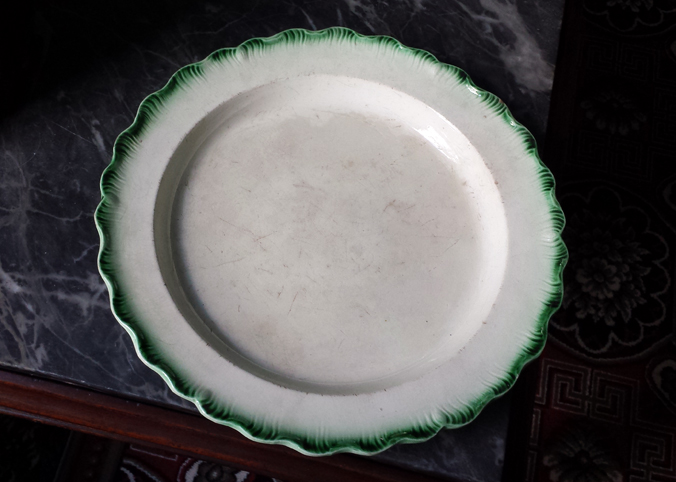
    Take for example this, um, interesting platter made between 1935 and 1941 by The Homer Laughlin China Company. It is a hideous imitation of the beautiful shell edge decoration popular in the late 18th and first half of the 19th century.  Of course, not all Colonial Revival is quite this debased as this extreme example.

    Colonial Revival Ceramics 3
    This 20th century Colonial Revival reproduction made by The Homer Laughlin China Company is a ‘debased’ version of a shell edge platter from the 18th century pictured below.

    Colonial Revival Ceramics 4

    Some are actually pretty accurate, like this tasteful white granite pitcher or this stoneware mustard pot, which dates from 1993.  I’m pretty sure it came from The Cracker Barrel.

    Colonial Revival Ceramics 2
    Colonial Revival white granite pitcher.
    Colonial Revival Ceramics 1
    Colonial Revival stoneware mustard pot dating from 1993 and perhaps sold by The Cracker Barrel.

    It just so happens that our awesome team of specialists (curators and archaeologists – a fun bunch) are currently furnishing the Washington house at Ferry Farm with reproductions the public may handle as we create an interactive house. Original 18th century objects are not an option.  Good colonial reproductions can sometimes cost as much as originals and can also be surprisingly hard to find.  Thus, despite our prejudices, we’re finding ourselves extremely grateful for the glut of Colonial Revival tea and tablewares currently on the market.

    Colonial Revival pieces are often quite sturdy, relatively inexpensive, and no member of our staff will dissolve into tears if a stoneware crock with cobalt blue hand-painted decoration originally purchased at The Cracker Barrel in 1997 broke.  We might actually celebrate it.  And so we hunt for modern items that straddle the line between historically accurate and, if need be, expendable.  We are diligently scouring auction sites, thrift and junk shops, antique markets, and sometimes our own cupboards in our never ending quest for Colonial Revival.  We will be sure to keep you updated on our progress and hope you can visit the Washington House to see how we did!

    Mara Kaktins, Archaeologist
    Ceramics & Glass Specialist

  • George’s Hometown: Kenmore

    As George Washington’s Ferry Farm prepares to celebrate the reconstruction of the Washington house, we traveled around George’s hometown – Fredericksburg, Virginia – to visit a few places important in the transformation of George from boy to man.

    Fredericksburg remained important to George Washington throughout his life. It was the home of Mary Ball Washington, his mother, until her death on August 26, 1789 at the age of 80 from breast cancer. It remained the home of Betty Washington Lewis, his sister, until 1795 when she was forced by financial circumstances to leave the grand house she and husband Fielding Lewis, a wealthy merchant, had built to live at Mill Brook, a farm in Spotsylvania County.  Washington visited his mother as well as his sister and brother-in-law regularly but, as the years passed, these visits became more and more infrequent as the Revolution and Presidency required all his time and attention.  George Washington visited Betty and Fielding at Kenmore once in 1784.

    George's Hometown 5
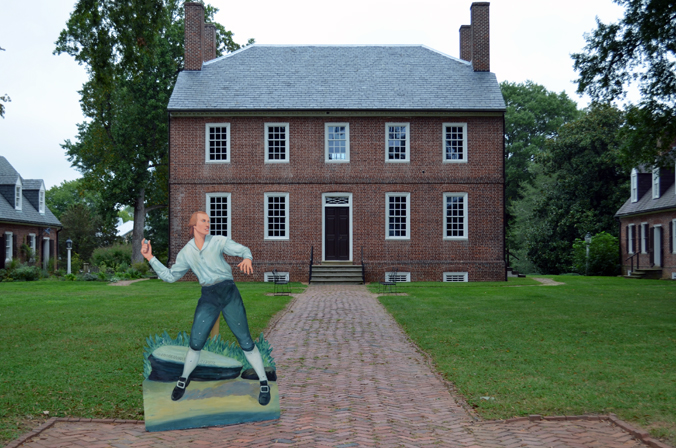
    Historic Kenmore

    Join us at the Washington House Celebration on Saturday, October 7, 2017 from 12:00 p.m. – 4:30 p.m. to celebrate the construction of the Washington house! A special ribbon-cutting ceremony will begin at 1:30 p.m. featuring notable speakers. After the ceremony, guests will be invited to view the reconstructed Washington house!

    Ferry Farm opens to visitors at noon on Saturday, October 7.

    DSC_3072
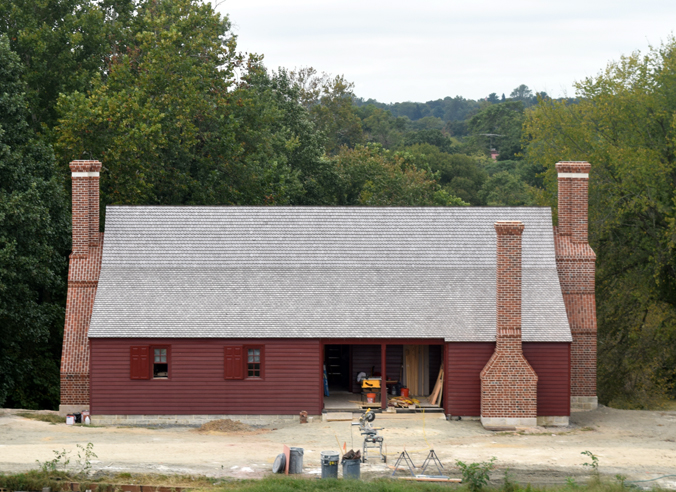
    The reconstructed Washington house at Ferry Farm.

    PLEASE NOTE: PARKING for the event is off site at the VRE Fredericksburg Park and Ride Lot G at the corner of Prince Edward Street and Frederick Street. Buses will transport guests to and from Ferry Farm—traveling from the VRE lot to Ferry Farm on a regular schedule from 11:45 a.m. to 1:15 p.m., and 3:00 p.m. to 4:15 p.m. Bus transportation will pause during the ribbon-cutting ceremony. The last bus will depart Ferry Farm at 5:15 p.m. Limited handicap parking is available at Ferry Farm.

  • “A Silly Bauble”: Ferry Farm’s Sputnik Moment

    EDITOR’S NOTE: Sixty years ago today, the Soviet Union launched Sputnik, Earth’s first artificial satellite, into orbit.  It was an event with consequences, both great and small, that spanned the globe, even reaching Ferry Farm, once the boyhood home of George Washington, in Virginia. Today, we reshare this blog post about Ferry Farm’s Sputnik moment.

    Sputniks and mutniks, flying through the air,
    Sputniks and mutniks, flying everywhere,
    It’s so ironic. Are they atomic?
    Those funny missiles have got me scared.
    -Lyrics from “Sputniks and Mutniks” by Ray Anderson and the Home Folks (1958)

    sputnik
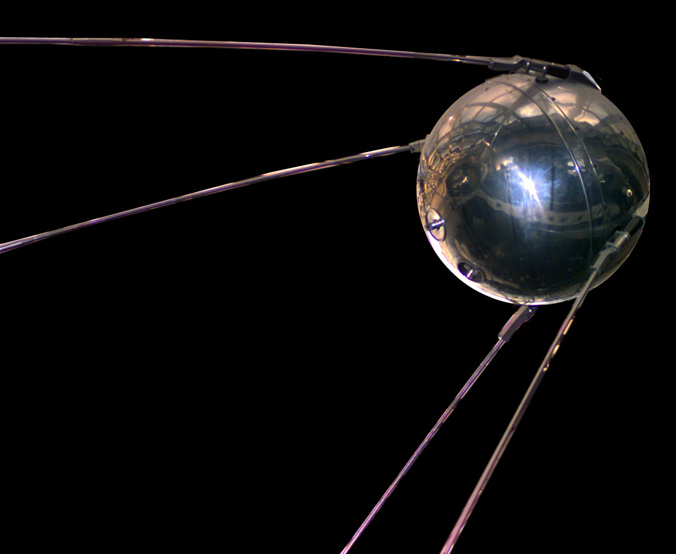
    A replica of Sputnik at the National Air and Space Museum in Washington, DC. Credit: NASA/Wikipedia.

    “Beep, Beep, Beep…” went the sinister telemetry signals from the Earth’s first artificial satellite.  Launched by the Soviet Union on October 4, 1957 — 59 years ago today — those irritating beeps, which can be heard below, provided undeniable evidence of the successful launch. It occurred during the Cold War between the Communist East and the Capitalist West, and represented the dawn of the space age. Embedded within Sputnik were two radio transmitters that, using a single watt of power, broadcast a series of beeps received by radios and televisions all over the world. These beeping sounds frightened some, who mistrusted the technological breakthrough and its potential military applications.


    awake-at-last
    Uncle Sam is “Awake at Last” from his bed of complacency while Sputnik can be seen through the window hurtling across the sky transmitting it’s urgent ‘beep.’ Cartoon by Edwin Marcus. Credit: Library of Congress

    Sputnik roused considerable political anxiety on the part the United States, a country determined to perfect satellite technology and to engage in cosmic exploration.  They underestimated the progress of the Soviet program. Today, in popular parlance, a “sputnik moment” refers to being spectacularly caught off guard by the unanticipated advancements of a rival. President Obama incorporated “Sputnik moment” in his 2011 State of the Union Address designed to encourage investment in research and technology.

    At the height of the crisis in 1957, the Eisenhower administration referred to Sputnik as “…a silly bauble….” The satellite represented a rather modest accomplishment whose engineers prioritized being first in orbit over producing a sophisticated data-gathering tool. Recently, some scholars have suggested that the satellite was a bit of a ‘bluff’ to make the United States believe that the Soviet program was more sophisticated than it was.  Like many martial ‘bluffs,’ the impact was far-reaching and it exacerbated and escalated an already frigid Cold War.

    About the size of a beach ball, Sputnik orbited less than 600 miles above earth. Each orbit lasted 96 minutes. The National Aeronautics and Space Administration (NASA) was created in 1958 as a response to this (perceived) technological “wake up” call. Nationally, efforts to strengthen primary school science education ensued and encouraged more students to seek technologically-oriented careers in service of a more robust space program.

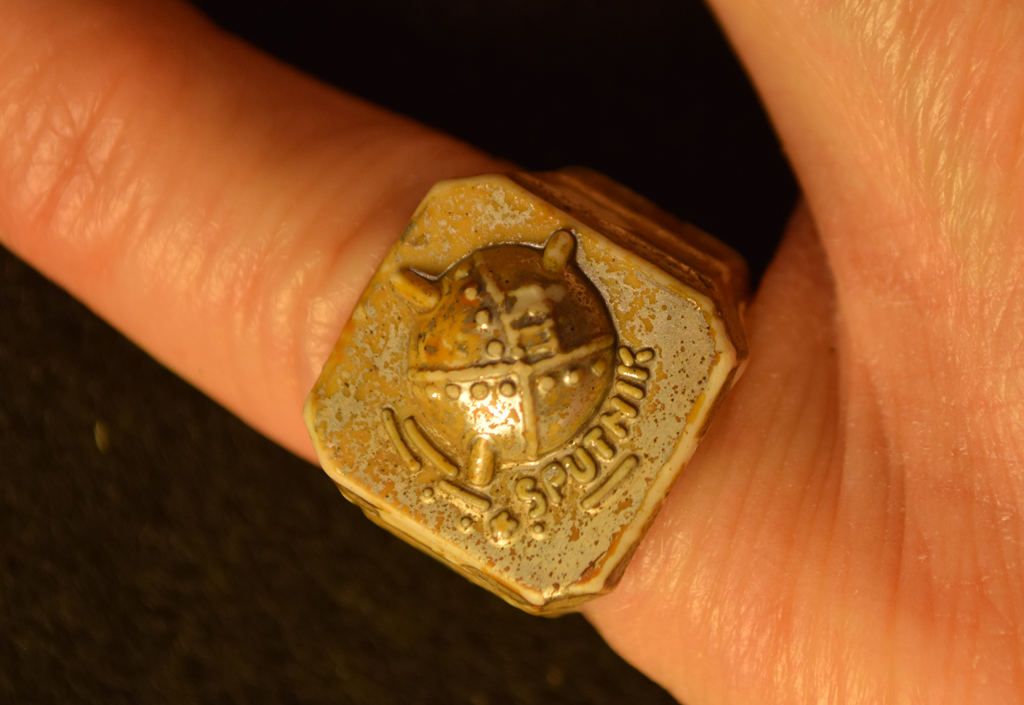
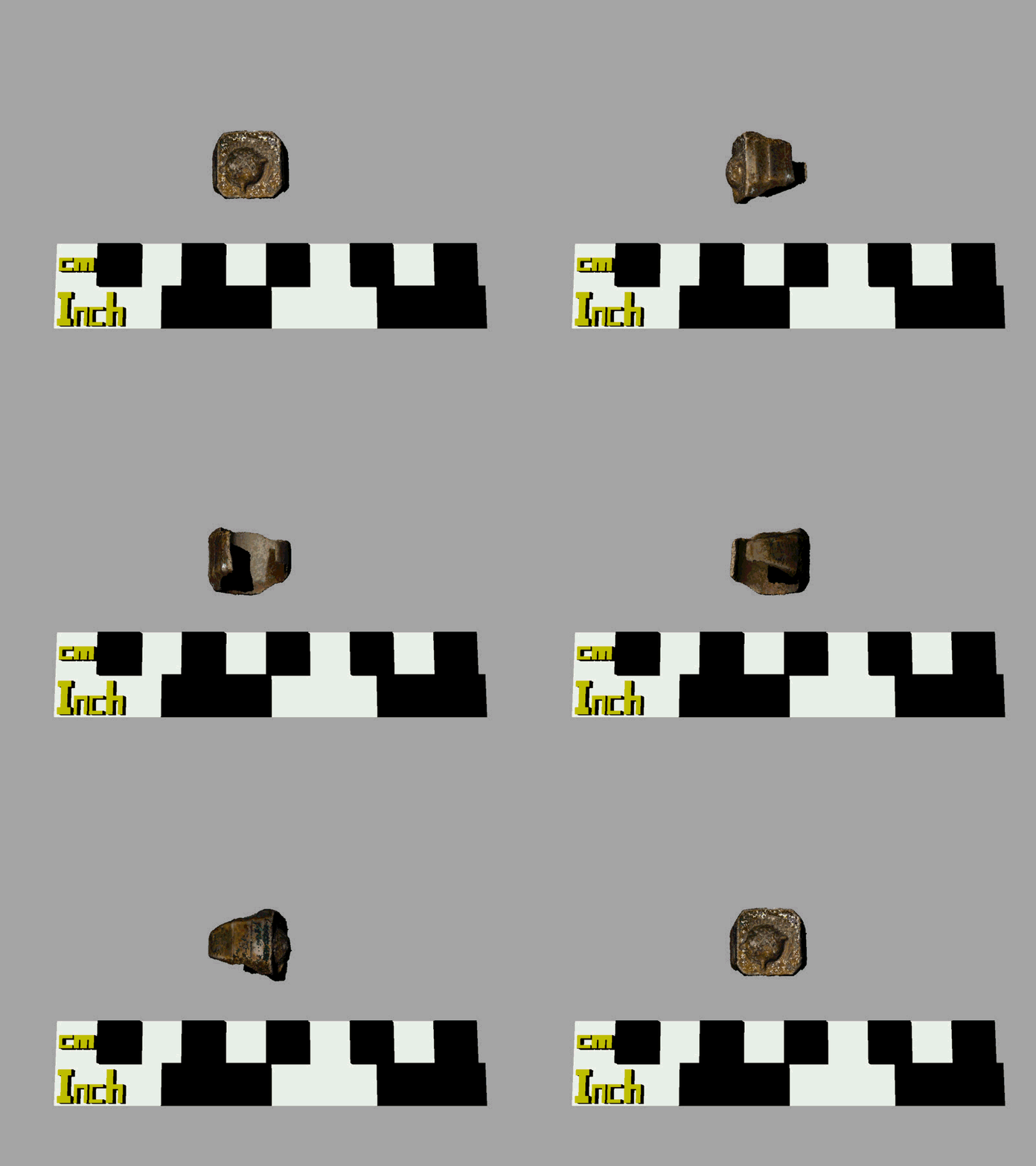
    In 2014, Ferry Farm archaeologists unearthed a tangible prize from this moment: a plastic toy “Sputnik” finger ring. Remember that Ferry Farm remained home to a variety of individuals and families in the centuries since the Washingtons lived there.  The flashy gold-colored ring, originally dispensed from a gumball machine, featured an idealized image of the satellite and the word “SPUTNIK.” It was no doubt cherished by its original owner, and envied by the prospective young space explorer’s friends.

    sputnik-ring-2
    The Sputnik ring recovered archaeologically at George Washington’s Ferry Farm.
    sputnik-ring-3
    A 3D image of the Sputnik ring.

    As an archaeologist, the find confused me: why would toys commemorating Soviet satellites exist in the United States?  Who would buy this celebratory object for their child? For goodness sake this land had once been Washington’s home, first president of the definitely-not communist United States. I foremost saw the object through a politico-military lens, rather than as a space-age wonder for all people.

    In popular American culture of the late 1950s, the surprise of Sputnik frequently was one of delight rather than apprehension. For some, those cosmic beeps were inspirational, promising future space travel and technological progress. From this new age of cosmic exploration emerged songs, dance, theatre, literature, and graphic art.

    A generation of young Americans, enthralled by science fiction adventures of Buck Rogers and Flash Gordon, could not contain their excitement.  They were captivated by the real-life manifestation of their outer space fantasies. The launch excited children who dreamed of the day they might defend the earth against hostile invaders from space. Kids who spent their school days engaged in “duck and cover” drills ironically raced out to their back yard for a glimpse of the Soviet technology racing across the night sky.

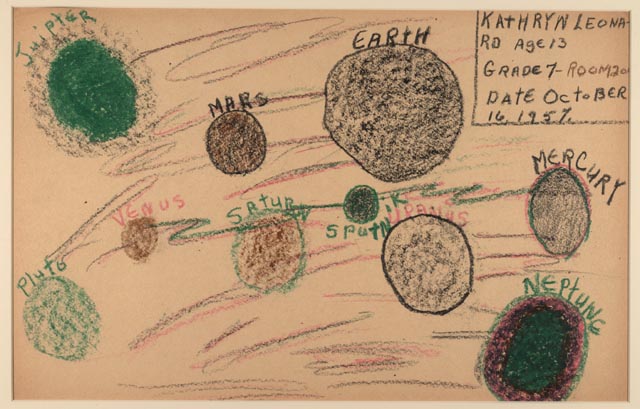
    childs-drawing-1
    American child’s drawing of Sputnik by a female, aged 13, October 18, 1957. Crayon on paper. Credit: Manuscript Division, Library of Congress (252L)
    childs-drawing-2
    American child’s drawing of Sputnik by a female, aged 13, October 16, 1957. Crayon on paper. Credit: Manuscript Division , Library of Congress (252h)

    The satellite orbited the earth for three months, though its radio signals tactfully subsided after three weeks.  Sputnik’s orbit eroded 4 January 1958.  Its effects were as far reaching as they were long lasting.

    The Sputnik launch garnered a diverse array of reactions nationally and internationally: pride, disquiet, excitement, imagination, and infinite inspiration. The rich variety of these responses led to the creation of a wide range of material culture – objects as small and inexpensive as a child’s toy ring and as massive an investment as the Kennedy Space Center. People created – and experienced – music, technology, literature, dance, and theatre that allowed them to understand this event in ways relevant to their own lives.   These responses reflect humankind’s desire to comprehend pivotal events that are beyond their control through personal agency.  Material culture – artifacts – gives us the capacity to participate in, to understand, and to ‘own,’ grand events that are larger than we are.

    This was true in the past as well, as the assorted artifacts analyzed daily at Ferry Farm attest. Prehistoric ground stone tools were an astonishing advancement in their time: this technology allowed our ancestors to maximize the nutritional benefits of nuts, seeds, and grains, to fell trees that made dwellings more comfortable, and to toss spears farther and with greater force. Such scientific wonders no doubt inspired non-ground stone-producing peoples to invest in technological developments of their own.

    Have a Sputnik moment! Let’s redefine the phrase to commemorate the boundless scientific and artistic creativity that the launch stimulated, rather than the political anxiety that emerged. Create a technologically- or arts-inspired marvel of your own! Don’t avoid sputnik moments… pursue them.  Show your support for World Space Week, which is held annually October 4-10. To learn more about this year’s events: http://www.worldspaceweek.org/

    Laura Galke, Archaeologist
    Site Director/Small Finds Analyst

    Further Reading

    Blair, Elizabeth
    2007  “Sputnik in Space and Song.”  National Public Radio.  Accessed 15 September 2016. http://www.npr.org/temptates/story/story.php?storyId=14937486.

    Blough, Glenn O.
    1957  “Children, Put Away Your Sputniks.”  The Science Teacher 24(8):373-374.

    Bonner, Thomas N.
    1958  “Sputniks and the Educational Crisis in America.”  The Journal of Higher Education 29(4):177-184, 232.

    Brandau, Daniel
    2015  “Demarcations in the Void: Early Satellites and the Making of Outer Space.”  Historical Social Rsearch/Historische Sozialforschung 40(1[151]):239-264.

    Cowen, Ron
    2007  “Sputnik + 50: Remembering the Dawn of the Space Age.”  Science News 172(14):216-217, 221.

    Kabakchi, V. V. and Charles Clay Doyle
    1990  “Of Sputniks, Beatniks, and Nogoodniks.”  American Speech 65(3):275-278.

    Launius, Roger D.
    2009  “Abandoned in Place: Interpreting the U.S. Material Culture of the Moon Race.”  The Public Historian 31(3):9-38.

    Moskowitz, Clara
    2012  “How Sputnik Changed the World 55 Years Ago Today”.  Space.com. http://www.space.com/17894-sputnik-anniversary-changed-the-world.html.  Accessed 14 September 2016.

    Osgood, Kenneth
    2006  Total Cold War: Eisenhower’s Secret Propaganda Battle at Home and Abroad. Lawrence, KS: University of Kansas Press.

    Starnes, Bobby Ann
    2011 “Change, Sputnik, and Fast Food.”  The Phi Delta Kappan 92(7):72-73.

    Usselman, Steven W.
    2010  “From Sputnik to SCOT: The Historiography of American Technology.”  OAH Magazine of History 24(3):9-14.

  • George’s Hometown: Masonic Lodge

    As George Washington’s Ferry Farm prepares to celebrate the reconstruction of the Washington house, we traveled around George’s hometown – Fredericksburg, Virginia – to visit a few places important in the transformation of George from boy to man.

    In 1753, 21-year-old George Washington became a Master Mason having joined the Masonic Lodge in Fredericksburg the year prior.  In his encyclopedia on all things George, Frank Grizzard concluded that “For Washington, joining the Masons was a rite of passage, a formal entry into respectable and genteel if not elite society.”  The boy who arrived at Ferry Farm at the age of 6 was now an upper class Virginia gentleman.

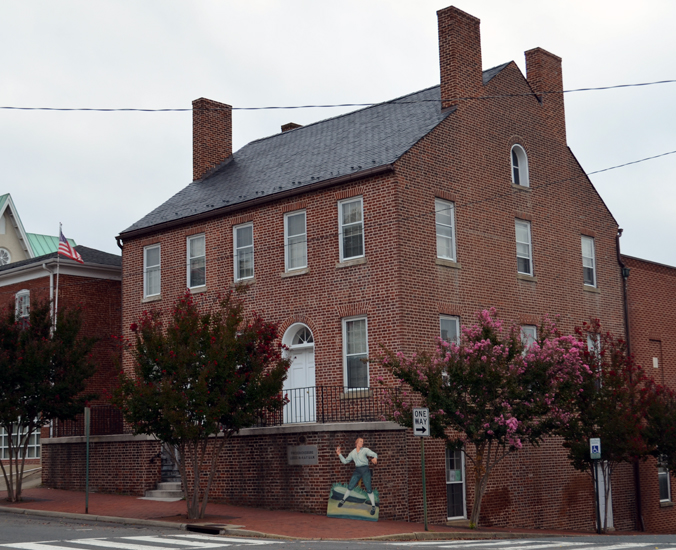
    George's Hometown 4
    The Masonic Lodge of Fredericksburg at the intersection of Princess Ann and Hanover Streets.

    The Fredericksburg lodge formed in 1753, the year Washington joined.  Its current building (pictured) was built in 1816.

    Join us at the Washington House Celebration on Saturday, October 7, 2017 from 12:00 p.m. – 4:30 p.m. to celebrate the construction of the Washington house! A special ribbon-cutting ceremony will begin at 1:30 p.m. featuring notable speakers. After the ceremony, guests will be invited to view the reconstructed Washington house!

    Ferry Farm opens to visitors at noon on Saturday, October 7.

    PLEASE NOTE: PARKING for the event is off site at the VRE Fredericksburg Park and Ride Lot G at the corner of Prince Edward Street and Frederick Street. Buses will transport guests to and from Ferry Farm—traveling from the VRE lot to Ferry Farm on a regular schedule from 11:45 a.m. to 1:15 p.m., and 3:00 p.m. to 4:15 p.m. Bus transportation will pause during the ribbon-cutting ceremony. The last bus will depart Ferry Farm at 5:15 p.m. Limited handicap parking is available at Ferry Farm.