Lives and Legacies

Author: ferryfarmandkenmore

  • Meet the Lewis Family: George Lewis

    George Washington Lewis was Fielding and Betty Lewis’s fourth son, being born on March 14, 1757.  His birth came within months of the deaths of two of his older brothers – Augustine and Warner, ages 4 and 1 – and was a bright spot in dark days for his parents.  He was named for his uncle George, who would have great influence on his nephew later in life.  Young George would also become a favorite of his uncle’s, too.

    Bed and Desk
    No known images of George Lewis exist. This photograph shows a bed and the desk he inherited from his parents and that both currently reside in the Bed Chamber at Historic Kenmore.

    The earliest mentions of George in the Lewis family records concern his education.  In 1771, he and his younger brother Charles were sent away to school in New Jersey.  Thirteen-year-old George attended the College of New Jersey (now known as Princeton), while ten-year-old Charles went to a nearby grammar school.  The Lewis boys would be enrolled in New Jersey for the next three years, coming home to Fredericksburg on occasional school breaks.[1]  Whether it was his family relationship to the man who would lead the Continental Army during the Revolution or the strict anti-Anglican education he received in New Jersey, George Lewis would become the most militarily-involved of all of the Lewis children.

    In November of 1775, George Washington asked that his wife, Martha, leave Mount Vernon and spend the winter with him at his encampment in Cambridge.  He was well aware that his nephew George (now eighteen years old) was interested in joining the cause, but Washington was reluctant to give any family members appointments in his army for fear of the appearance of favoritism.  In an attempt to give his eager nephew something to do, he asked the young man to accompany his wife on what would be a very arduous winter journey from Virginia to the encampment.  When George left his childhood home for Mount Vernon, he carried with him a letter from his father to General Washington, in which Fielding gave his blessing for his son to join the military, but hoped that the General could find some “little post that will bear his expenses”[2] for him, safely away from the fighting.  No doubt, this is what Washington originally hoped for, as well.  The reality of George Lewis’s military career would be far different.

    Initially, George did serve as a secretary for his uncle after his arrival in Cambridge.  He must have proved himself trustworthy and capable, though, because in the spring his uncle suddenly reversed his position on commissioning relatives and made his nephew a First Lieutenant on March 12th, 1776, just two days before his 19th birthday.  Lt. Lewis was made second in command of a new cavalry unit, the Commander-in-Chief’s Guard.  In addition to performing as Washington’s personal couriers and escorts, the Guard was also responsible for his protection during battle.  Lt. Lewis would be in the vanguard of the surprise attack on Trenton, and later in the attack on his former stomping grounds at Princeton.  During the battle of Princeton, fellow Fredericksburger General Hugh Mercer was mortally wounded, and captured by the British.  Washington sent his nephew George under a flag of truce and carrying a letter to General Cornwallis, asking that the young man be allowed to tend to General Mercer in his final days.  Cornwallis relented, and Lt. Lewis spent the next few days providing comfort to the dying man.[3]

    In 1777, Lt. Lewis was promoted to Captain in the Third Continental Dragoons.  He participated in the Philadelphia Campaign, wintered with the army at Valley Forge, and survived an encounter with the British 17th Light Dragoons at the disastrous Baylor’s Massacre, when most of the Third Dragoons were ambushed in a barn and slaughtered.[4]

    “Washington and Lafayette at Valley Forge” by John Ward Dunsmore, 1907. Library of Congress photo.

    During the rebuilding of the Third Dragoons, the few officers who remained were assigned to Washington’s headquarters, where Capt. Lewis returned to the rather mundane activities of being Washington’s courier.  At some point during 1779, George met Colonel William Daingerfield, Commander of the Seventh Virginia Regiment of the Continental line, and his daughter Catherine.  George and Catherine fell in love, and apparently the relationship became a huge distraction for the young Captain, who was increasingly absent from camp.  General Washington wrote his nephew an angry rebuke in February, saying that his behavior reflected badly not only on himself but on Washington, too.[5]  Although George returned to his duties immediately after receiving the letter from his uncle, he would resign by September and marry Catherine.

    George and Catherine settled near Berryville, Virginia, on land owned by Fielding Lewis that would eventually be George’s inheritance.  Although he became a planter, his military career wasn’t quite over.  In 1794, the Whiskey Rebellion in southwestern Pennsylvania broke out, and President Washington called on his trusted nephew to supplement the tiny standing army.  George raised a cavalry unit that he called the Fredericksburg Troop of Volunteers.  George was made a Major Commandant and his unit was deployed to Fort Pitt.

    Finally, with the end of the Whiskey Rebellion, George Lewis took up a quiet life.  He and Catherine had three children, and eventually purchased the plantation Marmion, on Virginia’s Northern Neck outside of Fredericksburg.  Many of the original furnishings from Kenmore would be left to George, and would descend through his family at Marmion.  George continued to maintain a close friendship with Washington, who often asked for his advice on family and business matters.  When Washington died, he left his nephew a handsome inheritance, as well as his pick of Washington’s swords.
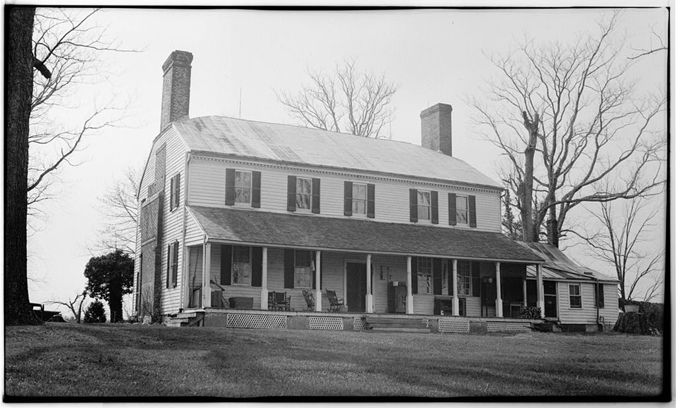
    Marmion
    Marmion, the home of George Lewis and family, as it appeared in the mid-20th century. Library of Congress photo.

    George Lewis died in 1821.  He and Catherine are thought to be buried at Willis Hill in Fredericksburg, the home of their son-in-law, Byrd Willis.

    Meghan Budinger
    Aldrich Director of Curatorial Operations

    [1] Felder, Paula S. Fielding Lewis and the Washington Family, 1998. Pgs. 163-164.

    [2] Fielding Lewis to George Washington, November 14th, 1775.  Pennsylvania Historical Society.

    [3] Lossing, Benson J., ed. Recollections and Private Memoirs of Washington, 1859. Pgs. 180-184.

    [4] Moran, Donald L. The Men of the Commander in Chief Guard, The Liberty Tree Newsletter, 2006; Demarest, Thomas. The Baylor Massacre, Bergen County History Annual, 1971.

    [5] George Washington to George Lewis, February 13th, 1779.
  • Kenmore’s Kitchen: Then & Now

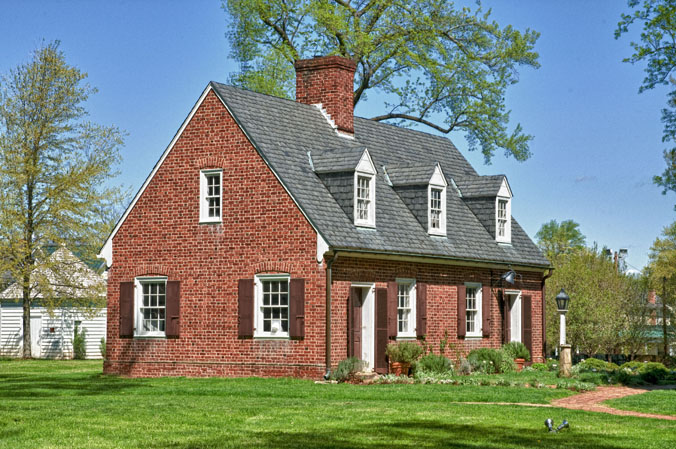
    The brick kitchen building next to Historic Kenmore is not original to the property. It was built in the 1930s in the colonial revival architectural style popular at that time.

    Kitchen01

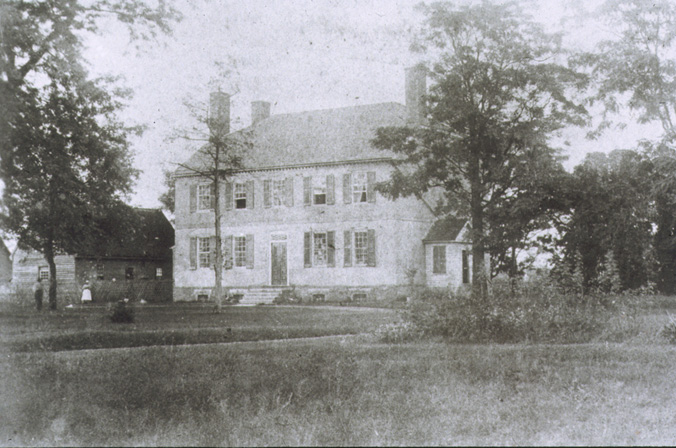
    The brick construction does not reflect the kitchen building seen in the earliest known photo of such a building at Kenmore.  That image, taken around the time of the Civil War, shows a large wooden kitchen to the north of the house as well two enslaved people standing in the kitchen yard.

    pre-1862kitchen02
    The wooden kitchen can be seen to the left of the house in this Civil War-era photograph.

    The Kenmore Association, a group of women who saved the mansion and transformed the property into a historic site open to the public, built the brick kitchen in the 1930s.

    ms 1687
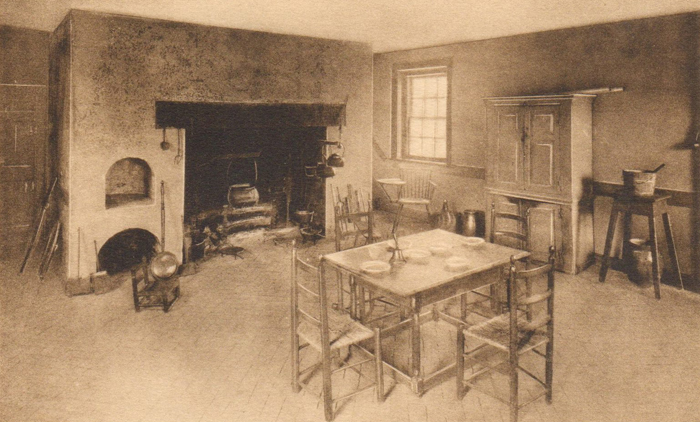
    Inside the brick kitchen just after construction was completed in the 1930s.

    Throughout much of the 20th century, visitors sat around the table in the photo above to enjoy gingerbread and tea served by the ladies of the Kenmore Association.

    Recently, we decided to highlight these ladies and their efforts to preserve Kenmore even more during our tours. We felt the most logical of places to do this was in the kitchen where they served their famed gingerbread and tea.

    We placed a tea set and faux gingerbread on the same table used to serve visitors for so many years. We surrounded that table with many of the same ladderback chairs, though most of their seats have been re-caned. We returned some of the china and the china cupboard that had stood for so long in the kitchen back to that space.

    While we cannot serve actual gingerbread and tea – modern-day museum guidelines prohibit food service inside historic structures – we can discuss the Kenmore Association’s monumental efforts to save Kenmore and make the mansion accessible to the public. You can read about these efforts here.  Although it does not date back to Kenmore’s very beginning, the 80-year-old brick kitchen is still a part of the site’s centuries-long story.

  • After Digging: What Happens in the Archaeology Lab?

    Intro to Lab (3)
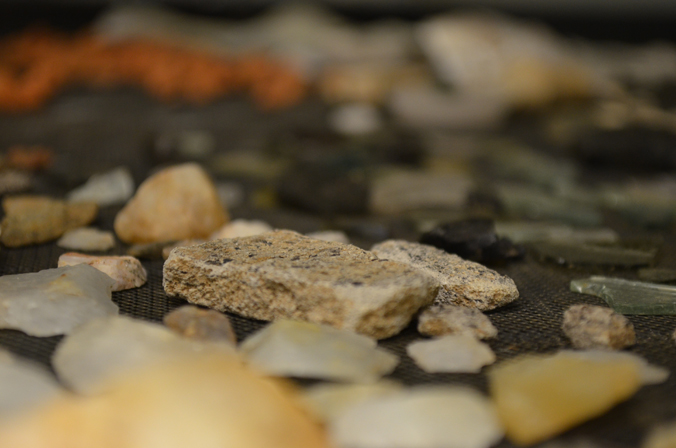
    Artifacts excavated at George Washington’s Ferry Farm.

    Here at Ferry Farm for the last 13 years, professional archaeologists have been exploring the local landscape, digging hundreds of excavation units in their quest to reveal the history of all those who lived here, including, of course, the Washington family.  Their investigative efforts have resulted in a multitude of artifacts dating from the earliest prehistoric Native American occupation of this riverine site, through the Colonial and Civil War periods, all the way to a 1990s occupation of the farm.

    So, what happens to all the artifacts that are uncovered and dug up with trowels and shovels? All of those items are important pieces to the puzzle of reconstructing the history of this site, but only if they are cleaned up and recognizable.  That is the purpose of the archaeology lab here at George Washington’s Ferry Farm.   With the help of both professional staff and dedicated volunteers, every single artifact that has come out of the ground is washed, dried, identified, labelled, and, finally, catalogued into a searchable computer database.

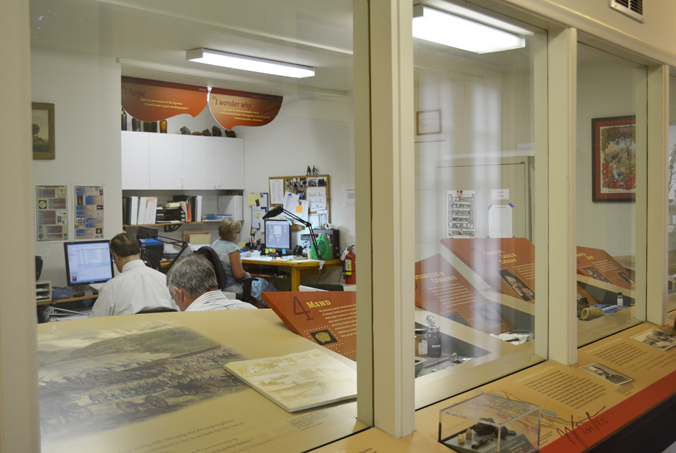
    The archaeology lab is located within the Ferry Farm Visitor Center which houses museum exhibits, storage rooms for the artifacts, and other administrative offices.  Visitors making their way through the exhibits can check out our lab spaces through large windows, allowing them a peek into our work spaces and giving them the ability to see the different processes the artifacts go through.

    Intro to Lab (1)
    The visitor’s view of the Archaeology Lab.

    While archaeological excavations at Ferry Farm take place every year, actual digging occurs only three months out of the year.  Artifact processing and analysis in the lab goes on for 12 months out of the year.  Archaeologists often say that “1 day in the field equals 3 days in the lab” and, in general, that adage is true.  Once the artifact bags come into the lab, it can be six months to one year or more before an entire artifact collection is completely processed.

    So where does it all start? Well, in the wet lab…

    Wet Lab

    Intro to Lab (4)
    Where artifacts are washed inside the Wet Lab.

    The wet lab is a small room where the artifacts are washed and dried.  It is fitted out with two sinks – the artifacts are washed only with water – and a countertop to provide space for the washing process.  Toothbrushes, dental picks, pipe cleaners, washtubs, and other cleaning tools are handily arranged for easy access by the staff.

    The washing process is pretty straightforward.  The artifacts, covered with dirt from the field excavation, are poured out of the bag onto a tray.  The washer separates the different items on the tray and proceeds to carefully wash them with a tooth brush and water.  After a quick rinse, the washed items are placed on a tray covered with mesh and the tray is placed in a drying rackThe washing process can be seen in this video. The artifacts stay on the drying racks for at least a week to make sure they are completely dried before being bagged.  Large windows allow visitors to watch this process and to see the “treasures from the earth” as they are uncovered and completely revealed, often for the first time in 200 years or more!

    Dry Lab

    Intro to Lab (2)
    Volunteers work in the Dry Lab.

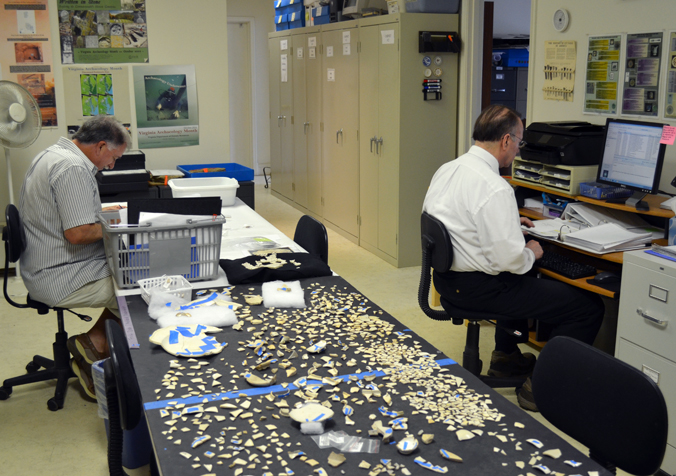
    The dry lab is a larger space containing desk space for the staff, the small finds cabinets, and long tables used for labeling and other projects.  It is here that the dried artifacts are placed into acid-free plastic bags, catalogued, and then labelled by the staff and volunteers.  Our staff spends quite a bit of time cataloguing the artifacts, which involves identifying, counting, measuring, and weighing all the artifacts.  The cataloging process can be seen in this video. Each artifact is labeled with identifying information and the address of the exact location where it was found on the site.  Research is always an ongoing activity as identifying and dating specific artifacts helps in understanding Ferry Farm’s past and the people who once occupied this ground.

    Time is also spent on the mending, conservation, and analysis of artifact collections. The small finds cabinets contain hundreds of unique artifacts that are studied because of their personal relationships to the individuals that lived here.  Long term projects, such as our current white-salt glazed ceramic mending, take place in the dry lab space, where a table covered with hundreds of ceramic sherds awaits matching. And as with the wet lab, museum visitors can look through the windows and observe all the projects being currently worked on.

    Having an archaeology lab on site is very convenient for the archaeologists that work at Ferry Farm as it allows them easy access to the artifacts at all stages of their processing.  Future plans for Ferry Farm rely on knowing what has been found here and weaving together that data with the historical record.  It also gives the public an exciting chance to see all the work that goes into getting the artifacts ready for further research.

    Judy Jobrack, Archaeologist
    Assistant Lab Supervisor

  • Video: Inside the Archaeology Lab – Cataloging Artifacts

    Archaeologists spend much more of their time working to determine the significance of an object than actually finding the object through excavation. This analytical work is done in an archaeology lab. First, artifacts must be washed, which you can see here. Then, the artifacts are cataloged as the video below shows.

    Learn more about archaeology at Ferry Farm here.

  • Dental Care in Early America

    Editor’s Note: Looking back in time, people’s personal hygiene, fashion choices, medical treatments, and more sometimes look, at the very least, bizarre, if not outright disgusting.  When confronted with these weird or gross practices, our first reaction can be to dismiss our ancestors as primitive, ignorant, or just silly.  Before such judgments, however, we should try to understand the reasons behind these practices and recognize that our own descendants will judge some of what we do as strange or gross.  Here at George Washington’s Ferry Farm and Historic Kenmore, we’ve come to describe our efforts to understand the historically bizarre or disgusting as “Colonial Grossology.”  The following is the latest installment in Lives & Legacies’ “Colonial Grossology” series.

    The 100th rule of the famed Rules of Civility and Decent Behavior  copied by George Washington as a school boy advised people to “Cleanse not your teeth with the Table Cloth Napkin Fork or Knife but if Others do it let it be done wt. a Pick Tooth.”  This advice proved necessary two centuries ago because “the most common means of cleaning teeth was by rubbing them with a cloth dipped in a little salt and water.”[1]  As long as this happened away from the dinner table, all would be well regarding propriety.

    Dental care has improved greatly in 200 years but the seeds of modern tooth care can certainly be seen when looking back to colonial days.

    Bristle toothbrushes are an age-old invention of the Chinese.  Today’s brushes are remarkably similar in shape and design to ones used in centuries past.  The pig bristle is now nylon and the animal bone is now plastic.  Archaeologists have found bone toothbrush heads — two of which date from the 1820s — during excavations at Ferry Farm.  Even without their handles, they look quite familiar even to the modern eye.

    FF Toothbrush Heads
    Bone toothbrush heads excavated by archaeologists at Ferry Farm.

    Instead of toothpaste, early Americans brushed with tooth powders. To clean teeth, these powders contained abrasives like alum, ground seashells, bone, eggshells, brimstone, baking soda, and even gunpowder. To freshen breath, powders included cinnamon, musk, or dragon’s blood.[2]  If dragon’s blood sounds strange, tobacco merchant William Hugh Grove claimed tobacco ashes were “excellent to clean teeth!”  These powders were not hard to make yourself and were even available for purchase in cities.

    On January 2, 1772, ‘surgeon dentist’ John Baker took an ad in the Virginia Gazette “to inform the Gentry that he is now at Mr. Maupin’s, in Williamsburg, and will wait on them.”  His ad is worth examining at length for its fascinating glimpse into dental procedures of the time.

    VaGazette
    Page 3 of the January 2, 1772 edition of The Virginia Gazette. Baker’s ad is near the top of the far right column.

    Baker Dentist Ad

    Ostensibly, Baker could cure “the SCURVY in the GUMS, be it ever so bad.”  He did so by scrapping from the teeth “that corrosive, tartarous, gritty Substance which hinders the Gums from growing, infects the Breath, and is one of the principal Causes of the Scurvy, which, if not timely prevented, eats away the Gums, so that many Peoples Teeth fall out fresh.” We each have essentially this same procedure performed every six months when we visit the dentist for a cleaning.

    Furthermore, Baker said he “prevents Teeth from growing rotten, keeps such as are decayed from becoming worse, even to old Age, makes the Gums grow up firm to the Teeth, and renders them white and beautiful.”

    In a passage familiar to any modern cavity suffers, the ad notes that Baker “fills up, with Lead or Gold, those that are hollow, so as to render them useful; it prevents the Air from getting into them, which aggravates the Pain.”

    Baker even transplanted “natural Teeth from one Person to another.”  The use of human teeth as replacements for extracted teeth as well as in dentures was quite common in the 1700s.  Indeed, teeth collected from thousands of the dead after the Battle of Waterloo were used in dentures for years.  Before Waterloo, “teeth were frequently acquired from executed criminals, exhumed bodies, dentists’ patients and even animals and were consequently often rotten, worn down or loaded with syphilis. The prospect of an overabundance of young, healthy teeth to be readily pillaged from the battlefield must have been a dentist’s dream.” 

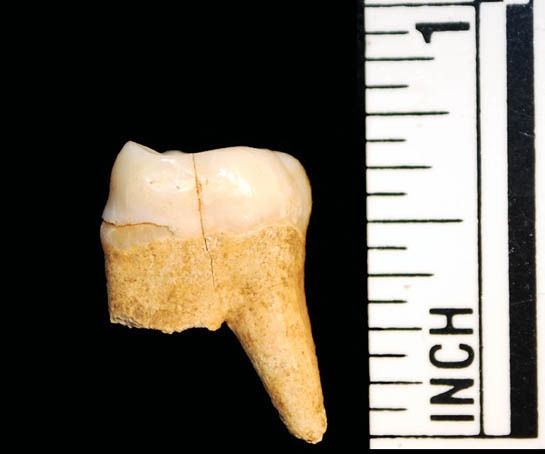
    Surgeon Dentist Baker extracted whole or partial teeth, even if they were “ever so deep sunk into the Socket of the Gums.”  Once extracted, the tooth was cleaned of infection and, if necessary, filled.  Then, it might be placed back in the same person, into another person, or in a set of dentures.  Some teeth even ended up in the archaeological record.  An extracted human tooth was uncovered during excavations at Ferry Farm.  From the upper jaw, the tooth belonged to a person of European descent and featured an incredibly large cavity. That said, the nerve was likely dead by the time this tooth was pulled. We know it was pulled because of a broken root. There is no decay from the top of the tooth and it has little wear, indicating it belonged to a younger person.  The tooth was discovered in the plow zone[3], meaning that it could not be dated historically.

    FF Tooth 1
    Human tooth excavated at Ferry Farm shows an incredible cavity.
    FF Tooth 2
    Human tooth excavated at Ferry Farm.

    Using toothbrushes for preventative care, treating gum disease through cleaning, and filling cavities with lead or gold all represent some commonalities between past and present dental care.  While seeds of modern dentistry can be traced to the 18th century, significant advances have been made in replacing single teeth and in using dentures.  Even if past dentists had some of today’s treatments, however, it seems safe to bet that they still would have been unable to stop the terrible tooth trouble suffered by George Washington throughout his life.  We now have picture of 18th century dentistry.  In a future post, we’ll examine George’s famously troublesome teeth.

    Zac Cunningham
    Manager of Educational Programs

    [1] Dorothy A. Mays, Women in Early America: Struggle, Survival, and Freedom in a New World, Santa Barbara, CA: ABC-CLIO, Inc., 2004: 191.

    [2] Dragon’s blood was a red powder obtain from any of several different plants and used as a folk medicine.

    [3] The plow zone is the area of soil that is churned up during plowing.  This churning destroys soil stratification or layering, which is the first method archaeologists use to date objects.  This dating is based on the principle that the deeper an artifact is found in the soil, the older the artifact is.   Plowing mixes up the artifacts and makes dating challenging.

  • Photos: Hummingbirds

    Just outside a window of the Archaeology Lab near the demonstration garden at George Washington’s Ferry Farm stands a hummingbird feeder. We regularly receive feathered visitors to the feeder.  Archaeologist Laura Galke recently captured some photos of a couple of the hummingbirds as well as a surprise guest.

  • Fine and Fashionable Fruit Dishes

    Fruit!  It’s good for you, delicious, and often beautiful – but have you ever thought of fruit as a status symbol?  In today’s world of relatively quick, inexpensive long-distance transportation, we enjoy fresh fruit from all over the world year-round.  We generally take this ability for granted.  In the eighteenth century, however, if you or your neighbors didn’t grow a particular fruit at home, then it had to be shipped to you at great cost.  In this age before refrigerated shipping, fruit’s extremely short shelf life was magnified.  As a result, a simple pineapple or lime represented a household’s wealth and the display of expensive fruits was a way to impress dinner guests. If you’ve got it, flaunt it, right?

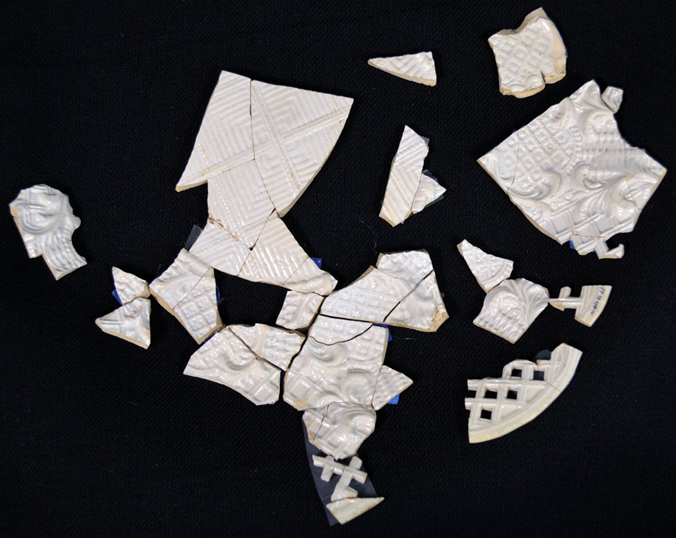
    Fruit proved such a rare luxury in the 1700s that people purchased special dishes in which to serve the fruit.  These dishes also emphasized the social status of the owner because they signaled to people that this person could afford fresh fruit even if none might be available at the moment.  Like the fruit, the dishes themselves came to the owner’s table from all the way across an ocean, further emphasizing their wealth.   Archaeologically, we’ve recovered one such special fruit dish from George Washington’s Ferry Farm.  Made of white salt-glazed stoneware around 1755, this favorite ceramic of Mary Washington, George’s mother, is heavily decorated.  The entire surface of the object has some visually interesting thing to catch the eye.  With a geometric design in the center surrounded by a variation of the basket-dot-diaper motif common to the time period and an intricately pierced rim flanked by scroll-work, this dish would certainly have been highly valued in the Washington household.

    Fruit Dish 1
    The fruit dish sherds excavated at Ferry Farm.

    In the eighteenth century, one of the most important ways a person could display their standing and refinement was by hosting elaborate dinners.  This meant having extravagant and highly decorated centerpieces, preferably of silver.  However, if you couldn’t afford silver, then a ceramic equivalent was the next best thing.  Ceramic fruit dishes, like our white salt-glazed one, even borrowed some forms and stylistic elements common on silver dishes of the time.

    What makes our particular fruit dish found at Ferry Farm even more special is that sherds from an almost identical one were excavated at Mount Vernon.[1]  In 1757, not long after George Washington moved to Mount Vernon, he sent to England for a large amount of ceramics, including 100 “white stone” dishes.[2]  There were numerous other vessels ordered in white salt-glaze as well, including patty pans, mustard pots, butter dishes, mugs, teapots, slop basins, and more.  Having special tablewares just for specific types of foods and condiments impressed your dinner guests with both your financial wealth and your knowledge of the “proper” way to serve things.  Having the appropriate tableware was so important that when Washington didn’t receive certain items ordered from England, he complained to his supplier, Thomas Knox, writing that “The Crate of Stone ware don’t [sic] contain a third of the Pieces I am charg’d with, and only two things broke, and everything very high Charg’d.”  Though showing disappointment about the broken pieces, Washington’s concern that he did not receive all he ordered hints at how fashionable the stoneware was considered.  Also, given the large number of items ordered, it is impressive only two pieces broke.  White salt-glazed stoneware was sturdy enough for the Washington family to use every day.

    If finding similar ceramic dishes at Ferry Farm and Mount Vernon were not enough, we have also excavated very similar sherds at Historic Kenmore, the home of George’s sister Betty.  Apparently, the taste for lovely and heavily molded white salt-glazed dishes must have run in the family!  The icing on the cake is that we also have a complete example of a fruit dish in Kenmore’s collection of ceramics that matches the sherds recovered in digs at both Kenmore and Ferry Farm.  What are the odds?

    Fruit Dish 2
    The complete fruit dish in Kenmore’s ceramics collection.

    The archaeologists at Ferry Farm are working diligently to mend together as much of Mary Washington’s fruit dish fragments as possible.  We’re a third of the way there.  We hope to display these excavated pieces next to the complete dish so visitors can enjoy these lovely examples of eighteenth century artwork as much as we do.

    The Washingtons – Mary, George, and Betty – all went to great lengths to demonstrate their status and refinement to friends and neighbors.  They did so, in part, by serving exotic fresh fruit shipped to the colonies from around the Atlantic World.  To serve that fruit, they used fine and fashionable ceramic fruit dishes that were also shipped great distances.  Think about that the next time you enjoy a fruit cup!

    Lauren Jones, Archaeology Lab Technician
    Mara Kaktins, Ceramics & Glass Specialist
    Melanie Marquis, Archaeology Lab Supervisor

    [1] Email between Eleanor Breen, Director of Archaeology at George Washington’s Mount Vernon and Melanie Marquis, Archaeology Lab Supervisor at The George Washington Foundation, November 12, 2010.

    [2] Janine E. Skerry and Suzanne Findlen Hood, Salt-Glazed Stoneware in Early America, University Press of New England, 2009.

  • Video: A Busy Morning at Kenmore

    Historic Kenmore’s beautiful grounds and gardens require much work to remain beautiful. On a recent morning, staff mowed and weeded flower beds in the unending effort to make the flowers and grounds look their best.

    Historic Kenmore and George Washington’s Ferry Farm always need volunteers to help with our gardens. If you might be interested in volunteering, visit http://kenmore.org/foundation/volunteers.html for more information.

  • The Atlantic World in Fielding Lewis’s Library

    Ships and sea-faring were parts of daily life and culture in the Atlantic World port of Fredericksburg.  This was especially the case for the Fielding Lewis family, who became wealthy through shipping, ship owning, and ship building.  Wednesday’s Lives & Legacies entry recounted a typical sea voyage around the Atlantic Ocean by the Stanton, a brig owned by John Lewis, Fielding’s father.

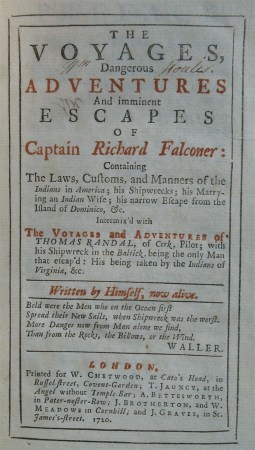
    Chetwood-title-pageShips, the sea, and the Atlantic World even seeped into Fielding’s reading life.  In her latest post on The Rooms at Kenmore blog, Curator Meghan Budinger discusses our efforts to collect books owned by Fielding Lewis.  Her blog entry deals with one book in particular called The Voyages, Dangerous Adventures and Imminent Escapes of Captain Richard Falconer, an adventure story of life at sea in the 1700s.
    As Meghan notes, his choice to include Captain Falconer in his library “may be a nod to Fielding’s lifelong association with merchant vessels, both his father’s fleet and his own.”  It also demonstrates that the Atlantic World was about far more than moving goods across oceans.  It reached into every aspect of life for the peoples living within reach of the great Atlantic Ocean, even into their literature.

    Read about the mystery behind this book on The Rooms at Kenmore.

  • The Voyage of the ‘Stanton’

    In colonial times, ocean-going ships could sail up the Rappahannock River all the way to Fredericksburg.  This made the tiny but growing town a bustling seaport.  All types of goods were loaded onto ships to be sent to Europe while others were unloaded to be sold right here in the colonies.

    George Washington, Fielding Lewis, their families and slaves, as well as the town’s other residents were all members of a wider community centered on the trade traveling back and forth across the Atlantic Ocean.  The townspeople of Fredericksburg saw sailing ships on the Rappahannock every day.  Those ships brought goods to sell and to buy, news from the rest of the British Empire, and people to settle and work in the colonies.  Washington, Lewis, and their neighbors interacted with the sailors from these ships every day and were aware of the hardships of life at sea.

    Map shows actual voyages of British ships in the last half of the 18th century according to their log entries. Learn more about how the map was created and compare British trade routes with Spanish and Dutch ones on the Spatial.ly blog. Created by Geographer James Cheshire, PhD, and used with permission.

    George even experienced life at sea first-hand when he left Ferry Farm and Fredericksburg to sail to Barbados for a visit at the age of 19. This journey is the only time Washington left the confines of the future continental United States.  For a time, George, supported by elder half-brother Lawrence, even toyed with the idea of joining the British navy until Mary, George’s mother, firmly refused to give her permission.  For his part, Fielding Lewis made his riches from shipping goods to and from the colonies.  Shipping cargo, ship owning, and ship building was the family business started by his father John.

    In the 1600s and 1700s, tobacco was Virginia’s most important export but, for a variety of reasons, many planters in this area chose to export things like wheat, timber, and other raw materials. Using the raw materials exported from the Americas, manufactured goods were made in Europe and then sent to Africa and back to the Americas.  The manufactured goods paid for slaves in Africa and for more raw materials in America.  Often known as the ‘triangular trade’ because of the triangle shape it forms on a map, this historic trade pattern is one we learn as early as elementary school.

    More than goods traveled along these trade routes.  People (sailors, settlers, and slaves) moved along them as well.  All of these movements created connections between nations, colonies, and groups of people in Europe, Africa, the Americas, and beyond.  The Atlantic Ocean was at the center of all these connections.  “Every European or African who moved to or was born in Virginia” was also a member of what historians call the Atlantic World.[1]

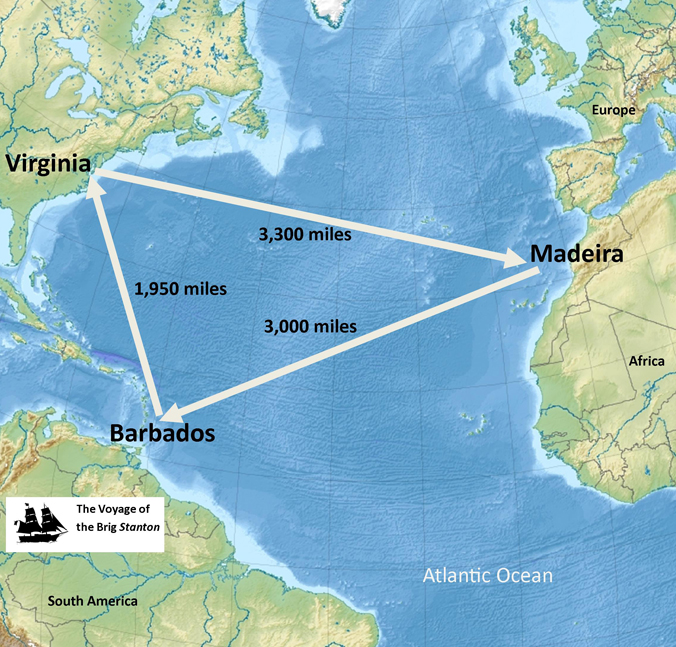
    A voyage typical of those that took place within the Atlantic World was made by one of John Lewis’ ships in early 1732.  On December 23, 1731, the 80-ton brig Stanton — captained by Richard Williams — set sail with 8 crew and 2 guns aboard.

    The Stanton was a brig, a sailing vessel with two square-rigged masts. While we have no idea what the Stanton itself looked like, a replica ship named the Lady Washington provides an idea of a brig’s size and appearance.

    The tall ship, Lady Washington, under sail in Commencement Bay near Tacoma, Washington. Photo by Miso Beno.
    Brig Lady Washington in Morro Bay, California. Photo by “Mike” Michael L. Baird.

    If you look closely at the people toward the ship’s stern in the photo, you can appreciate just how small a brig can be.  Imagine crossing the stormy Atlantic Ocean in a ship that size!

    As it left Virginia, the Stanton’s cargo was listed as “46 Pipe Staves, 1800 bushel corn, 1000 bushell wheat, 40 [tierces] of Bread, 15 barr[els of] flower, 1 bar[rel] of lard, 300 lb of beeswax, 2000 feet plank, 1100 feet heading & 15 barr[els of] Pork.”  Surprisingly to us, in this age before refrigeration, butchered livestock was an important export for Virginia.

    The Stanton was bound for the island of Madeira 550 miles off the coast of Portugal.  The specific cargo exchanged at Madeira is not listed but, after that exchange, the ship set sail for Barbados in the Caribbean Sea.  Once more, cargo was exchanged but specifics were not recorded.

    After a five month voyage covering 8,250 miles, the Stanton finally returned to Virginia on May 10, 1732. When the ship came into port in the colonies, it’s cargo included  “Rum – 21 [tierces and] 16 barrels, Sugar – 14 Barrels [and] 11 Qt. Casks, 8 Negros, 3 baggs ginger, & Sundry household goods.” Though not specified in the Stanton’s case, sundry household goods shipped to the colonies included ceramic and glass dishes, different cloths, jewelry, and books.

    Map of the Stanton's Voyage

    The Stanton’s voyage, the ports it visited, and the cargo it carried are all exceedingly typical of Atlantic World trade throughout the 1700s, whether in the earlier decades of John Lewis or the century’s later decades of his son Fielding.

    Ultimately, situated where farm, frontier, city, river, and road converged on the edge of English empire and the Atlantic World, the people of Fredericksburg found their daily lives governed by Britain’s global economy and imperial culture.  Colonial men – whether gentry, tradesman, or servants – pursued homes, professions, pleasures, and possessions that conveyed their status, wealth, and English identities. Fielding Lewis used the ships he owned and the wealth he gained from actively participating as a British merchant in the Atlantic World to fund the struggle to throw off English colonial control, to do his part to support his brother-in-law’s army, and to create a new nation.

    Zac Cunningham
    Manager of Educational Programs

    Special thanks again to Geographer James Cheshire for permission to use his map of British trade routes. Visit Spatial.ly, his geography blog, at http://spatialanalysis.co.uk/.

    [1] April Lee Hatfield, Atlantic Virginia: Intercolonial Relations in the Seventeenth Century. Philadelphia: University of Pennsylvania Press, 2004: 39.