Archaeologists spend much more of their time working to determine the significance of an object than actually finding the object through excavation. This analytical work is done in an archaeology lab. Before analysis can begin, the newly uncovered artifacts have to be thoroughly washed. This video shows how.
Virginia celebrates a proud theatrical history. It boasts the first recorded performance of a play in all the colonies. It also claims the first permanent playhouse and the first evening of professional theatre. That first evening was in September of 1752 and was presented by Lewis Hallam’s London Company of Comedians. What set this company above others in the colonies was that they had actual experience with professional performances in London.
At the center of this company was the Hallam family. The leader of the Company and patriarch of the family was Lewis Hallam. Lewis’s brother sent him to Virginia to start a successful traveling company, which had never been attempted before by performers from England. With him, Lewis brought his wife Sarah, who starred as the new company’s leading lady, and three of their children. In a few short years, the company established itself as a clear success and, in spite of the loss of Lewis Hallam in 1756, the company continued to travel the colonies for almost twenty years.
In 1765, Nancy Hallam, a young niece of Sarah’s, came from London to perform with the successful troupe now rechristened as The American Company of Comedians. Actually, Nancy may have been the same ‘Miss Hallam’ who played children’s roles with the Company in 1759 but this is uncertain. In 1766, Nancy starred in the ingénue roles and quickly moved up within the Company. In 1769, she took over the role of Juliet while performing in New York, marking her beginning as the company’s leading lady during which she starred in comedies, tragedies, and even ballad operas (the musicals of the age.)
A playbill for the American Company featuring Nancy Hallam. She is featured as the lead in Thomas Arne’s ballad opera Love in a Village.
In 1770, the American Company returned to Williamsburg with their new ingénue and premiered with The Beggar’s Opera, the most famous ballad opera of the 18th century. This performance was undoubtedly chosen to display Nancy’s vocal talents; talents that both George Washington and Thomas Jefferson would have enjoyed as they were in attendance. Her talent as a singer as well as an actress was praised throughout the colonies. Her performance as Imogen in Shakespeare’s Cymbeline inspired one theatre-goer to write a glowing review in the September 6, 1770 edition of the Maryland Gazette.
“She exceeds my utmost idea. Such delicacy of manner! Such classical strictness of expression! The musick of her tongue! The Vox Liquida, how melting!… How true and thorough her knowledge of the character she personated! Her whole form and dimensions how happily convertible, and universally adapted to the variety of her part.”[1]
Nancy Hallam’s portrayal of Imogen caught the attention of another Marylander. After losing his father in 1750, when he was only 9 years old, the young Charles Willson Peale apprenticed as a saddle maker. After completing his apprenticeship and opening his own saddle shop, Peale realized his true calling was to become a painter. He spent several years travelling the colonies as an amateur painter and met other early American artists such as James Claypoole, Jr. and John Singleton Copley (known for his portrait of Paul Revere). Eventually, Peale traveled to London to study portrait painting from 1767-1769. Upon his return to the colonies, he started taking up commissions around his home of Annapolis, a city the American Company frequented.
In 1771, Peale painted Nancy Hallam portraying the famous ingénue Imogen in Cymbeline. The painting depicts her in what is known as a ‘breeches role’ where Imogen is hiding her true identity by posing as a male servant named Fidele. Peale’s painting is the sole image of a professional actor from America in the period. It is also unique because it depicts a woman who is not wearing 18th-century women’s clothing. The image gives great insight to the level of costuming that went into a professional production. It also illustrates the fashion of the time to dress servants in lavish and unique garb. In this case, she is in what was known as ‘Turkish’ attire that includes a turban, long waistcoat, and wide loose breeches.
Nancy Hallam as Fidele in Shakespeare’s Cymbeline. 1771. Courtesy of Colonial Williamsburg Foundation.
Peale’s career may have been just beginning, but the American Company and Nancy Hallam were not long for America. The same event — The American Revolution — pushed one artist to prominence while pushing the others away. During the war, there was no place for frivolous evenings at the playhouse. Professional companies left the warring colonies and Nancy Hallam apparently retired from the stage.
The year after he painted Nancy Hallam, Charles Willson Peale painted a Virginia Colonel and veteran of the French and Indian War at his home of Mount Vernon. This was not the last time George Washington sat for the painter. Peale is credited with painting the most images of the first President along with other early American notables. Peale also painted several portraits for the Lewis family: two of which hang in Historic Kenmore today.
John Lewis by Charles Willson Peale. Part of the George Washington Foundation Collection.
For a limited time, those portraits are joined at Kenmore by a reproduction of Nancy Hallam’s Cymbeline costume and a print of Peale’s portrait of her. The costume and portrait are on loan to The George Washington Foundation from the Colonial Williamsburg Foundation. They are on display in the Crowninshield Museum Building in the run-up to the production of Cymbeline during “Shakespeare by Candlelight” on August 14, 15, or 16. For more details about attending a performance, which does require reservations, visit www.kenmore.org.
Joseph Ziarko, Manager of Interpretation & Visitor Services
[1] Johnson, Odai, The Colonial American Stage, 1665-1774: A Documentary Calendar, Cranbury: Associated University Presses., 2001, pg. 372.
One of the aspects of a historian’s job is dealing with primary sources, the paper trail of history. The archives here at The George Washington Foundation contain primary sources that include letters, wills, land grants, court orders, military orders, bills and receipts. These hand-written documents are largely related to the Fielding and Betty Lewis family and provide us with a wealth of information on all facets of their lives from how much rum they bought to how much they paid in yearly taxes. At the same time, they and other written historical records provide a glimpse into some fascinating dynamics of early American society and culture.
However, sometimes these documents can be difficult to read because, in the 18th century, writing style and spelling were still not completely standardized.
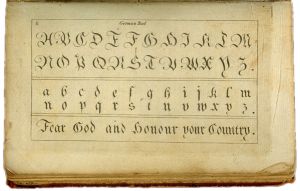
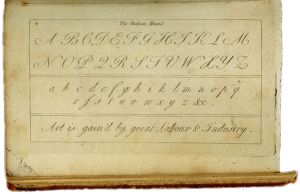
Students in early America usually learned to write by copying different styles of writing known as ‘hands’ in a copybook that showed alphabets and phrases in the ‘hand’ to be learned. Students copied the alphabets and phrases exactly, for practice and for reference, and business forms. For example, while attending school in Fredericksburg, young George Washington copied The Rules of Civility and Decent Behaviorto learn handwriting as well as proper behavior in polite society.
Above: Examples of ‘hands’ (Flourishing Alphabet, Italian Hand, German Text, Round Hand) from The Instructor, or American Young Man’s Best Companion Containing Spelling, Reading, Writing, and Arithmetick by George Fisher and published by Isaiah Thomas, Worcester, 1786
In the 1700s, writing was a skill reserved for select groups of people, mainly professionals and upper class males. Women, artisans, lower classes, and the enslaved were not formally taught handwriting because it was viewed as unnecessary to their everyday life. A lack of formal education did not stop people from writing. Instead, they just developed their own system of penmanship and style.
Spelling
Colonial-era writers could choose from a number of dictionaries to assist with spelling. Many of these books, however, focused only on difficult, obscure, or archaic words. It wasn’t until 1755 that Samuel Johnson published the influential A Dictionary of the English Language, which offered a more comprehensive lexicon of contemporary English of the time. By the colonial period, much English spelling was recognizably modern due to the beginning movements of standardization in education and print. Dictionaries also assisted in the development of a more uniform writing style.
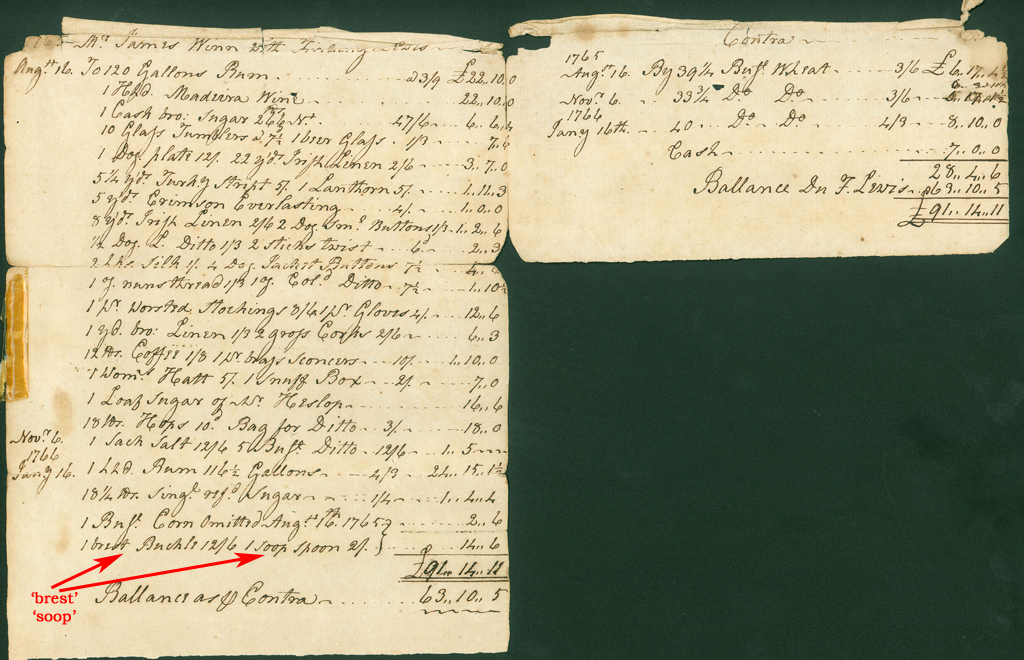
What if you had not been to school or had never seen a dictionary? Well, you simply spelled a word the best you could by sounding it out phonetically. So, ‘school’ became ‘skool’ or ‘laugh’ became ‘laff.’ A word might be spelled a dozen different ways by a dozen different people. When read aloud, these words sound fine but, when silently reading a primary source document, the written phonetic spelling can take a few seconds to process.
An account statement from 1766 between James Winn and Fielding Lewis that includes two examples of phonetic spelling: “brest” buckle and “soop” spoon.
The Long ‘s’
The long ‘s’ was a style of spelling that generally fell out of use in print by the end of the 18th century. It persisted in handwriting until the mid-19th century. The long ‘s’ was an elongated version of a lowercase ‘s’. It was often seen at the beginning of a word, in the middle of a word, and in words containing a double ‘s’. A notable example is the spelling of Congress in the Bill of Rights.
Understandably, when we read primary sources today, the long ‘s’ is often mistaken for an ‘f’ or ‘p’ and it takes some practice to get the context of what is being said.
The word ‘Witnes’ in this document includes an excellent example of the long ‘s’ in the word and it’s close resemblance to an ‘f.’ This is a bond dated 14 September 1747 that requires George Lewis, who lives in Frederick County, to pay 3 pounds of Pennsylvania Currency to Charles Dunnahie by 1 May 1749.
Abbreviations/Subscript
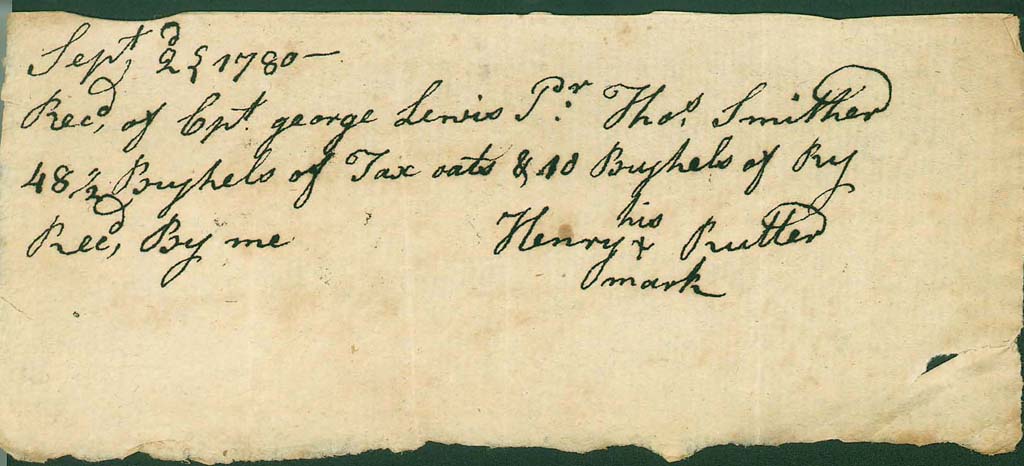
Abbreviations and subscript often come up in colonial-era handwritten documents, particularly on bills, invoices and receipts. Shortening words or phrases like can’t for cannot or asap for as soon as possible is something we are familiar with today. Commonly, abbreviations in the 18th century were indicated by beginning the word in regular-sized letters and ending with superscript letters like Recd for received. Superscript or subscript letters are most frequently seen today in chemical compounds (H₂O) or in mathematical expressions.
This receipt, dated 25 September 1780, from Henry Rutter to George Lewis for 48 1/2 bushels of tax oats and 40 Bushels of Rye from George Lewis per Thomas Smither. The “Recd” at the beginning of the receipt is an excellent example of both an abbreviation and superscript.
All the quirks in 18th century writing present many challenges for the historian. Creating a system of deciphering can take time and plenty of practice. At times, it can be more than a little frustrating. Once the documents’ particular meanings are deciphered, the writing itself can reveal many different dynamics about early American society and culture.
One of the biggest of these dynamics is that very few people received enough education to develop a professional level of literacy. Professional level of literacy, at the time, would mean having enough skill to conduct business. Such a level was reserved, usually, for white middle to upper class males.
Selective education provided a powerful form of social control and a framework for society to judge and instantly understand a person’s social status, education, and occupation. At this time, it was not thought important for women, slaves, or the lower classes to know how to write. Some even thought that teaching these groups to write would encourage them to aspire above their allotted station in life. Writing gives people the freedom to express themselves and their ideas in a concrete way which can easily be transmitted to others, an uncomfortable prospect for a society based on a selective hierarchy.
Though a woman, George Washington’s mother Mary Ball Washington could write. Her spelling was extremely phonetic as seen in this letter transcriptionand reflects a lack of formal schooling but not necessarily a lack of intelligence as some historians have argued. Indeed, primary sources like Mary’s letters supported by “new archaeological data has yielded a decidedly more complex picture of this influential matron than is possible using the historical record alone.” Laura Galke, an archaeologist here at The George Washington Foundation, argues (PDF)that artifacts discovered at George Washington’s boyhood home at Ferry Farm demonstrate that Mary “enjoyed the personal agency that widowhood allowed her; she was responsible for the management decisions of the Washington household and the surrounding farm. Mary’s choices reflect an ambitious woman determined to participate in the genteel society her family had enjoyed before Augustine’s death.” This required much intelligence.
Interestingly, Mary’s daughter Betty Washington Lewis also knew how to write. Mary ensured Betty knew how to run a household and keep in touch with family, which numerous letters written by Betty show she did effectively.
Portrait of Betty Washington Lewis painted by John Wollaston in the 1750s
Her phonetic spelling in this letter transcriptionis an improvement over her mother’s. The improvement in Betty’s spelling when compared to Mary’s further illustrates the increasing standardization during the 18th century and can also be seen as an example of changing beliefs in education for women at the end of the 1700s. A movement was growing late in the century to teach writing to women. This movement, however, did not come from a revolutionary drive for equality but, rather, from an expanded idea regarding the duties of Motherhood. If women could not read and write, it was thought, how would they teach their sons, the future generation of leaders, to do the same?
Though difficult, at times, to decipher, the simple act of writing gives us a glimpse into the minds of people who thought about and experienced a life quite different from ours.
Archaeologists sometimes recreate technology from the past to understand how people lived. This is called experimental archaeology. Native American occupation of Ferry Farm left behind many artifacts including fire-cracked rocks. This video shows how those rock artifacts were made through a cooking technique known as stoneboiling.
See the first video in our Science of History series here.
Chances are you haven’t spent much time thinking about chicken digestive tracts. This is normal. Here at George Washington’s Ferry Farm, however, the topic actually comes up from time to time. More than once we archaeologists have found ceramic artifacts that have been rounded in an odd fashion, as if tumbled in a river for many years. What accounts for this phenomenon? The answer lies – or roosts, rather – in the coop.
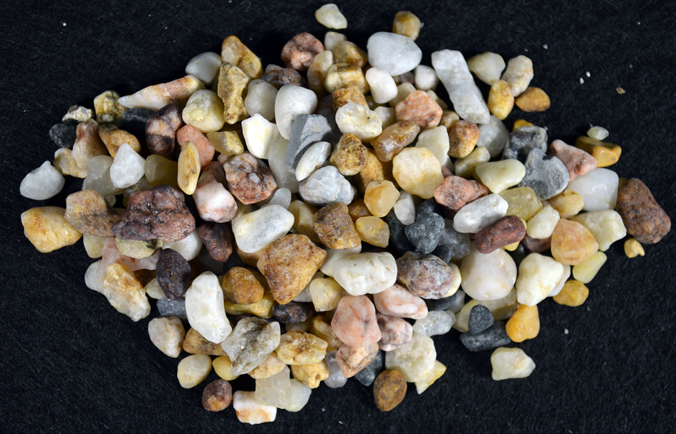
Have you ever given thought to how birds eat? How they chew food and digest whole seeds without any teeth? A bird chews its food, but not with its mouth. Most birds use gizzards that essentially act as second stomachs. Almost pure muscle with a strong lining, the gizzard mashes up food to make its nutrients absorbable by the intestines. A bird ingests rocks and grit to help the gizzard grind tough foods like seeds and plant material. These rocks are not passed through the bird but remain inside its gizzard until they are completely ground up or the bird dies. Subsequently, these rocks sometimes take on a rounded, polished look because the gizzard is essentially a tiny rock tumbler.
Stones recovered from the gizzard of a modern turkey.
How does all this relate to archaeology? Simply put, a bird cannot differentiate between a rock and an artifact. The free-range chickens, turkeys, and geese that live with humans gobble up anything that is about the right size for their gizzard, whether rocks, glass, ceramics, or even plastic and metal (The plastic and metal is probably not all that good for them). When a bird is butchered, the gizzard stones – known as ‘gastroliths’ to archaeologists – are released, buried, and excavated to confuse some poor archaeologist hundreds of years later. This is exactly what happened at Ferry Farm. At least one Ferry Farm bird had expensive taste and swallowed porcelain. Some ceramic gastroliths excavated by our archaeologists were in a gizzard so long that the glaze wore off entirely and was ingested. Eighteenth century ceramic glazes contained lead, and this ultimately would have been passed on to the humans who ate the unlucky fowl.
Ceramic pieces worn smooth inside a turkey or goose gullet and recovered archaeologically at Ferry Farm.
In addition to being an archaeologist, I also keep birds on a small farm. After butchering a few chickens and a turkey, I notice that the size of the gizzard stones reflected the size of the bird. A turkey is capable of ingesting much larger objects as gastroliths than chickens. This was such an exciting revelation that I saved some stones recovered from the turkey gizzard and analyzed them. Archaeologists are an odd bunch! The stones were partially rounded and, in addition to rock, the turkey had eaten chucks of concrete and even a bone.
Two pieces of concrete and one piece of bone from inside a modern turkey gizzard.
Given the size of the ceramic gizzard stones excavated at Ferry Farm, we can deduce that the birds which ate them were probably large domestics such as turkeys or geese. So we not only learned why the chicken ate the artifact but that it probably wasn’t even a chicken at all. This helps to us to understand what kinds of livestock the Washington family kept at Ferry Farm. Who knew you could learn so much from a beat up piece of pottery in a gizzard?
Mara Kaktins, Archaeologist
Ceramics & Glass Specialist
George Washington’s Boyhood Home at Ferry Farm offers a wonderful blend of woods, fields, wetlands, and riverfront. Fox, groundhogs, snakes, lizards, turtles, and deer make Ferry Farm their home. In the meadows, bushy heads of grass seeds provide an important source of food for birds. Beautiful flowers and majestic trees abound across the landscape. A few weeks ago, we set out on a nature walk around Ferry Farm to enjoy the flora and fauna.
Ferry Farm
Cherries on the cherry trees in the Demonstration Garden.
Daylilies in the Demonstration Garden.
The tickseed variety of Coreopsis.
Magnolia bloom
Magnolia fruit
Tall grass
Groundhog near the river.
The Rappahannock River
Trail through the woods along the river.
Wild strawberry
Ferry Farm’s Wild Meadow
Bluebird peaks from inside a birdhouse.
Bluebird in flight.
Yarrow
Crown vetch
Trail through the Meadow.
Learn more about Ferry Farm’s natural environment here.
Editor’s Note: Looking back in time, people’s personal hygiene, fashion choices, medical treatments, and more sometimes look, at the very least, bizarre, if not outright disgusting. When confronted with these weird or gross practices, our first reaction can be to dismiss our ancestors as primitive, ignorant, or just silly. Before such judgments, however, we should try to understand the reasons behind these practices and recognize that our own descendants will judge some of what we do as strange or gross. Here at George Washington’s Ferry Farm and Historic Kenmore, we’ve come to describe our efforts to understand the historically bizarre or disgusting as “Colonial Grossology.” The following is the latest installment in Lives & Legacies’ “Colonial Grossology” series.
In over five years working in historic house museums, it has come up in conversations with visitors more than one might expect and far more than the 18th century Virginia gentry would have thought proper. After passing through drawing rooms, dining rooms, and bedrooms, the youngest in a tour group often realizes, with very little shyness, that “There’s no bathroom! Where did they go to the bathroom?” Veteran historic house visitors will often notice a certain object on the floor near a bed and, in hopes of not being overheard by others on the tour, quietly ask if the object is what they think it is. As a museum educator, I’ve come to embrace discussing how colonial Americans did their business because those acts are fundamental to being human. Discussing them reminds us that the larger-than-life characters who lived two centuries ago were just like us.
A simple outhouse.
So, just how did early Americans go to the bathroom? Many visitors imagine they used an “outhouse.” It seems that few colonial Virginians, however, had outhouses or privies, as the structures where known in the 1700s. These buildings were much more common in other colonies. A privy was a small wooden structure usually built behind the house with a floor built over a good-sized hole dug into the ground. Inside the structure, a wood plank served as the seat and a round hole cut in this plank allowed the waste to fall down into the pit. Privies sometimes featured multiple holes (including smaller holes to ensure children did not fall into the pit) but, of course, little privacy.
While certainly important to their early American users, privies also yield important secrets to today’s archaeologists. Seeds ingested when colonial people ate passed from the people into their privies and actually survive to be excavated hundreds of years later. These seeds tell archaeologists what kind of fruits and vegetables people were eating. Even eggs from parasites that lived inside colonial people were deposited into the privy pit when they went to the bathroom. These eggs also survive and reveal what kind of illnesses people suffered from 200 years ago. A lot of people had stomach worms!
When someone living in the 1700s woke to the call of nature in the middle of the night, that person didn’t necessarily want to go outdoors and use a privy. Who wants to walk outside when it’s raining, snowing, cold, and dark, after all? Instead, you simply used a chamber pot resting next to your bed. Chamber pots came in a variety of shapes and sizes and could be made from ceramic or metal.
Chamber pot tucked under the bed in The Chamber at Historic Kenmore.A porcelain child-sized chamber pot.
It actually was quite common for the chamber pot to even be part of a special chair called a close stool, which looked like an ordinary chair but, in fact, its hinged seat lifted up to reveal a chamber pot. The collection at Kenmore contains a chair originally made in the 1700s and then modified in the early to mid-1800s into a close stool chair.
The chamber pot and the close stool chair were probably enough for most colonial Americans, a good majority of whom never bothered to build a privy. No privy dating from George Washington’s time has been found at Ferry Farm, which means he and his family probably used only chamber pots and/or close stool chairs. In fact, archaeologists found fragments of a stoneware chamber pot in the Washington house cellar during excavations in 2008 and 2009. It features hand-painted cobalt blue floral design and dates from the mid-18th century. In the photos below, the pot is upside down and resting on its rim.
At Kenmore, Fielding Lewis’ probate inventory lists a “close stool chair and pan” among the house’s upstairs furniture. When George or Fielding used the pot or the chair, either they themselves or, more likely, their enslaved house servants tossed the waste outside. People emptied their pots in a variety of convenient places: into a pit for just that purpose, into the nearest body of water, onto their vegetable garden as a fertilizer known as “night soil,” or just out the nearest window. What could be more convenient!
On plantations and farms, waste flying out of windows wasn’t necessarily an immediate danger to other humans. People living in crowded cities and towns throughout the colonies and Europe still emptied their pots in much the same way as their rural counterparts. They just tossed the waste into the street. Some localities did have rules about disposal. In Edinburgh, for example, residents could only empty their chamber pots “after 10:00 p.m., upon the sound of a drum, and only once they had shouted a warning of ‘Gardy-loo!’ (‘Mind the water!’) to passerby.”[1] The southern French city of Marseilles required residents to give three warnings before emptying. In nearby Avignon, however, people walking in the street at night had to make their presence known by shouting. New York City passed an ordinance in 1724 making it illegal to dump waste into the street. Residents had to walk to one of the rivers to dispose of their waste.
Privies, chamber pots, close stool chairs, night soil, rampant stomach worms, and waste lying in the street. Relative to today, the 18th century was not a terribly clean or healthy time. While not a pleasant topic, the ‘gross’ bathroom tools and customs of two centuries ago can teach us much about the everyday lives of early Americans and, ultimately, their most important lesson may simply be that our ancestors were human too.
Zac Cunningham
Manager of Educational Programs
[1] A. Roger Ekirch, At Day’s Close: Night in Times Past, New York: W.W. Norton & Co., 2006, pg. 28.
Scenes from the Demonstration Garden at George Washington’s Ferry Farm on a peaceful summer morning. The garden contains a variety of colonial-era plants that would have been grown by the Washington family like tobacco, corn, and squash. There are also modern flower species plus birds and other wildlife.