Lives and Legacies

Author: ferryfarmandkenmore

  • Horror Artifacts of Ferry Farm: Myth, Disease, Vampires, and Dolls

    With Halloween just around the corner, we thought we would take our readers behind the scenes to look at some of the creepiest and macabre artifacts we have uncovered at Ferry Farm. Some may seem like obvious choices, but others have hidden connections and meanings. Be sure to let us know your favorite in the poll at the end.

    Bartmann Jug: The Wild Man and Witchcraft

                This jug may look familiar to those who enjoy visiting Colonial sites. Made predominantly in Germany during the 16th and 17th centuries, these pieces of salt-glazed stoneware proved incredibly popular. Known as Bartmann Jugs, all pieces share the presence of a bearded face on the neck of the vessel. Some have additional designs, such as crests, on the body. The face lends the name to the jug as “Bartmann” translates from German to “bearded man.” Still, this begs the question of who the face belongs to?

    Bartmann Jugs
    Remnants of Bartmann Jug

                The bearded face depicts a figure known as the Wild Man. A character from Northern European folklore of the 14th-16th centuries, Wild Men reportedly flourished in remote, alpine regions. In characterization, Wild Men are similar to the satyrs and fauns of Greco-Roman tradition. They are covered in hair, hence the bearded face, and wear no clothes. The popular depiction of Wild Men began in the late Middle Ages when the figure became secular. They thus appeared in all art forms with males and females being depicted. The somewhat exaggerated face on the Bartmann Jug speaks the Wild Man’s untamed nature.

    Wild Man by Martin Schongauer, 1480s

                Aside from Wild Men, Bartmann Jugs have a role in witchcraft. At a time of religious turmoil and witch hunts, England saw a rise in the use of witch bottles in the 1600s. These bottles were white magic in nature and supposedly protected against black magic. Bartmann Jugs account for most witch bottles from this period and the abnormal face may have factored in to its use. To make a witch bottle, one filled the vessel with items such as nails, human hair, fingernail clippings, heart-shaped pieces of cloth, pins, and urine before sealing it. The bottle was then buried or submerged near the area it protected. No Bartmann witch bottles have been found in the America, but the Mathers of Massachusetts wrote about witch bottles in the late 1600s. Could ours have served such a purpose?
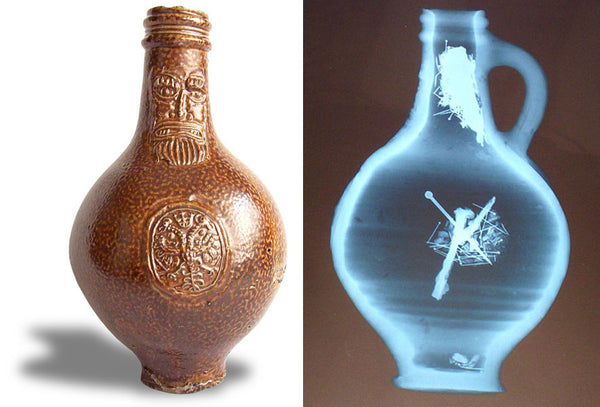
    X-Ray of Bartmann Witch Bottle

    Civil War Medicine

                Just the thought of Civil War medicine is typically enough to conjure scenes of horror, so this simple glass bottle may seem a bit disappointing. However, things are rarely what they seem. We recovered this artifact from a Civil War trench and quickly became interested in what it originally held. Scientific analysis of the remaining residue revealed that the bottle served a medicinal role and once contained liquid mercury. As mercury is known as extremely dangerous, this may come as a shock. Why would anyone have mercury on their person and how could it be medicinal? Believe it or not, mercury once served as a cure-all in the medical world and it was only in 20th century that its dangers were fully accepted. Those who used mercury medicinally viewed the topical burning, sweating, excess saliva, and diarrhea it produced as signs of successfully purging their body of their affliction. In reality, it was their body trying to rid itself of the mercury.
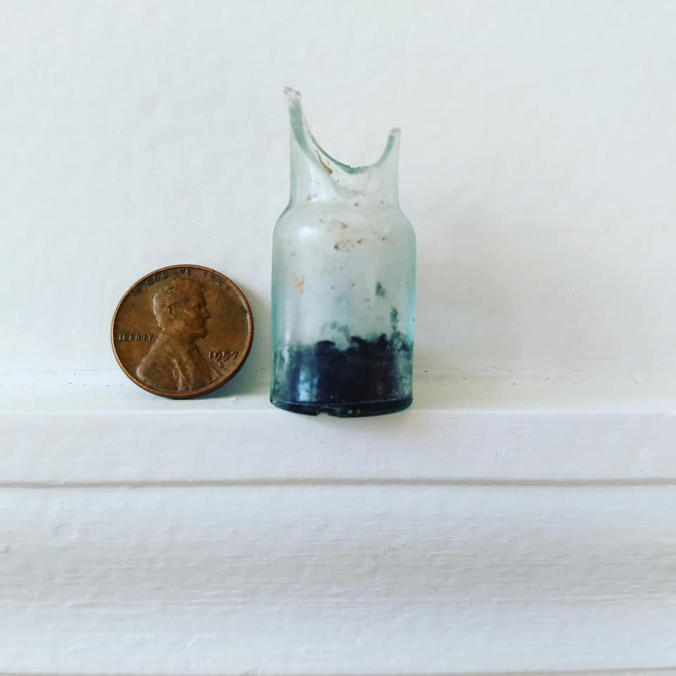
    Mercury Bottle

    As a cure all, people utilized mercury for all sorts of afflictions and pest control. Common uses in a Civil War camp may have included treatment for head lice, bed bugs, skin sores and lacerations, as well as parasitic infections. The most terrifying of all, however, would have been syphilis. The dominant strain of this disease is sexually transmitted, and was often ripe in military camps. A disease that did not kill quickly, a person could live with syphilis for years as it slowly ate away at the body. As it progressed, the afflicted would note rashes, open sores, and growths or bumps on their body. Neurological problems could occur and the loss of your nose was not uncommon. As the disease stayed with you until death, it had time to impact the skeleton, most notably leaving pitting on the skull, potentially an eaten away nose cavity, and other signs of deterioration. Overall, a horrible way to go and a wicked good topic for this blog.
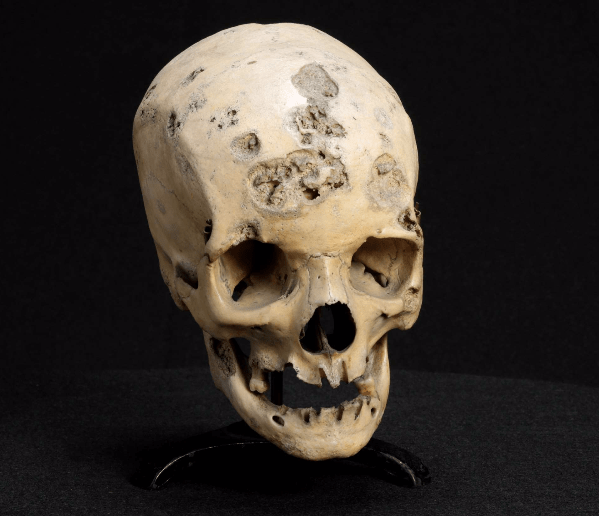
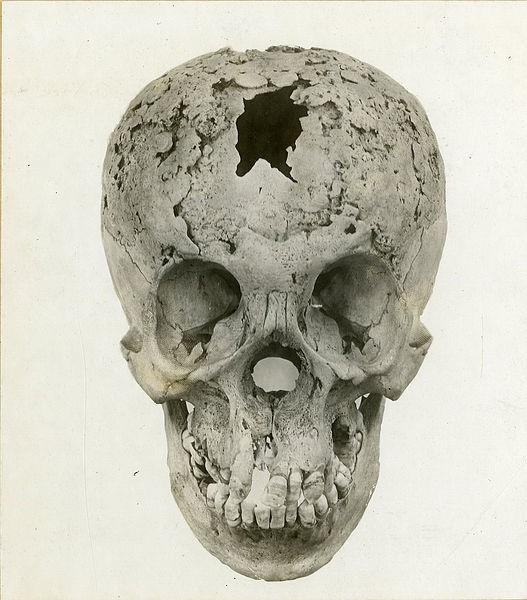
    For further reading on this artifact and the scientific analysis, you can read a previous blog on it here.

    Dracula’s Jewelry

                Mourning jewelry became extremely popular during the mid to late 1800s. While pieces came in many forms, they mainly reflected somber colors, like black, or carried something of the deceased’s, such as hair. The rise in this trend first derived from Queen Victoria’s endless mourning for her husband Prince Albert in the United Kingdom. Her mourning set a fashion trend and, with the number of deaths that occurred in the American Civil War, Americans had a reason to adopt it. Alongside the somber tone of jewelry, the period approached the topic of death with a rise in the macabre, séances, and horror.
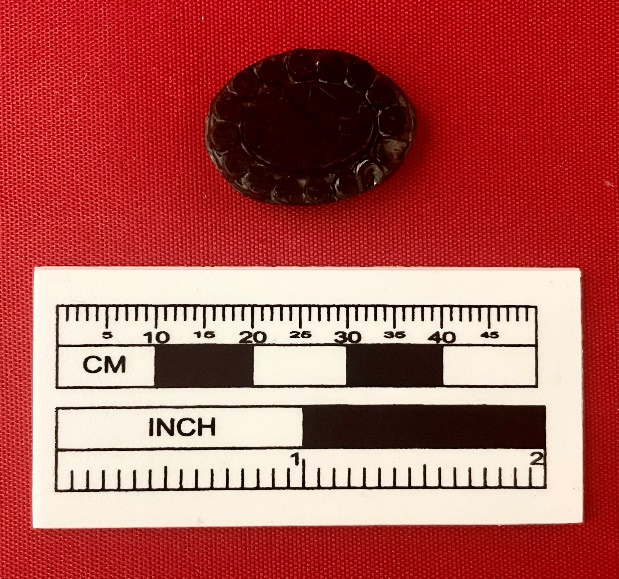
    Mourning Jewelry

                At Ferry Farm, we have uncovered a single piece of mourning jewelry, which connects to one of the most famous Gothic novels and literary monsters of all time, DRACULA! This small piece may have once been set in a necklace or bracelet and belonged to someone who inhabited the property or visited after the war. While that is all very interesting, I am sure you want to know where the King of Horror fits in. The answer lies in the material. The pendant is made of jet, which accounted for much of the 1800s’ mourning jewelry. Sources of jet exist in various parts of Europe and the American Southwest, but the most prosperous jet production existed in Whitby, England during Victorian times.

    A seaside, port town in the north of England, Whitby is noted for the ruins of an impressive abbey that dominate the landscape. Fans of Bram Stoker’s novel will recognize the town as the location where Count Dracula first arrives in England, and Whitby Abbey even appears in the novel. Stoker wrote much of the book in Whitby, and he reportedly first came across the story of Vlad the Impaler in the local library. Today, Whitby embraces its vampiric legacy (they currently hold the record for the largest gathering of vampires at 1,369 people) and the jet business has seen a resurgence in popularity by aligning itself with this tourist draw. So what do you think of our piece? We highly recommend it for lovers of death, horror, and literature. Please note: Vampire not included.
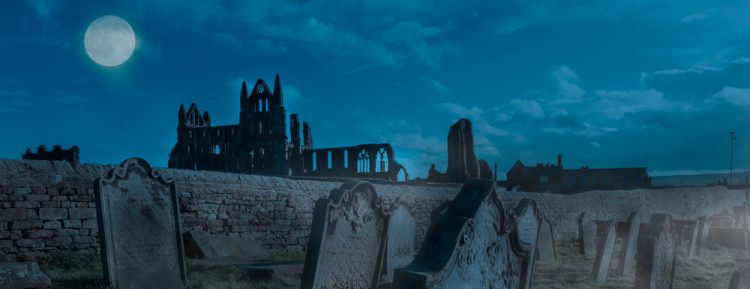
    Whitby Abbey

    Creepy Dolls

                It goes without saying the most people find dolls creepy. They frequently feature in ghost stories and many serve as the malevolent force in horror movies. Here at Ferry Farm, I am not sure which is worse, finding a full doll or severed doll parts.

                With people living on the property through the 1990s, we have plenty of potential to uncover dolls. In fact, we found a severed doll hand this summer that we previously featured as a #FridayFind. Other parts include ceramic legs, broken arms, heads, and faces. Perhaps this is the most obvious choice for a scary artifact blog, but, then again, dolls will never stop being creepy.

    Creepy Doll Parts

    Emma Schlauder (she/her/hers)

    Research Archaeologist

  • To Instruct and Amuse: Fun & Games in George’s Day

    The fall season at George Washington’s Ferry Farm and Historic Kenmore is finally upon us! This is a busy time of year for the education team because as cooler temperatures roll in, so do the school buses! Students who take field trips to our sites learn about the Washington and Lewis families, archaeology, and daily life in the 18th century. A favorite activity during field trips (for students and chaperones alike!) is learning how children in the past entertained themselves by playing a few popular eighteenth-century games. Our youngest visitors especially love learning what life was like for George and Betty Washington when they were children at Ferry Farm.

    Ferry Farm Field Trip

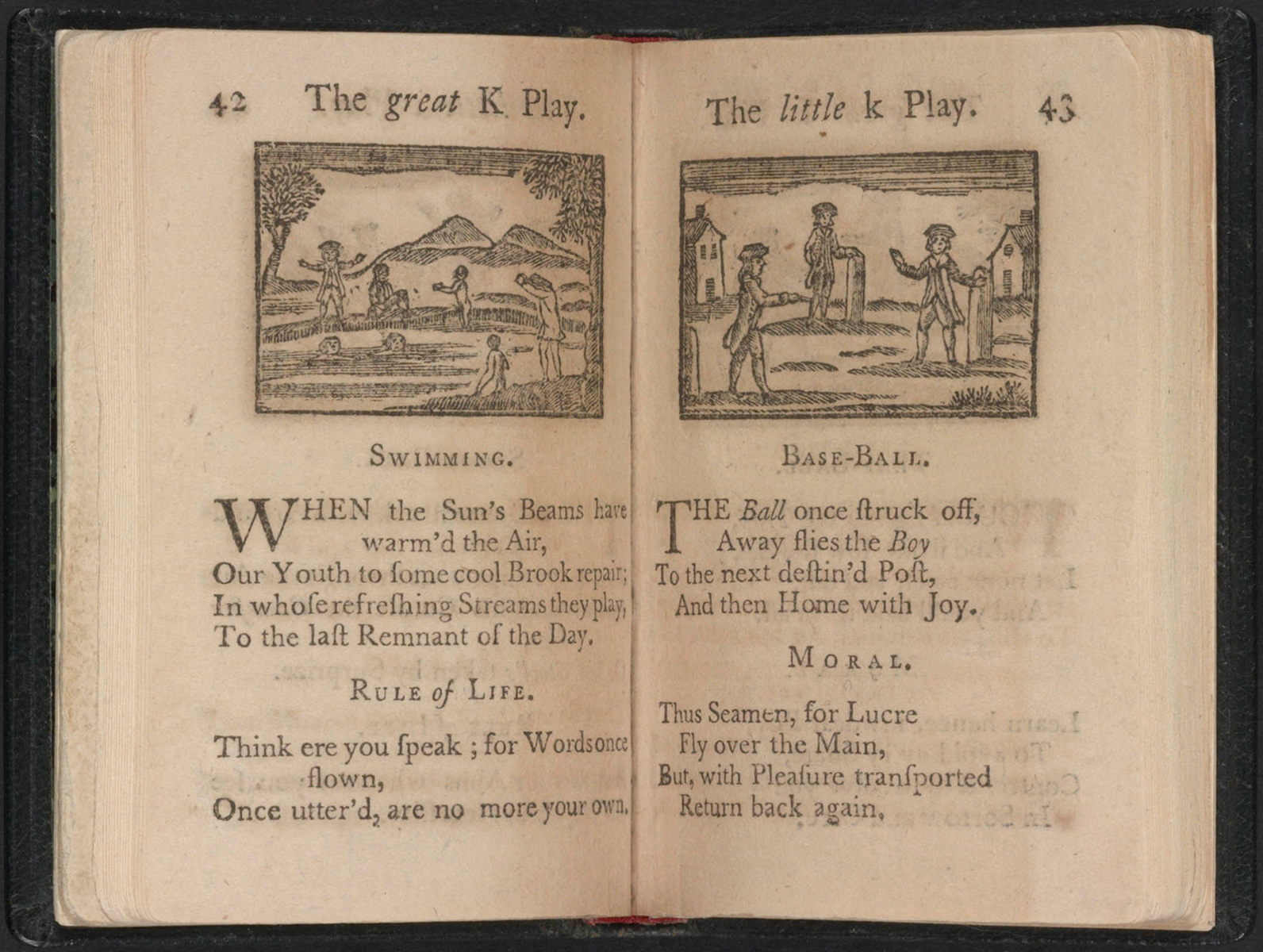
    A Little Pretty Pocket-Book, a children’s book published in 1744 by John Newbery, depicts some games and activities from the 18th century that today’s children are likely still familiar with, like flying kites, hopscotch, and leapfrog. Other games may be less familiar to some readers, such as “Tip Cat,” a game similar to cricket where a large stick is used to strike a smaller piece of wood into the air, and “Peg Farthing,” a game involving wooden spinning tops. An interesting fact for sports fans is that Newbery’s little book contains what is believed to be the first printed reference to baseball. The Pocket Book’s illustration for “base ball” depicts three boys standing next to their “post” or base.

    A page from A Little Pretty Pocket Book depicting swimming and “Base Ball.” Source: Library of Congress

    Each game or activity is presented as a rhyme, a letter of the alphabet, and a “Rule of Life” or moral lesson. Interestingly, the book was also marketed with either a ball or pincushion gift to further help children understand good morals. Boys and girls were to track their good or bad deeds by sticking a pin in either the black (bad) or red (good) side of their toy. The book speaks to the practical element of many children’s games at this time; it was intended to instruct as well as amuse. The Library of Congress has a copy of A Little Pretty Pocket Book printed in Massachusetts by Isaiah Thomas in 1787. Clearly, the popularity of the book was long-lived.

    Opening pages of A Little Pretty Pocket Book. Source: British Library

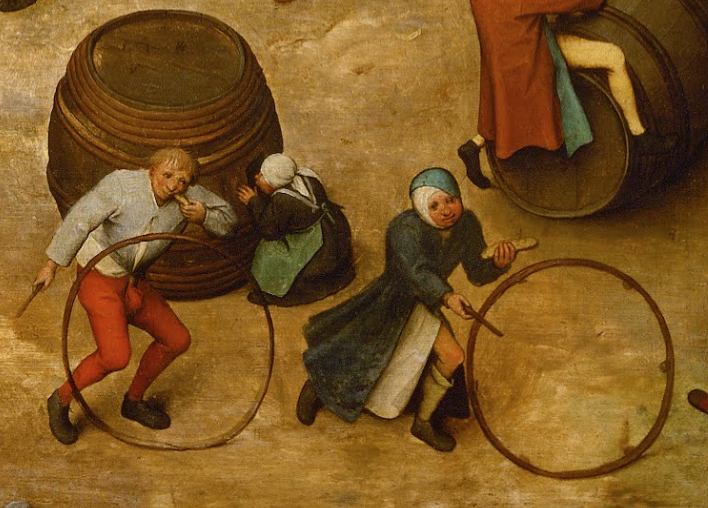
    Two popular games today’s students can play at Ferry Farm and Kenmore are hoop rolling (or trundling) and Graces. Hoop rolling has a long history across many different cultures. Images from ancient Greek and Roman art depict youth playing with hoops. Dutch painter Peter Bruegel’s, Children’s Games was painted in 1560 and showed 230 children playing 83 different games, one of which was hoop rolling. In George Washington’s time, the stick and hoop were made of wood, and the goal was to push the hoop along with the stick without it falling over.

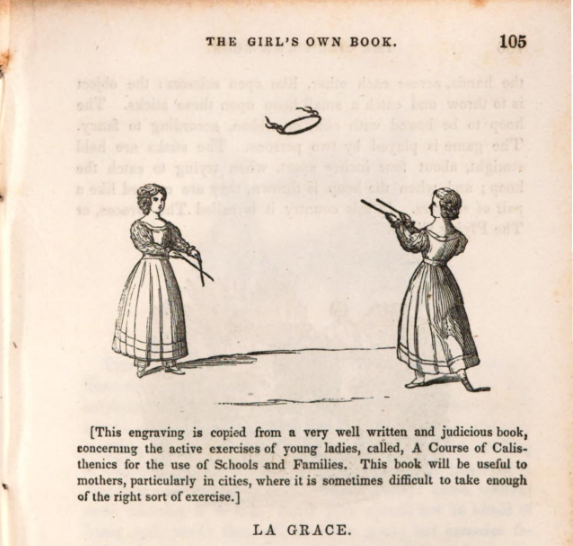
    Graces, or French Hoops, was a popular game in the early 1800s and was said to have been introduced to England from France. It was considered an appropriate pastime for young girls, as the game was supposed to inspire graceful movement in the players. The game requires two players, two sets of sticks, and one hoop (or two for added difficulty!) One player holds the sticks crossed in front of themselves with their hoop hanging off the end. To toss the hoop, they pull the sticks apart. The second player has to catch the hoops on their sticks. Each player gains one point when they catch the hoop, and the goal is not to let it hit the ground.

    Two books published in the 19th century illustrate the game of graces: American Girl’s Book by Eliza Leslie, published in 1831, and The Girl’s Own Book by Lydia Maria Child, published in 1833. Both authors mention particular benefits of the game, such as encouraging healthy exercise, graceful movements, dexterity and coordination, and of course, fun!

    Today, students who visit Ferry Farm and Kenmore might try their hand at graces or hoop rolling or play with other 18th-century toys. These games, along with those depicted in children’s books like Newbury’s, may have been familiar to children like George and Betty Washington. Often, these children’s games were seen as having some kind of practical instructional value.

    While some games have withstood the test of time and others have faded from popularity, it’s clear that children across time have always found ways to amuse and entertain themselves! [1][2][3]

    Ann Waters

    Manager of Interpretation & Visitor Services


    [1] Child, L. M. (1833). The Girl’s Own Book. Ireland: Clark Austin & Company.

    [2] Leslie, E. (1863) The American girl’s book: or, Occupation for play hours. New York: J. Miller. [Image] Retrieved from the Library of Congress, https://www.loc.gov/item/76355554/.

    [3] Thomas, I. & Miniature Book Collection. (1787) A little pretty pocket-book: intended for the instruction and amusement of little Master Tommy, and pretty Miss Polly: with two letters from Jack the giant-killer, as also a ball and pincushion, the use of which will infallibly make Tommy, a good boy, and Polly a good girl: to which is added, A little song-book, being a new attempt to teach children the use of the English alphabet, by way of diversion. Printed at Worcester, Massachusetts: by Isaiah Thomas, and sold, wholesale and retail, at his bookstore. [Pdf] Retrieved from the Library of Congress, https://www.loc.gov/item/22005880/.

  • Oyster Ice Cream: The Enigma

    This past week the curatorial and archaeology departments came together to fulfill a long-held dream to make oyster ice cream. Many people asked “why?” others said “gross,” and many just shook their heads at our endeavor. But we are not easily put off by odd things in history. In fact, many of us seek them out, and oyster ice cream is indeed an oddity.

    But before we dive into oysters and ice cream, there are some common myths that need to be cleared up. Oyster ice cream was not mentioned in The Adventures of Tom Sawyer. Dolley Madison did not serve it during her time in the White House. Oyster ice cream was not served at the “first” Thanksgiving. And finally, no, it was not George Washington’s favorite creamy treat; in fact, there is no connection between the two.[1]

    Now that we are all on the same page, let us begin because this will be a long one.

    History of Oysters

    Oysters have been an easy and plentiful source of protein for humans since humans began. Prehistoric middens have been found in Australia containing the remnant of oysters used for food. They have been cultivated in Japan since at least 2000 BCE, and farming beds have been found in England since Roman times.[2]  The period between the eighteenth and nineteenth centuries was known as the Golden Age of Oysters as an increase in production made them extremely affordable for the working class in the US and Europe.[3][4]

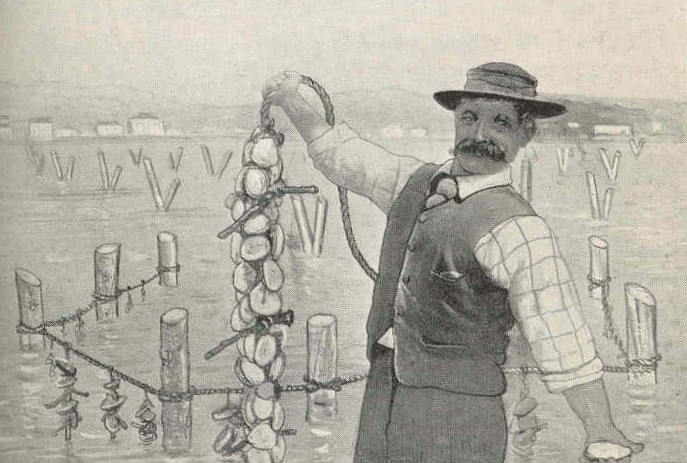
    Oyster Culture in the Bay of Spezia, Italy. Wikicommons

    The invention of railroad transportation, canning, and refrigeration in the nineteenth century meant that oysters could now be shipped to markets all over Europe and the US. With the growth in production oysters became a cheap source of protein compared to the pricier meat, poultry and fish. Soon cities like New York City, Philadelphia, Baltimore and New Orleans became hubs of large oyster markets.[5]

    Oyster stands in Fulton Market. Wikicommons

    History of Ice Cream

    The history of ice cream is a bit obscure, but ice cream, as we would know, was not possible until the discovery of the endothermic effect. The endothermic effect is where a substance, like cream, can be made to freeze by immersing or surrounding it with a mixture of ice and salt. Surrounding the cream with ice alone only chills but does not freeze the cream. Adding salt to ice lowers the melting point and draws the heat out of the cream causing it to freeze. This process was described as early as the thirteenth century by Arab medical historian Ibn Abu Usaybia.[6] But it wasn’t until the latter part of the seventeenth century that Europeans made soberts and ice cream using this process.[7]

    The first English recipe for ice cream was published in Mrs. Mary Eale’s Receipts in London in 1718[8]. It was again published in our blog’s favorite cookbook, The Art of Cookery made Plain and Easy, by Hannah Glasse.[9]  How and when it came to America can be debated, but the Found Fathers regularly enjoyed it, with Washington, in the summer of 1790, purchasing around $200 worth of ice cream.[10]  This did not mean that the common man or woman in the street would necessarily enjoy the frozen treat as it was still time-consuming and expensive to make, needing ice to be cut and stored in winter for use in summer.

    By the nineteenth century, developments in ice cream production, like the hand-cranked churn and industrial refrigeration, allowed manufacturers to produce ice cream on a large scale. Mass production lowered the cost of ice cream, and its popularity has soared ever since.   

    So oyster ice cream, where did that come from?

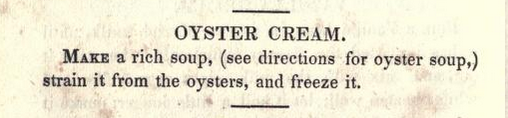
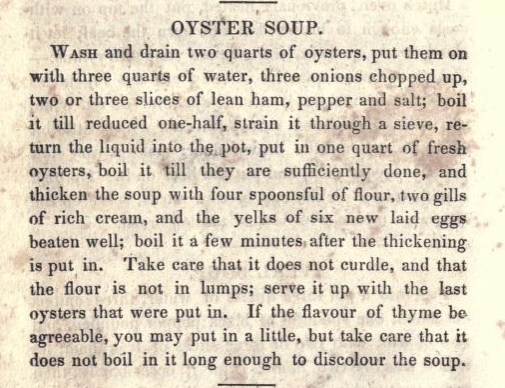
    The first and only recipe for oyster ice cream was printed in Mrs. Randolph’s book The Virginia Housewife, published in 1824. The Virginia Housewife was a singular work focused on Virginia produce and cooking practice. It became a model of nineteenth-century Southern American cookery.[11] But the publication of the recipe and the subsequent disappearance of it from history has confused historians for ages. No one is sure why oyster ice cream or where it would be served during dinner. Was it a dessert or a palette cleanser, was it served in place of soup? Was it popular, and if not, then why include it in the cookbook?

    Those are questions that will probably never be answered. However, through our little experiment, we could at least answer a few, like is it easy to make, what does it taste like, and should this be revived for our modern palettes?   Note: we did pare down the recipe because, unfortunately, oysters are not as cheap as they once were, and we didn’t want gallons of oyster ice cream. 

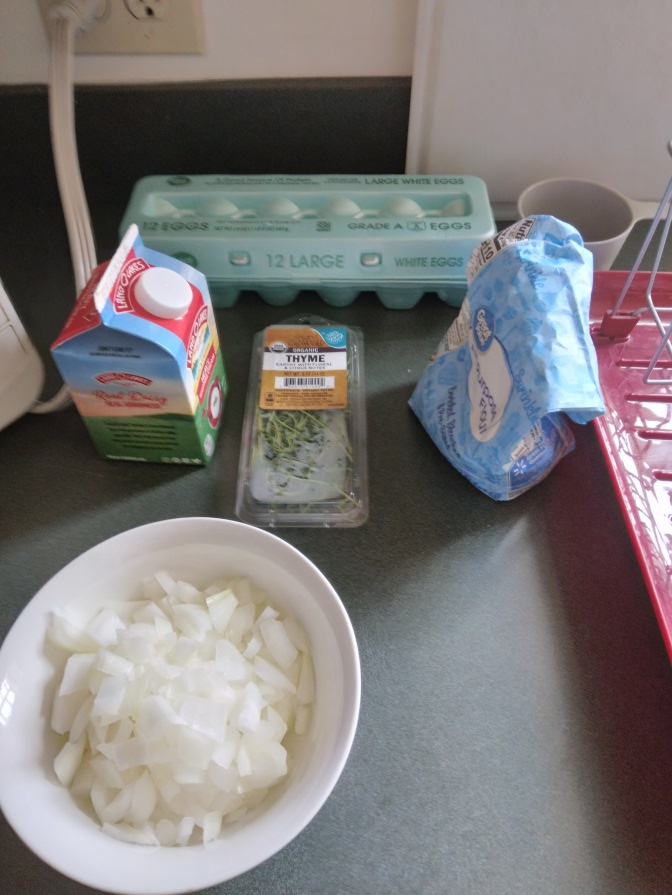
    First Step: we gathered our ingredients, including onions, cream, flour, eggs, and oysters

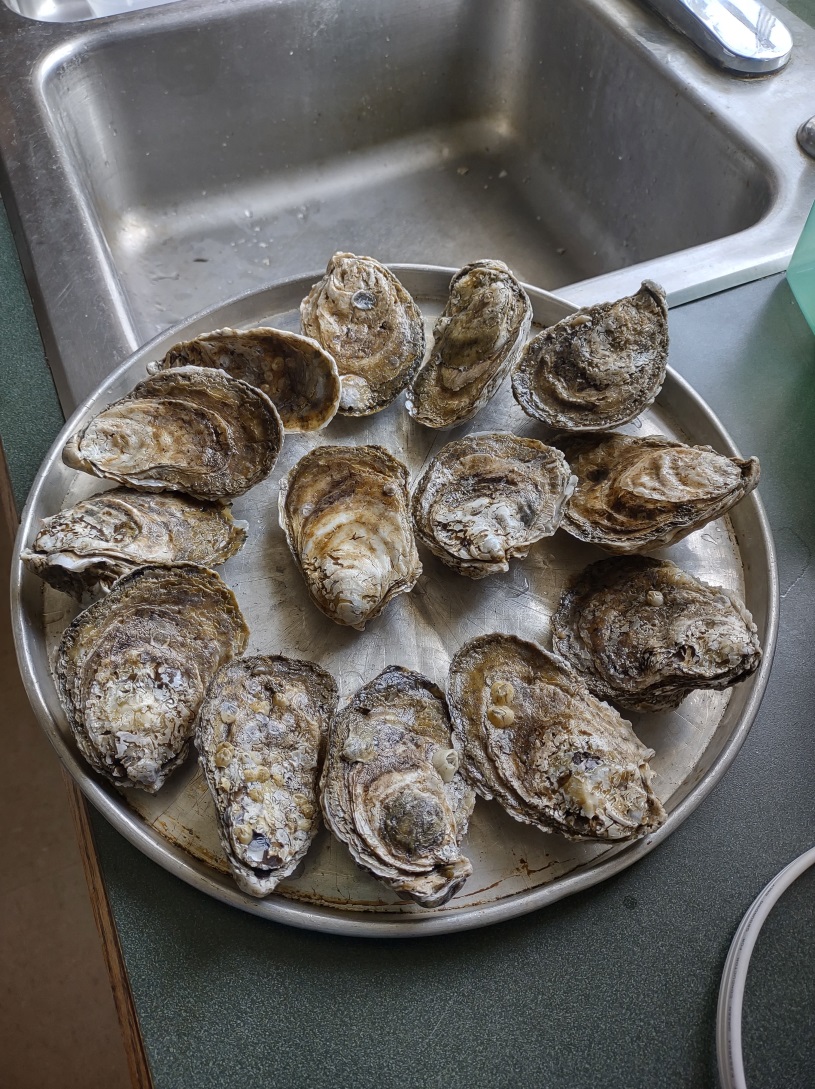
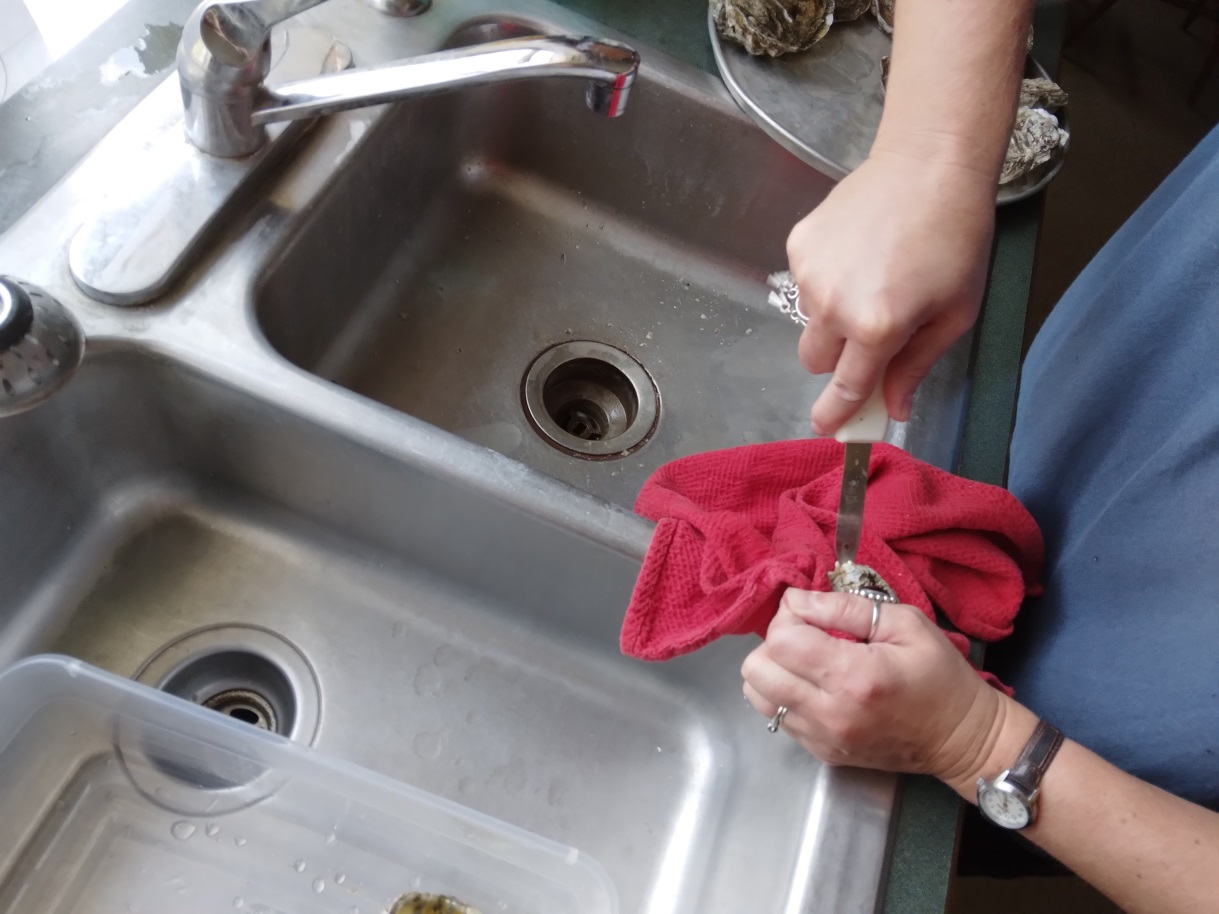
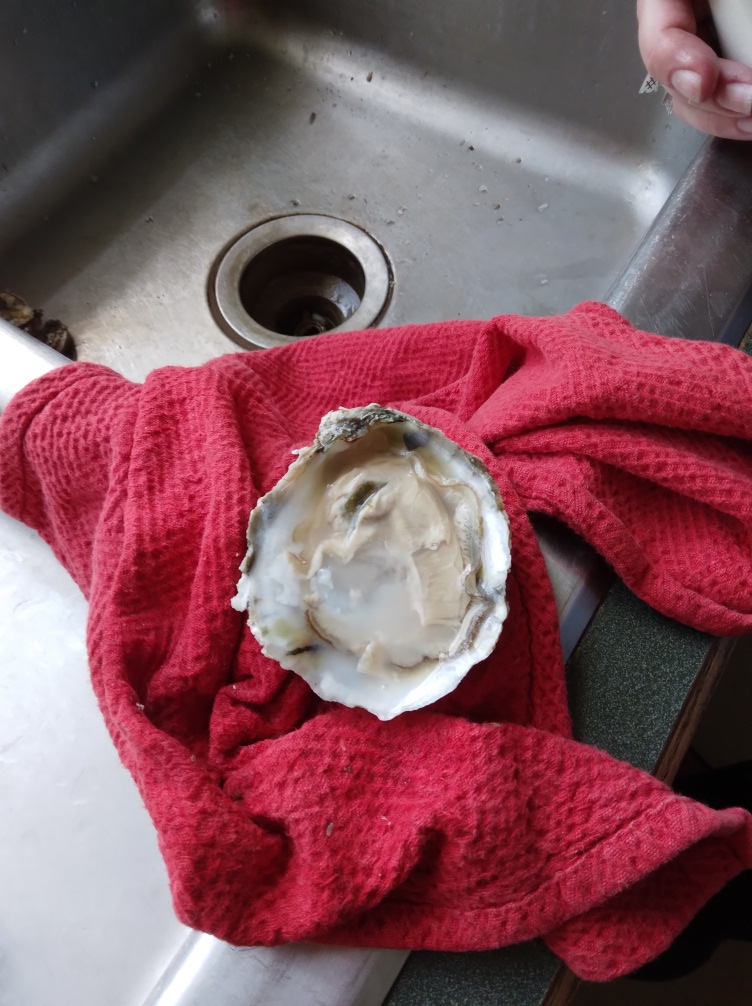
    Second Step: shuck oysters. Luckily our fearless Archaeology Lab Manager and super fan of oysters, Mara Kaktins, and her deft hands were able to shuck the oysters in minutes.  

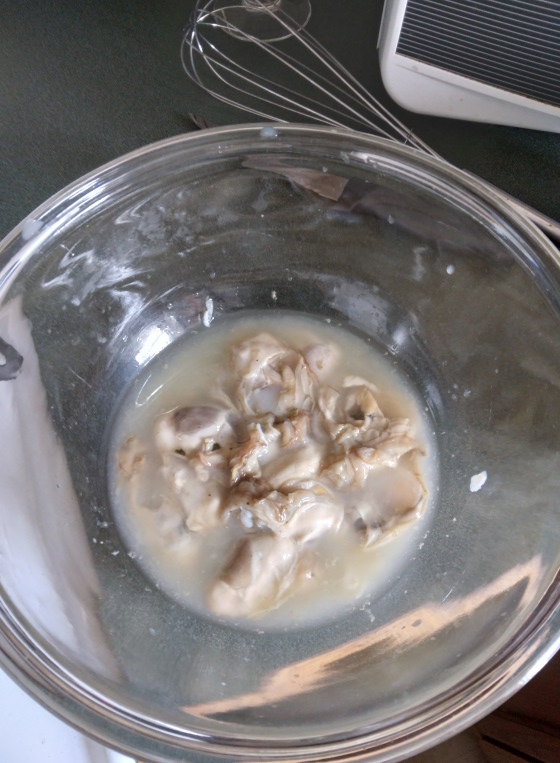
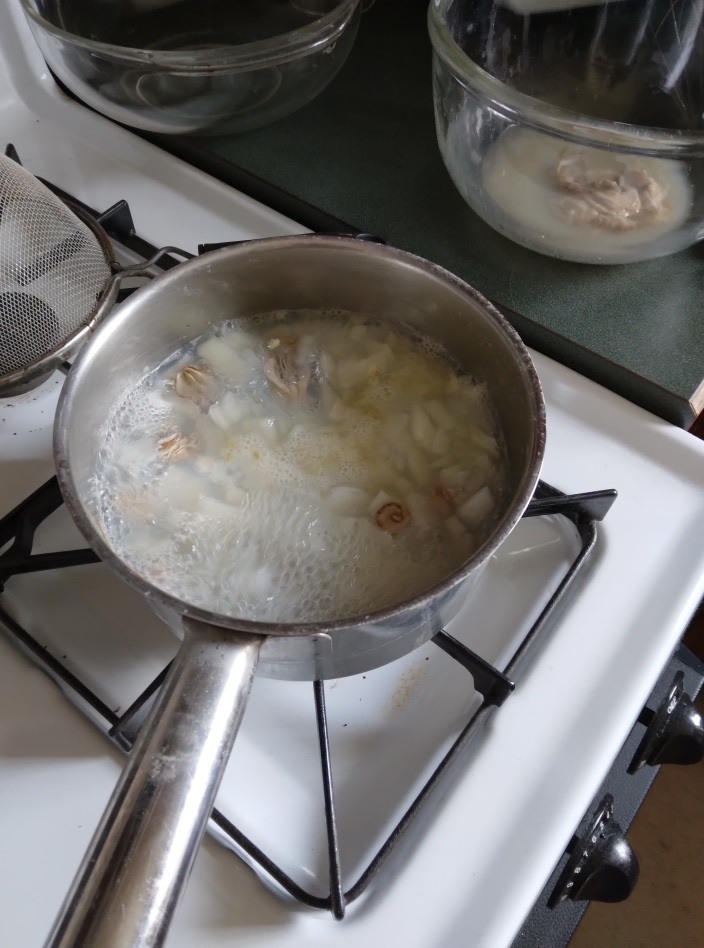
    Third Step: We put 2/3 of the oysters in a boiling pot of water with ½ a yellow onion and let that simmer until the water was reduced by ½.

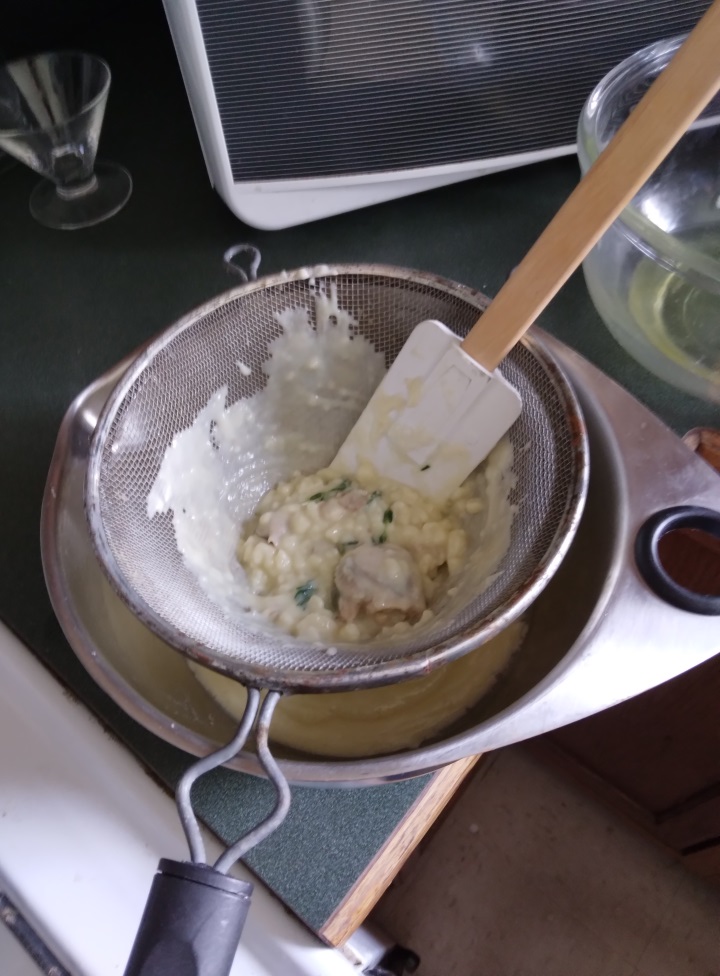
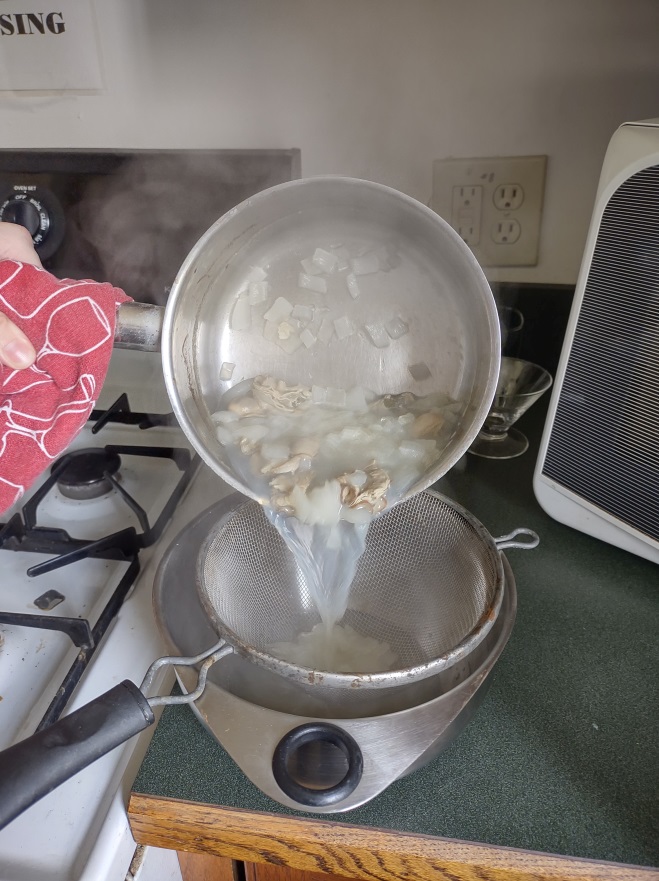
    Fourth Step: Drain liquid, removing cooked oysters and chopped onions. Keep liquid and return it to the pot for the next Step.

    Straining oysters and onion mix

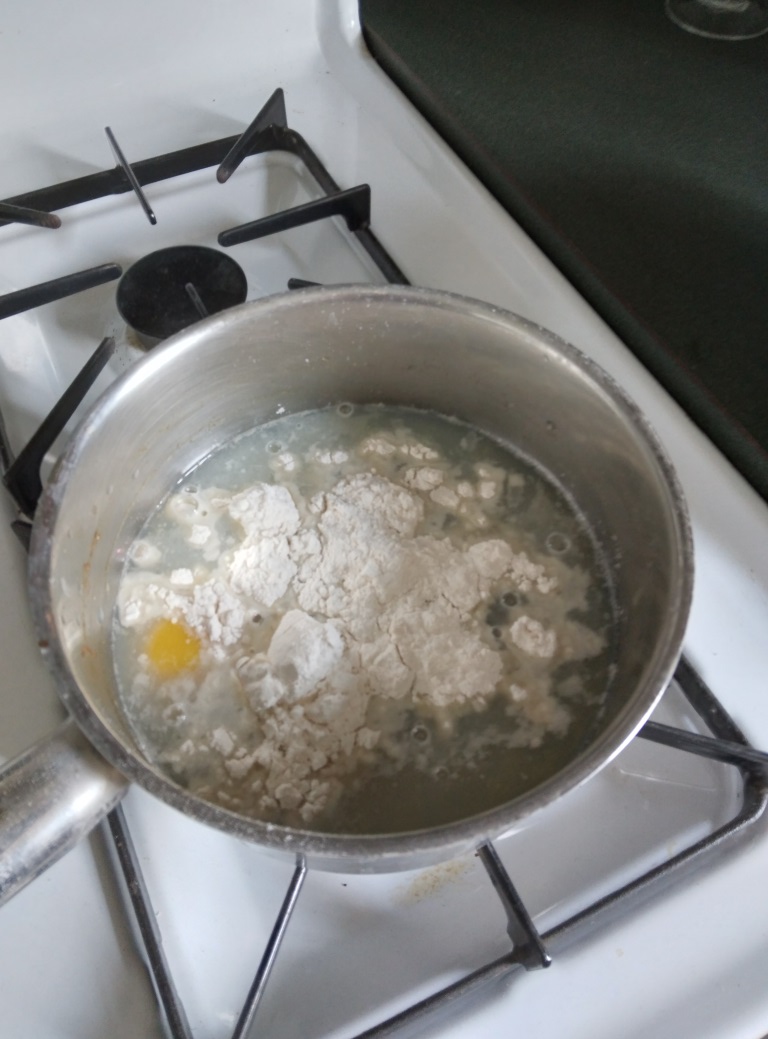
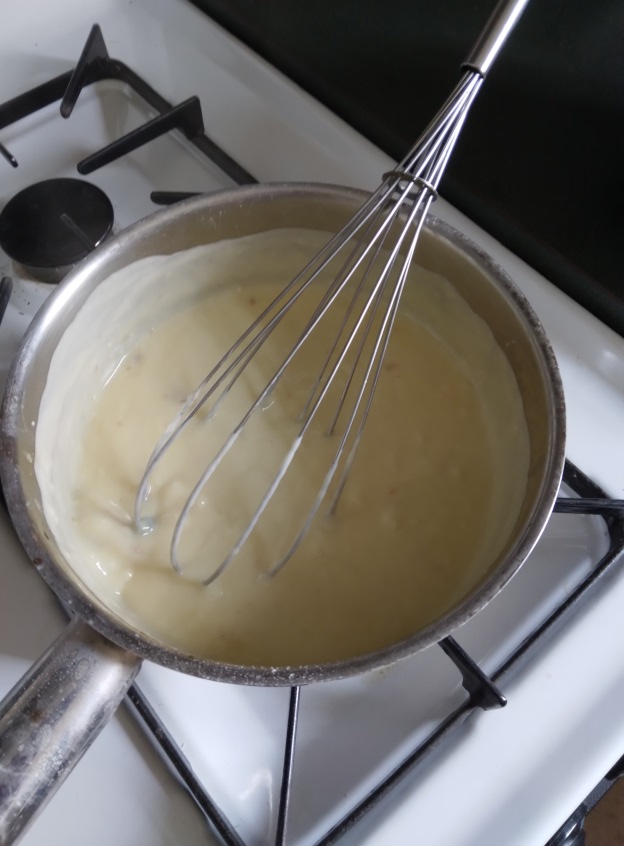
    Fifth Step: add the other 1/3 of the oysters to the liquid, along with a few tablespoons of flour, eggs, and cream. Simmer until it thickens but make sure not to burn or let it curdle.


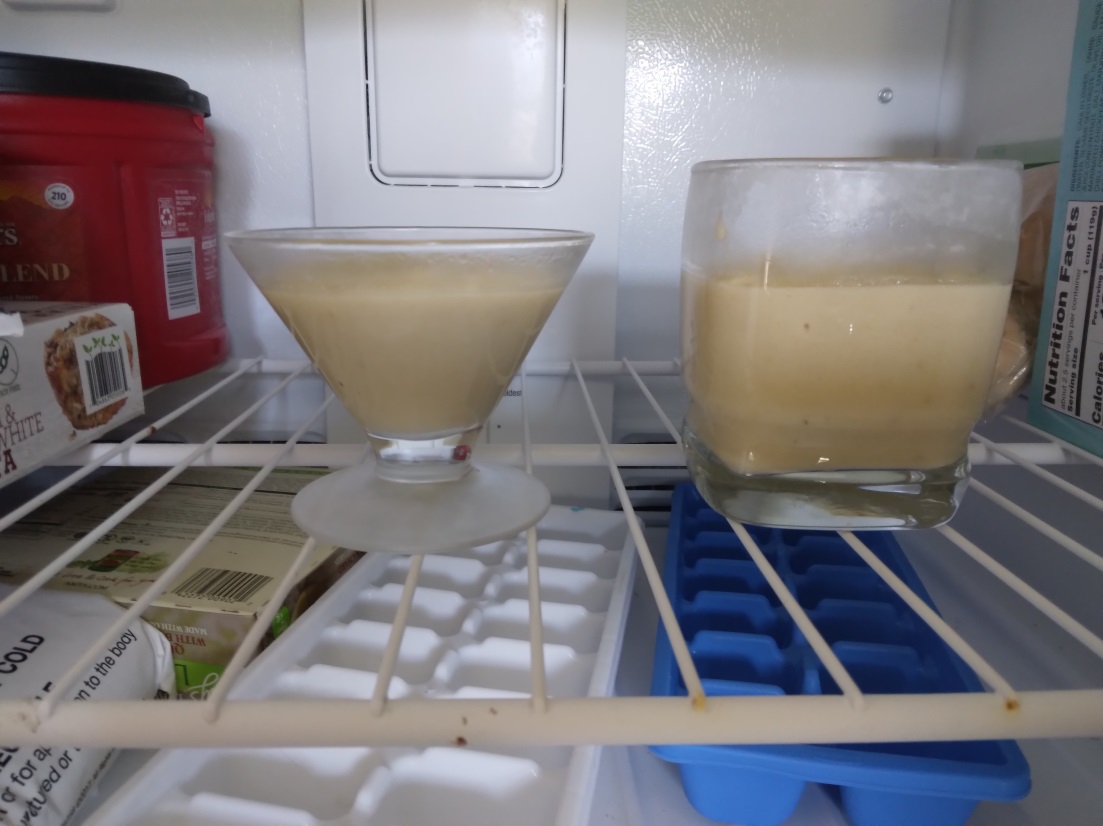
    Sixth Step: Sieve the creamy soup, remove the last of the oysters and put into glasses, and freeze for a few hours.

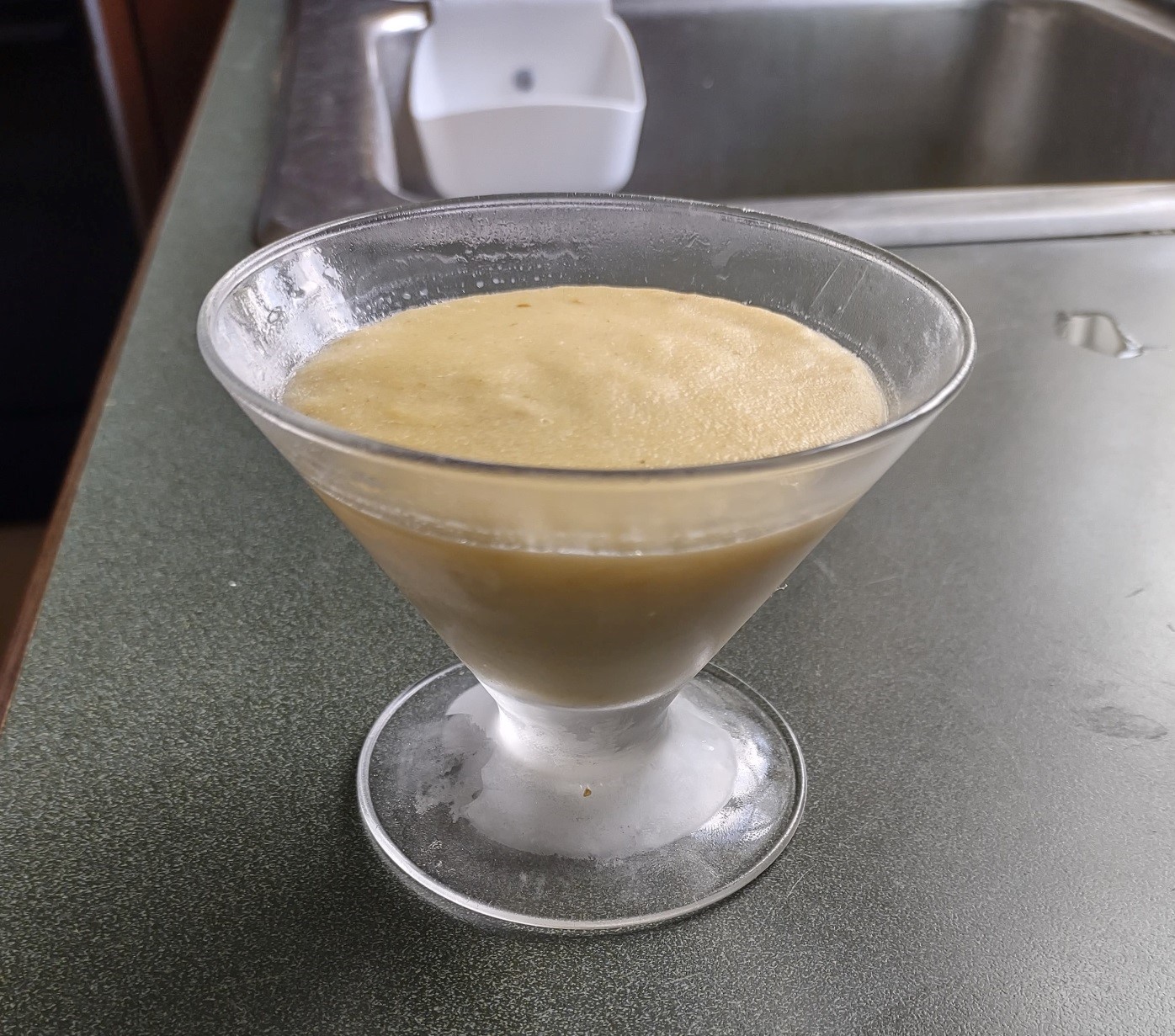
    Last Step: remove from freezer and enjoy?        

    Finished ice cream

    Needless to say, after it was ready, we proceeded to run around the offices, and made everyone try a bit. Surprisingly, the reviews were mixed and pretty even, with slightly positive reviews at four and negative reviews at 4.   Positive reviews overwhelmingly stated that “it was not as bad as I thought it would be” or “it’s not awful but would be better as a warm soup.” The negative reviews were a little more critical, with “ew, it tastes like oysters” being the primary feedback. 

    So what have we learned from this experiment? What were our conclusions? We discovered that it is easy, if expensive, to make. It requires neither specialty tools nor any particularly rare ingredients. We also concluded that it indeed tasted like frozen oyster soup, which many would have actually preferred. Not surprisingly, if the person did not like fresh oysters, they weren’t too keen on them frozen. But the most important question is, should this be revived for modern palettes? Does the world need oyster ice cream? I believe we answered that with a resounding “No.” It seemed to most that the ice cream basically ruined some delicious fresh oysters or spoiled a warm, comforting oyster stew.

    Oyster ice cream will always be an enigma; it combines two things people enjoy: oysters and ice cream. But, while it may have worked for peanut butter and chocolate, sometimes two wonderful things just shouldn’t be mixed. And with that, we bid a fond farewell to oyster ice cream hoping that Mrs. Randolph’s The Virginia Housewife is the last we will ever see of this peculiar concoction.

    Mara Kaktins, Archaeologist & Lab Manager

    Heather Baldus, Collections Manager


    [1] Swerdloff, Alex. “The Long, Weird History and Mythology of Oyster Ice Cream.” Vice Magazine, November 18 2016.  https://www.vice.com/en/article/nzkewm/the-long-weird-history-and-mythology-of-oyster-ice-cream

    [2] Unknown. “Oyster Industry in NSW”. https://web.archive.org/web/20151222111017/http://www.dpi.nsw.gov.au/fisheries/aquaculture/publications/oysters/industry/oyster-industry-in-nsw

    [3] Swerdloff, Alex. “The Long, Weird History and Mythology of Oyster Ice Cream.” Vice Magazine, November 18 2016.  https://www.vice.com/en/article/nzkewm/the-long-weird-history-and-mythology-of-oyster-ice-cream

    [4] Unknown. “The History of Oysters: Its Rise as a Delicacy and a Staple Food Beloved by Many.” Food Worth Writing For, July 31 2018. https://foodworthwritingfor.com/2018/07/31/the-history-of-oysters-its-rise-as-a-delicacy-and-a-staple-food-beloved-by-many/

    [5] Ibid

    [6] Goldstein, Darra. The Oxford Companion to Sugar and Sweets. Oxford University Press, 2015.

    [7] Day, Ivan. Cooking In Europe 1650-1850. Greenwood Press. 2009.

    [8] Eales, Mary. Mrs. Mary Eale’s receipts. J. Brindley. 1733

    [9] Glasse, Hannah. The Art of Cookery, made plain and easy. A. Millar, and J. and R. Tonson, 1765

    [10] Jacob, Matthew. “America’s Unwavering Passion for Ice Cream.” Huffington Post, May 25 2011. https://www.huffpost.com/entry/americas-unwavering-passi_b_652268

    [11] Egerton, John. Southern Food: At Home, on the Road, in History. The University of North Carolina Press, 1987, pg 19

  • Music from the Past: Jaw Harps and their Players

    What is a jaw harp, and what does it tell us? This little instrument likely looks familiar, but you may not know that much about it. That certainly proved the case for me when I decided to research the four we have in our collection.

    To start, a jaw harp is an extremely simple instrument to make and play. It only requires an iron or copper alloy frame and a flexible metal tongue, or lamella, which runs through the center. Manufacturing styles vary, but many undergo casting or forging to create the bow shape and arms. The lamella most often attaches by hammering it in place. This part is rarely preserved in the archaeological record, so only the frame remains for us to find.

    To play the instrument, one places it against their mouth and plucks the lamella while breathing out. Varying your breathing and the shape of your mouth cavity allows the sound to change. That said, while the instrument is easy to play, it proves difficult to play well, and many dislike its boings and buzzes. Those skilled at the jaw harp, however, went on to play for the likes of Frederick the Great and George IV. They even managed to play more than one jaw harp at once.

    Man playing a jaw harp (Mackinac State Historic Parks 2018)

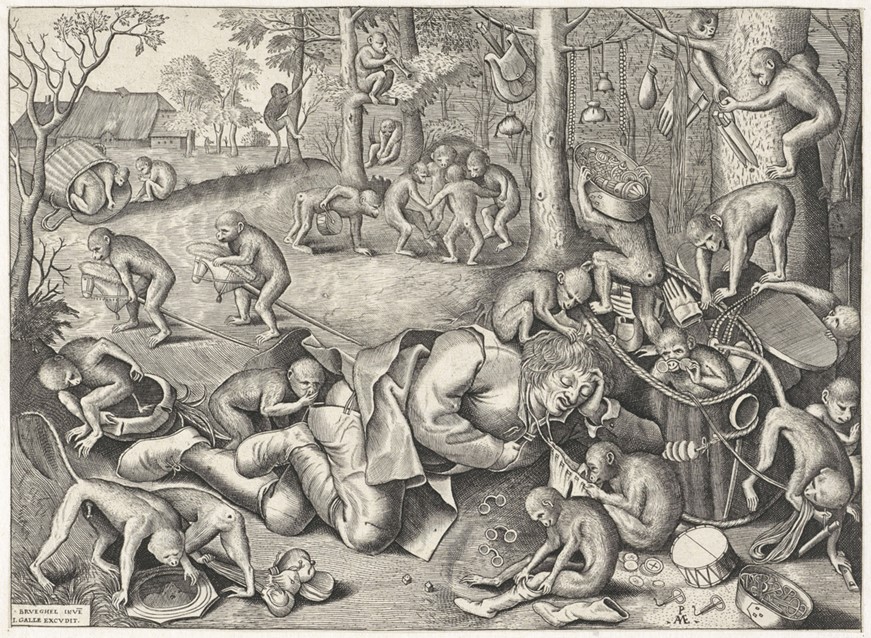
                The history of jaw harps dates beyond the fifth century BCE in Asia. Archaeological evidence places the instrument’s arrival in Europe around 1200, with the migration occurring along northern routes through the Baltic. Due to their mundane nature, jaw harps rarely appear in historic accounts or art. Two exceptions include Pieter Bruegel the Elder’s The Sleeping Peddler Robbed by Monkeys (1562), which helps identify peddlers as the main purveyors of jaw harps, and accounts of the North Berwick Witch Trials (1590-1592), where one of the accused performed for James VI of Scotland. Witches aside, the most common players at this time included the lower classes and soldiers.

                While jaw harps may not have generated the most attention, they played key roles in early trade deals in North America. Jaw harps likely first came to North America in the company of soldiers, but they soon gained popularity amongst indigenous groups, such as the Five Nations Iroquois. Confirmation of this occurred as early as 1595, with Robert Dudley reporting that the instrument made a successful trade item. As trade continued, the exchange of jaw harps frequently related to the fur trade, but some larger and more dubious, deals included the acquisitions of Staten Island and Maryland. That said, even the fur traders came under fire for using jaw harps of poor quality.

    Within established colonies, jaw harps appeared as an item frequently sold by merchants. Numerous adverts appeared in papers between the 1730s and 1780s. For Virginia, this included merchants in Williamsburg during the 1760s, as well as Alexandria and Gloucester in the 1770s. Production would have occurred in England with the then imported good available to all customers in the colonies. We know that soldiers played them during the French & Indian War and the American Revolution. This connection to soldiers would even continue through the Civil War. As for other players in Colonial times, a couple of adverts for runaway indentured servants placed in Benjamin Franklin’s Pennsylvania Gazette listed jaw harps as a special talent of the individual and amongst the items possibly carried by them.

    Aside from these individuals, the other most common players consisted of enslaved people. Evidence of this comes solely from the archaeological record. Excavations have uncovered jaw harps at a number of sites in Virginia, including Monticello, that date from the mid-1700s to early 1800s. In all of these cases, the instruments came from enslaved domestic quarters and work areas. Due to their nature, jaw harps would have proved an easy item for an enslaved person to hold on to, use, and share with others. In use, they would have been part of the enslaved music culture, which offered individuals a respite from work, a way to express themselves, and perhaps an outlet for the continuation of West African cultural practices.

    As I mentioned earlier, four jaw harps reside in our collection. Three came from the Washington cellar, while the fourth came from a Civil War trench that ran through the cellar. To understand their significance, an examination of the artifacts themselves and their contexts help us identify and date them.

    Physically, all four appear to reflect a design known as Gloucester. This means they consist of an iron frame and represent one of the most common designs in America during Colonial times and after the Revolution. We know that the ones that came directly from the cellar pre-date the 1830s due to the collapse of the house. A closer look at the artifacts accompanying them provide us with a range of the 1780s-1830s for the date of deposit.

    Depiction of a Gloucester-type jaw harp sans lamella

    As for the harp from the Civil War trench, while this may seem like an obvious identification, it remains tricky. A Union soldier may have played and discarded it while encamped here. However, when people filled the trench after the war, they may have used dirt that contained earlier artifacts from Ferry Farm. As the trench ran through the cellar, this harp ultimately lay close to the other three, and the dirt used to fill the trench may have come from that area. We may never know for sure on this particular piece, but it likely dates either to the war period or as a contemporary of the other three.

    Ferry Farm’s jaw harps

    While the dates provided occur after the Washington occupation of Ferry Farm, jaw harps existed on the market during their time, meaning the instrument may have had an earlier presence. As for who played them, these instruments likely reflect use by enslaved individuals. After the Battle of Princeton (1777) claimed the life of Hugh Mercer, who had purchased Ferry Farm from George Washington, the property passed through a series of renters. None occupied the site for long, but an enslaved population maintained a constant presence as each renter relied on enslaved labor. This continued up until the Civil War. With the evidence of enslaved people using jaw harps at other sites in Virginia and the fact that enslaved individuals constantly lived or worked at Ferry Farm, we can attribute these artifacts to them.

    One of our future projects involves reconstructing the enslaved quarters at Ferry Farm to better represent and tell the enslaved narrative. As jaw harps represents an activity that occurred during the limited down time allocated to enslaved people and reflects the importance of music in the culture, one will certainly be included upon completion of the project.  

    After all that history and archaeology, I leave those wondering what a jaw harp sounds like with the perfect piece. Fittingly titled “Washington’s Birthday,” this 1909 piece by Charles Ives utilizes the instrument to invoke the sound of country dances on a cold, dreary day in February. To hear the jaw harp, skip to 7:37. Enjoy!

    Emma Schlauder

    Research Archaeologist
                                    

    References

    Clyne, Anthony, 1928. The Jew’s Harp a Century Ago. The Musical Times 69(1024): 508-509.                                                                                        

    DAACS, 2022.Artifact Query 3, 8 August 2022. The Digital Archaeological Archive of Comparative Slavery (https://daacsrc.org/queries/aq_three_results).

    Kolltveit, Giermund, 2006. Jew’s Harps in European Archaeology. Archaeopress, Oxford, UK.

    2009, The Jew’s Harp in Western Europe: Trade, Communication, and Innovation, 1150-1500. Yearbook for Traditional Music 41: 42-61. 

    Samford, Patricia M.,1994. Searching for West African Cultural Meanings in the Archaeological Record. African Diaspora Archaeology Newsletter 1(3): 1-3.                                                                                                            

    Wright, Michael, 2008. The Jew’s Harp in the Law, 1590-1825. Folk Music Journal 9(3): 349-371.    

    2011, The Jew’s Harp Trade in Colonial America. The Galpin Society Journal 64: 209-218.


  • Catherine of Braganza: How the copy of a 17th-century plate tells the story of design, consumer consumption, and the Washington Family

    The concept of buying items to remember certain events or travels is commonplace today. Who goes abroad without bringing back a trinket naming the location? Is it possible to go antiquing without seeing an item that commemorates the wedding of Charles and Diana? Even the smallest item has the ability to tell a story through what it depicts. In our world of mass consumption, these items prove commonplace and relatively easy to obtain, but the concept is not new.

    Charles & Diana memorabilia

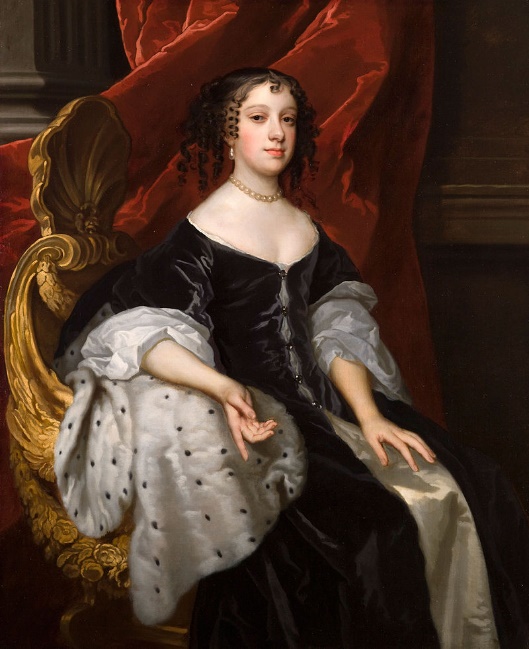
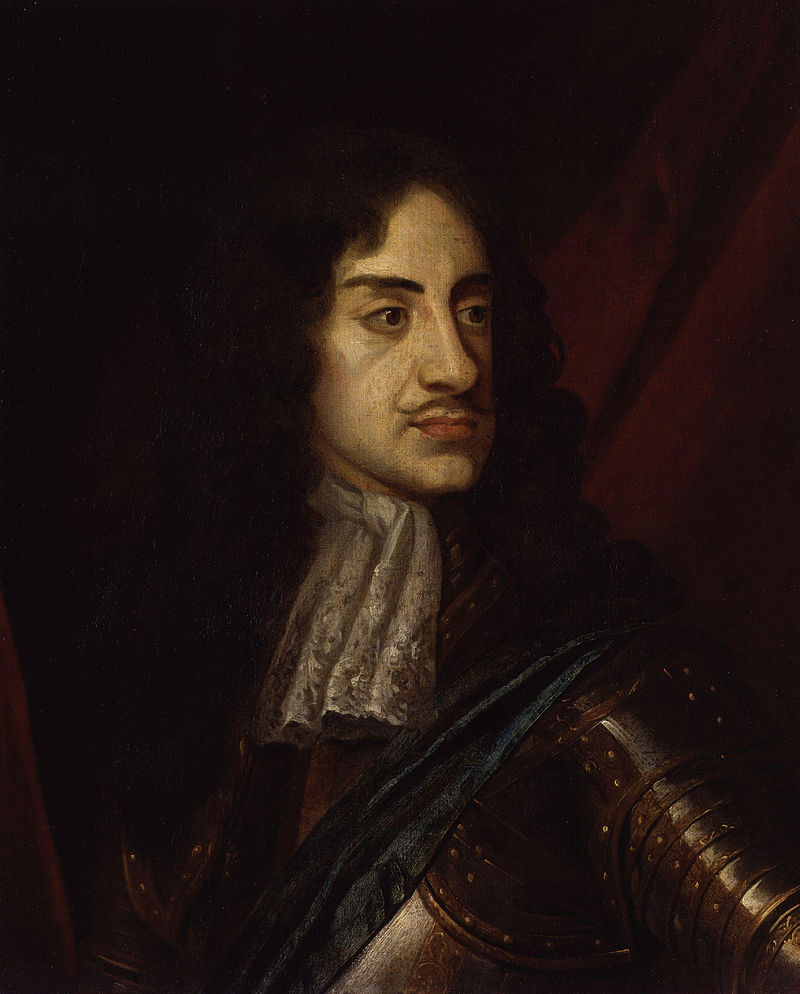
    Back in the mid to late 1600s, a potter by the name of Thomas Toft (d.1689) produced a series of plates depicting Charles II and his wife Catherine of Braganza. When Cromwell’s strict Puritan regime ended in 1660, the people of Great Britain rejoiced at the restoration of the monarchy. Charles II was an active king who enjoyed the arts and a good time. His marriage to Catherine, a Portuguese princess, in 1662 was a cause for further celebration, even if her Catholic faith raised concerns. Regardless, Toft had his market.

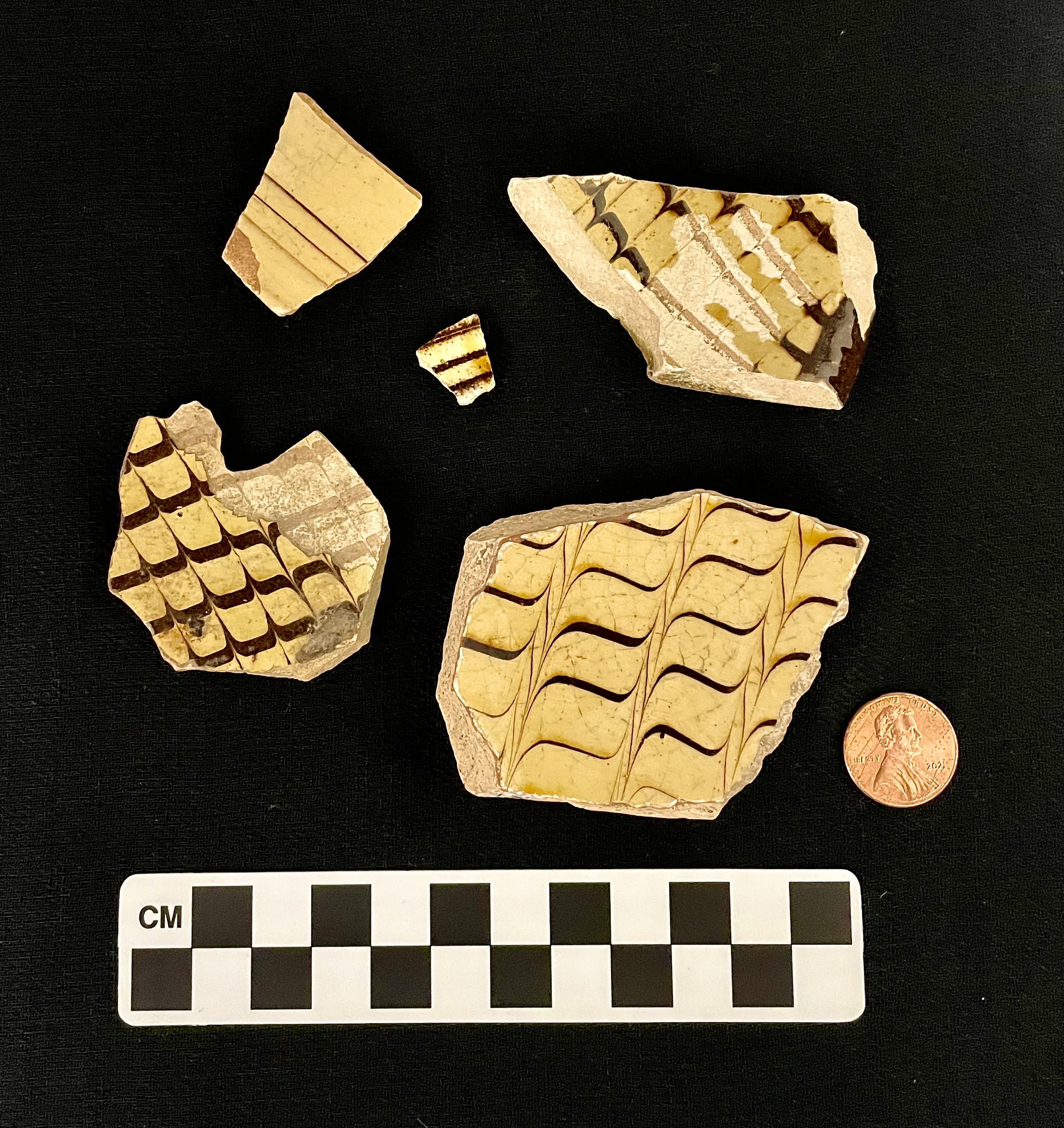
                A Scandinavian immigrant, Toft lived in Staffordshire, England, and specialized in slipware. Slipware involved the use of clay slips and a lead glaze to decorate a piece. Typically, a white clay slip, which is essentially, watered-down clay, covered the upper surface of a piece before the artist drew on the design. Dark brown and orange-red clay slips then helped bring the design to life. To complete the piece, the artist utilized a lead glaze to enrich the colors and seal it. Toft became one of the most famous slipware potters of the time due in part to his habit of prominently signing his works at the base of his cross-hatching border, which was unusual in the 17th century. He produced plates depicting the royals throughout his career. Toft’s pieces may not have undergone the mass production that they would today, but they fed a market that desired commemorative memorabilia.

    Slipware plate by Thomas Toft depicting Charles II and the Royal Oak

    You may be asking how talk of royals and artists from the 1660s connect to Ferry Farm? The answer comes from the desire to add a slipware plate to the house. As many will know, the items in the Washington house are replicas inspired by archaeological finds on site and pieces dating to the period. Until now, the slipware style did not appear in the house. Aiming to fix this, I went about choosing a design that would not only serve the desired purpose but also tell a story. In the end, I found a Toft plate that depicted Catherine, and the idea came to me.

    Pieces of slipware found at Ferry Farm

    John Washington (1631-1677), George’s great-grandfather, immigrated to Virginia in 1657. Motivation for this possibly derived from hardships faced by the Washington family after Cromwell came to power since the family had sided with the monarchy during the English Civil War (1642-1651) and business ties. With the restoration of the monarchy three years after their arrival, it seems likely that this would have been a cause for celebration in the Washington household. We know from finds at Ferry Farm and Kenmore that the Washington and Lewis families owned items depicting royal motifs up until the Revolution. So not only would the Washingtons of the 1660s have raised a toast to the King and later his bride, but they may have acquired items celebrating them. While we do not have evidence for the Washingtons’ owning a piece with this specific theme, items pass through generations, and we know the family brought older items with them to Ferry Farm in 1738.

    In making the replica, I aimed to keep it as close to the original as I could, though the cross-hatching border proved impossible to keep as tight. The imagery itself prompts the telling of the Washington-Royalist-immigration story, so nothing major needed changing. Keen viewers, looking at the images below, will notice the addition of a “Q” and a “K” to help identify Catherine. While Toft’s work rarely included royal monograms, they did appear on other designs of the time, making it a simple and fitting addition. In these other pieces, Catherine’s first initial always appears as a “K.” While we may spell Catherine’s name with a “C,” there was no standard of spelling in the 1600s, and this may have occurred since her husband’s name also starts with a “C.” After prepping the plate with a base coat of paint, I sketched the desired design and painted over it in a way that mimicked slipware techniques. A clear coat of spray paint then sealed the design in place of the lead glaze.

      The plate will go on display in the Visitor’s Center, where we display and explore the topics of our blog. Next time you visit, be sure to keep your eyes peeled and let Catherine tell you her story.

    Emma Schlauder

    Research Archaeologist
  • When is a rock also an artifact?

    As archaeologists, we focus on studying the past by examining the items previous humans have left behind. Anything that has been made or changed by someone in the past is therefore considered to be an artifact.

    When you think of stone artifacts, the first thing that usually comes to mind are arrowheads. Arrowheads and spearheads are referred to by archaeologists as projectile points. In addition to projectile points, archaeologists also find a wide variety of other stone tools, including awls, scrapers, knives, axe heads, grinding stones, and fishing weights. All of these tools, and others, were used to procure and process food and for preparing items of clothing, storage, and shelter.

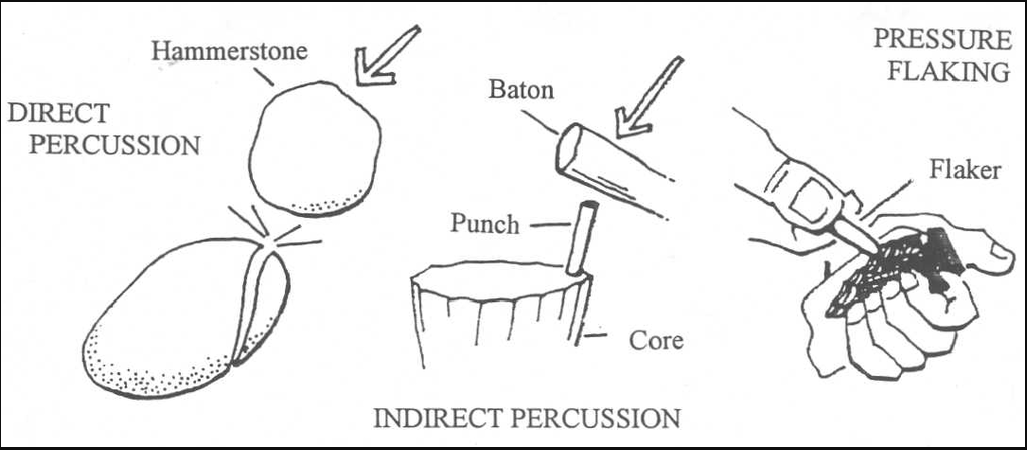
    Complete tools, however, are not the only evidence Native Americans left behind. Stone artifacts called flakes, shatter, and cores are evidence of the production of stone tools and are found in abundance on prehistoric Native American sites. A core is the first stage of lithic reduction, where the rock is considered an artifact. Typically a natural rock is broken into one or more lithic cores, which will be reduced to usable flakes and tools. Flakes are relatively thin shards of stone precisely removed from a stone core. Shatter consists of chunks of stone that come off the core in unintended or less predictable ways. To make a stone tool, flakes are removed from a core by striking them off with a hammerstone or antler baton. This is called percussion flaking. Each core would then be reduced through percussion flaking to a rough preform of the intended tool. Once that is complete, a lithic tool will be reduced to a finished shape and then sharpened. This is done through a process called pressure flaking. While percussion flaking makes bigger lithic flakes, pressure flaking makes very small flakes. Instead of hitting the stone, a narrow piece of bone or antler is firmly pressed against the side of the stone, breaking off a small flake and leaving a sharp and more robust edge.The best lithic tools are made from stones that break in predictable patterns. This quality is found in rocks that have a cryptocrystalline structure. Some examples of rock types we find lithic tools made from are: chert, flint, jasper, and quartz.

    Three methods of lithic reduction.
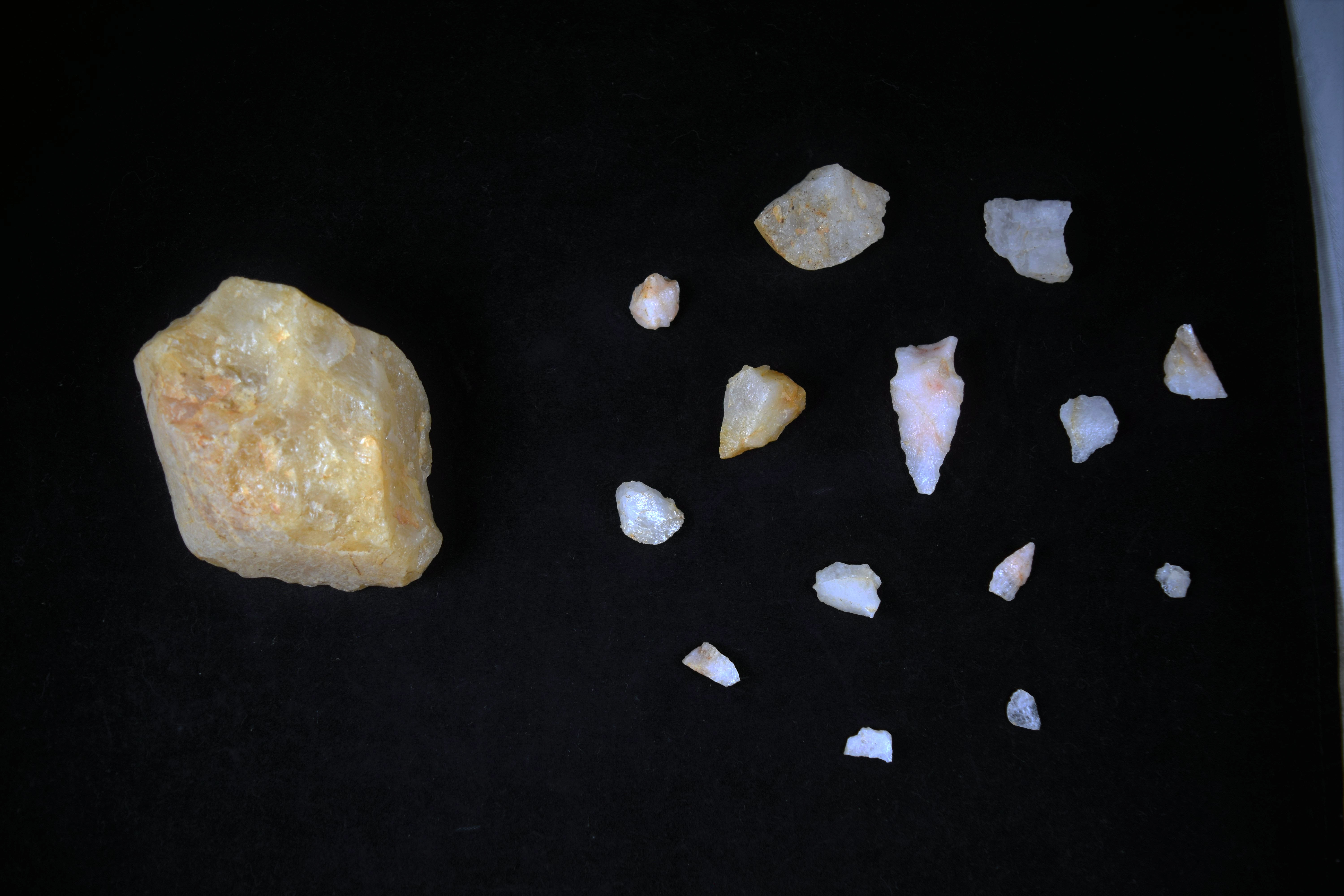
    Examples of lithics found at Ferry Farm, a core on the left and on the right a projectile point surrounded by flakes and shatter.

    While archaeologists can learn much from artifacts such as projectile points and tools, we are also interested in a category of stone artifacts called fire-cracked rock. Fire cracked rock, commonly abbreviated to FCR, is a byproduct of cooking at a time primarily before the creation and widespread use of ceramics more than 3000 years ago. In order to boil water for cooking, they would heat rocks in a fire and drop them into pots of water made from animal hides or wood. After doing this multiple times, the rocks would permanently turn red from the heat of the fire and shatter into small pieces from the rapid cooling and heating. By finding FCR here at Ferry Farm, we can deduce that people were cooking meals here before ceramic technology was widespread.

    Fire Cracked Rock found at Ferry Farm. Note the red color on the exterior caused by the heat of a fire.

    When lithic flakes and shatter are found, we know that at some point, someone made a stone tool there. By examining the type of stone, it is possible to determine where that material came from. Sometimes the local material available isn’t the best for making tools, and people would travel or trade for better materials. This is the case at Ferry Farm, where most of the lithics we find are made of quartz, but sometimes we find jasper or chert flakes that indicate travel or trade.

    There’s even more, we can learn from projectile points and some tools. Projectile points changed in shape, size, and form over time. These changes could be due to a change in purpose of the point or a change in maker. Archaeologists have grouped points together to create types that were made in a certain region during a given date range. We can use these groups to match points we find in our excavations and determine where it came from and when it could have been made.

    Native Peoples lived in the Rappahannock area, including what would become Ferry Farm, for thousands of years before Europeans arrived. The projectile points, tools, FCR, and lithic debris they left behind are some of the only artifacts that were able to survive until today. Being able to tell the difference between them and a natural rock becomes an important skill for archaeologists. Have you ever found a lithic?[1][2][3]

    Top and Bottom images: Examples of different types of points and the various materials they can be made from. All excavated at Ferry Farm.

    Mason Schultz

    Co-Field Director and Staff Archaeologist


    [1] “Diagnostic Artifacts in Maryland, Projectile Point Typology.” Jefferson Patterson Park and Museum, Maryland Archaeological Conservation Lab, 2002, https://apps.jefpat.maryland.gov/diagnostic/ProjectilePoints/AboutProjectilePoints/ProjectilePointTypology.html. Accessed 9 Aug. 2022.

    [2] “Diagnostic Artifacts in Maryland, How Are Points Made?” Jefferson Patterson Park and Museum, Maryland Archaeological Conservation Lab, 2002, https://apps.jefpat.maryland.gov/diagnostic/ProjectilePoints/AboutProjectilePoints/HowArePointsMade.html. Accessed 9 Aug. 2022.

    [3] Cullen, Darcy. “Methods of Flaking Stone.” Quizlet, https://quizlet.com/250350464/methods-of-flaking-stone-diagram /. Accessed 9 Aug. 2022.

  • Letters from the Battlefield

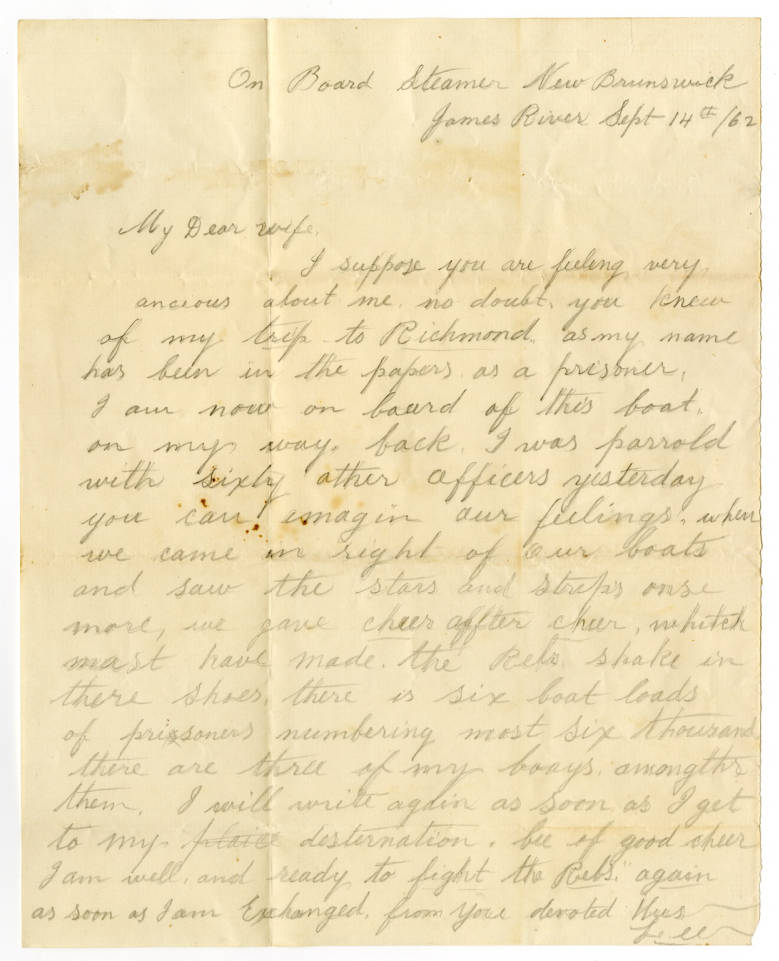
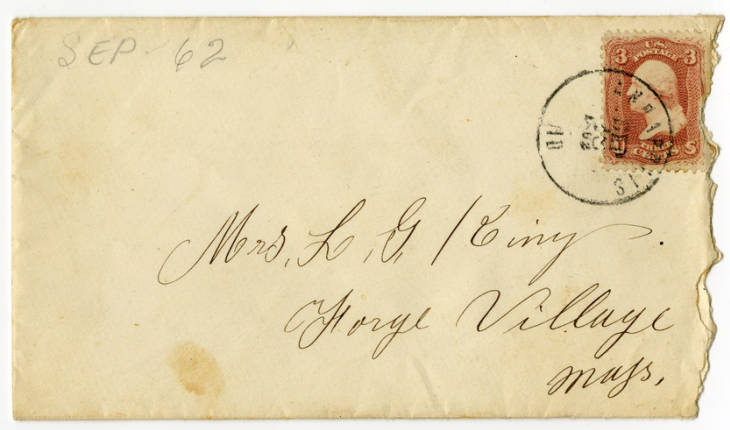
    Such a tiny thing, a letter. What does it mean now? For many of us, a letter via ‘snail mail’ is a nuisance. Needless paper that litters our mailbox. Ads. Spam. Bills. Scams (most of which are electronic now and also a pain). Mail has been ruined for most of us with the sheer barrage of unimportant stuff that claims a box at the end of the driveway which once held so many wonders. Communications evolve rapidly throughout time, as well they should. But they change so fast that occasionally we forget just how important getting a letter was. Being delivered a letter was a moment of anticipation, perhaps dread or admiration, instead of the mundane. Many have written of the hopes or fear of a letter in the mail. In the iconic song ‘Mr. Postman’ by the Marvelettes, a lovelorn lady, yearns for word from her boyfriend. “So many days you passed me by, you saw the tears standin’ in my eye. Wait a minute, Mr. Postman.” Still, others have had to pen terrible letters they never wished to send, which informed families of what they feared most, the loss of a loved one.

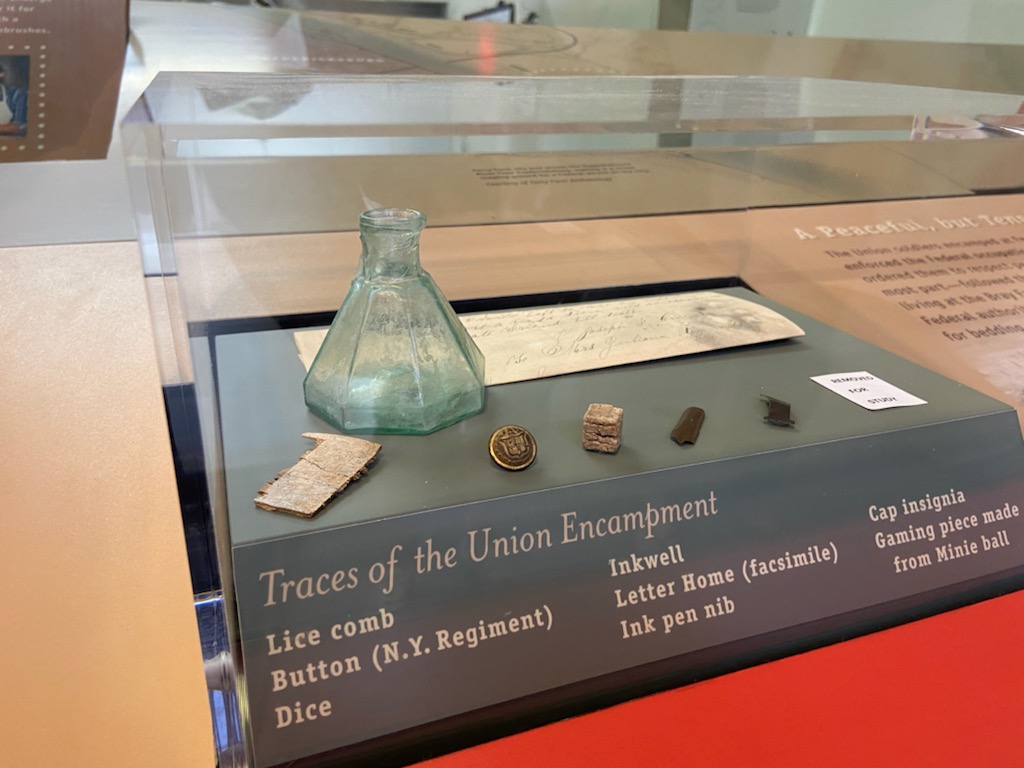
                Our artifact blog posts tend to focus on unique objects. However, this time I’m going to concentrate on a very commonplace ink bottle that dates to the mid-19th century. So many of these were made that they normally escape notice. Mere curiosities. Who doesn’t love an old bottle? However, the importance of a simple vessel such as this one should not be understated. This particular example is in an ‘umbrella’ shape, one of the most ubiquitous ink bottle forms from this era. However, this particular bottle has the distinction of having been located within a portion of a Union Civil War trench which extended through the cellar of the house George Washington grew up in.

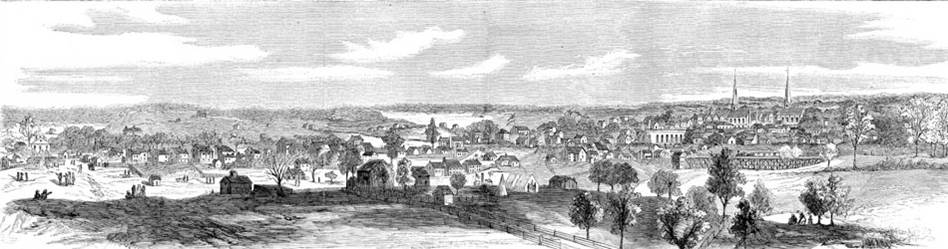
                Several units were assigned to Ferry Farm during the two occupations in 1862. The spring deployment was relatively quiet and uneventful except for the chaos of the hasty August withdrawal to defend Washington DC. The second occupation cumulated in the Battle of Fredericksburg. Union soldiers deployed at Ferry Farm include regiments from New York, the 7th Wisconsin, and the 36th Massachusetts. While no large encampments were established at Ferry Farm, soldiers did occasionally camp there and used the farm for picket duty and to provision themselves. The farm experienced combat only during the initial stages of the Battle of Fredericksburg.

                The Federals appear to have built no large, formal camps at Ferry Farm. No evidence of winter huts, latrine trenches, or clay borrow pits have been unearthed to date. That is not to say that soldiers were not stationed at Ferry Farm both before and after December 1862. Photographs of the farm show small groups of tents situated on the terrace overlooking the river. The terrace served as bivouacs for soldiers guarding or maintaining the pontoon bridges and later for pickets. These activities suggest that a small force was a relatively constant at the farm.  Artifacts associated with soldiers at Ferry Farm included buttons, knapsack hooks, grommets, cap letters, minie balls, percussion caps, exploded artillery shells, cutlery, and of course, one simple ink bottle. The ink held within probably penned many a letter with critical information that could have changed the tide of war and/or altered the lives of so many families expecting word from the front. 

    Military Encampment, Spring 1862. Credit: Unknown

                Really this bottle would be totally insignificant were it not for the location it was found in. We do know that the bottle was typically meant for single use and would have been made in one of the numerous American glasshouses present during the 19th century. It was then filled with ink, affixed with a label, and marketed for single use, which does not mean it wasn’t refilled from a ‘master ink’ bottle when the original contents were depleted. We’ll never know the exact history of this object, and there lies the mystery of it. As archaeologists, we can’t be privy to who owned it, what letters were written with the ink, or if those correspondences even made it out of the trench to the outside world. We’ll never know the travels of the bottle before it was deposited in the trench or the circumstances that led to it being abandoned. We only know that it was used during the Civil War by the Union and was found in a location many soldiers never wanted to be stuck in. Chances are, the soldier or soldiers who made use of the bottle never made it back home alive. The fact that it was discarded when the bottle still potentially retained at least some value and during a time when possessions were at a premium indicates a hasty departure, or perhaps the owner expected to return but didn’t. Regardless, letters were likely written using the ink from this humble bottle. Some may have had great importance in our country’s history, while some may have carried tidings of possible homecomings or hardships endured. Every ink bottle held the potential for countless correspondences, but this one has quite a history, the exact nature of which we’ll never know.

    Mara Kaktins, Archaeologist

    Archaeology Laboratory Manager

  • Marbled Paper – The (Secret) Art and Function of Paint Blobs

    The design of books today is an art form. Think about it. What will catch the reader’s eye? What cover art will convey the theme or subject of the pages inside? If you’ve ever pulled an older book off a shelf, say one owned or used by George Washington (or a descendant of the family), you might notice a somewhat drab cover with the title stamped on the front, but otherwise very nondescript. You might notice if the bindings holding the pages together are tight or loose if there’s a crease in the spine (heaven forbid!), or even if there’s a bookplate denoting the ownership of said book.

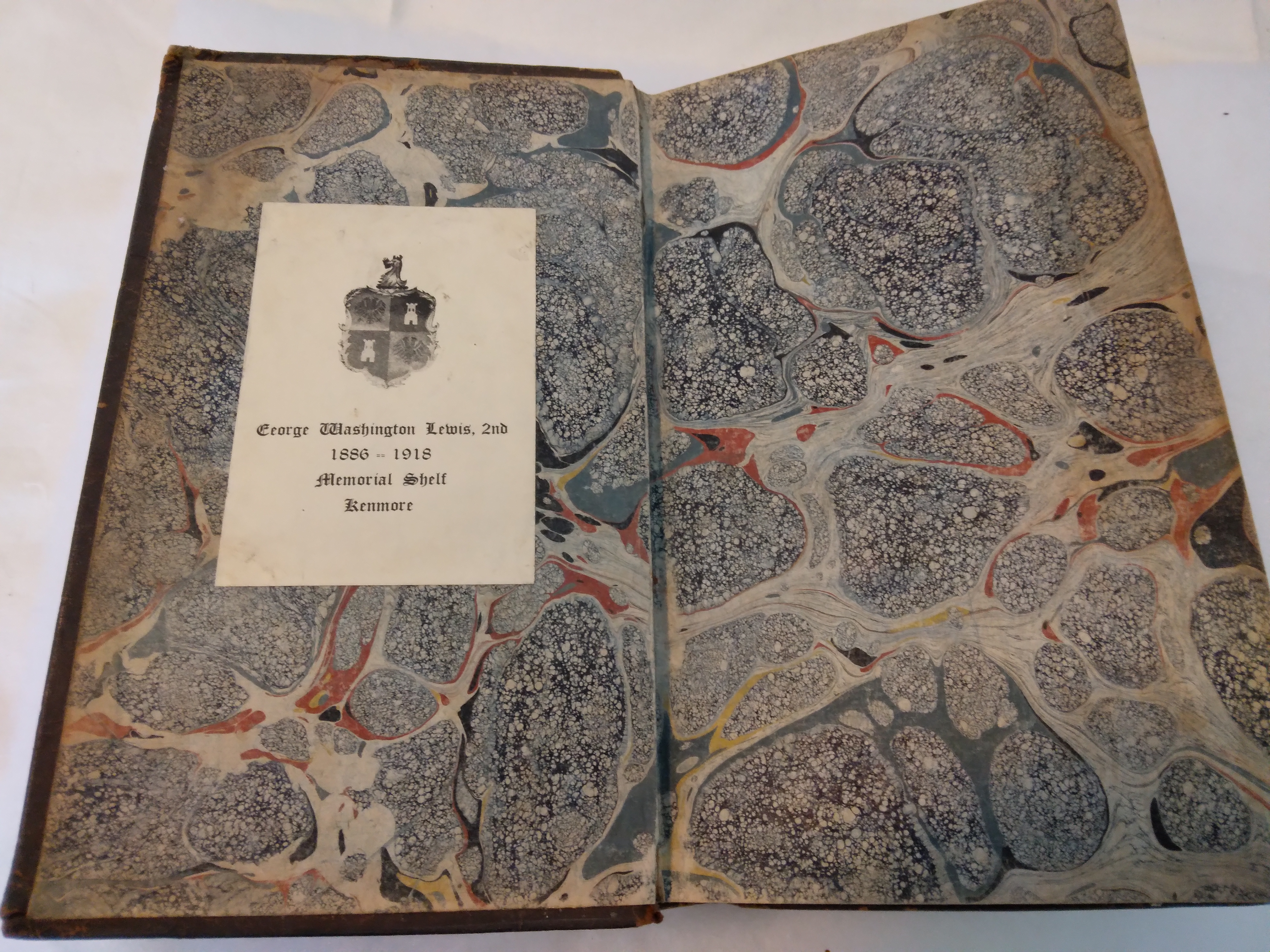
    Look at this book in our collection.

    The Life of George Washington by John Marshall, 1807 owned by George Washington Lewis, 2nd

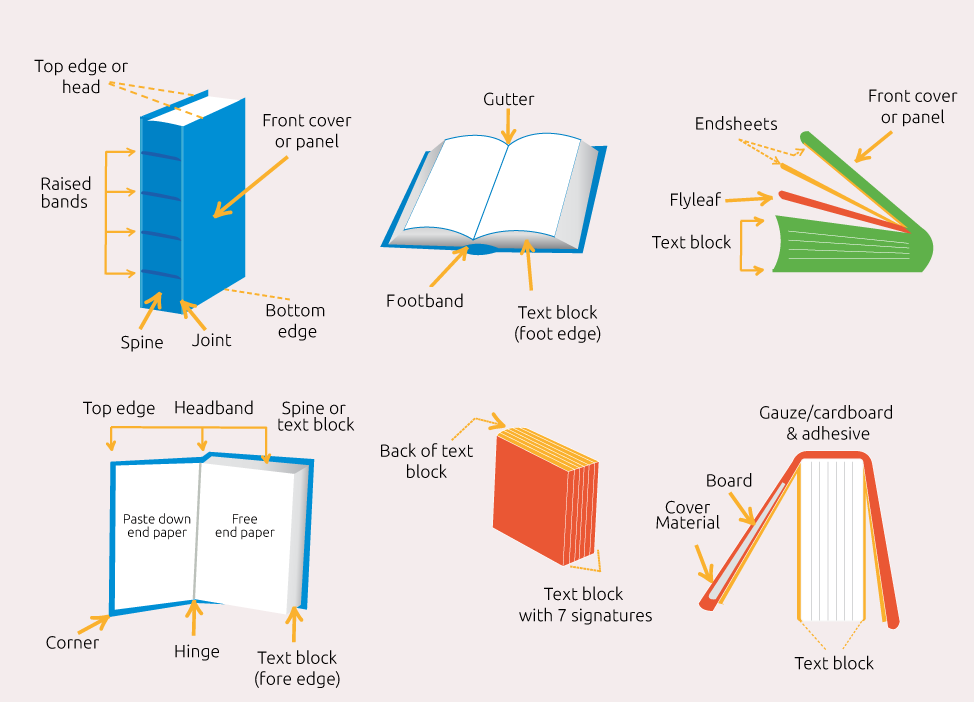
    Do you see all the parts mentioned? Great! However, what about those paint blobs? What is that, and why do so many older books have those kinds of endpapers?

    Parts of a book

    These papers are art in and of themselves. They are typically called “marbleized” paper (the process is “paper marbling”), and the earliest known use of the technique was in 10th century Japan. The process in Japan is known as Suminagashi, which literally translates to “floating ink”.[1] The process migrated to Turkey, where artisans began using paint rather than ink. Eventually, the art form arrived in Western Europe after the Crusades and took hold in France, the Netherlands, and Germany.[2] Most historians credit the French for taking this art form to the next level, using it for books. Imagine that fancy, leather-covered book without marbled end pages…what could possibly cover the strings and glue that holds the book together? Plain paper? Non, c’est horrible!

    The art form rose to such a skill level that a specific guild was created to keep the secret from others. For those unfamiliar, a guild is an association that oversees a specific craft or trade. It is what our modern-day professional associations are to those in previous centuries. In this case, however, the marbling guild took great pains to keep their trade a secret since the technique was highly valued by bookbinders who wanted to streamline (read: make less expensive) the process. While the guild kept the process a secret for over a century, eventually, someone decided to publish a how-to guide. That person was Charles W. Woolnaugh, and his book is The Art of Paper Marbling.[3] The cat was effectively let out of the bag at this point (1851), and Woolnaugh followed up with a second book on the practice about 30 years after the first one.

    The most interesting aspect of marbled paper is that no two designs are alike. There can be many similarities from the color scheme to a feathered design, but it is almost impossible to create the same image each time. When you think about it, it is neat because each endpaper is unlike any other.

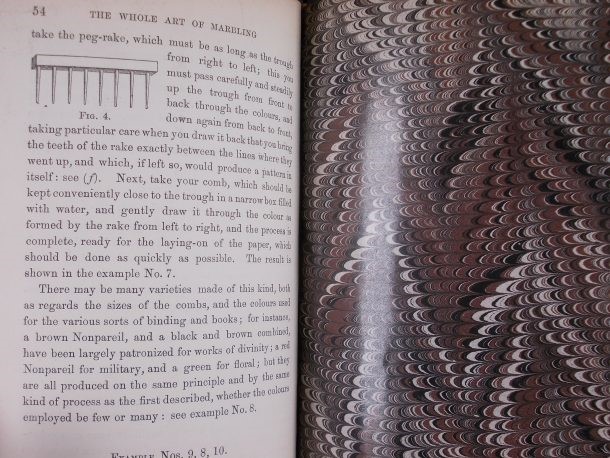
    Victoria & Albert Museum, The Whole Art of Marbling

    This image was created by using a comb (also shown) that, when gently pulled through the paint (which is floating on top), creates this arches. For single, larger arches, or even a more feathery technique, a quill or sharp-pointed device (a nail, for instance) could be used to gently manipulate the paint into a particular design. To transfer the image to paper, one would lay the paper on top of the floating paint, touch the four corners to ensure the entire surface made contact, and then gently pull up from one of the corners, letting the residual liquid drain back into the pan.

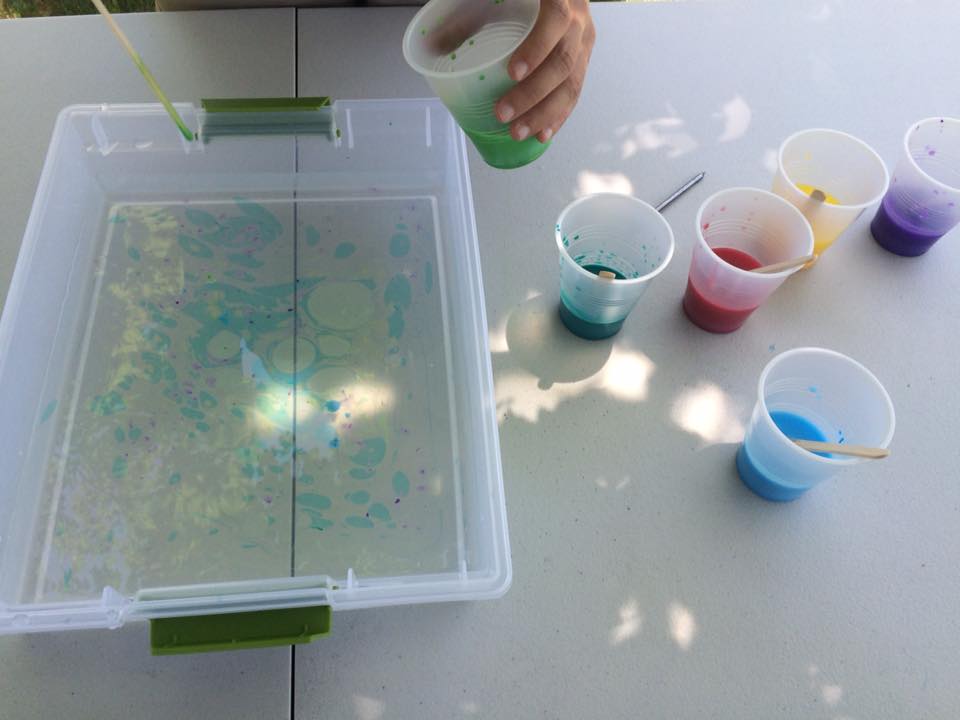
    Want to try your hand at paper marbling? Join us for our annual Fabulous Fourth at Ferry Farm event on Monday, July 4, from 10 am to 4 pm. We will be using water, carrageenan (seaweed extract), and acrylic paint to recreate the marbleizing process. You can try the comb and feather technique in red, white, and blue hues. The product will result in a bookmark with the added bonus of one of GW’s “Rules of Civility” printed on it too. Fun fact: To practice his penmanship, GW copied those rules from a French etiquette book! However, one might wonder, did his book have marbled end pages? We can only hope.

    Amy N. Durbin

    Director of Education


    [1] Ryan, L. (2021, February 18). Marbled Papers: A Brief History of an Endagered Bookcraft. UDC Library Cultural Heritage Collections. Retrieved June 21, 2022, from https://ucdculturalheritagecollections.com/2021/02/18/marbled-papers-a-brief-history-of-an-endangered-bookcraft/

    [2] Berry, G. (n.d.). Some History of Marbling. The Ancient Art of Marbling on Paper and Fabric. Retrieved June 20, 2022, from https://marbleart.us/SomeHistory.htm

    [3] Revell, S. (2016, November 2). Divers oiled colours: Exploring the history of marbled paper in the National Art Library •. V&A Blog. Retrieved June 20, 2022, from https://www.vam.ac.uk/blog/museum-life/divers-oiled-colours-exploring-the-history-of-marbled-paper-in-the-national-art-library

  • Summertime Fun: Colonial June Fair

    Ask someone to list traditional summertime activities, and they will probably mention picnics, family reunions, beach vacations, mountain getaways, and baseball games. Their list is likely to include going to the fair as well.  The fair as a summer pastime is a long tradition and, like many American traditions, can be traced back to the age of Washington.
    In 1738, Augustine Washington moved his wife Mary and their five children, including six-year-old George, to Ferry Farm on the Rappahannock River opposite Fredericksburg, Virginia.  Coincidentally, in the same year, the colony’s General Assembly authorized two fairs to be held each year in Fredericksburg.[1]  This act built on an earlier ordinance passed in 1705, allowing for ‘markets and fairs’ as a necessary and civilizing element of early Virginian society.

    Although other cities held fairs, Fredericksburg was one of the few that had a fair in June.  Sometimes called June Fair, it was one of the oldest and largest in the colony.  June Fair and other fairs were “first and foremost a market ‘for the sale and vending of all manner of cattle, victuals, provisions, goods, wares, and merchandizes.’ Prizes, ‘or bounties,’ were sometimes offered for the best stock and poultry”.[2]

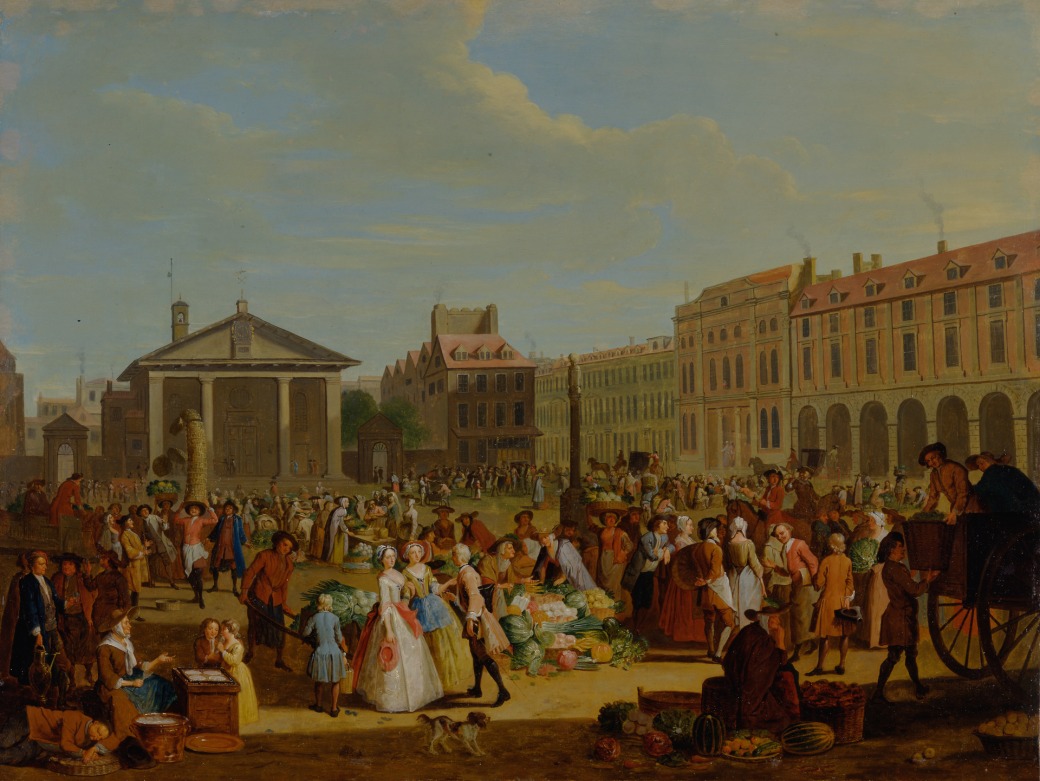
    Although this painting depicts a busy London agricultural market in the early 1700s, a similar hustle and bustle likely filled Fredericksburg during June Fair.  Covent Garden (1726) by Pieter Angillis, 1685–1734, Flemish, active in Britain (from ca. 1715), Oil on copper. Pubic domain. Credit: Yale Center for British Art, Paul Mellon Collection.

    Fairs were about more than agriculture, however. The importance of a summer fair was its ability to gather people from all over the surrounding counties to a single central location to conduct business and government and offer social interactions and entertainment.  In an agricultural colony such as Virginia, homes and plantations were very distant. People hardly saw anyone besides their immediate neighbors and family members for much of the year.  Most colonial Virginians traveled no more than fifty miles from home in their lifetimes. This made for an isolated existence focused on the constant attendance of crops. However, during natural seasonal breaks, farmers traveled to a town to sell those crops at the fair.

    Fairs were not just for farmers to sell. Court sessions, also known as ‘Public Times,’ often coincided with fairs. Soon merchants and entertainers saw the opportunity in the large numbers of people gathered together at the fair. Many people got paid or, more likely, an increase in credit and ready money made the fair a natural time to celebrate, entertain, gamble, and socialize.

    Among the amusements common to colonial-era fairs, “contests for prizes . . . in cudgeling, wrestling, manual-exercises, foot-racing, dancing, singing, violin-playing, greased-pig-chasing, etc. Prizes were offered to the most beautiful maid.  In towns large enough to warrant their attention, companies of actors sometimes arranged to give plays during fairs. Such plays, however, were held at the local playhouse or theatre, and not on the market square, where the fair usually took place”.[3]

    For example, in 1752, an acting troupe known as “THE Company of COMEDIANS, from the new Theatre at Williamsburg, propose[d] … to proceed to Fredericksburg, to play during the Continuance of June Fair.” The troupe hoped “That all Gentlemen and Ladies, who are Lovers of Theatrical Entertainments, will favour us with their Company.”[4]

    Advertisement in The Virginia Gazette announcing the appearance of the Company of Comedians at June Fair in 1752.

    The fair brought people together to conduct more than agricultural business.  Indeed, “the fair was also a place where men met to make and pay debts. Land, houses, storehouses, and personal property were offered for sale at fairs — privately and by public auction”.[5]

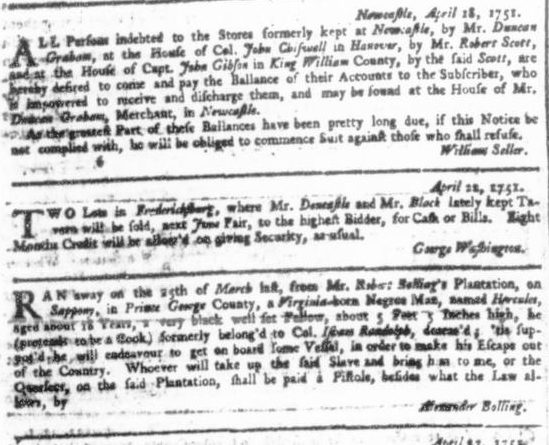
    During June Fair in 1751, 19-year-old George Washington auctioned off two of his lots in Fredericksburg.  His announcement of the sale in The Virginia Gazette offered the lots, “where Mr. Doncastle and Mr. Black lately kept Tavern, next June Fair, to the highest Bidder, for Cash or Bills. Eight Months Credit will be allow’d on giving Security, as usual” and was signed “George Washington.”[6]

    Announcement placed in The Virginia Gazette by George Washington announcing his intention to auction off two lots of his land in Fredericksburg at June Fair in 1751.

    A decade later, at June Fair in 1760, George’s account ledger shows him paying Fielding Lewis £40.  Furthermore, just a few days before paying his debt to brother-in-law Fielding, George also race, both popular fair activities. [7]

    Indeed, “the most popular attractions of the fairs in Virginia and Maryland were the horse-races . . . held at race-tracks near the town. Purses were subscribed, and many gentlemen, who had no interest in the other activities, would attend the races”.[8]

    Gambling at the fair, mainly in the form of lotteries, even supported more noble pursuits.  At June Fair in 1769, a lottery was undertaken to raise £450 for building a new church and for purchasing an organ for that church.  The drawing was to take place on “the 7th day of JUNE next (being the first day of the Fredericksburg fair) at the town-house” and was supervised and supported by a host of the town’s luminaries including Charles Dick, Hugh Mercer, Charles Washington (George’s brother), George Weedon, and Fielding Lewis. [9]

    June Fair was a community event attended by Virginians from across the colony and brought George Washington back to his boyhood home on more than one occasion.  At the fair, Virginians sold farm goods and land, settled debts and tried court cases, enjoyed a play, and gambled on the horses.  June Fair, much like today’s summer pastimes, was a moment in the year to enjoy the summer weather and the company of neighbors, friends, and family before returning to isolated plantations and farms and the unending work of plowing, planting, and harvesting.

    Come and join our 18th-century colonial fair on Saturday, June 11, from 10:00 a.m. to 3:00 p.m. There will be magic, medicine, music, and more with Dr. Balthasar’s Marvelous Miracle Medicine Show, music by Colonial Fare, colonial games, and craft activities for the kids. Admission includes access to the grounds, performances, activities, and walk-through tours of the Kenmore House. Tickets are $5 for ages five and up, and under  five are free.

    Zac Cunningham, School Programs Educator, Hampton Roads Naval Museum at Naval History and Heritage Command


    Joe Ziarko, Actor Interpreter at Colonial Williamsburg Foundation


    [1] Eighteenth Century Fairs. Colonial Williamsburg Digital Library https://research.colonialwilliamsburg.org/DigitalLibrary/view/index.cfm?doc=ResearchReports%5CRR0069.xml, pg 35. Accessed 6 June 2022

    [2] Ibid, pg 18

    [3] Ibid, pg 19

    [4] The Virginia Gazette, April 30 1752.

    [5] Eighteenth Century Fairs. Colonial Williamsburg Digital Library https://research.colonialwilliamsburg.org/DigitalLibrary/view/index.cfm?doc=ResearchReports%5CRR0069.xml, pg 18. Accessed 6 June 2022

    [6] The Virginia Gazette, 1751.

    [7] Cash Accounts, May 1760.National Archives and Records Administration https://founders.archives.gov/documents/Washington/02-06-02-0226. Accessed 6 June 2022

    [8] Eighteenth Century Fairs. Colonial Williamsburg Digital Library https://research.colonialwilliamsburg.org/DigitalLibrary/view/index.cfm?doc=ResearchReports%5CRR0069.xml, pg 19. Accessed 6 June 2022

    [9] The Virginia Gazette, 1751.

  • Camp George v. George: A Summer Camp to Travel Back to Colonial Virginia

    School is out for summer…almost! Students are counting down the days until they are free from homework, but the learning does not have to stop!. The George Washington Foundation has been busy preparing fun-filled summer camps to encourage critical thinking through exploring the past.

    In our Camp George v. George, students will be asked, “Would you be an American patriot or a British loyalist?” as they learn about George Washington and his family’s experience living under the rule of King George III.

    The camp will alternate between George Washington’s Ferry Farm, his boyhood home, and Historic Kenmore, his sister’s later-in-life house. George lived at Ferry Farm from six years old until 22 years old. This was where George learned how to survey, dance, and petitioned for his first military office at Ferry Farm. His time at Ferry Farm shaped him into the man who navigated the battlefield and the political arena to pursue the American cause.

    Similarly, George’s sister, Betty Washington Lewis, was shaped by her time at Ferry Farm. She was instructed in the customs of gentility, which included the tea ceremony.[1] While at Ferry Farm, her uncle, Joseph Ball, gifted a silver tea set and other tools so Betty could refine her skills as a future lady of the house. During this time, Betty was taught the expectations for young women in colonial Virginia.

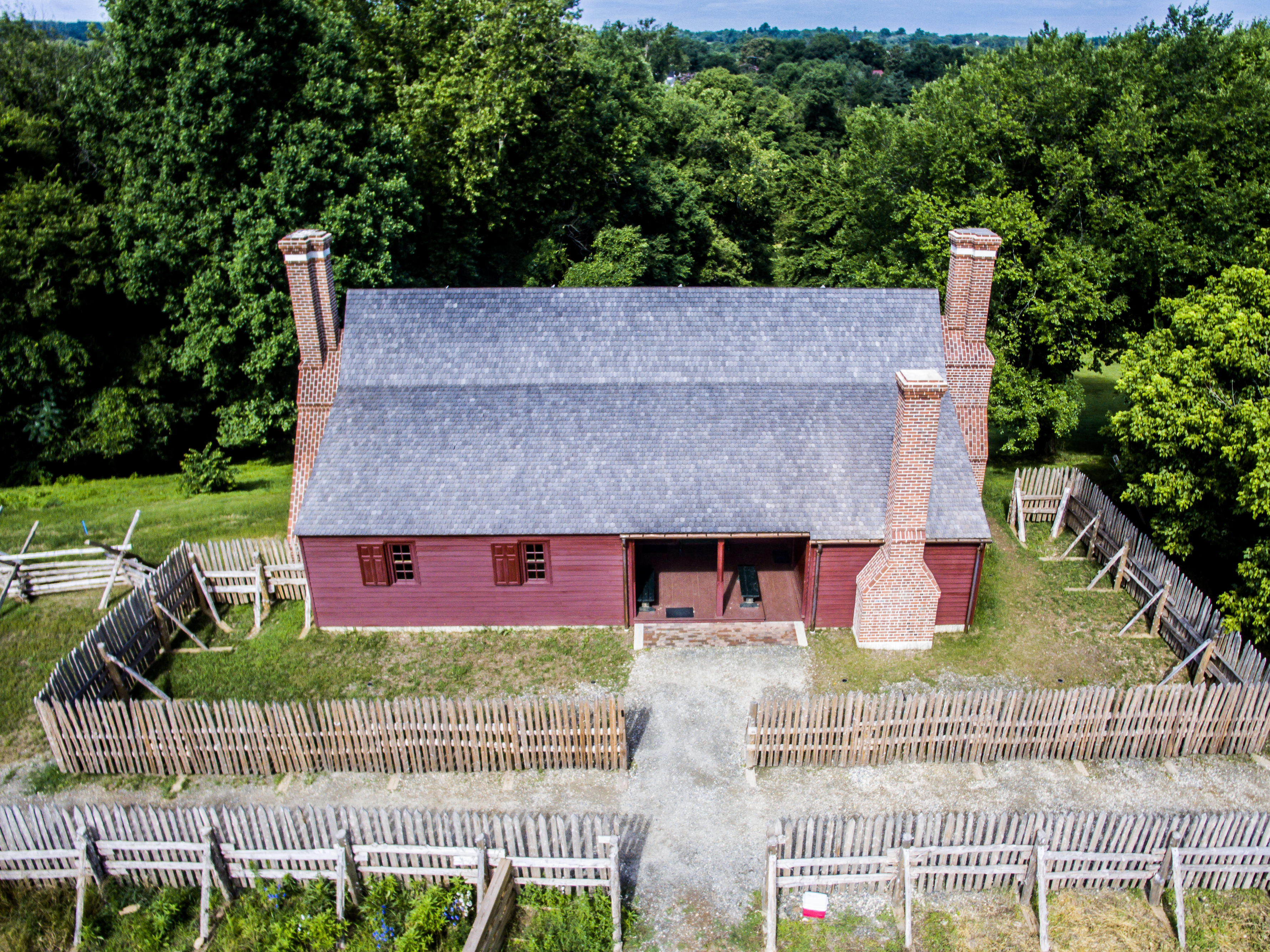
    Washington’s Ferry Farm

    While Betty’s experience at Ferry Farm was significant, her story does not end there. The skills she acquired at Ferry Farm equipped her to marry Fielding Lewis, a wealthy merchant in town. Twenty-five years later, they moved into their new home at Kenmore in 1775. Fielding and Betty envisioned the mansion as the site of lavish social events filled with tea, dancing, and awe from their guests. However, that dream was never realized, and the couple sacrificed greatly for the American cause. Betty managed the household and attended to the needs of the Washington family, including her mother, Mary. Fielding could not fight in the war, but he voluntarily gave up his trading business with British merchants, donated supplies to the war effort, and financially supported a gunnery in Fredericksburg.[2] Fielding also collected debts and handled several land deals for his brother-in-law.[3] The stress of the financial strain took its toll on Fielding, and he passed on December 7, 1781. Betty struggled financially for the rest of her life due to Lewis’ sacrifices for the Patriot cause.

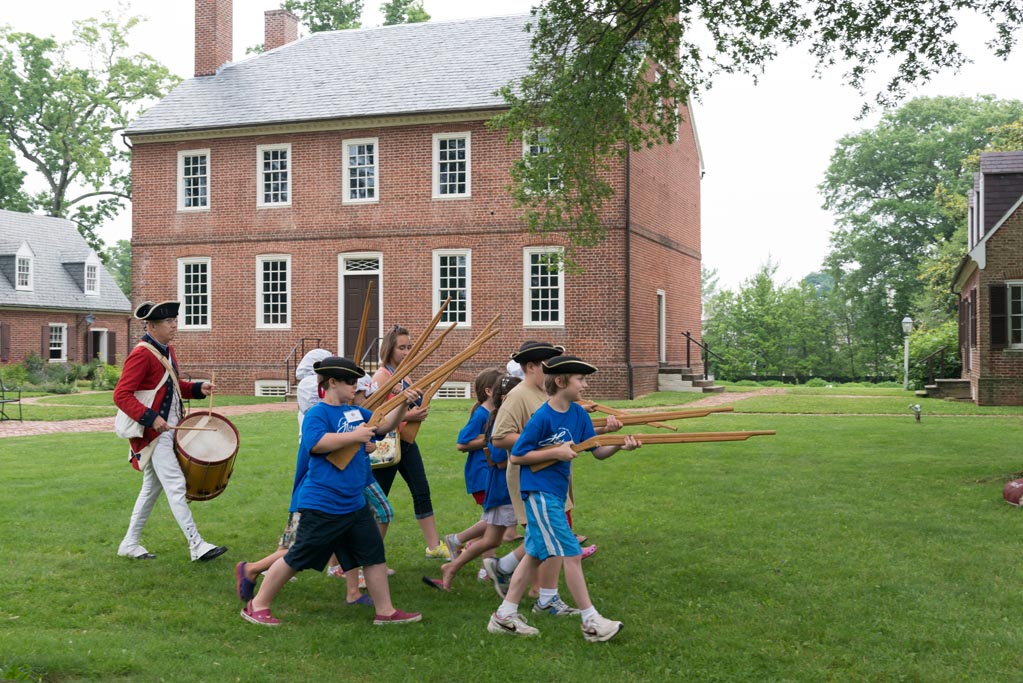
    Historic Kenmore and Ferry Farm will be the sites where campers will learn about life in colonial America. Archaeologists, socialites, dancers, surveyors, and soldiers are just a few of the roles that the campers will embody as they explore the cultural, social, and military life of colonists during the Revolutionary War era. Activities will include a mock archaeological dig, a surveying hike, dancing lessons, militia drills, and more! This experience will provide insight into life before, during, and after the American Revolution. George, Betty, and Fielding, along with many others, had their lives transformed by society, government, and friendships. What would you do in such instances? That is the question campers will think about during their experiences, but don’t worry, plenty of fun, games, and activities will be included!

    Camp George v. George will be offered in two sessions for families’ convenience. Session A will be June 13 – 17 from 9 am to 12 pm, and Session B will be from July 25 – 29 from 9 am to 12 pm. Please see our events page at Kenmore.org/events for more information!

    Kaylie E. Schunk

    Manager of School & Youth Programs


    [1] Laura J. Galke, “The Mother of the Father of Our Country: Mary Ball Washington’s Genteel Domestic Habits,” in Northeast Historical Archaeology 38 (2009): 33.

    [2] “Fielding Lewis;” Palmer, and McRae, eds. Calendar of Virginia State Papers, 456, 502-3; Duke, Kenmore and the Lewises, 94-96; Fleming, Story of Kenmore, 9; “To George Washington from Fielding Lewis, 14 November 1775,” Founders Online, National Archives, Source: The Papers of George Washington, Revolutionary War Series, vol. 2, 16 September 1775?–?31 December 1775, ed. Philander D. Chase (Charlottesville: University Press of Virginia, 1987), 371–373.

    [3] “From George Washington to Fielding Lewis, 20 April 1773,” Founders Online, National Archives, Source: The Papers of George Washington, Colonial Series, vol. 9, 8 January 1772?–?18 March 1774, ed. W. W. Abbot and Dorothy Twohig (Charlottesville: University Press of Virginia, 1994), 221–224; “To George Washington from Fielding Lewis, 8–9 May 1773,” Founders Online, National Archives, Source: ibid., 229–230. “To George Washington from Fielding Lewis, 24 May 1773,” Founders Online, National Archives, Source: ibid., 235.