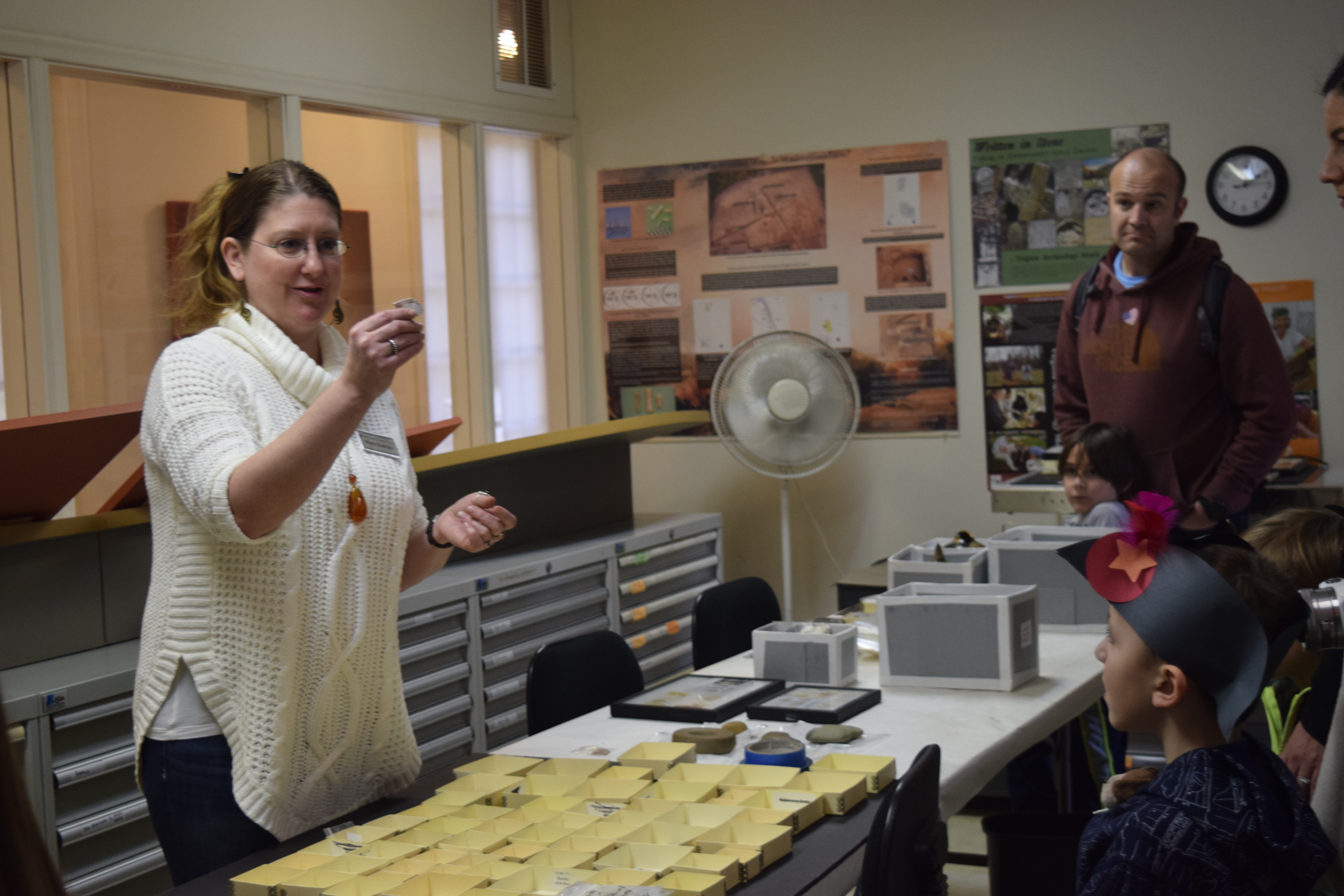
Field archaeologists will once again be working outdoors at George Washington’s Boyhood Home at Ferry Farm from May 16th through July 29th. Work hours will be Monday through Friday, 8 am to 4 pm. The excavation site, located on the east side of the Washington House, is accessible to the public, and our staff will be happy to explain what we have been finding every day and what we hope to learn from this year’s dig. Visitors can even help us sift our dirt and look for artifacts!
Visitors enjoy a turn at the sifting screen.
The archaeological exploration of the Ferry Farm site has been ongoing for many years with great success. The discovery of the two-story cellared home of the Washington family was announced in 2008, with its historic reconstruction completed in 2018. Additional archaeological investigations around the house site have resulted in the identification of multiple outbuildings and work areas, adding to our analysis and recreation of the eighteenth-century farm landscape. This summer, we will see two new outbuildings go up on the grounds – the enslaved quarters to the north of the house and a storage building in the work yard to the east. Both buildings and their locations were found by means of our archaeological digs.
Location of the 2022 archaeological dig at Ferry Farm.
The site of this year’s dig is an extension of last year’s, during which we found a possible post-in-the-ground structure in the work yard area of the farm. Opening up new units on the southern end of the dig site will allow us to determine the full size of this structure. Artifacts found in the surrounding units are still being processed and analyzed and will help us determine the function of the building.
Overall view of the 2021 dig shows modern utility trenches and eighteenth-century oval postholes.
So be sure to stop by the dig when visiting Ferry Farm this summer and find out what we have learned so far from our excavations!
Archaeologists cleaning the site in the Washington House workyard.
As a Historic Preservation major at the University of Mary Washington, I spend a lot of time studying objects from the past. Through my courses, I have learned that common, everyday objects are often able to reflect the values of the people that created and used them. I kept this in mind during my internship in the Archaeology Lab at Ferry Farm this semester. While looking through the collection, I came across one of these everyday items, an item that I use every day, the Mason Jar.
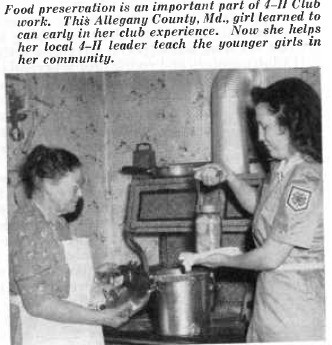
Though there are many uses for Mason jars today, these glass jars were originally designed for home canning and have been preserving food in America for over 150 years. Using the idea that everyday objects such as the Mason jar are able to reflect the values of the people using them, let’s take a look at the evolution of home canning and the Mason jar throughout its 150-year history to see how the value of the Mason jar may have changed.
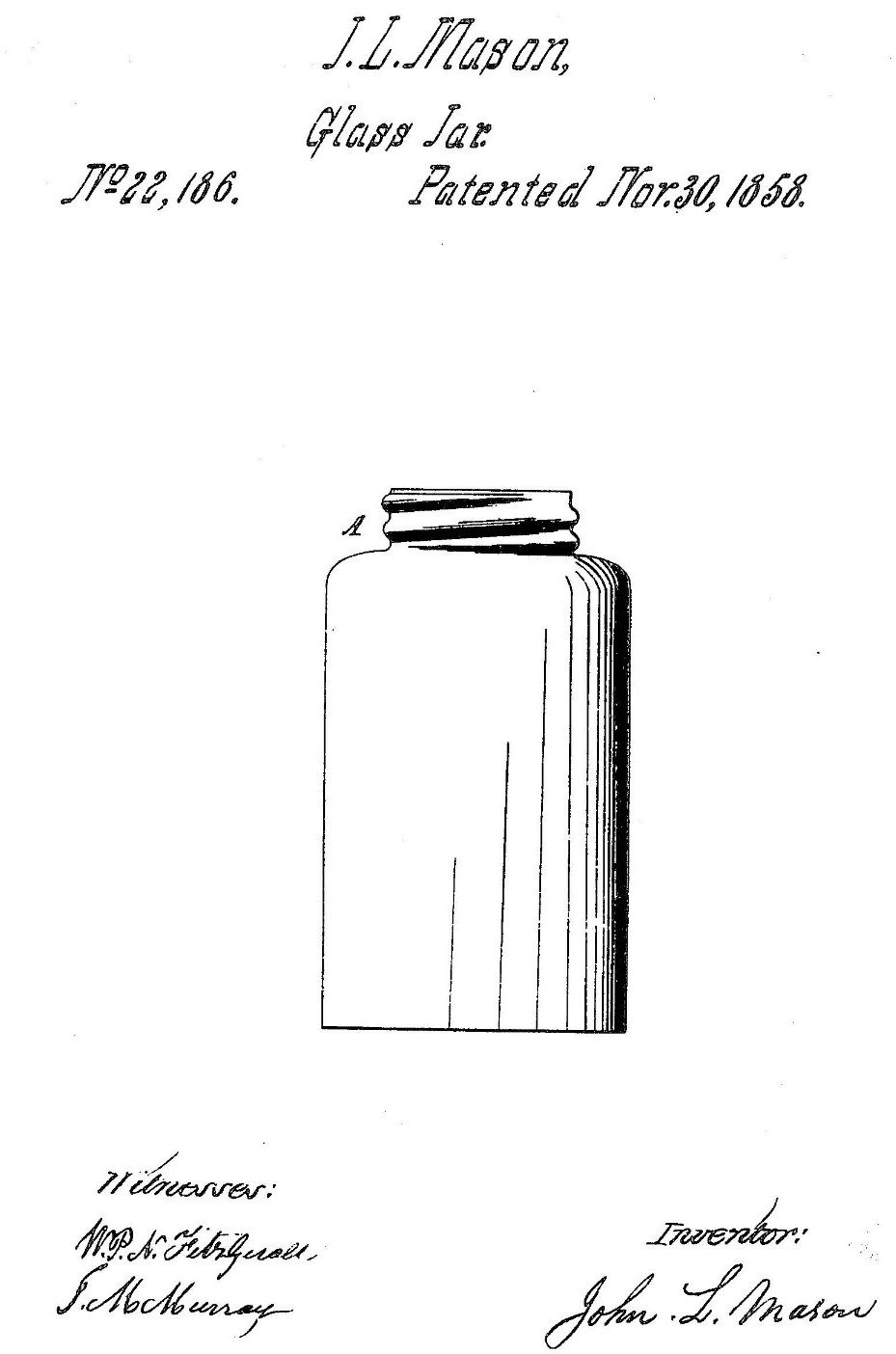
The 1850s marked the beginning of home canning’s popularity in America, and the glass canning jar as we know it today was first patented by John Landis Mason in 1858.[1] Mason’s first jars were sealed using a zinc screw-on lid. With this design, the zinc was able to come into contact with the contents of the jar, affecting the food’s taste.[2] This issue was remedied in 1869 when Mason sold his patents to Lewis Boyd the creator of milk glass lid liners.[3] Together Mason’s glass jar and screw-on lid with Lewis Boyd’s patented milk glass lid liner created an affordable canning jar that was able to be sealed without interfering with taste. Here at Ferry Farm, we have a few examples of these milk glass lid liners in our collection.
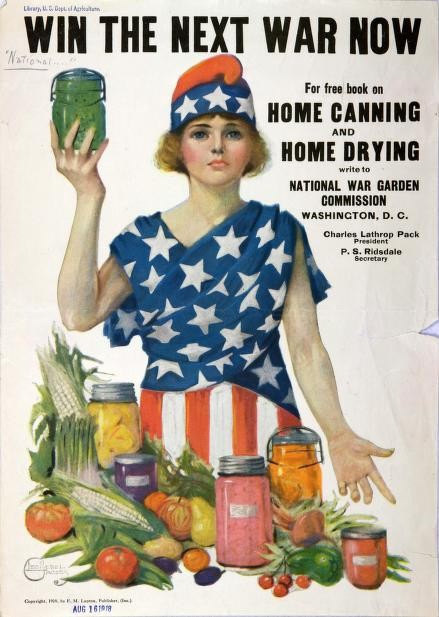
While canning food during this early period served as a practical way to preserve surplus food, during the early 20th century its value shifted to something a bit more patriotic. During World War I and World War II, home canning became a way for American’s, primarily women, to support their country and troops on the home front.[4] By growing and preserving food at home in their ‘war gardens’ (or ‘victory gardens’ as they were called after the war), they were ensuring that the available food supplies were able to get to the troops.[5] This also became a way for communities to band together and help support one another during periods of rationing food supplies.[6]
After World War II, canning at home decreased in popularity due to the increased accessibility of home refrigeration and the rise of the supermarket.[7] Though it may have lost its widespread popularity, canning continued to serve as a way for gardeners to preserve their pickles, jams, and other produce. During the beginning of the 21st century, the Mason jar became widely popular once again, but for its looks rather than its use in canning.[8] It became the symbol for the ‘rustic farmhouse’ aesthetic and a popular do-it-yourself crafting item for everything from wedding decor to light fixtures. Mason jars also became a more sustainable, economic replacement for plastic food storage and even drinkware.
Recently we have seen a revival in home canning in response to the pandemic. As people had more time at home, and supply issues caused produce scarcity in supermarkets, many turned to their gardens once again. The popularity of the Mason jar may ebb and flow, but it is an object that has been a staple for many Americans for over 150 years. Do you have a Mason jar at home? What do these canning jars mean to you?
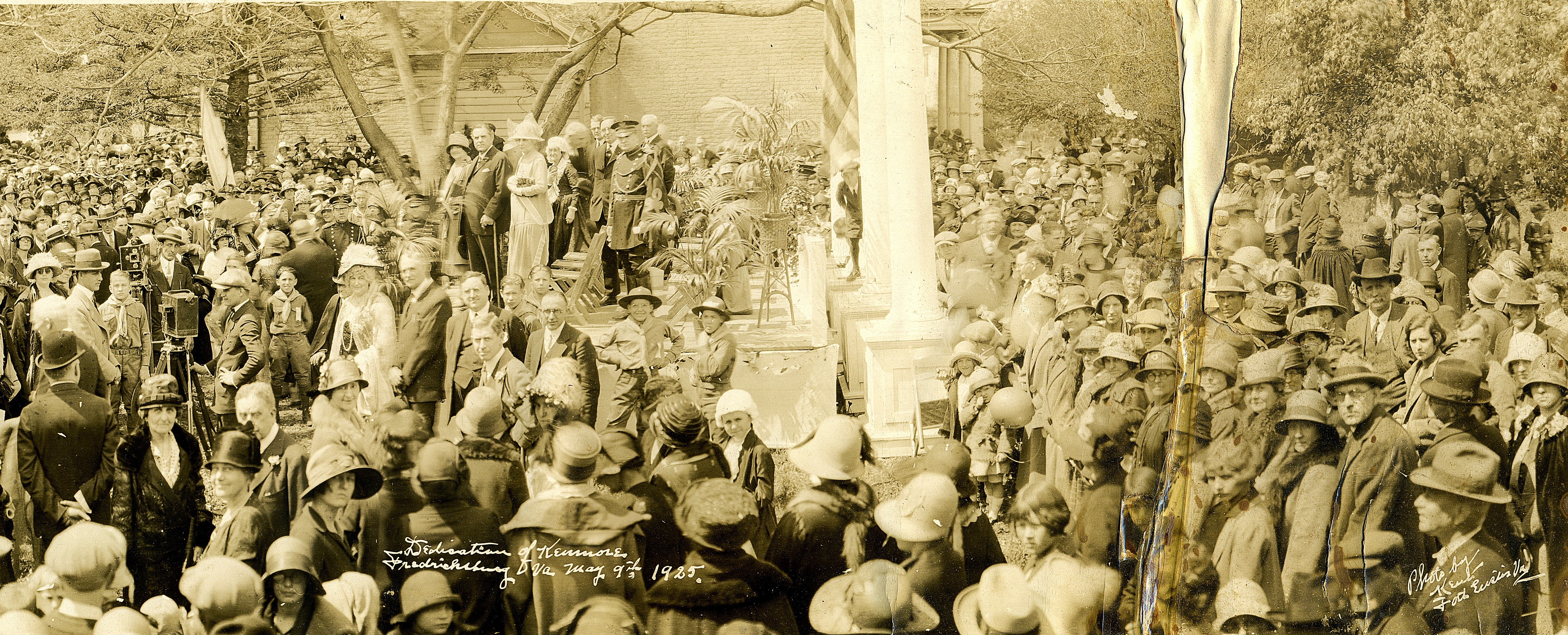
Spring is a busy time of year for historic house museums, as we see an influx of school groups, vacationers, and families taking advantage of the beautiful weather. This spring is an especially exciting year at Historic Kenmore since we are preparing to celebrate our centennial anniversary! As discussed in our previous blog post, it is thanks to the efforts of Emily White Fleming, her daughter Annie Fleming Smith, and the Washington Lewis DAR chapter, that Kenmore was saved from development in 1922. In honor of the centennial, we have installed a new exhibit in the Crowninshield Building Visitor Center that explores Kenmore’s preservation history. One image currently on display is a photograph from May 9, 1925, Kenmore’s dedication day.
Dedication Day 1925
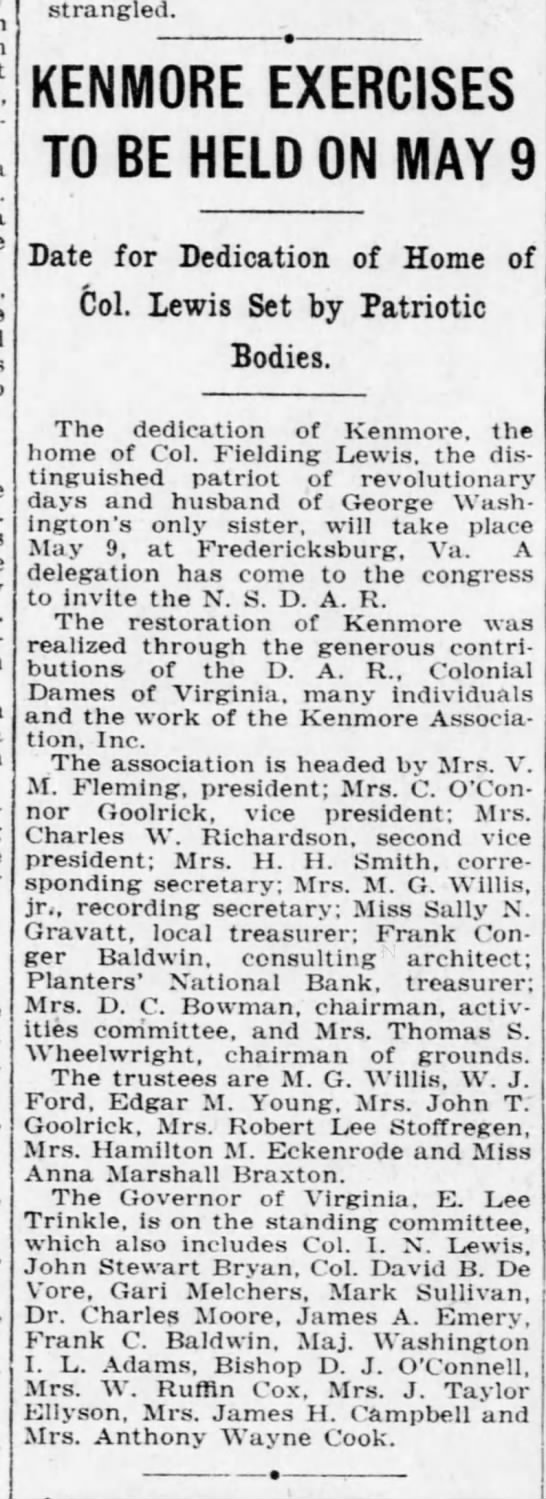
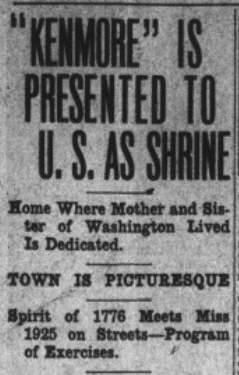
On May 9, 1925, a dedication was held to celebrate Kenmore opening to the public. People flocked to Washington Avenue for the day’s festivities. According to the Richmond News Leader, “automobiles from all parts of the state and from other states” brought people to Fredericksburg, and “every train was crowded.”[i] Articles advertising the event can be found in local papers ranging from The Evening Star (Washington, D.C.) to the Gloucester Gazette and Northern Neck News, as well as in larger publications like TheNew York Times. In large block print, the Times declares: “BETTY WASHINGTON’S HOME HAS BEEN SAVED; Women of Fredericksburg, Va., Will Dedicate Kenmore on May 9.”[ii] Dedication day activities included a large parade, costume contest, and brass tunes played by the United States Marine Band. Fredericksburg school children danced the minuet; students from the Virginia State Teachers College hosted a maypole dance, and the mayor and governor gave remarks. The widespread publicity that Kenmore’s reopening received was a reflection of Americans’ growing interest in the historic preservation movement of the day. Notably, many of these early twentieth-century preservation efforts were led almost entirely by women.
As part of our centennial celebrations (and reminiscent of Kenmore’s original dedication day), we will host a Centennial Block Party at Kenmore on Saturday, April 9th, from 10:00 am to 2:00 pm. This community event will feature tours of the house, games, crafts, stories in the garden, and more! Many of the activity tables will highlight different elements of the house that, thanks to twentieth-century preservation efforts, we are still able to appreciate today.
Stucco Ceilings:
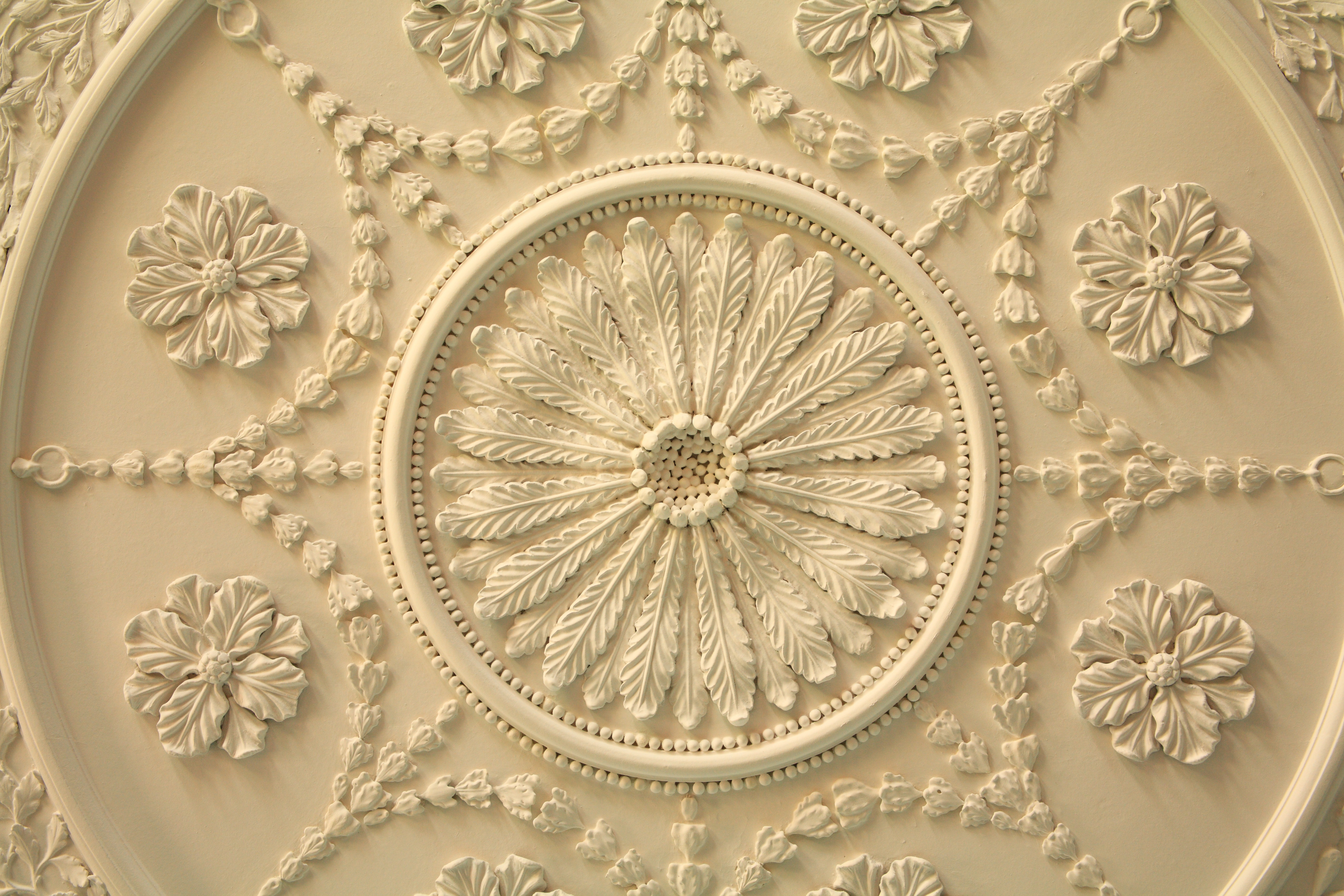
Stucco Ceiling at Kenmore
Referred to in Lewis family letters simply as “The Stucco Man,” not much is known about the craftsperson who created Kenmore’s beautiful stucco ceilings. “The Stucco Man” is responsible for the three elaborate plasterwork ceilings and two over-mantel inlays at Kenmore. In 1882, Kenmore resident William Key Howard, Jr. lay on his back atop scaffolding to clean and repair extensive damage to the original plasterwork ceilings. At our plaster activity table, visitors can try their hand at making their own “plaster” impressions or, like Howard, tracing the intricate ceiling patterns. (Scaffolding not included!)
Flocked Wallpaper
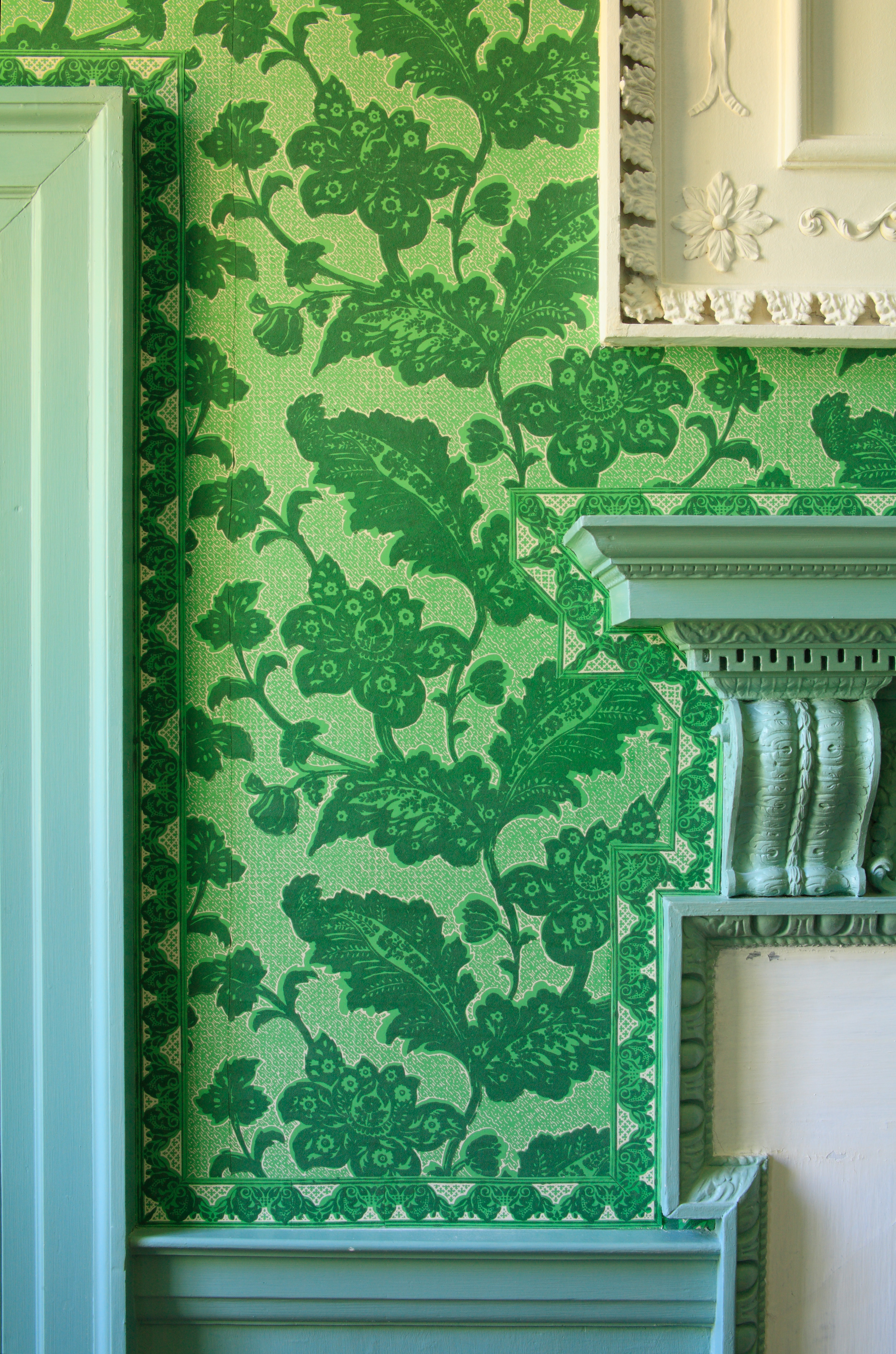
Flocked wallpaper in Drawing Room at Kenmore
Vibrant green flocked wallpaper covers the walls of Kenmore’s drawing room. “Flocked” wallpaper was supposed to imitate the look of expensive damask or velvet hangings. The raised velvet-like texture was created by adhering small powdered textile particles called “flock” to the wallpaper.[iii] At our wallpaper activity table, visitors can design their own wallpaper swatch using stamps and stencils to mimic eighteenth-century block printing techniques.
In addition to these and other activities, throughout the event, visitors can engage with historic interpreters, curators, and archaeologists to learn more about preservation history, the Lewis and Washington families, and the enslaved men and women who lived and worked at Kenmore.
Kenmore has a long history with many different stories to tell, and it is thanks to the twentieth-century preservation movement that we still have the physical spaces in which to bring these stories to life. Peopling these spaces is important, and our goal is to continue to preserve, uncover, and interpret the histories of all those who have passed through Kenmore. While the historic preservation field has grown and evolved since Kenmore’s dedication day in 1925, we hope that our community block party will spark a similar interest in preservation efforts and will encourage visitors to reflect on why historic preservation still matters today. What places in your own community have special meaning to you? What stories would you choose to preserve and protect for future generations?
Ann Waters
Manager of Interpretation and Visitor Services
[i] ”Kenmore” is presented to U.S. as shrine. (1925, May 9). The Richmond News Leader, Number 8690 Page 1.
As spring approaches in the Middle Atlantic and Northeastern states, we welcome the chance to spend more time outdoors in the fresh air instead of cooped up in our houses – getting sick. Ailments such as colds and flu are contractible anytime, but we usually associate them with the wintertime as that’s when they seem to be more prevalent.
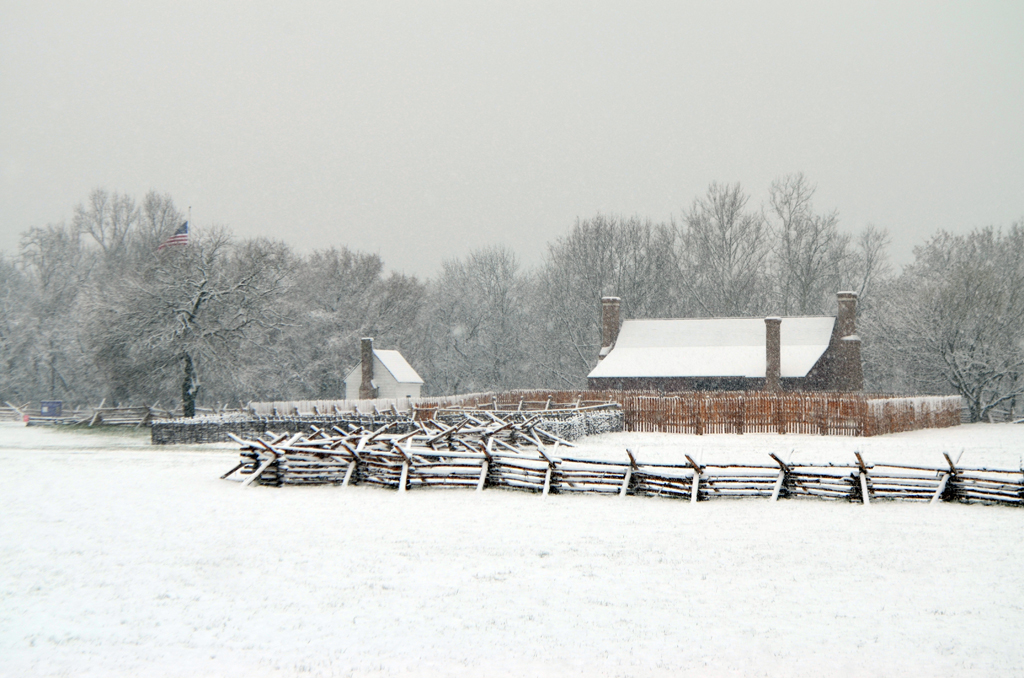
Ferry Farm during winter storm
With modern medicine, we can easily treat and overcome these and other more serious illnesses that rise up during the colder months. People living in the eighteenth century, however, did not have the luxury of our scientific knowledge of modern medicines, and so what is easily treatable today could be, and often was, deadly during their lifetime. They had to deal with serious diseases, such as dysentery, measles, mumps, smallpox, rickets, typhus, typhoid, tuberculosis, and yellow fever, without the benefit of antibiotics.
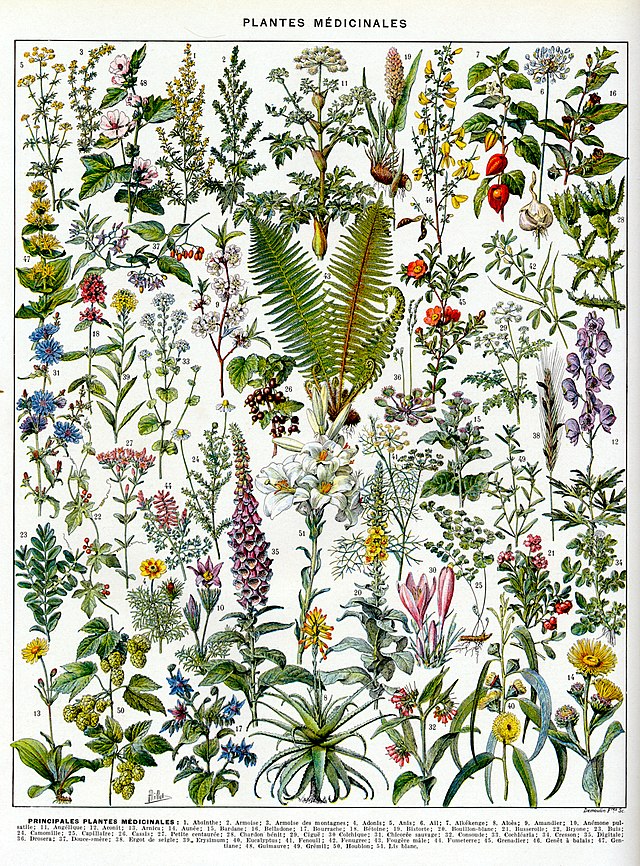
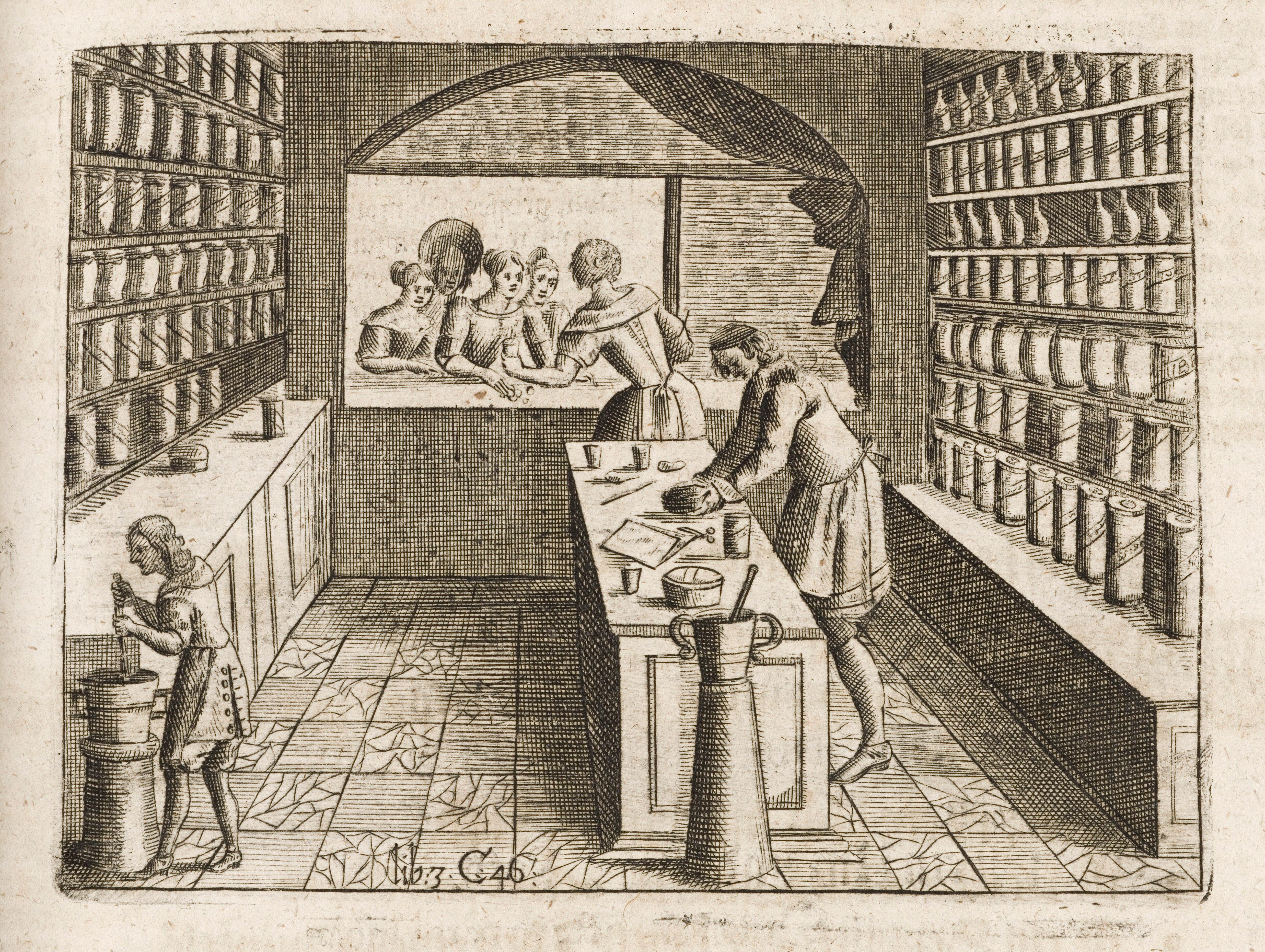
Medical treatments for dealing with illnesses in the eighteenth century were primarily herbal remedies and traditions passed down over the centuries in medical books or as local knowledge. People like the Washington family probably relied on local healers, apothecaries, physicians, or midwives in the Fredericksburg area to prepare the medicines and treat their illnesses. It is also very likely that Mary Washington would have had the knowledge herself to oversee the formulation of cough syrups, laxatives, and other tinctures using the herbs and flowers in her own garden. Betty Washington Lewis, Mary’s daughter, owned a copy of Eliza Smith’s 1739 The Compleat Housewife: or, Accomplished Gentlewoman’s Companion, a cookbook, in which are explicit medicinal recipes for dealing with hysterics, the vapours, pain from stones, the plague, upset stomachs, a cancerous breast, consumption, and for ‘preserving the lungs,’ among other things.[1] The chances are pretty good her mother Mary also had access to this same recipe book.
We do not have any historical information on the childhood diseases or winter ailments that were present in the Washington home, but here are two that they might have experienced.
Pneumonia
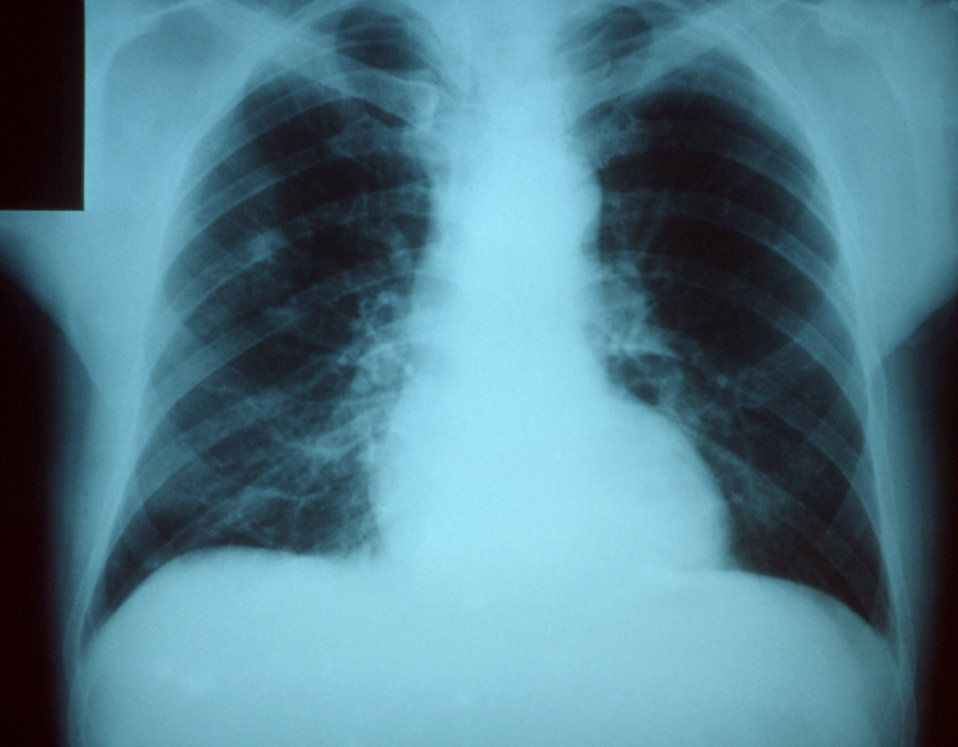
Anteroposterior chest x-ray revealed right upper lobe pneumonia. Credit: Public Domain Files
Pneumonia, a bacterial infection of the lungs, also known as ‘Winter Fever’, was a great concern in colonial Virginia. Although it was not known as a disease in and of itself but rather a symptom of other illnesses until much later, the presence of this respiratory ailment was noted by colonists.
Pneumonia and many other such illnesses were prevalent in the winter months when conditions forced people inside with closed windows and doors. Prior to modern home climate-control technology, windows and doors were opened in good weather to create a breeze that cooled down a house but also served to air it out. Additionally, many activities we perform indoors today took place outside, such as laundry and food processing, which got people out in the open more. When the weather turned cold, however, people were stuck inside with little ventilation and essentially stewing in their own germs. As such, pneumonia spread rampantly throughout the winter, and with no antibiotics, it was often deadly especially for the young and elderly.
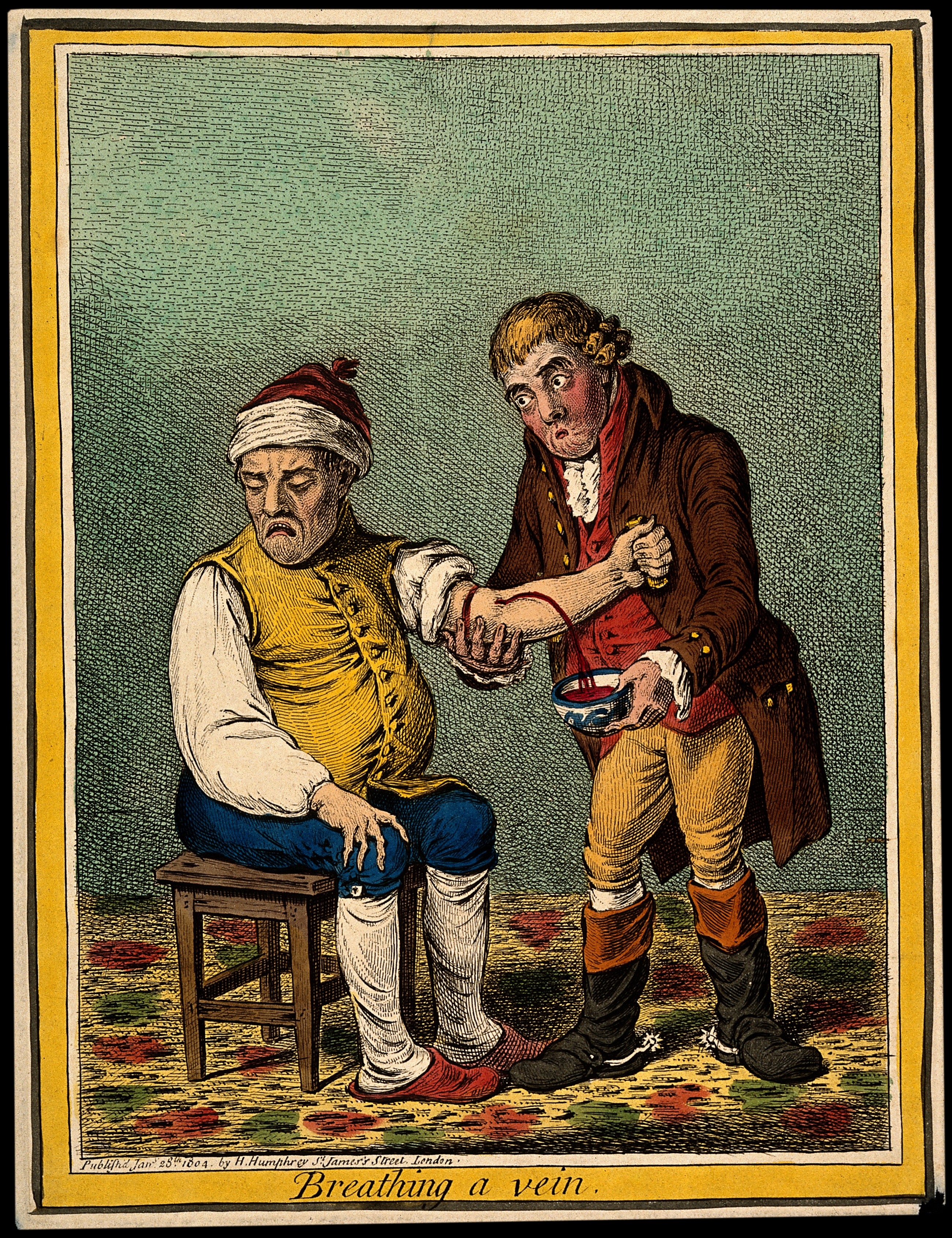
An ill man who is being bled by his doctor.Credit: Wikimedia Commons
The commonly incorrect assumption at the time was that many illnesses resulted from bad smells or miasma. Bloodletting, laxatives, and emetics were justified treatments for almost anything wrong with you because it was essential to purge and expel the bad blood and humours from one’s body. In general, these treatments did more harm than good and, in some cases, killed the patient.
In addressing the symptoms of pneumonia (fever, cough, inflammation of the lungs), a mixture of treatments would have been proscribed for the patient. Cough syrups recipes were many and concocted from a wide variety of aromatic herbs infused in flavored waters, honey, or liquor. Opium in the form of poppy leaves was also a common ingredient. Additional treatments included bloodletting “8 to 10 ounces if strong 12 ounces” and applying ‘blisters’ on the back of their neck to promote sweating and to help with a headache.[2] Blistering was an aggressive treatment to the skin and essentially created pain in one spot to counteract pain elsewhere. A blistering agent, such as mustard, capsicum, or Spanish Fly, was applied in a poultice to the skin, causing redness and, in extreme cases, a raised pus-filled blister.[3] The cure might have been worse than the disease!
Scientists have since made great breakthroughs in treating pneumonia, including the invention of penicillin by Alexander Fleming in 1928. Yay science!
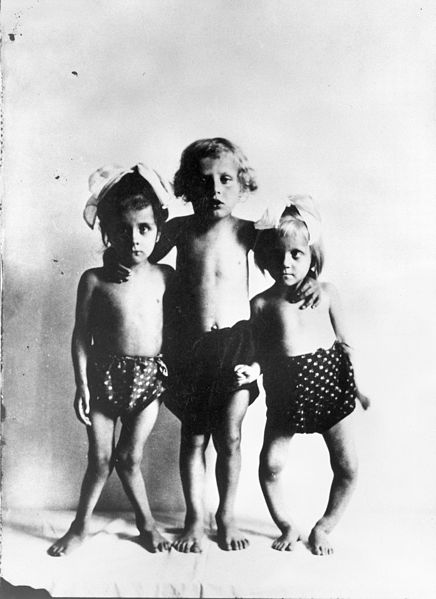
Bowed legs, thickened wrists and ankles, low weight, and deformities of the skull and pelvis are all signs of Rickets, a common disease of the 18th century and prevalent during the winter months. Rickets is caused by a lack of Vitamin D in a child’s diet, leading to soft, weak bones that don’t mineralize properly. The symptoms of rickets usually appear between the ages of 3 to 18 months, and if caught early, the disease is reversible by ensuring a proper diet of Vitamin D-rich foods (fatty fish, egg yolks, fish oil) and exposure to sunlight.
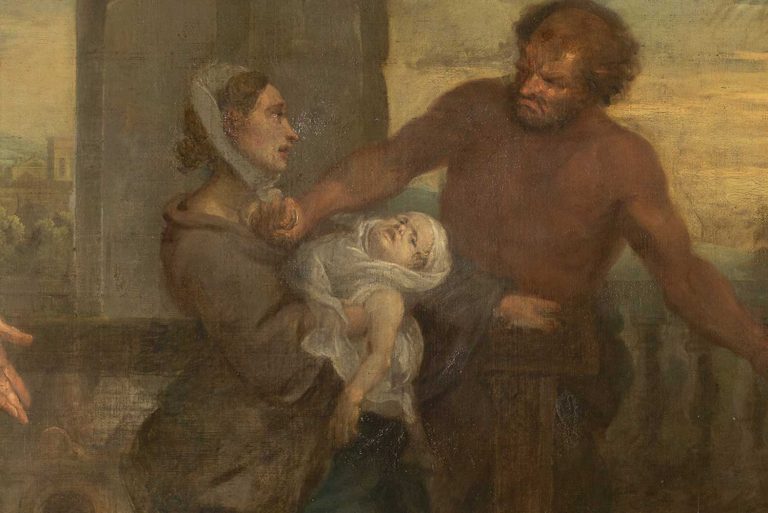
Eighteenth-century physicians knew about the disease and discussed the symptoms and possible remedies in their medical books, but they didn’t understand the actual cause (Vitamin D deficiency) and, therefore, how to cure it. And although Rickets is often associated with children living in poverty with limited diets or restricted to sunless living and working conditions, it affected children of all socio-economic levels.
Mother holding a child with symptoms of rickets in Christ at the Pool of Bethesda by William Hogarth (1697–1764) Credit: Barts Heritage
John Freke, in his 1748 book “An Essay on the Art of Healing,” felt that the diet of the children affected by Rickets was “in general too luxuriant” and should be scaled back to a more austere diet than ordinary.[4] “Care should be taken to send this sort of Children into a sharp Air,” and “rousing their Blood by shaking and tossing them often, giving them now-and-then a little red Wine, and dipping them every Morning in cold Water.” He was spot on to suggest letting them play outside in the sun, but restricting their diet would certainly have had a deleterious effect on the patient.
The 1710 Book of Physick was a recipe book of natural remedies using plants and minerals to cure the everyday ills and complaints of the sick.[5] The first step incurring rickets was to administer a “purge,” which was a drink that flushes everything out of your digestive system by either vomiting or diarrhea. Purgatives were seen as a cure-all for many diseases because the prevailing thought was you had to expel whatever was making you sick out of your body.
The recommended purge was made of a long list of plants, including liverwort, speedwell, and yarrow, mixed with fruits such as figs and raisins, all slowly simmered together in water. Dosage was three spoonful’s every morning and night for 14 days.
Next on the list was bloodletting, of course! Just a prick on the ear would do the job, or leeches behind the ears! What is interesting is that this instruction was immediately followed by a reference to the page on how “to staunch bleeding.”
Not all remedies had to come from physician’s books but could be found in publications geared towards laymen. The Servants Directory, Improved; or House-Keepers Companion, published in1762, was an instruction manual on all things household, ranging from how to kill rats, clean furniture, wash silk stockings to the best way to cook parsnips. Included in a chapter on the care of small children was a cure for a Rickety child. The first suggestion was to give the child three doses of a gentle physic, or purge, similar to the 1710 Phisick book. Next, rub the child with a concoction of smashed garden snails and liquor every day for a month. Outside exercise was also recommended, thank goodness![6]
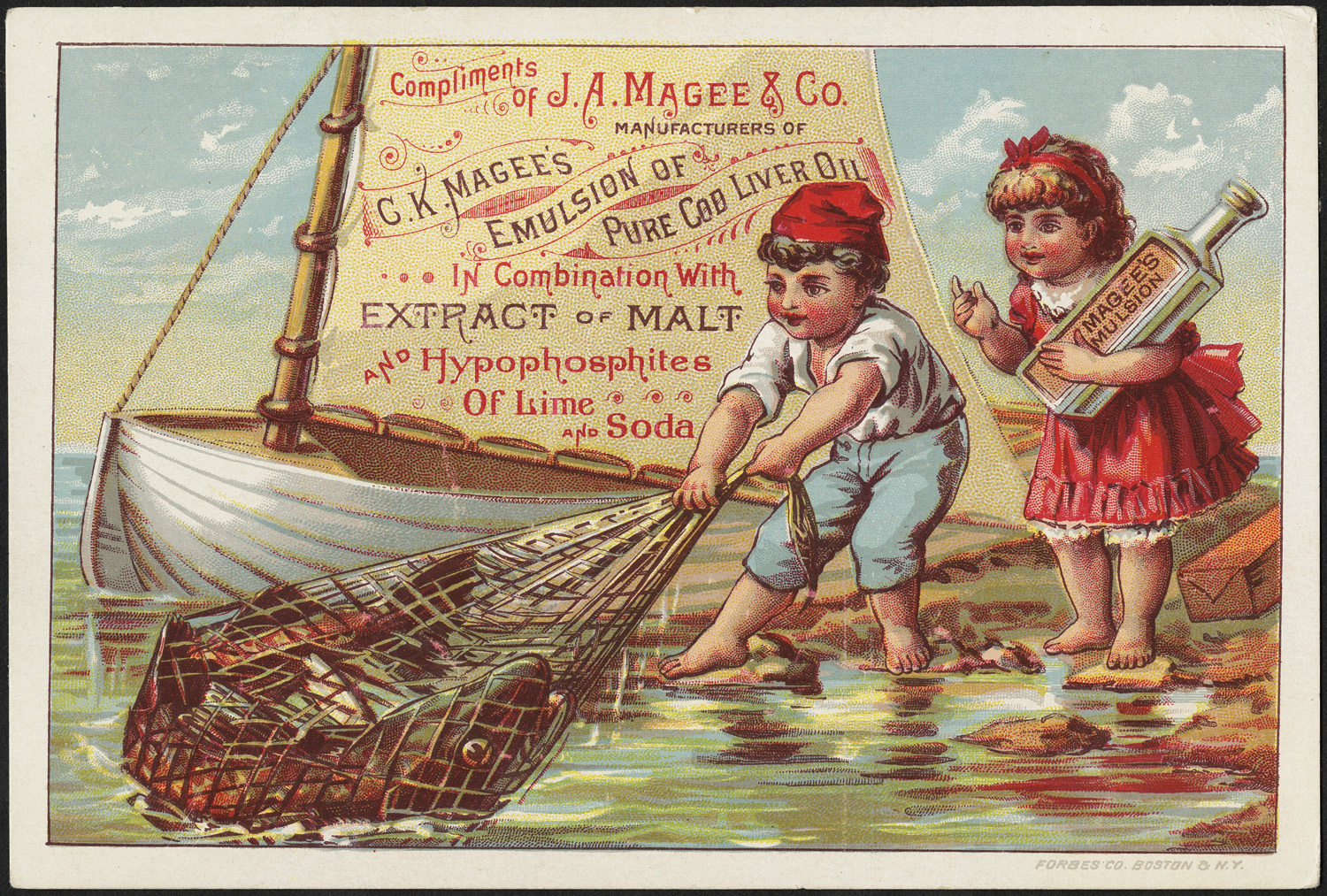
If the 18th century rickety child could survive multiple purges, bloodletting, a restrictive diet, vigorous body rubs with bug juice, and occasional sun exposure, who’s to say which treatment was the one that was most effective (Just kidding)! Progress in studying the causes and treatments of Rickets culminated in the early 20th century when it was clearly shown the benefits of using sources of Vitamin D, such as cod liver oil and sun exposure, in curing rickets.[7]
[6] The Servants Directory, Improved; or, House-Keepers Companion. H. Glass. Fourth Edition, 1762. Reprinted 2001 by United States Historical Research Service.
The year 2022 is significant for The George Washington Foundation as it is the centennial of the saving of Kenmore. We have begun the new year with a new exhibit exploring the saving of Kenmore by The Kenmore Association and the beginning of the restoration of the house and turning it into a treasured historic site.
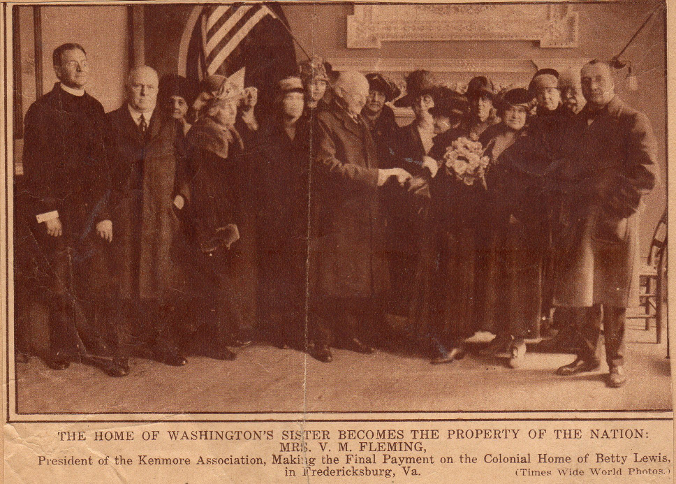
On January 1, 1925 — ninety-seven years ago — a group of well-dressed women in hats and long fur coats assembled at Kenmore to hand over the final $1,000 payment and gain full possession of the house and land. This meeting was the culmination of thirty-two months of persistent work and determination by the ladies of The Kenmore Association to save the historic property from destruction.
Emily White Fleming (identified in the newspaper caption by her husband Vivian Minor Fleming’s initials) makes the final payment to purchase Historic Kenmore on January 1, 1925.
This crusade began four years earlier with a brief notice in the Fredericksburg Daily Star from Mr. E. G. Heflin, the owner of the Kenmore property. The announcement stated: “I have decided to build at once…6 or more modern, up-to-date residence [sic] on Kenmore.” Built on a section of the plantation property, these houses prompted concern among many local citizens at the thought of further loss to the historic site.
By 1922, the destruction of the old Lewis home seemed imminent. Mr. Heflin placed an advertisement for the sale of the house itself and cut up much of the original estate into smaller building lots to be sold to developers. If the house was sold, it might be remodeled into apartments or just razed to the ground. This escalation increased the alarm even more, and some tried to raise funds to purchase Kenmore. This attempt proved unsuccessful, and the house did look to be lost. However, salvation appeared in the form of Kate Waller Barrett and the National Society of the Daughters of the American Revolution (DAR).
In March of that year, Mrs. Barrett, Virginia Regent of the DAR, came to Fredericksburg with the purpose of organizing a new chapter in the town. Emily White Fleming and a group of intrepid ladies proposed this turn of events as a potential way of saving Kenmore. Mrs. Fleming was 68 years old and, though seemingly small and fragile, she, in reality, had a tenacious and determined spirit. She accepted the position and, with the help of her daughter Annie Fleming Smith, known as “Miss Annie,” began their campaign to save the old Lewis house from destruction.
The ladies approached Mr. Heflin and negotiated an agreement to the purchase the property. The group had to make a first payment of $10,000 within four months, or the deal would be off. Furthermore, if Mr. Heflin got a satisfactory offer within those four months, he could go ahead and sell the property outright. It was a tough deal, but the ladies rose to the challenge spectacularly.
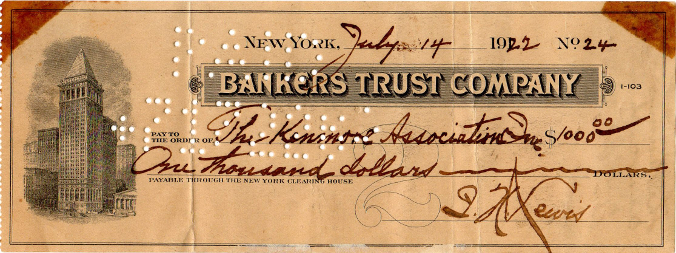
Mrs. Fleming and Miss Annie began fundraising immediately. They wrote hundreds of letters by hand, stating facts about Kenmore in a simple, forceful style and then making appeals for help. Mrs. Fleming recalled, “I could write thirty-nine letters a day and Annie forty-nine. We never had a typewriter until the campaign was over.” In response to one of Mrs. Fleming’s letters, Colonel Isaac Newton Lewis, maker of the Lewis machine gun and a descendant of Fielding Lewis, contributed the first $1,000. Not to be outdone, The Colonial Dames of America in the State of Virginia gave a substantial donation of a $1,000 as well.
Donation from Colonel Isaac Newton Lewis donated the first $1,000 to the Kenmore Association.
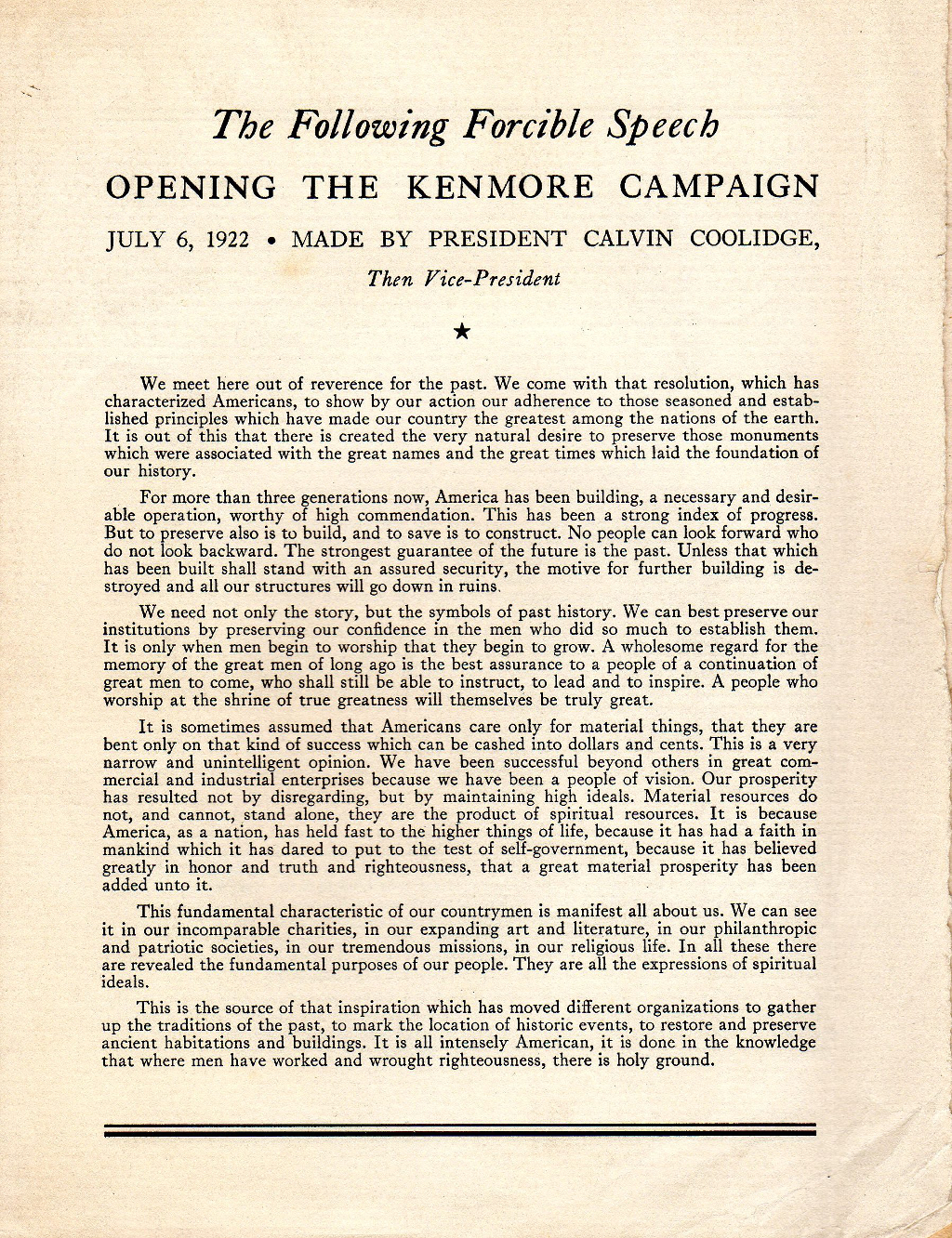
In July 1922, the Kenmore Association launched a public fundraising drive with a host of distinguished men and women coming to Fredericksburg for the start of the campaign. Even Calvin Coolidge, then the vice president under Warren G. Harding, made a speech (see below) pleading for patriotic Americans to save this home that was so critical in the history of the country. “It ought to be preserved for its own sake,” Coolidge demanded, “It must be preserved for the sake of patriotic America.”
Speech made by Vice President Calvin Coolidge in support of the Kenmore Association’s effort to save the historic home.
Through the efforts of this determined group of women, by the first of September 1922, they were able to pay an initial installment of $12,000 on the account. Impressed with the Kenmore Association’s work, Mr. Heflin made his own gift of $2,000. By New Year’s Day 1925, the hard work paid off, and the ladies made the final payment and took possession of the property. Historic Kenmore was saved!
Although the saving of Kenmore one hundred years ago certainly marked a new beginning, transforming the house into a historic site for the public to enjoy required many more years of work. Indeed, in many ways, the work begun by Mrs. Fleming, Miss Annie, and the Kenmore Association continues even as 2022 begins. In the New Year at Kenmore, we will focus celebrating the establishment of the Kenmore Association and the ladies’ work to save this national treasure. You can follow the year’s celebration here of the “Lives and Legacies” blog and The George Washington Foundation website. Like in 1922, the year 2022 should prove an exciting time.
The sending of a letter in Colonial America was more challenging than today. The concept of post offices and regularly scheduled mail arrivals and departures evolved slowly in the colonies. Colonial mail faced many obstacles. Geography, political opposition, and a general lack of interest hindered a national system that serviced all the colonies.
How to Get a Letter Sent
While not impossible to get a letter sent, the question was, would it arrive? There were two main ways to send your letter: send someone you know or pay someone else to deliver your correspondence for you.
We will call these two types of mail delivery private and public systems. A private system means that the sender and the recipient knew the mailing source. For example, you might entrust your letter to be delivered by an acquaintance, family member, or servant. You would put your mail in the hands of someone you knew who happened to be traveling in the direction of the addressee, be it across town or the colonies. In such cases, the letter was delivered free of charge.[1]
A public system consisted of a letter being passed through a series of people unknown to the sender, with postage paid by the sender. This was an informal arrangement where strangers, for a fee, carried letters for people to specific destinations. This would eventually evolve into what we now recognize as the postal system.
Artist Lloyd Branson depicts a colonial mail carrier in this partial view from his painting “Transporting Mail”.Credit: Smithsonian’s National Postal Museum
English Colonies
The history of mail service in America is complicated. It took over one hundred years to evolve into a true American Postal System. In the beginning, the English government established the “Royal Mail” in 1660.[2] Under the Act of 1660, the price to send a single letter was two pence for “fower score English miles,” or threepence for greater distances.[3] The colonies did not have an official postal service until King William and Queen Mary appointed Thomas Neale to create one in 1691. This patent established an officially-designated letter depot or post office, but there was no inter-colony service until later.
Mail in Virginia
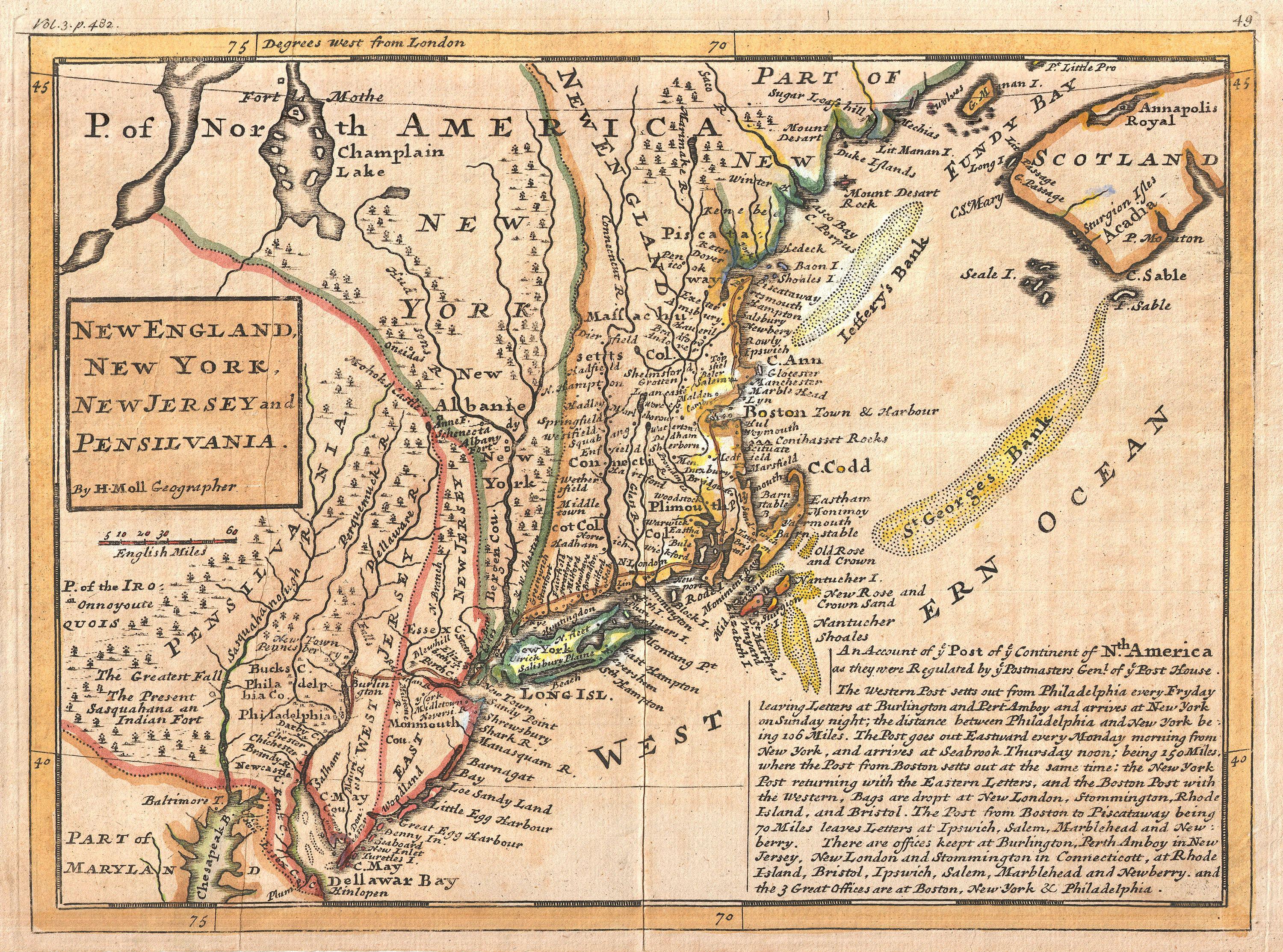
Shortly after his appointment Thomas Neale chose Andrew Hamilton of New Jersey as a resident deputy. Hamilton established regular service in the North between Boston, New York, and Philadelphia.[4]
1729 Moll Map of New York, New England, and Pennsylvania (First Postal Map of New England). Credit: Wikimedia Commons
Hamilton was eager to continue establishing service to the Southern states of Virginia and Maryland. However, his application to extend the post to Virginia was not accepted with enthusiasm. Virginia didn’t find a need to link up to a more costly overland inter-colonial mail service because their mail could travel by the schooners and tobacco ships.[5]
Lieutenant governor Alexander Spotswood persisted in starting a post-service in Virginia. In 1717, Spotswood announced that post offices had been “settled” throughout Virginia and that fortnightly (two weeks) post was established between Philadelphia and Williamsburg.[6] However, Spotswood’s works were not appreciated by many Virginians, particularly politicians, and there was still considerable resistance to the service. [7] The people’s main concern was that the postal service would become a monopoly where prices were controlled by the owner rather than by competition.[8]
When the Assembly met in the spring of 1718, many counties complained about this postal monopoly. The Burgesses and the (Governor’s) Council united in passing a bill that prevented the execution of the Act of Parliament establishing a mail service in the colony. Spotswood subsequently blocked this bill, but the bill’s proponents were successful and promptly suspended official service in Virginia. Because of this lack of co-operation as late as 1727, Annapolis was still the southern terminus for regular postal service.[9]
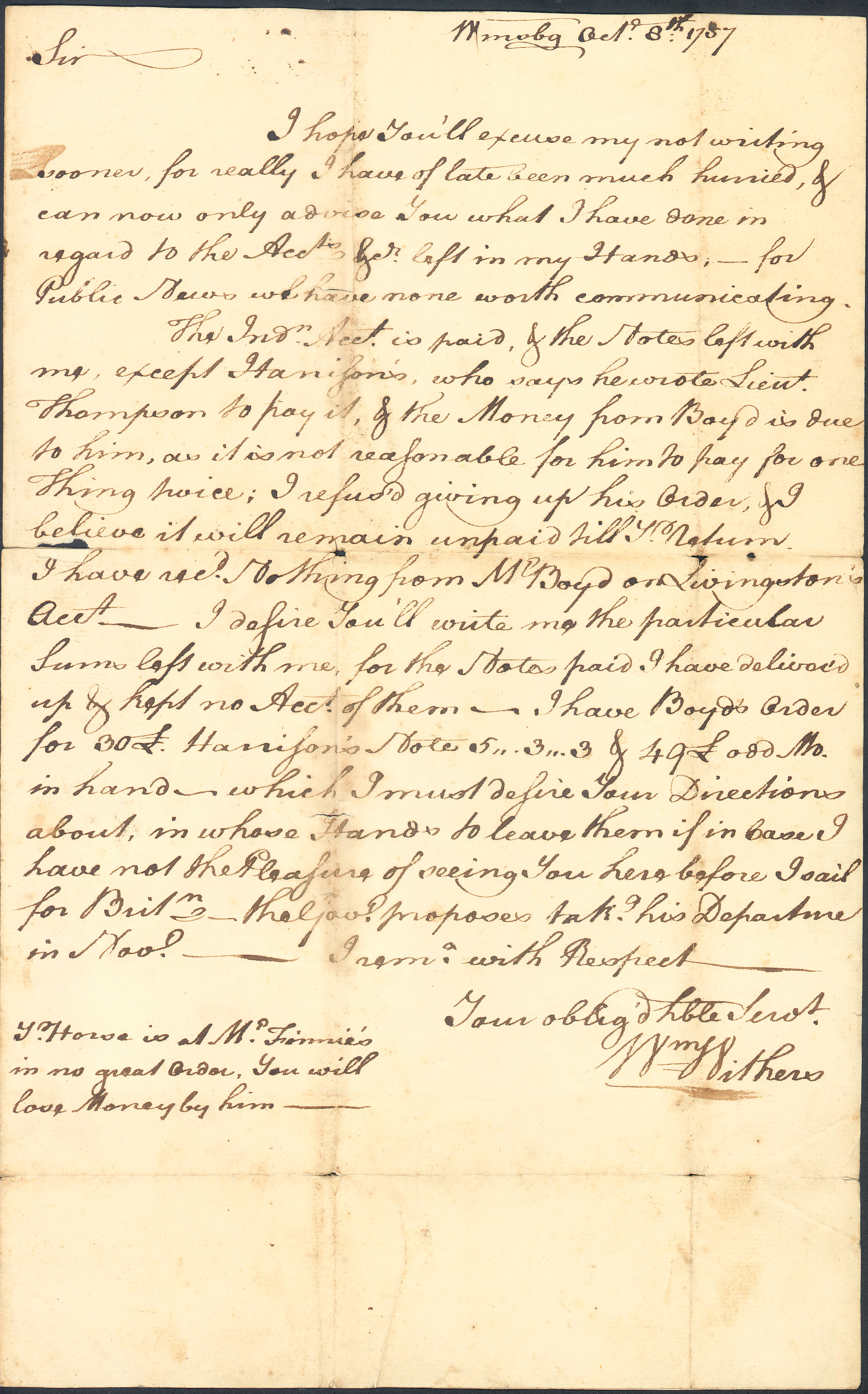
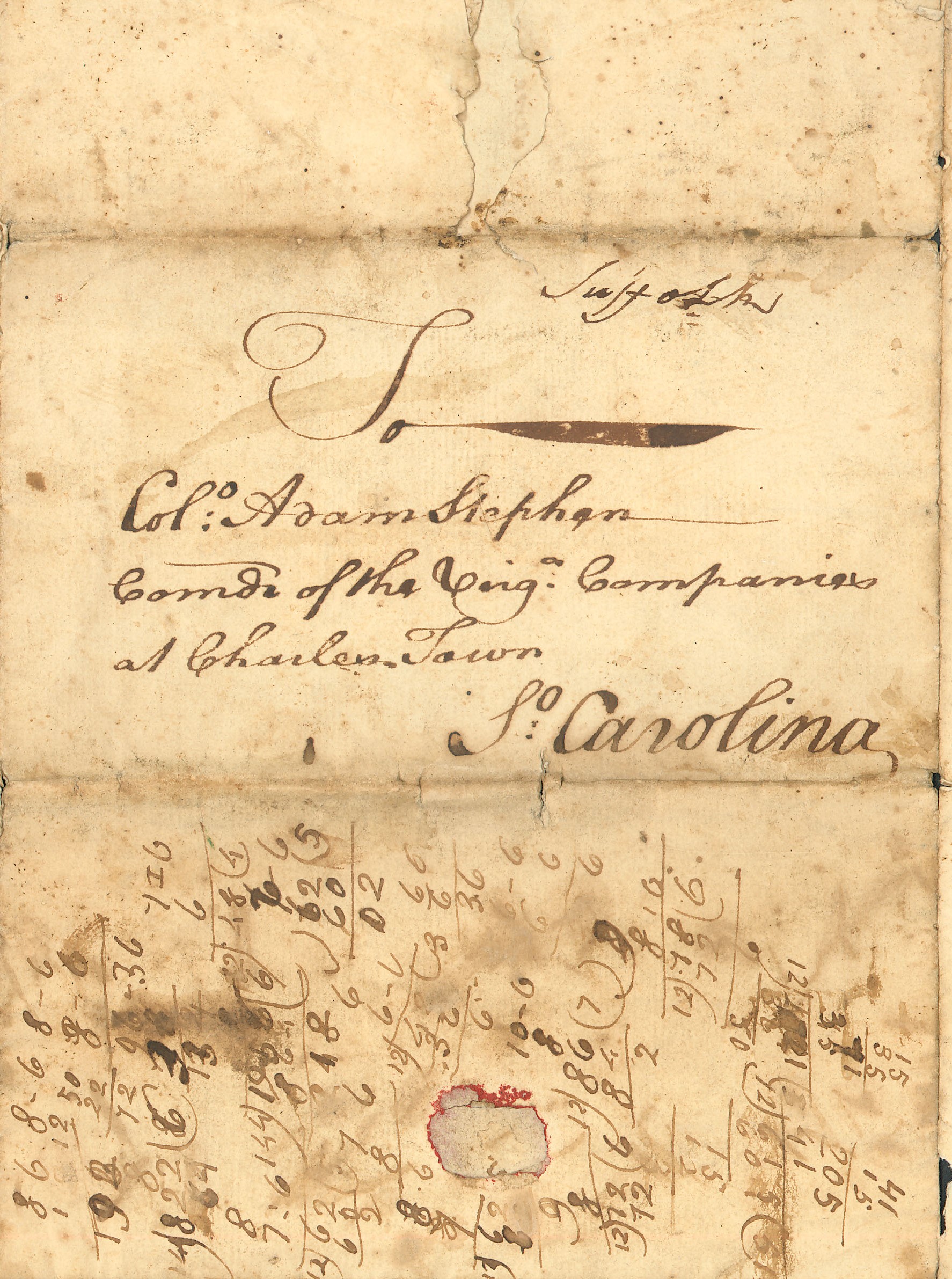
In 1730, Spotswood took over the position of Deputy Post Master General after the resignation of John Hamilton for failing to turn a profit for the post office and suffering accusations of excessive spending.[10] His goal was to establish a better route between Annapolis and Williamsburg and eventually push that further south. He succeeded and, by 1739, had created a route from Williamsburg to Charles Town, South Carolina. Spotswood’s post office was called “General Post Office at New Post” and was located near the Rappahannock River in Fredericksburg on land he owned. After Spotswood’s death in 1740, the post office was maintained in New Post, Virginia, until Benjamin Franklin took office in 1753 and moved headquarters to his native Pennsylvania.[11]
Revolution
The postal system in the Colonies continued growing until British Parliament passed the Stamp Act of 1765. The Stamp Act placed an official stamp on all printed material, including legal documents, magazines, playing cards, newspapers, and other types of paper used throughout the colonies. [12]
Unsurprisingly, the Stamp Act was very unpopular among the colonists as many considered it a violation of their rights as Englishmen not to be taxed without their consent. With the significant uproar and protests, the act was quickly repealed in March of 1766. Still, Parliament continued to declare its power to legislate the colonies by passing the Declaratory Act. Additionally, a new series of taxes and regulations were introduced, which fostered resentment to British rule and was the beginning of what would become a revolution in America. [13]
The post office symbolized British power, and a new system would have to be established if the colonists wished to overthrow the government and create an independent country. The colonist began their postal service, the Constitutional Post, in May 1775 with Benjamin Franklin as the new postmaster general. Subsequently, the Crown’s postal service in the colonies ceased by Christmas of the same year.[14]
By July 1775, the Second Continental Congress ordered The United States Post Office (USPO) with Franklin overseeing its creation as department head. In 1789, George Washington appointed Samuel Osgood as the first American postmaster general. More than 75 official post offices and more than 2,000 miles of post roads.[15]
Over America’s development as a new country, its postal system has continued to grow to accommodate its populations and postal needs. Today, the United States Post Office has over 30,000 offices and delivers around 150 billion pieces of mail a year.[16]
We are excited to be celebrating George Washington’s 290th birthday (although it’s the day before his actual birth date) on President’s Day! On February 22, 1732, George was born in Westmoreland County, Virginia. Some interesting facts are associated with his birth-date and the subsequent birthday celebrations he would have as an adult. For instance, did you know that he technically has two birthdays? It’s true! Under the Julian calendar, his birth date would have been February 11, 1731. This means that his birthday was actually earlier in the month until the calendar switched to the Gregorian calendar in 1752. The Gregorian calendar added 11 days and one year to his date of birth!
Just when did his birthday become so popular to celebrate? The earliest known date of his birthday being recognized (beyond his family) was actually during the American Revolution. It was the winter of 1778, and the soldiers were desperate to keep warm at their headquarters in Valley Forge, Pennsylvania. General Henry Knox planned the event. Clearly, General Knox did more than coordinate the movement of cannons from Canada to Boston; he apparently could also list “party planner” upon his resume.
The festivities of this inaugural birthday bash included a parade from an artillery band consisting of drums and fifes. Around this time, George was also becoming known as the “Father of his Country,” replacing King George III at every chance. For instance, the King’s birthday would no longer be listed in the Almanac. Instead, you would find the birth-date of George Washington. However, that doesn’t quite answer the question of when his birthday became an annual event on a broader scale.
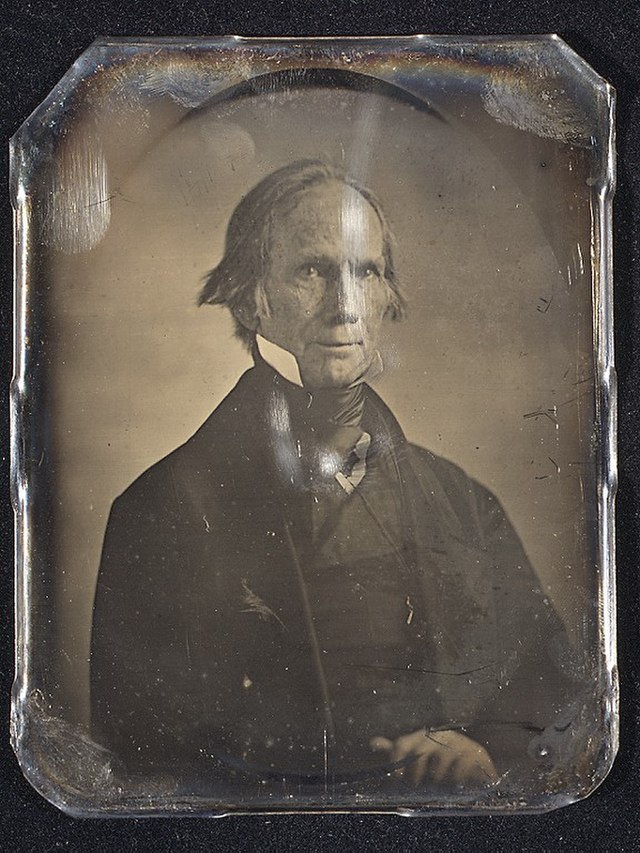
For that, we turn to everyone’s favorite statesman, whose most significant accomplishment was never being elected President of the United States despite the number of times he ran for that office. The one, the only…Henry Clay. Senator Clay was part of a joint Congressional committee that wanted to recognize the centennial of George’s birth. They decided to do this by giving themselves the day off and adjourning Congress on February 22, 1832. While not the celebration you might have imagined, it did get the ball rolling for an expanded holiday that we celebrate today.
As the years went by, cities, states, and even Congress realized they had to do more to commemorate George’s contribution to the Nation. In 1862, yes, in the midst of the Civil War, the Senate began to read Washington’s Farewell Address each year on his birthday. In 1879, Congress made the date a federal holiday for federal employees ONLY IN DC. Though this caused confusion among those employees as some were paid for that holiday and others were not… This discrepancy was amended in 1885 when the holiday became a paid one for all DC federal workers.
Almost 100 years after the Senate began their annual tradition of reading the Farewell Address on February 22, Congress passed the Monday Holiday law to make federal holidays more uniform. So instead of celebrating George’s birthday on February 22, it was recognized on the third Monday of the month. There are two interesting things about this law when applied to George’s birthday. First, because of February’s shortened number of days, there is no possible way for the federally observed holiday to fall on his actual birthday. Second, the holiday we all know as “President’s Day” doesn’t actually exist. It has yet to be formally changed by Congress or the President from being first recognized as “Washington’s Birthday,” which is pretty fascinating!
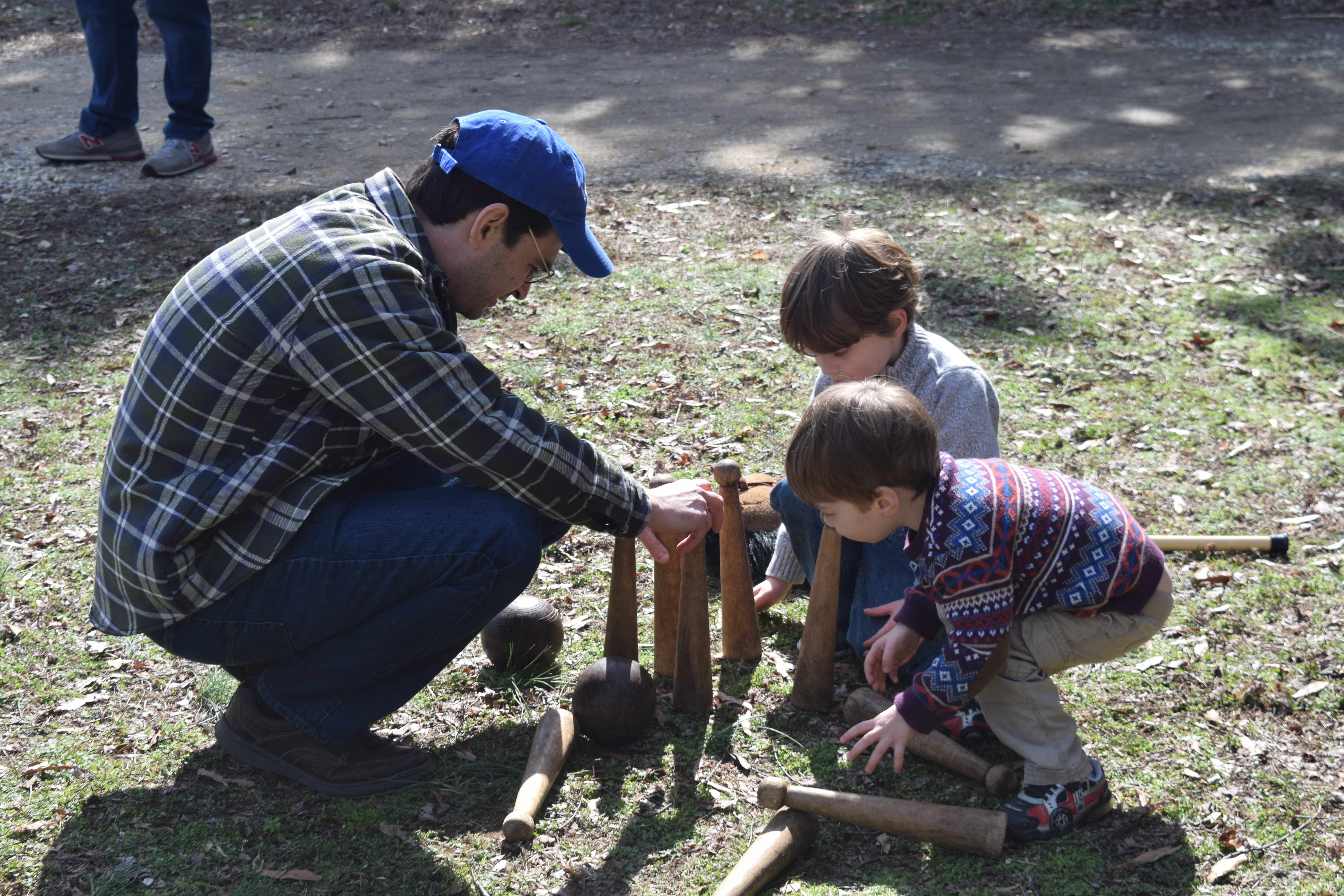
If you’re looking for a fun way to celebrate George’s birthday this year, I encourage you to check out our event at Ferry Farm. For the event, we are offering tours of the reconstructed Washington House, new (and returning) crafts, a chance to meet real archeologists and learn about what they’ve found at the site, the opportunity to see if you can throw a stone as far as George supposedly could, and obviously, we’re having cupcakes because it’s a birthday party!
This year’s event will be held on Monday, February 21, from 10 am to 3 pm, and tickets can be purchased by visiting our website. Tickets are $5 per adult (age 18+) and FREE for children (17 & unders). We encourage you to purchase your tickets in advance.
The staff at the George Washington Foundation posited the idea of what it would be like to go on a date with a Founding Figure. We use the term “Founding Figure,” because a couple of dates are with the ladies of the American Revolutionary period and not just the “fathers.” Although, fun fact, the term “Founding Father” was supposedly coined by then-Senator (later President) Warren Harding in 1916. A founding figure is a person who was instrumental during the Revolution, the creation of the Republic, and the early years of said Republic.
While some traditional figures have been classified as “lesser-known” or the “last of,” we have chosen those who are pretty well known (and if not, should be!). Each date is set in the 21st century but is tailored to that person’s 18th and 19th-century interests. The following paragraphs are fictional, sadly, but contain threads of facts.
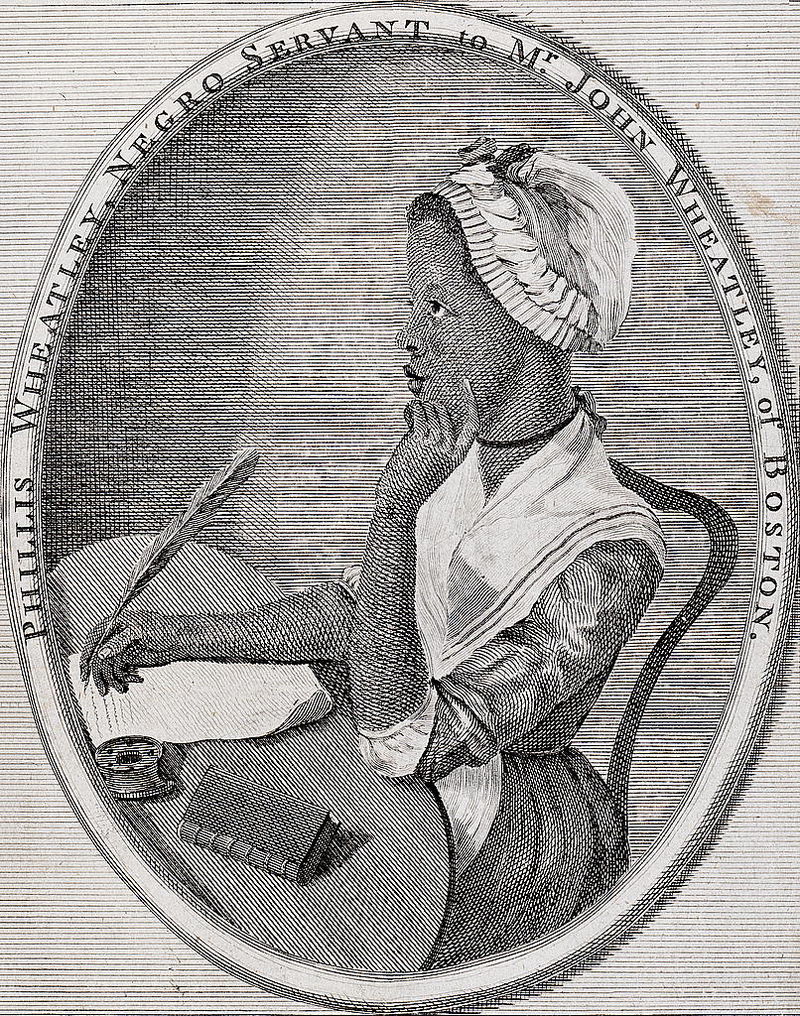
My dream date with Phillis Wheatley would involve a lot of active listening on my part. I would ask her whether she remembers her time as a child in West Africa before she was enslaved and brought to the British North American Colonies. We both are familiar with Boston, so we’d talk a lot about our favorite places around that city while having tea at Hyperion in downtown Fredericksburg.
Phillis was a great fan of General George Washington and famously wrote him a poem which resulted in George inviting her to his headquarters in Cambridge, Massachusetts, so I would offer her a tour of Ferry Farm and show her some of the artifacts we have that relate to the Washington family’s time here. From Ferry Farm, we would head to D.C. to check out the museums. I think Phillis would be interested in how history has progressed.
Over dinner, we would talk about the Revolutionary War, a cause she adamantly supported. At the end of the evening, we would go to a late-night café and sip coffee during a poetry open mic night. Phillis would take the stage and wow everyone with her amazing talent.
For those interested in learning more about Phillis, take a look at the Poetry Foundation’s information on her and her work by clicking here.
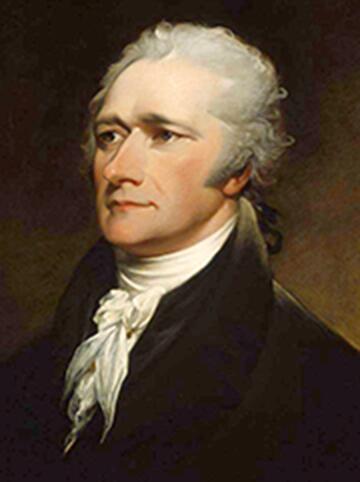
A day-long date with Alexander Hamilton in Fredericksburg, VA would start early. First, we would head out in search of some lively morning debate at a local coffee shop. Alex is well known for his oratory and debate skills; I would enjoy listening to him engage with local folks in discussing the politics and page one issues printed in our morning newspaper. The conversation might also veer into the topic of the newspaper industry itself as Alex was a founder of the New-York Evening Post in 1801, now called the New York Post.
After breakfast, we would take a walk following the Trail to Freedom, a Civil War-era tour that retraces the routes of freedom-seeking enslaved men, women, and children through the City of Fredericksburg and the County of Stafford. Alex opposed slavery and vocally supported abolitionist causes. He would be very interested in learning the story of John Washington, enslaved for 24 years in Fredericksburg before escaping to freedom during the Civil War.
As a side note, we would definitely avoid going past the James Monroe Museum and Memorial Library (too bad, since it’s a great museum!). Monroe and Hamilton had a serious falling out over the public disclosure of Hamilton’s affair with Maria Reynolds and accusations of financial malfeasance. Hamilton and Monroe nearly ended up as a duel over the situation!
Lunch is at one of two Jamaican-themed restaurants in town in honor of his Caribbean roots. Over the meal, we would discuss our afternoon plans to tour the Civil War battlegrounds in and around the city. I’d be interested to hear his views on military history and tactics. Hamilton loved all things military and even resigned as Washington’s aide-de-camp to take an active role in the Revolutionary fight.
The day ends with dinner and good conversation at the Rising Sun Tavern. This local landmark is a suitable replacement for the George Weedon Tavern, once a popular gathering spot for patriots in Fredericksburg during the Revolutionary War. Located at the northwest corner of Caroline and William Streets, the tavern unfortunately burned down in 1807. Many important American patriots met here during the War to discuss politics and design policies. The tavern was the setting of the Peace Ball on November 11, 1781, following the defeat of Cornwallis at Yorktown. Weedon hosted many important dignitaries at this event, including George Washington himself and the Marquis de Lafayette. Alex and I would spend a pleasant evening convening with the ghosts of his compatriots of the Revolutionary War.
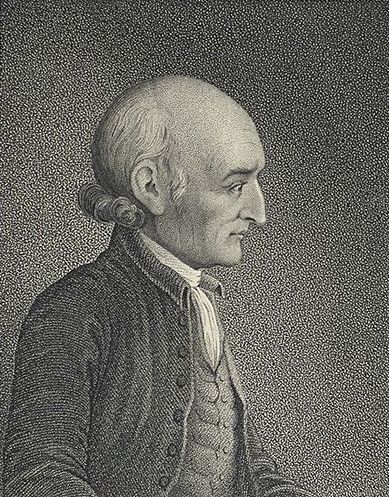
On my date with George Wythe, a lesser-known Founding Figure, we would spend an afternoon strolling along Duke of Gloucester Street in Colonial Williamsburg. For those of you who might not know George, he was a prominent lawyer and Williamsburg local. He taught law at the College of William & Mary (in fact, he’s considered America’s first law professor!), so perhaps we would start our day with a leisurely walk around campus and a tour of the Wren Building.
Next, we’d stop in the aptly named Wythe Candy & Gourmet Shop (I’d probably need to explain the modern sales tax to him, though…) to buy a snack before wandering down to the capitol building. Since he was a member of the House of Burgesses and a signer of the Declaration of Independence, we might debate colonial politics while we tour the building and as we continue our walk along the Palace Green. (Maybe I could convince him to toss a Frisbee on the lawn?)
On our drive home from the ‘Burg, we’d queue up a true-crime podcast for the road. Wythe himself had quite the connection to true crime. The events surrounding his death, namely, a suspected poisoning, caused quite the scandal in 1806. I probably shouldn’t bring that up during our date, though.
-Ann Waters, Manager of Interpretation & Visitor Services
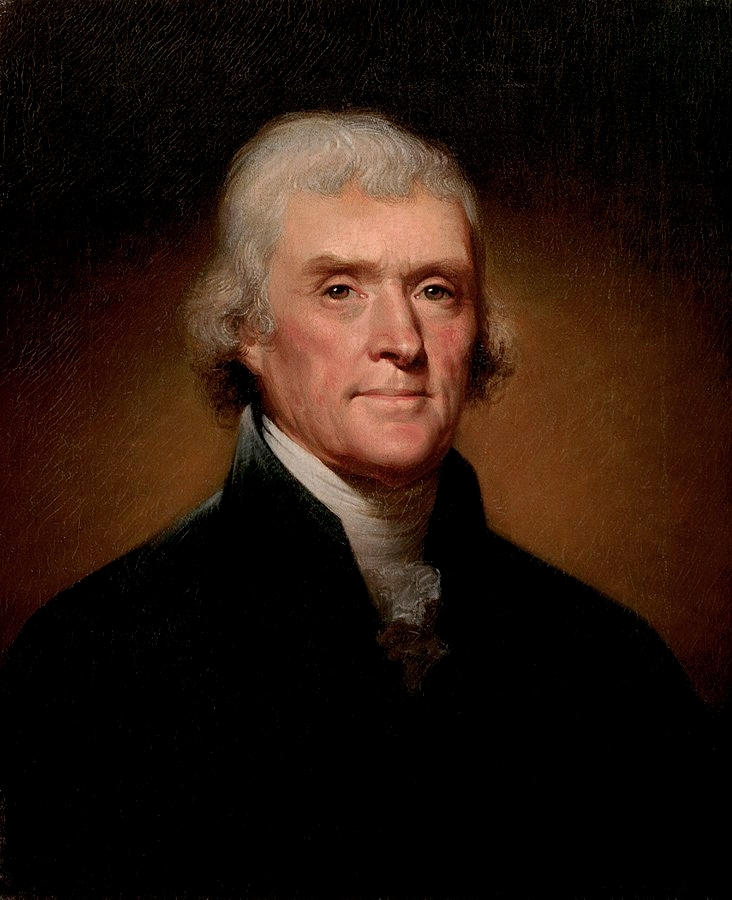
A date with Thomas Jefferson, the 3rd President of the United States, would be an all-day affair. How could we possibly browse bookstores and discuss literature in only a few hours? A good date must start with coffee. After stopping in Agora (in Fredericksburg, VA) and skimming their used book collection, I would insist on bringing Tom to Riverby Books. Since he was an avid reader, we would likely spend most of the day browsing their shelves. I imagine we would gather a large number of books to peruse.
The rest of our day-date would be spent reading at the window seat in Riverby and discussing the novels we’ve found. We would leave the bookstore with a few tote bags of books and continue our conversation as we strolled down Caroline Street. The day would end with me gifting Tom a copy of Pride and Prejudice, and I doubt the author of the Declaration of Independence has that on his shelves. Though I wonder, do you think he’d appreciate a Kindle?
-Gillian Both, University of Mary Washington Fleming-Smith Scholar 2021-22
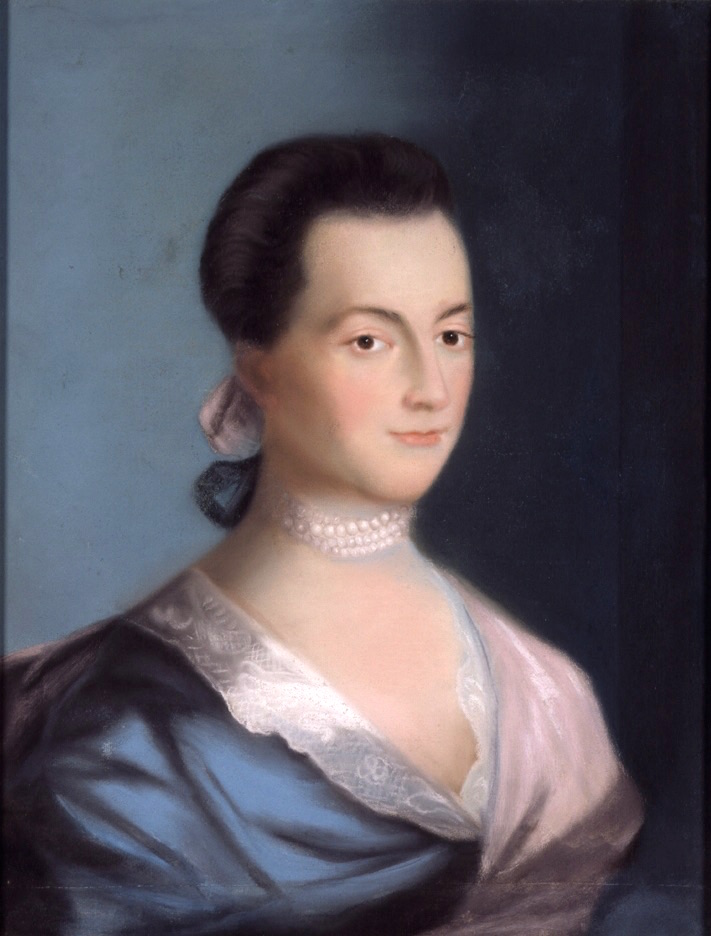
My date would be with Abigail Adams, but I’m hoping I get to call her “Abby.” We would probably go for tea in downtown Fredericksburg. In her letters to John during his absence on crucial government business, she often wrote about the rights of women in the new nation. One aspect of women’s rights that seems to be most important to her was the ability of women to own property and make their own money. With this in mind, I would suggest the woman-owned Freedom Society tea room for our date. Over tea, we would discuss the political progress of women’s rights since the 18th century.
After tea, since she was also an avid reader, I’m sure she would be happy to visit Riverby bookstore where she could explore the many books unavailable to her in the 18th and 19th centuries, and then I would be happy to hear her opinions on those books, and what she thinks of 21st century Fredericksburg.
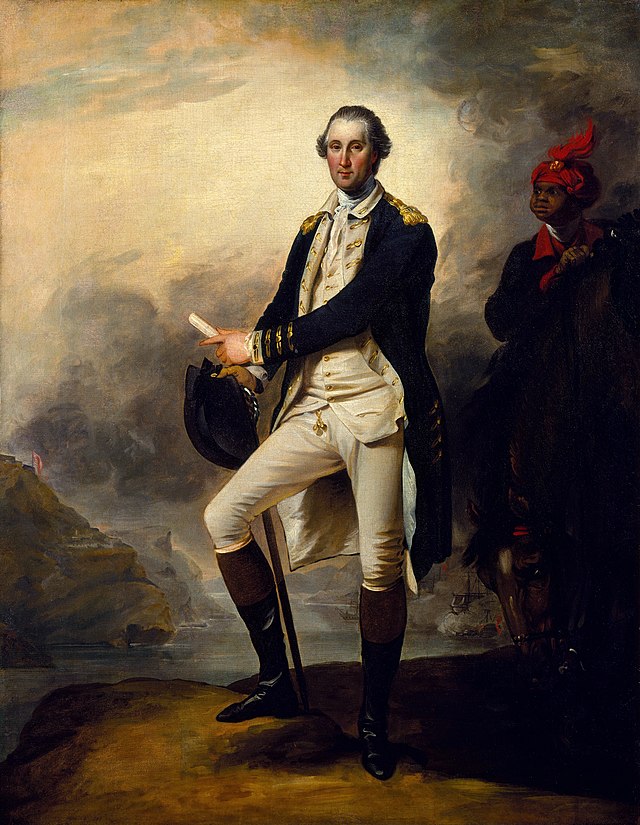
A date with George Washington, Stafford’s boy who grew up to be the 1st President of the United States, would be an evening affair of dinner, dancing, and conversation, of the most respectful sort. Dinner would be a restaurant in downtown Fredericksburg, maybe Sammy T’s? After dinner, considering the incivility of modern-day clubs, George and I would attend a prom—as overly enthusiastic chaperones.
We would revel in bopping our heads to the D.J. while remaining a respectful 6 feet apart. Furthermore, George would take this date as an opportunity to educate the youth. He would separate students who were not dancing with the purest intentions and would read them excerpts from Rules of Civility, which, while entertaining, would also probably get us removed from future chaperone lists.
After the prom, George would make sure that I arrived safely home. While I would certainly find George to be charming and honorable, I will forever remember the students’ groans that reverberated off the gymnasium’s walls.
-Kaylie Schunk, School & Youth Programs Coordinator
Fredericksburg is the perfect setting for a date with James Monroe. Did you know? He actually had a law office in town, and his descendants turned it into a museum in the 1920s! While it would be interesting to take him to his own museum, I think we’d leave that for a second date.
First, we would peruse newspapers for yard and garage sales. I can see us at Agora, on the back patio, sipping coffee, James with the newspapers opened, and me on my smartphone, plotting the location of the sales. James was quite the thrifty furniture finder in his day. One time, while President, he purchased furniture from the Russian ambassador who was having a sale of his things before moving back to Russia.
After a successful morning of thrifting, we would relax over lunch at La Petite Auberge. I would ask James to tell me all about his time in France as the ambassador during George Washington’s administration. The fact that he sent his wife on a diplomatic mission during the French Revolution is something I really want to hear more about. Additionally, I also want to know more about his trips to England and Spain. Being a diplomat to many places during the late 1790s and early 1800s must have been thrilling!
-Amy N. Durbin, Director of Education
Marquis de Lafayette
Marie-Joseph Paul Yves Roch Gilbert du Montier a.k.a Marquis de Lafayette. Credit: Wikipedia
Oh, la la! What comes to mind when you think of Marie-Joseph Paul Yves Roch Gilbert du Motier? Êtes-vous confus? He’s better known by his title, Marquis de Lafayette! Our daylong date would begin mid-morning, as the Marquis would have arrived late the night before. The last time he was in the United States was 1824 so, it’s been a minute. He’s currently on the U.S. leg of his college speaking tour.
As a person who grew up in a small town in France, traveled overseas, fought for liberty here, and also in his own country, was arrested during his home country’s Revolution, survived, sought to end slavery, and to keep the ideals of the American Revolution alive, the University jumped at the chance to have him encourage the graduating students. So, after his fiery speech to get the students ready to live their dreams, I’d present him with some donuts from Paul’s, and we’d grab some coffee from Hyperion. Taking our treats down to the waterfront, we would spend the afternoon discussing his views on the right and wrong of humankind.
In the early evening, we’d walk through Hurkamp Park, taking in the sounds of a local band. He probably wouldn’t care to dance as he wasn’t the most graceful dancer, but it’s 2022, dance moves are whatever a person wants them to be, right? After the park, we would end the day over dinner from Juan More Taco. I think he would like how much the restaurant gives back to the community.
-Amy N. Durbin, Director of Education
And so, we ask you, what do a poet, an accountant, a professor, an architect, an advocate, a surveyor, a diplomat, and an idealist have in common? They all paved the way for others to also grow up and to make their mark on the world. What they accomplished, be it good, not-so-good, or even unknown to many, can still be educational. What founding figure would you date?
It can be daunting to look at a blank space and realize you are in charge of filling it. And not just filling it, you need to create something that will leave a lasting impression on the public. The process of creating an exhibit is much more complicated than it seems. From the initial idea to the final product, there are many steps that require careful attention.
With countless artifacts in the Archaeology Lab, finding inspiration for a topic was easy. Once I settled on 18th Century tea practices, everything seemed to fall into place. There were many subjects I could have focused on from this topic. In order to connect the idea to Ferry Farm and the Washington legacy, I chose to focus on Betty Washington and what she would have learned from her mother growing up at Ferry Farm.
This inspiration came from an archaeologically excavated pewter teaspoon handle with the initials ‘BW’ stamped into it. It is clear that Miss Betty Washington was the owner of this spoon. The spoon was likely part of a children’s tea set that Betty was given in order to teach her the intricacies of the American Tea Ceremony. This education was Mary’s legacy for Betty; it taught her how to be a proper gentry lady and interact with the upper-class circles in Virginia.
Teaspoon handle with “BW” initials.
Once I picked my topic, it was time to begin researching. Research is the backbone of any exhibit, though it might not be the most exciting part. I was able to obtain an understanding of the Tea Ceremony from my research that I applied to my specific topic. The biggest question on my mind throughout my research was: Why was this important for Betty?
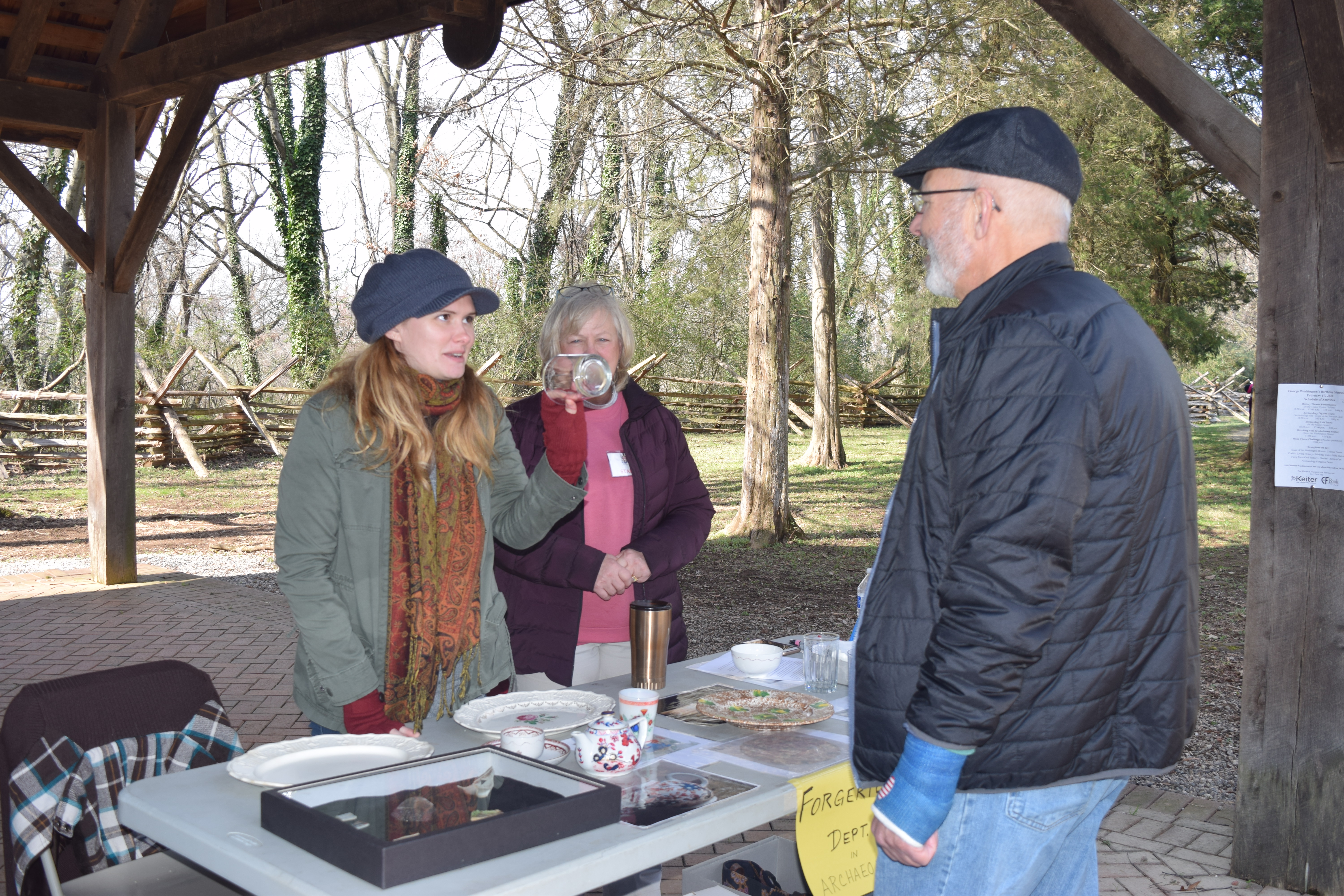
While working on research, I was simultaneously creating a reproduction 18th Century creamware teapot. With the help of the Archaeology Lab Forgeries Department, I quickly transformed a Goodwill find into delicate creamware with a rose motif. The pot is the centerpiece of the exhibit on 18th Century tea practices. Many scholars wrote that the teapot is the literal and figurative center of the ceremony, bringing people together and initiating the ceremony. This concept inspired my placement of the teapot for the exhibit.
Hand painting of reproduction teapot.
After concluding my research, writing the signs for the exhibit, and finishing the replica pot, I had to choose the artifacts to include in the exhibit. Throughout this process, I kept my thoughts on Betty. The BW teaspoon handle was set aside for the exhibit as well as the replica teapot. Including teaware from Ferry Farm and Kenmore displayed the continuity of Betty’s gentry practices throughout her life. A slop bowl excavated from Kenmore, as well as a teacup and a saucer excavated from Ferry Farm were both chosen for the exhibit in order to support that point.
Once this was all completed, the excitement truly began. I saw my work come to fruition when I set up the display in the conservation window of the Archaeology Lab. Being able to share what I had learned with the public was an excited prospect. The exhibit is currently on display and can be seen in the Ferry Farm Visitor Center.
Intern Gillian Both standing behind her exhibit.
This process has taught me a lot about exhibit design and the research process. I couldn’t have completed the exhibit without the Archaeology Lab staff helping me along every step of the way. I encourage you to go and visit the lab to see the exhibit and learn more about archaeology at Ferry Farm.
Usually, at this time of year preparations are well underway for our annual Twelfth Night at Kenmore: A Dramatic Performance. The play takes place in January 1776, during the first Christmas season celebrated at Kenmore. Unfortunately, this year’s celebration of Twelfth Night at Kenmore is canceled due to winter weather. However, if you are familiar with the performance, or have read some of our past blog posts, you might already know a thing or two about this once popular Christmastide holiday. While traces of Twelfth Night still exist today, the celebration is much diminished, if not entirely eclipsed, by Christmas and New Year’s. Why is this, exactly? When did we stop celebrating Twelfth Night?
There is no single, short answer as to why Twelfth Night celebrations fell out of fashion. Rather, attitudes surrounding the Christmas season changed throughout history, and old traditions were often absorbed or re-imagined into something new. A very brief look into the history of the season sheds some light on why today’s Christmas traditions rose in popularity, while Twelfth Night celebrations became part of Christmas Past.
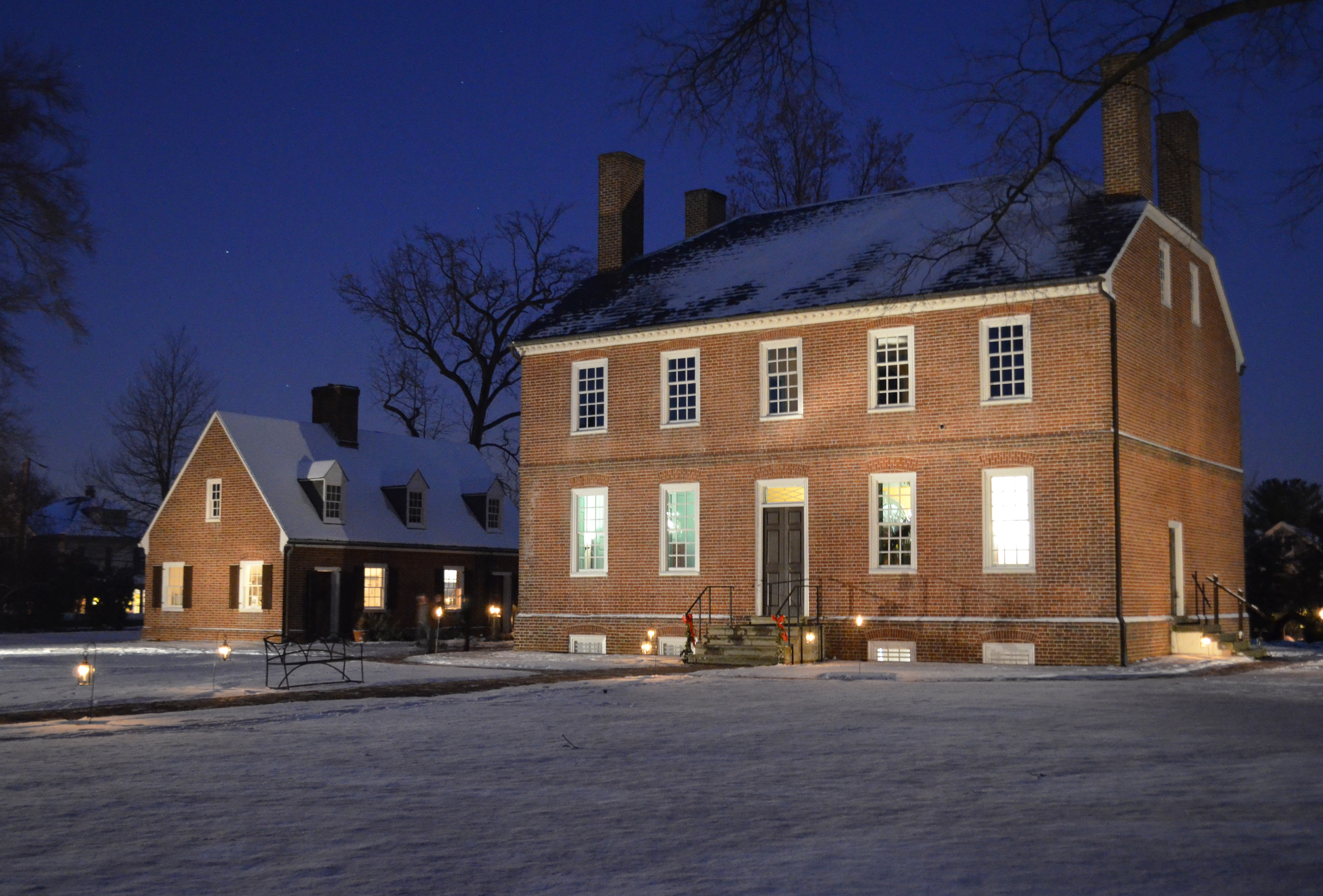
Historic Kenmore on the eve of Twelfth Night. Credit: GWF Photo
Many Christmas and Twelfth Night traditions are rooted in holidays celebrating the winter solstice. For example, Saturnalia, a holiday honoring the Roman god Saturn, took place in mid-December. During Saturnalia, the normal social order was temporarily overturned. Romans closed schools and businesses, held grand feasts, and in some families, a king or “Lord of Misrule” was chosen to rule over the household’s festivities.[1] In Scandinavia, people celebrated the winter solstice during the Nordic festival, Yule. Festivities included bonfires (or yule logs), evergreen decorations, and feasts. It wasn’t until the 4th century that the Roman church officially observed December 25th as Jesus’s birth date. Historians speculate that church officials chose this date precisely because so many popular winter celebrations occurred around that same time.[2]
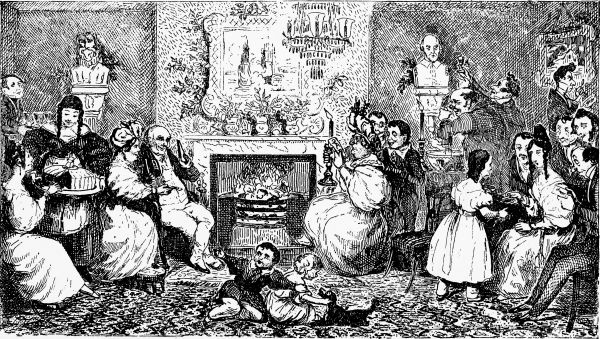
If we fast forward in time, we see how some of these winter rituals were absorbed into the festivities of Twelfth Night. But first- what exactly is Twelfth Night? Typically celebrated on either January 5th or 6th, Twelfth Night, or Epiphany, is a Christian holiday that marks the end of the Twelve Days of Christmas and commemorates the Magi’s visit to Jesus. During the colonial era, the holiday season kicked off on December 25th and culminated on Twelfth Night. The twelve days after Christmas were full of games, music, dancing, feasts, and visiting with family and friends. Families often celebrated the season with a Twelfth Night Cake. Recipes called for a dried bean and pea to be baked into an elaborately decorated fruit filled cake. The man who found the bean was declared King for the night, while the woman who found the pea was declared Queen.
Illustration of a Twelfth Night party by Robert Seymour. The woman on the far left serves pieces of a large Twelfth Cake. Credit: The Project Gutenberg
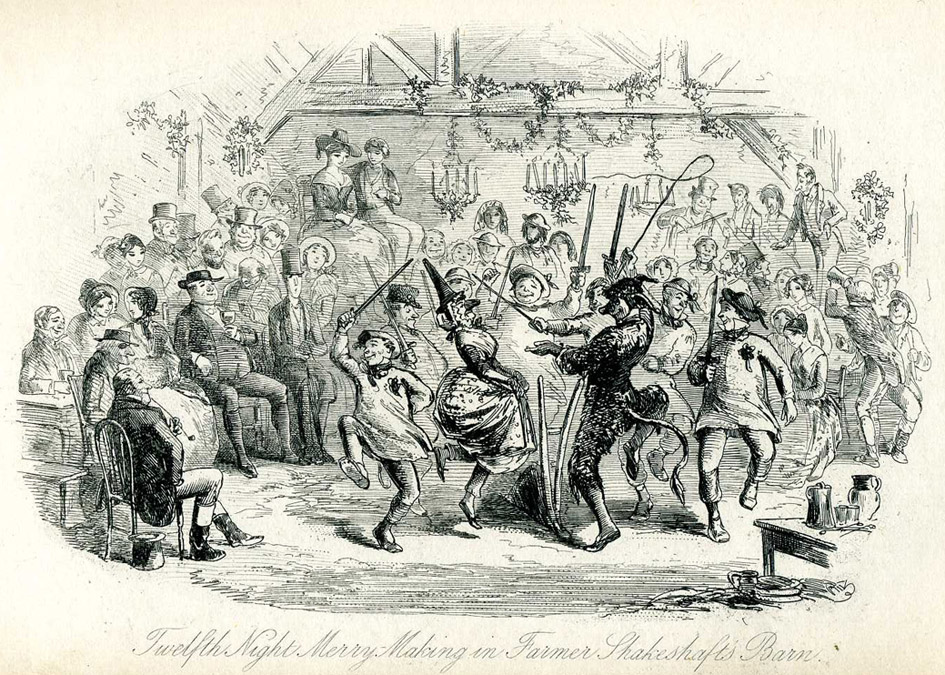
Of course, there has always been debate surrounding how the Christmas season should be celebrated, and practices varied from place to place and person to person. In the 17th century, New England Puritans (echoing sentiments from Cromwellian England) viewed Christmastime celebrations as rowdy, excessive, and downright bacchanalian. Massachusetts went as far as to outlaw celebrations between 1659 and 1691.[3]
The Twelfth Night party’s “King” and “Queen” sit on chairs overlooking the crowd. Dancing, drinking, and mumming (costumed acting) are in full swing. Puritans disapproved of these festive antics.Credit: Wikipedia
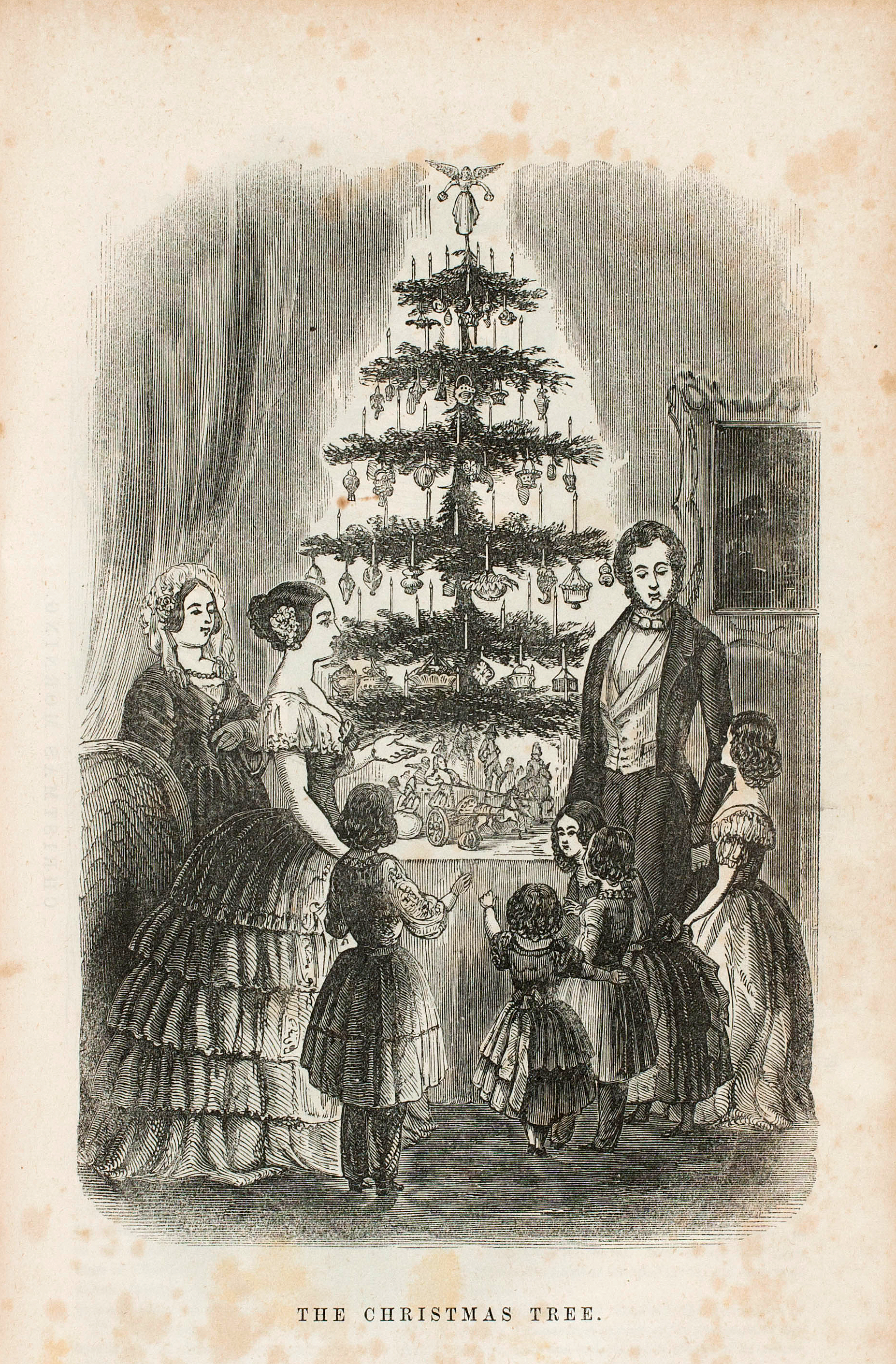
During the 19th century, Queen Victoria influenced a shift in popular opinion towards a more family-focused Christmas season. In 1850, Godey’s Lady’s Book, a popular American magazine, published an image of the royal family gathered around a Christmas tree. While German immigrants had already introduced the Christmas tree tradition to America, this image fascinated the English and American public alike, and it further popularized the practice. In the American version of the print, editors removed Victoria’s tiara and Albert’s royal sash, and the group came to embody the ideal American family at Christmas.[4]
These changing ideals shaped the Christmas season during the Victorian era, and combined with rapid industrialization and commercialization, they sparked the beginning of a number of now familiar traditions. For example, improvements in mass printing technology popularized the practice of sending Christmas cards. In 1843, Charles Dickens published A Christmas Carol, a tale promoting charity, good will, and the virtues of a domestic family Christmas. Thomas Nast, who made popular the modern image of Santa Claus, published his first Santa cartoons in the 1863 edition of Harper’s Weekly.
You might be asking, where then, does this leave the Twelve Days of Christmas and our Twelfth Night celebrations? As we’ve seen, changing ideals during the 19th century promoted a holiday season focused on children and family. Modern industry and commercialization further bolstered shopping and gift giving habits, and a twelve day holiday certainly didn’t fit within the parameters of the new industrialized era. The once twelve day celebration now culminated on one, and it was celebrated with visits from Santa and gifts for children, rather than with feasts and parties for adults.
However, some Twelfth Night traditions live on during the modern Christmas season, albeit under new guises. Between Christmas and New Year’s, people may decorate their homes with greenery, raise a toast with a glass of wassail, or host extravagant parties with family and friends. If you visit New Orleans during the carnival season (beginning with Epiphany and ending on Mardi Gras) you might celebrate by eating “King Cake,” where the lucky person who finds the plastic baby figurine inside their piece of cake is crowned “king” for the day! That sounds a little familiar, doesn’t it?

















_-_Geographicus_-_NewEnglandNewYork-moll-1729.jpg)

.jpg)

#/media/File:Twelfth001.jpg)
