The George Washington Foundation’s curators recently oversaw the hanging of portraits in Historic Kenmore’s Drawing Room. Portraits of Fielding and Betty Lewis painted by John Wollaston as well as of John Lewis and Fielding Lewis, Jr. painted by Charles Willson Peale were returned to the room where they hung originally. In this video showing the installation process, Meghan Budinger, Aldrich Director of Curatorial Operations, also explains the significance of these types of portraits to the Lewis family and the rest of Virginia’s gentry. You can also read more about the portraits and the installation process on “The Rooms at Kenmore” blog at http://kenmore.org/wordpress.
Category: Historic Kenmore
-
Caring for Historic Kenmore: Climate Control
Editor’s Note: The behind-the-scenes tour mentioned at the end of this post and on the video’s end title is sold out.
Today, we’re linking to a behind-the-scenes video on The George Washington Foundation’s YouTube channel. In the video, Heather Baldus, Collections Manager, gives us a tour of Historic Kenmore’s underground heating and cooling system. This geothermal system helps maintain the proper climate inside the mansion and protects all of the furniture and historic objects on display.
You can see more during “Kenmore: Behind-the-Scenes” on Saturday, March 21 when Meghan Budinger, Aldrich Director of Curatorial Operations, gives an extraordinary tour of the mansion, including rare stories and insights into its history, furnishings, and ongoing preservation. Visit the cellar, second floor, attic, and other spaces behind-the-scenes! Admission: $12.00 adults, $6.00 ages 12-17. Reservations required and space is very limited. Please call 540-370-0732 x24 or email [email protected]. Please note: on this tour, participants visit each floor in the mansion, climbing a total of 80 stairs. A few passageways and stairwells are narrow and confined.
-
Snow Days
This year, we’ve not had a particularly photographic snow at George Washington’s Ferry Farm or Historic Kenmore… yet. Snow eventually will come but, until then, we’re sharing some of our best snowy photos from last year and from ten years ago.
 December 2005
 December 2005
 December 2005
 December 2005
 December 2005
 March 2005
 February 2014
 February 2014
 February 2014
 March 2014
 March 2014
 March 2014
 March 2014
 March 2004
 -
Kenmore’s New Beginning: How the Ladies of the Kenmore Association Saved the Lewis Family Home
January and the start of the year are always a time of new beginnings. Recently, while digging through archival material, I came upon an exciting collection of newspaper clippings and photographs that detailed the New Year’s purchase of Kenmore and the beginning of the old home’s transformation into a historic site to be enjoyed by all.
On January 1, 1925 — ninety years ago — a group of well-dressed women in hats and long fur coats assembled at Kenmore to hand over the final $1,000 payment and gain full possession of the house and land. This meeting was the culmination of thirty-two months of persistent work and determination by the ladies of The Kenmore Association to save the historic property from destruction.
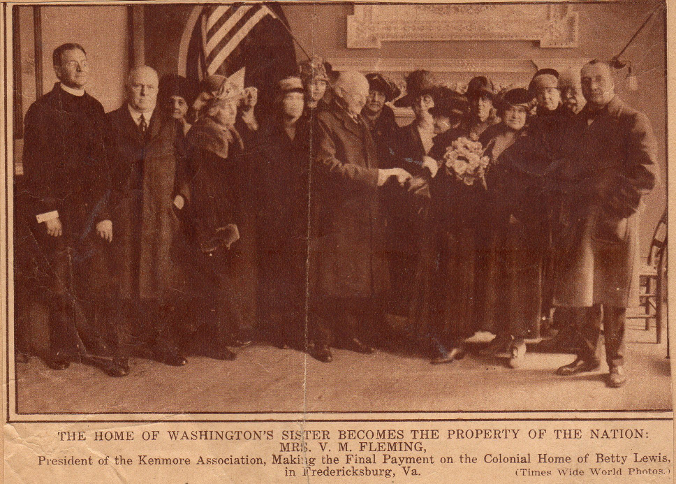
Emily White Fleming (identified in the newspaper caption by her husband Vivian Minor Fleming’s initials) makes the final payment to purchase Historic Kenmore on January 1, 1925. This crusade began four years earlier with a brief notice in the Fredericksburg Daily Star from Mr. E. G. Heflin, the owner of the Kenmore property. The announcement stated: “I have decided to build at once…6 or more modern up-to-date residence [sic] on Kenmore.” Built on a section of the plantation property, these houses prompted concern among many local citizens at the thought of further loss to the historic site.
By 1922, the destruction of the old Lewis home seemed imminent. Mr. Heflin placed an advertisement for the sale of the house itself and cut up much of the original estate into smaller building lots to be sold to developers. If the house was sold, it might be remodel into apartments or just razed to the ground. This escalation increased the alarm even more and some tried to raise funds to purchase Kenmore. This attempt proved unsuccessful and the house did look to be lost. However, salvation appeared in the form of Kate Waller Barrett and the National Society of the Daughters of the American Revolution (DAR).
In March of that year, Mrs. Barrett, Virginia Regent of the DAR, came to Fredericksburg with the purpose of organizing a new chapter in the town. She asked Emily White Fleming to lead the proposed chapter, which would work to save Kenmore. Mrs. Fleming was 68 years old and, though seemingly small and fragile, she, in reality, had a tenacious and determined spirit. She accepted the position and with the help of her daughter Annie Fleming Smith, known as “Miss Annie,” began their campaign to save the old Lewis house from destruction.
The ladies approached Mr. Heflin and negotiated an agreement to the purchase the property. The group had to make a first payment of $10,000 within four months or the deal would be off. Furthermore, if Mr. Heflin got a satisfactory offer within those four months, he could go ahead and sell the property outright. It was a tough deal but the ladies rose to the challenge spectacularly.
Mrs. Fleming and Miss Annie began fundraising immediately. They wrote hundreds of letters by hand, stating facts about Kenmore in simple, forceful style and then making appeals for help. Mrs. Fleming recalled, “I could write thirty-nine letters a day and Annie forty-nine. We never had a typewriter until the campaign was over.” In response to one of Mrs. Fleming’s letters, Colonel Isaac Newton Lewis, maker of the Lewis machine gun and a descendant of Fielding Lewis, contributed the first $1,000. Not to be outdone, The Colonial Dames of America in the State of Virginia gave a substantial donation of a $1,000 as well.
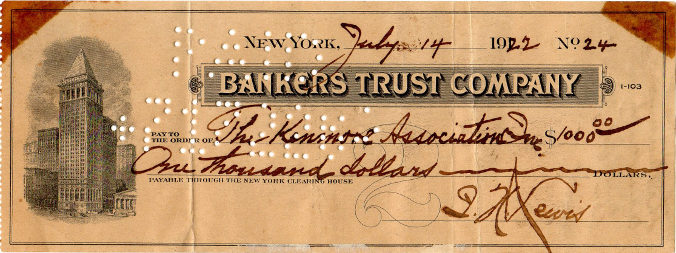
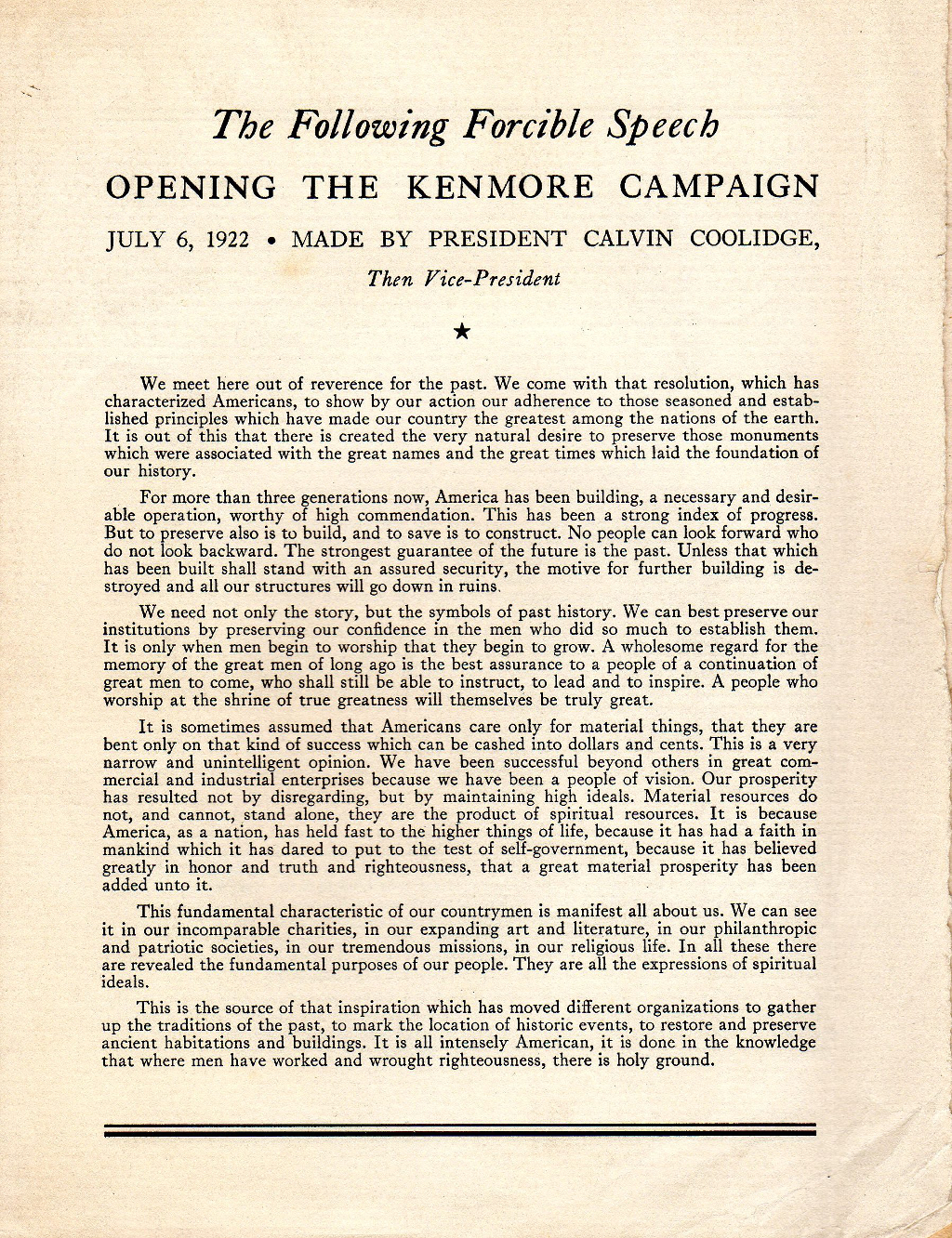
Donation from Colonel Isaac Newton Lewis donated the first $1,000 to the Kenmore Association. In July 1922, the Kenmore Association launched a public fundraising drive with a host of distinguished men and women coming to Fredericksburg for the start of the campaign. Even Calvin Coolidge, then the vice president under Warren G. Harding, made a speech (see below) pleading for patriotic Americans to save this home that was so critical in the history of the country. “It ought to be preserved for its own sake,” Coolidge demanded, “It must be preserved for the sake of patriotic America.”

Speech made by Vice President Calvin Coolidge in support of the Kenmore Association’s effort to save the historic home. Through the efforts of this determined group of women, by the first of September 1922, they were able to pay an initial installment of $12,000 on the account. Impressed with the Kenmore Association’s work, Mr. Heflin made his own gift of $2,000. By New Year’s Day 1925, the hard work paid off and the ladies made the final payment and took possession of the property. Historic Kenmore was saved!
Although the purchase of Kenmore nine decades ago certainly marked a new beginning, transforming the house into a historic site for the public to enjoy required many more years of work. Indeed, in many ways, the work begun by Mrs. Fleming, Miss Annie, and the Kenmore Association continues even as 2015 begins. In the new year at Kenmore, we will focus on refurnishing Fielding’s office and will soon hang portraits of Fielding Lewis, Betty Washington Lewis, and other family members in the Drawing Room. You can follow the year’s work here on the “Lives & Legacies” blog and on “The Rooms at Kenmore” blog, which is solely dedicated to the refurnishing project, at www.kenmore.org/wordpress. Like 1925, the year 2015 should prove to be an exciting beginning!
Heather Baldus
Collections Manager -
Photos: “Twelfth Night at Kenmore”
Today – January 6 – marks the end of Christmas or, at least, it did two centuries ago. If we lived in the days of George Washington, Betty Washington Lewis, and Fielding Lewis and moved within their social circle, we would all be preparing for the grandest celebration of the Twelve Days of Christmas, which began on December 25. This grand event, known as Twelfth Night, was celebrated much in the same way that many of us mark New Year’s Eve with family and friends gathered together for food, drink, sweets, music, dancing, games, and conversation.
This past weekend, Historic Kenmore hosted just such a celebration in the form of a theatrical presentation titled “Twelfth Night at Kenmore.” Set in January 1776, as Fielding and Betty Washington Lewis end their first Christmas in their newly built home, “Twelfth Night at Kenmore” depicted an unusual seasonal celebration, as the growing American Revolution brings fear, doubt, and frustration to the Lewis family, their friends, and members of the enslaved community.
 Kenmore is lit for the celebration.
 Betty Washington Lewis (Amy Wolf) and daughter-in-law Nancy Alexander Lewis (Juliana Jones) ponder how the war might impact the family.
 Betty welcomes her guests.
 Guests listen to Betty’s welcome.
 (l-r) John Lewis (Michael Taylor) and George Lewis (Will Goldstein), two of Fielding Lewis’s sons, are joined by Captain Richard Taylor (Scott Houk) , a local ship’s master, in the singing of a traditional carol.
 Visitors, some who came dressed in colonial-era clothing, join in the singing.
 Fielding Lewis (John Hollinger) leads the singing.
 Our excellent musicians for the evening: Zach, Kelsey, Kaylee, and Luke Payne.
 George Weedon, a leading Fredericksburg patriot and tavernkeeper.
 Captain Taylor and George Weedon argue about the wisdom of suspending horse racing because of the war.
 The men continue debating.
 George Lewis (Will Goldstein) expresses his desire to enlist in the Continental Army.
 Captain Taylor, John Lewis, and George Lewis play cards while discussing George’s desire to enlist.
 Hetty (Ashlee’ James), an enslaved washerwoman and house servant for the Lewises, overheard party guests talking about Lord Dunmore’s offer of freedom to slaves and wonders if she ought to run away to the British side.
 The “Twelfth Night” cast.
-
Historical Holiday Cheer
In the colonial-era, the Christmas season lasted into January and concluded on Twelfth Night, a festive evening to mark the end of the Twelve Days of Christmas and celebrated much like our New Year’s Eve is today. While the entire period featured frequent banquets and balls with much food and spirits, Twelfth Night was especially known for its revelry.
Just as we do today, many colonial Americans got into the holiday ‘spirit’ with a glass of something special and warming on Twelfth Night. Special drinks called for distinctive mugs, glasses, and containers that were both functional and designed to impress your party guests. In these containers, early Americans enjoyed familiar festive beverages like eggnog, hot chocolate, hot toddies, and punch. At the same time, some of their holiday drinks are now a thing of the past or perhaps only enjoyed by those imbibers with an appreciation for history.
Many of these holiday beverages were created out of a desire to preserve the taste of fresh fruits harvested in the summer and fall so they could be enjoyed during the winter months. Cherry ‘Bounce’ is a great example of this – in addition to being fun to say! Easy to make, cherry bounce was started in the early summer when the fruit is ripe. Fresh cherries (traditionally of the sour variety) were placed in bottles and topped off with brandy then stored for as long as you could stand to wait. Leaving the fruit to infuse as long as possible increased the flavor and lent a lovely red color to the brandy. The decanted off-flavored brandy was mixed with sugar and spices. Martha Washington possessed a recipe for cherry bounce that included cloves, cinnamon and nutmeg and George Washington was said to have loved it so much that he took some in a canteen with him on a trip over the Allegheny Mountains in 1784.
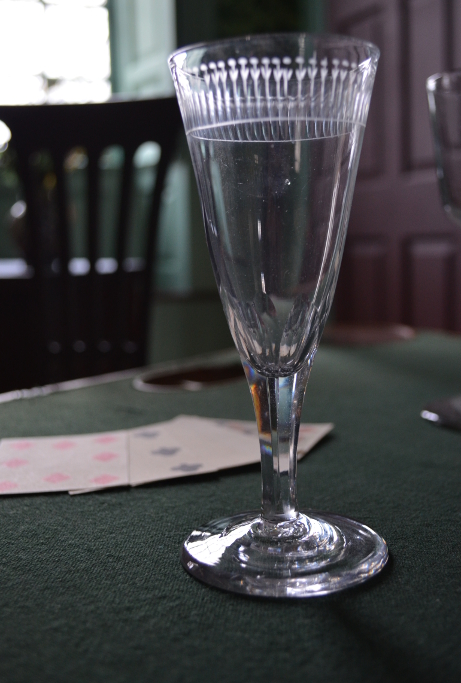
Copper wheel engraved wine glass. Syllabub is another colonial beverage that has been forgotten. Originating in England, this odd-sounding half-dessert, half-cocktail, was created by combining spirts such as wine, sherry, ale or cider with fresh milk – preferably so fresh that it had just come out of the cow and was still warm! In fact, some recipes stated that a maid should milk the cow directly into a pan of your chosen spirit. Unfortunately, this technique probably also resulted in some ‘barn yard’ material ending up in the concoction. Sugar, spices and possibly citrus were then added. While there are many versions of syllabubs, it often involved a frothy mixture of whipped egg whites, curd or cream that can be spooned off and eaten while you drink the liquid whey that separates beneath. Served in a conical glass and sometimes displayed on a pyramid-shaped dessert tray with colorful jellies, syllabub made for a very festive holiday drink.
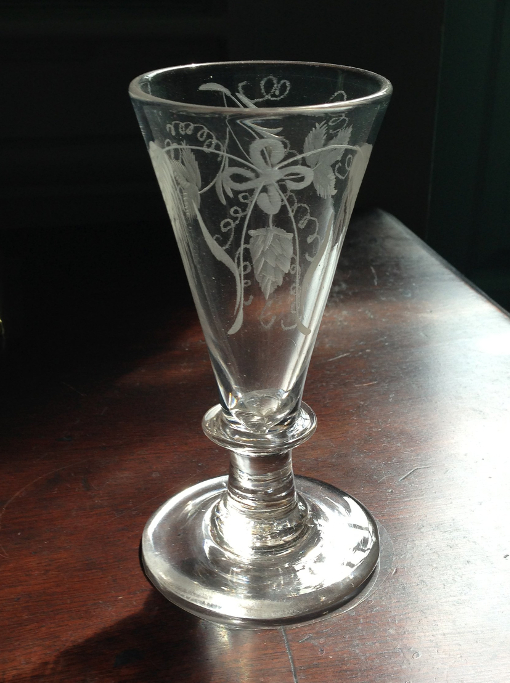
A Copper Wheel engraved dessert/fortified wine glass used to serve syllabub. While many people may not have heard of syllabub and cherry bounce, wassail is a term that most are familiar with even if they’re not entirely sure what it is. Actually, wassail was both a beverage and an activity. Similar to today’s mulled ciders and wine, wassail was often served from a punch bowl passed around from person to person in an act of sharing and celebration. The old Christmas carol “Here We Come A-Wassailing” describes the act of going from house to house singing and wishing good cheer while also sipping the punch-like drink composed of hot wine or ale mixed with spices, apples and sometimes topped with bread or toast. But before you condemn our ancestors for drinking odd things, just think what future generations might think of what we consume today. And perhaps try a colonial holiday beverage or two this Twelfth Night and evoke the spirit of holidays past!
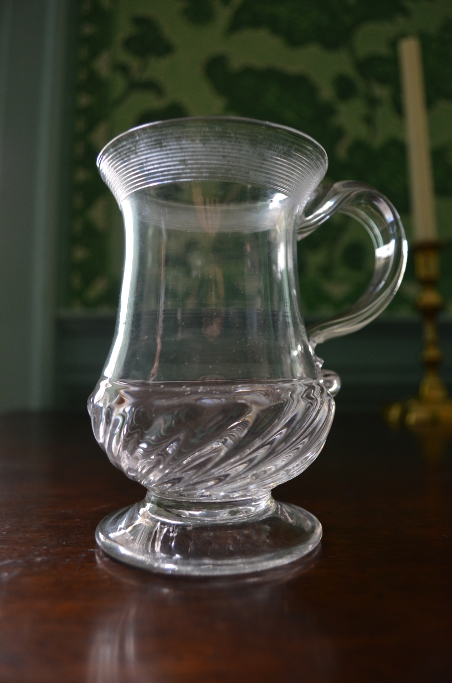
Hand-blown mug for hot beverages such as wassail. You can experience a dramatic theater presentation depicting a Twelfth Night celebration (minus the alcohol) at Historic Kenmore on Saturday, January 3 or Sunday, January 4. Reservations are required and can be made by calling 540-370-0732 x24 or emailing [email protected]. Visit the events page on http://www.kenmore.org for more information!
Mara Kaktins
Archaeologist, Ceramics and Glass Specialist -
The Whimsical Worlds of Kenmore’s “A Wee Christmas”
This year is our first-ever “A Wee Christmas — Dollhouses and Miniatures Show” at Historic Kenmore! “A Wee Christmas” has brought together many different dollhouses, miniature scenes, and figurines loaned by friends, neighbors, and staff for visitors to Kenmore Plantation to enjoy. The highly detailed, replica dollhouse of Kenmore on display in our Crowninshield Museum inspired this new holiday event. You can read a blog post about the history of the Kenmore dollhouse here.
The photos in the gallery below show several of the whimsical dollhouses and miniatures on display. To enjoy all of them up close, visit Historic Kenmore before the exhibit ends on December 30. Check out the events page on http://www.kenmore.org for more information!
 “Country Church.” Submitted by James Opher.
 A glimpse through the church’s front door.
 Inside the country church.
 “Antique Dollhouse.” Submitted by Susan Larson.
 Susan bought her dollhouse during a visit to Fredericksburg, not knowning that she would soon move to the city.
 “The Apple Blossom.” Submitted by David Budinger.
 David built the house for his daughter, Meg (now Kenmore’s curator) around 1990.
 Christmas tree inside “The Apple Blossom.”
 “Plantation House.” Submitted by James Opher.
 It was built in 1975…
 …and renovated in 2014.
 Inside the “Plantation House.”
 “Bonaise” Submitted by Lucy Harmon.
 “Bonaise” is a replica of the Harmons’ old farmhouse on White Oak Road in Stafford County.
 Scene from “The Nutcracker.” Submitted by Anne Higgins.
 “Victorian Dollhouse.” Submitted by Beth Waters Hunsinger & son Jackson Waters Hunley.
 Santa gave Beth this house when she was about 9 years old.
 Now, her son Jackson enjoys rearranging the furniture inside.
 Interior of “Rammings’ House.” Submitted by Anna Jennings.
 Made by Michael & Gloria Ramming in 1985, the house is a miniature of their home and furnishings in San Francisco, California.
 “The Quilt Shop.” Submitted by Carol House.
 The shop was featured in the Miniature Quilts magazine.

-
‘A Wee Christmas’ Display Inspired by a ‘Wee’ Kenmore
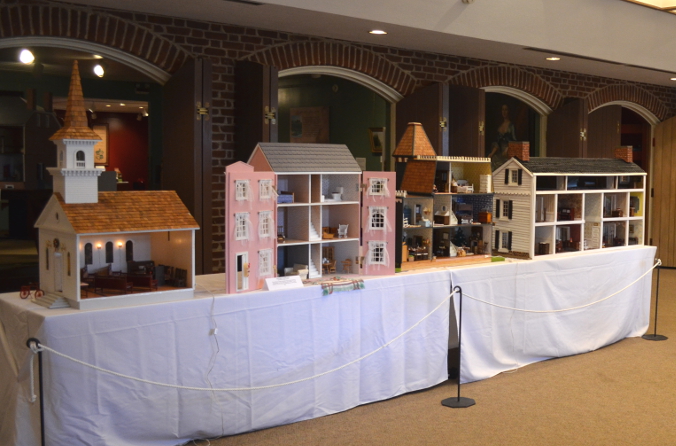
Dollhouses on display as part of our first-ever “A Wee Christmas” Dollhouses & Miniatures Show. This holiday season, we’re excited to share with our visitors the many dollhouses and miniatures loaned by friends, neighbors, and staff to form our first-ever dollhouses and miniatures show that we’re calling “A Wee Christmas at Historic Kenmore”. A highly detailed, replica dollhouse of Kenmore on display in our Crowninshield Museum served as the inspiration behind this new exhibit. Like its real life counterpart, this unique Kenmore replica has a fascinating history all its own.
While on a visit to Fredericksburg in the spring of 1984, Florence White, an enthusiast of Georgian architecture, fell in love with Kenmore. She had been searching for years to find just the right place to make into a grand historical dollhouse. Kenmore with its simple, symmetric windows and imposing brick walls was perfect.
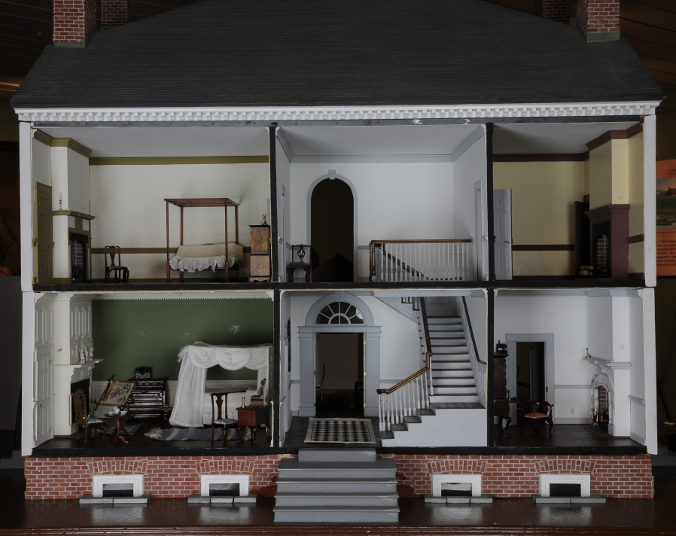
The dollhouse version of Historic Kenmore. However, Florence needed someone who would construct this dollhouse with the degree of detail and intricacy that would mimic the elegant original. After a long unsuccessful search there came a chance meeting with Jim Freytag, a retired railroad man turned miniature enthusiast, and she knew she had her builder.
Jim’s first task was to visit the home that Florence wanted to replicate and gather as many details as he could. He wanted to make it as structurally authentic as possible from the number of bricks between the windows to the outside steps worn down with years of use. He toured the house taking notes on the particulars of each room, the furniture, the décor, and the layout. Photographs were not permitted inside the house so Jim purchased postcards in order to get better detail for the intricate plaster ceilings and mantels.
Some 2700 hours of work, 18,929 bricks and over $4000 later Florence had her Kenmore dollhouse. Jim had completed four bedrooms, a dining room, living room, drawing room, and study. They are each equipped with miniature pieces of furniture from a large cherry-stained Queen Anne table in the dining room flanked by two portraits of Colonel Lewis and Mrs. Lewis to canopy beds, brass candlesticks and leather boots in the bedrooms.
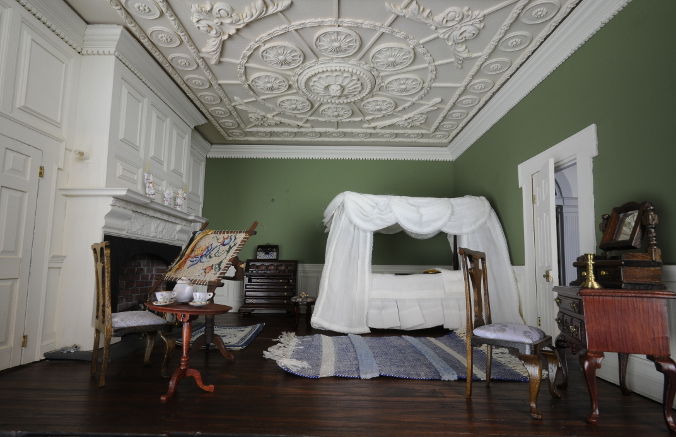
A view of the Chamber inside the Kenmore dollhouse. Over twenty-six years later, the dollhouse now sits in the museum gallery at Kenmore’s visitor center for all to view. Each room still has the exact furnishings so painfully and meticulously created by Jim and positioned to Florence’s specifications. The house is a time capsule which shows Kenmore before renovations completed nearly a decade ago. Visitors can see pieces of furniture that are no longer on display and can understand the dimensions of the upper floor rooms which are not currently open to the public.
Florence’s devotion to detail and Jim’s immense skill leave us with a whimsical model of Kenmore which exudes all the elegance and beauty of the original that would have made the Colonel and Betty proud.
You can see Florence and Jim’s replica of Kenmore as well as all the other wonderful dollhouses and miniatures that make up “A Wee Christmas at Historic Kenmore” until December 30.
Heather Baldus
Collections Manager -
A Kenmore Christmas
Historic Kenmore is decorated for the holidays, portraying what it may have looked like during the Christmas season of 1775. At that time, the Lewis family would have just moved into Kenmore a couple of months earlier, and it would have been their first Christmas in the new house. It was a time of some sadness, as well – their 15 year old son Charles had died that fall, of an unidentified illness. Although unknown at the time, it also would be the last “normal” holiday before the Revolution began in earnest.
The photos in the gallery below provide a glimpse of some traditional holiday decorations (a few have modern twists) and customs common to the 1700s.
Want to see Historic Kenmore in all of its holiday splendor? Seasonal tours are offered daily through December (Closed Christmas Eve, Christmas Day, and New Year’s Eve). Or reserve a spot for our dramatic theater presentation that re-creates a Twelfth Night celebration inside the house on Saturday, January 3 and Sunday, January 4 . See the events page on www.kenmore.org for more information!
 A wreath adorns Kenmore’s front gate.
 Kenmore peaks through the center of a wreath.
 A wreath on the door of an administrative building.
 Kenmore’s garden volunteers created the amazing wreaths and swags hanging on our buildings this year.
 A wreath on the door of an administrative building.
 A close-up view of a wreath.
 The garden gate.
 The west front of Kenmore.
 Festive doors.
 Magnolia in an evergreen swag.
 Inside of Kenmore, we bring out greenery to decorate the banister in the Passage.
 Curatorial staff attach the greenery to the banister.
 In the 1700s, evergreens and local plant material, like boxwood, magnolia and holly would be brought into the house, but in small quantities.
 Colonial-era decorations were quite subdued.
 Branches of pine or holly would be placed in clay jars and set on tables or mantels.
 In the Passage, we re-create a dessert table Betty Lewis might have created to impress her holiday guests.
 We carefully unwrap jelly glasses to be displayed on the table.
 The table features plum pudding, miniature marzipan fruits, candied citrus, and syllabubs.
 The desserts served as the centerpiece of a Twelfth Night ball.
 The Christmas season lasted much longer than ours does, extending into January to Twelfth Night (a festive night marking the end of the Twelve Days of Christmas and celebrated much like New Year’s Eve is today).
 During the ball, usually around midnight, guests were treated to the unveiling of the elaborate dessert table…
 …filled to overflowing with sweets and confections arranged in imaginative ways and displayed on the best silver and glassware.
 There is also a hedgehog cake, a favorite of Martha Washington’s at Mount Vernon.
 The lady of the house would be severely judged on the creativity of her dessert table.
 Among this year’s decorations are five tiny foxes, part of scavenger hunt for our younger visitors.
 Fox hunts were a popular holiday custom with colonial Virginians and were much-loved by George Washington.
 The completed decorations in the Passage.
 Looking down into the Passage from above.
 Holiday swags with modern lights on Kenmore’s doors.


 Brightly lit on a dark December night.