Lives and Legacies

Category: Historic Kenmore

  • History’s Paper Trail: What Handwriting & Spelling Reveal about Early America

    One of the aspects of a historian’s job is dealing with primary sources, the paper trail of history.  The archives here at The George Washington Foundation contain primary sources that include letters, wills, land grants, court orders, military orders, bills and receipts.  These hand-written documents are largely related to the Fielding and Betty Lewis family and provide us with a wealth of information on all facets of their lives from how much rum they bought to how much they paid in yearly taxes.  At the same time, they and other written historical records provide a glimpse into some fascinating dynamics of early American society and culture.

    However, sometimes these documents can be difficult to read because, in the 18th century, writing style and spelling were still not completely standardized.

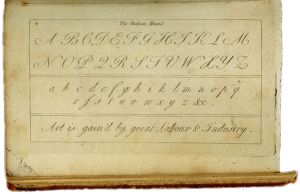
    Students in early America usually learned to write by copying different styles of writing known as ‘hands’ in a copybook that showed alphabets and phrases in the ‘hand’ to be learned.  Students copied the alphabets and phrases exactly, for practice and for reference, and business forms.  For example, while attending school in Fredericksburg, young George Washington copied The Rules of Civility and Decent Behavior to learn handwriting as well as proper behavior in polite society.

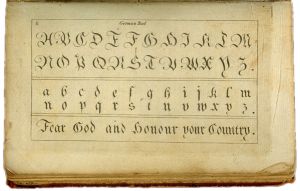
    Above: Examples of ‘hands’ (Flourishing Alphabet, Italian Hand, German Text, Round Hand) from The Instructor, or American Young Man’s Best Companion Containing Spelling, Reading, Writing, and Arithmetick by George Fisher and published by Isaiah Thomas, Worcester, 1786

    In the 1700s, writing was a skill reserved for select groups of people, mainly professionals and upper class males.  Women, artisans, lower classes, and the enslaved were not formally taught handwriting because it was viewed as unnecessary to their everyday life.  A lack of formal education did not stop people from writing.  Instead, they just developed their own system of penmanship and style.

    Spelling

    Colonial-era writers could choose from a number of dictionaries to assist with spelling.  Many of these books, however, focused only on difficult, obscure, or archaic words.  It wasn’t until 1755 that Samuel Johnson published the influential A Dictionary of the English Language, which offered a more comprehensive lexicon of contemporary English of the time.  By the colonial period, much English spelling was recognizably modern due to the beginning movements of standardization in education and print. Dictionaries also assisted in the development of a more uniform writing style.

    What if you had not been to school or had never seen a dictionary?  Well, you simply spelled a word the best you could by sounding it out phonetically.  So, ‘school’ became ‘skool’ or ‘laugh’ became ‘laff.’ A word might be spelled a dozen different ways by a dozen different people.  When read aloud, these words sound fine but, when silently reading a primary source document, the written phonetic spelling can take a few seconds to process.
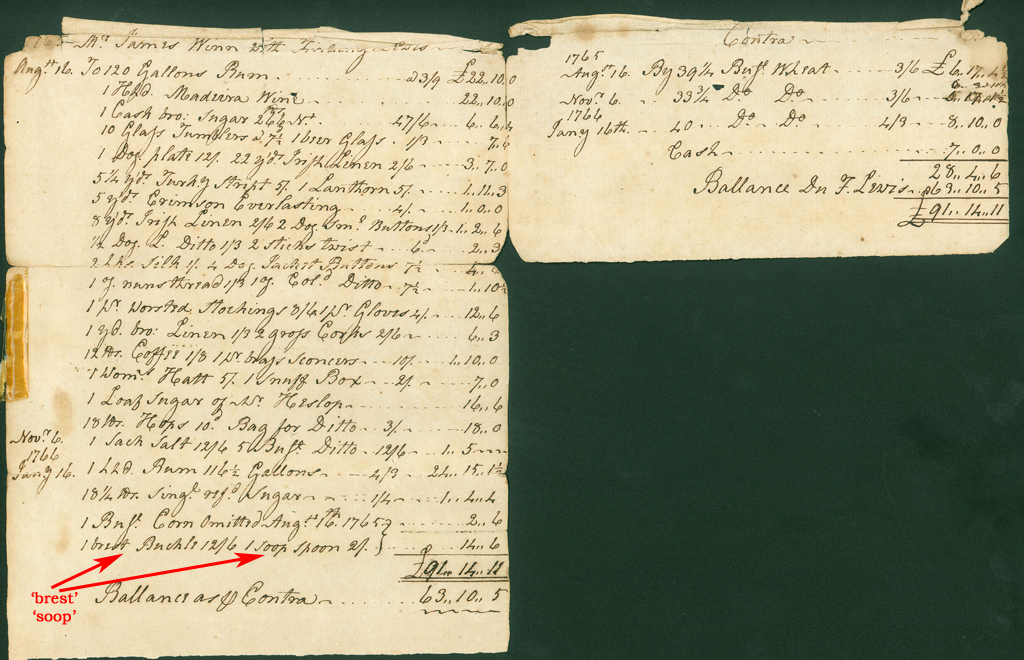
    An account statement from 1766 between James Winn and Fielding Lewis that includes two examples of phonetic spelling: “brest” buckle and “soop” spoon.

    The Long ‘s’

    The long ‘s’ was a style of spelling that generally fell out of use in print by the end of the 18th century.  It persisted in handwriting until the mid-19th century.  The long ‘s’ was an elongated version of a lowercase ‘s’.  It was often seen at the beginning of a word, in the middle of a word, and in words containing a double ‘s’.   A notable example is the spelling of Congress in the Bill of Rights.

    Understandably, when we read primary sources today, the long ‘s’ is often mistaken for an ‘f’ or ‘p’ and it takes some practice to get the context of what is being said.

    The word ‘Witnes’ in this document includes an excellent example of the long ‘s’ in the word and it’s close resemblance to an ‘f.’  This is a bond dated 14 September 1747 that requires George Lewis, who lives in Frederick County, to pay 3 pounds of Pennsylvania Currency to Charles Dunnahie by 1 May 1749.

    Abbreviations/Subscript

    Abbreviations and subscript often come up in colonial-era handwritten documents, particularly on bills, invoices and receipts. Shortening words or phrases like can’t for cannot or asap for as soon as possible is something we are familiar with today.  Commonly, abbreviations in the 18th century were indicated by beginning the word in regular-sized letters and ending with superscript letters like Recd for received.  Superscript or subscript letters are most frequently seen today in chemical compounds (H₂O) or in mathematical expressions.
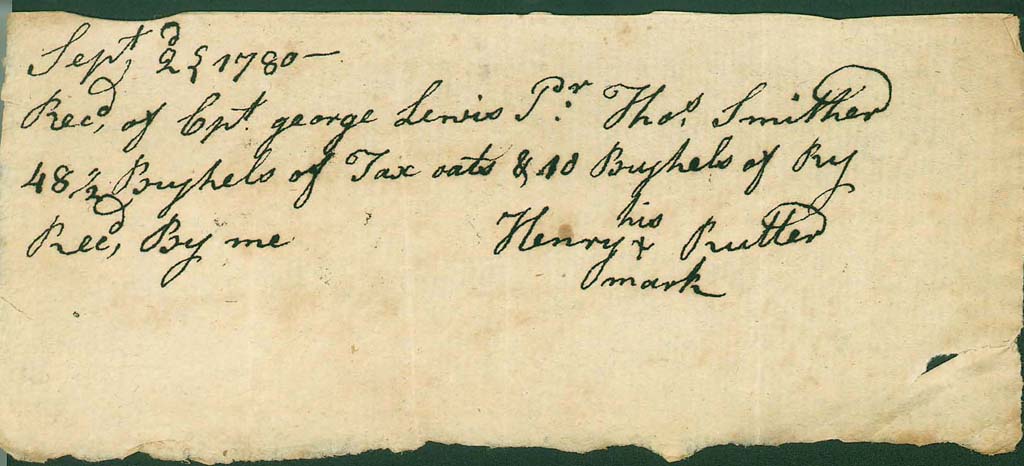
    This receipt, dated 25 September 1780, from Henry Rutter to George Lewis for 48 1/2 bushels of tax oats and 40 Bushels of Rye from George Lewis per Thomas Smither.  The “Recd” at the beginning of the receipt is an excellent example of both an abbreviation and superscript.

    All the quirks in 18th century writing present many challenges for the historian.  Creating a system of deciphering can take time and plenty of practice.  At times, it can be more than a little frustrating.  Once the documents’ particular meanings are deciphered, the writing itself can reveal many different dynamics about early American society and culture.

    One of the biggest of these dynamics is that very few people received enough education to develop a professional level of literacy.  Professional level of literacy, at the time, would mean having enough skill to conduct business.  Such a level was reserved, usually, for white middle to upper class males.

    Selective education provided a powerful form of social control and a framework for society to judge and instantly understand a person’s social status, education, and occupation.  At this time, it was not thought important for women, slaves, or the lower classes to know how to write.  Some even thought that teaching these groups to write would encourage them to aspire above their allotted station in life.  Writing gives people the freedom to express themselves and their ideas in a concrete way which can easily be transmitted to others, an uncomfortable prospect for a society based on a selective hierarchy.

    Though a woman, George Washington’s mother Mary Ball Washington could write.  Her spelling was extremely phonetic as seen in this letter transcription and reflects a lack of formal schooling but not necessarily a lack of intelligence as some historians have argued.  Indeed, primary sources like Mary’s letters supported by “new archaeological data has yielded a decidedly more complex picture of this influential matron than is possible using the historical record alone.” Laura Galke, an archaeologist here at The George Washington Foundation, argues (PDF) that artifacts discovered at George Washington’s boyhood home at Ferry Farm demonstrate that Mary “enjoyed the personal agency that widowhood allowed her; she was responsible for the management decisions of the Washington household and the surrounding farm. Mary’s choices reflect an ambitious woman determined to participate in the genteel society her family had enjoyed before Augustine’s death.”  This required much intelligence.

    Interestingly, Mary’s daughter Betty Washington Lewis also knew how to write.  Mary ensured Betty knew how to run a household and keep in touch with family, which numerous letters written by Betty show she did effectively.

    Betty Washington Lewis
    Portrait of Betty Washington Lewis painted by John Wollaston in the 1750s

    Her phonetic spelling in this letter transcription is an improvement over her mother’s.  The improvement in Betty’s spelling when compared to Mary’s further illustrates the increasing standardization during the 18th century and can also be seen as an example of changing beliefs in education for women at the end of the 1700s.  A movement was growing late in the century to teach writing to women.  This movement, however, did not come from a revolutionary drive for equality but, rather, from an expanded idea regarding the duties of Motherhood.  If women could not read and write, it was thought, how would they teach their sons, the future generation of leaders, to do the same?

    Though difficult, at times, to decipher, the simple act of writing gives us a glimpse into the minds of people who thought about and experienced a life quite different from ours.

    Heather Baldus
    Collections Manager

  • Celebrate!

    A quick post today because everyone here at The George Washington Foundation are busily preparing for The Fourth of July at Ferry Farm this Saturday!

    Still, we did have a bit of time to take a quick look through the archives for some images of celebrations in Fredericksburg’s past.  First, we share a few 90-year-old newspaper clippings about the “Colonial Pageant” held in May 1925 to dedicate Kenmore as a historic house museum.  You can read more about efforts in the 1920s to save the house here.

    We also found snapshots of some fascinating floats that formed part of a parade to celebrate the 250th anniversary of the founding of Fredericksburg back in 1921.  Unfortunately, we do not yet know all that much about the organizations or groups that made these floats or who is in these photos.  Regardless, it’s interesting to see that float-building traditions haven’t changed terribly much since the Jazz Age.

    This year, we hope you will Celebrate Independence Day with us at the place where George Washington spent his boyhood years. Our theme – “Let Freedom Ring” – honors home and country with a variety of activities and entertainment for the entire family.

    FF4TH
    Members of the Fredericksburg Spinners and Weavers Guild help a young visitor learn to spin thread during The Fourth of July at Ferry Farm in 2014.

    From 10:00 a.m. to 5:00 p.m. on Saturday, you can visit the Washington house archaeology site and learn about Phase 1 construction at Ferry Farm, enjoy a patriotic flag retirement ceremony, interact with colonial and Civil War re-enactors, visit with members of the Patawomeck tribe, and participate in educational programs, crafts and games, and hands-on activities for the whole family, including a July Fourth hat contest!  Learn more about Ferry Farm’s Independence Day celebration at http://kenmore.org/events.html.

    Heather Baldus
    Collections Manager

    Zac Cunningham
    Manager of Educational Programs

  • ‘King Lear’ in Washington’s Day – Part 2

    King Lear is known far and wide as William Shakespeare’s finest tragedy but it has not always been the preferred version of the story. In part one, we saw how Shakespeare popularized the old story of King Lear by crafting a story aimed directly at Elizabethan audiences experiencing great political upheaval. In part two, we see how Shakespeare’s Lear changed to reflect the life and times of Restoration England and, ultimately, George Washington’s America.

    Not long after the first printing of Shakespeare’s King Lear, the English Civil War brought a temporary end to the monarchy and closed theatres, in part, to prevent civil disorder at public gatherings. Soon, however, laws specifically targeting theatres followed as an outgrowth of Puritanical notions that saw playhouse as dens of vice, sin, and extravagance.

    Playhouses’ disfavor ended in 1660 when the Restoration returned King Charles II from his exile in France and placed him on the throne as his father’s successor.  Charles’s return sparked new style of theatre that boasted elegant costumes, fanciful farces, happy endings, and, for the first time in England, women on the stage! It should be no surprise that with a new king and new type of theatre, a new Lear was sure to follow.

    Enter Nahum Tate, the son of a Puritan Irish clergyman and a playwright, whose adaptation of King Lear reflected his loyalty to the crown and the Restoration’s jubilance over the monarchy’s return. The History of King Lear debuted in 1682 and brought a new take to the age-old tale. Tate felt Shakespeare’s original was “a Heap of Jewels, unstrung and unpolisht” and needed modernizing. He gave King Lear his own restoration back, removed the questioning and criticizing fool, and added a romance between Cordelia, Lear’s daughter and true heir, and Edgar, Gloucester’s son and true heir.  Tate even gave Gloucester a line clearly referring to Charles’s Restoration: “Conduct me to his Knees to hail; His second Birth of Empire; my dear Edgar; Has, with himself, reveal’d the King’s blest Restauration [sic.]”

    For the next 150 years, actors performed and audiences lauded Tate’s version. Not only was the happier ending preferred but Shakespeare’s work was considered like any other Elizabethan playwrights’ work, free to be changed and augmented.

    Cover of Tate’s “The History of King Lear,” first performed 1862. Public domain.

    Tate’s Lear was not without criticism, of course. In 1711, Joseph Addison, author of Cato (George Washington’s favorite play) lauded Shakespeare’s ability to enact poetical justice and felt that Tate’s version “had lost half its beauty,” by allowing the good to triumph. To a certain extent, Samuel Johnson agreed writing in 1765 that “The Tragedy of King Lear is deservedly celebrated among the dramas of Shakespeare” even though he found Cordelia’s death so sad and tragic that “I know not whether I ever endured to read again the last scenes of the play.” While Johnson appreciated the Bard’s tragedy, he still preferred a lighter Lear.

    David Garrick, a star of the 18th century stage, led a movement to immortalize Shakespeare as England’s national poet. He wrote a poetic eulogy about the Bard’s work at the first-ever Shakespeare festival.  Surely he would prefer Shakespeare’s original text? Not quite. When Garrick staged the play and starred as a King Lear in 1756, he restored a good portion of Shakespeare’s original text but also kept Tate’s happy ending and the Cordelia/Edgar romance.

    George Washington, Fielding Lewis, and other 18th century colonial Americans would have known Tate’s happier version of King Lear.  American audiences would have to wait to see Tate’s version until after 1752 when the first professional actors arrived in the colonies from London. The first instance of King Lear being performed in any of the colonies comes in 1754 with a performance by Lewis Hallam’s London Company of Comedians in New York. Because so few playbills from the era have survived, this instance might not be the first time the company performed it in the colonies, but it was most certainly not the last.

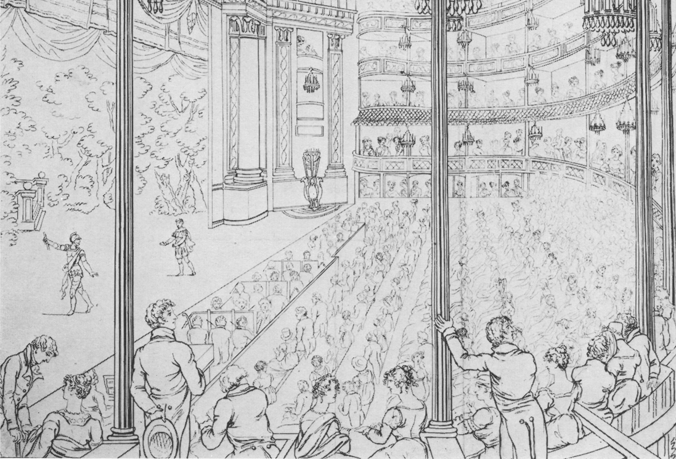
    This sketch of the Theatre Royal, Drury Lane, London in 1813 — not long after it opened — gives an idea of how one of the world’s finest theaters appeared in the early 19th century. Colonial America’s theaters would not have been this elaborate. Indeed, many traveling acting companies like those that occasionally performed in Fredericksburg performed wherever they could.  Performances usually took place in taverns but sometimes even in barns. Public domain.

    Washington loved theatre and attended the playhouse frequently throughout his life. While Cato was his favorite play, he attended the theater whenever he could. One of the first plays he ever sees is right here in Fredericksburg. Indeed, on June 2, 1752, nineteen-year-old Washington wrote in his diary that he and his brother paid for admission to an evening of theatre. The amateur company that probably performed that evening would have most likely not have attempted a performance of Lear. Later in his life, Washington saw the London Company of Comedians by then renamed the American Company of Comedians many times including during a season in Williamsburg where Nahum Tate’s King Lear was part of their repertoire.  In fact, this company of actors performed in Williamsburg during the fall of 1771. Washington and Thomas Jefferson both attended several nights in a row and the company presented Lear on November 12, 1771. We don’t know if Washington and Jefferson attended on that particular evening or if one of the other evenings also featured a performance of Lear.

    Shakespeare’s Lear would have to wait until the next century to be fully restored. In 1838, William Charles Macready finally would restore Shakespeare’s text entirely, nixing the love story, bringing back the fool, and allowing Cordelia and Lear’s deaths to conclude the play.

    Joe Ziarko
    Manager of Interpretation & Visitor Services

    See Shakespeare’s King Lear during Historic Kenmore’s Shakespeare on the Lawn. This weekend’s performances at 7:00 p.m. on Saturday or again at 7:00 p.m. on Sunday are the last chance to see the Bard’s popular, yet heartbreaking tragedy, at Kenmore this summer.  Event details can be found at http://kenmore.org/events.html.  See more photos from last weekend’s performances here.

    King Lear (Marcus Salley - center) decides to divide his kingdom among his three daughters but demands they declare how much they love him first. Goneril (Corinn Keene - far left) makes her disingenuous declaration.
    King Lear (Marcus Salley – center) decides to divide his kingdom among his three daughters but demands they declare how much they love him first. Goneril (Corinn Keene – far left) makes her disingenuous declaration.
  • Photos: “King Lear” at Kenmore’s Shakespeare on the Lawn

    Shakespeare on the Lawn returned to Historic Kenmore this past weekend with the first two performances of King Lear.  Below are photos from the shows.  Don’t worry if you missed this past weekend’s performances because there are two more shows this coming Saturday, June 20 and Sunday, June 21.  For event details, visit http://kenmore.org/events.html.

  • Meet the Lewis Family: Lawrence Lewis

    Lawrence Lewis

    Lawrence Lewis was born on April 4, 1767, the ninth child of Fielding and Betty Lewis and nephew of George Washington.  His birth was noted by Fielding in the Lewis family bible,

    “Our Ninth a Son named Lawrence born the 4th of April 1767.  Mr. Chas Washington & Mr. Francis Thornton Godfather & Mrs. Mary Dick Godmother”[1]

    Just as the American Revolution started, Lawrence moved into Kenmore with his parents and siblings when he was eight years old.  Sadly, the move to the new house began a devastating chapter for the family that saw the loss of their financial security and, ultimately, of their patriarch.  Lawrence witnessed the toll that financing and supporting the War for Independence exacted on his father.  For the Patriot cause, Fielding provided much needed supplies to the army, bought and built ships for the navy, and funded a musket factory with his own money.  After all these sacrifices, Fielding died in 1781 when Lawrence was fourteen.

    Fielding bequeathed his ninth child “one thousand acres of land in the County of Frederick [this land was near Bath, Virginia, which is now Berkeley Springs, West Vriginia] on which my overseer Butler now lives as surveyed by Mr. Berry with the one sixth part of all my negroes.”

    Instead of going west, however, Lawrence struck out east.  By 1790, the twenty-three year old was living in Essex County and awaiting the birth of his first child with his wife Susannah Edmonton.  Sadly, Susannah and the child died in labor.  After this devastating death, Lawrence disappears from the historic records until four years later.

    In 1794, Lawrence volunteered for military service and served as aide-de-camp to General Daniel Morgan in western Pennsylvania during the Whiskey Rebellion. [2]  This rebellion was led by western farmers in response to the tax on all domestically-produced distilled spirits.  This was the first time the newly formed government, under the leadership of Lawrence’s Uncle Washington, who was now President of the United States, imposed a tax on a domestic product.  A destructive uprising was avoided and the tax was eventually repealed under Thomas Jefferson but the event led to the formation of America’s first political parties. [3][4][5]

    WhiskeyRebellion
    President George Washington reviews troops near Fort Cumberland, Maryland, before their march to suppress the Whiskey Rebellion in western Pennsylvania. Unknown, attributed to Frederick Kemmelmeyer – Metropolitan Museum of Art. Public domain.

    After Washington retired from the presidency, he began looking for a personal secretary and offered the position to Lawrence.

    “I require some person (fit & Proper) to ease me of the trouble of entertaining company…and for a little time only, to come, an hour in the day, now and then, devoted to the recording of some Papers which time would not allow me to complete before I left Philadelphia.”[6]

    Lawrence became part of the Washington household at Mount Vernon assisting his uncle with his entertaining, correspondence, and day-to-day activities. Also residing at Mount Vernon was Eleanor “Nelly” Parke Custis, the granddaughter of Martha.  Eleanor and her brother George had been informally adopted by the Washingtons after the death of their father. Two years after arriving at his uncle’s house, Lawrence and Eleanor married on February 22, 1799.

    Obviously fond of his nephew and step-granddaughter, Washington enjoyed having them near Mount Vernon.  Shortly before his death, he offered Lawrence and Nelly a large tract of land.  Washington made it known that he wanted them to start enjoying the property immediately and not wait for his death.

    “But, as it has been understood from expressions occasionally dropped from your wife, that it is the wish of you both to settle in the neighborhood…I shall inform you, that in the will which I have by me …that part of my Mount Vernon tract…is bequeathed to you and her jointly, if you incline to build on it.”[7]

    Sadly, George died a few months after he made the offer of land to the couple and never got to enjoy his nephew’s family living so near.

    Lawrence and Eleanor started building their home, now known as Woodlawn, in 1800. The house was completed five years later and designed by William Thornton, the same architect who designed the U.S. Capitol.  Owned by the National Trust for Historic Preservation in Alexandria, Virginia, you can visit Woodlawn as well as the 20th century Pope-Leighey House designed by Frank Lloyd Wright.  The two houses provide a great juxtaposition between a classical Federal house of straight lines and proportion and a modern Usonian home that exudes simplicity and nature.[8]  Lawrence and Nelly raised their eight children and lived peacefully at Woodlawn until 1830.

    Woodlawn. Photo Courtesy of the National Trust for Historic Preservation – Gordon Beall Photography
    PLH
    Pope-Leighey House. Photo Courtesy of the National Trust for Historic Preservation.

    Lawrence Lewis died on November 20, 1839 at the age of 72 and was buried close to George and Martha in the vault at Mount Vernon.  His wife Eleanor passed away in 1852 and was placed next to her husband and much loved adopted grandparents.

    Heather Baldus
    Collections Manager

    [1] Felder, Paula. “Fielding Lewis and the Washington Family”, The American History Company, Fredericksburg, 1998, pg 73

    [2] http://www.mountvernon.org/research-collections/digital-encyclopedia/article/lawrence-lewis/

    [3] Holt, Wythe. “The Whiskey Rebellion of 1794: A Democratic Working-Class Insurrection”.

    [4] http://historynewsnetwork.org/article/27341

    [5] http://www.mountvernon.org/research-collections/digital-encyclopedia/article/whiskey-rebellion/

    [6] “From George Washington to Lawrence Lewis, 4 August 1797,” Founders Online, National Archives (http://founders.archives.gov/documents/Washington/06-01-02-0245 [last update: 2015-03-20]). Source: The Papers of George Washington, Retirement Series, vol. 1, 4 March 1797 – 30 December 1797, ed. W. W. Abbot. Charlottesville: University Press of Virginia, 1998, pp. 288–289.

    [7] “From George Washington to Lawrence Lewis, 20 September 1799,” Founders Online, National Archives (http://founders.archives.gov/documents/Washington/06-04-02-0263-0001 [last update: 2015-03-20]). Source: The Papers of George Washington, Retirement Series, vol. 4, 20 April 1799 – 13 December 1799, ed. W. W. Abbot. Charlottesville: University Press of Virginia, 1999, pp. 311–315.

    [8] http://www.woodlawnpopeleighey.org/pope-leighey-house

  • ‘King Lear’ in Washington’s Day: Part 1

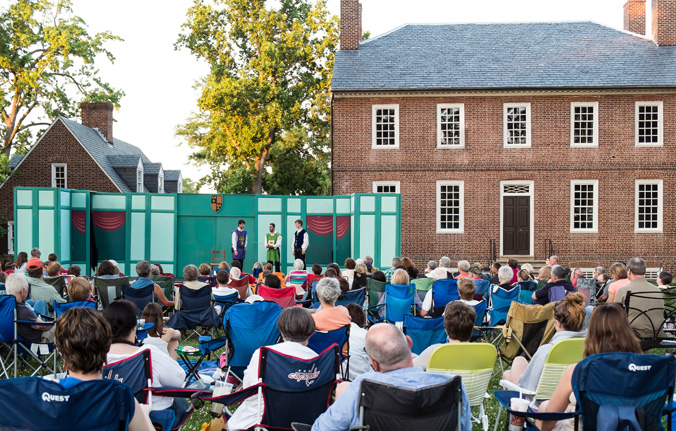
    The audience enjoys last year’s Shakespeare on the Lawn performance of “Macbeth.”

    Once again this summer, Historic Kenmore looks forward to its annual Shakespeare on the Lawn performances.  While settings and costumes may change, today’s Shakespeare audiences most usually witness performances that remain true to the artistry of an unchallenged master carefully crafting his words and stories for the Elizabethan age.  Two centuries ago, however, colonial-era theatregoers like George Washington (who loved attending the theater and did so right here in Fredericksburg) and Fielding Lewis often witnessed drastically altered versions of the Bard’s famous works.

    Today, William Shakespeare’s King Lear is celebrated as his greatest tragedy; some may even argue one of the greatest theatrical tragedies ever.   This June, Kenmore’s audiences will see Shakespeare’s tragic version, which is far different from the version Washington or Lewis may have witnessed.  Indeed, in times past, Shakespeare’s Lear was not always a tragedy.  In this two-part post, we’ll review the history of the Lear story and discuss how that story changed to please audiences of different eras.

    King Lear was not a random literary invention of William Shakespeare. In fact, his Lear was not even the first character of that name to tread the board of an English stage. The name and story of King Lear (or Leir in the earlier iterations) come to us originally from Geoffrey Monmouth’s Latin manuscript Historia Regum Britanniae [“History of the Kings of Britain”] written c. 1136.  Monmouth actually introduces two kings that Shakespeare would dramatize in his writings: Cymbeline and Leir.

    Monmouth’s Leir is a king of 8th Century BCE Brittany and is assumed to be more myth than man. Still, the story is a familiar one.  It tells of a king who divides his land between his three daughters.  To decide who gets the largest portion, Leir asks who loves him the most. The two elder daughters, Gonorilla and Ragau, lie and flatter their father but the youngest and only true daughter, Cordeilla, answers humbly. Leir banishes his youngest child.  He is then betrayed, usurped, and banished by Gonorilla and Ragau.  Now united, Cordeilla and Leir rally an army, restore him to the throne, and survive the ordeal.  This is the story known to English history and folklore long before Shakespeare’s time.

    But is this the account that inspires Shakespeare?  Honestly, it is difficult to say. In the Elizabethan age, Historia Regum Britanniae had not yet been translated from Latin.  Shakespeare undoubtedly took Latin lessons in his youth and perhaps he was exposed to Monmouth’s stories in these lessons.

    There are, however, two other works from Shakespeare’s own time that are more likely to have inspired his classic tragedy: Holinshed’s history book The Chronicles of England, Scotland, and Ireland and a play called The Chronicle History of King Leir.

    Holinshed’s Chronicles is a collection of stories from British history originally published in 1577 and then again in 1587.  It included two stories that Shakespeare dramatized. One was the story of a somewhat forgotten Scottish king named Macbeth while the other was the story of King Leir.

    The play The Chronicle History of King Leir about a father and his three daughters clearly took its story of Leir from Holinshed’s Chronicles.  It was performed at the Rose Theatre in 1594.  Shakespeare clearly knew this play since it features similar passages to some of his own scenes. Yet, this earlier play is still missing some of the key elements for which Shakespeare’s is known.  There is no fool, the subplot between Gloucester and his sons is absent, and, most notably, Leir and Cordelia survive. These elements are the inventions of the Bard.  What inspired him to change this tragicomedy into his greatest tragedy?

    Title page for M. William Shake-speare, his true chronicle historie of the life and death of King Lear, and his three daughters, 1608, by William Shakespeare
    Title page for M. William Shake-speare, his true chronicle historie of the life and death of King Lear, and his three daughters, 1608, by William Shakespeare

    The state of English society and its monarchy when Shakespeare wrote King Lear is key to understanding this shift.  The only known performance of Shakespeare’s version in the Bard’s lifetime was for King James I on St. Stephen’s Day in 1606.  Only three years earlier, James’ accession united England and Scotland into one kingdom. Such a shift in power, even a peaceful one, caused a rise in tension among Britons. These tensions were especially high following the Gunpowder Plot, when Catholics attempted to assassinate the Protestant James by blowing up Parliament the previous year.

    Like art from any era, Shakespeare took his cues from the fears of the populous. His play came out in an England nervous about its future. The last monarch died without a direct heir.  Some questioned the current monarch’s claim. Fears of faction and civil war were in abundance.

    Shakespeare’s tale about a king who divides his kingdom reflected the fears of the people of England and had a very tangible correlation to their own lives. Shakespeare’s King Lear is a cautionary tale about a divided kingdom; it is an example of everything terrible that can come from a nation dividing itself. This is why Shakespeare allows a fool to cast doubt on the king’s decisions, allows a monarch to go mad, and allows an ending that is full of tragedy without hope.

    This Elizabethan version is the King Lear known to most modern theatregoers and it comes right out of Shakespeare’s world. Just as Elizabethan audiences expected the play to reflect their times, however, later 18th century audiences also wanted a King Lear unique to their time and tastes. In part two, we’ll see how the English Civil War and the Restoration changed this story once again as King Lear comes to the America of George Washington and Fielding Lewis.

    Joe Ziarko
    Manager of Interpretation and Visitor Services

    See Shakespeare’s King Lear during Historic Kenmore’s Shakespeare on the Lawn. For details, check below or visit http://kenmore.org/events.html.

    King Lear

  • Coming Soon! William Shakespeare’s “King Lear”

    King Lear

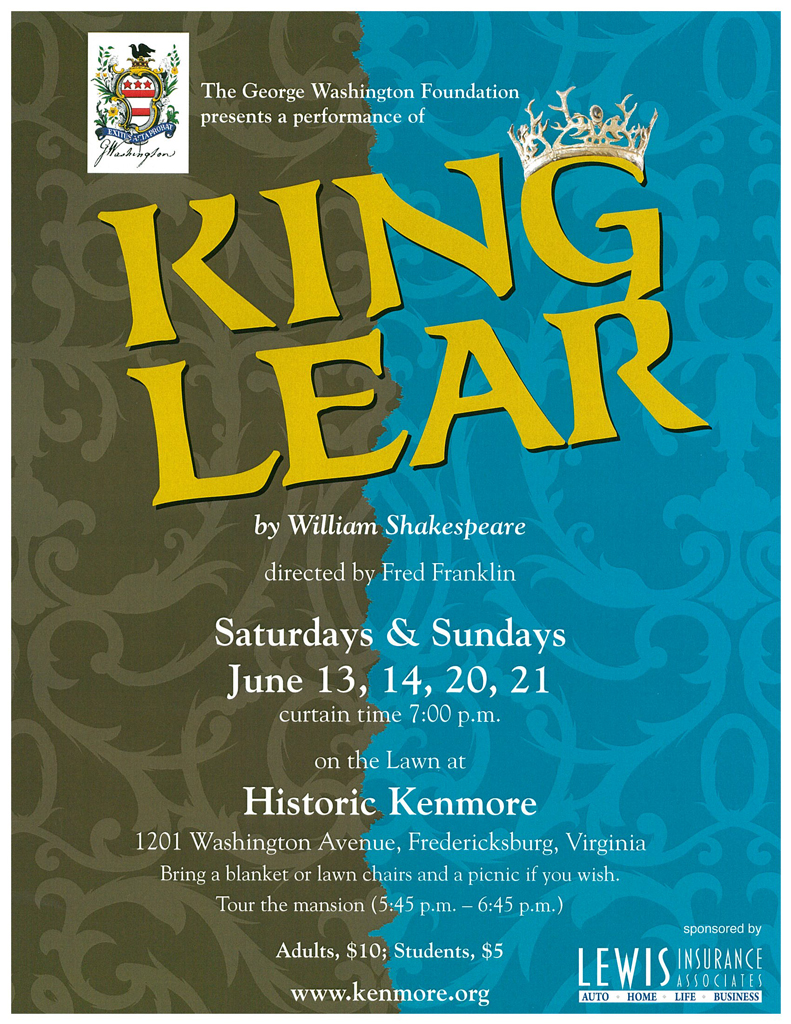
    Shakespeare on the Lawn at Kenmore returns this June with four performances of the popular drama, King Lear, performed by The Fredericksburg Players and directed by Fred Franklin.

    King Lear is one of Shakespeare’s most heart-breaking tragedies—the story of a father who puts his faith in his two treacherous, elder daughters while casting out his youngest daughter, the only one that he truly loves. The play features conniving relatives and secret plots. It concludes with the deaths of the King’s advisor, all three of his daughters, and of course, Lear himself.

    As Kenmore prepares for another summer of the Bard, Lives & Legacies shares a few posters from past theatrical performances at Kenmore.

    Be sure to watch for forthcoming details about more summertime Shakespeare coming in August to Kenmore!

  • Photos: Our Urban Nature at Historic Kenmore

    Nature shaped the lives of English colonists and enslaved Africans living and working at Kenmore Plantation 200 years ago.  Over centuries, humans changed Kenmore’s natural world from a plantation setting into an urban green space. Yet, nature remains just outside the door.

    This past Saturday at Historic Kenmore, visitors had a chance to explore humans’ dynamic relationship with nature through the years during Our Urban Nature.  They discovered — in some cases, held — the wildlife living right in town with Fredericksburg Parks & Recreation. They explored the meaning behind the color of the river’s water with Friends of the Rappahannock. Visitors learned about worm composting with the Rappahannock Regional Solid Waste Management Board. They dug into the importance of dirt with the Tri-County/City Soil and Water Conservation District. Visitors also enjoyed a native plant and urban geology walk through the neighborhood and learned how to build terrariums from found objects and plants. Kids created a food web mobile, fairy houses, and built their own river.

  • Dining Room vs. Dining Room

    Several months ago, Historic Kenmore concluded the refurnishing effort in the Dining Room.  After painstaking research and scientific investigation, that room has been returned to a state that would be immensely familiar to Fielding and Betty Washington Lewis.

    It might look somewhat unfamiliar, however, to later occupants of Kenmore.  The first picture below was taken sometime between 1880 and 1902 when the Howard family occupied the house.

    When, in 1881, Kenmore was purchased by Mr. William Key Howard of Maryland, the place was in deplorable condition.

    Kenmore suffered considerable damage to its ornamental plaster ceilings during the Civil War. Young William K. Howard, Jr. urged his father to allow him to repair them. When scaffoldings were built, the artistic lad worked long and patiently making his own molds for replacement elements when needed.

    The Howards saved the ceiling but, naturally, their goal was not to return the building to its colonial-era appearance.  When Kenmore became a historic house museum, changes still had to be made over many decades to achieve a historically accurate décor that closely resembles the one the Lewises would have known in the late 1700s.

    The second picture shows the dining room as it appears today after meticulous restoration and refurnishing.  Comparing the two photos, we see the biggest architectural change to the room was the removal of the gothic arched niches on each side of the fireplace.  The arches were returned to the original square doors.

    The narrow oak flooring, which replaced the original floor stained with the blood of Civil War soldiers who received medical treatment at Kenmore, was itself replaced with heart pine flooring.  Late last year, the floor was covered with a beautiful replica 18th century carpet.

    Decorative coal grating and surrounding bricks were removed from the fireplaces making them larger.

    The wood molding put on the walls to create false panels was removed and replaced with plaster molding whose original location was found during removal of paint during restoration work.

    Those are just a few of the changes both large and small that can be seen when comparing these two photos.  The changes occurred over many decades and involved many dedicated people but each started, in many ways, with the Howards.  They and all the rest of us who have spent our days at Kenmore have taken something old and made it new again.

    Heather Baldus, Collections Manager
    Zac Cunningham, Manager of Educational Programs

  • “They gave me grog…and put me to sleep with opium pills”: Kenmore as a Civil War Hospital

    Kenmore sometime before the end of 1862.  The wooden structure to the mansion's left is the kitchen, which would be destoryed during the Battle of Fredericksburg.
    Historic Kenmore sometime before the end of 1862. The wooden structure to the mansion’s left is the kitchen, which would be destroyed during the Battle of Fredericksburg.  An enslaved woman can be seen standing at the corner of the kitchen while an enslaved man is visible under the tree at the far left.

    As the sesquicentennial of the Civil War draws to a close, we are remembering the war at Kenmore, and its aftermath.  Although Kenmore is best known as a house of the colonial period, it had quite a history during the Civil War.  Visitors to Kenmore have long heard that the house survived bombardment during the Battle of Fredericksburg in December, 1862.  At least 11 cannon balls hit the house, with at least one penetrating the interior, damaging the famous plasterwork ceiling in the Drawing Room.  While that battle was intense and destructive, the true lasting effects of the war on Kenmore came later, when the house was used as a Union field hospital during the early stages of the Overland Campaign.

    Cannon ball hole in Kenmore's roof.
    Cannon ball hole in Kenmore’s roof.

    In May of 1864, Union and Confederate forces clashed at The Wilderness just west of Fredericksburg, with further hostilities throughout the month at nearby Spotsylvania Courthouse.  The wounded from these battles were evacuated from the front lines to Fredericksburg.  The city was soon overwhelmed with soldiers in dire circumstances, needing far more medical attention and resources than were available.

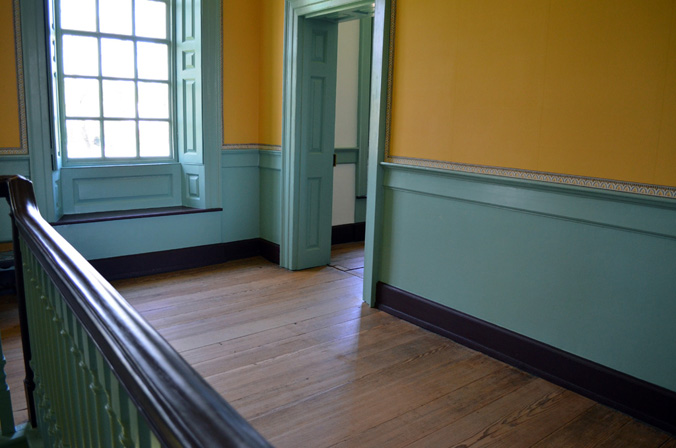
    A memoir of experiences during the war written by Amos Rood, an officer in the 7th Wisconsin Infantry who was wounded at Spotsylvania, gives a vivid account of the situation in Fredericksburg and at Kenmore specifically (a transcription of the memoir is in the Kenmore manuscript collection).  Rood writes, “…where to put the thousands who were being brot [sic] in! City already full: every house, barn, shop, factory, shed: all overcrowded and thousands laying on the sidewalks and gardens and fields!”[1] Rood was in a wagon which had been left on a crowded street in the city, but a chaplain who he knew happened by and helped him find shelter at Kenmore.  He describes the scene upon his arrival, “…took me out of the rig and had me carried into Kenmore house and (no room on the ground floor so they toted me up one flight and laid my cot down on the floor by the bannister or balustrade) so I could see people (Drs & c.) coming up and going down…Surgeons noticed me…They gave me grog…and put me to sleep with opium pills.”

    The second floor landing where Rood was treated for his wounds.
    The second floor landing where Rood was given medical treatment.

    Rood would stay at Kenmore, in increasingly dire circumstances, from May 14th through the 17th.  Although he describes a serious leg wound that was obviously infected, he was given no medical treatment other than doses of opium and liquor.  The fact that a man in such a condition did not rate top billing for treatment perhaps speaks to the situation of the other soldiers being brought into Kenmore by the hundreds every day.  It has long been believed that Kenmore’s glorious dining room was used as the surgery, as evidenced by the fact that all of its original floorboards had to be ripped up and replaced after the war.  War era graffiti left on the rafters of the attic attest to the fact that wounded soldiers were crammed into every available space in the house.  Eventually, more than a hundred bodies and at least one horse were buried on Kenmore’s grounds, mostly in hastily dug shallow graves.

    In 1868, the removal of soldiers’ remains from temporary graves all over the city began, when a national cemetery was established in Fredericksburg.  Eventually more than 13,000 remains were re-interred.  The process took decades.  In fact, the last known grave of a soldier buried at Kenmore was discovered in December, 1929, when the Kenmore Association began excavations to rebuild the kitchen dependency.  An article in the Free Lance-Star on December 5th said, “The finding of soldier’s [sic] remains in Fredericksburg and its environments is not unusual and often workmen engaged in digging ditches…or in excavating for new building projects, come across all that is left of a once youthful soldier.”[2] The ladies of Kenmore made arrangements with the American Legion to have the remains re-interred with full military honors on the 66th anniversary of the Battle of Fredericksburg on December 13th. An account of the ceremony reads, “…the cortege left ‘Kenmore’.  The body had been placed in a new casket and this draped with a large United States flag, which often floated from the ‘Kenmore’ flagstaff.”[3]

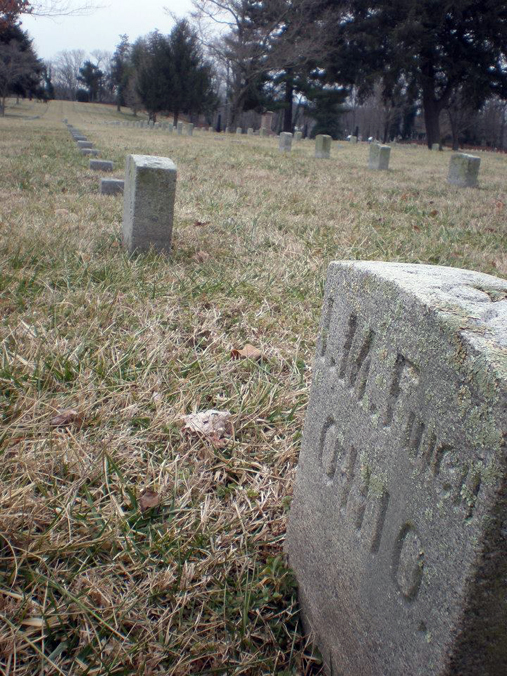
    Fredericksburg National Cemetery
    Gravestones at Fredericksburg National Cemetery

    With that last re-interrment, the war finally came to an end for Kenmore.  150 years later, we still remember its lasting effects.

    Meghan Budinger
    Aldrich Director of Curatorial Operations

    [1] Rood, Amos. Memoirs of the War. Trans. Steven L. Acker.  Kenmore Manuscript Collection.

    [2] “Remains of Union Soldier are Found.” The Free Lance-Star [Fredericksburg, VA] 5 December, 1929: Kenmore Manuscript Collection.

    [3] “Unknown Soldier Buried in Kenmore.” The Chattanooga Times 12  January , 1930: Kenmore Manuscript Collection.