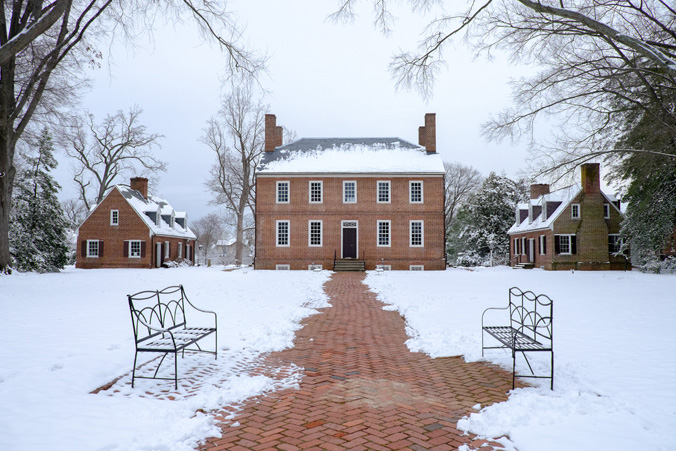
Each January, Historic Kenmore presents Twelfth Night at Kenmore, a dramatic theater presentation that imagines the first Christmas that Fielding and Betty Washington Lewis spent in their newly built home. The play is set in January 1776 and that year is not a time for the usual celebration. War brings fear, doubt, and frustration to the Lewis family and their friends.
The 2016 edition of Twelfth Night at Kenmore took place this past weekend. Here are photos from that performance.
Kenmore is ready for the party.
George Lewis (Joe Ziarko) gazes out the window and ponders enlisting in the Continental Army.
George Weedon (L-Rae Ehlen) and Fielding Lewis (R-John Hollinger) lament the burning of Norfolk and Dunmore’s Proclamation.
The dessert table includes a hedgehog cake.
Candles light the Passage
Betty Washington Lewis (L-Barbara Cochran) and Nancy Alexander Lewis (R-Corinn Keene) determine to smile through the troubles of war.
The Lewis family and guests sing “God Rest Ye Merry Gentlemen.”
The Payne Family provided music for the performance. (L-R) Zach, Kelsey, Kaylee, and Luke.
George Weedon explains to Captain Richard Taylor (Sam Fulton) why horse racing ought to be banned during the war.
Captain Taylor, John Lewis (Mike Taylor), and George Lewis play cards.
Wassail in a punch bowl.
Sausage cooking over the fire in the kitchen.
Rachel (Gladys Perkins), enslaved cook for the Lewis family, tends the fire.
Rachel ponders the future that war might bring for the enslaved community and if that future will include freedom.
This coming weekend — Friday, January 8, Saturday, January 9, or Sunday, January 10 — Historic Kenmore again presents Twelfth Night at Kenmore, a dramatic theater presentation set in January 1776. It is the first Christmas that Fielding and Betty Washington Lewis celebrate in their newly built home. It is not the usual celebration, however. War brings fear, doubt, and frustration to the Lewis family and their friends.
Here is a collection of photos from last year’s performances.
George Weedon (Sam Fulton) and Fielding Lewis (John Hollinger) remark upon the Christmas decorations.
Betty Washington Lewis (Amy Wolf) and daughter-in-law Nancy Alexander Lewis (Juliana Jones) ponder how the war might impact the family.
George Lewis (Will Goldstein) expresses his desire to enlist in the Continental Army.
George Weedon, a leading Fredericksburg patriot and tavernkeeper.
Our excellent musicians for the evening: Zach, Kelsey, Kaylee, and Luke Payne.
Two-hundred-year-old violin on display in Kenmore’s dining room
Violin is on loan by Wayne A. Hill, Violinist/Composer
Rachel (Gladys Perkins), enslaved cook, and Hetty (Ashlee James), enslaved washerwoman and house servant, ponder the future.
Immerse yourself in the experience the candlelight, music, and decorations of an eighteenth-century Christmas!
Performance Times: 3:00, 3:45, 4:45 and 5:30 p.m. Reservations required. Call 540-370-0732 x24 or email [email protected] Cost: $12.00 adults, $6.00 ages 3-17; free ages 3 and under.
On January 8, 9, and 10, Historic Kenmore presents “Twelfth Night at Kenmore,” a dramatic theater performance inside the 18th century home of Fielding and Betty Lewis. This short video previews the performance.
Immerse yourself in the experience the candlelight, music, and decorations of an eighteenth-century Christmas!
Performance Times: 3:00, 3:45, 4:45 and 5:30 p.m. Reservations required. Call 540-370-0732 x24 or email [email protected] Cost: $12.00 adults, $6.00 ages 3-17; free ages 3 and under.
The George Washington Foundation wishes everyone a joyous holiday season! Enjoy these photos of holiday decorations created by wonderful volunteers! The George Washington Foundation Garden Guild decorated at Kenmore and the Lake Anna Garden Club decorated at Ferry Farm.
There is still time to see Historic Kenmore and George Washington’s Ferry Farm adorned for the season as well as each site’s annual display of dollhouses, miniatures, and gingerbread creations. For details about these exhibits, visit kenmore.org/events. Finally, if you missed it, check out our most recent post A Christmas of Uncertainty, December 1775.
When Fielding Lewis moved his family into their new home – the magnificent brick house we call Kenmore – in late 1775 it was the culmination of years of hard work and planning. It might seem as though that year’s holiday season should have been one of continual joy. Unfortunately, the Lewis family’s first Christmas inside Kenmore was far from joyful. December 1775 was an extremely difficult time in their lives and for the American Revolution.
That December, the Revolution was in a frustrating state of limbo. Although declared to be in open rebellion by the King and Parliament, few colonies had yet to see any armed conflict. Fighting outside of Boston started in the spring but fizzled into stalemate following the Battle of Bunker Hill in June. Independence may have been discussed in taverns but was still far from being discussed at the Continental Congress in Philadelphia.
The colonies were still suffering economically and had been suffering for some time. In 1774, Congress passed the Non-Importation Agreement. These measures stopped all trade with Great Britain and other British-owned ports. The Association, as it came to be known, remained in effect in December 1775. Colonists lacked numerous supplies and goods. Fielding Lewis experienced a significant drop in his shipping business and the family’s finances began to suffer.
Even though it was the holiday season, the Non-Importation Agreement also discouraged…
To be loyal to the American cause, one could not delight in the revelries typically enjoyed during Christmas.
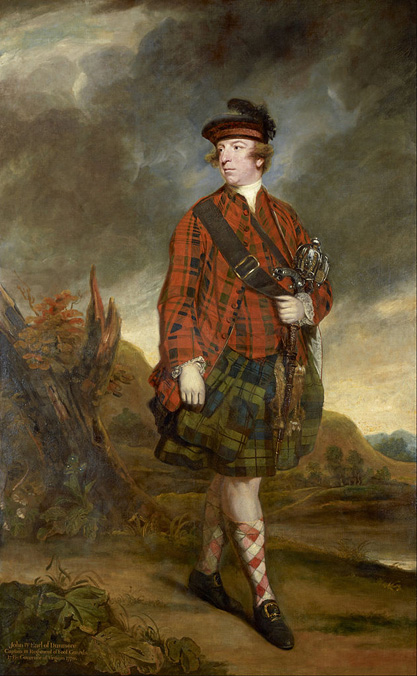
All levels of Virginia society felt the strain of war’s uncertainty that fateful December. John Murray, 4th Earl of Dunmore and Virginia’s Royal Governor, had been at odds with his colonists since he removed portions of the public stores of gunpowder to a Royal Navy ship back in the spring. Lord Dunmore’s most recent action, however, hit much closer to home for Fielding Lewis and his fellow planters. The Governor threatened to take their slaves, the precious private property, as they saw them, upon which they had built their livelihoods and wealth.
Portrait of John Murry, 4th Earl of Dunmore by Joshua Reynolds (1765)
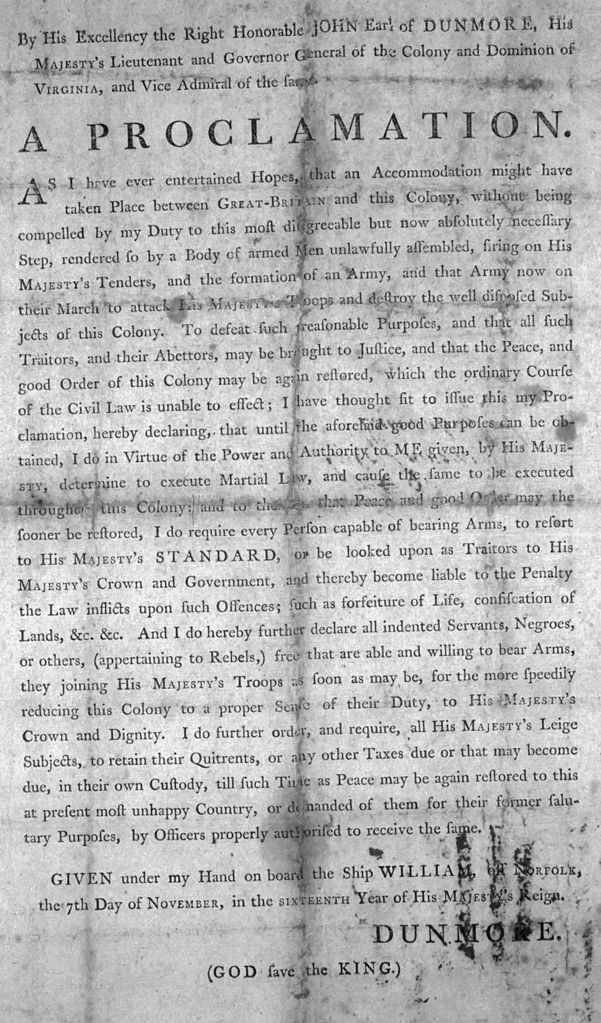
In November 1775, Dunmore had issued a proclamation in Virginia intended to swell his ranks and cripple the so-called ‘rebels’ by imposing martial law, raising the King’s standard, and declaring, most significantly,
A copy of Dunmore’s proclamation. Library of Congress photo
Dunmore’s Proclamation angered and frightened slave owners throughout Virginia and put the colony’s enslaved population in a difficult predicament. Achieving freedom was highly dependent on an enslaved person’s ability to get to Dunmore in Norfolk. Not surprisingly, the largest percentage of enslaved people who fled to the British came from the counties closest to that port city. While it is uncertain if any Lewis slaves ran away to the British, at least one indentured servant perhaps did. Joseph Smith, an a painter who had worked for George Washington and presumably for Fielding Lewis, saw the political schism in Virginia as an opportunity to free himself from his servitude and fled in the summer of 1775. In November, Fielding wrote to George, saying “I have never heard of your Painter tho’ suspected he was gone to Ld Dunmore[.] I do not expect he can be got as Dunmore wants Men.” Smith’s successful escape may have been on the mind of the other indentured servants and enslaved people in the Lewis household when word of Dunmore’s Proclamation arrived in Fredericksburg.
December 1775 in the Lewis family’s new home was an anxious one for many and yet for others it must have been a hopeful one as well. The American forces at Bunker Hill had proven to the British that the fight would not be easy or quick. The Fourth Virginia Convention met that December and ordered even more companies formed to support the Continental forces. Most hopefully, Dunmore’s forces were defeated in the Battle of Great Bridge on December 9. The Governor would leave the shores of Virginia in the early part of 1776 never to return. His forces did include a portion of enslaved people who had dared to hope for their own freedom, a hope that would be denied for many Christmases to come. A large portion were captured and returned to slavery, many more died from disease or lack of supplies, and others perished in battle. Few actually gained their freedom.
Back in Fredericksburg, the December of 1775 was most likely not what the Lewises had expected or hoped for. It was a Christmas of uncertainty, when war raged on Virginian soil. Yet, the future was not solely bleak for Fielding, Betty, and the Americans. As 1776 began, it begged the hopeful question: what may the new year bring?
Joe Ziarko
Manager of Interpretation & Visitor Services
Experience this Lewis family’s Christmas of uncertainty during Twelfth Night at Kenmore, a dramatic theater presentation at Historic Kenmore on Friday, January 8, Saturday, January 9, or Sunday, January 10. The year is January 1776. It is the first Christmas that Fielding and Betty Washington Lewis celebrate in their newly built home. It is not the usual celebration, however. War brings fear, doubt, and frustration to the Lewis family and their friends. Immerse yourself in the experience the candlelight, music, and decorations of an eighteenth-century Christmas!
Performance Times: 3:00, 3:45, 4:45 and 5:30 p.m.
Reservations required. Call 540-370-0732 x24 or email [email protected]
Cost: $12.00 adults, $6.00 ages 3-17; free ages 3 and under.
For the second year, Historic Kenmore presents “A Wee Christmas,” an exhibit for the holiday season of highly detailed, replica dollhouses – including the Kenmore mansion – and miniatures in the Crowninshield Museum Building. Come to Kenmore and share memories of your dollhouse with children and grandchildren as you explore the treasures in this festive display!
The dollhouses and miniatures of the “A Wee Christmas” remain on display until December 30. Historic Kenmore is open Monday – Saturday from 10:00 a.m. – 4:00 p.m and on Sunday from 12:00 p.m. – 4:00 p.m. Kenmore will be closed Christmas Eve and Christmas Day.
Admission cost for viewing the dollhouse exhibit only is $5 adults, $2.50 students, under 6 free. There is an additional fee for a guided tour of Kenmore. Visit www.kenmore.org for more details.
“Baxter House” submitted by James Opher, Julie Silvester, owner of Lilliput’s Doll House Shop, and Traci Haden, president of Virginia Minature Enthusiast Region E-1. Originally built by Mr. & Mrs. Baxter the house has over 16 rooms including a Grand Ballroom.
“Harris Farm” submitted 6-year-old collector Emily Jane Harding, who received the house from her grandmother.
“Smaller Home and Garden” submitted by Fernanda L. Kain.
“Petite Princess Collection” submitted by Jessica and Nancy Burger features dollhouse furniture that first appeared in the Sears Christmas Wish Book in 1964.
“Santons” submitted by Anna Jennings. A Santon is a small hand-painted terracotta Nativity scene figure made in France’s Provence region.
“Teapot Tea Room (at the North Pole)” submitted by Joanna Borgman even includes tiny bags of “Kenmore-blend” tea.
“Bartlett House” submitted by Katherine S. Opdycke.
“Place of Worship” submitted by James Opher has features to represent the Catholic, Islamic, Methodist, and non-demoninational faiths.
“The Apple Blossom” submitted by David Budinger is the childhood dollhouse of Kenmore’s Curator Meghan Budinger.
“Georgian Court” submitted by 8-year-old collector Elizabeth Harding, who was given the house by her mother.
“A Collection” submitted by Gail Steffey includes a display of leather furniture and a glass conservatory.
“Antique Dollhouse” submitted by Susan Larson
“Santa’s Slumber” submitted by Jessica Waltz
“Lost But Not Forgotten” submitted by James Opher is a diorama of a Japanese castle.
“Santa’s Workshop” submitted by Peggy Severson
Some of the dollhouse exhibitors: (l-r) Meghan Budinger, James Opher, Joanna Borgman, Fernanda L. Kain, Gail Steffey, Peggy Severson, (front) Elizabeth and Emily Jane Harding.
Although Fielding Lewis certainly built a home capable of hosting the elaborate Christmas celebrations popular in 18th century Virginia, Historic Kenmore probably never saw occasions on such a lavish scale, with the possible exception of the family’s first Christmas in the house in December 1775. If the family hosted the traditional Christmas celebration, Fielding and Betty would have welcomed lots of friends and family, serving them fancy dinners and entertaining them with dancing and music. They and their guests might have enjoyed fox hunts as well.
Virginians regularly included fox hunts as part of their Christmas celebrations.[1] In an era long before environmental conservation, colonial Virginians viewed foxes as pests that endangered livestock, which is why they hunted them so relentlessly.[2]Additionally, during hunts, gentry men like George Washington could show off their hunting dogs and their skill at horseback riding while chasing foxes through the countryside.
George Washington loved fox hunting. In the year 1768, for example, he went on fox hunts 40 different times. These hunts often lasted hours. On a March day in 1768, he caught “a fox with a bobd Tail & cut Ears, after 7 hours chase.”
George owned numerous hunting dogs and “helped develop the breed known as the American Foxhound.” These hounds chased the fox and hunters on horseback chased the hounds. The chase required galloping horses to jump over streams, bushes, and fences and riders to duck under low-hanging tree limbs. Fox hunting allowed wealthy Virginians to show-off their horse riding skills and George was widely considered an excellent horseman.
Hunters also wore special clothes. George went hunting in “a blue riding frock and scarlet waistcoat threaded with gold lace and topped by a black velvet cap. He wore high boots and carried a . . . riding crop.”[2] He wore cuff links that said “tallio” on them – that’s what hunters would shout when they found a fox. These cufflinks were unearthed by archaeologists at George Washington’s Ferry Farm and their discovery hint at George’s interest in fox hunting even in his younger years. He also hung paintings of fox hunts on the walls of his home at Mount Vernon.
Cufflinks discovered in the parlor root cellar and yard of the Washington House at Ferry Farm show a fox running across grassy rolling hills with the word “tallio” engraved above. This is a popular 18th century motif.
Like the George’s paintings at Mount Vernon, Fielding Lewis included foxes in the decor of his home. At Kenmore, the Lewis children were always reminded of the sneaky ways of foxes when they looked at a picture above the Dining Room fireplace. The plaster image illustrates the Aesop’s fable known as “The Fox and the Crow.”
This plaster over-mantle in Historic Kenmore’s dining room depicts the Aesop’s Fable known as “The Fox and the Crow.”
One day a fox saw a crow flying with a piece of cheese in its beak and settle on a branch of a tree. “That’s for me!’ said Master Fox, and he walked up to the foot of the tree.
“Good-day, Mistress Crow,” he cried, “How well you are looking today; how shiny your feathers; how bright your eyes. Your voice must be more beautiful than that of other birds. Won’t you, please, sing me a song that I may know you are the Queen of Birds?
The crow, quite happy to hear such praise, began to sing her best – “Caw, Caw, Caw”, but when she opened her beak, the piece of cheese dropped to the ground and was snapped up by Master Fox.
A close-up view of the over-mantle shows Mistress Crow dropping her cheese to be scooped up by Master Fox.
“Aha, Mistress Crow,” said he. “That was what I wanted. In exchange for your cheese I will give you some advice for the future: “Beware of false flattery.”
This Christmas, some sneaky foxes have found their way into Kenmore.
A sneaky fox hiding somewhere inside Kenmore.
During the holiday season, younger visitors can help us look for them in a special scavenger hunt and learn about the colonial Christmas custom of fox hunting.
Zac Cunningham
Manager of Educational Programs
[1] Philip Vickers Fithian, Journal & Letters of Philip Vickers Fithian, 1773-1774: A Plantation Tutor of the Old Dominion, ed Hunter Dickinson Farish (Williamsburg, Va., 1943), entry for Dec. 18, 1773: 44
[2] Jane Carson, Colonial Virginians at Play, Williamsburg, VA: Colonial Williamsburg Foundation, 1998: 62-64
[3] Ron Chernow, Washington: A Life, New York: Penguin Press, 2010: 124-5.
This past Friday, November 13, visitors enjoyed “Night in Washington’s Day,” a special evening event at Historic Kenmore that explored the history of nighttime in the 18th century. Night was an active time 200 years ago. People cleaned, cooked, plowed, prayed, and visited neighbors at night. Darkness inspired scientists to make incredible discoveries that led to centuries of exploration and different cultures composed epic narratives inspired by the stars. You can read information similar to that presented during “Night in Washington’s Day” here and here.
The Kenmore grounds lit by lanterns and luminaries.
Lanterns light the steps into the mansion.
A display of 18th century lighting technology.
Curator Meghan Budinger talks about how lighting technology was used 200 years ago.
Meghan demonstrates how colonial Americans carried their candles as they moved around a dark house.
The dining room was lit to approximate nighttime conditions.
Eventually, the modern electric lighting was extinguished, leaving only the replica candles and fireplace to light the room.
In a theater skit, two enslaved women owned by Fielding Lewis are up in the middle of the night. Hetty, a washerwoman and house servant, and Rachel, a cook, do extra laundry to earn money and fund an attempt to runaway.
Zac Cunningham, Manager of Educational Programs, told stories about the constellations. Here Zac recounts how Hercules flung two bears into the night sky and created the constellations Ursa Major and Ursa Minor.
Glenn Holliday of the Rappahannock Astronomy Club presents a history of astronomy.
In this video, we make a rare colonial-era treat known as “An Orange Fool” recently featured in a written blog post about where colonial Americans got their fresh fruit from. You can find the blog post and the “Orange Fool” recipe here.