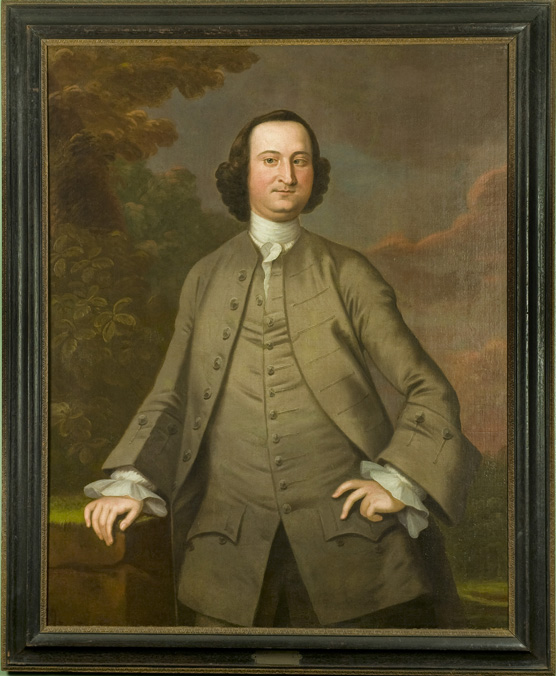
As George Washington’s Ferry Farm prepares to celebrate the reconstruction of the Washington house, we traveled around George’s hometown – Fredericksburg, Virginia – to visit a few places important in the transformation of George from boy to man.
George Washington lived at Ferry Farm from age 6 (1738) to around age 22 (~1754). At Ferry Farm, he copied the Rules of Civility and Decent Behavior, read his first book about military adventures, joined the Masonic Lodge, and petitioned colonial Virginia’s British Governor for his first military office. Two hundred forty-six years ago, on September 13, 1771, George recorded in his diary that he “Returnd to my Mothers to Breakfast and Surveyd the Fields before Dinner, returnd to Town afterwards.” The fields of Ferry Farm were pivotal to George Washington’s development into an extraordinary man.
Join us at the Washington House Celebration on Saturday, October 7, 2017 from 12:00 p.m. – 4:30 p.m. to celebrate the construction of the Washington house! A special ribbon-cutting ceremony will begin at 1:30 p.m. featuring notable speakers. After the ceremony, guests will be invited to view the reconstructed Washington house! Parking for the event is off site at the VRE Fredericksburg Park and Ride Lot G at the corner of Prince Edward Street and Frederick Street. Limited handicap parking is available at Ferry Farm. Buses will transport guests to and from Ferry Farm. The Washington House Celebration is a free event and RSVPs are not required.
We’ll have more from around George’s hometown over the next three weeks!
On Tuesday, September 5, 2017, Dave Muraca, director of archaeology and vice president of museum content at The George Washington Foundation, presented “Building George’s House: Introducing the New Ferry Farm,” his account of the last eighteen months as George Washington’s Ferry Farm witnessed the careful reconstruction of the Washington house using many traditional techniques. Dave reviewed the archaeology that made the reconstruction possible and recounted the work of the skilled craftsmen building George’s house. The lecture was given at the Central Rappahannock Regional Library headquarters in Fredericksburg, Virginia.
Join us at the Washington House Celebration on Saturday, October 7, 2017 from 12:00 p.m. – 4:30 p.m to celebrate the construction of the Washington house! A special ribbon-cutting ceremony will begin at 1:30 p.m. featuring notable speakers. After the ceremony, guests will be invited to view the reconstructed Washington house! Parking for the event is off site at the VRE Fredericksburg Park and Ride Lot G at the corner of Prince Edward Street and Frederick Street. Limited handicap parking is available at Ferry Farm. Buses will transport guests to and from Ferry Farm. The Washington House Celebration is a free event and RSVPs are not required.
Learn more about the Washington House here and view other videos, photos, and blog posts about the project here.
“There is no man who hates the power of the crown more, or who has a worse opinion of the Person to whom it belongs than I.” – Charles James Fox, letter to Edmund Burke, 24 January 1779. Quoted in L. G. Mitchell, Charles James Fox (1997:41).
“It is intolerable that it should be in the power of one blockhead to do so much mischief.” – Charles James Fox referring to King George III. From a letter to Mr. Fitzpatrick, 9 September 1781. Quoted in John Brooke, George III (1974:363-364).
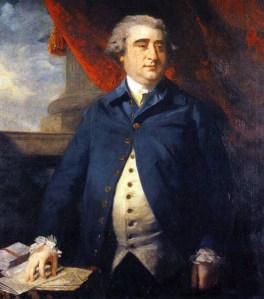
The Right Honourable Charles James Fox, MP, wore buff and blue apparel for this 1782 portrait by Joshua Reynolds. Credit: Wikipedia.
Charles James Fox was contrary. He gambled excessively, drank heavily, and he was generally irreverent. He enjoyed resisting powerful people, supported unpopular causes, and expressed his disdain for high society by adopting a disheveled appearance later in life. His colorful British Parliamentary career spanned decades. He was a champion of liberty: including the abolition of slavery, religious freedom, the colonists’ struggles with King George III, and he supported the French people in their quest for democracy.
Fox questioned King George III’s policies toward the American colonies and feared that the monarch was becoming tyrannical. It was parliament’s job to guard against such corruption. Fox and his supporters often wore apparel in the colors of buff and blue – the colors of Washington’s army – to show their support for American concerns. The Americans, in turn, honored their parliamentary champion with their own fashion accessory: they wore buttons that featured a fox, an obvious – and often used – stand-in for the controversial orator.[1]
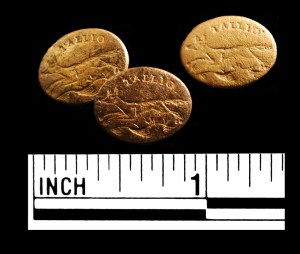
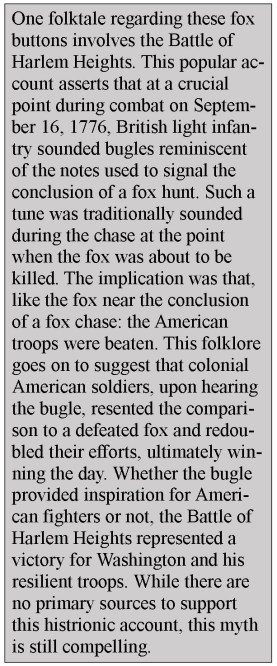
Buttons featuring a fox racing across the landscape with the word “TALLIO” were intensely popular from the 1770s through at least the first quarter of the 1800s and they are common discoveries at archaeological sites. “Tallio,” “talley-o,” “talley-oh,” “talleo” and “talley ho” were all acceptable spellings for the traditional huntsmen’s shout upon spotting the fox during a chase. But this exclamation dates from the 1770s: well over a century after the sport had been brought to the Chesapeake. [2]
A close-up of a “TALLIO” sleeve button from the Washingtons’ parlor cellar, c. 1766-1772.
Fox hunting enjoyed wide popularity among Chesapeake gentlemen. The English Brook family brought their foxhound pack to Prince George’s County, Maryland when they immigrated in 1655.[3] Fox hunting continued in the Brook family for generations, and the popularity of this privileged recreational activity spread. Fox hunting on horseback was an amusement of the leisure class and the chase was considered more important than the capture of the prey. By the late 1760s, Washington himself maintained a pack of fox hounds at Mount Vernon.
Additional TALLIO sleeve buttons from the antebellum-era plowzone at Washington’s boyhood home. They are notably more weathered from its increased exposure to the elements given its shallow soil burial environment.
Many who discover these buttons today attribute their imagery solely to the popularity of fox hunting as a sport. These buttons are often referred to as “hunt” buttons, a category that includes buttons which feature favored hobbies or athletic pursuits. Some assert that these sleeve links were widespread because fox hunting was so popular. And indeed, it was. These links – historically referred to as ‘sleeve buttons’ – enjoyed great popularity in the years surrounding the American Revolution, the Early Republic, and into the antebellum period.
I believe these buttons also achieved a deeper, political meaning, however, especially in the years around the American Revolution. Due to the support by Charles James Fox of the American cause, fox imagery came to represent resistance to tyranny. A number of contemporary British political cartoons used a fox to symbolize this politician. In addition to this documentary evidence, I believe the fox imagery used on these buttons came to symbolize the fight for liberty. For those recovered buttons for which we have context, it is evident that they are especially prevalent at sites associated with the Revolutionary War and with American patriots.
Colonial discord is represented in this 1776 image showing America (symbolized as a woman in a feathered headdress, center left) attacking a defenseless Britannia (symbolized by the woman at center right). Charles James Fox is represented as a fox in the background (see arrow). Courtesy of the Lewis Walpole Library, Yale University.
As the political difficulties between the British Crown and the American colonies intensified, Fox’s outspoken support of colonial concerns attracted attention on both sides of the Atlantic. In Britain, some called Fox a traitor for his disrespectful rhetoric against the crown. In Britain’s North American colonies, his stoic support for their cause provided colonists a crucial ally in an unexpected, but politically powerful position. Patriots and revolutionaries enthusiastically incorporated these fox hunting-themed buttons into a celebration of Fox’s ardent support.
A 1784 image of a fox, featuring the head of British parliamentarian Charles James Fox. Courtesy of the Lewis Walpole Library, Yale University
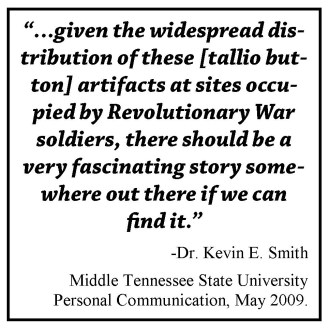
Tallio/fox buttons have been recovered from several American Revolution-era and Early Republic era forts in Tennessee and New York. Two domestic sites associated with George Washington have yielded these buttons as part of their archaeological discoveries. Signer of the Declaration of Independence, William Paca, proudly wore a tallio/fox button. Colonial towns such as Dumfries, Virginia and Jacksonborough, South Carolina have yielded these buttons from layers dating from the Revolutionary era.
Anthropologists – scholars who study people – make special efforts to identify such symbols in societies, both in contemporary studies and in analyses of past people.[4] Symbols are especially powerful because viewers do not need to be able to read, to understand language, to hear, or to speak, in order to comprehend a symbol’s message. These messages can summon strong emotional responses. Think about how you feel when you see an American flag and how your responses might change depending on how a flag might be used at a protest, funeral, or baseball game. During the last quarter of the eighteenth century, the fox symbolized resistance to tyranny, freedom, and the pursuit of liberty. Wearing a fox button proclaimed your support for American independence.
The die struck fox image on these buttons was not originally created as a political symbol for Charles Fox, however. The meaning of these buttons was adapted to that purpose after their initial manufacture. As we have seen, fox hunting was indeed a common pastime for gentlemen, and these fashionable buttons were popular among those who “chased the hounds.” As tensions between Britain and her North American colonies increased, beginning by the 1760s, the fox symbolism present on tallio buttons was malleable[5], and provided a gentleman with leeway in a politically volatile climate: its meaning could change according to a gentleman’s situation. Among unfamiliar company, such a multivocal symbol would allow an adroit – or perhaps even a vacillating – patriot some political latitude. Uncertain if the person with whom you’re dining is a Tory? Your innocent little TALLIO sleeve link merely celebrates a popular, recreational activity, whose roots in the Middle Atlantic region went back generations. But, at the same time, comrades in the struggle for American Independence recognized their solidarity in the symbolism of the fox: honoring their parliamentary advocate of colonial resistance to the King George III.
Along with the tallio sleeve button, another apparel item as evidence for the Washington family’s burgeoning resistance to the Crown has been found at Ferry Farm. As I wrote in an earlier blog post, the Washingtons wore a mid-1700s William III sleeve button to display their resistance to George III: a monarch that many colonists deemed tyrannical in his exercise of power. On more than one occasion, Charles Fox himself compared America’s Declaration of Independence to William and Mary’s “Glorious Revolution,” and (fairly or not) drew parallels between the monarchical abuse of powers exercised by George III and James II. British subjects had the right to replace a tyrannical king with another: an example set by William and Mary, and an important precedent for the American colonists. The Washingtons’ support for the Leedstown Resolves in February 1766 provides documentary evidence for their concerns with Britain’s rule and (at the time) their loyalty to the Crown.[6]
Close-up of a mid-1700s sleeve button recovered at Ferry Farm. It features the image of King William III and reads “Gulielmus D. G.” which translates as “William by the grace of God King.” This button is another demonstration of growing resistance to George III from Washington’s boyhood home.
Together, the symbolism on each of these buttons and the Washington brothers’ participation in the Leedstown Resolves demonstrates a long and growing frustration among Virginians with Britain’s colonial policies. The material expression of these sentiments can be traced back to the mid-1700s-era male apparel buttons at Washington’s childhood home. These discoveries were possible thanks to the preservation of this site, the thorough excavation of its layers, and a contextual understanding of the social and political landscape of this period.
This fox/liberty symbolism apparently endured well into the 1800s in the United States. Archaeologists recovered a “TALLIO” sleeve button from the root cellar of a quarter for enslaved laborers in South Carolina:[7] strong circumstantial evidence that this symbol of the struggle for liberty and freedom continued beyond the American Revolution. As previous mentioned, Fox was an ardent abolitionist. The layer from which this particular button was recovered dated no earlier than 1845. In this context, this symbol of liberty underwent another change and now represented a reproach displayed by enslaved Americans to highlight the paradox of slavery in what was supposed to be a democracy. Though Charles James Fox died in 1806, the use of the fox as a symbol for the struggle for freedom endured.
Laura Galke, Archaeologist
Site Director/Small Finds Analyst
Sites where such TALLIO links have been recovered Collectors and archaeologists have found TALLIO buttons from at least New York to South Carolina, and westward to Tennessee,[8] where they occur at a number of United States military forts, late 1700s-era towns, and at sites associated with patriots.
Bledsoe’s Station, Tennessee (1783-1795) – “civilian fort” (Context dates from c. 1783-1795).
British Officer’s Revolutionary War Hut in New York (Calver and Bolton 1950: 225, 227).
Fitts, Mary Elizabeth, Ashley Peles, and R. P. Stephen Davis, Jr.
2012 Archaeological Investigations at the Vance Site on the University of North Carolina Campus, Chapel Hill, North Carolina. Research Report No. 34. The University of North Carolina, Chapel Hill.
Hastings, Anne M.
1997 Fox Hunting: History and Change in a Mountain Sport. Appalachian Journal 25(1):30-46.
Mitchell, Leslie George
1997 Charles James Fox. Penguin, London.
Noël Hume, Ivor
1961 Sleeve Buttons: Diminutive Relics of the Seventeenth and Eighteenth Centuries. In Antiques 79(4):380-383.
Polhemus, Richard R.
1979 Archaeological Investigations of the Tellico Blockhouse Site (40MR50): A Federal Military and Trade Complex. Report of Investigations 26, Department of Anthropology, University of Tennessee, Knoxville.
Reich, Jerome R.
1998 British Friends of the American Revolution. M. E. Sharpe, Armonk, New York.
Smith, Kevin E.
2000 Bledsoe Station: Archaeology, History, and the Interpretation of the Middle Tennessee Frontier, 1770–1820. Tennessee Historical Quarterly 59(3):175–187.
Smith, Samuel D., and Benjamin C. Nance
2000 An Archaeological Interpretation of the Site of Fort Blount, a 1790s Territorial Militia and Federal Military Post, Jackson County, Tennessee. Tennessee Dept. of Environment and Conservation, Division of Archaeology, Nashville, TN
Smith, Steven D., Audrey R. Dawson, and Tamara S. Wilson.
2008 The Search for Colonial Jacksonborough (38CN280) Colleton County, South Carolina. South Carolina Institute of Archaeology and Anthropology Report, Columbia. Presented to Lowcountry Council of Governments, Yemassee, and Francis Marion Trail Commission, Florence.
Sprouse, Deborah A.
1988 A Guide to Excavated Colonial and Revolutionary War Artifacts. Heritage Trails, Turbotville, Pennsylvania..
Steen, Carl
2008 Archaeology on the Great Pee Dee River: The Johannes Kolb Site. http://38da75.com/professional.htm, accessed July 31, 2012. Diachronic Research Foundation, Columbia, SC.
Notes
[1] A generation earlier Fox’s father, Henry Fox – also a member of parliament – found himself represented as a fox on multiple occasions in political satire.
[2] The recovery of this artifact from a layer created between 1766 and 1772 indicates that “tallio” was a term popular before it first appeared in print in 1773 (“tally-ho, int. and n.” OED Online. Oxford University Press, March 2017. Web. 31 May 2017). Since this “TALLIO” button was deposited before 1773, perhaps the Oxford University Press might consider updating their “tally-ho” entry.
[3] A nice history of fox hunting is provided in Anne M. Hastings, 1997 article “Fox Hunting: History and Change in a Mountain Sport.” Appalachian Journal 25(1):30-46.
[4] Archaeology is a subfield of anthropology. Archaeologists study past peoples.
[5] Political sleeve buttons that said “Liberty” (revolutionary) or portrayed a Crown (Loyalist) provided their gentlemen no political leeway: they betrayed the political sympathies of their gentlemen quite directly. Did gentlemen who elected to wear TALLIO buttons lack commitment, perhaps coveting the ambiguous – and potentially innocent – message of the fox imagery?
[6] Samuel, John Augustine, and Charles Washington all signed the Leedstown Resolves which, though it expresses concern, is nonetheless effusive in its expressed respect for the monarchy.
[7] Carl Steen, Personal Communication, 15 April 2013.
“I heard Bulletts whistle and believe me there was something charming in the sound.”[1] — George Washington
Before his first brush with battle, three military adventures worked together to charm and inspire young George Washington’s fascination with the military and helped push him to pursue a career as a soldier in Virginia’s militia and then as commander of the Continental Army.
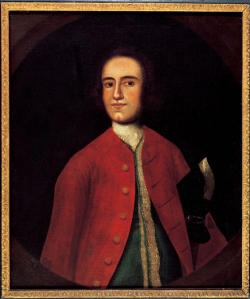
Portrait of Lawrence Washington attributed to Gustavus Hesselius (c. 1738). Credit: Wikipedia / Mount Vernon.
The boy Washington was first charmed by the military service of his older half-brother Lawrence. In 1739, the colorfully-named War of Jenkins’ Ear between Britain and Spain began. Ostensibly sparked by the Spanish coast guard boarding a ship captained by Robert Jenkins and cutting off his ear, the war was another one of those conflicts over trade, colonies, and the spoils of the New World so often fought between Europe’s empires in the 18th century.
In June 1740, a commission from George II arrived in Virginia for Lawrence. He was made a captain in one of four infantry regiments of colonial Virginians being raised for service in the war. On May 30, 1741, Lawrence wrote to his father Augustine describing his role in the Battle of Cartegena de Indias when the British launched an amphibious assault on the city of Cartegena de Indias in Colombia.
Lawrence reported to his father that the British “destroyed eight Forts, six Men of War, six gallioons and some Merchant ships” but “what number of Men they [the Spaniards] lost we know not; the enemy killed of ours about six hundred & some wounded, & the climate killed us in greated [sic] numbers.” In the end, the British suffered a crushing defeat but more because of disease than battle casualties.
“Defensa de Cartagena de Indias por la escuadra de D. Blas de Lezo, año 1741” by Luis Fernández Gordillo. Credit: Wikipedia / Naval Museum of Madrid.
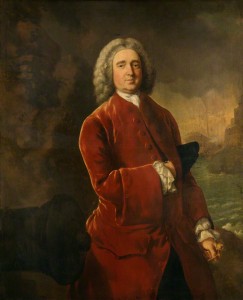
Virginia’s regiments suffered greatly. “Some are so weak as to be reduced to a third of their men,” Lawrence wrote but he also revealed that “vastly to my satisfaction” he had been serving “on board Admiral Vernon’s ship.” Vernon was the naval commander during the battle and was greatly admired by Lawrence. He was so admired, in fact, that Lawrence named the family’s Little Hunting Creek property bequeathed to him after Augustine’s death Mount Vernon.
Lawrence ultimately concluded that “war is horrid in fact, but much more so in imagination.” His experiences aboard an admiral’s flagship probably protected him some from the horrors of war. War did not turn Lawrence off of military service. He was awarded the post of Adjutant General for all of Northern Virginia’s militia along with the rank of major.
George was about 10-years-old when Lawrence returned home from war. How many war stories did his older brother share with him? We do not know but we do know that George and Lawrence were close, especially in the aftermath of their father’s death. It seems a safe bet to conclude that Lawrence’s military service also likely influenced his effort in 1746 to have fourteen-year-old George join the Royal Navy.
George’s captivation with military adventure was further strengthened by the exploits of Duke Frederick Herman von Schomberg. On September 10, 1747, fourteen-year-old George purchased 3 books from his cousin Bailey for the combined price of 4 shillings 12 pence. One of the books is listed as “Scomberg,” a reference to a 17th century German Protestant soldier of fortune, who fought under the flags of France, Germany, Portugal, and England and died at the Battle of the Boyne fighting for William of Orange. Schomberg wrote about his adventures, which would have been of great interest to a young man like Washington. That George willing spent hard earned money during a time of financial hardship reveals how enthralled he was with military exploits.
Portrait of Friedrich von Schomberg atrributed to Adrian van der Werff (c. 1600s) Credit: Wikipedia.
We do not know the impact, if any, of Schomberg’s exploits upon George’s military thinking. One incident does stands out, however. While in Ireland commanding the army of William of Orange, England’s new king, against supporters of James II, England’s old king, Schomberg decided that his raw and undisciplined troops would not fare well in battle. As a result, he held his army behind defensive works instead of confronting the enemy and their superior numbers. This much-criticized action bares notable similarities to Washington’s main strategy during the Revolutionary War. Washington defeated the British because, overall, he did not fight the British. Instead, he maintained his “army in being.” Washington wisely avoided confrontation, when possible, with the professionals who made up the best army in the world. The American army was inexperienced and initially amateur but as long as the army existed, the newly independent United States would also exist. The Continental Army had to survive even if that meant avoiding, instead of confronting, the British Army.
The final adventure that inspired a fascination with military things in young George Washington was his trip to Barbados. In 1751, nineteen-year-old George and his older half-brother Lawrence traveled to that Caribbean island in the hope that the tropical climate would relieve Lawrence’s tuberculous. This was George’s first and only trip away from the North American continent and to another part in Britain’s vast Empire.
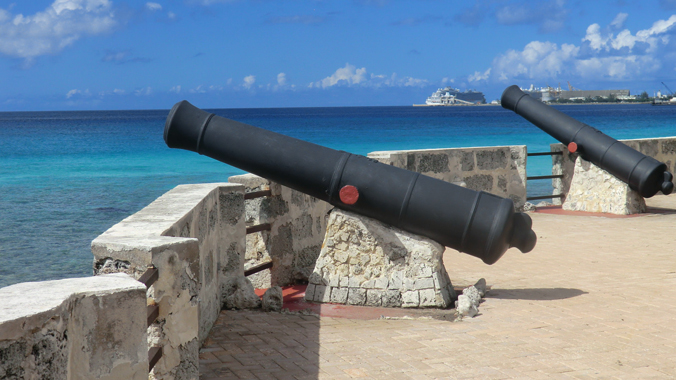
Early in their stay, Washington made the first of several visits to Needham’s Fort guarding the south side of Carlisle Bay. He met Captain Petrie, the fort’s commander, and dined with him at the fort more then once. The fortress seems to have impressed the teenage Washington for he recorded in his journal that it was “pretty strongly fortified and mounts about 36 Gunes within the fortifin and 2 facine Batterys.”[2]
Furthermore, he and Lawrence stayed at the house of Captain Croftan, who commanded James Fort on the bay’s north side. Even Croftan’s house, Washington noted, “command[ed] the prospect of Carlyle Bay & all the shipping in such manner that none can go in or out with out being open to our view.”[3]
Home of Captain Croftan where Washington lived during the several months he visited Barbados in 1751. Credit: Wikipedia / Jerry E. and Roy Klotz
On the return voyage to Virginia and Ferry Farm, George judged that because Barbados had “large intrenchments cast up wherever its possible for an Enemy to Land” the island itself was essentially “one intire fortification.”[4]
As Jack Warren ably concludes, “George Washington’s encounter with the British military establishment in Barbados seems to have had a crucial impact on his aspirations . . . . After returning to Virginia, he dedicated himself to advancement in the military more completely than any of his Virginia contemporaries. And unlike most of the prominent colonial militia officers of the 1750s, he sought a commission in the regular British military establishment– an ambition that was probably prompted, and undoubtedly stimulated, by his experience in Barbados.”
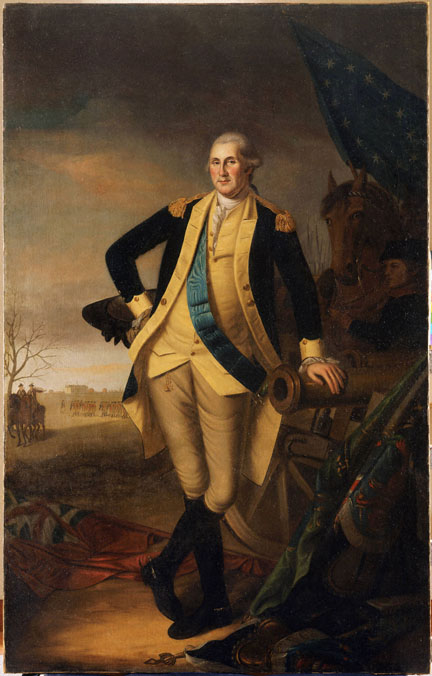
Portrait of George Washington (1772) by Charles Willson Peale. The earliest authenticated portrait depicts Washington in the Virginia Militia uniform he wore during the French and Indian War. Credit: Washington and Lee University / Wikipedia
These three military adventures – Lawrence’s service in the War of Jenkin’s Ear, the written exploits of Schomberg, and George’s trip to the heavily fortified imperial outpost of Barbados – all worked to inspire Washington’s fascination with military matters and drove him to eventually pursue the life of a soldier in the French and Indian War and then, most importantly, in the War for Independence.
[2] Washington in The Daily Journal of Major George Washington in 1751-2 Kept While on a Tour from Virginia to the Island of Barbadoes, J.M. Toner, ed., Albany, NY: Joel Munsell’s Sons, 1892: 52.
As we saw in this blog post, Harriot Washington lost both of her parents by the time she was five years old. Her childhood was spent shuffling from one relative’s household to another. Finally, she came into the care of her uncle George Washington, who along with aunt Betty Washington Lewis, provided stability and support throughout Harriot’s teenage years. She lived with Betty for many years at Kenmore. By the age of 19, Harriot had matured into respectable young woman. Marriage was at hand.
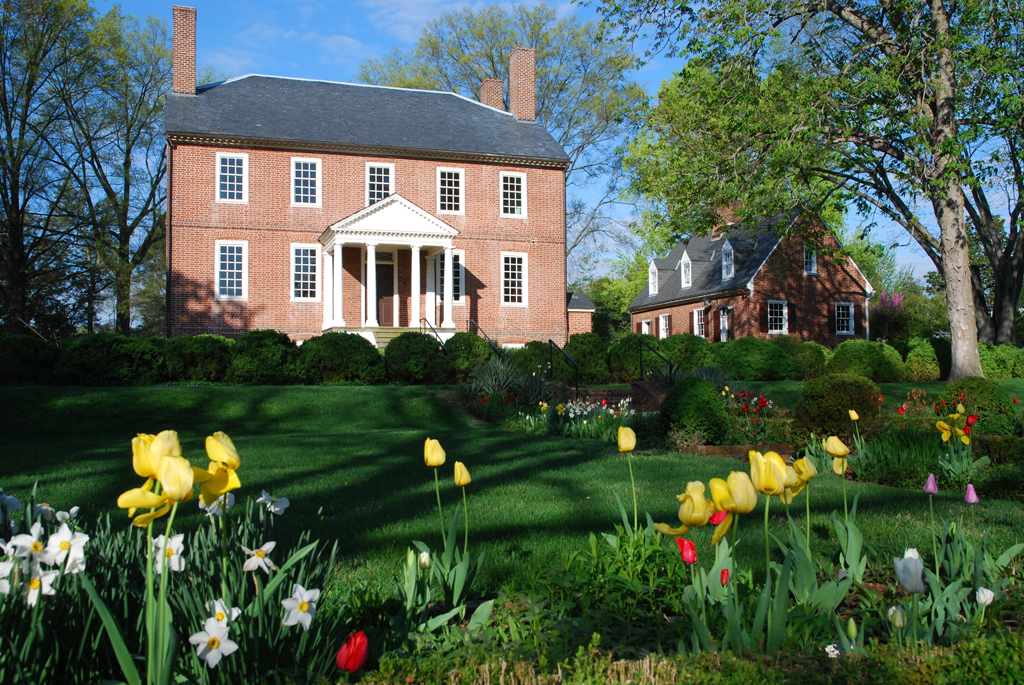
Kenmore in Spring
On April 1, 1796, Washington received a letter from Andrew Parks of Fredericksburg. Andrew had asked Harriot to marry him. Harriot referred him to Washington for his consent and had told Andrew that she would not marry him unless her uncle approved. Andrew wrote a letter promoting himself, with details on his life in town as a mercantile businessman. He frankly revealed that his fortune did not “exceed three thousand pounds.” He believed that he was a hard enough worker to make up for his lack of current money and that he had hopes of improving his situation. He mentioned relations in Baltimore and offered to provide a complete accounting of these family connections, if Washington desired.
Washington replied on April 7. He noted the proposal was a “serious one” that deserved “serious consideration” and that he would take time to ponder it. He warned Andrew that, while Harriot had “very little fortune of her own,” fortunes were not the only factors to consider when contemplating marriage. Harriot’s guardian desired to see her happy and believed only a “gentleman of respectable connexions, and of good dispositions,” who made money, instead of spending it, and who could “support her in the way she has always lived” was an acceptable match.
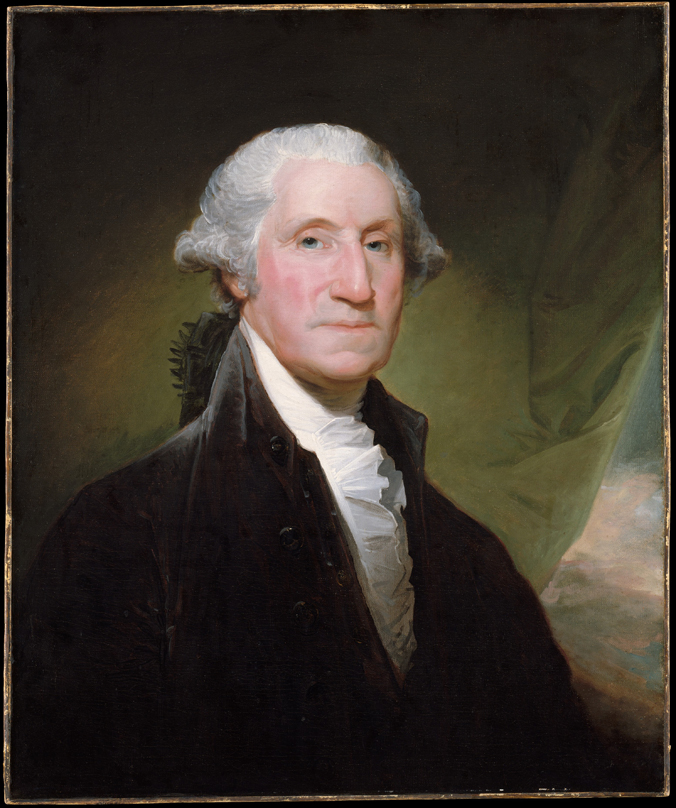
Portrait of George Washington (1795) by Gilbert Stuart. Credit: Public Domain / Metropolitan Museum of Art
Of course, Betty also contacted Washington to inform him of Andrew’s proposal. Her letter seems not to have survived but his response, also dated April 7, basically requested more information about Andrew. Harriot’s uncle acknowledged that “having very little fortune herself,” Harriot had “no right to expect a great one in the man she marry‘s; but if he has not a competency to support her in the way she has lived, in the circle of her friends, she will not find the matrimonial state so comfortable as she may have expected when a family is looking up to her & but scanty means to support it.” Though a great one was beyond possibility, he still believed Harriot ought to “expect one whose connexions are respectable, & whose relations she could have no objection to associate with.” What really troubled Washington was “How far this is, or is not the case with Mr Parks.” He worried, “I know not for neither his own letter, or yours give any acct of his family nor whether he is a native or a foreigner—& we have his own word only for his possessing any property at all altho’ he estimates his fortune at £3000. A precarious dependance this when applied to a man in Trade.”
Although he had no desire to impede the marriage, Washington indeed was anxious for information, which he immediately endeavored to collect. Secretary of War James McHenry wrote Thomas McElderry, Andrew’s brother-in-law and business partner, on behalf of the president. McElderry replied that, after the death of Andrew’s father, he had made Andrew his partner, allowing his brother-in-law to be well set up in business. McElderry also reported that Andrew was a hard worker, gentlemen, and generally well-liked in the community. McElderry judged him “much more promising than many of the Virginia Gentlemen with their large landed Estate and Negroes.” One wonders how helpful this final statement might have been in convincing Washington – the first among Virginia’s landed and slaveholding gentlemen – of Andrew’s good connections!
Betty also made inquiries about Andrew and notified Washington that she had “heard nothing to his disadvantage” and that “he is respected by all his acquaintance.” She revealed that Andrew was “A Constant Visitor here and I believe Harriots Affections are plac’d intirely on him.” Indeed, Harriot, in Betty’s opinion, was sick with “anxiety for fear of offending and not gaining your consent.” Betty then admonished her brother that his “long Silence has given her much uneasiness.”
George Lewis, Betty’s son, examined Andrew’s background and concluded the match, at least at the moment, “to be madness in the extreme.” He suggested waiting until Washington returned to Mount Vernon after his presidency ended, so that he could attend the matter personally and better investigation of Andrew could be made. Still, he believed Andrew “a young Man of good talents” and noted that none of his initial inquiries revealed major problems.
Betty again wrote George about the matter on July 5, 1796. She told George that Lawrence Lewis, another of her sons, had made inquiries and seemed “well pleased” while Harriot’s own brother told Betty that he thought the marriage would be a “very happy one.” Ultimately, Betty herself concluded that Andrew bore “the Best caracter of any young Person that I know” and that Harriot was “Old Enougf now to make choice for her self.” It was high time she was married and that is exactly what happened. On July 16, 1796, Harriot Washington, aged 20, married Andrew Parks.
The day after her wedding, Harriot wrote to her uncle, hoping he was “not offend’d at my Union.” She expressed, with some finality, that “my heart will ever with the liveliest gratitude most gratefully acknowledge and remember your’s & Aunt Washington’s great goodness and attention to me.”[1]
“Far from being displeased at the event,” Uncle Washington responded, “I offer you my congratulations thereon; and sincerely wish it may prove the source of continual happiness to you.” Washington closed the letter with an invitation for his niece and her new husband to visit Mount Vernon whenever Andrew’s business might allow it.
I need not repeat to my dear & Honord Uncle, the infinite pleasure I experienced on reading his kind, & affectionate letter… Mr. Parks and myself return our most grateful thank’s, to you and Aunt Washington for your congratulations and also polite invitation, to visit you which no circumstance whatever could afford us more satisfaction…
My love to Aunt Washington & Nelly Custis. I am my dear & Honord Uncle Your ever affectionate Neice
March 6, 2017 was the 286th wedding anniversary of Augustine and Mary Ball Washington, George Washington’s amazing parents. In addition to calling to mind how grateful we are for their role in raising the boy who would become our courageous General and first president, this anniversary also provides us with an opportunity to discuss the circumstances of Augustine and Mary’s marriage, their family, and their eventful lives here in Stafford and Spotsylvania Counties.
It was not Augustine Washington’s first time to the altar. His earlier marriage to Jane Butler in 1715 produced four children. Jane was likely 16 when she gave birth to their first son, Butler, who died in infancy. Butler was followed by Lawrence (b. 1718), Augustine Jr. (b. 1719 or 1720), and Jane (b. 1722). Their mother tragically passed away in 1729 just shy of her thirtieth birthday. This left young Lawrence (about 11 years old), Augustine Jr. (around ten), and Jane (about seven) without a mother. Their devoted father immediately began a judicious search for a proper wife for himself, a nurturing mother for his children, and an experienced household manager.
He discovered such a gem in the Northern Neck’s attractive and highly eligible maiden, Mary Ball. Mary’s family had thrived in the Virginia Colony’s tidewater region for generations. Mary gained valuable experience managing property from her mother, Mary Johnson Ball who oversaw the family’s substantial resources after the death of Mary’s father Joseph Ball when Mary was only three years old. Mary’s mother again wed, and was soon widowed with additional resources to manage, thanks to the generosity of her devoted husband. When Mary was only 13, her mother passed away, and Mary joined the household of her older, half-sister Elizabeth Johnson. Thereafter, childbirth and childrearing became second nature to Mary who, as a loving aunt, gained valuable experience helping to nurture her sister’s children and perfecting the lessons in household management first learned under her mother’s tutelage.
When it came to matrimony, anxious parents typically steered their children toward appropriate choices, especially among established and propertied clans as the Washington and Ball families. But death had robbed both Augustine and Mary of their respective parents and their wisdom. Some claim that Colonel George Eskridge, a prominent Northern Neck Lawyer and family friend, helped bring this destined pair together. While a parent’s concerns provided some guidance for young lovers, it was only one of several considerations for eager suitors. Ideally, the opportunity for social advancement, acquiring property (both land and enslaved labor), financial security, and – of course – affection were also carefully weighed.
Mistress Mary Ball rang all of these “bells:” She was experienced with children. She had been tutored in plantation management and household skills by her experienced mother. Mary Ball’s generous and enviable dowry had accumulated to include 1000 acres of Virginia land, enslaved laborers, horses, cattle, and sundry personal belongings. Notably, the majority of her acreage bordered Augustine Washington’s iron mine in Accokeek, just one of Mary’s assets that Augustine found irresistible.
On March 6, 1731, the pair joined. Mary was about 23 and her new husband Augustine was 37. Of Augustine’s three living children from his first marriage, Lawrence, Augustine Jr., and Jane, it was Jane who remained a daily part of their Westmoreland Plantation home. Mary continued the household training that young Jane started learning from her own mother. Lawrence and Augustine Jr. continued their education at the Appleby Grammar school in England where their father had attended school.
Before their first wedding anniversary, Mary and Augustine welcomed their first son, George, into the world. He was born on February 11, 1731 (Old Style) in Westmoreland County. In all, their happy marriage produced six children: George (1732), Betty (1733), Samuel (1734), John Augustine (1736), Charles (1738), and Mildred (1740). All but little Mildred survived to adulthood.
Just twelve years after their wedding, Augustine Washington passed away around the age of 48. Mary remained a widow throughout her long life, focused upon raising their children, and later playing an active and cherished role in the rearing and education of her grandchildren. Mary moved into the town of Fredericksburg in the spring of 1772, within easy walking distance of her daughter Betty’s household, headed by Fielding Lewis and known today as Kenmore. She was remembered fondly by her grandchildren and, at her request, was buried near Meditation Rock in Fredericksburg, Virginia.
Laura Galke, Archaeologist
Site Director/Small Finds Analyst
With one sister and three brothers, George Washington was uncle to numerous nieces and nephews. One niece was Harriot Washington was born sometime in 1776 to his brother Samuel and Samuel’s fourth wife Ann Steptoe. Harriot was orphaned by the time she was five years old, when her mother died in 1777 and her father in 1781. Harriot’s younger years were a hard life of shuffling between relatives’ households. She gained stability with her aunt Betty Lewis at Kenmore, where she spent her teenage years. Both George and Betty were constantly concerned about her financial well-being and development into a respectable woman of the gentry class.[1]
HARRIOT AT MOUNT VERNON, Late 1780s-1792
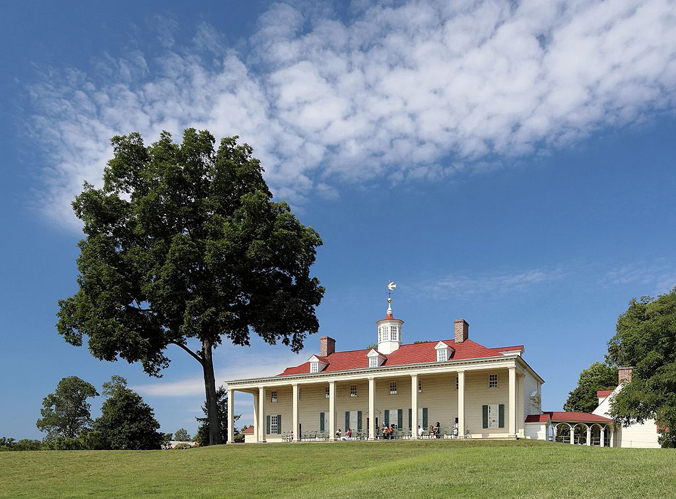
Mount Vernon. Credit: Wikipedia/Martin Falbisoner
After her parents’ deaths and living in the care of her mother’s relatives for four or five years, Harriot came to live with uncle George at Mount Vernon because, as Washington noted to nephew George Augustine Washington, he knew of “no resource that Harriot has for Supplies but from me.”
When George and Martha departed Mount Vernon for New York City and his presidency, however, Martha’s niece Fanny became Harriot’s de facto guardian. Washington lamented to Tobias Lear that Fanny was “little fitted” to the task of caring for her, however. The new president seemed perplexed by Harriot “who is almost grown” but “is not quite a Woman” and wondered, with some exasperation, about what to do with her. He judged that, while she was by no means too old to attend boarding school, any such school would have to “enforce good rules” since Harriot was “prone to idleness” and had been “under no control.”
Several letters between Harriot and her uncle survive. The first in the record was written on April 2, 1790. Harriot was 14-years-old and living at Mount Vernon while Washington was in New York. Harriot asked her uncle to send her a guitar since she wanted to take lessons for “all the young Ladyes are a learning musick.” Harriot was confident “that five or six lessons would be sufficient for any body to learn.” The records consulted reveal no response from Washington.
Harriot wrote a brief letter on October 24, 1791 with short comments about the dreadful weather and an illness plaguing Lund Washington. Harriot mentioned that she had waited until the last minute to write the letter before it had to be sent. This seeming laziness displeased Washington and, worried about his niece’s idle behavior, he took the opportunity to provide a lengthy letter of advice beyond admonishing her to not wait until the last moment to begin a task. He warned Harriot of the…
“delicacy and danger of that period, to which you are now arrived under peculiar circumstances—You are just entering into the state of womanhood without the watchful eye of a Mother to admonish, or the protecting aid of a Father to advise and defend you; you may not be sensible that you are at this moment about to be stamped with that character which will adhere to you through life.”
Washington assured Harriot that her cousins at Mount Vernon were “well qualified to give you advice” and he hoped that she was “disposed to receive it.” If she was “disobliging—self willed and untowardly,” however, her cousins would not “engage themselves in unpleasant disputes” but would likely leave her to descend into poor character. Washington encouraged her to “Think then to what dangers a giddy girl of 15 or 16 must be exposed in circumstances like these—To be under but little or no controul may be pleasing to a mind that does not reflect, but this pleasure cannot be of long duration.” Washington seemed to express concern about those with whom she was associating and that from them she “can derive nothing that is good.” This warning might have also been a general caution against keeping poor company. Regardless, he wanted her to “aid to your Cousin in the domestic concerns of the family.”
Harriot replied, “I was very sensible, of your kindness in giving me such good advice, and shall try to profit, by it as much as I can, I know very well, the obligations I am under, to you and I am very thankful for your care and attention to me.” She duly promised to assist more with the household duties. On May 28, 1792, Harriot requested a guitar again and this time, Washington bought her one for $17.
HARRIOT AT KENMORE, 1792-1795
Portrait of Betty Washington Lewis by John Wollaston, c. 1755.
In the fall of 1792, Washington determined it was necessary for Harriot to go live with his sister Betty Washington Lewis in Fredericksburg. He and Martha were to return to the new national capital of Philadelphia while Fanny and her ill husband were leaving for New Kent County. No one was left at Mount Vernon to care for Harriot.
Betty raised no objections to taking in Harriot “if she comes well cloath’d or Provided to get them, that she may appear tolerable.” She wanted to forestall any chance that the young lady “was prevented frequently from appearing in publick.” Betty reminded George of the Lewis family’s deep financial difficulties and that her grandchildren were living with her too.
Washington assured his sister that Harriot would arrive “very well provided with every thing proper for a girl in her situation.” He judged Harriot as having “sense enough, but no disposition to industry nor to be careful of her Cloaths.” He hoped Betty’s example and guidance would end the 16-year-old’s habit of always wearing her best things while also leaving clothing lying all over her room. Fanny had been too lenient with her, Washington suggested, but Betty’s firm hand could still yet “make a fine woman.”
Not long after getting settled in Fredericksburg, however, Harriot requested money from Washington for a dress or dress material so that she could attend the town’s ball celebrating the president’s birthday. She apologized for again troubling Washington and assured him that any money sent would be kept by Betty. Harriot promised to “properly care for the new dress.
At the end of January 1793, Betty confirmed receiving money sent by Washington for Harriot. She noted that living in town was “unfortunate” for Harriot “for many [of her] things that could be wore to the last string in a [country] Place, will not do here, where we see so much Company.” Betty took the opportunity to praise Harriot as well, noting that she “Payes the strictest regard to the advice I give her and really she is very Ingenious in makeing her Clothes and altering them to the best advantage.”
Time and a few other letters about money passed back and forth until September 1793 when Betty sent a letter to her brother asking when he might send for Harriot so that she could again live at Mount Vernon. Betty revealed that, while she knew “of none that I would sooner have to live with me,” her own dire financial situation was not conducive to Harriot staying. Betty expressed dismay over the small amount of her income and the small number of servants she had. To compound matters, she now only owned two horses, which kept her from visiting over any lengthy distance. All the while, Harriot and two grandchildren lived with her.
Washington perhaps agreed that the time had come for Harriot’s return to his household. It seems he told Betty that if Philadelphia’s yellow fever epidemic continued, Martha would spend the winter of 1793-94 away from danger at Mount Vernon. If this were the case, he would send for Harriot and she could stay with Martha. This plan, however, was not implemented. Instead, Harriot spent part of the winter of 1793-94 with a relative in Culpeper.
As Kenmore, life for Harriot seemed to settle into something of a routine. Her letters reveal a growing maturity and an understanding of her situation. Money was still an ever present matter but one gets the impression that her requests were for real needs. In 1794, requests for cash went to Washington on May 25, and June 27. A letter of thanks from Harriot to him is dated July 10. One further request for money came on January 4, 1795.
Betty and Harriot left Kenmore to live at Millbrook in November 1795. Harriot turned 19-years-old that year and the focus of her relationship with both her aunt and uncle shifted from an orphan girl who had lived a “hard knock life” to a eligible and mature young woman with a respectable suitor and marriage on the horizon.
To be continued….
Zac Cunningham
Manager of Educational Programs
[1] ; Frank E. Grizzard, Jr., “Washington, Samuel, (1734-1781),” George! A Guide to All Things Washington, Charlottesville, VA: Mariner Publishing, 2005, 337-338; Note accompanying “To George Washington from Harriot Washington, 2 April 1790,” Founders Online, National Archives, http://founders.archives.gov/documents/Washington/05-05-02-0199; “Samuel Washington,” Wikipedia,http://en.wikipedia.org/wiki/Samuel_Washington, [accessed September 8, 2014].
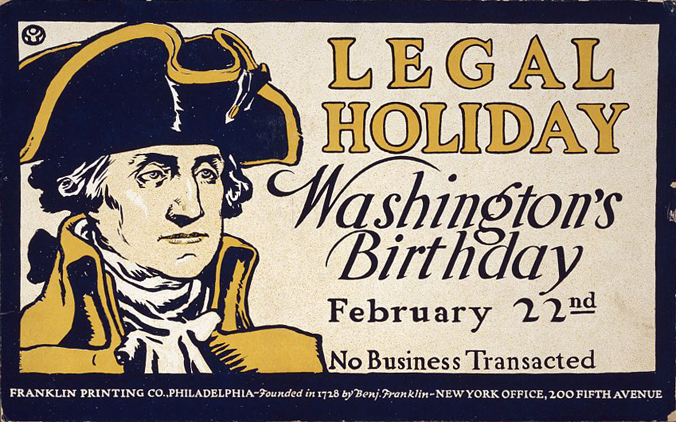
A poster from the late 1800s announcing that no business will be conducted on Washington’s Birthday, which was then celebrated on his actual birth date of February 22. Credit: Library of Congress
Happy Birthday, George!! Two-hundred and eighty five years ago today on February 22, 1732, George Washington was born. Americans have commemorating his birth and his life for centuries, since he rose to prominence as the commanding general of the Continental Army and the nation’s very first president. For centuries, his likeness has been added to plates, glasses, and bottles, carved in stone, etched on coins, used in advertisements, and printed on clothing to create unique memorabilia celebrating the man who was eulogized as “First in war, first in peace, and first in the hearts of his countrymen.”
The 1932 celebration of Washington’s 200th birthday especially led to increased demand for Washington memorabilia. The George Washington Foundation has a small collection of both this bicentennial and a few commemorative objects from even earlier. To mark George’s birthday in 2017, Lives & Legacies shares photographs of this memorabilia!
Amber glass hatchet from either the 1893 Chicago World’s Fair or the 1904 St. Louis World’s Fair. Made by the Libbey Glass Company at the World’s Fair Libbey Glass Demonstration Furnace where visitors could observe glass manufacture and then purchase the glass hatchets. They came in other colors such as opaque white, amethyst, green, and cobalt blue.
Medal featuring a right-facing bust of Washington that was awarded by the New York State George Washington Bicentennial Commission “in appreciation of Services generously Rendered to the Commission During 1932.” The accompanying card is signed by Charles Tobin, the commission’s chairman.
A pin dating from around 1900 that features a portrait of George Washington from the chest up and wearing a red coat. The image is printed on paper or fabric and is covered by celluloid, with a metal, goldtone rim. The pin could be attached to a piece of clothing and has a bar for hanging a ribbon or pendant. The Washington image of has “PAT. W.& H. CO. / NEWARK, N.J.” printed on either side.
A Washington Bicentenary Memorial Plate from 1932 made by Crown Ducal in Stoke-on-Trent, England. This ceramic plate with blue transfer-print was part of a series of 12 to commemorate the 200th anniversary of Washington’s birth. It imagines General Washington and Mary, his mother, strolling through a romanticized rural landscape.
A clear glass bottle from 1932 made by the Owens-Illinois Glass Company of Huntington, West Virginia. One side is a crude embossed profile of a Washington bust while the other side has embossed depiction of a cherry tree with the dates “1732” and “1932” on a scroll beneath.
A commemorative plate from 1932 with an elaborate floral gilded border and a transfer-printed bust of George Washington in the center and made by the Capital Souvenir Company.
A commemorative porcelain tray depicting George Washington, Martha Washington, and Mount Vernon. The vignettes were transfer-printed first and then hand-painted to add details. At the bottom of the Mount Vernon vignette is printed “Washington’s Home / Mount Vernon, Va.” The tray was made by Tressemann & Vogt in Germany between 1891 and 1907.
A green water bottle with a likeness of George Washington under the word “water.” The bottle reads “Washington / Bicentennial” with the dates 1732 and 1932 on either side. It was made by the Hemingray Glass Company in Muncie, Indiana.
Parents, perhaps hoping to spur their offspring to similar greatness, have named their children George Washington ever since the most famous George Washington rose to prominence as commander of the Continental Army and the nation’s first president. Few other George Washingtons ultimately achieved the original’s stature, although a few perhaps came close. As we mark George Washington’s birth this month (Come to our Washington’s Birthday celebration at Ferry Farm this Saturday!), we share the compelling stories of five notable Americans named George Washington.
George Washington Vanderbilt II Credit: Wikipedia/Biltmore Co.
George Washington Vanderbilt II was born in 1862 into New York’s wealthy Vanderbilt family. At the age of 27, he began buying vast tracts of land near Asheville, North Carolina. He loved the mountains and wanted to build a grand home among the Blue Ridge. Working with architect Richard Morris Hunt, Vanderbilt planned the house and oversaw construction of the $3,000,000 mansion. He named the home and estate “Biltmore.” Vanderbilt used his vast acreage to help to pioneer scientific forestry and began a forestry school on his estate. His first superintendent of forests was Gifford Pinchot, who became the first chief of the U.S. Forest Service. Vanderbilt died in 1914 in Washington, DC.[1]
The Biltmore Estate near Asheville, North Carolina. Credit: Wikipedia
George Washington Gale Ferris, Jr. Credit: Wikipedia
George Washington Gale Ferris, Jr. was born in Galesberg, Illinois in 1859. He studied engineering at Rensselaer Polytechnic Institute in New York. He worked for a series of railroad and mining companies in West Virginia before focusing on bridge-building and structural steel construction. He started G.W.G. Ferris & Company in Pittsburgh and helped build bridges across the Ohio River in that city as well as in Wheeling and Cincinnati. For the Chicago World’s Fair in 1893, he designed the Ferris Wheel. “Rising 250 feet above the Midway, carrying thirty-six cars, each with a capacity of some forty passengers, revolving under perfect control, and stable against the strongest winds from Lake Michigan, it excited general attention.” He died in Pittsburgh in 1896.[2]
The Ferris Wheel at the 1893 Chicago World’s Fair. Credit: Wikipedia/New York Times
George Washington De Long was born in New York City in 1844. An American naval officer, he organized and commanded an attempt to reach the North Pole via the Bering Strait. His expedition left San Francisco aboard the Jeanette, a coal-burning steamer also equipped with sails, on July 8, 1879. The Jeanette became trapped in the ice for 22 months before being crushed and forcing the crew to abandon ship. The crew took to three lifeboats. One was lost, one made it to shore but all of its crew died of starvation and exhaustion, and one made it to shore where its crew was rescued. De Long did not survive, dying in Siberia on October 30, 1881. Three years later, debris from the Jeanette was found nearly 3,000 miles away off Greenland’s coast, proving the polar ice was in motion.[3]
George Washington Crile was born in Ohio in 1864. He received his M.D. from what is known today as Case Western Reserve University School of Medicine. He was a leading pioneer in surgical medicine during the first half of the 20th century. He dedicated much of his wide-ranging and groundbreaking career to studying the impact of shock on patients undergoing surgery and to developing pioneering ways to treat and combat that shock. He advocated for monitoring blood pressure during surgery and, most importantly, recognized the most effective way to stave off shock was through blood transfusions during operations. He is credited with performing the first direct blood transfusion. Surgical shock’s worst outcome was death so Crile developed resuscitation methods and, in the process, discovered the brain could be deprived of oxygen for only a very few minutes before resuscitation become impossible. In 1921, he and several colleagues founded the Cleveland Clinic, considered one of the world’s foremost medical centers. Furthermore, a pressure suit he developed to prevent surgical shock was adapted to prevent blackout in pilots during World War II. He died in Cleveland in January 1943.[4]
George Washington Carver Credit: Wikipedia/Tuskegee University Archives
George Washington Carver was born a slave in Missouri in the early 1860s. He attended a series of schools in Kansas and Missouri and graduated from Minneapolis High School in Minneapolis, Kansas. He was rejected from one college because of his race but became the first black student at Iowa State Agricultural College, where he received both his bachelor’s and master’s degrees. In 1896, Booker T. Washington hired Carver to chair the agricultural department at the Tuskegee Institute, where he remained for half-a-century. As a agricultural scientist, Carver created methods to revive soil exhausted from planting only cotton year after year. These methods centered on rotating cotton with sweet potatoes, peanuts, soybeans, and cowpeas, which restored nitrogen in the soil and provided income for farmers as well. He trained farmers to grow these alternative crops and distributed recipes using these crops to the public to spur demand. His efforts to promote the peanut especially sparked the public’s imagination. He died on January 5, 1942 in Tuskegee, Alabama.[5]
Zac Cunningham
Manager of Educational Programs
[1] “George Washington Vanderbilt.” Dictionary of American Biography, Charles Scribner’s Sons, 1936. Biography in Context, link.galegroup.com/apps/doc/BT2310001556/BIC1?u=crrl&xid=3822e021. Accessed 9 Feb. 2017.
[2] “George Washington Gale Ferris.” Dictionary of American Biography, Charles Scribner’s Sons, 1936. Biography in Context, link.galegroup.com/apps/doc/BT2310013691/BIC1?u=crrl&xid=3144ffeb. Accessed 9 Feb. 2017.
[3] “George Washington De Long.” Explorers & Discoverers of the World, Gale, 1993. Biography in Context, link.galegroup.com/apps/doc/K1614000095/BIC1?u=crrl&xid=e0125245. Accessed 9 Feb. 2017.
[4] “George Washington Crile.” Dictionary of American Biography, Charles Scribner’s Sons, 1973. Biography in Context, link.galegroup.com/apps/doc/BT2310015367/BIC1?u=crrl&xid=8dcc7fd9. Accessed 10 Feb. 2017.
[5] “George Washington Carver.” Contemporary Black Biography, vol. 4, Gale, 1993. Biography in Context, link.galegroup.com/apps/doc/K1606000443/BIC1?u=crrl&xid=3bdf1f8b. Accessed 10 Feb. 2017.
Fielding Lewis was married twice. He and Catharine Washington, his first wife, had three children: John, Frances and Warner. Both Warner and Frances died leaving John as the sole heir from this first marriage. After Catharine’s death, Fielding married Betty Washington, and not quite a year later Fielding Lewis Jr. was born in 1751. Although just 4 years younger than his half-brother John, by rights at that time, Fielding Jr. could have supplanted his older brother as Fielding Sr.’s primary heir. No personal accounts or letters tell us what Fielding Sr. thought about his two eldest sons’ status as heirs to his estate but his actions in the years after their births are telling.
Fielding Lewis Jr (c. 1775) by Charles Willson Peale
John Lewis (c. 1775) by Charles Willson Peale
In 1775, Fielding Lewis commissioned five portraits by American artist Charles Willson Peale, for his newly completed home at Kenmore. Only two have been located and they are of Fielding’s two eldest sons. Peale scholars feel fairly certain that the works were painted as companion portraits, intended to hang side by side with the poses of the two sitters meant to complement one another. Perhaps Fielding was making a visual statement that his two eldest sons were on equal footing and that neither took precedence. Indeed, in his final will and testament, Fielding provides for both sons equally, giving his Spotsylvania lands to John and his Frederick County lands to Fielding Jr. On the surface, it might appear that the two brothers had an amicable relationship, not marred by the usual 18th century family in-fighting over inheritance. Well, that appearance might not tell the whole story. The half-brothers couldn’t have been more different.
Unfortunately, Fielding’s prediction would prove true. Over the next decade, Fielding Sr. paid his son’s debts time and again, while Fielding Jr. continued to make significant purchases on credit. Eventually, Fielding Sr.’s burden would be passed to John Lewis.
Fielding Lewis passed away in 1781. John Lewis remained in the Fredericksburg area, acting as executor of his father’s estate, and seeing to its myriad debts and complicated business transactions. He oversaw operations on the lands left to him, and assisted his step-mother, Betty Lewis, in maintaining Kenmore, which would become his upon her death. He wrote on several occasions of tight finance, and frustrations with his father’s estate but managed to hold it all together.
As Fielding was seeking help from his uncle, John was planning one of many trips to “the Westward” as he called it – the Western frontier, and Kentucky in particular. His first expedition to the Kentucky territory was on behalf of his father, before the Revolution, when Fielding Sr. was considering a land purchase there. Apparently, John fell in love with the country, and returned many times in the coming years, making several land purchases of his own. His uncle George asked him to act as his agent on several of these trips, to assess the state of Washington’s own property near Pittsburgh.
Fielding’s improved situation was short-lived. His wife Nancy died in 1788. Fielding remarried to Elizabeth Dade, who apparently did not bring a fortune to the union, and so the 1790s would be a rough decade for Fielding. He was returned to debtor’s prison in 1790, and found that there was no one in a financial situation to save him, with the exception of his brother John. John, however, was not willing to give him money outright. Instead, he required that Fielding mortgage everything – slaves, housewares, livestock – in exchange for £1200.[2] One senses the family losing patience with Fielding.
After this disastrous turn of events, Fielding’s whereabouts for the rest of his life become murky. He never again owns property, and most likely stayed with various family members, including John. His children remained with Betty at Kenmore. There may have been little contact between Fielding and his children, as indicated in a letter written to him by his brother George informing him of Betty’s death in 1797. George wrote, “You will no doubt be anxious to know what is to be done with poor little Nancy (Fielding’s daughter), she is in good health, and at present with sister Carter…”[3] It is unknown where Fielding was when George sent him this letter.
After Betty’s death, John moved quickly to sell Kenmore. Although it would take several years, he did eventually save enough money to move his family to his land in Kentucky, where he spent the rest of his life. Perhaps the family obligations and strain of his father’s estate made Kentucky a more appealing home than Fredericksburg. While Fielding Lewis Sr. wanted very much for his two eldest sons to be seen and treated as equals, their lives played out in very different ways, and that’s the real story behind the portraits.
[1] Fielding Lewis Jr. to Richard Simcock, 15 January 1786. The George Washington Foundation Manuscript Collection.
[2] Indenture Between Fielding Lewis Jr. and John Lewis, 20 March 1790. The George Washington Foundation Manuscript Collection.
[9] George Lewis to Fielding Lewis Jr., 31 March 1797. The George Washington Foundation Manuscript Collection.





 Anthropologists – scholars who study people – make special efforts to identify such symbols in societies, both in contemporary studies and in analyses of past people.
 beginning by the 1760s, the fox symbolism present on tallio buttons was malleable