In April 1738, an advertisement in the Virginia Gazette described the 100 acres of land later purchased by Augustine Washington as “a beautiful situation” with “a very handsome dwelling house.” Located about 2 miles below the falls of the Rappahannock and near the public ferry, this unique landscape became George Washington’s boyhood home.
“The Old Mansion of the Washington Family” (1833) by John Gadsby Chapman shows the foundation stones of the Washington house and the surrounding river landscape.
Steeped in the legends of our nation’s first Founding Father, Ferry Farm is of course a popular destination for those looking to immerse themselves in history and walk in young George’s footsteps. At the same time, visitors to Ferry Farm have the unique opportunity to explore the natural landscape and learn more about local wildlife. Whether you are meandering along the wooded river trails, traipsing through the demonstration garden, or observing the drama of the Rappahannock from the river bluff, visitors can understand why this location was once described as a “beautiful situation.”
The front door of the Washington House overlooks the river flood plain on a sunny summer day.
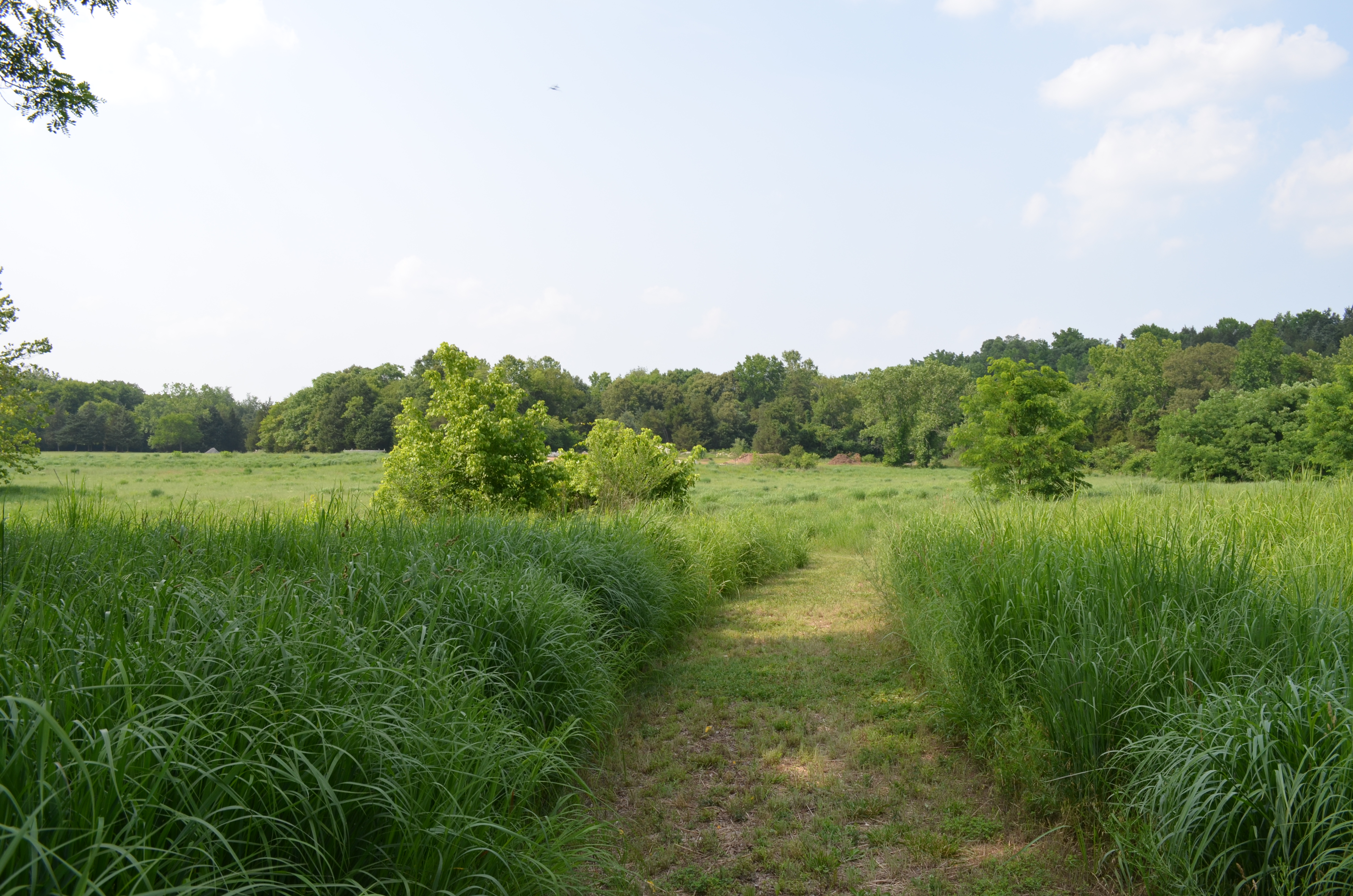
Visitors to Ferry Farm can traverse through a variety of habitats during their visit, including the open lawns surrounding the Washington House, native plant and wildflower meadows, and hardwood bottomlands (ie. river swamps). These trails and natural features are home to a menagerie of wildlife, including commonly spotted critters like deer, groundhogs, foxes, and bald eagles.
While bald eagles may be the most patriotic bird swooping over our property, Ferry Farm is a prime birding location for all kinds of species. Over the years, several local birding groups have surveyed the property. (Read more about past bird surveys at Ferry Farm here and here.) At Ferry Farm, we are lucky to also have a bluebird trail maintained by The Virginia Bluebird Society. While walking the grounds, guests can enjoy the sights and sounds of Eastern Bluebirds and other native bird species as they flit about the bluebird boxes.
The Virginia Bluebird Society (VBS) was founded in 1996 to help promote, protect, and support native cavity bird species in Virginia. What originally began as 3 trails and 47 nest boxes expanded to a network of trails that, in 2020, encompassed 431 trails and 4,752 nest boxes.VBS trains a dedicated force of volunteers who monitor the boxes and record invaluable data. From April to August, volunteers walk the Ferry Farm trails checking on our 10 boxes and monitoring nest activity. In addition to bluebirds, other native cavity nesters such as tree swallows, chickadees, and house wrens may also make their home in these boxes. Last year at Ferry Farm, 28 bluebirds and 8 tree swallows fledged. We are incredibly grateful to the Virginia Bluebird Society for all their hard work and are excited to see how many birds fledge at Ferry Farm this year!
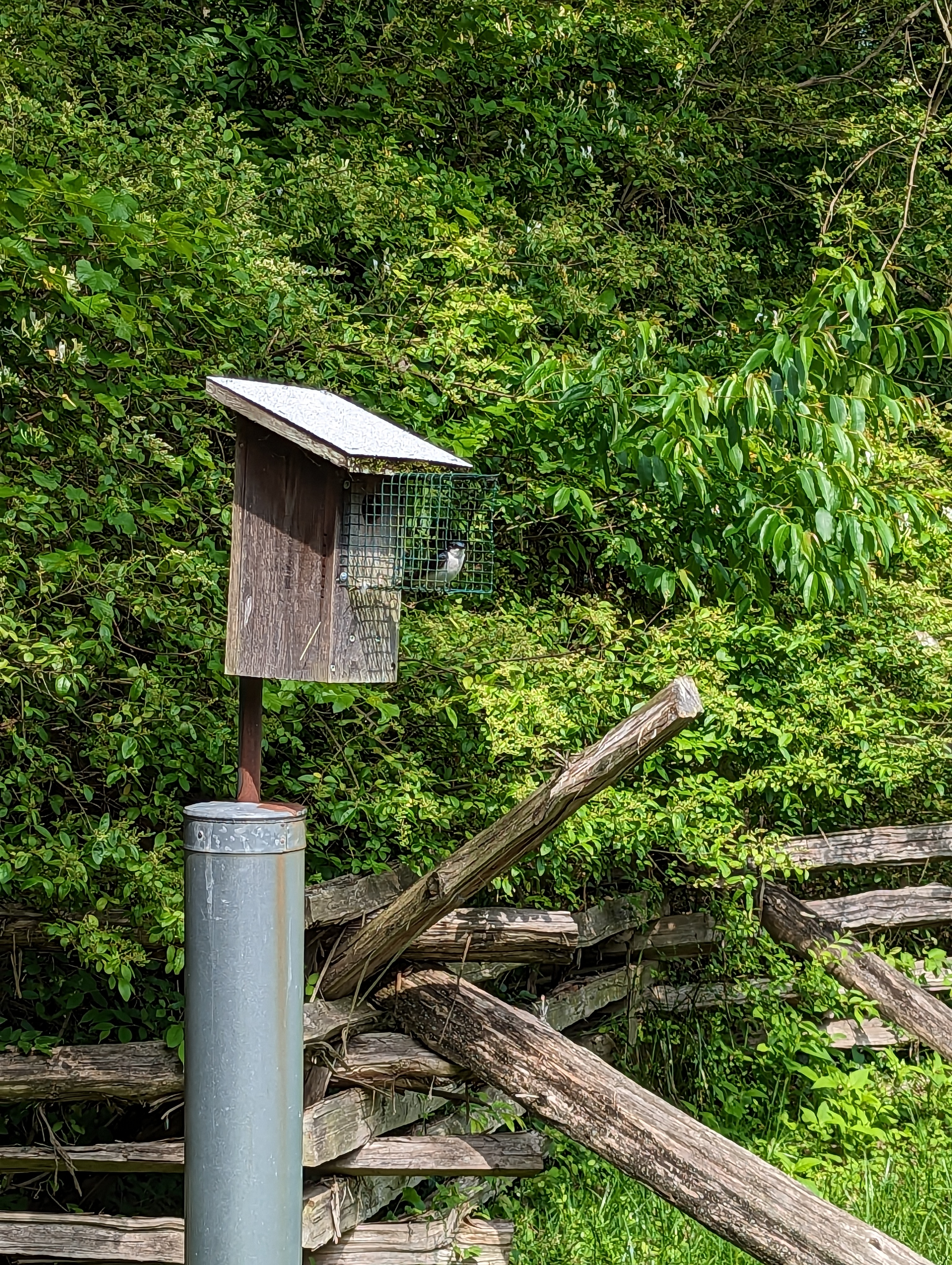
Look closely and you’ll spot a tree swallow perched outside a Ferry Farm nest box! Two predator guards, a Snake Guard and a Cat/Raccoon Guard, are installed to help prevent predators from accessing the boxes. The metal mesh on the front of the box makes it harder for curious paws to reach inside the nest, and the metal cylinder covering the mounting post prevents snakes from scaling the post.
If you visit Ferry Farm this summer, make sure to bring your bird book and binoculars and keep an eye on the sky as you explore the natural landscape!
Both Historic Kenmore and George Washington’s Ferry Farm – perhaps surprisingly – feature fairly significant maritime histories. Situated on the Rappahannock River, Fredericksburg was a bustling seaport in the 1700s when George Washington grew up at Ferry Farm and when Fielding Lewis practiced his merchant trade while living at Kenmore. George saw ocean-going sailing vessels unloading and loading cargo from his bedroom window. Some of these ships were owned by Fielding and his family. Both men were part of “the Atlantic World,” a global community of many different peoples trading back and forth across the Atlantic Ocean.
Here on Lives & Legacies, we’ve written regularly about Fredericksburg as a seaport and about the impact of Atlantic trade on both the Washingtons and the Lewises.
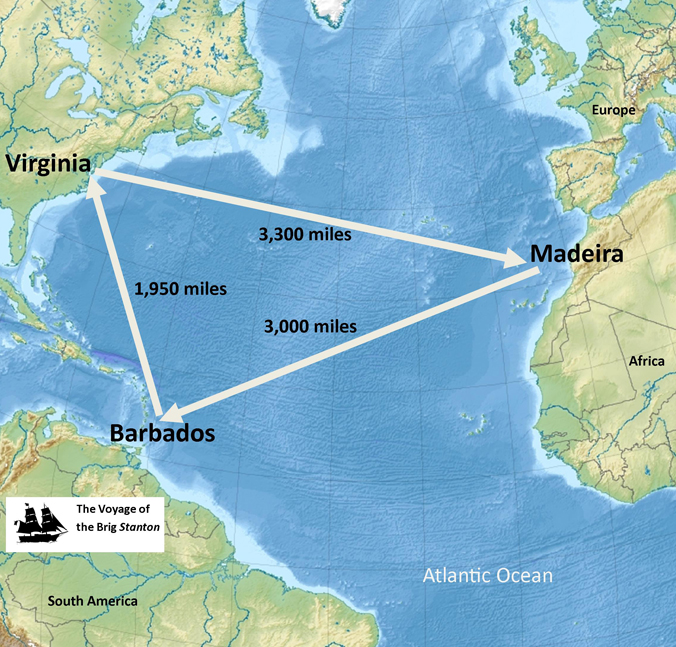
“The Voyage of the ‘Stanton’” recounts one voyage of a Lewis family ship and the cargo it carried traveling from Virginia to Madeira off the European coast, then to the British West Indies in the Caribbean, and finally back to Virginia. Each leg of this journey formed part of the Atlantic World’s famed “Triangular Trade.”
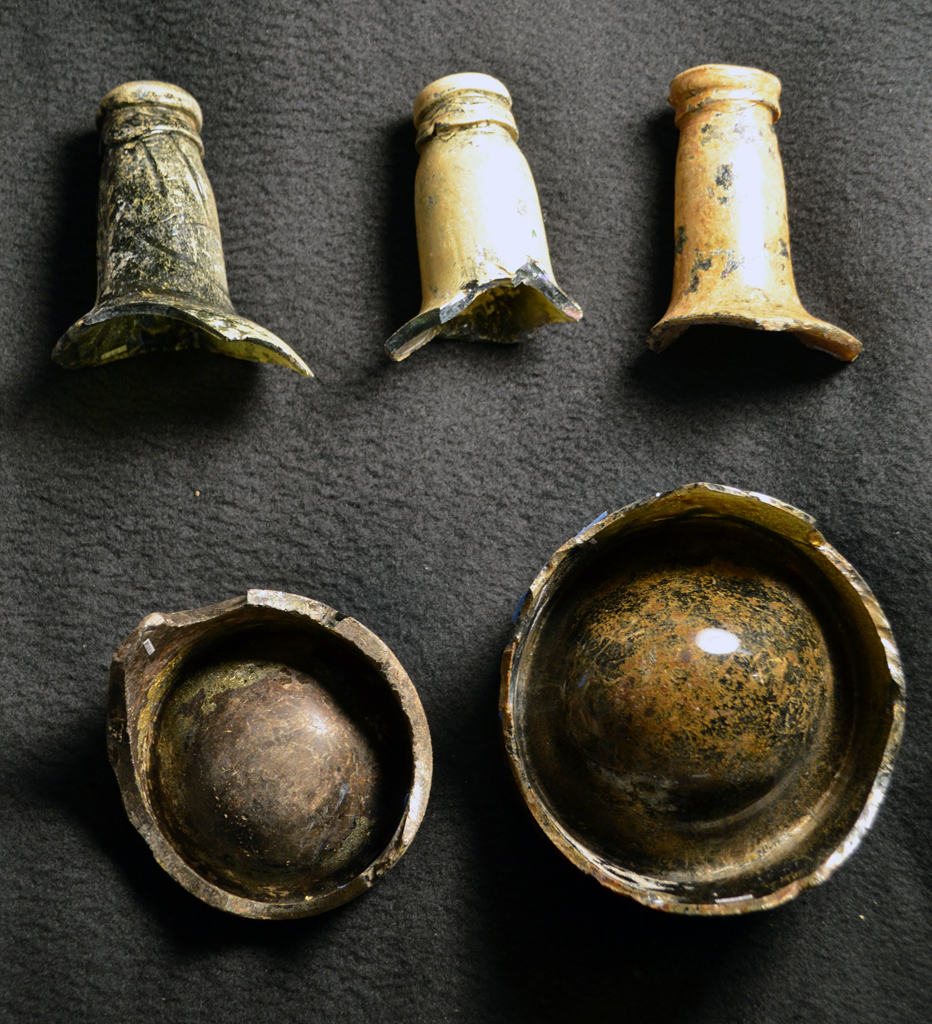
Many of the Washington family artifacts recovered at Ferry Farm came to their home from different parts of this triangle and beyond. For example, the fragments of wine bottles depicted below and written about in “The Wine Bottle: Ubiquitous and Informative” may have carried fortified wine from Madeira to Ferry Farm. European grapes did not grow well in the colonies while native grapes did not make good wine so wine was imported.
Mid-18th century bottle neck and base fragments excavated from the Washington house cellar at Ferry Farm.
An example of what the bottles excavated at Ferry Farm looked when they were whole.
The maritime-based economy that brought Madeira wine and the many other goods used by the Washingtons at Ferry Farm is also perfectly symbolized by a “black dogg” coin. Unearthed not far from the Washington house site and written about in “The Tale of the ‘Black Dogg,’” this coin “originally circulated in the French Caribbean” and may well have come to Fredericksburg in a sailor’s pocket.
“Black dogg” coin excavated at George Washington’s Ferry Farm.
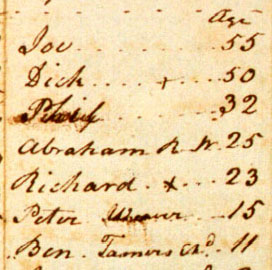
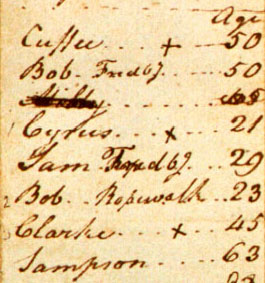
As a merchant, Fielding Lewis owned ships that traveled the Atlantic World carrying goods to and from Fredericksburg. The goods brought to Fredericksburg he then sold to the community or placed in his fashionable home. Maritime trade was Fielding’s life-long business and he put some of his enslaved workers to that task. As written about in “Abraham and The Ropewalkers,” a handful of Lewis slaves wove rope at ropewalks near Fredericksburg or perhaps even in Richmond. Of course, much of this rope was likely used on Virginian sailing vessels.
Portion of The Divvy List made by Betty Washington Lewis showing Abraham with an “R.W.” after his name.
Portion of The Divvy List showing Bob #2 with “Fredbg” after his name and Bob #2 with “Ropewalk” after his name.
The impact of today’s ocean-going global trade can be largely unseen. Similarly, the maritime histories of Kenmore and Ferry Farm are not immediately evident to our eyes. However, sailors, ships, and their cargos significantly influenced the lives of the Washingtons, the Lewises, and the enslaved people of Ferry Farm and Kenmore in 1700s. World Maritime Day is a good day to remember the impact of the international maritime industry, past and present.
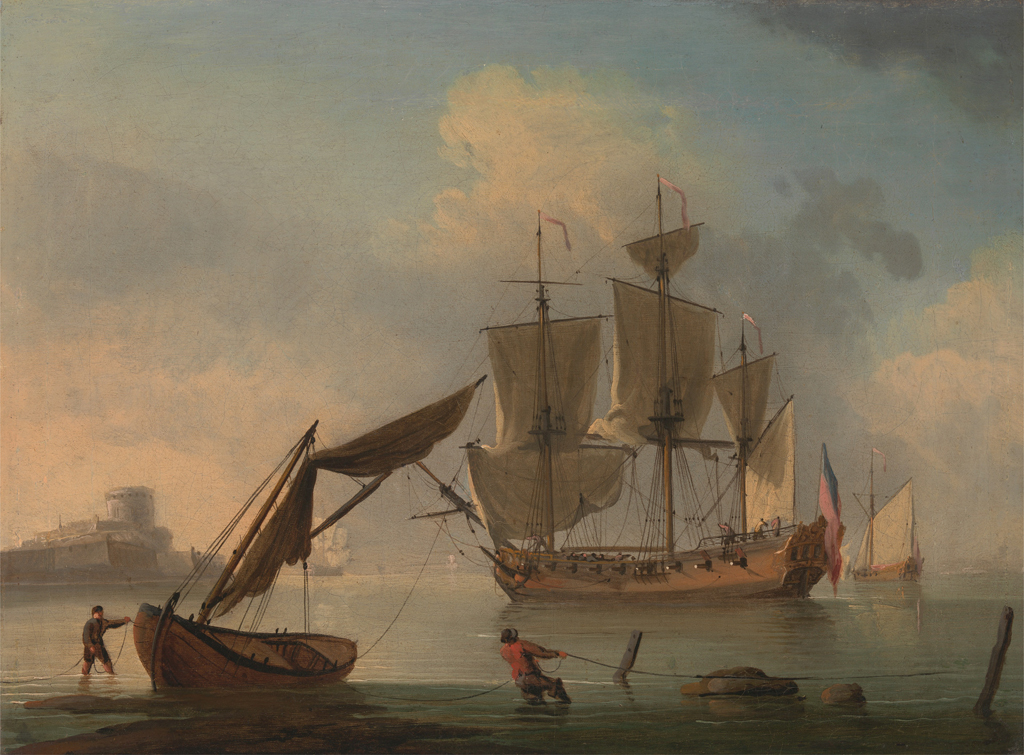
“An English Sloop Becalmed near the Shore” (mid-18th cent.) by Francis Swaine. Credit: Yale Center for British Art, Paul Mellon Collection
George Washington’s Ferry Farm is located on a hill overlooking the Rappahannock River. That river connects to the Chesapeake Bay and eventually the Atlantic Ocean. When young George Washington lived at Ferry Farm, the Rappahannock was a gateway to the entire world. Fredericksburg was a port town on the river’s opposite bank from the farm and small ocean-going sailing vessels traveled up the Chesapeake and into the Rappahannock to dock at the bustling town’s wharves. Ships like the brigs Stanton and Priscilla as well as the schooners Grampus and Penguin brought goods to buy, news from the rest of the British Empire, and occasionally people to settle and work in the colonies.
Growing up next to the river influenced the young Washington. He got to experience life at sea first-hand when he left Ferry Farm and sailed to Barbados at the age of 17. Also, for a time, the family debated whether teenage George should pursue a career in the Royal Navy. Moreover, at Ferry Farm, the Washingtons produced and consumed the goods that ships plied back and forth across the ocean.
George Washington, his family, slaves and neighbors were members of what historians call “The Atlantic World,” a global community of many different peoples taking part in the trade that traveled back and forth across the Atlantic Ocean. Washington, his brother-in-law Fielding Lewis, and other Fredericksburg residents saw sailing ships on the Rappahannock every day and interacted with the sailors from those ships every day. They supplied the ships with goods to take to destinations far across the sea and then bought the goods these ships carried when they returned.
In the 1600s and 1700s, tobacco was Virginia’s most important export but, at the same time, many planters along the Rappahannock chose to export things like wheat, foodstuffs, timber, and other raw materials used to manufacture goods.
Broadly speaking, these manufactured goods were made in Europe using the raw materials exported from the Americas. Europe then sent the manufactured goods to Africa as well as back to the Americas. In Africa, they were used to buy slaves while, in the Americas, they were used to purchase more raw materials. This movement of goods has long been referred to as the “Triangular Trade” because of the triangle shape that the goods traveled when traced on a map. Of course, this is a very simplistic description of a very complex network of trade that really spread across the globe. Still, a triangle is a useful way to imagine, understand, and remember the basics of the process.
Washington’s brother-in-law Fielding Lewis and the Lewis family built and owned ships that transported goods throughout the Atlantic World. Records of these ships’ voyages help illuminate the Triangular Trade and also how Atlantic trade routes often did not look like a triangle at all.
In one of the earliest voyages of a Lewis ship, the 80-ton brig Stanton – owned by Fielding’s father John Lewis and captained by Richard Williams – made a roughly six month voyage in the first half of 1732. The Stanton was bound for Madeira, an island off the coast of Portugal, and then Barbados, an island in the Caribbean Sea, before returning to Virginia. Its voyage is a perfect illustration of the Triangular Trade and we’ve written about it here.
But the Atlantic trade was not always a triangular one.
During the first half of 1737, the Lewis brig Priscilla sailed directly to London and back under the command of Richard Williams and carrying 192 hogsheads of tobacco, six tons of iron, and 5,000 staves.[1] The ship returned to Virginia with “European goods” and, after a brief stop at Madeira, added some wine to its cargo.
The next year, the John Lewis-owned schooner Grampus mastered by John Briggs set sail with 300 staves, 600 bushels of corn, 900 bushels of peas, 180 bushels of wheat, 1 hogshead of wine, and 400 feet of walnut plank bound on a direct voyage to and from “New England.” It returned with 5 hogsheads and 6 barrels of rum, some molasses, cider, oil, and “New England Ware.”
Finally, about a decade later, we find another John Lewis-owned ship departing Virginia. The Penguin, a schooner captained by Will Whitterong with a crew of six, set sail for Antigua in the Caribbean on March 1, 1745 carrying 100 barrels of pitch, 303 barrels of tar, 35 barrels of turpentine, 100 bushels of peas, 8 barrels of tallow, and 13,800 shingles. The Penguin arrived at Antigua on May 17 and returned to Virginia on June 5 with a cargo of 30 hogsheads and 1 tierce[2] of rum, 27 barrels of sugar, and British goods.
Did some of the items these ships brought back from across the Atlantic end up at Ferry Farm to be consumed or used by George Washington and his family (or the Strother family, the farm’s earlier occupants)? It’s unlikely but not impossible. Many of the items excavated by archaeologists at Ferry Farm definitely fit the descriptions “European goods,” “New England Ware,” or “British goods.” Westerwald jugs, Bartmann bottles, white salt-glazed stoneware fruit dishes, and glass wine bottles all journeyed across the Atlantic to be used by Ferry Farm’s residents, then broken, thrown away, and buried, eventually to be recovered by archaeologists. No matter who actually used them, these recovered items represent the people and way of life of the 18th century’s Atlantic World made possible by the ships Stanton,Priscilla, Grampus, and Penguin.
Zac Cunningham
Manager of Educational Programs
[1] Staves are the curved lengths of wood used to make barrels, buckets, or, in this case, pipes. Yes, wooden pipes.
[2] Tierce is an archaic measure of wine that roughly equaled 35 gallons. The term was also used as a synonym for cask, which seems what is meant in this case.
George Washington’s Boyhood Home at Ferry Farm offers a wonderful blend of woods, fields, wetlands, and riverfront. Fox, groundhogs, snakes, lizards, turtles, and deer make Ferry Farm their home. In the meadows, bushy heads of grass seeds provide an important source of food for birds. Beautiful flowers and majestic trees abound across the landscape. A few weeks ago, we set out on a nature walk around Ferry Farm to enjoy the flora and fauna.
Ferry Farm
Cherries on the cherry trees in the Demonstration Garden.
Daylilies in the Demonstration Garden.
The tickseed variety of Coreopsis.
Magnolia bloom
Magnolia fruit
Tall grass
Groundhog near the river.
The Rappahannock River
Trail through the woods along the river.
Wild strawberry
Ferry Farm’s Wild Meadow
Bluebird peaks from inside a birdhouse.
Bluebird in flight.
Yarrow
Crown vetch
Trail through the Meadow.
Learn more about Ferry Farm’s natural environment here.
I find that February, though it has the fewest days, can be the longest month of the year. The novelty of winter has worn off and, often, I simply seem to be enduring until the first glimpses of spring in March. I do, however, look forward with excitement to two moments in February: George Washington’s Birthday and the day that Major League Baseball’s pitchers start their spring training. In a way, these two events are connected by more than their close proximity to one another on the calendar.
After the familiar cherry tree tale, the second most popular story about George Washington’s youth is the story of him throwing a rock the size of a silver dollar across a river. This legend has changed several times over the years but it may have some truth.
The earliest version appears in The Life of Washington by Mason Locke Weems, who notes that George’s cousin remembered seeing him “throw a stone across [the] Rappahannock, at the lower ferry of Fredericksburg.”[1] George Washington Parke Custis, Martha’s son, provides a bit more detail for this toss, noting that the rock was actually “a piece of slate, fashioned to about the size and shape of a dollar, and which, sent by an arm so strong, not only spanned the river, but took the ground at least thirty yards on the other side.”[2] Archaeologist Phil Levy estimates “that could have been a distance of anywhere from a staggering 440 feet (professional baseball fields vary from 390 to 435 feet at the centerfield wall) to an impressive 340 feet.”[3]
We’ll never have the evidence historians need to say with certainty that young George actually threw a rock across the Rappahannock. It is a plausible story, however. So, each February at Ferry Farm’s birthday celebration, visitors try and duplicate George’s feat, provided the day’s weather or any lingering snow on the ground doesn’t prevent us from traipsing down to the river.
A visitor attempts to throw a rock across the Rappahannock River during the George Washington Birthday Celebration at Ferry Farm.
The feat has actually been duplicated, most famously by Walter “Big Train” Johnson, celebrated pitcher for the Washington Senators, on a Depression-era February day in 1936. Officials in charge of that year’s birthday celebration at Ferry Farm challenged the retired Major League right-hander, raising the ire of Congressman Sol Bloom of New York, who believed the story of Washington’s toss, to be “preposterous.” Quoted in the February 18, 1936 edition of The Free Lance Star, Bloom felt the feat “physically impossible” because “Washington was about 10 years old when the miracle was supposed to have happened.” Perhaps, he forgot that George lived at Ferry Farm well into his late teens?
A few days before the celebration, reporters found Johnson training for the toss by throwing a coin at the barn on his Germantown, Maryland farm. “‘Maybe I can’t throw that far,’ he drawled, ‘but there’s one thing certain—if George Washington did it, I can too.’”
Walter Johnson poses as if in mid-throw on the icy bank of the Rappahannock.
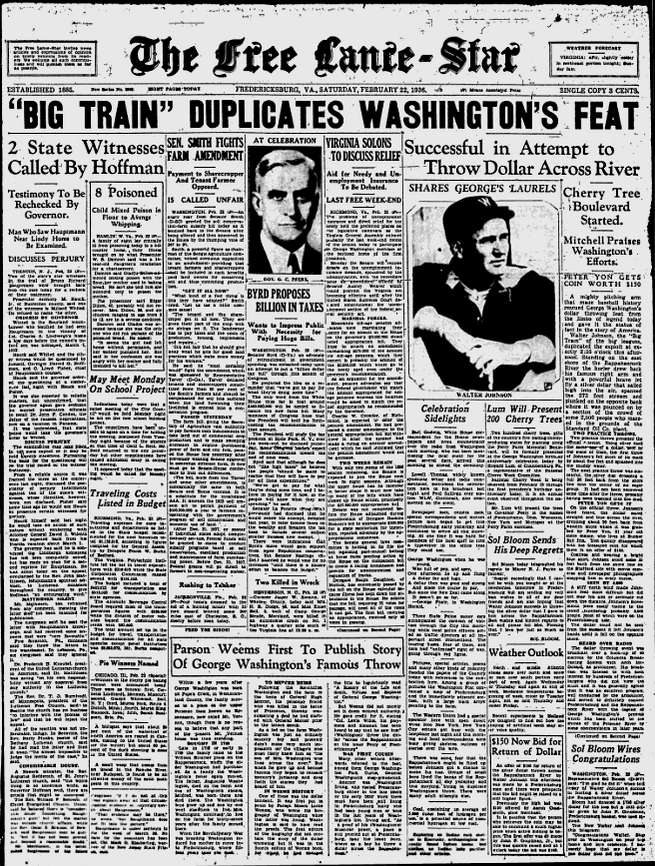
Finally, the day came. On the front page of the February 22, 1936 edition, The Free Lance Star’s banner headline trumpeted “‘Big Train’ Duplicates Washington’s Feat.” Standing on the Ferry Farm side of the river at 2:30 p.m. that day, Johnson took two practice tosses. The first plopped into the water just five feet short of the bank while the second made it across. Then, he attempted the official throw. Johnson “drew back his famous right arm and with a powerful heave let fly a silver dollar that sailed high into the air, spanned the 273 foot stream and plunked on the opposite bank.” Bloom graciously wired his congratulations and invited Johnson to stop in Washington and celebrate with him on his way back to Germantown.
Front page of The Free Lance Star, February 22, 1936
The attempt became something of a national sensation with newspapers in Michigan, Florida, Connecticut, Kansas, Missouri, and beyond reporting the story. A live radio program on the Columbia Broadcasting System beamed a description of the throw into countless homes across the nation.
Although it doesn’t garner the attention it did in 1936, the Stone Throw Challenge remains a centerpiece of Ferry Farm’s annual Washington’s Birthday Celebration when the weather allows it. On that day, which is usually about the time that today’s aspiring Walter Johnsons are starting to prepare for their seasons, I think of a day during the Great Depression when a big league pitcher added to his own legend by duplicating the prodigious feat of the most legendary American of all. As I watch our visitors attempt their throws, I think of the “Big Train” and I also always wonder just what kind of ballplayer George Washington might have been.
Zac Cunningham
Manager of Educational Programs
Join us at Ferry Farm on Saturday, February 14 for our George Washington’s Birthday Celebration, when – weather permitting – we’ll see if anyone else can throw a stone across the Rappahannock River. Along with the Stone Throw Challenge, enjoy crafts, games, exhibits, live history performances, and birthday cake! Visit www.kenmore.org/events.html for more details about the Birthday Celebration along with Archaeology Day on Monday, February 16!
[1] Mason Locke Weems, A History of the Life and Death, Virtues and Exploits of General George Washington, Macy-Masius Publishers, 1927: 39.
[2] George Washington Parke Custis, Recollections and Private Memoirs of Washington, Philadelphia, J.W. Bradley, 1861: 482.
[3] Phil Levy, Where the Cherry Tree Grew: The Story of Ferry Farm, George Washington’s Boyhood Home, New York: St. Martin’s Press, 2013: 226.