Lives and Legacies

Category: Daily Life in the 1700s

  • To Instruct and Amuse: Fun & Games in George’s Day

    The fall season at George Washington’s Ferry Farm and Historic Kenmore is finally upon us! This is a busy time of year for the education team because as cooler temperatures roll in, so do the school buses! Students who take field trips to our sites learn about the Washington and Lewis families, archaeology, and daily life in the 18th century. A favorite activity during field trips (for students and chaperones alike!) is learning how children in the past entertained themselves by playing a few popular eighteenth-century games. Our youngest visitors especially love learning what life was like for George and Betty Washington when they were children at Ferry Farm.

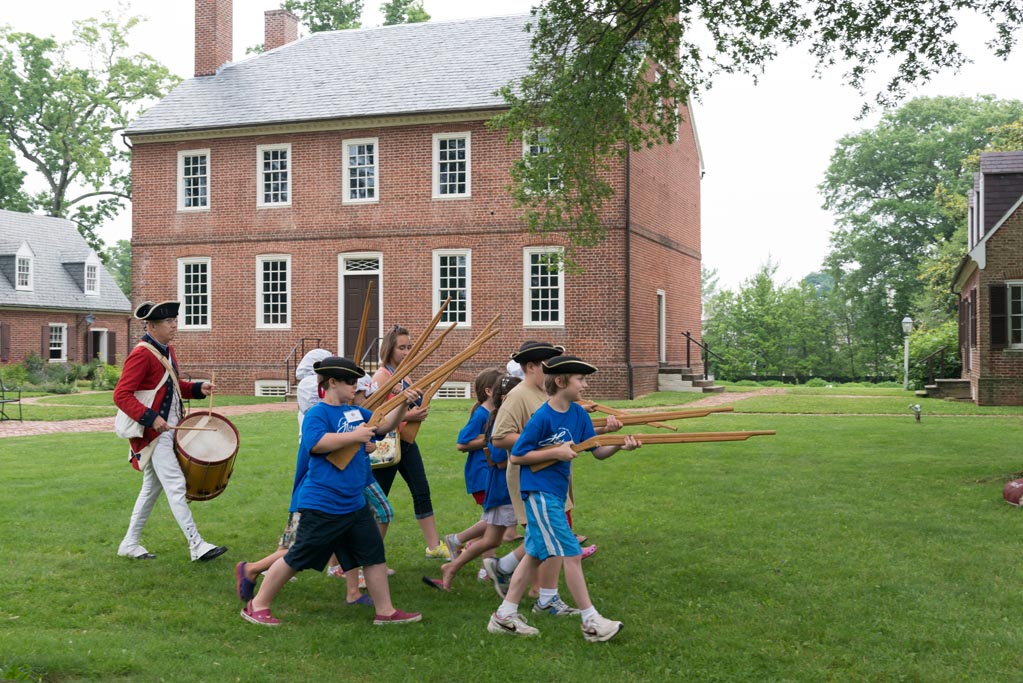
    Ferry Farm Field Trip

    A Little Pretty Pocket-Book, a children’s book published in 1744 by John Newbery, depicts some games and activities from the 18th century that today’s children are likely still familiar with, like flying kites, hopscotch, and leapfrog. Other games may be less familiar to some readers, such as “Tip Cat,” a game similar to cricket where a large stick is used to strike a smaller piece of wood into the air, and “Peg Farthing,” a game involving wooden spinning tops. An interesting fact for sports fans is that Newbery’s little book contains what is believed to be the first printed reference to baseball. The Pocket Book’s illustration for “base ball” depicts three boys standing next to their “post” or base.
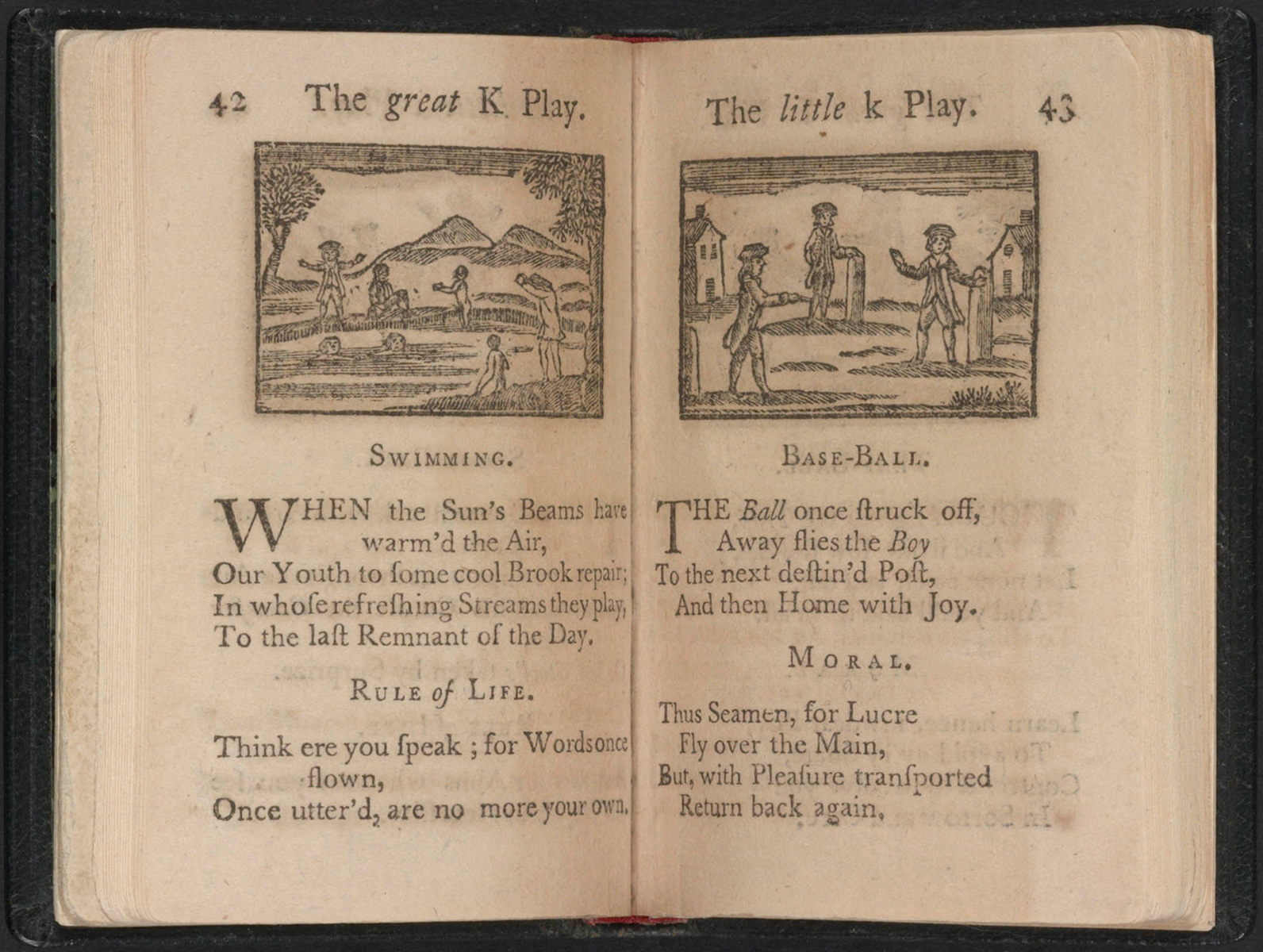
    A page from A Little Pretty Pocket Book depicting swimming and “Base Ball.” Source: Library of Congress

    Each game or activity is presented as a rhyme, a letter of the alphabet, and a “Rule of Life” or moral lesson. Interestingly, the book was also marketed with either a ball or pincushion gift to further help children understand good morals. Boys and girls were to track their good or bad deeds by sticking a pin in either the black (bad) or red (good) side of their toy. The book speaks to the practical element of many children’s games at this time; it was intended to instruct as well as amuse. The Library of Congress has a copy of A Little Pretty Pocket Book printed in Massachusetts by Isaiah Thomas in 1787. Clearly, the popularity of the book was long-lived.

    Opening pages of A Little Pretty Pocket Book. Source: British Library

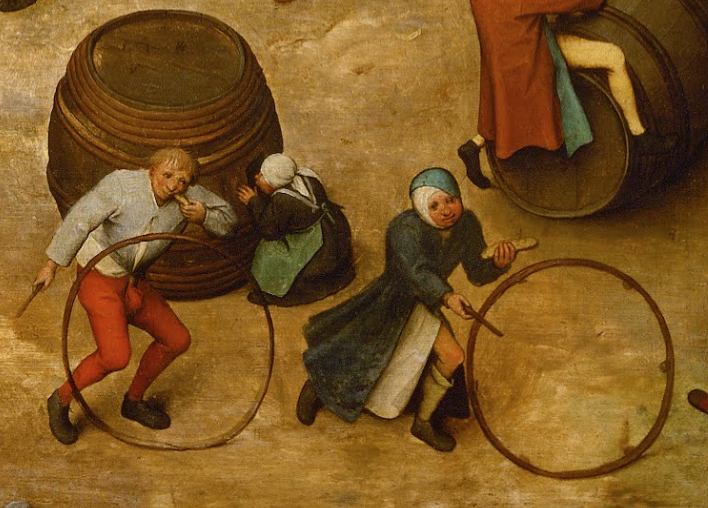
    Two popular games today’s students can play at Ferry Farm and Kenmore are hoop rolling (or trundling) and Graces. Hoop rolling has a long history across many different cultures. Images from ancient Greek and Roman art depict youth playing with hoops. Dutch painter Peter Bruegel’s, Children’s Games was painted in 1560 and showed 230 children playing 83 different games, one of which was hoop rolling. In George Washington’s time, the stick and hoop were made of wood, and the goal was to push the hoop along with the stick without it falling over.

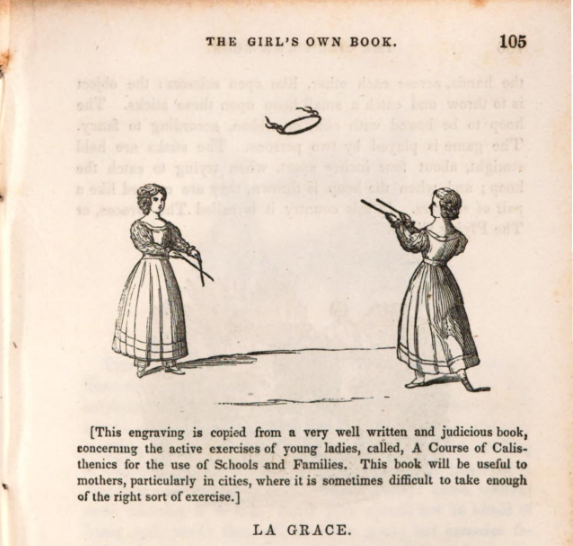
    Graces, or French Hoops, was a popular game in the early 1800s and was said to have been introduced to England from France. It was considered an appropriate pastime for young girls, as the game was supposed to inspire graceful movement in the players. The game requires two players, two sets of sticks, and one hoop (or two for added difficulty!) One player holds the sticks crossed in front of themselves with their hoop hanging off the end. To toss the hoop, they pull the sticks apart. The second player has to catch the hoops on their sticks. Each player gains one point when they catch the hoop, and the goal is not to let it hit the ground.

    Two books published in the 19th century illustrate the game of graces: American Girl’s Book by Eliza Leslie, published in 1831, and The Girl’s Own Book by Lydia Maria Child, published in 1833. Both authors mention particular benefits of the game, such as encouraging healthy exercise, graceful movements, dexterity and coordination, and of course, fun!

    Today, students who visit Ferry Farm and Kenmore might try their hand at graces or hoop rolling or play with other 18th-century toys. These games, along with those depicted in children’s books like Newbury’s, may have been familiar to children like George and Betty Washington. Often, these children’s games were seen as having some kind of practical instructional value.

    While some games have withstood the test of time and others have faded from popularity, it’s clear that children across time have always found ways to amuse and entertain themselves! [1][2][3]

    Ann Waters

    Manager of Interpretation & Visitor Services


    [1] Child, L. M. (1833). The Girl’s Own Book. Ireland: Clark Austin & Company.

    [2] Leslie, E. (1863) The American girl’s book: or, Occupation for play hours. New York: J. Miller. [Image] Retrieved from the Library of Congress, https://www.loc.gov/item/76355554/.

    [3] Thomas, I. & Miniature Book Collection. (1787) A little pretty pocket-book: intended for the instruction and amusement of little Master Tommy, and pretty Miss Polly: with two letters from Jack the giant-killer, as also a ball and pincushion, the use of which will infallibly make Tommy, a good boy, and Polly a good girl: to which is added, A little song-book, being a new attempt to teach children the use of the English alphabet, by way of diversion. Printed at Worcester, Massachusetts: by Isaiah Thomas, and sold, wholesale and retail, at his bookstore. [Pdf] Retrieved from the Library of Congress, https://www.loc.gov/item/22005880/.
  • Summertime Fun: Colonial June Fair

    Ask someone to list traditional summertime activities, and they will probably mention picnics, family reunions, beach vacations, mountain getaways, and baseball games. Their list is likely to include going to the fair as well.  The fair as a summer pastime is a long tradition and, like many American traditions, can be traced back to the age of Washington.

    In 1738, Augustine Washington moved his wife Mary and their five children, including six-year-old George, to Ferry Farm on the Rappahannock River opposite Fredericksburg, Virginia.  Coincidentally, in the same year, the colony’s General Assembly authorized two fairs to be held each year in Fredericksburg.[1]  This act built on an earlier ordinance passed in 1705, allowing for ‘markets and fairs’ as a necessary and civilizing element of early Virginian society.

    Although other cities held fairs, Fredericksburg was one of the few that had a fair in June.  Sometimes called June Fair, it was one of the oldest and largest in the colony.  June Fair and other fairs were “first and foremost a market ‘for the sale and vending of all manner of cattle, victuals, provisions, goods, wares, and merchandizes.’ Prizes, ‘or bounties,’ were sometimes offered for the best stock and poultry”.[2]

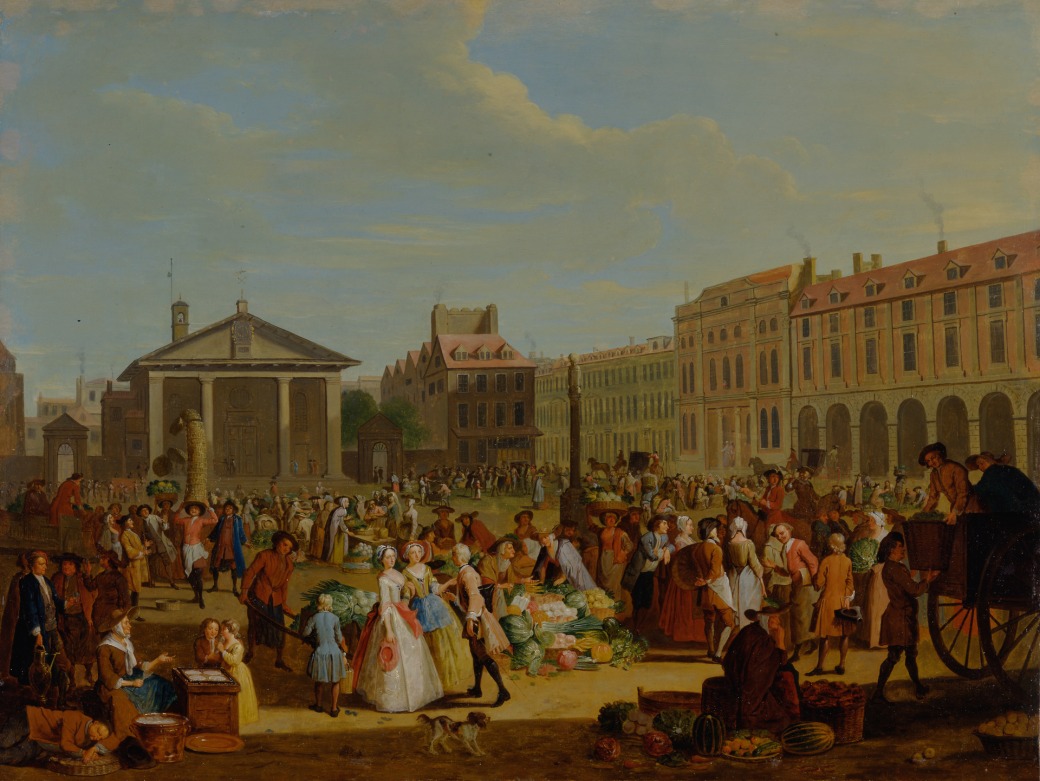
    Although this painting depicts a busy London agricultural market in the early 1700s, a similar hustle and bustle likely filled Fredericksburg during June Fair.  Covent Garden (1726) by Pieter Angillis, 1685–1734, Flemish, active in Britain (from ca. 1715), Oil on copper. Pubic domain. Credit: Yale Center for British Art, Paul Mellon Collection.

    Fairs were about more than agriculture, however. The importance of a summer fair was its ability to gather people from all over the surrounding counties to a single central location to conduct business and government and offer social interactions and entertainment.  In an agricultural colony such as Virginia, homes and plantations were very distant. People hardly saw anyone besides their immediate neighbors and family members for much of the year.  Most colonial Virginians traveled no more than fifty miles from home in their lifetimes. This made for an isolated existence focused on the constant attendance of crops. However, during natural seasonal breaks, farmers traveled to a town to sell those crops at the fair.

    Fairs were not just for farmers to sell. Court sessions, also known as ‘Public Times,’ often coincided with fairs. Soon merchants and entertainers saw the opportunity in the large numbers of people gathered together at the fair. Many people got paid or, more likely, an increase in credit and ready money made the fair a natural time to celebrate, entertain, gamble, and socialize.

    Among the amusements common to colonial-era fairs, “contests for prizes . . . in cudgeling, wrestling, manual-exercises, foot-racing, dancing, singing, violin-playing, greased-pig-chasing, etc. Prizes were offered to the most beautiful maid.  In towns large enough to warrant their attention, companies of actors sometimes arranged to give plays during fairs. Such plays, however, were held at the local playhouse or theatre, and not on the market square, where the fair usually took place”.[3]

    For example, in 1752, an acting troupe known as “THE Company of COMEDIANS, from the new Theatre at Williamsburg, propose[d] … to proceed to Fredericksburg, to play during the Continuance of June Fair.” The troupe hoped “That all Gentlemen and Ladies, who are Lovers of Theatrical Entertainments, will favour us with their Company.”[4]

    Advertisement in The Virginia Gazette announcing the appearance of the Company of Comedians at June Fair in 1752.

    The fair brought people together to conduct more than agricultural business.  Indeed, “the fair was also a place where men met to make and pay debts. Land, houses, storehouses, and personal property were offered for sale at fairs — privately and by public auction”.[5]

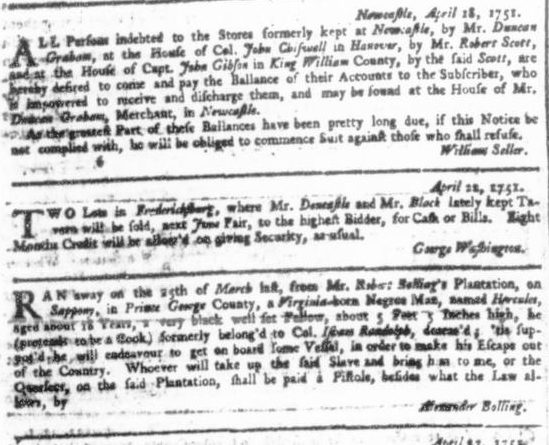
    During June Fair in 1751, 19-year-old George Washington auctioned off two of his lots in Fredericksburg.  His announcement of the sale in The Virginia Gazette offered the lots, “where Mr. Doncastle and Mr. Black lately kept Tavern, next June Fair, to the highest Bidder, for Cash or Bills. Eight Months Credit will be allow’d on giving Security, as usual” and was signed “George Washington.”[6]

    Announcement placed in The Virginia Gazette by George Washington announcing his intention to auction off two lots of his land in Fredericksburg at June Fair in 1751.

    A decade later, at June Fair in 1760, George’s account ledger shows him paying Fielding Lewis £40.  Furthermore, just a few days before paying his debt to brother-in-law Fielding, George also race, both popular fair activities. [7]

    Indeed, “the most popular attractions of the fairs in Virginia and Maryland were the horse-races . . . held at race-tracks near the town. Purses were subscribed, and many gentlemen, who had no interest in the other activities, would attend the races”.[8]

    Gambling at the fair, mainly in the form of lotteries, even supported more noble pursuits.  At June Fair in 1769, a lottery was undertaken to raise £450 for building a new church and for purchasing an organ for that church.  The drawing was to take place on “the 7th day of JUNE next (being the first day of the Fredericksburg fair) at the town-house” and was supervised and supported by a host of the town’s luminaries including Charles Dick, Hugh Mercer, Charles Washington (George’s brother), George Weedon, and Fielding Lewis. [9]

    June Fair was a community event attended by Virginians from across the colony and brought George Washington back to his boyhood home on more than one occasion.  At the fair, Virginians sold farm goods and land, settled debts and tried court cases, enjoyed a play, and gambled on the horses.  June Fair, much like today’s summer pastimes, was a moment in the year to enjoy the summer weather and the company of neighbors, friends, and family before returning to isolated plantations and farms and the unending work of plowing, planting, and harvesting.

    Come and join our 18th-century colonial fair on Saturday, June 11, from 10:00 a.m. to 3:00 p.m. There will be magic, medicine, music, and more with Dr. Balthasar’s Marvelous Miracle Medicine Show, music by Colonial Fare, colonial games, and craft activities for the kids. Admission includes access to the grounds, performances, activities, and walk-through tours of the Kenmore House. Tickets are $5 for ages five and up, and under  five are free.

    Zac Cunningham, School Programs Educator, Hampton Roads Naval Museum at Naval History and Heritage Command


    Joe Ziarko, Actor Interpreter at Colonial Williamsburg Foundation


    [1] Eighteenth Century Fairs. Colonial Williamsburg Digital Library https://research.colonialwilliamsburg.org/DigitalLibrary/view/index.cfm?doc=ResearchReports%5CRR0069.xml, pg 35. Accessed 6 June 2022

    [2] Ibid, pg 18

    [3] Ibid, pg 19

    [4] The Virginia Gazette, April 30 1752.

    [5] Eighteenth Century Fairs. Colonial Williamsburg Digital Library https://research.colonialwilliamsburg.org/DigitalLibrary/view/index.cfm?doc=ResearchReports%5CRR0069.xml, pg 18. Accessed 6 June 2022

    [6] The Virginia Gazette, 1751.

    [7] Cash Accounts, May 1760.National Archives and Records Administration https://founders.archives.gov/documents/Washington/02-06-02-0226. Accessed 6 June 2022

    [8] Eighteenth Century Fairs. Colonial Williamsburg Digital Library https://research.colonialwilliamsburg.org/DigitalLibrary/view/index.cfm?doc=ResearchReports%5CRR0069.xml, pg 19. Accessed 6 June 2022

    [9] The Virginia Gazette, 1751.

  • Camp George v. George: A Summer Camp to Travel Back to Colonial Virginia

    School is out for summer…almost! Students are counting down the days until they are free from homework, but the learning does not have to stop!. The George Washington Foundation has been busy preparing fun-filled summer camps to encourage critical thinking through exploring the past.

    In our Camp George v. George, students will be asked, “Would you be an American patriot or a British loyalist?” as they learn about George Washington and his family’s experience living under the rule of King George III.

    The camp will alternate between George Washington’s Ferry Farm, his boyhood home, and Historic Kenmore, his sister’s later-in-life house. George lived at Ferry Farm from six years old until 22 years old. This was where George learned how to survey, dance, and petitioned for his first military office at Ferry Farm. His time at Ferry Farm shaped him into the man who navigated the battlefield and the political arena to pursue the American cause.

    Similarly, George’s sister, Betty Washington Lewis, was shaped by her time at Ferry Farm. She was instructed in the customs of gentility, which included the tea ceremony.[1] While at Ferry Farm, her uncle, Joseph Ball, gifted a silver tea set and other tools so Betty could refine her skills as a future lady of the house. During this time, Betty was taught the expectations for young women in colonial Virginia.

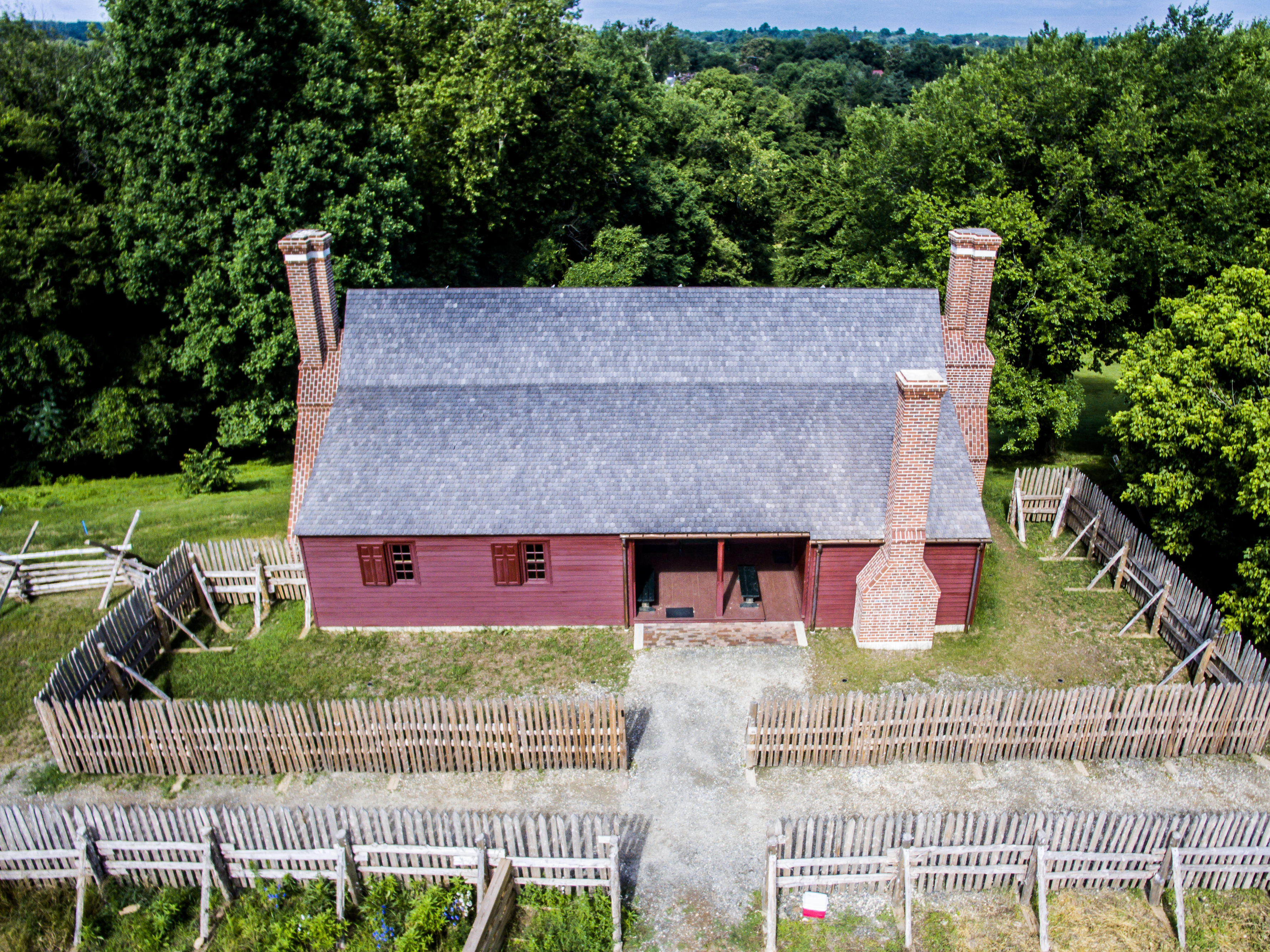
    Washington’s Ferry Farm

    While Betty’s experience at Ferry Farm was significant, her story does not end there. The skills she acquired at Ferry Farm equipped her to marry Fielding Lewis, a wealthy merchant in town. Twenty-five years later, they moved into their new home at Kenmore in 1775. Fielding and Betty envisioned the mansion as the site of lavish social events filled with tea, dancing, and awe from their guests. However, that dream was never realized, and the couple sacrificed greatly for the American cause. Betty managed the household and attended to the needs of the Washington family, including her mother, Mary. Fielding could not fight in the war, but he voluntarily gave up his trading business with British merchants, donated supplies to the war effort, and financially supported a gunnery in Fredericksburg.[2] Fielding also collected debts and handled several land deals for his brother-in-law.[3] The stress of the financial strain took its toll on Fielding, and he passed on December 7, 1781. Betty struggled financially for the rest of her life due to Lewis’ sacrifices for the Patriot cause.

    Historic Kenmore and Ferry Farm will be the sites where campers will learn about life in colonial America. Archaeologists, socialites, dancers, surveyors, and soldiers are just a few of the roles that the campers will embody as they explore the cultural, social, and military life of colonists during the Revolutionary War era. Activities will include a mock archaeological dig, a surveying hike, dancing lessons, militia drills, and more! This experience will provide insight into life before, during, and after the American Revolution. George, Betty, and Fielding, along with many others, had their lives transformed by society, government, and friendships. What would you do in such instances? That is the question campers will think about during their experiences, but don’t worry, plenty of fun, games, and activities will be included!

    Camp George v. George will be offered in two sessions for families’ convenience. Session A will be June 13 – 17 from 9 am to 12 pm, and Session B will be from July 25 – 29 from 9 am to 12 pm. Please see our events page at Kenmore.org/events for more information!

    Kaylie E. Schunk

    Manager of School & Youth Programs


    [1] Laura J. Galke, “The Mother of the Father of Our Country: Mary Ball Washington’s Genteel Domestic Habits,” in Northeast Historical Archaeology 38 (2009): 33.

    [2] “Fielding Lewis;” Palmer, and McRae, eds. Calendar of Virginia State Papers, 456, 502-3; Duke, Kenmore and the Lewises, 94-96; Fleming, Story of Kenmore, 9; “To George Washington from Fielding Lewis, 14 November 1775,” Founders Online, National Archives, Source: The Papers of George Washington, Revolutionary War Series, vol. 2, 16 September 1775?–?31 December 1775, ed. Philander D. Chase (Charlottesville: University Press of Virginia, 1987), 371–373.

    [3] “From George Washington to Fielding Lewis, 20 April 1773,” Founders Online, National Archives, Source: The Papers of George Washington, Colonial Series, vol. 9, 8 January 1772?–?18 March 1774, ed. W. W. Abbot and Dorothy Twohig (Charlottesville: University Press of Virginia, 1994), 221–224; “To George Washington from Fielding Lewis, 8–9 May 1773,” Founders Online, National Archives, Source: ibid., 229–230. “To George Washington from Fielding Lewis, 24 May 1773,” Founders Online, National Archives, Source: ibid., 235.

  • Winter Ailments (and how to endure them in the eighteenth century)

    As spring approaches in the Middle Atlantic and Northeastern states, we welcome the chance to spend more time outdoors in the fresh air instead of cooped up in our houses – getting sick.  Ailments such as colds and flu are contractible anytime, but we usually associate them with the wintertime as that’s when they seem to be more prevalent.

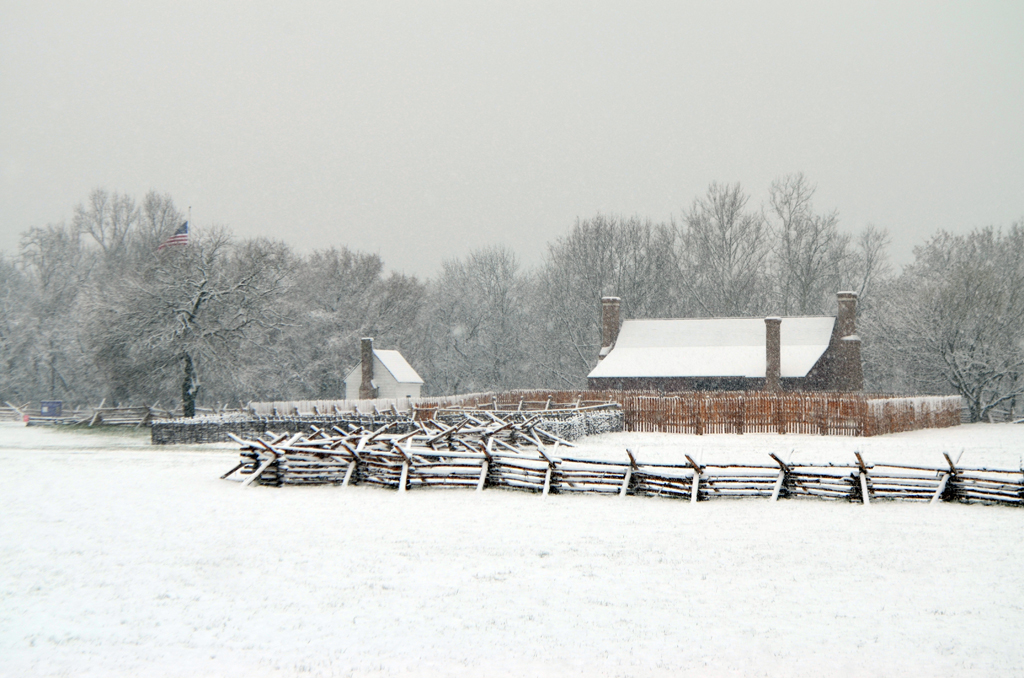
    Ferry Farm during winter storm

    With modern medicine, we can easily treat and overcome these and other more serious illnesses that rise up during the colder months.  People living in the eighteenth century, however, did not have the luxury of our scientific knowledge of modern medicines, and so what is easily treatable today could be, and often was, deadly during their lifetime. They had to deal with serious diseases, such as dysentery, measles, mumps, smallpox, rickets, typhus, typhoid, tuberculosis, and yellow fever, without the benefit of antibiotics. 

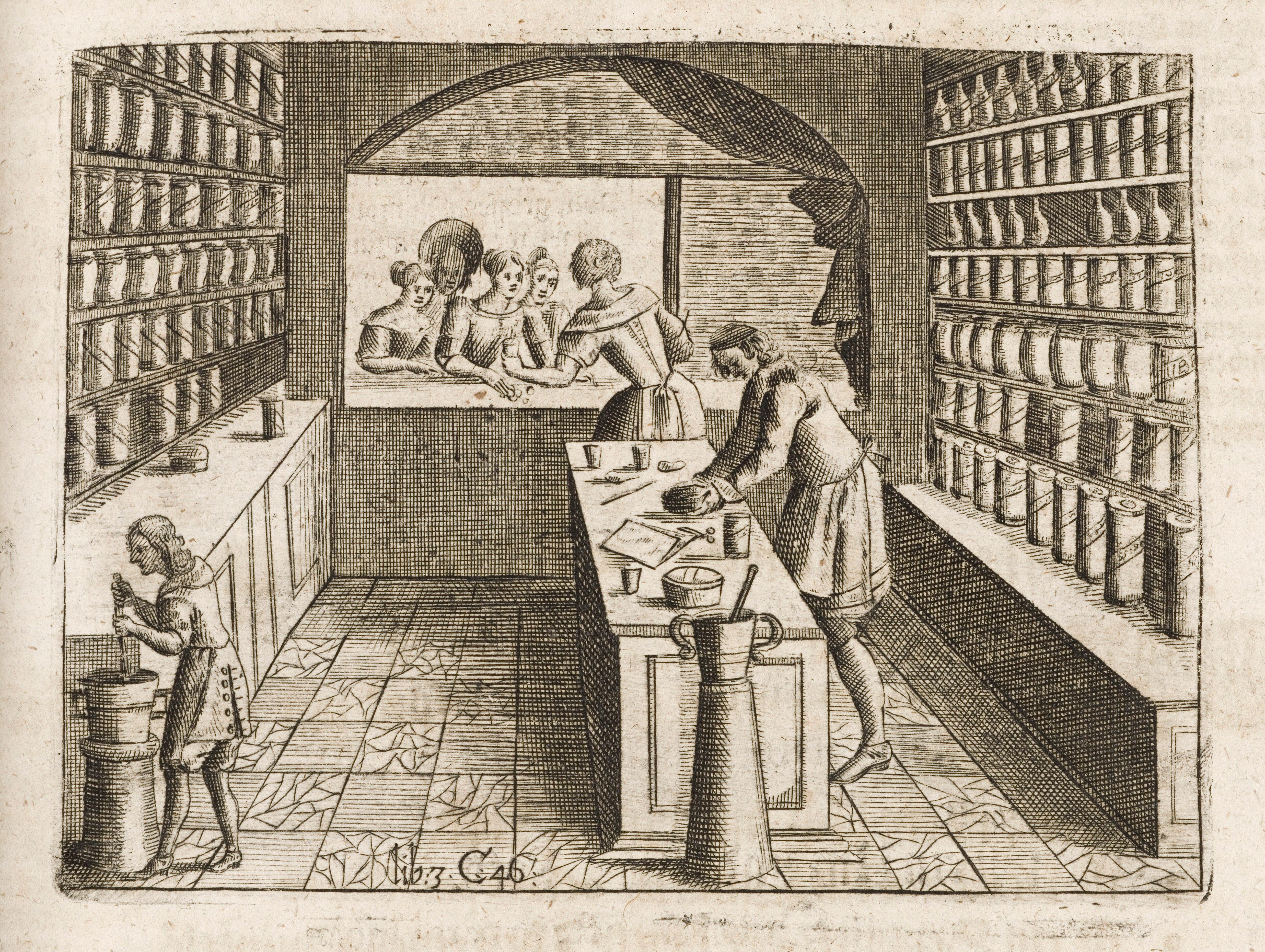
    Medical treatments for dealing with illnesses in the eighteenth century were primarily herbal remedies and traditions passed down over the centuries in medical books or as local knowledge. People like the Washington family probably relied on local healers, apothecaries, physicians, or midwives in the Fredericksburg area to prepare the medicines and treat their illnesses.  It is also very likely that Mary Washington would have had the knowledge herself to oversee the formulation of cough syrups, laxatives, and other tinctures using the herbs and flowers in her own garden. Betty Washington Lewis, Mary’s daughter, owned a copy of Eliza Smith’s 1739 The Compleat Housewife: or, Accomplished Gentlewoman’s Companion, a cookbook, in which are explicit medicinal recipes for dealing with hysterics, the vapours, pain from stones, the plague, upset stomachs, a cancerous breast, consumption, and for ‘preserving the lungs,’ among other things.[1]  The chances are pretty good her mother Mary also had access to this same recipe book.

    We do not have any historical information on the childhood diseases or winter ailments that were present in the Washington home, but here are two that they might have experienced.

    Pneumonia

    Anteroposterior chest x-ray revealed right upper lobe pneumonia. Credit: Public Domain Files

    Pneumonia, a bacterial infection of the lungs, also known as ‘Winter Fever’, was a great concern in colonial Virginia.  Although it was not known as a disease in and of itself but rather a symptom of other illnesses until much later, the presence of this respiratory ailment was noted by colonists. 

    Pneumonia and many other such illnesses were prevalent in the winter months when conditions forced people inside with closed windows and doors.  Prior to modern home climate-control technology, windows and doors were opened in good weather to create a breeze that cooled down a house but also served to air it out.  Additionally, many activities we perform indoors today took place outside, such as laundry and food processing, which got people out in the open more.  When the weather turned cold, however, people were stuck inside with little ventilation and essentially stewing in their own germs.  As such, pneumonia spread rampantly throughout the winter, and with no antibiotics, it was often deadly especially for the young and elderly. 

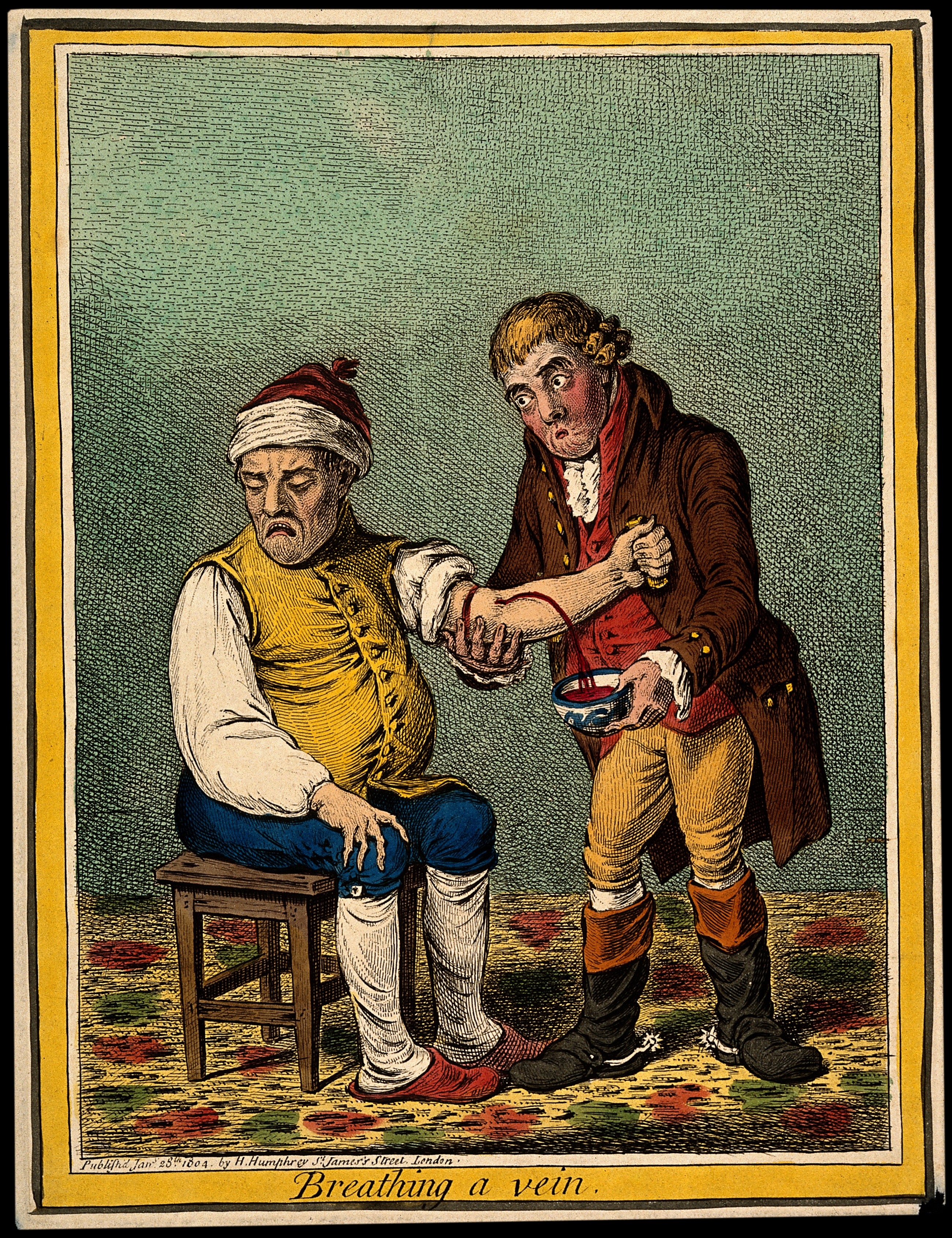
    An ill man who is being bled by his doctor. Credit: Wikimedia Commons

    The commonly incorrect assumption at the time was that many illnesses resulted from bad smells or miasma. Bloodletting, laxatives, and emetics were justified treatments for almost anything wrong with you because it was essential to purge and expel the bad blood and humours from one’s body.  In general, these treatments did more harm than good and, in some cases, killed the patient.

    In addressing the symptoms of pneumonia (fever, cough, inflammation of the lungs), a mixture of treatments would have been proscribed for the patient.  Cough syrups recipes were many and concocted from a wide variety of aromatic herbs infused in flavored waters, honey, or liquor. Opium in the form of poppy leaves was also a common ingredient.  Additional treatments included bloodletting “8 to 10 ounces if strong 12 ounces” and applying ‘blisters’ on the back of their neck to promote sweating and to help with a headache.[2]  Blistering was an aggressive treatment to the skin and essentially created pain in one spot to counteract pain elsewhere. A blistering agent, such as mustard, capsicum, or Spanish Fly, was applied in a poultice to the skin, causing redness and, in extreme cases, a raised pus-filled blister.[3] The cure might have been worse than the disease!

    Scientists have since made great breakthroughs in treating pneumonia, including the invention of penicillin by Alexander Fleming in 1928.  Yay science!

    Rickets

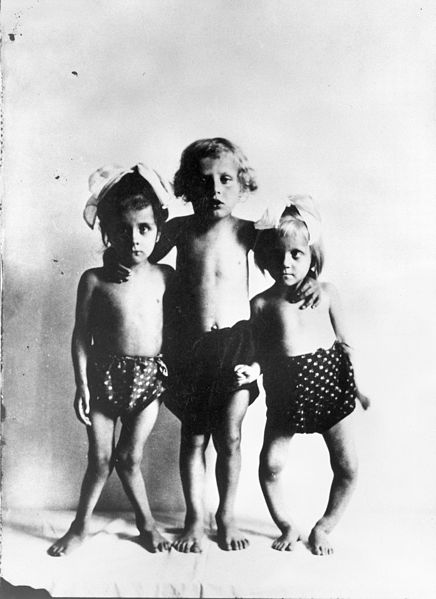
    Three children displaying signs of rickets. Credit: Wellcome Collection

    Bowed legs, thickened wrists and ankles, low weight, and deformities of the skull and pelvis are all signs of Rickets, a common disease of the 18th century and prevalent during the winter months.  Rickets is caused by a lack of Vitamin D in a child’s diet, leading to soft, weak bones that don’t mineralize properly. The symptoms of rickets usually appear between the ages of 3 to 18 months, and if caught early, the disease is reversible by ensuring a proper diet of Vitamin D-rich foods (fatty fish, egg yolks, fish oil) and exposure to sunlight.

    Eighteenth-century physicians knew about the disease and discussed the symptoms and possible remedies in their medical books, but they didn’t understand the actual cause (Vitamin D deficiency) and, therefore, how to cure it. And although Rickets is often associated with children living in poverty with limited diets or restricted to sunless living and working conditions, it affected children of all socio-economic levels.

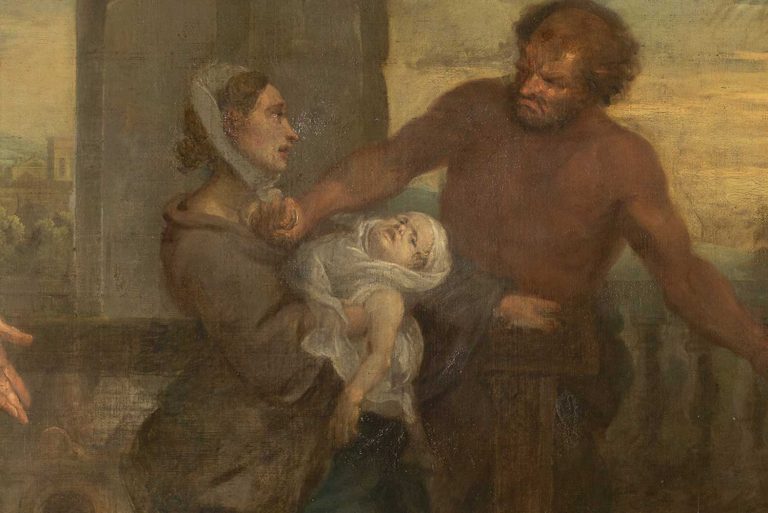
    Mother holding a child with symptoms of rickets in Christ at the Pool of Bethesda by William Hogarth (1697–1764) Credit: Barts Heritage

    John Freke, in his 1748 book “An Essay on the Art of Healing,” felt that the diet of the children affected by Rickets was “in general too luxuriant” and should be scaled back to a more austere diet than ordinary.[4]  “Care should be taken to send this sort of Children into a sharp Air,” and “rousing their Blood by shaking and tossing them often, giving them now-and-then a little red Wine, and dipping them every Morning in cold Water.” He was spot on to suggest letting them play outside in the sun, but restricting their diet would certainly have had a deleterious effect on the patient.

    The 1710 Book of Physick was a recipe book of natural remedies using plants and minerals to cure the everyday ills and complaints of the sick.[5] The first step incurring rickets was to administer a “purge,” which was a drink that flushes everything out of your digestive system by either vomiting or diarrhea.  Purgatives were seen as a cure-all for many diseases because the prevailing thought was you had to expel whatever was making you sick out of your body.

    The recommended purge was made of a long list of plants, including liverwort, speedwell, and yarrow, mixed with fruits such as figs and raisins, all slowly simmered together in water. Dosage was three spoonful’s every morning and night for 14 days.

    Next on the list was bloodletting, of course! Just a prick on the ear would do the job, or leeches behind the ears! What is interesting is that this instruction was immediately followed by a reference to the page on how “to staunch bleeding.”

    Not all remedies had to come from physician’s books but could be found in publications geared towards laymen.  The Servants Directory, Improved; or House-Keepers Companion, published in1762, was an instruction manual on all things household, ranging from how to kill rats, clean furniture, wash silk stockings to the best way to cook parsnips.   Included in a chapter on the care of small children was a cure for a Rickety child.  The first suggestion was to give the child three doses of a gentle physic, or purge, similar to the 1710 Phisick book.  Next, rub the child with a concoction of smashed garden snails and liquor every day for a month.  Outside exercise was also recommended, thank goodness![6]

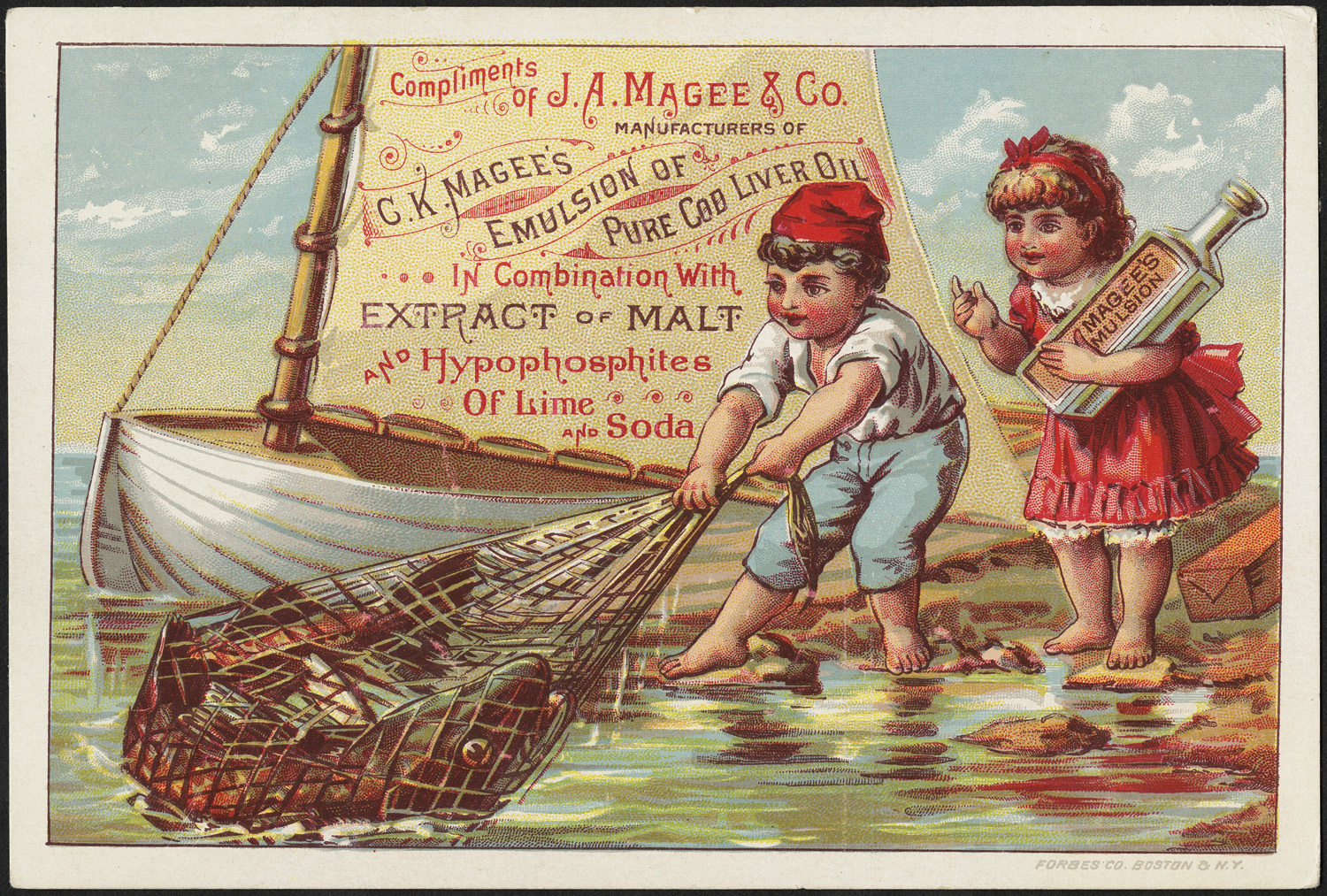
    If the 18th century rickety child could survive multiple purges, bloodletting, a restrictive diet, vigorous body rubs with bug juice, and occasional sun exposure, who’s to say which treatment was the one that was most effective (Just kidding)!  Progress in studying the causes and treatments of Rickets culminated in the early 20th century when it was clearly shown the benefits of using sources of Vitamin D, such as cod liver oil and sun exposure, in curing rickets.[7]

    If you are interested in medical history see our other blog posts on mercury, patent medications, Civil War medicines, Civil War hospitals, bad medicines, homemade medical remedies, dental care and smallpox.

    Judy Jobrack

    Staff Archaeologist

    Mara Kaktins, Archaeologist

    Ceramic & Glass Specialist


    [1] Eliza Smith, The Compleat Housewife: or, Accomplished Gentlewoman’s Companion, J. and J. Pemberton, 1739, pgs. 240-250.

    [2] A Book of Phisick. Made June 1710, p. 46. Wellcome Collection. Public Domain Mark

    [3] Souter, Keith. Bleed, Blister, Vomit and Purge. July 23, 2015. https://westernfictioneers.blogspot.com/

    [4] Freke, John. An Essay on the Art of Healing, p. 247-248. 1748. https://play.google.com/books/reader?id=H_o1AQAAMAAJ&pg=GBS.PA246&hl=en

    [5] A Book of Phisick, pg. 92-93.

    [6] The Servants Directory, Improved; or, House-Keepers Companion. H. Glass. Fourth Edition, 1762. Reprinted 2001 by United States Historical Research Service.

    [7] O’Riordan, Jeffrey and Olav Bijvoet. Rickets before the discovery of vitamin D. Published online 2014 Jan 8. https://www.ncbi.nlm.nih.gov/pmc/articles/PMC3899557/

  • You’ve Got Mail: Development of the Colonial Postal Service in Virginia

    The sending of a letter in Colonial America was more challenging than today.  The concept of post offices and regularly scheduled mail arrivals and departures evolved slowly in the colonies.  Colonial mail faced many obstacles.   Geography, political opposition, and a general lack of interest hindered a national system that serviced all the colonies. 

    How to Get a Letter Sent                                    

    While not impossible to get a letter sent, the question was, would it arrive?   There were two main ways to send your letter: send someone you know or pay someone else to deliver your correspondence for you.

    We will call these two types of mail delivery private and public systems.  A private system means that the sender and the recipient knew the mailing source.  For example, you might entrust your letter to be delivered by an acquaintance, family member, or servant.  You would put your mail in the hands of someone you knew who happened to be traveling in the direction of the addressee, be it across town or the colonies.  In such cases, the letter was delivered free of charge.[1] 

    A public system consisted of a letter being passed through a series of people unknown to the sender, with postage paid by the sender.  This was an informal arrangement where strangers, for a fee, carried letters for people to specific destinations.   This would eventually evolve into what we now recognize as the postal system. 

    Artist Lloyd Branson depicts a colonial mail carrier in this partial view from his painting “Transporting Mail”.Credit: Smithsonian’s National Postal Museum

    English Colonies

    The history of mail service in America is complicated.  It took over one hundred years to evolve into a true American Postal System.  In the beginning, the English government established the “Royal Mail” in 1660.[2]    Under the Act of 1660, the price to send a single letter was two pence for “fower score English miles,” or threepence for greater distances.[3]  The colonies did not have an official postal service until King William and Queen Mary appointed Thomas Neale to create one in 1691.  This patent established an officially-designated letter depot or post office, but there was no inter-colony service until later.

    Mail in Virginia

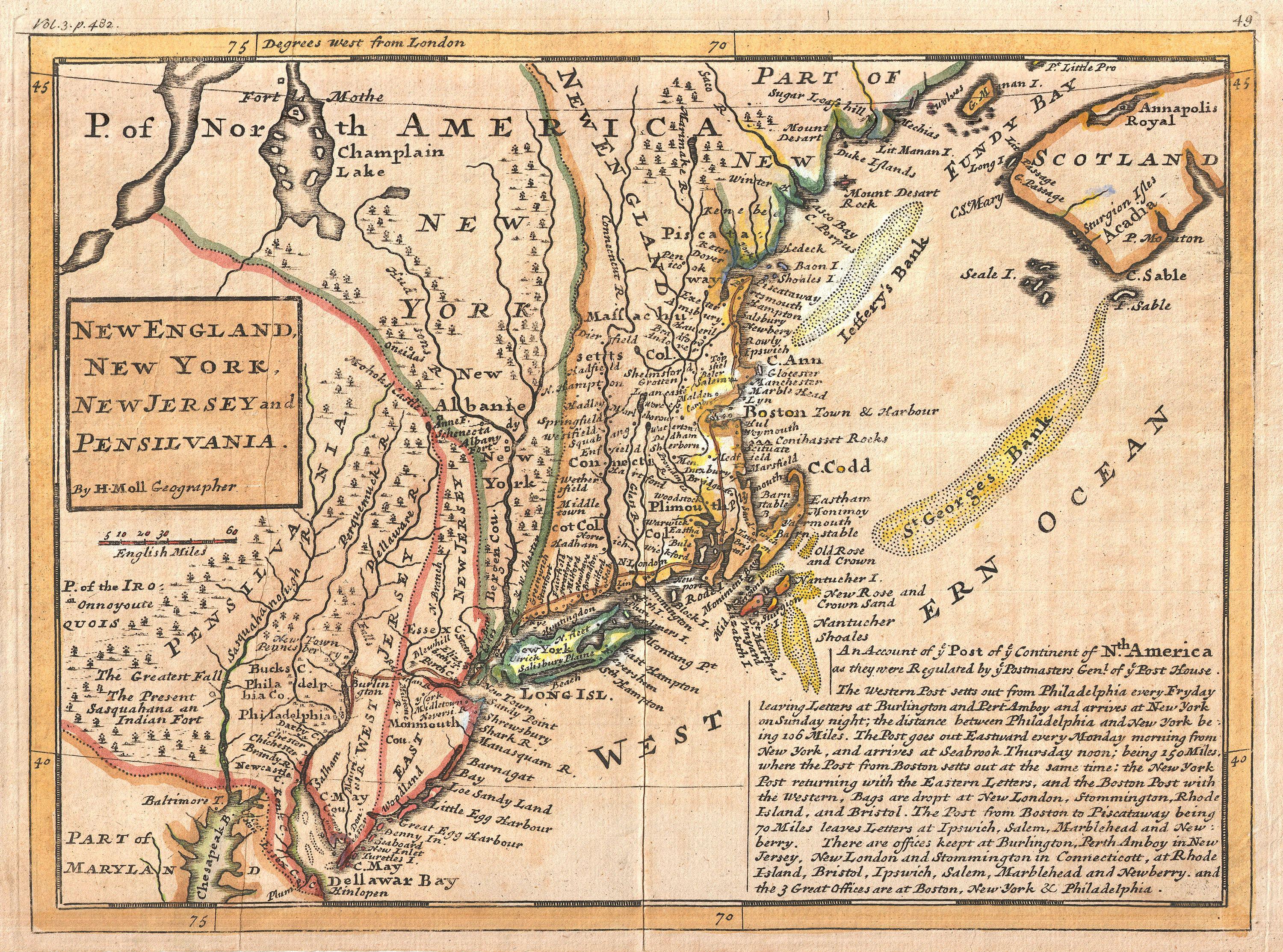
    Shortly after his appointment Thomas Neale chose Andrew Hamilton of New Jersey as a resident deputy.  Hamilton established regular service in the North between Boston, New York, and Philadelphia.[4]

    1729 Moll Map of New York, New England, and Pennsylvania (First Postal Map of New England). Credit: Wikimedia Commons

    Hamilton was eager to continue establishing service to the Southern states of Virginia and Maryland.  However, his application to extend the post to Virginia was not accepted with enthusiasm.  Virginia didn’t find a need to link up to a more costly overland inter-colonial mail service because their mail could travel by the schooners and tobacco ships.[5]

    Lieutenant governor Alexander Spotswood persisted in starting a post-service in Virginia.  In 1717, Spotswood announced that post offices had been “settled” throughout Virginia and that fortnightly (two weeks) post was established between Philadelphia and Williamsburg.[6] However, Spotswood’s works were not appreciated by many Virginians, particularly politicians, and there was still considerable resistance to the service. [7] The people’s main concern was that the postal service would become a monopoly where prices were controlled by the owner rather than by competition.[8]

    When the Assembly met in the spring of 1718, many counties complained about this postal monopoly.  The Burgesses and the (Governor’s) Council united in passing a bill that prevented the execution of the Act of Parliament establishing a mail service in the colony.  Spotswood subsequently blocked this bill, but the bill’s proponents were successful and promptly suspended official service in Virginia.  Because of this lack of co-operation as late as 1727, Annapolis was still the southern terminus for regular postal service.[9]

    In 1730, Spotswood took over the position of Deputy Post Master General after the resignation of John Hamilton for failing to turn a profit for the post office and suffering accusations of excessive spending.[10] His goal was to establish a better route between Annapolis and Williamsburg and eventually push that further south.  He succeeded and, by 1739, had created a route from Williamsburg to Charles Town, South Carolina. Spotswood’s post office was called “General Post Office at New Post” and was located near the Rappahannock River in Fredericksburg on land he owned.  After Spotswood’s death in 1740, the post office was maintained in New Post, Virginia, until Benjamin Franklin took office in 1753 and moved headquarters to his native Pennsylvania.[11]

    Revolution

    The postal system in the Colonies continued growing until British Parliament passed the Stamp Act of 1765.  The Stamp Act placed an official stamp on all printed material, including legal documents, magazines, playing cards, newspapers, and other types of paper used throughout the colonies.  [12] 

    Unsurprisingly, the Stamp Act was very unpopular among the colonists as many considered it a violation of their rights as Englishmen not to be taxed without their consent.   With the significant uproar and protests, the act was quickly repealed in March of 1766.  Still, Parliament continued to declare its power to legislate the colonies by passing the Declaratory Act.  Additionally, a new series of taxes and regulations were introduced, which fostered resentment to British rule and was the beginning of what would become a revolution in America. [13] 

    The post office symbolized British power, and a new system would have to be established if the colonists wished to overthrow the government and create an independent country.  The colonist began their postal service, the Constitutional Post, in May 1775 with Benjamin Franklin as the new postmaster general.  Subsequently, the Crown’s postal service in the colonies ceased by Christmas of the same year.[14]

    By July 1775, the Second Continental Congress ordered The United States Post Office (USPO) with Franklin overseeing its creation as department head.  In 1789, George Washington appointed Samuel Osgood as the first American postmaster general.  More than 75 official post offices and more than 2,000 miles of post roads.[15]

     Over America’s development as a new country, its postal system has continued to grow to accommodate its populations and postal needs.  Today, the United States Post Office has over 30,000 offices and delivers around 150 billion pieces of mail a year.[16]

    Heather Baldus

    Collections Manager


    [1] Butler, Nic. 2018. Mail Service in Colonial-Era Charleston, Charleston County Public Library, 2018 https://www.ccpl.org/charleston-time-machine/mail-service-colonial-era-charleston

    [2] Ibid

    [3] Harrison, Fairfax. “The Colonial Post Office in Virginia”, The William and Mary Quarterly, Apr 1924, 73.

    [4] Ibid, 74.

    [5] Ibid, 74-75.

    [6] Ibid, 78.

    [7] Ibid, 79.

    [8] Colonial Post Office N-10, Fredericksburg, Stafford, Spotsylvania Historical Markers, 2021 https://fredmarkers.umwblogs.org/2008/03/23/colonial-post-office-n-10/

    [9] Harrison, 79.

    [10] Colonial Post Office N-10, 2021

    [11] Ibid

    [12] Wood, S.G. “The American Revolution: A History.” Modern Library. 2002, 24.

    [13] Daniella Garran (19 July 2010). “Steps to the American Revolution”. Lesson Planet. Retrieved 21 July 2010.

    [14] Gavin, Alison M. “Hugh Finlay and the Postal System in Colonial America”, 2009 https://www.archives.gov/publications/prologue/2009/summer/finlay.html

    [15] The Early American Postal System”, https://www.constitutionfacts.com/founders-library/early-american-postal-system/

    [16] “Size and scope”. About USPS. United States Postal Service. Archived from the original on December 15, 2018. Retrieved December 8, 2018.

  • Behind the Glass of the Archaeology Lab: Creating an Exhibit

    It can be daunting to look at a blank space and realize you are in charge of filling it. And not just filling it, you need to create something that will leave a lasting impression on the public. The process of creating an exhibit is much more complicated than it seems. From the initial idea to the final product, there are many steps that require careful attention.

    With countless artifacts in the Archaeology Lab, finding inspiration for a topic was easy. Once I settled on 18th Century tea practices, everything seemed to fall into place. There were many subjects I could have focused on from this topic. In order to connect the idea to Ferry Farm and the Washington legacy, I chose to focus on Betty Washington and what she would have learned from her mother growing up at Ferry Farm.

    This inspiration came from an archaeologically excavated pewter teaspoon handle with the initials ‘BW’ stamped into it. It is clear that Miss Betty Washington was the owner of this spoon. The spoon was likely part of a children’s tea set that Betty was given in order to teach her the intricacies of the American Tea Ceremony. This education was Mary’s legacy for Betty; it taught her how to be a proper gentry lady and interact with the upper-class circles in Virginia.

    Teaspoon handle with “BW” initials.

    Once I picked my topic, it was time to begin researching. Research is the backbone of any exhibit, though it might not be the most exciting part. I was able to obtain an understanding of the Tea Ceremony from my research that I applied to my specific topic. The biggest question on my mind throughout my research was: Why was this important for Betty?

    While working on research, I was simultaneously creating a reproduction 18th Century creamware teapot. With the help of the Archaeology Lab Forgeries Department, I quickly transformed a Goodwill find into delicate creamware with a rose motif. The pot is the centerpiece of the exhibit on 18th Century tea practices. Many scholars wrote that the teapot is the literal and figurative center of the ceremony, bringing people together and initiating the ceremony. This concept inspired my placement of the teapot for the exhibit.

    Hand painting of reproduction teapot.

    After concluding my research, writing the signs for the exhibit, and finishing the replica pot, I had to choose the artifacts to include in the exhibit. Throughout this process, I kept my thoughts on Betty. The BW teaspoon handle was set aside for the exhibit as well as the replica teapot. Including teaware from Ferry Farm and Kenmore displayed the continuity of Betty’s gentry practices throughout her life. A slop bowl excavated from Kenmore, as well as a teacup and a saucer excavated from Ferry Farm were both chosen for the exhibit in order to support that point.

    Once this was all completed, the excitement truly began. I saw my work come to fruition when I set up the display in the conservation window of the Archaeology Lab. Being able to share what I had learned with the public was an excited prospect. The exhibit is currently on display and can be seen in the Ferry Farm Visitor Center.

    Intern Gillian Both standing behind her exhibit.

    This process has taught me a lot about exhibit design and the research process. I couldn’t have completed the exhibit without the Archaeology Lab staff helping me along every step of the way. I encourage you to go and visit the lab to see the exhibit and learn more about archaeology at Ferry Farm.

    Gillian Both

    Fleming Smith Scholar, UMW Class of 2022

  • What in the World is Twelfth Night?: A Visit with the Ghost of Twelfth Night Past

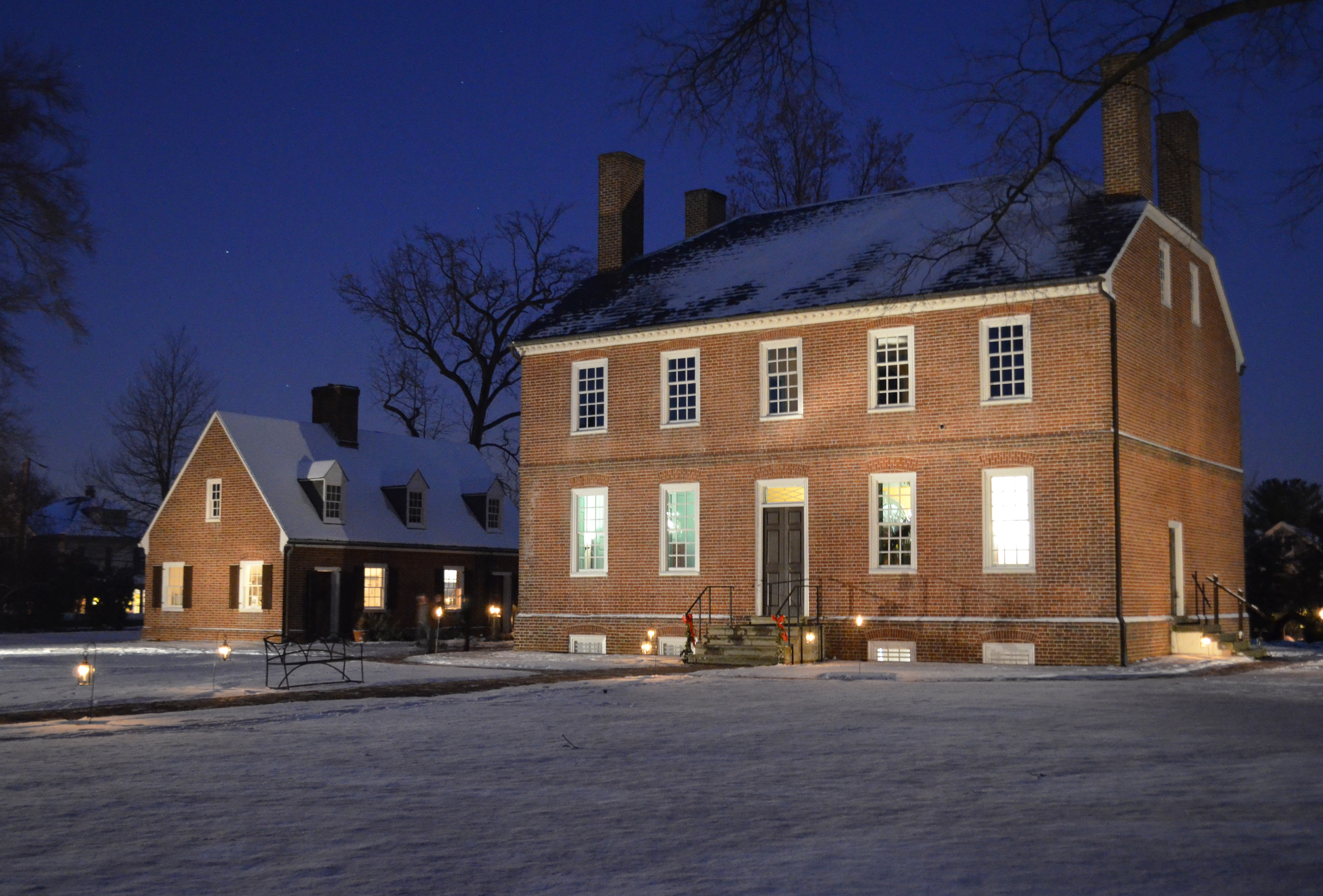
    Usually, at this time of year preparations are well underway for our annual Twelfth Night at Kenmore: A Dramatic Performance.  The play takes place in January 1776, during the first Christmas season celebrated at Kenmore. Unfortunately, this year’s celebration of Twelfth Night at Kenmore is canceled due to winter weather.  However, if you are familiar with the performance, or have read some of our past blog posts, you might already know a thing or two about this once popular Christmastide holiday. While traces of Twelfth Night still exist today, the celebration is much diminished, if not entirely eclipsed, by Christmas and New Year’s. Why is this, exactly? When did we stop celebrating Twelfth Night?

    There is no single, short answer as to why Twelfth Night celebrations fell out of fashion. Rather, attitudes surrounding the Christmas season changed throughout history, and old traditions were often absorbed or re-imagined into something new. A very brief look into the history of the season sheds some light on why today’s Christmas traditions rose in popularity, while Twelfth Night celebrations became part of Christmas Past.

    Historic Kenmore on the eve of Twelfth Night. Credit: GWF Photo

    Many Christmas and Twelfth Night traditions are rooted in holidays celebrating the winter solstice. For example, Saturnalia, a holiday honoring the Roman god Saturn, took place in mid-December. During Saturnalia, the normal social order was temporarily overturned. Romans closed schools and businesses, held grand feasts, and in some families, a king or “Lord of Misrule” was chosen to rule over the household’s festivities.[1] In Scandinavia, people celebrated the winter solstice during the Nordic festival, Yule. Festivities included bonfires (or yule logs), evergreen decorations, and feasts. It wasn’t until the 4th century that the Roman church officially observed December 25th as Jesus’s birth date. Historians speculate that church officials chose this date precisely because so many popular winter celebrations occurred around that same time.[2]

    Saturnalia by Antoine Callet. Credit: Wikipedia

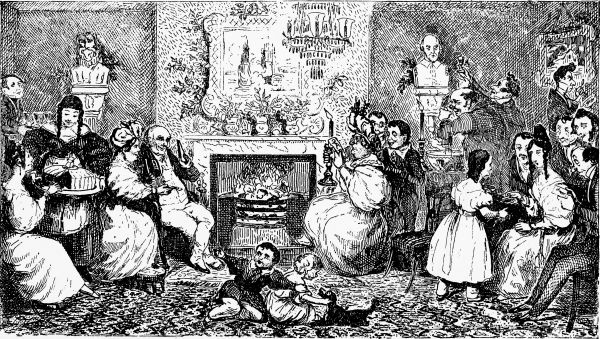
    If we fast forward in time, we see how some of these winter rituals were absorbed into the festivities of Twelfth Night. But first- what exactly is Twelfth Night? Typically celebrated on either January 5th or 6th, Twelfth Night, or Epiphany, is a Christian holiday that marks the end of the Twelve Days of Christmas and commemorates the Magi’s visit to Jesus. During the colonial era, the holiday season kicked off on December 25th and culminated on Twelfth Night. The twelve days after Christmas were full of games, music, dancing, feasts, and visiting with family and friends. Families often celebrated the season with a Twelfth Night Cake. Recipes called for a dried bean and pea to be baked into an elaborately decorated fruit filled cake. The man who found the bean was declared King for the night, while the woman who found the pea was declared Queen.

    Illustration of a Twelfth Night party by Robert Seymour. The woman on the far left serves pieces of a large Twelfth Cake. Credit: The Project Gutenberg

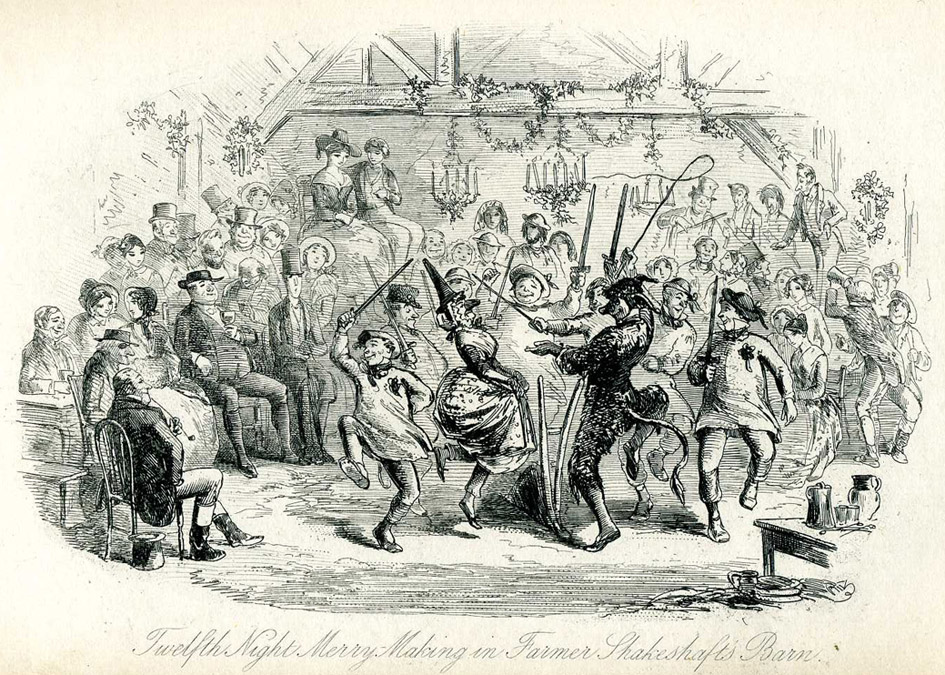
    Of course, there has always been debate surrounding how the Christmas season should be celebrated, and practices varied from place to place and person to person. In the 17th century, New England Puritans (echoing sentiments from Cromwellian England) viewed Christmastime celebrations as rowdy, excessive, and downright bacchanalian. Massachusetts went as far as to outlaw celebrations between 1659 and 1691.[3]

    The Twelfth Night party’s “King” and “Queen” sit on chairs overlooking the crowd. Dancing, drinking, and mumming (costumed acting) are in full swing. Puritans disapproved of these festive antics. Credit: Wikipedia

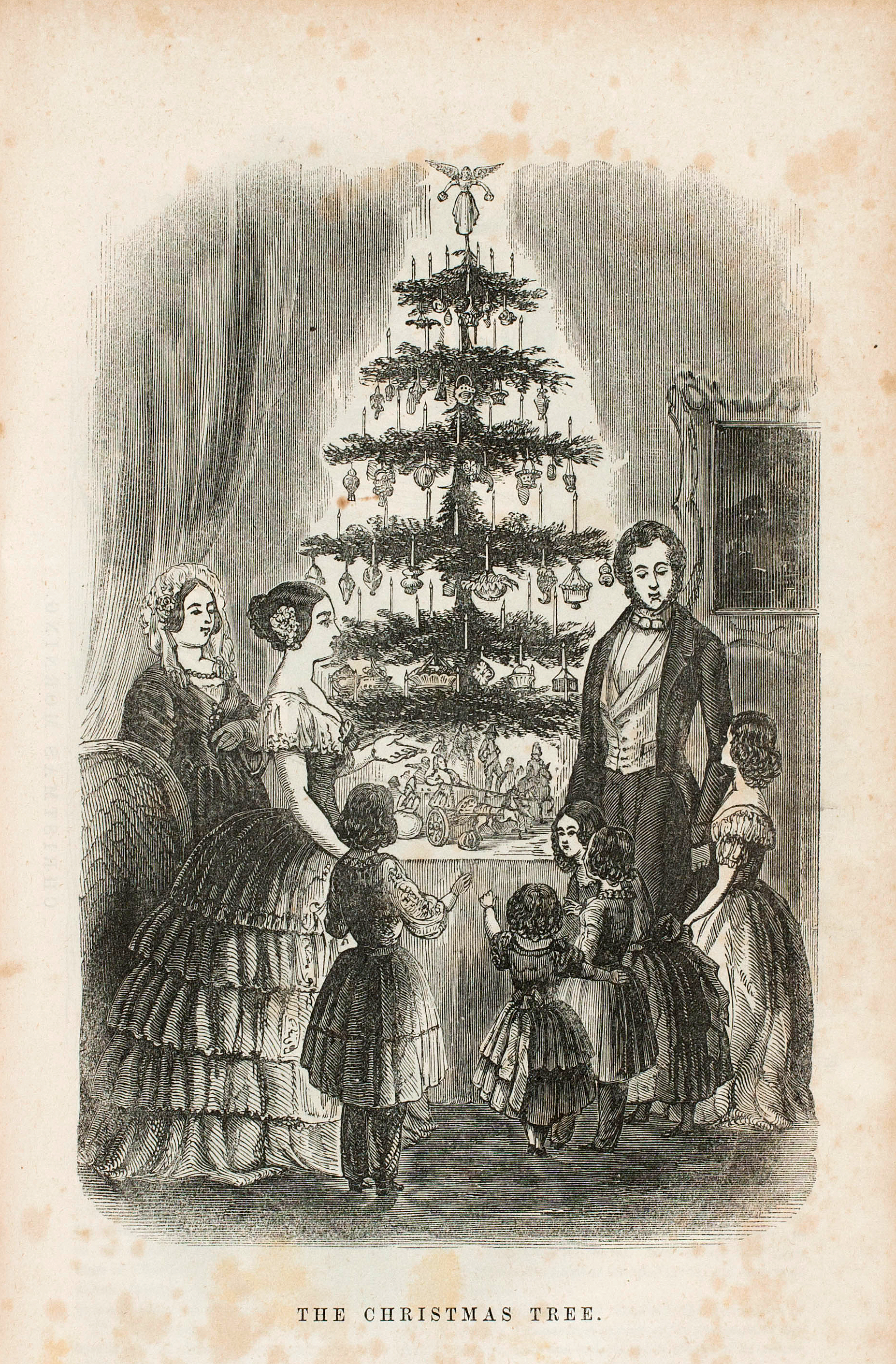
    During the 19th century, Queen Victoria influenced a shift in popular opinion towards a more family-focused Christmas season. In 1850, Godey’s Lady’s Book, a popular American magazine, published an image of the royal family gathered around a Christmas tree. While German immigrants had already introduced the Christmas tree tradition to America, this image fascinated the English and American public alike, and it further popularized the practice. In the American version of the print, editors removed Victoria’s tiara and Albert’s royal sash, and the group came to embody the ideal American family at Christmas.[4]

    Godey’s Lady’s Book illustration. Credit: Wikimedia Commons

    These changing ideals shaped the Christmas season during the Victorian era, and combined with rapid industrialization and commercialization, they sparked the beginning of a number of now familiar traditions. For example, improvements in mass printing technology popularized the practice of sending Christmas cards. In 1843, Charles Dickens published A Christmas Carol, a tale promoting charity, good will, and the virtues of a domestic family Christmas. Thomas Nast, who made popular the modern image of Santa Claus, published his first Santa cartoons in the 1863 edition of Harper’s Weekly.

    You might be asking, where then, does this leave the Twelve Days of Christmas and our Twelfth Night celebrations? As we’ve seen, changing ideals during the 19th century promoted a holiday season focused on children and family. Modern industry and commercialization further bolstered shopping and gift giving habits, and a twelve day holiday certainly didn’t fit within the parameters of the new industrialized era. The once twelve day celebration now culminated on one, and it was celebrated with visits from Santa and gifts for children, rather than with feasts and parties for adults.

    However, some Twelfth Night traditions live on during the modern Christmas season, albeit under new guises. Between Christmas and New Year’s, people may decorate their homes with greenery, raise a toast with a glass of wassail, or host extravagant parties with family and friends. If you visit New Orleans during the carnival season (beginning with Epiphany and ending on Mardi Gras) you might celebrate by eating “King Cake,” where the lucky person who finds the plastic baby figurine inside their piece of cake is crowned “king” for the day! That sounds a little familiar, doesn’t it?

    Ann Waters

    Manager of Interpretation and Visitor Services


    [1]“Saturnalia,” HISTORY, A&E Television Networks, Last modified December 18, 2020, Accessed December 22, 2021, https://www.history.com/topics/ancient-rome/saturnalia

    [2] Stephen Nissenbaum, The Battle for Christmas (New York: Knopf Doubleday Publishing Group, 2010), 4.

    [3] Bruce David Forbes,“Christmas,” In America’s Favorite Holidays: Candid Histories, 1st ed. (University of California Press, 2015), 28.http://www.jstor.org/stable/10.1525/j.ctv1wxrr3.5

    [4] Ibid., 34.

  • Maritime History at Kenmore & Ferry Farm

    Today – September 30 – is World Maritime Day. The United Nations and the International Maritime Organization created World Maritime Day in 1978 “to celebrate the international maritime industry’s contribution towards the world’s economy, especially in shipping.”

    “The South East Prospect of London from the Tower to London Bridge” (1746) by John Maurer. Credit: Royal Collection Trust / © HM Queen Elizabeth II 2018

    Both Historic Kenmore and George Washington’s Ferry Farm – perhaps surprisingly – feature fairly significant maritime histories.  Situated on the Rappahannock River, Fredericksburg was a bustling seaport in the 1700s when George Washington grew up at Ferry Farm and when Fielding Lewis practiced his merchant trade while living at Kenmore.  George saw ocean-going sailing vessels unloading and loading cargo from his bedroom window.  Some of these ships were owned by Fielding and his family.  Both men were part of “the Atlantic World,” a global community of many different peoples trading back and forth across the Atlantic Ocean.

    Here on Lives & Legacies, we’ve written regularly about Fredericksburg as a seaport and about the impact of Atlantic trade on both the Washingtons and the Lewises.

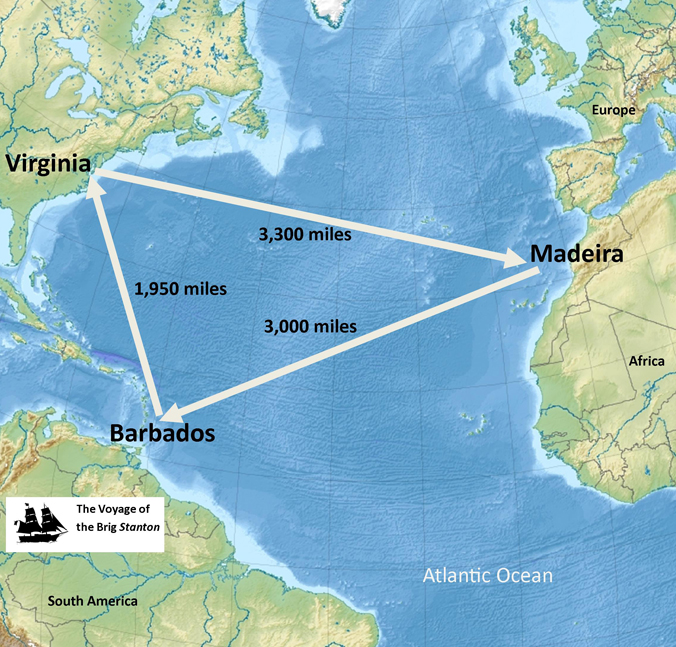
    “The Voyage of the ‘Stanton’” recounts one voyage of a Lewis family ship and the cargo it carried traveling from Virginia to Madeira off the European coast, then to the British West Indies in the Caribbean, and finally back to Virginia.  Each leg of this journey formed part of the Atlantic World’s famed “Triangular Trade.”

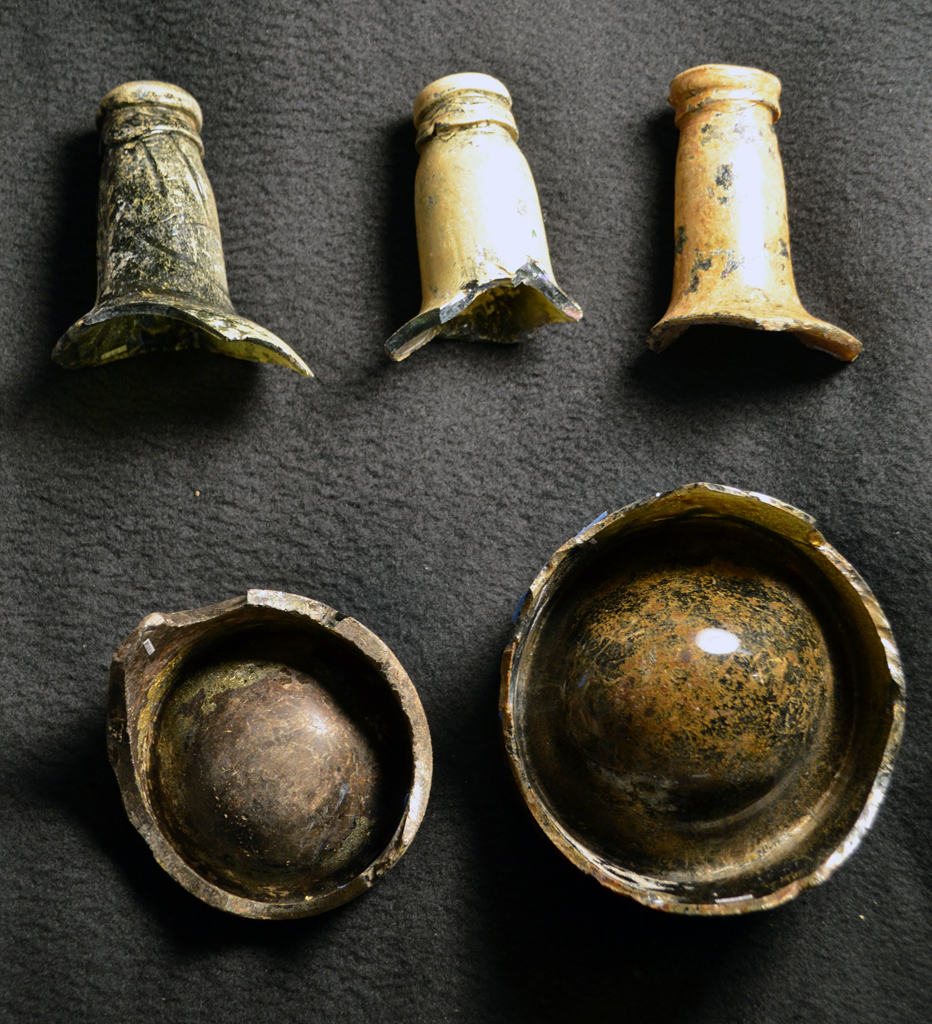
    Many of the Washington family artifacts recovered at Ferry Farm came to their home from different parts of this triangle and beyond.  For example, the fragments of wine bottles depicted below and written about in “The Wine Bottle: Ubiquitous and Informative” may have carried fortified wine from Madeira to Ferry Farm. European grapes did not grow well in the colonies while native grapes did not make good wine so wine was imported.

    Mid-18th century bottle neck and base fragments excavated from the Washington house cellar at Ferry Farm.
    An example of what the bottles excavated at Ferry Farm looked when they were whole.

    The maritime-based economy that brought Madeira wine and the many other goods used by the Washingtons at Ferry Farm is also perfectly symbolized by a “black dogg” coin. Unearthed not far from the Washington house site and written about in “The Tale of the ‘Black Dogg,’” this coin “originally circulated in the French Caribbean” and may well have come to Fredericksburg in a sailor’s pocket.

    “Black dogg” coin excavated at George Washington’s Ferry Farm.

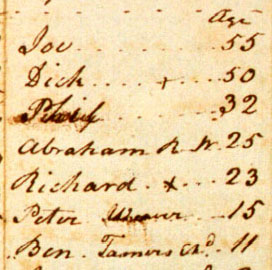
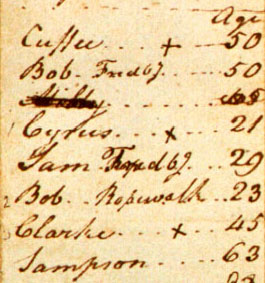
    As a merchant, Fielding Lewis owned ships that traveled the Atlantic World carrying goods to and from Fredericksburg.  The goods brought to Fredericksburg he then sold to the community or placed in his fashionable home.  Maritime trade was Fielding’s life-long business and he put some of his enslaved workers to that task.  As written about in “Abraham and The Ropewalkers,” a handful of Lewis slaves wove rope at ropewalks near Fredericksburg or perhaps even in Richmond.  Of course, much of this rope was likely used on Virginian sailing vessels.

    Portion of The Divvy List made by Betty Washington Lewis showing Abraham with an “R.W.” after his name.
    Portion of The Divvy List showing Bob #2 with “Fredbg” after his name and Bob #2 with “Ropewalk” after his name.

    The impact of today’s ocean-going global trade can be largely unseen. Similarly, the maritime histories of Kenmore and Ferry Farm are not immediately evident to our eyes. However, sailors, ships, and their cargos significantly influenced the lives of the Washingtons, the Lewises, and the enslaved people of Ferry Farm and Kenmore in 1700s.  World Maritime Day is a good day to remember the impact of the international maritime industry, past and present.

    Zac Cunningham
    Manager of Public Programs

  • “Mark’d with Gunpowder”: Tattoos in Early America

    Recently, I came across an interesting notice in an early edition of the Virginia Gazette.  On June 9, 1738, Augustine Washington, George Washington’s father, placed a notice in the newspaper about one of his indentured servants running away.  The notice read…

    “RAN away from Capt. McCarty’s Plantation, on Pope’s Creek, in Westmoreland County, a Servant Man belonging to me the Subscriber, in Prince William County; his Christian Name is John, but Sirname [sic] forgot, is pretty tall, a Bricklayer by Trade, and is a Kentishman; he came to Patowmack, in the Forward, Capt. Major, last Year; is suppos’d to have the Figure of our Saviour mark’d with Gunpowder on one of his Arms. He went away about the 20th of April last, in Company with three other Servants…”

    The notice then described the three other indentured servants, ostensibly belonging to McCarty. First, sailor Richard Martin was “a middle siz’d Man, fresh colour’d, and 22 Years of Age.” Next, tailor Edward Ormsby was “a small thin Fellow, of a swarthy Complexion . . . has a Hesitation or Stammering in his Speech, and being an Irishman, has a good deal of the Brogue.” Finally, carpenter Richard Kibble was “a middle siz’d young Fellow, has several Marks made with Gunpowder on his Arms, but particularly one on his Breast, being the Figures of a Woman and a Cherry Tree.”

    I found the inclusion of the tattoos’ descriptions fascinating and the spark to many questions. How common was tattooing in Colonial America?  Who was most likely to have tattoos? What kind were popular? Where were they placed on the body? And finally, why did colonial people choose to permanently mark their bodies in this fashion?

    Notice of runaway indentured servants placed by Augustine Washington in the Virginia Gazette on June 9, 1738.

    Tattoos in Early America

    Tattooing is as old as the human race itself.  Anthropologists place its origins sometime in the pre-historic Paleolithic era or “before the wide dispersal of man.”[1] Tattooing has been practiced in early societies and indigenous cultures for thousands of years

    Unfortunately, documentation of tattoos from the 18th century is scarce, and finding information about tattooing in early America is nearly impossible.  Two records I did find helpful were the Seamen’s Protection Certificate Applications (SPC-A) and various runaway indentured servant and convict notices in the Virginia Gazette.

    Sailors

    The SPC-A were applications made by seamen under the Act for Relief and Protection of American Seamen of 1796.  The act was passed to protect American seamen from impressment into the British Royal Navy in the years that led up to the War of 1812.  Each sailor who served on a United States vessel applied for a certificate of protection, which included a detailed physical description that encompassed any tattoos

    The applications range from sailors of 12-years-old with one tattoo to 59-years-old with several detailed designs.  Tattoos on the “17 and under” tended to be pretty standard symbols like personal initials, initials of loved ones, or small maritime and religious marks like anchors and crucifixes.  These were boys probably just starting their careers as sailors and had not yet had the time or the travels to collect a more complex range of tattoos.

    For the more seasoned sailor, initials, names, words, and letters seemed to be the most common and sought after tattoos with 38% of all reported from 1796-1818 falling into this category.[2]  Second most common was the 21% of sailors who reported some type of sea-themed tattoo from simple anchors and compasses to more complex ships, mermaids, and sea creatures. 

    Surprisingly, coming in at 8% were symbols of love with around 200 tattoos.  These included but were not limited to hearts, linked hearts, hearts and darts, hearts and arrows, hearts with initials and dates, bleeding hearts, and hearts with doves.[3]  Patriotic and political tattoos were prevalent as well, particularly with men born in or before 1776.  These designs included flags, eagles, clusters of stars, “1776”, and words such as “Independence” and “Liberty”.[4]  Religious symbols represented around 8% of tattoos and another 4% were miscellaneous depictions of people and animals or other crude drawings. 

    Around 95% of tattoos were found on sailors’ hands or arms.  This became much less common during the 20th century when areas like the chest, shoulders, back, and legs grew in popularity, providing a bigger canvas while also being easier to cover.

    Indentured Servants & Convicts

    Another source for my survey of colonial tattoo use was newspaper notices alerting the populace to runaway indentured servants and wayward convicts.  Fifteen different notices examined from the Virginia Gazette between 1737 and 1768 described a runaway’s tattoos.  For these 14 men and one woman, the tattoos ranged from initials made with gunpowder to a complicated floral design in blue ink. 

    The woman, a “convict servant” named Winnifred Thomas, was described as mark’d on the Inside of her Right Arm, with Gun-powder, W.T. and the Date of the Year underneath.”  It is a fair assumption that the tattooed W.T. were her initials and may have been done for identification purposes.

    Of the 14 men, 11 had lettering of some sort, whether their initials or the name of a loved one. Convict servant William Roberts, for example, had tattooed on his arm the name “Mary Roberts” along with “Letters on one of his Hands, mark’d with Gun-powder, and on one of his Arms a darted Heart.”

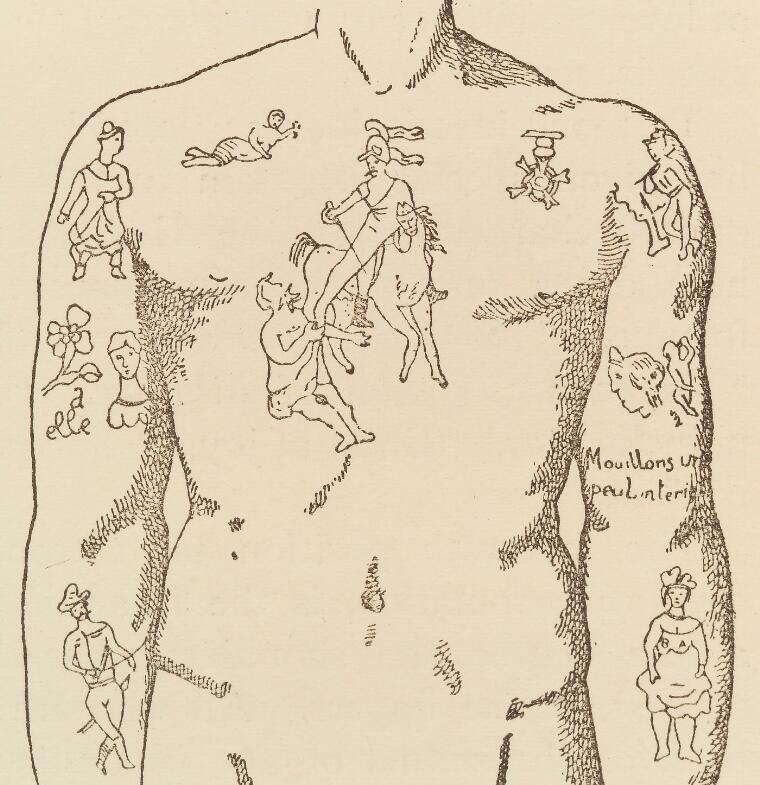
    Six of the men had designs ranging from floral patterns to bleeding hearts to religious iconography.  Christopher Lewellen, a runaway indentured servant, had “a great many letters and Flowers mark’d on his Arms in Blue, with the letters C L on one of his Hands, very dull.” John Peters, also an indentured servant, was “mark’d on the middle of his Breast, with the Picture of a Woman and several Children before her” plus “on one Arm, a crucifix,” and “on the other, the Jerusalem Arms.”

    The placement of the tattoos tended to be on the arms, wrists, or hands with all 15 having at least one mark on these extremities.  Only two men were described as having marks on their chest in addition to their arms.

    A French glazier, thief, deserter from army. The chief figure tattooed on his chest is St. George. Credit: Public Domain / Wellcome Collection

    Conclusions

    There is minimal information available that documents tattooing and tattoos in Colonial America.  What information we can glimpse is from records that were mainly descriptive markers of the subject.  The personal history and individual intent of the tattoos are lost to time. 

    We can surmise from the data that the people who marked their skin with gunpowder or ink tended to be those on the margins of society.  At the time, these were people deemed to be in the lower rungs of society or people in positions of servitude.  They could mark their bodies without their social position being questioned because they were already positioned at the bottom. 

    Why might they mark themselves in society when already marginalized? There are a few possible reasons.  First, the tattoos could have been forced upon them.   It was common for soldiers to get tattoos as a form of identification.  It would have been a convenient and permanent way to mark convicts, indentured servants, enslaved workers, and others in servitude, hindering potential escapes and creating easier captures. 

    Second, tattoos created comradery and a sense of belonging, particularly for the sailors.  It became sort of rite of passage for sailors to tattoo their bodies with marks of their trade and thereby distinguishing themselves from “landlubbers.” 

    Lastly, people got tattooed for sentimental reasons, which is similar to the primary reason people arguably get tattooed today.  Tattoos reminded them of their family, faith, and history.  It was a way to permanently remember important events and people in their lives.

    We do not know if Augustine Washington’s runaway notice in the Virginia Gazette resulted in the return of John or any of the other three indentured servants. He offered 5 pounds reward for John’s return. The notice reports that “They went away from Capt. Aylett’s Landing, on Patowmack, in a small Boat and are suppos’d to be gone towards the Eastern-Shore or North-Carolina.” Another of the runaways in one the other notices examined was believed to be headed to North Carolina as well.  The wild, sparsely-populated swamps, tidal marshes, and barrier islands of both regions drew many of the 18th century’s marginalized people seeking to create a new, freer life.  Many likely marked in some way by tattoos.

    Heather Baldus
    Collections Manager


    [1] Ira Dye, “The Tattoos of Early American Seafarers, 1796-1818” Proceedings of the American Philosophical Society, Vol. 133, No. 4 (Dec., 1989), 520; Petar N. Zidarov, “The Antiquity of Tattooing in Southeastern Europe,” in Ancient Ink: The Archaeology of Tattooing, ed. Lars Krutak and Aaron Deter-Wolf (Seattle: University of Washington Press, 2017), 137-149.

    [2] Dye, 544.

    [3] Ibid.

    [4] Dye, 541.

  • “I have the honor to be, your obedient servant”: Why Did Washington End His Letters this Way?

    How many times have you watched Hamilton? It’s okay, I’ve lost count too. In my most recent viewing, when Burr and Hamilton each proudly proclaim their letter-ending valedictions in the song “Your Obedient Servant”, I began thinking “Where exactly did this phrase come from, why did they use it, and how did it fall out of use?” Even though I am a historian, I have always taken the phrase for granted. It has always been there at the end of letters by Washington and his contemporaries, but I never really gave it much thought.

    When was the last time you sat down to write a letter? – Better yet, an email? How did you “sign off”? Today, we mostly use short phrases like “sincerely”, “regards”, “best wishes”, or simply “yours” when we end written communications. However, in the 18th century, writing was not only a form of communication; it was also a method of entertainment, personal expression, and the preservation of events and thoughts for posterity. Simply put, longer, more expressive valedictions were more popular because writing letters was more popular.  For example, in 1541, Spanish conquistador, Francisco Vázquez de Coronado, wrote to the King of Spain and signed the letter “Your Majesty’s humble servant and vassal, who would kiss the royal feet and hands.”  Could you imagine someone saying that to someone like Queen Elizabeth II today?

    The truth is that our letter writing skills have all but gone by the wayside considering modern conveniences of instant communication. Making a phone call, texting, and sending an email are much more informal than sitting down and writing out a letter – or even typing out a letter. When George Washington put pen to paper, like he so often did, he put much more thought into his words than we do when we send a quick “lol”.

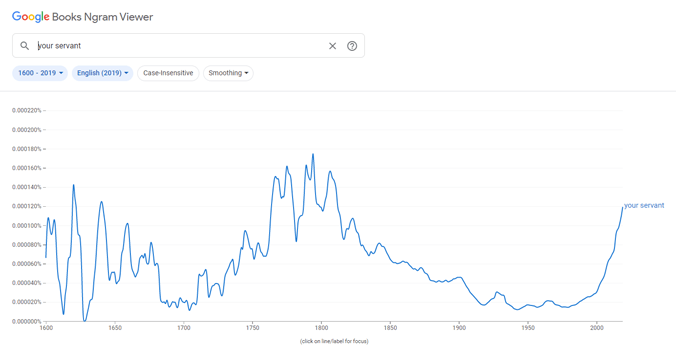
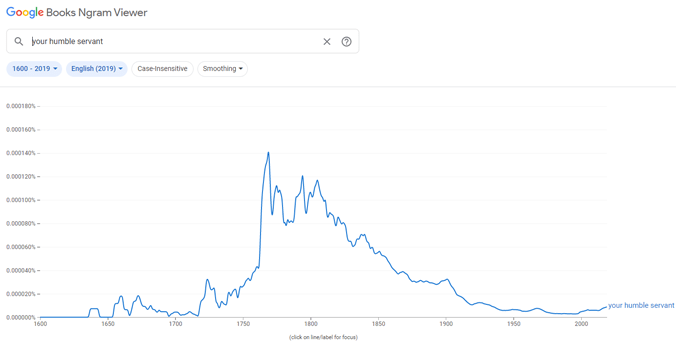
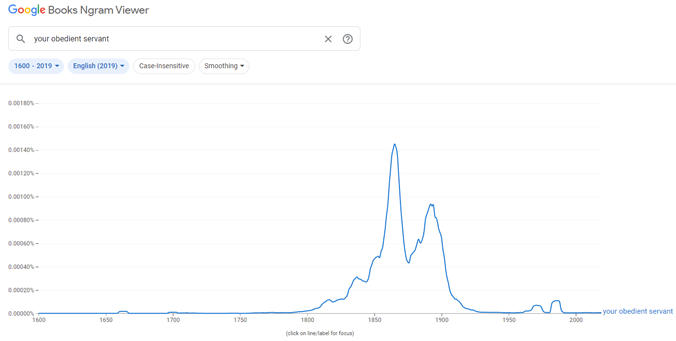
    During the 18th century, the most common valedictions – defined as statements made as farewells – were variations on the letter’s author referring to themselves as the servant of the recipient. To determine the popularity of this “servant valediction” and its variations, I used Google Books Ngrams to search their database of books and see how many times various valedictions were used over time. While Ngrams searches books and not all letters from the time, it can still give us a good idea of how common each phrase might have been.

    In the first graph, for example, we see that the shortened “your servant” appears quite a bit over time. It seems to fade from fashion briefly around 1700 before coming returning to popularity around 1800. It then begins to fall out of favor again and was rarely used in the 1900s.  However, there appears to be an uptick in recent years and, perhaps we can credit this, at least partially, to the Hamilton-effect.

    In the second graph, we see the phrase “your humble servant” was most popular in the late 18th and early 19th centuries. Looking to Washington’s writings, we see him use this phrase in a letter to George Beall, a shopkeeper, in 1756.

    Next, I entered the phrase “your obedient servant”. This phrase was also in its heyday at the end of the 18th and the beginning of the 19th centuries. Again looking to Washington’s papers, he does use the “your obedient servant” variation and often adds the word “most” as seen in a1755 letter to Robert Orme, a British soldier he fought with during the French and Indian War.

    Ultimately, Washington’s most common servant valediction combined all of these variations into the lengthy “your most obedient and most humble servant” as seen in this letter to Governor Fauquier from 1758.

    If you search the phrase “obedient servant” in the entirety of Founders Online, a digital repository of documents written by Washington, Adams, Jefferson, Madison, Hamilton, Franklin and other early American luminaries, it will return over 16,000 results! That number wouldn’t include all of the instances where the words were abbreviated, which was also common. Indeed, even in the letters referred to in the Hamilton song; Alexander Hamilton writes “your obed. Servt”, abbreviating both key words in the phrase.

    The use of the servant valediction didn’t fully fade from popularity until well after Washington’s life. By 1883, however, a different variation of the servant valediction had become popular. On page 43 of The Art of Correspondence, John Staples Locke instructs authors to use “respectfully yours” as a way to convey the same sentiment. It is still commonly seen today. Ultimately, even our simple “Yours” at the end of an email can be traced back to the flowery valedictions of Alexander Hamilton and George Washington.

    I have the honor to be, your obedient servant,

    E. Hosier
    Manager of Interpretation & Visitor Services