Lives and Legacies

Category: Washington in the World

  • Kenmore Goes to Sea: Ship Naming in the US Navy

    On July 22, 1942, Annie Fleming Smith wrote a letter. Smith was a prolific letter writer—her innumerable missives had helped raise the funds that saved Kenmore two decades earlier—so it is not surprising that she put pen to paper on that summer day. What is surprising is that the intended recipient of that letter was not a prospective donor, a fellow regent of the Kenmore Association, or a friend. Instead, she addressed her epistle to Frank Knox, the Secretary of the Navy. Smith wanted “confirmation of the fact of the naming of the U.S.S. KENMORE” after the home and “any other information you can release” about the ship.[1]

    Letter that Annie Fleming Smith sent to Secretary of the Navy Frank Knox asking for confirmation that the first USS Kenmore had been named after the historic home. Smith, Annie Fleming to Frank Knox, July 22, 1942. The George Washington Foundation.

    Although there is no record that Knox responded to Smith (there was, after all, a war on), the USS Kenmore was, in fact, named for the historic estate. The Naval History and Heritage Command ship-naming file on Kenmore I (AP-62) includes an April 13, 1942, memo to the Secretary of the Navy from the chief of the Bureau of Navigation and prepared by Louis Emil Denfeld, then assistant chief of the Bureau of Navigation, recommending that the President Madison be renamed Kenmore, in honor of the “[h]ome of Betty Washington at Fredericksburg, Virginia, sister of George Washington who married Col Fielding Lewis.”[2] The recommendation was approved on April 16 of that year, and the newly renamed vessel was “commissioned at Baltimore, Md., on 5 August 1942, Cmdr. Myron T. Richardson in command.”[3]
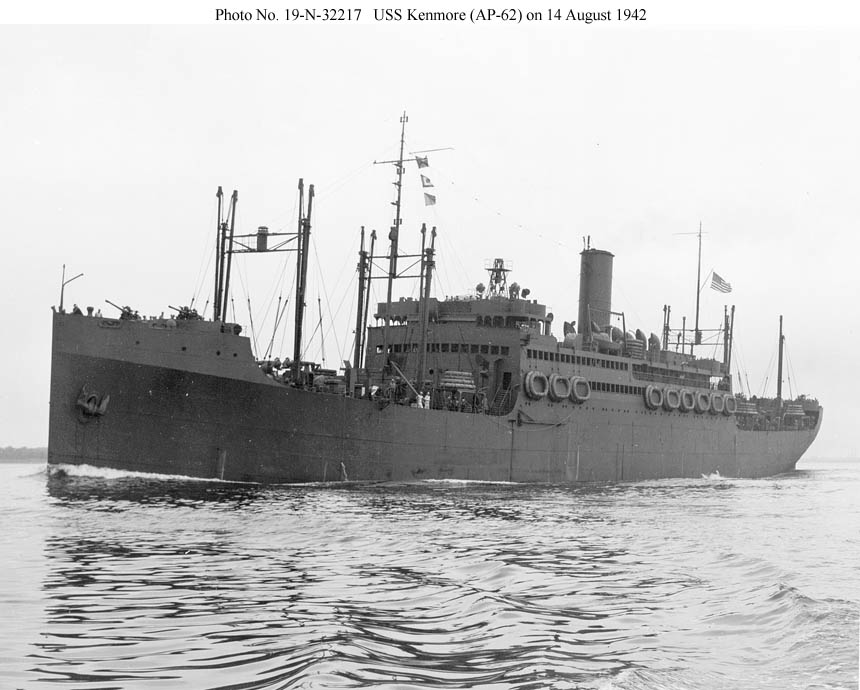
    USS Kenmore (AP-62) on trials in the Chesapeake Bay on August 14, 1942. Shipscribe

    Smith had learned of the ship during a mid-1942 visit to the estate from Lt. Commander William VanC. Brandt (USNR) of the Kenmore, who later wrote to “Miss Annie” to thank her for her hospitality.[4] “All the Officers of the Kenmore,” Brandt told Smith, “were most interested in learning the history and record of the beautiful estate for which our ship is named.”[5] Brandt planned to have framed and displayed in the ship’s wardroom photographs of the property given to him by Smith; later, the vessel’s captain requested a picture of the house for his room.[6] For her part, Smith was “thrilled” to meet Brandt and “to know about your ship,” although she was skeptical enough of the origin of the transport’s new name to write Knox.[7]
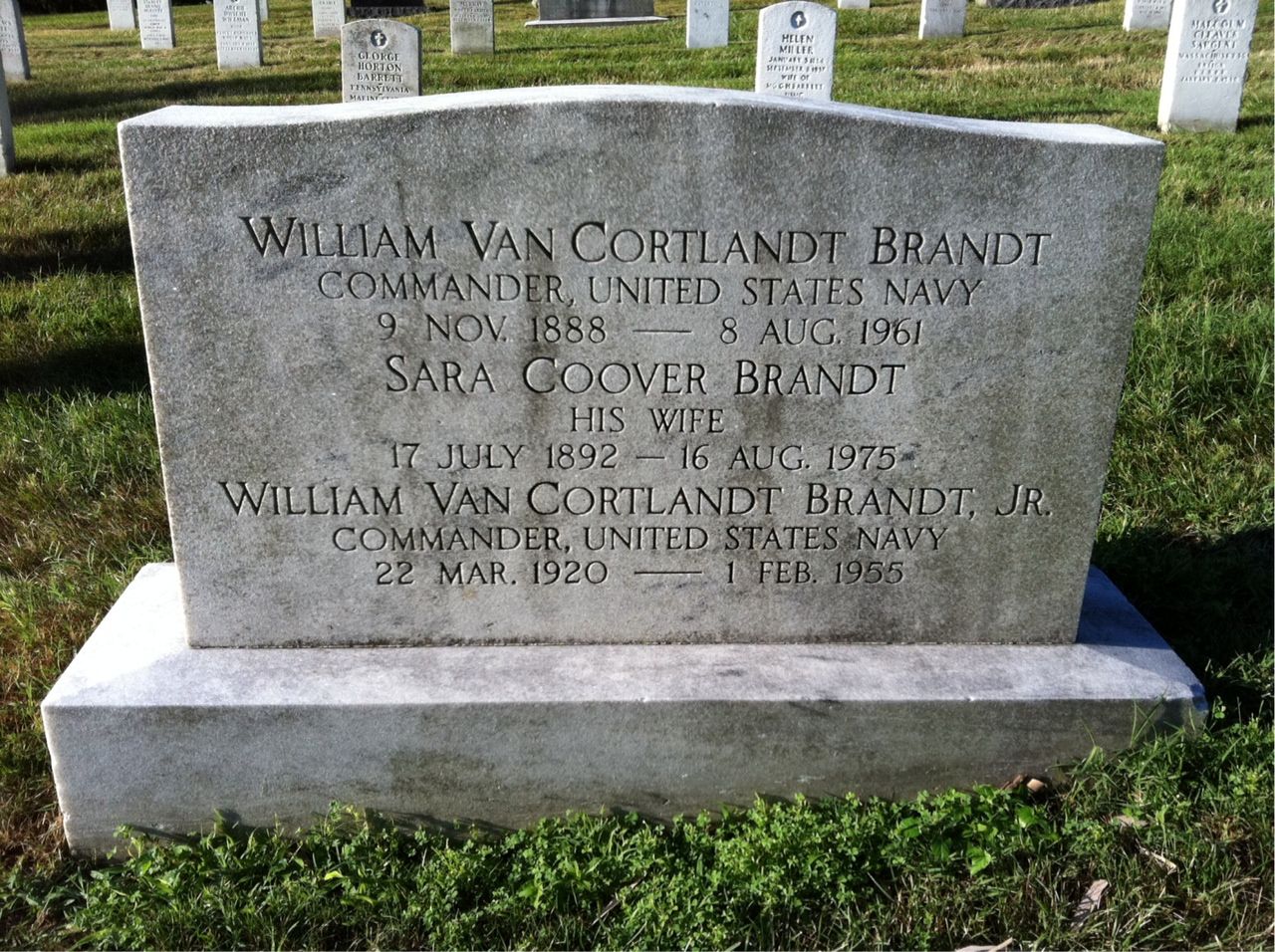
    The Arlington National Cemetery headstone of William VanC. Brandt, from whom Annie Fleming Smith learned that a Navy ship had been named after the historic home she had helped save from development in the 1920s.

    The Kenmore operated primarily in the Pacific until September 1943; she was then converted into a hospital ship and renamed Refuge.[8] The Navy must have liked the name Kenmore, as it was bestowed in October 1943 on another transport, originally called the James H. McClintock.[9] The Kenmore II also served in the Pacific Theater and, after “hostilities ended on 15 August 1945, [began] returning veterans to the U.S.”[10] She was decommissioned on February 1, 1946.[11]

    The Kenmores were not the only vessels named for properties associated with George Washington and his family. The Wakefield (AP-21) borrowed its name from the Westmoreland County birthplace of the first president, today owned by the National Park Service.[12] There have been five Mount Vernons; the first was built in 1859 and chartered by the Navy two years later, before they bought it later that year.[13] The most recent vessel named after Washington’s residence and plantation was a dock landing ship commissioned in 1972 and decommissioned in 2003.[14] The possible birthplace of Mary Ball, George Washington’s mother, lent its name to the Epping Forest, a dock landing ship launched in 1943.[15]

    The monikers of other ships are connected more tenuously to places tied to George Washington and his family. For example, a 1943 submarine chaser was rechristened the Abingdon in 1956.[16] The vessel’s new name came from the town of Abingdon, in Washington County, Virginia (named, yes, for George Washington).[17] According to the county’s official history, “myths claim that [the town] was named for Martha Washington’s ancestral home” in England.[18] While this may be a false etymology, were those who named the ship drawing on the tale when they chose to call the vessel Abingdon? Additionally, the many Arlingtons that have served the Navy over the years have each been named after Arlington County, which draws its appellation from Arlington House, built for George Washington Parke Custis, the step-grandson of his celebrated namesake.[19]

    Arlington Mansion was built by George Washington Parke Custis. Union soldiers posing on the lawn, June 28, 1864.

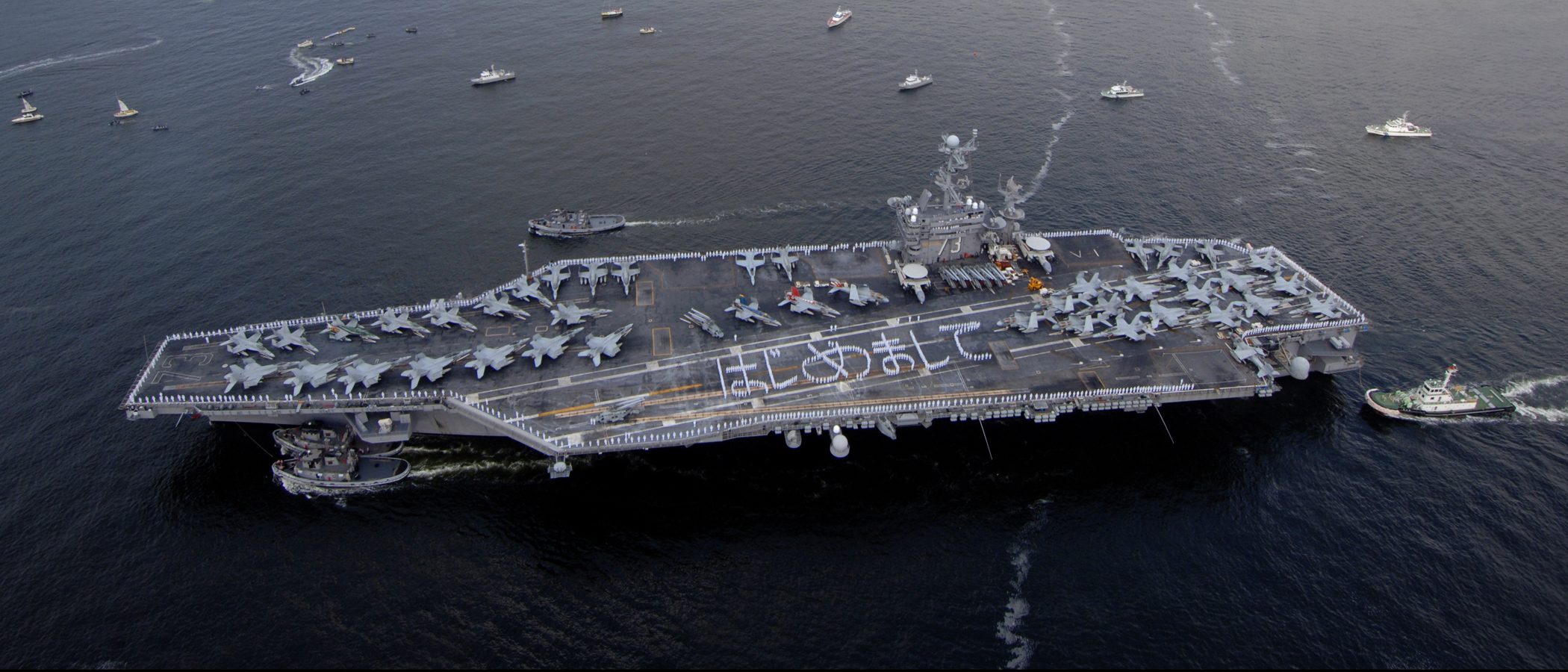
    The Navy’s infatuation with the commander in chief of the Continental Army has, of course, also been expressed by naming ships directly after Washington and his family, not just their properties. While a complete inventory of such vessels is beyond the scope of this post, it is worth noting that four ships have been named the George Washington, including CVN-73, an active nuclear-powered aircraft carrier, while several others have sailed under just his surname.[20] Martha, George’s wife and the nation’s first first lady, has inspired the names of at least two Navy ships: the Lady Washington and the Martha Washington.[21] Civilian shipbuilders have also found inspiration in the Washington family: the SS Mary Ball was a liberty ship active during World War II.[22]
    Who was responsible for naming these ships? As hinted at above, while final authority for ship names was (and still is) the responsibility of the Secretary of the Navy, during World War II, it was the Bureau of Navigation (renamed the Bureau of Personnel on May 21, 1942) that researched and recommend ship names based on the traditional naming conventions associated with each class of vessels.[23]

    Typically, it was dock landing ships, or LSDs, that were named for “cities and places of historical interest of same name, or places of historical interest only.” [24] Epping Forest, Gunston Hall I (named for George Mason’s home), Ashland (for the boyhood home of Henry Clay), Carter Hall (after the Virginia estate), Oak Hill (for the home of President James Monroe), and Shadwell (for the birthplace of Thomas Jefferson) are all examples of LSDs whose names aligned with this convention.[25]

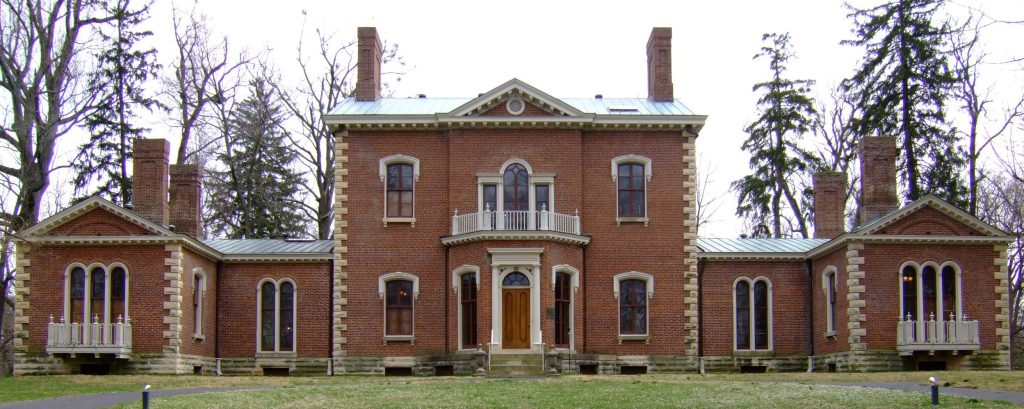
    But the Kenmores, the Mount Vernon IV, and the Wakefield were not LSDs; they were transports, classified AP, and anyone seeking consistency in the Navy’s naming of troop transports during World War II is bound to be disappointed. Some vessels in the AP class were named after celestial bodies, others after Revolutionary War heroes, and others, as we have seen, after historic estates.

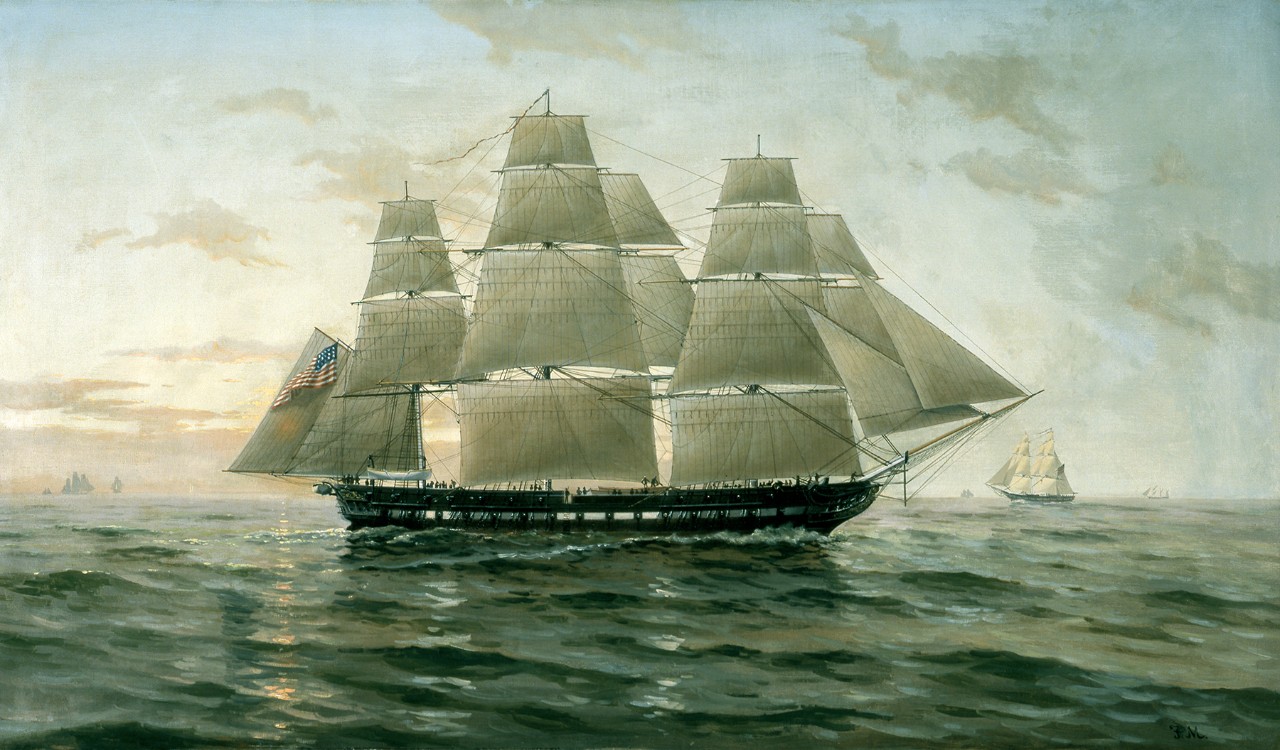
    This lack of consistency is not surprising. After all, when Benjamin Stoddert named the Navy’s sixth ship, a frigate, he chose to call it the Chesapeake, despite President George Washington’s agreement with the recommendation that frigates be named after “principles or symbols found in the US Constitution.” Therefore, “the very first naming decision by the very first Secretary of the Navy resulted in the ‘corruption’ of the established naming convention.”[26] This tradition of flexibility regarding ship names has endured, and ship names continue to excite interest (and occasionally strong feelings) from many parties, including those who propose denominations for new vessels. If you are such a person, here’s an idea: how about another Kenmore, or maybe a Ferry Farm?  


    Adam Nubbe

    Manager of School & Youth Programs


    [1] Smith, Annie Fleming to Frank Knox, July 22, 1942. The George Washington Foundation.

    [2] Naval History and Heritage Command, Kenmore I, ship-naming file, April 13, 1942.

    [3] Ibid; Cressman, R. J. (2020, March 31). Kenmore I (AP-62). https://www.history.navy.mil/research/histories/ship-histories/danfs/k/kenmore.html

    [4] Brandt, William VanC. to Annie Fleming Smith, June 30, 1942. The George Washington Foundation.

    [5] Ibid.

    [6] Ibid; Smith, Annie Fleming to William VanC. Brandt, July 10, 1942. The George Washington Foundation.

    [7] Smith, Annie Fleming to William VanC. Brandt, July 10, 1942. The George Washington Foundation.

    [8] Naval History and Heritage Command, Kenmore I, ship-naming file, April 13, 1942.

    [9] Cressman, R. J. (2020, March 31). Kenmore II (AP-162). https://www.history.navy.mil/research/histories/ship-histories/danfs/k/kenmore-ii–ap-162-.html

    [10] Ibid.

    [11] Ibid.

    [12] Cressman, R. J. (2022, April 1). Wakefield (AP-21). https://www.history.navy.mil/research/histories/ship-histories/danfs/w/wakefield.html

    [13] Naval History and Heritage Command. (2015, August 11). Mount Vernon I (Gbt). https://www.history.navy.mil/research/histories/ship-histories/danfs/m/mount-vernon-i.html

    [14] Pike, J. (n.d.). LSD 39 Mount Vernon. https://www.globalsecurity.org/military/agency/navy/lsd-39.htm

    [15] Naval History and Heritage Command. (2015, July 8). Epping Forest. https://www.history.navy.mil/research/histories/ship-histories/danfs/e/epping-forest.html

    [16] Mann, R. A., & Cressman, R. J. (2023, November 27). Abingdon (PC-1237). https://www.history.navy.mil/research/histories/ship-histories/danfs/a/abingdon.html

    [17] Ibid; Hagy, J. W. (2019, June 10). A Brief History of Washington County, Virginia. Washington County, Virginia. https://www.washcova.com/history/

    [18] Ibid.

    [19] Parsons, L., & Cressman, R. J. (2023, December 13). Arlington I (AP-174). https://www.history.navy.mil/research/histories/ship-histories/danfs/a/arlington-i.html; Arlington, Virginia. (n.d.). History of Arlington. https://www.arlingtonva.us/Government/Topics/Welcome-Kit/History-of-Arlington; National Park Service. (2023, January 12). George Washington Parke Custis. https://www.nps.gov/arho/learn/historyculture/george-custis.htm

    [20] Naval History and Heritage Command. (2020, May 5). Washington VIII (BB-56). https://www.history.navy.mil/research/histories/ship-histories/danfs/w/washington-viii.html; US Navy. (n.d.). USS George Washington (CVN 73). https://www.airpac.navy.mil/Organization/USS-George-Washington-CVN-73/

    [21]  Naval History and Heritage Command. (2016, February 9). Martha Washington. https://www.history.navy.mil/research/histories/ship-histories/danfs/m/martha-washington.html; Naval History and Heritage Command. (2015, July 28). Lady Washington. https://www.history.navy.mil/research/histories/ship-histories/danfs/l/lady-washington.html

    [22] Jobrack, J. (2020, September 10). True or False? Test Your Knowledge of Mary Washington. https://livesandlegaciesblog.org/2020/09/10/true-or-false-test-your-knowledge-of-mary-washington/.

    [23] Calkins, W. F. (1958, July). Down to the sea in ships’–names. U.S. Naval Institute. https://www.usni.org/magazines/proceedings/1958/july/down-sea-ships-names; Naval History and Heritage Command. (2020, June 29). Denfeld, Louis Emil. Louis Emil Denfeld. https://www.history.navy.mil/research/library/research-guides/modern-biographical-files-ndl/modern-bios-d/denfeld-louis-emil.html

    [24] Department of the Navy, A Report on Policies and Practices of the U.S. Navy for Naming the Vessels of the Navy (2012, November), 63. https://apps.dtic.mil/sti/tr/pdf/ADA569699.pdf

    [25] DANFS – Naval History and Heritage Command. Dictionary of American Naval Fighting Ships — Index. (n.d.). https://www.history.navy.mil/research/histories/ship-histories/danfs.html

    [26] Department of the Navy, A Report on Policies and Practices of the U.S. Navy for Naming the Vessels of the Navy (2012, November), 7. https://apps.dtic.mil/sti/tr/pdf/ADA569699.pdf


  • From the Vaults: Rarely Seen Documents

    Some of the most delicate objects in our collection are our archives. Paper and other document materials like vellum and parchment are very sensitive materials that can be irreversibly damaged simply by light.  This makes it very difficult to display or put on exhibit for extended periods despite our comprehensive policies for conserving and preserving documents; exhibition has always been unfeasible.  To remedy this, we have been working on getting archival-safe, high-quality images of our important documents online for everyone to access.  So, while you might not see the documents in person, you can still explore, read, and learn about these important papers while we preserve them for future generations.     
    Until we launch our online archives, I wanted to give everyone a sneak peek at a few of our incredible pieces.

    One of our oldest documents in the collection is a Land Grant signed by William Gooch on September 28, 1730, written on vellum.  William Gooch was a colonial administrator who served as governor of Virginia from 1727 to 1749.  The grant is not in the best condition, but it reads that it grants 400 acres in Spotsylvania County to Paul Plunkepee.  This grant is officially recorded as Land Office Patents, No. 14, 1728-1732, page 40, and is available at the Library of Virginia.

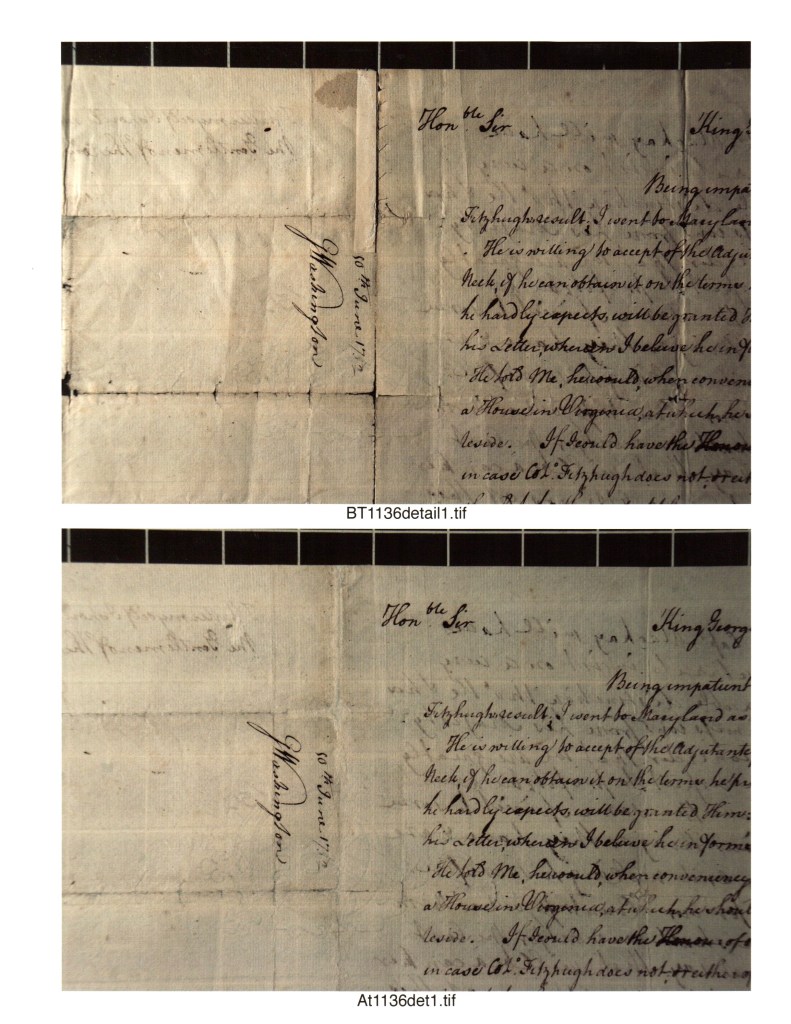
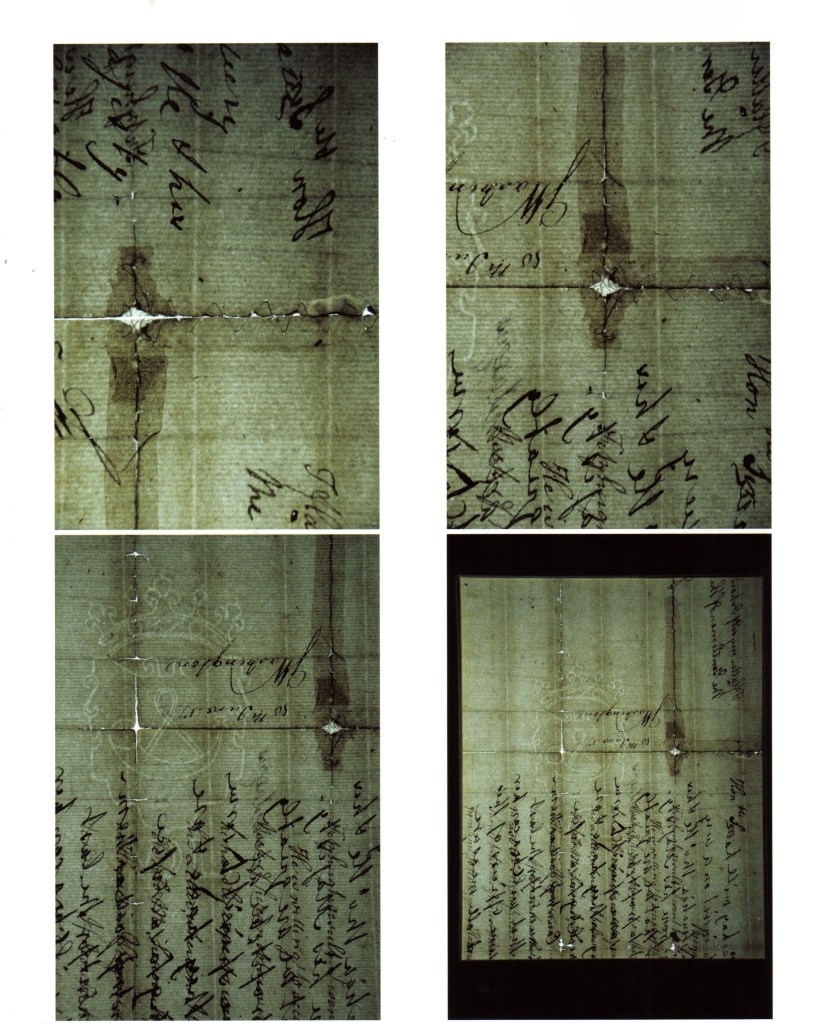
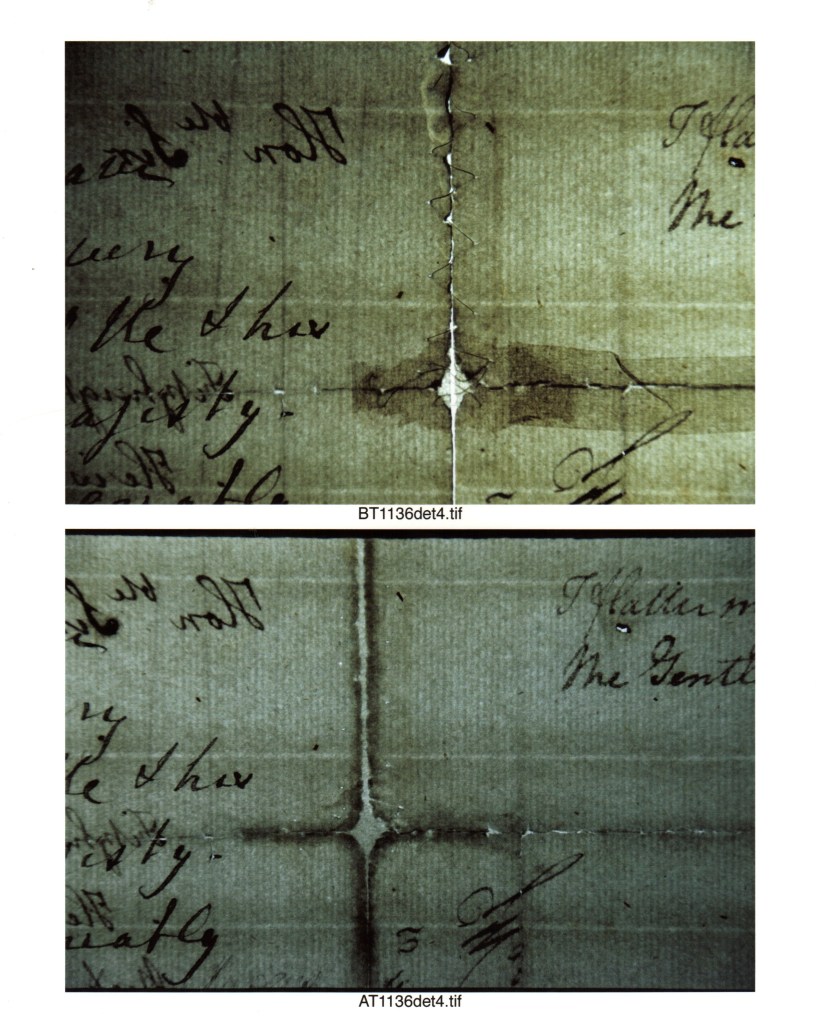
    One of our most unique documents is a letter from George Washington to Lieutenant Governor Robert Dinwiddie, written on June 10, 1752, when he was twenty.  Robert Dinwiddie served as Lieutenant Governor of Virginia from 1751 to 1758.  In the letter, George requests his first military appointment to the open adjutancy of the Northern Neck or other district.  George’s half-brother Lawrence had been appointed Adjutant General of the colony in 1743.  Due to his illness and eventual death, the adjutant was to be divided into smaller districts (i.e., Northern Neck).

    Dinwiddie declined the appointment but assigned George to an envoy position that winter to confront the French, who had recently built a fort on what Dinwiddie considered British land.  Additionally, George met with the Iroquois Confederacy to make peace and obtain intelligence about the French.  

    This amazing letter pinpoints the beginning of George Washington’s illustrious military career, which would eventually culminate in him becoming the first President of the new United States of America.  The letter is in great condition after meticulous conservation work, which included repairs with Japanese tissue called tengucho and wheat starch paste called jin shofu.  It was then cleaned and flattened, and the iron gall ink stabilized.

    A transcript of the letter can be found on the National Archives website at Founders Online.

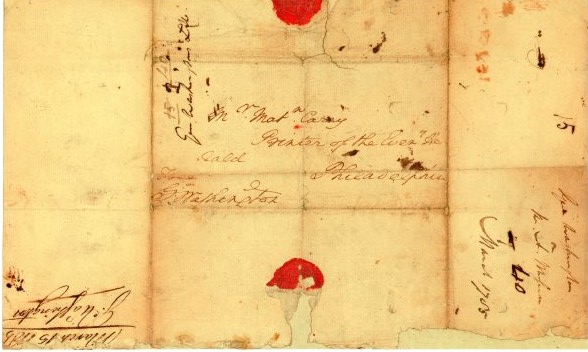
    Next are two letters between George Washington and Irish-born publisher Matthew Carey.  Matthew Carey moved to America in 1784 and settled in Philadelphia, where he established a publishing business and bookshop with $400 given to him by the Marquis de Lafayette.  Carey’s first publication was The Pennsylvania Herald in 1785, followed by two of the first successful American magazines, The Columbian Magazine and The American Magazine in 1786 and 1787.

    In George’s first letter to Carey in 1785, he requests a subscription to Carey’s newspaper but asks him to send the newspaper disguised as an ordinary letter because George has been having problems with the post office delivering his newspapers .  George thinks his papers may not have been delivered because “persons who wishing to read News Papers without being of the expence [sic] of paying for them, make free with those which are addressed to others.”

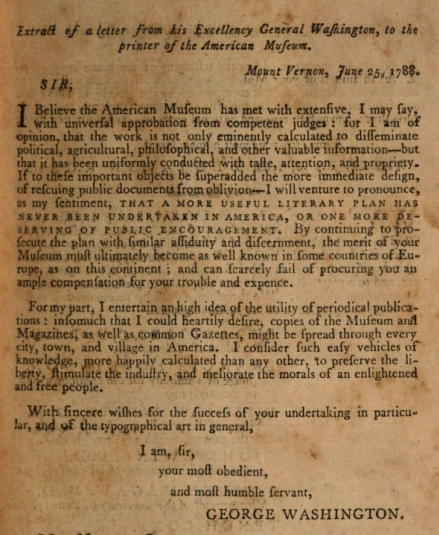
    The second letter between George and Matthew is dated June 25, 1788.  The year before, Carey launched “The American Museum” magazine.  It was a literary museum that reprinted significant historical documents on American history and original essays on politics, commerce, and culture.  The magazine got a positive response, but Carey was finding it expensive to distribute the magazine across the country, so he asked George, one of his first subscribers, to write an endorsement for the magazine that would help attract new subscribers.[2] 

    Washington responded immediately, seizing the opportunity offered by Carey to express his belief that the free dissemination of information and ideas was vital to preserving American liberty.  ‘I could heartily desire,’ Washington wrote, that ‘copies of the Museum and Magazines, as well as common Gazettes, might be spread through every city, town & village in America – I consider such easy vehicles of knowledge, more happily calculated that any other, to preserve the liberty, stimulate the industry and meliorate the morals of an enlightened and free People.”

    Carey published Washington’s endorsement in the next issue of his magazine—his marks for the typesetter can be seen in the original Washington letter.  The result was a flood of new subscriptions that allowed Carey to continue publishing The American Museum for another four years.

    Transcripts of the letters can be found on the National Archives website at Founders Online.

    These are just a few of the amazing documents in our collection, which we hope to bring you soon so that you can explore them yourself.  Check back often, and we will keep you updated on our progress with our digitization project.

    Heather Baldus

    Collections Manager


    Bibliography

    Edd Applegate (August 17, 2012). The rise of Advertising in the United States: A History of Innovation to 1960. Scarecrow Press. p.25.


  • Happy Birthday, Mr. President!

    Not every president gets their birthday celebrated every year with a federal holiday, but George Washington, a favorite of his countrymen and the first president, has had that privilege since 1879. But one year was a little different from the others: 1932.  It marked Washington’s 200th birthday, and the United States was going to make a big deal about it. 

    In honor of the upcoming birthday, we decided to look at some of the memorabilia in our collection created to celebrate and educate the American public.   

    George Washington Bicentennial Commission

    The planning for this celebration started early when Calvin Coolidge signed a joint resolution that established a commission to oversee the bicentennial ceremonies on Dec 2, 1924.  The resolution was to mark the occasion of the birthday across the country and increase the understanding of Washington. (George Washington Bicentennial Commission, 1932)  Under the direction of Representative Sol Bloom, an experienced entertainment promoter who got his start at the 1893 World’s Colombian Exposition, the committee initiated thousands of events, released educational resources for students, and had plays written in honor of Washington. (Larson, 2004)

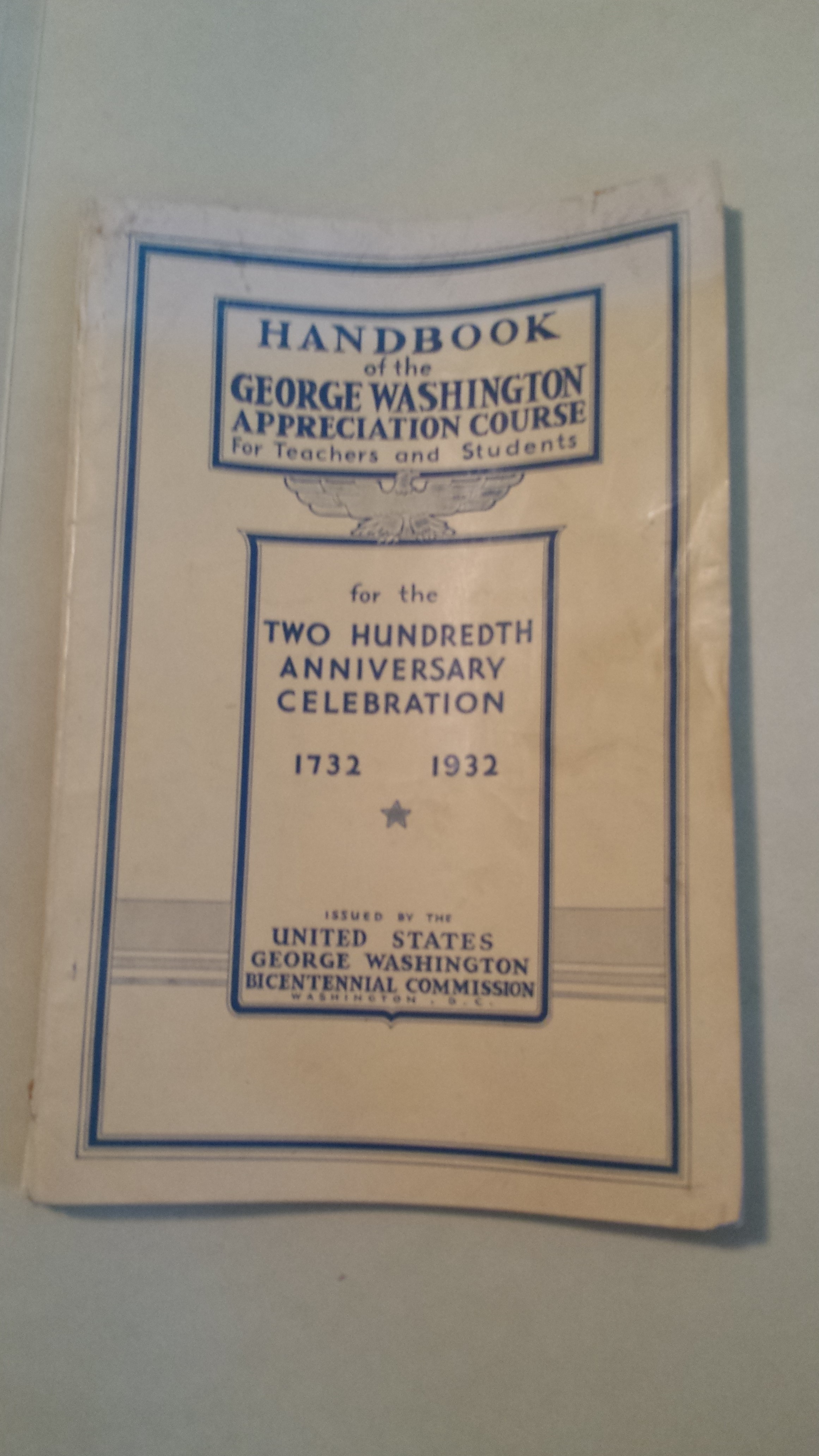
    Handbook of the George Washington Appreciation Course for Teachers and Students
    “Washington Takes the Risk”, including George Washington, Fielding Lewis, and Betty Washington Lewis

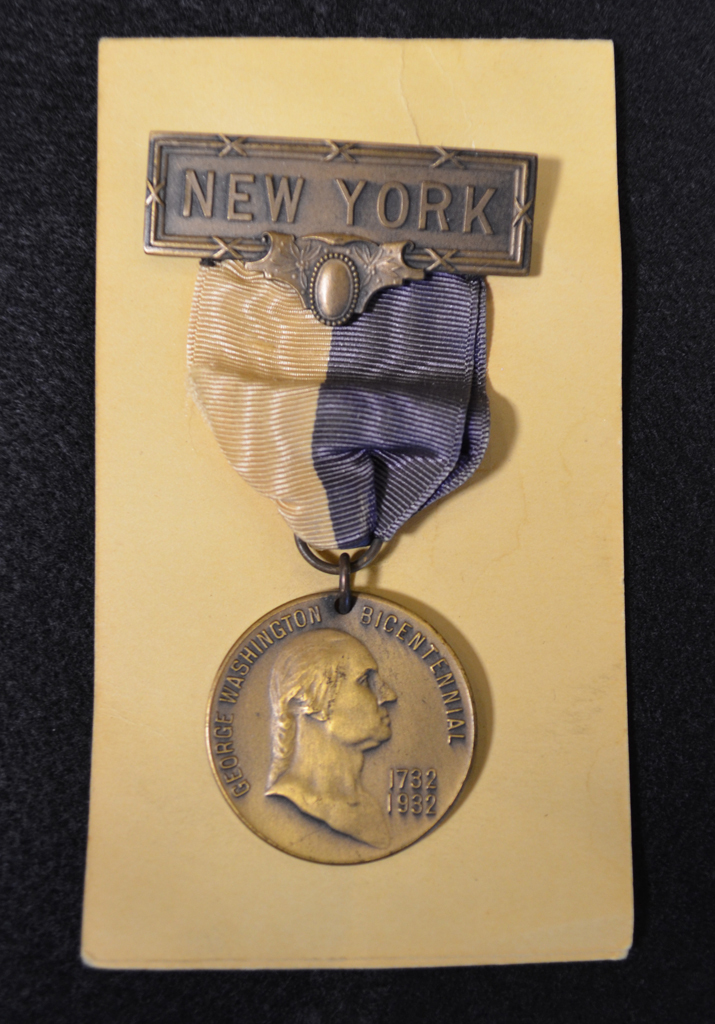
    The commission additionally worked with over 250,000 local commissions to organize special events at not only a federal level but a state and city too. (The Washington Post, 1932) Special volunteers and prominent local people were often given commemorative metals as thanks for their service.  We have one from the state of New York.  It is a circular bronze medal attached to a blue and white ribbon.  The back of the medal states, “1779 / Planned Sullivan / Clinton Campaign 1782 / Newburgh Temple Hill / Refused a crown / 1789 April 30th / New York City / Inaugurated first / President of the / United States.” 

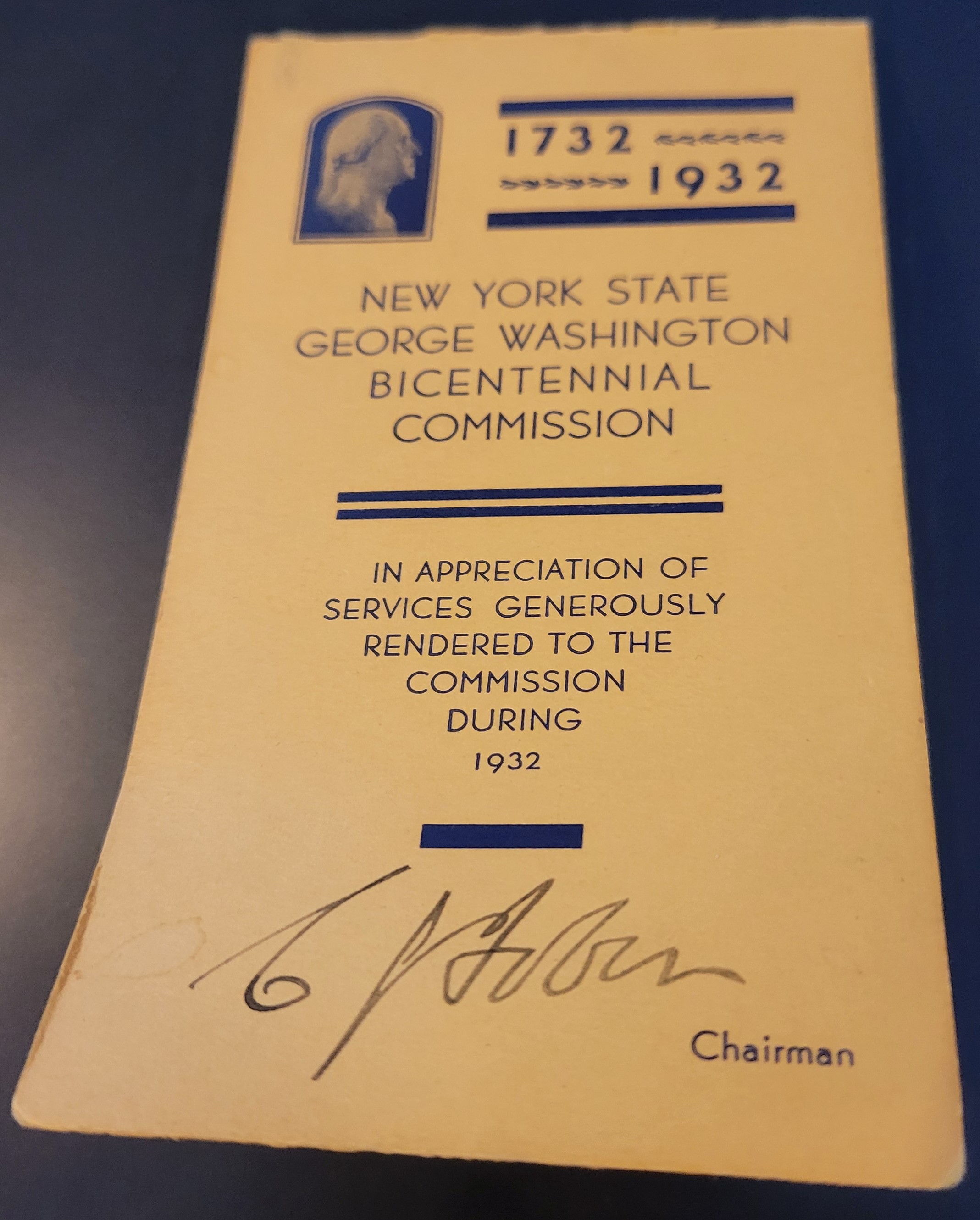
    The medal is encased in a paper envelope with “New York State / George Washington Bicentennial Commission / In appreciation of / Services generously / Rendered to the / Commission / During / 1932” written on the front along with the signature Charles Tobin, chairman representing New York state on the Bicentennial Commission. 

    Historical Context Help: The Sullivan-Clinton campaign was ordered by George Washington in response to the 1778 attacks by the Iroquois and British in central New York.  Newburgh Temple Hill was a Continental Army encampment near Washington’s headquarters, where he gave a speech to quell the mass of soldiers who were getting ready to mutiny and attack Congress to get their promised back pay and pensions. Finally, in 1789, George was sworn in as President at Federal Hall in New York City.

    Calling All Philatelists

    Washington Post, Jan 2, 1932

    The U.S. Post Office became involved in the commemoration of George with the release of a dozen stamps celebrating his life.   The stamps were incredibly popular, and when they were first released for sale in D.C., there was a crowd of 50,000 people waiting to get their set of stamps. (The Washington Post, 1932)

    Marketing George

    Private companies even got in on Washington-mania by releasing all types of souvenirs like postcards, pins, coins, bottles, calendars, cigar box covers, books and pamphlets, hat stands, billheads, stationary, cartes-de-visite, playing cards, and puzzles. (Subseries 5.8. Washington’s Birthday, Bicentennial Souvenirs, 1931-1932 , 2024)

    We have two bottles created for the Bicentennial celebration.  The green water bottle has a likeness of George with “Washington/Bicentennial” underneath the image and 1732 and 1932 written on the sides.  The water bottle was produced by the Hemingway Glass Company in Muncie, Indiana. 

    The clear pear-shaped bottle is embossed on one side with a cherry tree and the dates “1732 and 1932”.  On the other, with a profile of Washington.  It was created by the Owens-Illinois Glass Co. of Huntington, West Virginia.

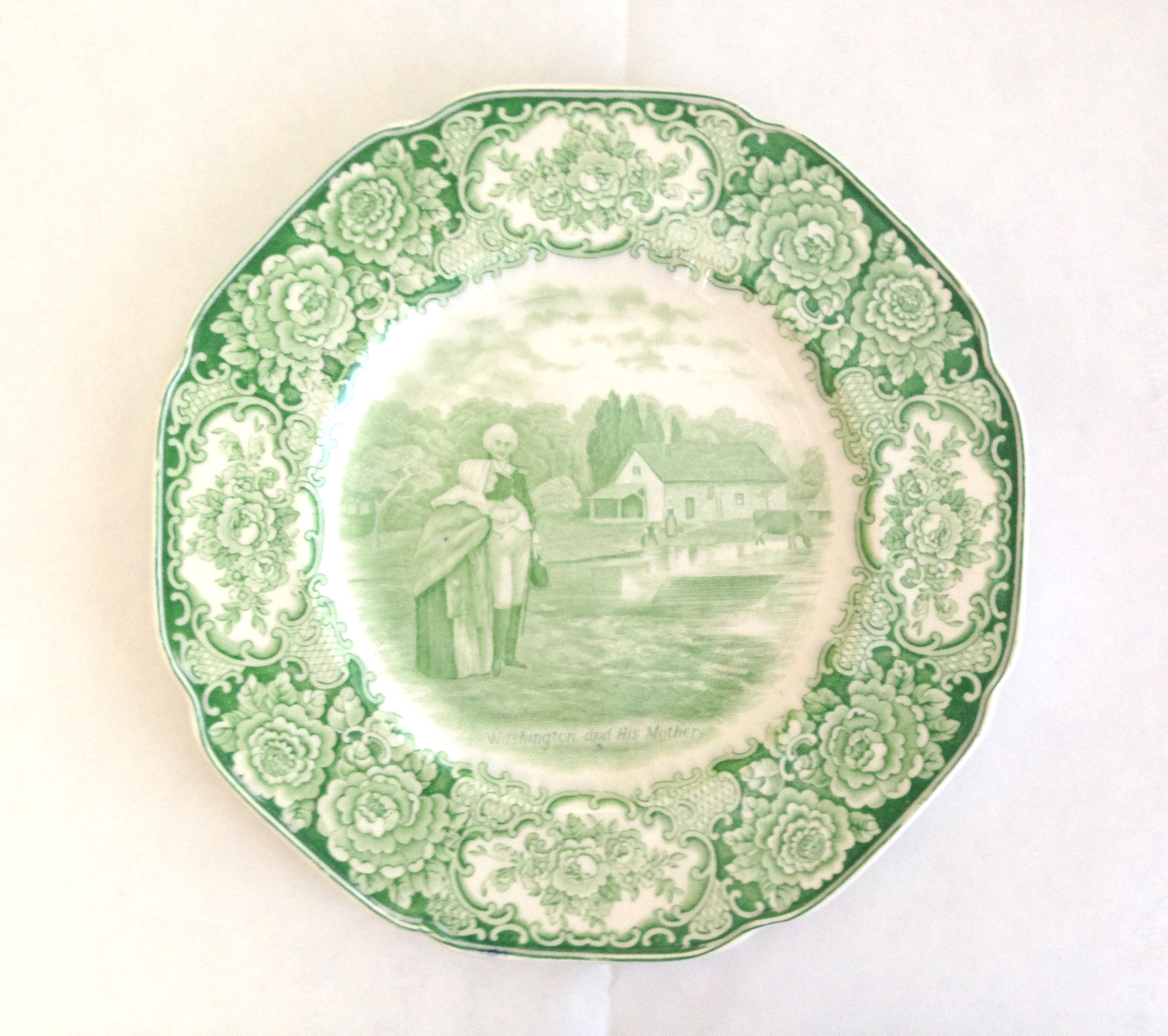
    Plates were another big commemorative item.  We have three plates issued by Crown Ducal, with the same scene of “Washington and his Mother” based on the print of the same name.  On the back with the Crown Ducal crest, it says, “George Washington Bicentenary Memorial Plates / 1732-1932 / First in War / First in Peace / First in the hearts of his countrymen”.  Crown Ducal released a series of twelve plates documenting Washington’s life.  Of course, we are a little biased and like the one with his mother, Mary Ball Washington, the best.

    Some companies even brought in Mrs. Martha Washington, like this set of plates from the Capital Souvenir Company.  These are two round commemorative plates depicting George and Martha Washington, both with an elaborate floral gilded border.

    Fun Bicentennial Fact:  On the eve of the birthday, Sears Roebuck was awarded a commission by the U.S. government to create a full-scale replica of Mount Vernon at the Exposition Coloniale Internationale in Paris.  The agreed-upon price was around $75,000, and every detail of the home was reproduced from brass hardware, mantelpieces, and even cabinets.  After the exposition, the house was bought by an American doctor working in Paris, and it was relocated to Vaucresson (a western suburb of Paris).  It still stands today as a private residence and was even on the market in 2012 for 27 million dollars.     

    Sears Roebuck also built the exact replica in Prospect Park, Brooklyn, NYC for the Bicentennial Commission. However, the house was not taken care of and boarded up and abandoned until it was eventually torn down. (The Brooklyn Daily Eagle, 1933) 

    Sears’ role in the reconstruction of Mount Vernon led to interest in their kit homes.  In 1932, they offered a house in their catalog, loosely based on Mount Vernon.  This model was oddly called “The Jefferson”.

    Sears Roebuck house kit “The Jefferson” which strangely resembles Mount Vernon.

    While we may not have as many George souvenirs, we are still putting on a big birthday party to celebrate George Washington and his time at Ferry Farm. 

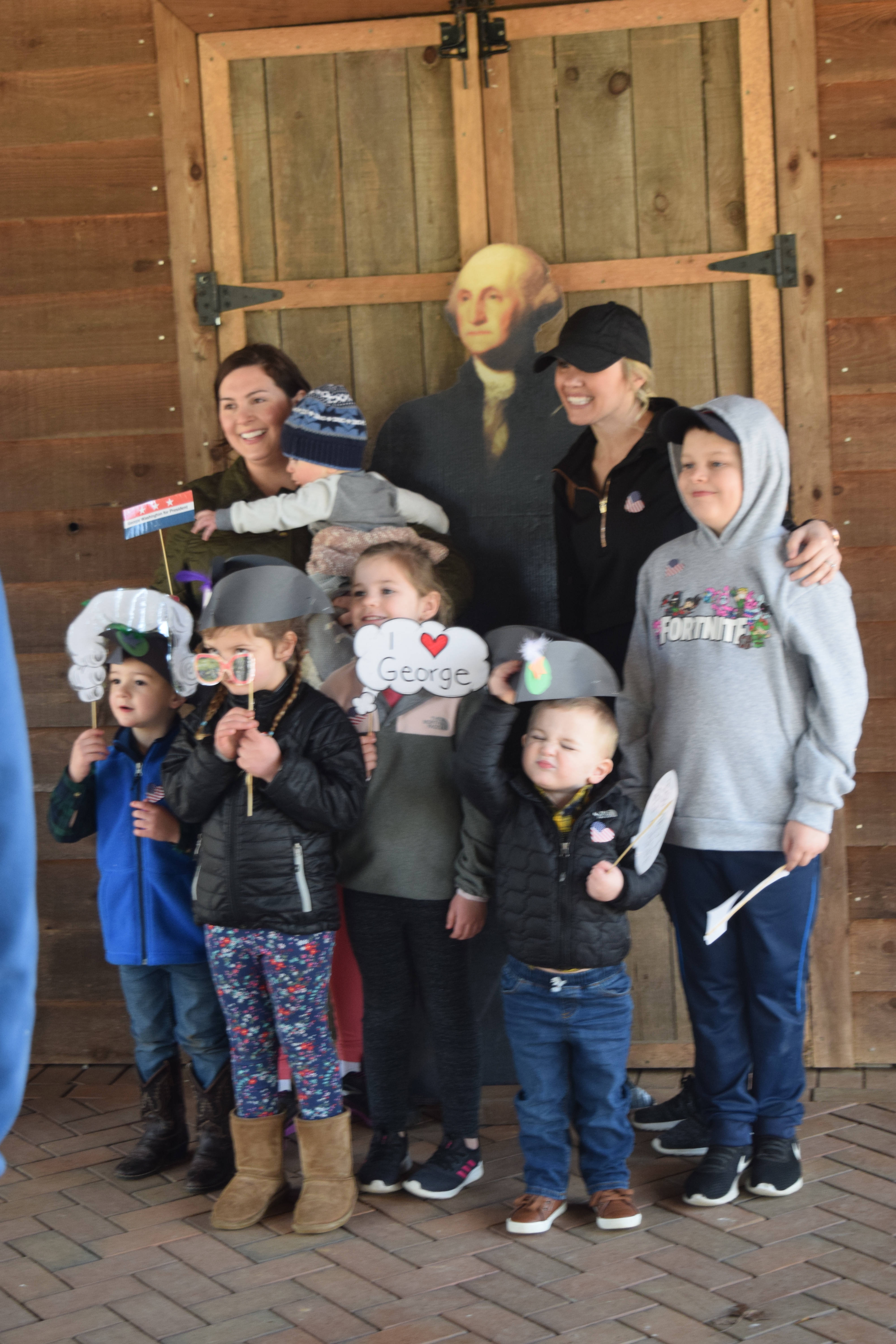
    The party is on Monday, February 19th from 10am – 3 pm.  While enjoying the grounds of Ferry Farm, you can take a selfie with “George Washington,” participate in our annual stone-throwing contest, play colonial games, and eat birthday cupcakes (while supplies last).

    Additionally, guests can enjoy several educational stations, take an abbreviated Washington House tour, and talk with archaeologists, historians, and other experts to learn about Ferry Farm and the Washington Family.


    Heather Baldus

    Collections Manager


    References

    George Washington Bicentennial Commission. (1932). History of the George Washington Bicentennial Celebration. Washington D.C.

    Larson, E. (2004). The Devil in the White City: Murder, Magic, and Madness at the Fair That Changed America. New York City: Knopf Doubleday Publishing Group.

    Subseries 5.8. Washington’s Birthday, Bicentennial Souvenirs, 1931-1932 . (2024). Retrieved from The George Washington Presidential Library at Mount Vernon: https://archives.mountvernon.org/repositories/3/archival_objects/14635

    The Brooklyn Daily Eagle. (1933, June 14). Fate in Doubt On Park Replica of Mt. Vernon. The Brooklyn Daily Eagle, p. 5.

    The Washington Post. (1932, January 2). 50,000 Stand In Line to Get New Stamps. The Washington Post, p. 1.

    The Washington Post. (1932, January 5). Bicentennial Stamps Profit. The Washington Post, p. 6.

  • Bane of the Washington Family Part I: The Disease

    Epidemics and pandemics loom large in history. Few have not heard of the Black Death or Spanish Flu, and Covid-19 still affects our lives. Short, two to three-year outbreaks of these diseases kill quickly and in staggering numbers, but what about the diseases that have stuck around throughout history and brought about death in a much slower fashion?

    Tuberculosis (TB) represents one disease that humanity has never managed to shake. A devastating illness marked by a cough and wasting of the body, it has infiltrated all corners of the world, killing more than any other microbial pathogen. The 1700s proved no exception, and the level of contagion associated with the disease meant that once it entered a family, it proved hard to eliminate. Sadly, this became the fate of many members in two generations of the Washington and Lewis families and, undoubtedly others who came in close contact with them. In Part I of this examination of TB in the Washington family, we will examine the disease itself.

    Watercolor of a TB Victim by R. Cooper, ca. 1912 (Wellcome Collection)

    Brief History of TB

    Tuberculosis originated in East Africa, possibly around 3 million years ago, and evolved into our modern strains between 250-1000 years ago. This makes it one of the oldest diseases still in existence. While primarily a disease of the lungs, TB has the potential to infect most tissues and organs. Skeletal deformities caused by certain strains make it identifiable in the archaeological record, which help to date the disease. As humans migrated across the world, they brought the disease with them. Evidence even exists to suggest that TB thrived in parts of the Americas before the arrival of Europeans. Its presence makes it one of the rare diseases that Europeans did not introduce, though encroachment on indigenous groups and confinement of them to specific areas did lead to a rise in cases. Various names have applied to the disease, but in the Western World, the most common historical names include “consumption,” “White Plague,” and “phthisis.”

    Highly contagious, the disease could strike anyone, with those living in cramped and unhygienic conditions experiencing a higher risk of infection. Cities, therefore, had more cases than the countryside. However, the true rate of infection for the 1700s remains unknown as the recording of disease cases did not start until the early 1800s. Once this practice got underway, TB ranked as the leading cause of death in places such as Philadelphia, where it accounted for nearly 15% of all deaths in two separate periods (1807-1826: 7,972 deaths or 15.04%; 1831-1840: 6,093 deaths or 14.23%). From statistics such as this, estimates for previous eras can occur with TB likely causing 25% of all deaths in Europe from the 1600s-1800s and similar numbers occurring in North America.

    With such a high rate of infection, and its tendency to spread within families, some came to interpret the disease as inherited, while others continued to support the theory of miasma. A more radical thought blamed vampires, leading to several periods of panic in New England during the 1800s. Today, we understand germ theory, but this would not become mainstream until late 1800s and early 1900s—nevertheless, suggestions of TB’s true contagious nature date to at least 1546. German scientist Robert Koch put the debate to rest when he identified Mycobacterium tuberculosis as the causative agent behind the disease in 1882. The rod-shaped bacteria thus gave the disease its common name. This discovery helped lead to the realization that several strains and forms of the disease exist. While M. tuberculosis spreads via the air and droplets, the zoonotic form of the disease, Mycobacterium bovis, thrives in cattle and their relatives before jumping to humans. This occurs through the consumption of contaminated dairy products and produces a near identical infection to M. tuberculosis.  

    Mycobacterium tuberculosis (NIH)

    Despite the pathogen’s deadliness, though also in part of it, TB took on a romantic and fashionable nature. Many a character would suffer from the disease in 19th-century literature, with it running as rampant in the novels of the Brontë sisters as it did in their family, and Lord Byron once lamented his good health since a case of TB would make his appearance more interesting to women. The pale, slim, feverish appearance of the infected fit the ideal female body image that emerged between the late 1700s and mid-1800s. On the extreme end of things, some individuals purposefully exposed themselves to the disease in the hopes of achieving this appearance. A more manageable level saw fashion attempt to mimic the symptoms with corsets and skirts creating the illusion of slim waists while makeup lightened the skin and tinted the cheeks.

    Sickness

                As with every disease, the onset, severity, and progress of the infection varies depending on the health of the infected individual. For instance, tuberculosis could burn through very young children before anyone identified the disease in the 1700s. Likewise, someone with a stronger immune system might fall ill for a longer period before all the symptoms came to together to provide a diagnosis. Nevertheless, TB has several key identifiers.

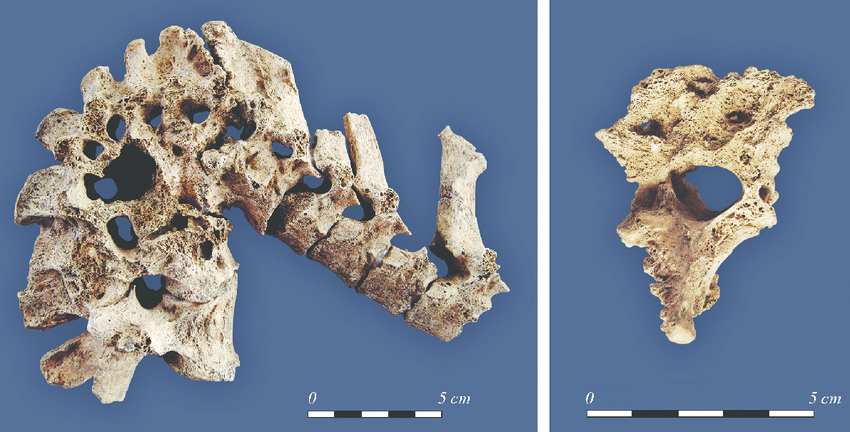
    The disease develops in two basic forms, pulmonary and extrapulmonary. The former sees the infection restricted to the lungs and serves as the most common manifestation. Typical symptoms included a cough, which produces blood at a progressed stage, extreme weight loss, decline in appetite, sweats, fever, fatigue, and paleness. The disease can occur over several attacks, interrupted by brief respites, which worsen with time. As the disease progresses, it leaves holes in the lung tissue giving it an appearance akin to Swiss cheese. Extrapulmonary cases pertain to TB that has spread to an organ or tissue outside of the lungs. The standard symptoms remain in addition to physical indications in the impacted areas. This may include enlarged lymph nodes, sores, and spinal deformities that develop over time. Two forms include Pott’s Disease, TB of the spine, and Scrofula, TB of cervical lymph nodes.        

    While TB can affect all age groups, historically, it has most often struck the young. In Ancient Greece, Hippocrates noted, “phthisis makes its attacks chiefly between the age of eighteen and thirty-five.”1 Higher rates of death amongst those in their twenties and thirties added to the tragedy of the disease, though hope of relief did exist. TB has a unique ability to go dormant during which it walls itself up in the lungs or simply pauses in other parts of the body. While this latent state can reverse at any point, meaning a victim could have years between symptoms and still die of it, the disease may never reactivate. In this scenario, a person would test positive under modern examinations, but suffer no impact to their health or prove contagious to others.  

    All active cases, however, lead to a decline in the sufferer’s immune system and leaves them open to secondary infections. Cases of pneumonia, as well as meningitis, prove common. A letter from a Fredericksburg woman, dated March 1867, perfectly illustrates the disease. Her son, who had just passed, suffered an “attack of Hemorrhage of the Lungs” first in 1865 and again in “the summer of ’66.” She reported that he recovered from both attacks, but became ill with the mumps in February of 1867 followed by “the symptoms of fell consumption being clearly developed.”2 The boy ultimately lost the strength to rise and found himself confined to a makeshift bed a few months prior to his death.

    Treatment

    No cure or successful management plan for tuberculosis existed in the 1700s. As such, roughly 66% of cases resulted in death within the first five years of infection. However, lack of success did not stop doctors from prescribing a standard course of treatment that originated in ancient times. To anyone familiar with medical practices of the eighteenth century, the use of emetics, such as mercury and bloodletting, will come as no surprise. Both treatments aimed to purge the body of an affliction, and doctors applied this to nearly every ailment. In truth, these “cure all’s” did more harm than good, with mercury poisoning the patient and bloodletting weakening them. Still, other prescription medicines may have brought some symptomatic relief or, at the very least, not harmed the patient further.

    Other forms of treatment involved lifestyle changes in the form of diet and exercise. Viewing items such as meat and alcohol as harmful in large quantities or too difficult for the body to process, doctors instructed TB patients to eliminate them from their diet. Instead, they should consume plenty of milk, preferably from a donkey, and vegetables. On top of this, the patient should increase fast-paced exercise or travel, such as horse riding, to the extent that their strength allowed. This would ideally force clean air into the lungs. While well-intentioned, neither change could treat a bacterial infection.

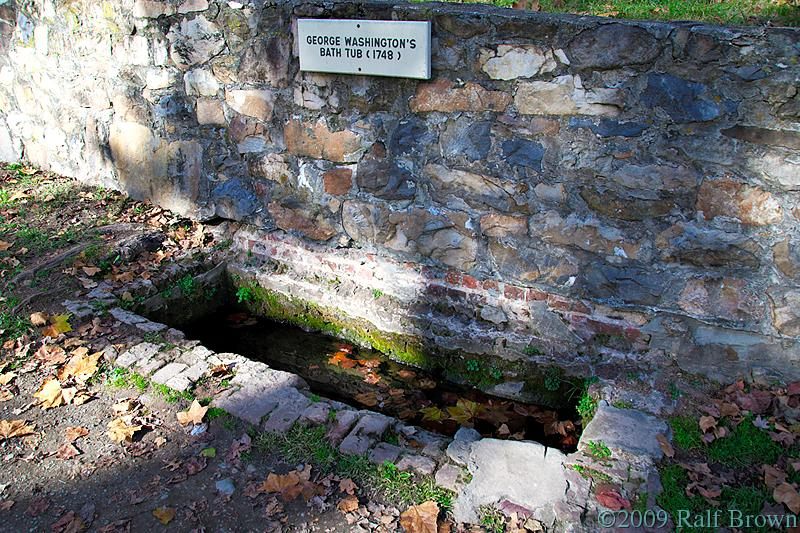
    Other changes involved relocation. Some may be familiar with the phrase “taking the waters” The belief that natural springs, particularly hot ones, provide health benefits dates to prehistory and exists in multiple cultures. Some truth lies in this, but no spring could cure TB beyond the warm waters and steam providing some relief to a weakened, cough-ridden body. Nevertheless, doctors frequently instructed patients to visit springs, giving rise to Berkeley Springs in Colonial Virginia. A destination for wealthy Virginians starting in the mid-1700s, some visited for general health benefits and the social scene, while others went specifically for TB. If none of these treatments worked, doctors would prescribe a course of action that everyone knew served as a last resort: relocating to a warmer climate. In Colonial America, some patients went to the southern colonies while others elected to try the Caribbean (Figure 6). They found no cure in these locations, but the belief in springs and warmer or dryer climates providing relief for TB victims would continue into the 1900s.  

    Bane of the Washingtons

                All forms of tuberculosis mentioned above existed in the 1700s, but which one did the Washingtons have? Parts II & III of our Tuberculosis Blog will closely examine individuals connected to the Washington and Lewis families that had the disease, but we can make a few conclusions. Regarding contraction of the disease, the number of people afflicted, and their close relations to one another, it remains highly probable that they passed it to each other. Of the eight people identified across two generations, none developed a spinal deformity, and no mention of enlarged lymph nodes appear. This implicates pulmonary TB as the likely suspect in all cases.

    Nevertheless, we cannot forget M. bovis. With no knowledge of the disease or methods of pasteurization, the frequent consumption of dairy products and presence of cows on farms made it a key source of potential exposure. The Probate Inventory taken in 1743 after Augustine’s death records an inactive dairy building at Ferry Farm. Whether the Washingtons ever used it for dairy remains unknown, but they certainly obtained and consumed dairy products regularly. We will never know what vector the disease took in entering the Washington Family or when each individual first contracted it, but we can piece together how it affected their lives and ultimately ended them. Stay tuned for Parts II and III: The Victims.

    Emma Schlauder

    Research Archaeologist

    Bibliography

    Barberis, Ilaria, Nicola Bragazzi, Lucia Galluzzo, & Mariano Martini 2017     The History of Tuberculosis: From the First Historical Records to the Isolation of Koch’s Bacillus. Journal of Preventive Medicine and Hygiene 58: 9-12.

    Brown, Kathleen M. 2009     Foul Bodies: Cleanliness in Early America. Yale University Press, New Haven, CT.

    Buchan, William 1772     Domestic medicine; or, The family physician: being an attempt to render the medical art more generally useful, by shewing people what is in their own power both with respect to the prevention and cure of diseases. Chiefly calculated to recommend a proper attention to regimen and simple medicines. Evans Early American Imprint Collection, University of Michigan < https://quod.lib.umich.edu/cgi/t/text/text-idx?c=evans;cc=evans;q1=Gout;rgn=main;view=text; idno=N09695.0001.001>. Accessed 11 April 2023.

    CDC History of World TB Day. CDC < https://www.cdc.gov/tb/worldtbday/history.htm#:~:text= Johann%20Schonlein%20coined%20the%20term,%E2%80%9Cschachepheth%E2%80%9D%20in%20ancient%20Hebrew.>. Accessed 11 April 2023.

    CDC Symptoms of Pulmonary and Extrapulmonary TB Disease. The Division of Tuberculosis Elimination, CDC < https://www.cdc.gov/tb/webcourses/Course/chapter4/4_ diagnosis_of_tb_ disease_4_clinical_practices_symptoms_of_pulmonary_and_extrapulmonary_tb_disease.html>. Accessed 11 April 2023.  

    2 Conway, Mary Catherine Washington Henry 1867     “Letter to Jane ?, Cabin Mill – March 22, 1867.” Access granted by Suzanne Leigh Peake (owner) and Wyatt Falcone,                        

    1 Daniel, Thomas M. 2006     The History of Tuberculosis. Respiratory Medicine 100: 1862-1870.

    Mackowiak, Philip A., Vera Tiesler Blos, Manuel Aguilar, & Jane E. Buikstra 2005     On the Origin of American Tuberculosis. Clinical Infectious Diseases 41(4): 515-518.

    Mullin, Emily                                                                                                                                            2016     How Tuberculosis Shaped Victorian Fashion. Smithsonian Magazine, Smithsonian < https://www.smithsonianmag.com/science-nature/how-tuberculosis-shaped-victorian-fashion-180959029/&gt;. Accessed 11 April 2023.

    Nardell, Edward A.  2022     Extrapulmonary Tuberculosis (TB). Merck Manual < https://www.merckmanuals.com/ professional/infectious-diseases/mycobacteria/extrapulmonary-tuberculosis-tb>. Accessed 11 April 2023.

    National Jewish Health  2013     Tuberculosis: History. National Jewish Health < https://www.nationaljewish.org/ conditions /tuberculosis-tb/history>. Accessed 11 April 2023.

    Otis, Edward O.  1909     The Great White Plague. Thomas Y. Crowell & Co., New York.

    Palmer, Mitchell V.  2011     Bovine Tuberculosis and the Establishment of an Eradication Program in the United States: Role of Veterinarians. Veterinary Medicine International

    Rankin-Hill, Lesley M. 1997     A Biohistory of 19th-Century Afro-Americans: The Burial Remains of a Philadelphia Cemetery. Bergin & Garvey, Westport, CT.

    White, Tim D., Michael T. Black, & Pieter A. Folkens  2012     Human Osteology, 3rd edition. Elsevier Inc., Burlington, MA.

  • Happy Birthday, George!

    We are excited to be celebrating George Washington’s 290th birthday (although it’s the day before his actual birth date) on President’s Day! On February 22, 1732, George was born in Westmoreland County, Virginia. Some interesting facts are associated with his birth-date and the subsequent birthday celebrations he would have as an adult. For instance, did you know that he technically has two birthdays? It’s true! Under the Julian calendar, his birth date would have been February 11, 1731. This means that his birthday was actually earlier in the month until the calendar switched to the Gregorian calendar in 1752. The Gregorian calendar added 11 days and one year to his date of birth!

    Just when did his birthday become so popular to celebrate? The earliest known date of his birthday being recognized (beyond his family) was actually during the American Revolution. It was the winter of 1778, and the soldiers were desperate to keep warm at their headquarters in Valley Forge, Pennsylvania. General Henry Knox planned the event. Clearly, General Knox did more than coordinate the movement of cannons from Canada to Boston; he apparently could also list “party planner” upon his resume.

    General Henry Knox aka “Party Planner”. Source: Wikimedia Commons

    The festivities of this inaugural birthday bash included a parade from an artillery band consisting of drums and fifes. Around this time, George was also becoming known as the “Father of his Country,” replacing King George III at every chance. For instance, the King’s birthday would no longer be listed in the Almanac. Instead, you would find the birth-date of George Washington. However, that doesn’t quite answer the question of when his birthday became an annual event on a broader scale.

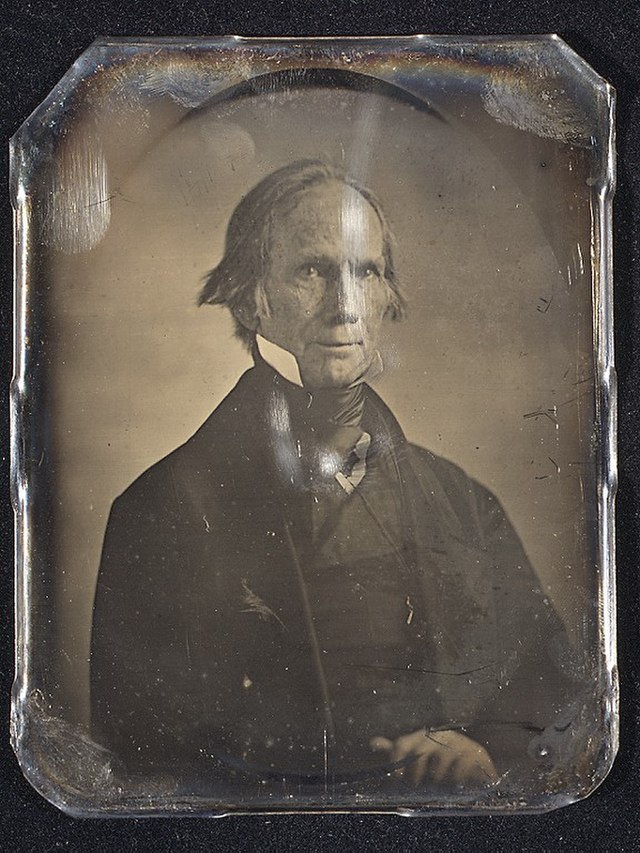
    For that, we turn to everyone’s favorite statesman, whose most significant accomplishment was never being elected President of the United States despite the number of times he ran for that office. The one, the only…Henry Clay. Senator Clay was part of a joint Congressional committee that wanted to recognize the centennial of George’s birth. They decided to do this by giving themselves the day off and adjourning Congress on February 22, 1832. While not the celebration you might have imagined, it did get the ball rolling for an expanded holiday that we celebrate today.

    Senator Henry Clay. Source: Wikimedia Commons

    As the years went by, cities, states, and even Congress realized they had to do more to commemorate George’s contribution to the Nation. In 1862, yes, in the midst of the Civil War, the Senate began to read Washington’s Farewell Address each year on his birthday. In 1879, Congress made the date a federal holiday for federal employees ONLY IN DC. Though this caused confusion among those employees as some were paid for that holiday and others were not… This discrepancy was amended in 1885 when the holiday became a paid one for all DC federal workers.

    Almost 100 years after the Senate began their annual tradition of reading the Farewell Address on February 22, Congress passed the Monday Holiday law to make federal holidays more uniform. So instead of celebrating George’s birthday on February 22, it was recognized on the third Monday of the month. There are two interesting things about this law when applied to George’s birthday. First, because of February’s shortened number of days, there is no possible way for the federally observed holiday to fall on his actual birthday. Second, the holiday we all know as “President’s Day” doesn’t actually exist. It has yet to be formally changed by Congress or the President from being first recognized as “Washington’s Birthday,” which is pretty fascinating!

    If you’re looking for a fun way to celebrate George’s birthday this year, I encourage you to check out our event at Ferry Farm. For the event, we are offering tours of the reconstructed Washington House, new (and returning) crafts, a chance to meet real archeologists and learn about what they’ve found at the site, the opportunity to see if you can throw a stone as far as George supposedly could, and obviously, we’re having cupcakes because it’s a birthday party!

    This year’s event will be held on Monday, February 21, from 10 am to 3 pm, and tickets can be purchased by visiting our website. Tickets are $5 per adult (age 18+) and FREE for children (17 & unders). We encourage you to purchase your tickets in advance.

    -Amy N. Durbin, Director of Education

  • Maritime History at Kenmore & Ferry Farm

    Today – September 30 – is World Maritime Day. The United Nations and the International Maritime Organization created World Maritime Day in 1978 “to celebrate the international maritime industry’s contribution towards the world’s economy, especially in shipping.”

    “The South East Prospect of London from the Tower to London Bridge” (1746) by John Maurer. Credit: Royal Collection Trust / © HM Queen Elizabeth II 2018

    Both Historic Kenmore and George Washington’s Ferry Farm – perhaps surprisingly – feature fairly significant maritime histories.  Situated on the Rappahannock River, Fredericksburg was a bustling seaport in the 1700s when George Washington grew up at Ferry Farm and when Fielding Lewis practiced his merchant trade while living at Kenmore.  George saw ocean-going sailing vessels unloading and loading cargo from his bedroom window.  Some of these ships were owned by Fielding and his family.  Both men were part of “the Atlantic World,” a global community of many different peoples trading back and forth across the Atlantic Ocean.

    Here on Lives & Legacies, we’ve written regularly about Fredericksburg as a seaport and about the impact of Atlantic trade on both the Washingtons and the Lewises.

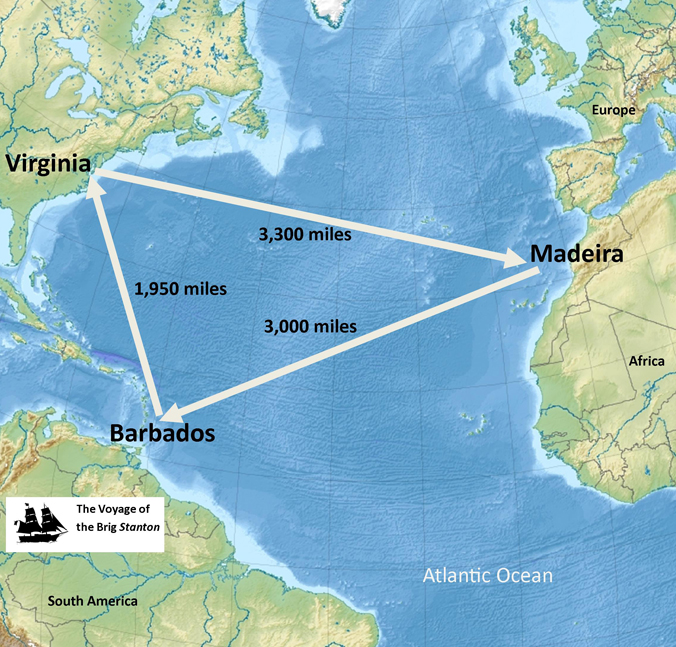
    “The Voyage of the ‘Stanton’” recounts one voyage of a Lewis family ship and the cargo it carried traveling from Virginia to Madeira off the European coast, then to the British West Indies in the Caribbean, and finally back to Virginia.  Each leg of this journey formed part of the Atlantic World’s famed “Triangular Trade.”

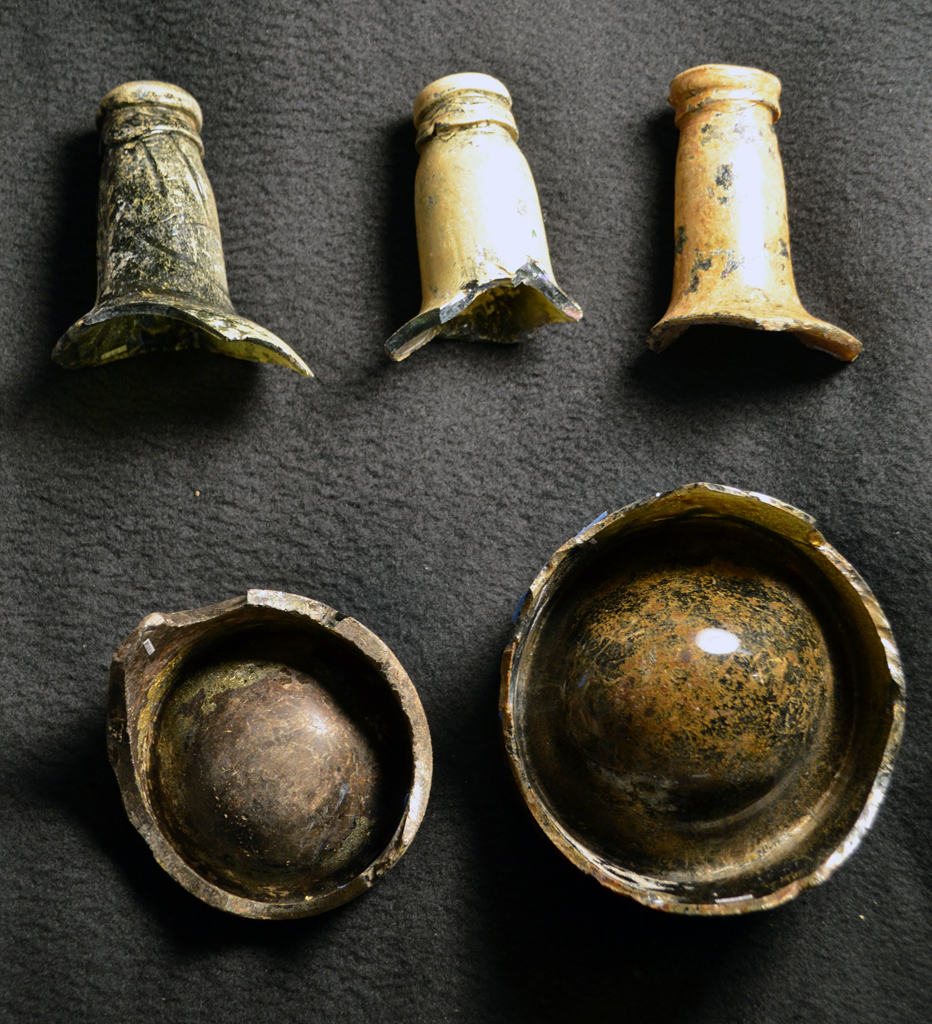
    Many of the Washington family artifacts recovered at Ferry Farm came to their home from different parts of this triangle and beyond.  For example, the fragments of wine bottles depicted below and written about in “The Wine Bottle: Ubiquitous and Informative” may have carried fortified wine from Madeira to Ferry Farm. European grapes did not grow well in the colonies while native grapes did not make good wine so wine was imported.

    Mid-18th century bottle neck and base fragments excavated from the Washington house cellar at Ferry Farm.
    An example of what the bottles excavated at Ferry Farm looked when they were whole.

    The maritime-based economy that brought Madeira wine and the many other goods used by the Washingtons at Ferry Farm is also perfectly symbolized by a “black dogg” coin. Unearthed not far from the Washington house site and written about in “The Tale of the ‘Black Dogg,’” this coin “originally circulated in the French Caribbean” and may well have come to Fredericksburg in a sailor’s pocket.

    “Black dogg” coin excavated at George Washington’s Ferry Farm.

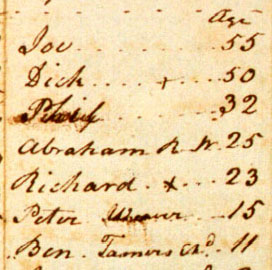
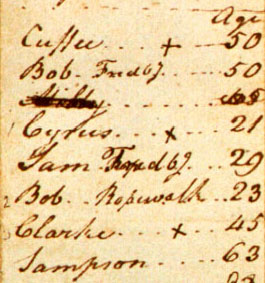
    As a merchant, Fielding Lewis owned ships that traveled the Atlantic World carrying goods to and from Fredericksburg.  The goods brought to Fredericksburg he then sold to the community or placed in his fashionable home.  Maritime trade was Fielding’s life-long business and he put some of his enslaved workers to that task.  As written about in “Abraham and The Ropewalkers,” a handful of Lewis slaves wove rope at ropewalks near Fredericksburg or perhaps even in Richmond.  Of course, much of this rope was likely used on Virginian sailing vessels.

    Portion of The Divvy List made by Betty Washington Lewis showing Abraham with an “R.W.” after his name.
    Portion of The Divvy List showing Bob #2 with “Fredbg” after his name and Bob #2 with “Ropewalk” after his name.

    The impact of today’s ocean-going global trade can be largely unseen. Similarly, the maritime histories of Kenmore and Ferry Farm are not immediately evident to our eyes. However, sailors, ships, and their cargos significantly influenced the lives of the Washingtons, the Lewises, and the enslaved people of Ferry Farm and Kenmore in 1700s.  World Maritime Day is a good day to remember the impact of the international maritime industry, past and present.

    Zac Cunningham
    Manager of Public Programs

  • Agreeable Amusements: Music & Dancing in the Life of George Washington

    On September 10, 1748, sixteen-year-old George Washington paid 3 shillings, 9 pence to a “musick master for my entrance.” Young Washington recorded these sparse details in Ledger Book Zero, a personal account ledger listing credits and debits with family, friends, and business associates between 1747 and 1750. This, as far as we can tell, is the first reference to music in the life of George Washington. By no means, would it be the last. Music was an important part of Washington’s life, just as it is with many of us today.

    Ledger Book Zero, young George Washington’s personal account book, shows payment to a “musick master for my entrance.”

    What was teenage age George paying for when he paid the “musick master for . . . entrance”?  Well, the lack of details makes it impossible to say with certainty.  The most obvious possibility is that he was paying for music lessons.  However, letters written by George himself and a friend indicate that Washington had little to no musical talent. Francis Hopkinson, a colleague during the war, composed a series of songs for harpsichord or piano and dedicated them to Washington. In a letter to George dated December 1, 1788, Hopkins explained his dedication even though George could “neither play Musick nor sing Songs.”  In a reply on February 5, 1789, Washington agreed, writing “I can neither sing one of the songs, nor raise a single note on any instrument.” Despite a professed musical inability, it is still possible young George was paying for music lessons in 1748. Often, you might pursue lessons only to discover that you do not have the aptitude.

    Regardless, while apparently not musical himself, music surrounded Washington. As Mount Vernon research historian Mary V. Thompson notes, “Washington was the head of a household where his wife, her two children, and her four grandchildren (two of whom were raised by the Washingtons) all studied music.” In particular, granddaughter Eleanor (Nelly) Parke Custis became fairly skilled at the harpsichord, despite an apparent reluctance to learn. In the summer of 1798, a visiting Polish nobleman enthusiastically claimed that Nelly “plays the harpsichord, sings, draws better than any woman in America or even in Europe.”

    Another Washington family member with an interest in music was George’s niece Harriot Washington, daughter of Samuel. The first letter in the record between Harriot and her guardian and uncle George was written on April 2, 1790.  Harriot was 14-years-old and living at Mount Vernon while President Washington was in New York. The niece asked her uncle to send her a guitar since she wanted to take lessons for “all the young Ladyes are a learning musick.”  Harriot was confident “that five or six lessons would be sufficient for any body to learn.”  The records consulted reveal no response from Washington. Eventually, Harriot would come to Historic Kenmore to live with her aunt Betty Washington Lewis. She again asked uncle George for a guitar in May of 1792. About a month later, he paid $17 for one. Harriot’s capabilities with the instrument are unknown.

    Besides family, another major source of music in Washington’s life was the Continental Army. Music was crucial to 18th century militaries. Fifes and drums issued commands during battle and put a spring in the step during weary marches. Much like the army’s initially amateur soldiers, its fifers and drummers (who were often boys serving with their soldier-fathers) took time to practice and professionalize.

    On June 4, 1777, General Washington issued a set of orders. One order dealt with the army’s music, which the General bluntly lamented was “very bad.” He ordered “that the drum and fife Majors exert themselves to improve it, or they will be reduced, and their extraordinary pay taken from them: Stated hours to be assigned, for all the drums and fifes, of each regiment, to attend them, and practice.” Washington concluded, “Nothing is more agreeable, and ornamental, than good music; every officer, for the credit of his corps, should take care to provide it.”

    A notable musical moment in the army’s history was the birthday serenade for General Washington on February 22, 1778 at Valley Forge. The musicians of Proctor’s Artillery played outside the General’s headquarters. Washington’s expense account lists a payment of 1 pound, 5 shillings to Proctor’s band. Joseph Lee Boyle, longtime historian at Valley Forge, explains that “Colonel Proctor commanded an artillery regiment, and this was one of the few, perhaps the only, unit to have musicians besides fifers and drummers. In 1779 ten ‘musicians’ are listed in the band, but not what instruments they played.” Mount Vernon scholars note that this was “the first public recognition of [Washington’s] birthday.”

    We’ve seen that music was definitely a part of Washington’s life but it was played by others mostly. George could not play an instrument nor sing. He may have paid for music lessons only to discover his inability. Another reasonable theory, however, is that he paid the “musick master for my entrance” to dancing lessons. Later in life, Washington uses similar phrasing – “Mr McKay entrance to Dancing” – to record a payment of 10 shillings for lessons for stepson John Parke Custis.

    Dancing was the leisure time obsession of most Virginians but especially those in the wealthy gentry. For the upper class, explains Amy Stallings, “ being a skilled dancer was an indication of good breeding” and allowed one to “put one’s gentility, accomplishment, beauty, and economic means on display in hopes of impressing—or, in some cases, intimidating—”others. As Philip G. Smucker adds, “Dexterity on the dance floor maintained social status.”

    Maintaining social status and the appearance of good breeding skyrocketed in importance to George and the Washington family after the death of father Augustine in 1743. His death created financial hardship and jeopardized the family’s social standing. Without a father, George’s life changed radically. Assisted and supported by both mother Mary and half-brother Lawrence, George was forced to acquire the refined skills and customs of the upper class in Fredericksburg instead of in England while at boarding school.

    One of those skills was dancing and the mystery “musick master” perhaps taught teenage George that skill.  Over the course of the 18th century, as Stallings notes, “a market developed for professional instructors, or dance masters, who were expected to know the latest dances from Europe.”  Virginia’s urban centers with their greater populations and high number of visitors “often boasted multiple dancing schools . . . Dancing masters operated in at least Yorktown, Williamsburg, and Hampton by 1739.” Traveling dance instructors served Virginia’s far-flung rural population. These masters usually “taught the sexes separately, at different hours or different days of the week.”

    If Washington was schooled in dancing by the “musick master,” he probably learned the era’s popular minuets, allemandes, and hornpipes. These fancy dances typically began any ball and were the best opportunities to show off one’s dancing abilities and good breeding. The minuet was the most important. As Stallings explains, “A man’s prowess at the minuet—an especially complicated dance, requiring excellent balance and coordination with one’s partner—could buoy his social position, whereas a poor minuet might leave him out of favor.”

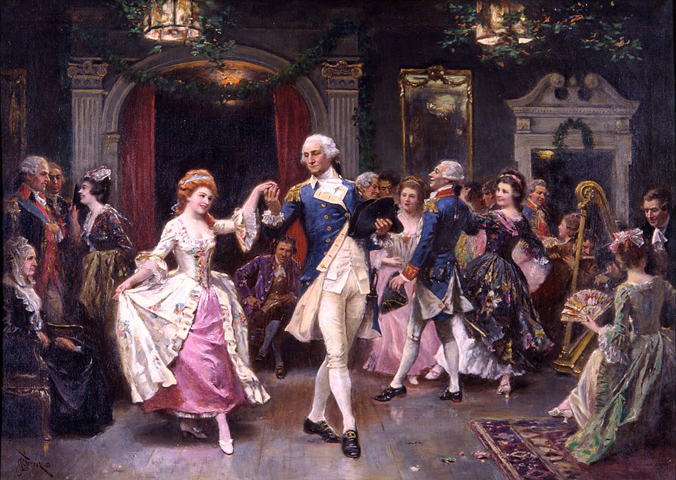
    A fanciful early 20th century painting by Jean Leon Gerome Ferris titled “The Victory Ball, 1781.” While Washington was a life-long and avid dancer, it is unlikely he attended any such “victory ball” or “peace ball” traditionally said to have taken place in Fredericksburg after the British defeat at Yorktown.

    Whether he was paying for dancing lessons in 1748 or not, young Washington learned to dance in some fashion, discovering both an extraordinary natural talent and life-long passion for it.  Numerous contemporaries recorded instances of Washington dancing and praised his abilities.

    “His Excellency . . .  and Mrs. Greene . . . danced upwards of three hours without once sitting down.” – General Nathanael Greene to Colonel Jeremiah Wadsworth, Middle Brook, New Jersey, March 19, 1779.

    “His Excellency General Washington was unusually cheerful. He attended the ball in the evening, and with a dignified and graceful air, having Mrs. Knox for his partner, carried down a dance of twenty couples in the arbor on the green grass.” – General Nathanael Greene to Joseph Reed, Morristown, New Jersey, Tuesday, February 29, 1780.

    “The General danced every set, that all the ladies might have the pleasure of dancing with him, or as it has since been handsomely expressed, get a touch of him.” – James Tilton to Gunning Bedford Jr., Annapolis, Maryland, December 25, 1783.

    “He . . . attended the ball of the 22nd of February; opened it by dancing a minuet with some lady, and then danced cotillions and country dances; was very gallant, and always attached himself, by his attentions, to some one or more of the most beautiful and attractive ladies at the balls.” – Judge Francis T. Brooke (1784).

    And finally a word on his dancing from George Washington himself, written on November 12, 1799, just a month prior to his death and turning down an invitation from to a grand function in Alexandria. He wrote,

    Gentlemen

    Mrs Washington and myself have been honoured with your polite invitation to the Assemblies in Alexandria, this Winter; and thank you for this mark of your attention. But alas! our dancing days are no more; we wish, however, all those whose relish for so agreeable, & innocent an amusement [emphasis added], all the pleasure the Season will afford them. and I am Gentlemen Your Most Obedient and Obliged Humble Servant

    Go: Washington

    George saw music and dancing both as “agreeable.” From the mostly taciturn Washington, this is high praise indeed.

    Join us on Saturday, April 10 for The Arts at Kenmore: Music on the Lawn and hear 18th century music group Colonial Faire performs music from all walks of colonial society – the music of the taverns, the manor houses, on the streets and on the battlefields. The evening’s opening act will include a short talk exploring the importance of music to George Washington and a theater scene depicting Washington’s first dancing lesson. For more information and tickets, visit kenmore.org/events.

    Zac Cunningham
    Manager of Educational Programs

  • Five International Influences on George Washington’s Early Life

    An Essay of a New and Compact Map, Containing the Known Parts of the Terrestrial Globe by Jacques-Nicolas Bellin was published in 1750 when George Washington was 18-years-old. Credit: Wikipedia.

    Ferry Farm was a unique place to live in the mid-1700s. Situated where farm, frontier, city, river, and road converged on the edge of English empire, young George Washington, his family, and the farm’s enslaved community found their daily lives governed by Britain’s global economy and imperial culture.  Ferry Farm, nearby Fredericksburg, and the colonies more broadly were international places made up of a host of different European, African, and Native American ethnicities and nationalities in the 18th century.  Accordingly, we present a list of “Five International Influences on George Washington’s Youth.” This is by no means an exhaustive list but each influence helped shape young Washington into a man capable of commanding the Continental Army and serving as the new nation’s first president.

    1) The Rappahannock River

    The Rappahannock River as viewed from a window in the Washington house replica at Ferry Farm.
    Voyages of British ships in the last half of the 18th century. Created by Geographer James Cheshire, PhD, on his Spatial.ly blog and used with permission.

    Young George could look from a window in the family home at Ferry Farm down the bluff to the Rappahannock River. He saw ocean-going, sailing vessels being loaded and unloaded at the wharves and warehouses of Fredericksburg. These vessels were part of a global trade network, which we’ve written about here and here, that stretched to Europe, Africa, the Caribbean, India and China. These vessels were not large but traveled the world nonetheless.  They took the corn, wheat, and timber of places like Ferry Farm to Europe or the Caribbean and returned with Westerwald mugs from Germany, tea from India, porcelain from China, and enslaved laborers from Africa. The sailors on these ships probably represented numerous ethnicities and nations. One easily can imagine young George, so prone to a thirst for adventure, finding any excuse he could to visit the docks and ships down on the river and, by doing so, traveling the world without leaving the Rappahannock.

    2) Westerwald stoneware

    Those ships carried numerous manufactured goods from all over the world to Ferry Farm. Westerwald ceramics were one such import. Produced in the Westerwald region of what is now Germany beginning in the 1500s, archaeologists have excavated numerous bits of decorated stoneware tankards, jugs, and other drinking vessels used in the 1700s at Ferry Farm.  Several of these excavated vessels sported the initials ‘G.R.’, meaning Georgius Rex, the Latin for King George. The three British kings of the 18th century were all named George and came from the House of Hanover, a German royal family placed on the British throne in 1714. A gentleman sporting a ‘G.R.’ on his Westerwald tankard or jug advertised his loyalty to the Crown with every draught of ale. The presence of these initialed drinking vessels at Ferry Farm show that, until the Revolution, Washington, like most Americans, viewed himself as a loyal subject of the British Crown (ironically worn by a German head).

    G.R. medallion on a Westerwald jug fragment.
    A nearly complete Westerwald drinking vessel in the collection at Historic Kenmore.

    3) Venetian glass

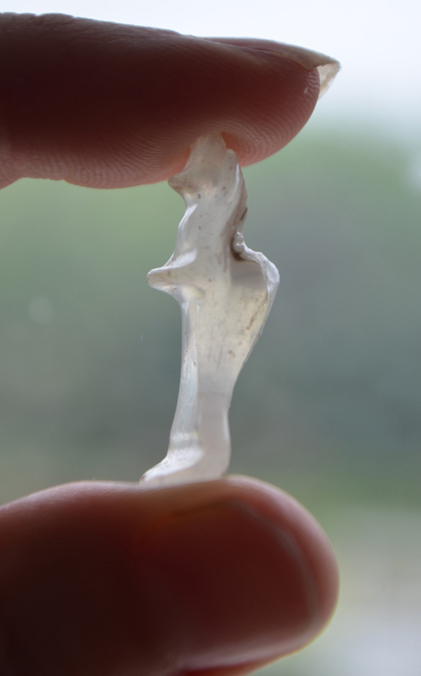
    The vast majority of ceramics in the Washington household came from England. The same can be said about the family’s table glass, but the fanciest glassware owned by the Washington family actually came from Venice, Italy.  Found by our archaeologists, this piece of a pincered and buttressed handle is likely part of an elaborate hand-blown Venetian piece, made of finely crafted colorless soda lime glass with a barely visible bead of opaque glass running through the center.  A Venetian glass goblet such as this was a show piece displayed prominently within the house to emphasize that, despite their colonial location, the Washington family strived to maintain a level of European refinement appropriate to their gentry status.

    Archaeologists excavated this small fragment of Venetian glass at Ferry Farm.
    Wine goblet made in the 16th century in Venice, Italy. Credit: The Metropolitan Museum of Art

    4) Barbados

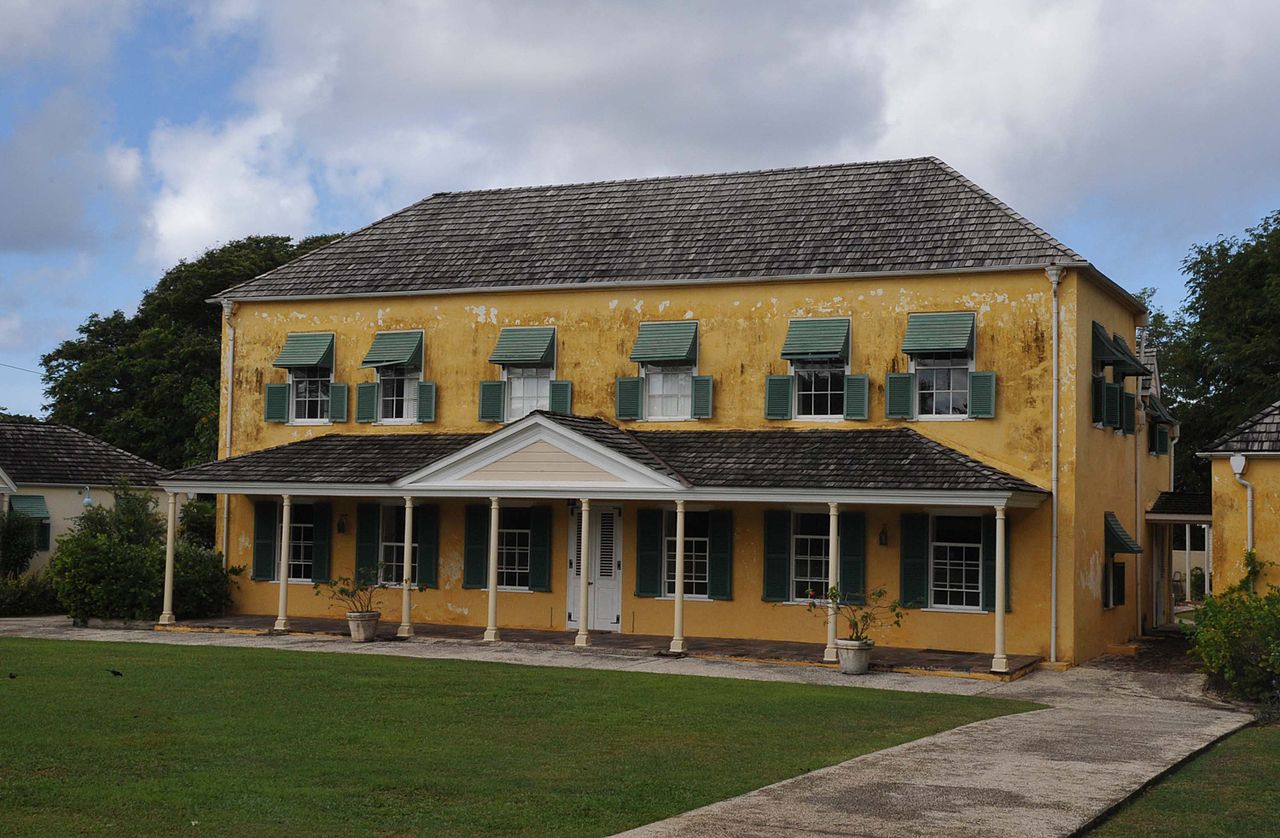
    In 1751, George Washington made his only trip off the North American continent, traveling with his half-brother Lawrence to Barbados. Visiting the island’s fortifications and meeting members of its military garrison fed George’s growing desire for a military career. As Jack Warren concludes, “After returning to Virginia, he dedicated himself to advancement in the military more completely than any of his Virginia contemporaries. And unlike most of the prominent colonial militia officers of the 1750s, he sought a commission in the regular British military establishment – an ambition that was probably prompted, and undoubtedly stimulated, by his experience in Barbados.”

    Needham’s Point, Barbados. Credit: Reinhard Link.

    5) The Frontier

    Military service eventually took George into the frontier wilderness of the vast Ohio country. Tasked by Governor Dinwiddie with delivering a demand to the French to leave lands claimed by Virginia and the British Crown, young Major George Washington embarked on a thousand-mile, ten-week trek to and from Fort LeBoeuf on Lake Erie. He was accompanied by the Dutchman Jacob Van Braam, who served as his French interpreter, and by Tanacharison, known as Half-King, as well as other men from Native American nations. Along the way, he met several French officers and soldiers. Although confined to North America, this trip in late 1753 and early 1754 was, in reality, a foreign trip that exposed Washington to different peoples and cultures. It provided vital diplomatic, military, and intelligence gathering experience to the future Continental Army commander and first president. Washington, notes Paul Royster, “practiced diplomacy to keep the Native leaders allied to the English cause; he interviewed French deserters and reported on the extent of French military posts between New Orleans and the Great Lakes; he reconnoitered the Forks of the Ohio with an eye to the proper site for building a fort; and he inspected and reported on the construction of the new French forts and made estimates of their strength . . . .”

    Portrait of George Washington, 1772 by Charles Willson Peale. Credit: National Portrait Gallery
    The Ohio region from Cumberland to Fort LeBoeuf through which Washington journeyed, overlayed onto the famed map in Thomas Jefferson’s Notes on the State of Virginia (1787). Credit: Paul Royster / University of Nebraska.

    Conclusion

    Although a fourth generation American, George Washington grew up in a time and place – 18th century Ferry Farm and British North America — where international economic and cultural influences on his life were quite numerous. Through the five international influences we’ve briefly examined, we’ve seen how these influences helped Washington maintain his gentry status, which ultimately set him on a path to military and political greatness.

    Zac Cunningham
    Manager of Educational Programs

    Mara Kaktins, Archaeologist
    Ceramics & Glass Specialist

  • Little George’s Grand Tour of Europe [Photos]

    A staff member who works at George Washington’s Ferry Farm and Historic Kenmore vacationed in England, Austria, and Hungary last September and October.  Little George accompanied her and enjoyed seeing new sites and delving into the history of Europe.  As the real George Washington left the shores of North America only once to accompany his ailing brother Lawrence to Barbados, this was a chance for Little George to experience an abbreviated version of the traditional Grand Tour of Europe popular in the 18th century.

    The first stop was London, where George’s Revolutionary War nemesis King George III once lived, and where Little George already spent some time last summer.  On this return trip for Little George, we saw the usual sites, such as the Tower of London, Parliament, and Big Ben (which was covered in scaffolding), but also mixed in a little ancient history, iconic pubbing, and English football.

    01
    Little George outside the Stanhope Arms.

    Upon arrival, we immediately had to have the nation’s favorite dish, some traditional Fish and Chips! The Stanhope Arms, a pub built in 1853, used to have a private jazz club upstairs and was visited often by the author during her college junior year abroad (1979-1980).

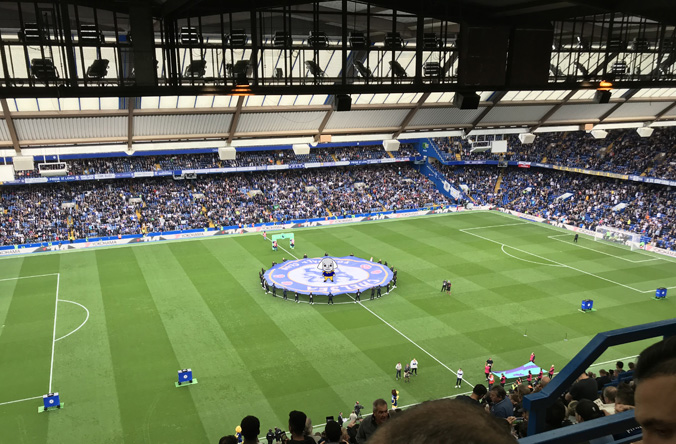
    At Chelsea Football Club’s home field of Stamford Bridge, we watched Liverpool Football Club win the match from the nosebleed section of the stadium. Look closely and you can see Little George participating in the opening ceremonies!

    02
    Stamford Bridge, home field of Chelsea Football Club.

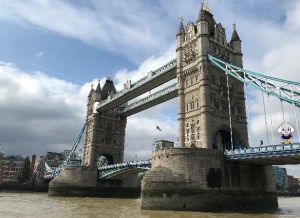
    On a river cruise we passed beneath the iconic Tower Bridge over the River Thames. Built between 1886 and 1894 in the Gothic style, the bridge stills opens to river traffic.  Little George is waiting in line to enter the exhibition inside the Tower.

    03
    Tower Bridge over the River Thames.

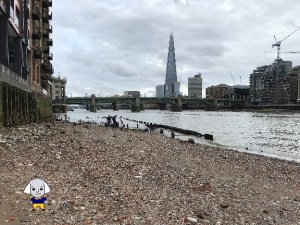
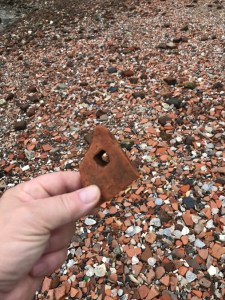
    Mudlarking along the Thames’s foreshore can reveal centuries of history hidden among the cobbles on the riverbank. Fragments of medieval and modern pottery, glass and ceramic bottles, tobacco pipe stems, buckles and buttons are all mixed in with 1st century roman roofing tiles, prehistoric tools, World War II shrapnel and spent shells from the Blitz. Little George was very helpful in spying things as he was so close to the ground! During our search of the shore, we found what may have been a Roman roofing tile (below right) from when the Romans ruled Britain between 43 and 410 AD.

    0405

    06
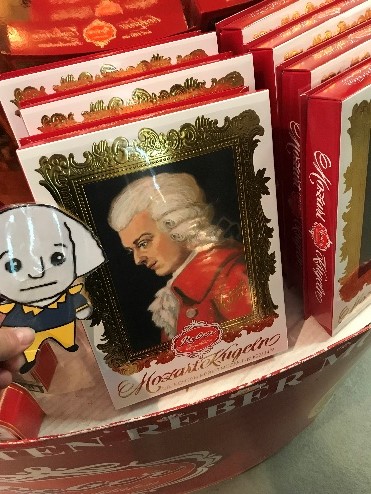
    Chocolate with Mozart’s image is in every confectioner’s window in Salzburg.

    After London, we headed for the Continent to begin our Grand Tour-inspired travels.  Our first European stop was Salzburg, Austria, the birth place of Wolfgang Amadeus Mozart, a classical pianist and composer who lived from 1756 to 1791.  Mozart and other contemporaries, such as Haydn, were extremely popular and well-known during their lifetimes, and copies of their compositions were present in Washington’s personal musical collection.  Mozart and Washington would never meet, but one can imagine George and his family enjoying Mozart’s music after hosting a dinner party.

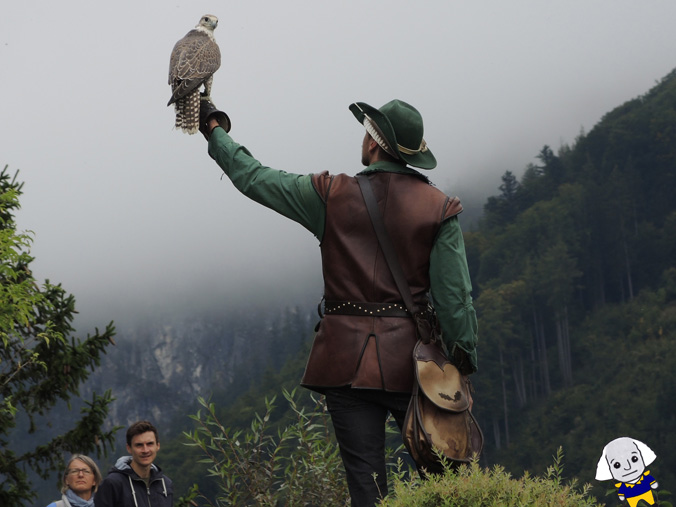
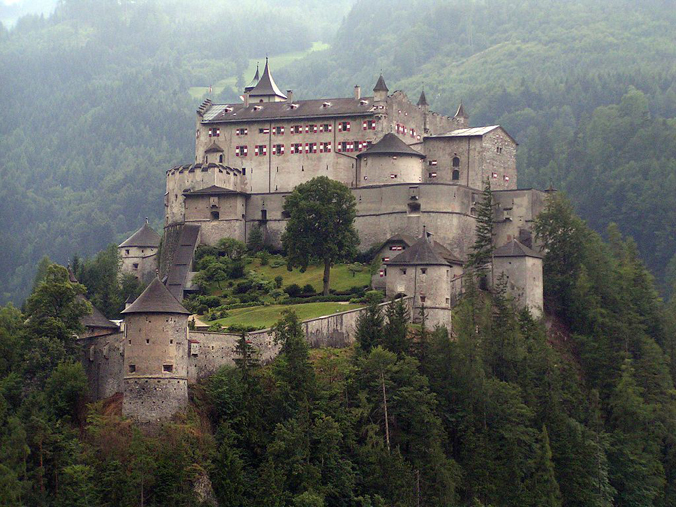
    A side trip to Festung Hohenwerfen, a medieval castle where the popular 1968 World War II film “Where Eagles Dare” was filmed, included a fascinating falconry exhibition.  We watched as a falcon was released, flew around in a huge arc over the castle valley, and then swooped back to the handler, just missing our heads. Little George would have been easy prey for these hunters so, although always fascinated by anything to do with hunting, he kept his distance.

    09
    A falconer holds aloft a falcon as he prepares to demonstrate how to hunt small prey using the birds.

    08 (Wikipedia)
    Castle Hohenwerfen, where the war movie “Where Eagles Dare”, starring Clint Eastwood and Richard Burton, was filmed in 1968. Credit: Memorator / Wikipedia

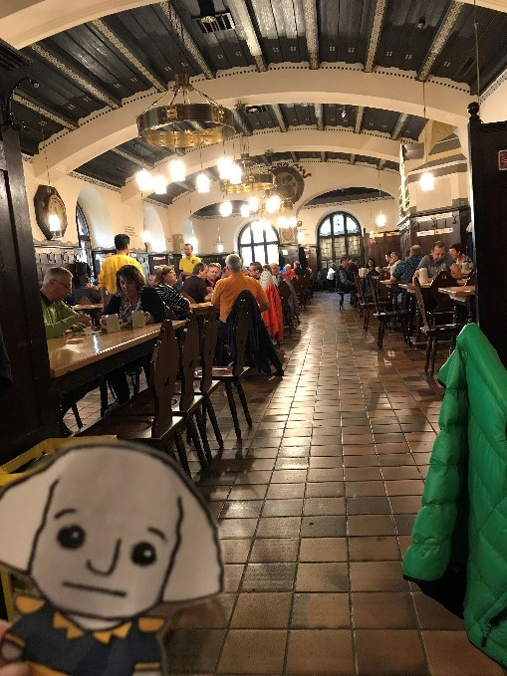
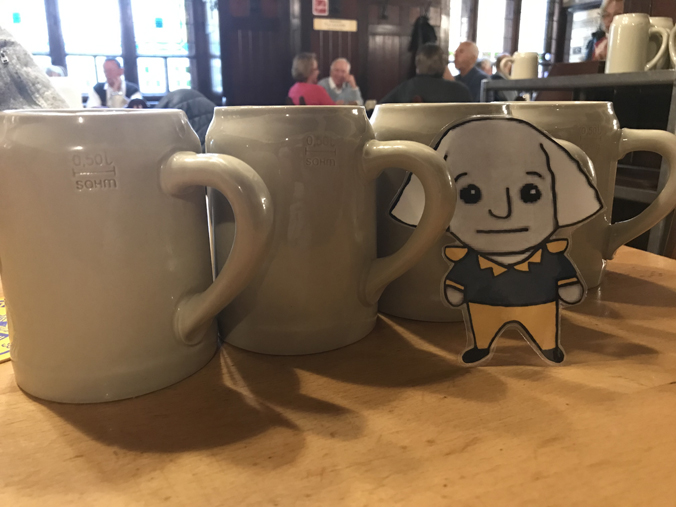
    After walking the streets and alleys of Salzburg’s old city and crossing the river to stroll through the world famous Mirabell Gardens and Palace, we retired for a late afternoon respite in a local beer hall, the Augustiner Brau. This brewery has been serving beer since 1621 and is Austria’s largest.  We sat in one of several halls inside the brewery and tried our best to have a conversation with a local using high school German and an English-German dictionary.  During the 18th century, whether in the colonies or Europe, beer was drunk daily since water was looked upon as unsafe, which it often was.  As a child, George Washington drank “small beer,” which contained almost no alcohol. In later times, Washington built a whiskey distillery at Mount Vernon. In 1799, his distillery produced almost 11,000 gallons of whiskey.

    10
    Augustiner Brau beer hall in Salzburg.

    11
    Little George enjoying a big mug of beer.

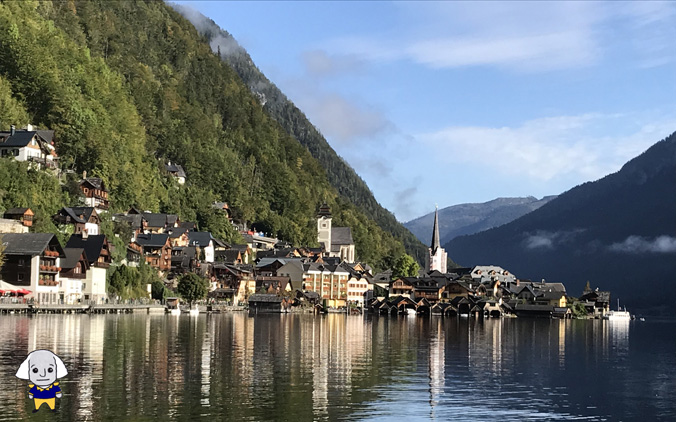
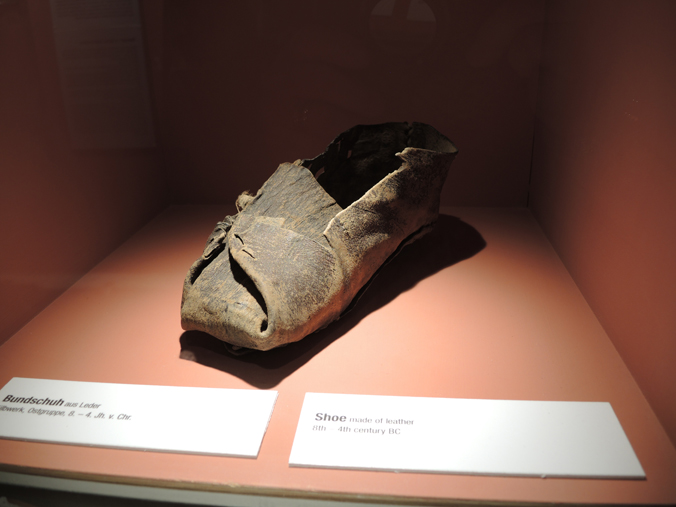
    In Halstatt, Austria, we enjoyed walking this picturesque town, a UNESCO World Heritage site, and visiting the famous bronze-age salt mine and graveyard in the mountains above the village. The unique preservative qualities of salt and sealed caves allowed the preservation of two thousand-year-old leather goods, such as the sandals pictured below. In contrast, acidic soil conditions at Ferry Farm and Kenmore do not allow the preservation of 200-year-old leather items.

    The 19th century excavation of the Halstatt’s bronze-age cemetery and its thousands of funerary goods led to the designation of the epoch from the 8th to the 5th century BC as the “Halstatt Culture.”

    12
    Halstatt, Austria, a UNESCO World Heritage site.

    13
    4th Century BC leather shoe found in the salt mines

    14
    Bronze Age Grave goods


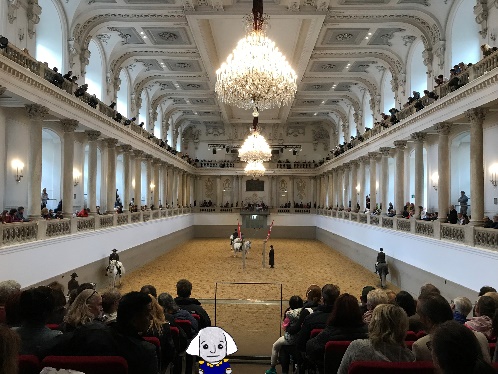
    Of the many sites we visited at our next stop in Vienna, Austria’s capital, our time spent at the world famous Spanish Riding School was perhaps the highlight of Little George’s trip.  Here at the Winter Riding School located in the Hofburg Palace, we watched the famed Lipizzaners and their riders perform their morning exercises to classical Viennese waltzes.  George Washington himself was an excellent horseman and would have appreciated the dedication these riders demonstrated towards learning their lessons.

    15
    Little George enjoying the Lipizzaners at the Hofburg Palace.

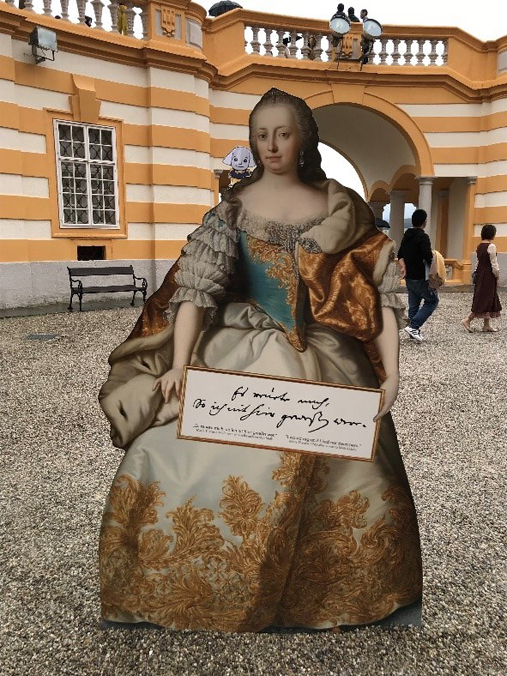
    On a side trip to Melk Abbey, a Benedictine abbey in the town of Melk overlooking the Danube River, Little George had the pleasure of meeting up with a contemporary of his, Empress Maria Theresa, a member of the Hapsburg dynasty and Queen of Austria and Hungary. Maria Theresa reigned from 1740 to 1780. They had much to talk about, as she was the first and only female Hapsburg ruler, and George was the first American president.

    18
    Little George and Maria Theresa having a private chat at Melk Abbey.

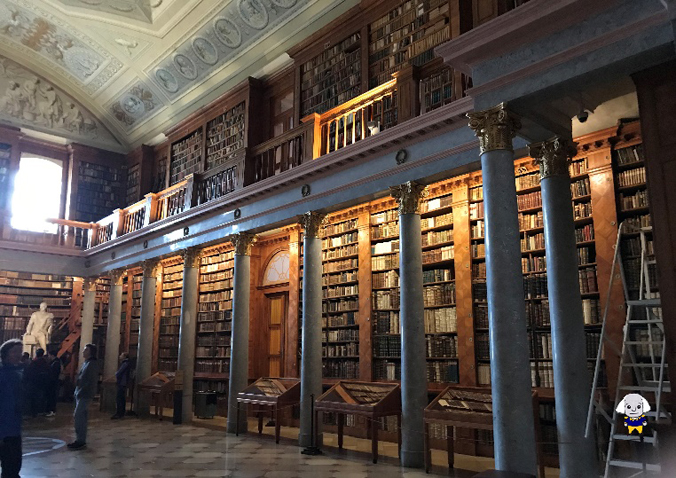
    Melk Abbey is noted for its extensive library containing hundreds of medieval manuscripts. George himself did not have the classical education in an English school that his older half-brothers had, but he spent his life reading as much as he could and enjoyed amassing a library of his own at Mount Vernon.

    19
    The library at Melk Abbey.

    After a short stay in Sopron, Hungary, our last stop was Budapest, the capital of Hungary.  We spent five days here, exploring and learning about the ancient and modern history of the city, walking around the castle on top of the hill, taking road trips outside the city to visit more castles, and taste testing the new fall Hungarian wines.

    21
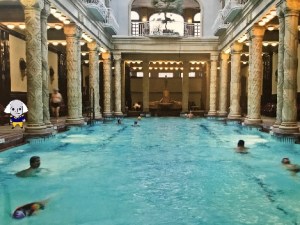
    St. Gellert Thermal Bath and Swimming Pools.

    One of the last things we did in Budapest was visit the famous St. Gellert Thermal Bath and Swimming Pools.  It is a natural hot spring spa housed in a beautiful building with additional outdoor pools and relaxing spa treatments.  George Washington was certainly no stranger to the healing powers of hot springs, as he visited and enjoyed the warm springs in present-day Berkeley Springs, WV, and eventually purchased property in the town, which in his day was called Bath.

    Then it was time to head back home.  Little George had a wonderful time exploring the archaeology and history of our host cities, meeting contemporary persons of fame, relaxing in the spas, cafes, pubs, and restaurants, and trying new foods.

    Judy Jobrack
    Archaeology Lab Assistant and Co-Field Director

  • Little George Goes Back to Pittsburgh [Photos]

    A staff member who works at George Washington’s Ferry Farm and Historic Kenmore recently visited Pittsburgh.  Little George accompanied her and visited places related in some fashion to George Washington’s life in the 1700s, the world he lived at that time , or his long legacy as a historic figure national and internationally.  Here is a collection of photos documenting Little George’s travels!

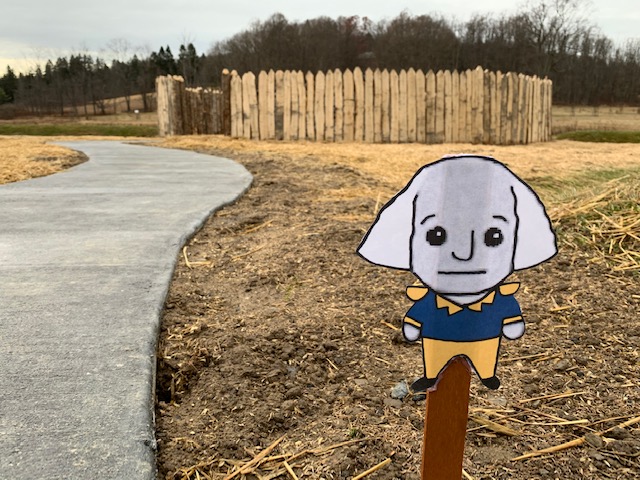
    First, on the road to Pittsburgh, Little George stopped a place that does not hold fond memories for him. The battle of Fort Necessity took place in 1754. Washington and a group of Virginia Militiamen were sent to the area to meet with Ensign Joseph Coulon de Jumonville, the leader of the French detachment of troops nearby. While there are not clear descriptions of what happened, there was clearly some miscommunication and Jumonville was killed. Within a few months, the French retaliated, attacking Colonial and British forces in this clearing known as Great Meadows. Washington had built Fort Necessity but the design, a circular fort surrounded by tree-lined high ground, led to a swift defeat.

    Fort Necessity
    A replica of Fort Necessity

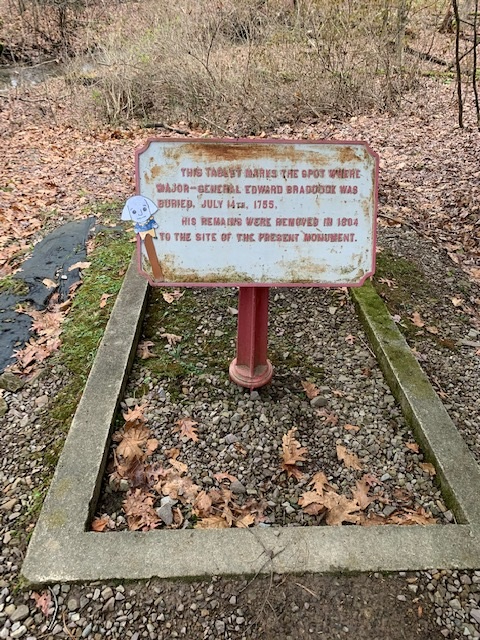
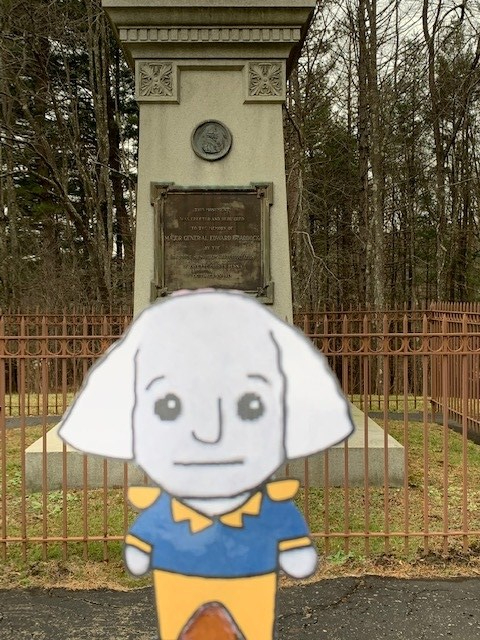
    A year after the disaster at Fort Necessity, George joined yet another expedition to “the Forks of the Ohio”, this time under the command of renowned British General Edward Braddock. During the march towards modern day Pittsburgh, the British were ambushed and after a three hour bloodbath, Braddock was carried from the field with fatal wounds. A few days later, Braddock was buried about a mile from the old site of Fort Necessity. Several years later, Braddock’s remains were moved to a nearby knoll. Little George decided to stop and pay respects to a man he admired, saying “…Thus died a man, whose good and bad qualities were intimately blended. He was brave even to a fault and in regular Service would have done honor to his profession. His attachments were warm, his enmities were strong, and having no disguise about him, both appeared in full force.”

    Braddock 1
    Original burial site of General Braddock.

    Braddock 2
    Current site of General Braddock’s grave.

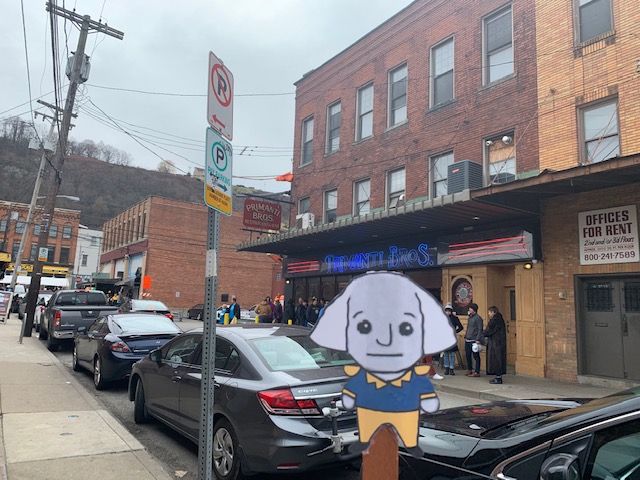
    After a few stops that tugged at Little George’s heartstrings, we decided to continue on into the city. Little George was looking a bit famished so I decided to take him to a place he hadn’t seen on his last trip to Pittsburgh. Little George thought Primanti Brothers was top notch!

    Pirmanti
    Pirmanti Brothers sandwich shop

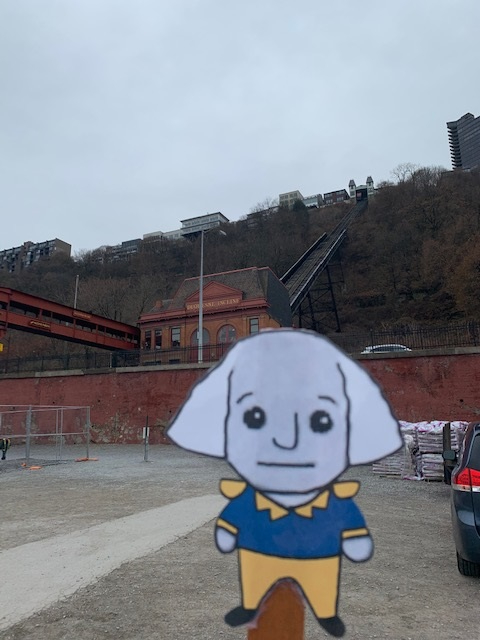
    Next, Little George thought a trip to the top of Mount Washington would make for a great view of the city. As he began to prepare for a hearty trek up the mountain, I drove us to another modern development. Little George decided that the Duquesne Incline would have been handy in the 1750s!

    Duquense Incline
    The Duquense Incline up Mount Washington

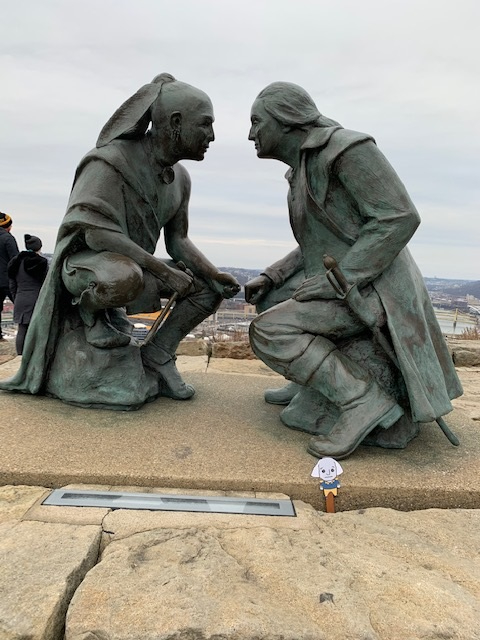
    As we got to the top of Mount Washington, we walked along, admiring the city and came to a spot where the people of Pittsburgh had memorialized George Washington and Guyasuta, a leader of the Seneca people who met and traveled with George Washington in 1753 but ultimately sided with the French during the French and Indian War. Later, he would take the side of the British during the American Revolution thus, making the two men constantly at odds with each other.

    George Washington and Guyasuta
    Statue of Guyasuta and Washington

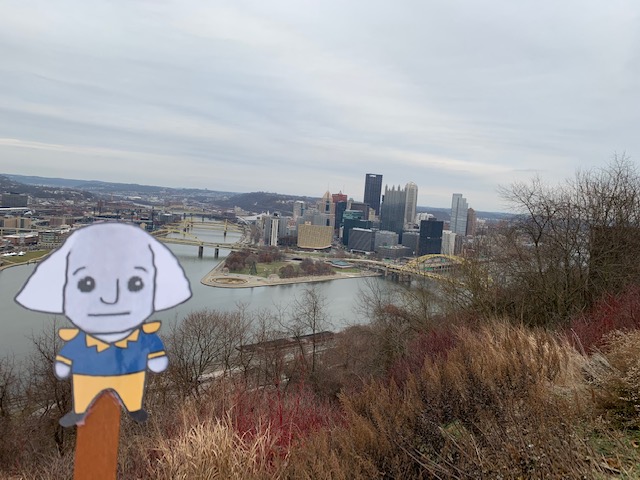
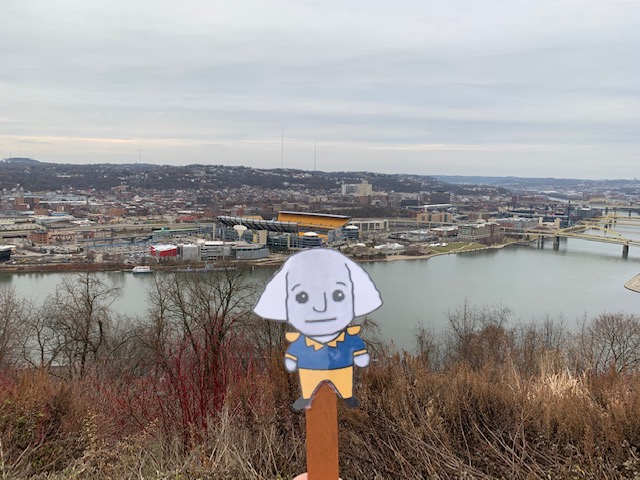
    Looking down over the confluence of the Alleghany and the Monongahela brought back a lot of memories for Little George. Even with the new buildings and bridges, he recalled his march to Fort Duquesne. However, he did seem very interested in this “football” that modern Americans seem to like so much. After I explained it a bit, he didn’t think he could pick a single team to root for, but thought the field of play here was in a beautiful location.

    Three Rivers
    Downtown Pittsburgh and the confluence of the Allegheny and, Monongahela Rivers, whose meeting forms the Ohio.

    Heinz Field
    A view of Heinz Field, home of the Pittsburgh Steelers

    After admiring the view from above, I took George down to the site of where Fort Duquesne once stood. He recalled the assault on Fort Duquesne. The battle was fierce, and despite the French victory, they withdrew from the area due to the fact that the British force was more than ten times the size of the French force. Thus, the British rebuilt the remains of Fort Duquesne and reinforced it, calling it Fort Pitt, in honor of the English Prime Minister at the time.

    Fort Duquense
    Site of Fort Duquense, later renamed Fort Pitt

    While down by the water, I convinced Little George to also take a picture next to the River. He was a little nervous getting too close to the Allegheny River and I asked him why. He explained that in 1753, when travelling through the area, he attempted a crossing. At the time, the water was very cold with large chunks of ice flowing through it. George fell into the water and nearly froze to death overnight while waiting on a small island for the river to freeze and he could finally cross safely the next morning.  I told him not to worry as the river wasn’t that cold just yet.

    Allegheny
    The Allegheny River

    Wigle's
    Visiting the Wigle Whiskey Distillery

    After all the talks of battles and falling in icy rivers, I decided we should warm up a bit. I remembered just down the river was a spot where Little George might also like to reminisce. During his Presidency, George Washington enacted a whiskey tax that led to the Whiskey Rebellion in western Pennsylvania. During this time, he sent representatives to attempt to collect the taxes, and even led organized troops to march against the insurrection. However, the rebels were no match and they folded. Only two of them were convicted of treason: John Mitchell and Philip Wigle. The men were sentenced to hang, but Washington later pardoned the men. In 2011, Wigle Whiskey was reopened to keep Philp Wigle’s legacy alive. Little George enjoyed the visit, noting that he too owned a whiskey distillery at the end of his life. He bragged only slightly to the folks at Wigle about producing 11,000 gallons in 1799. At the time, it was one of the largest distilleries in the country.