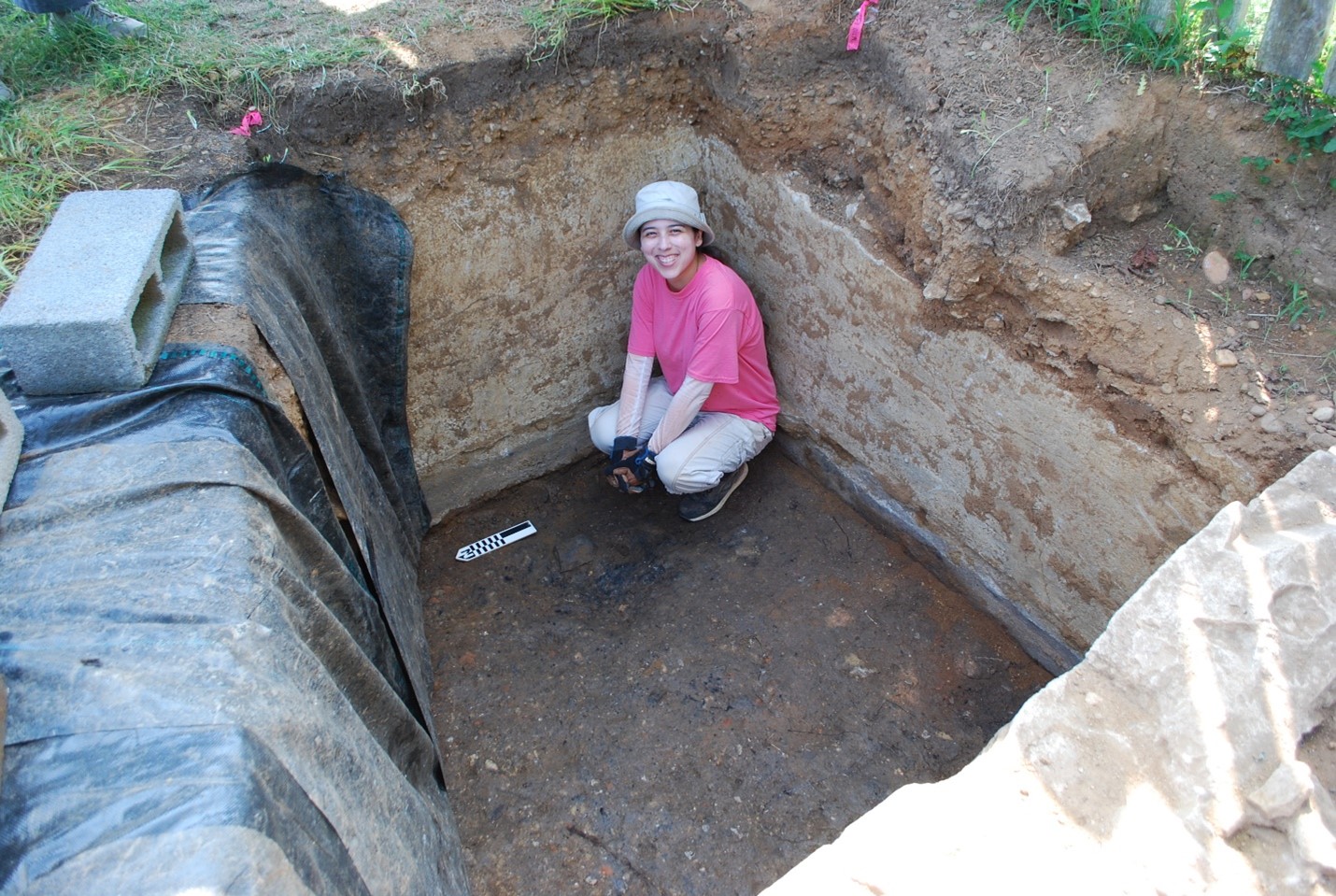
The dig is in full swing, and we are a little over halfway through our 11-week dig season. Over the past few weeks, we have made lots of new exciting discoveries, and as you may have noticed, added quite a few new faces to our crew.
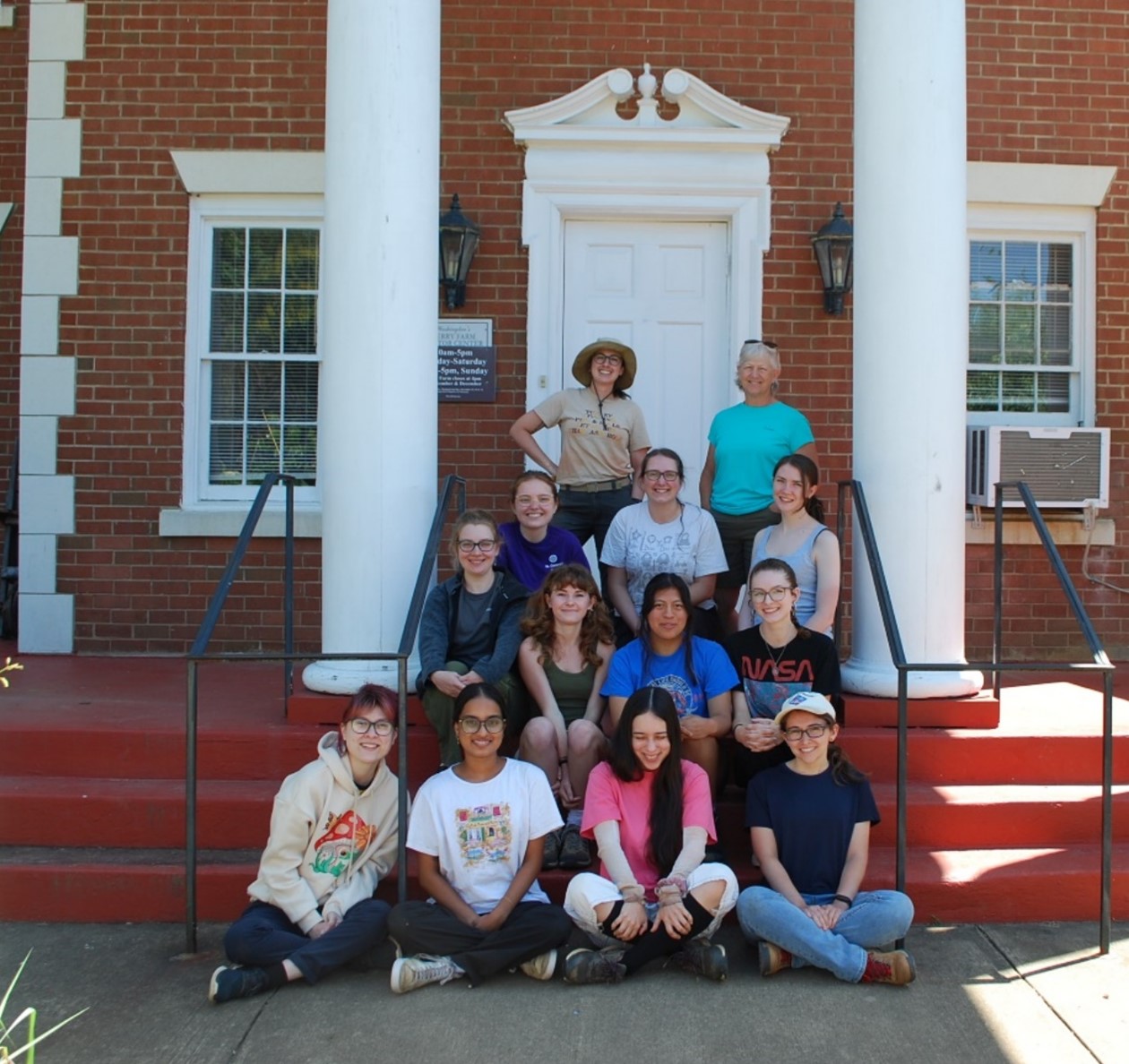
Hosting a field school from the University of South Florida as well as interns from colleges and universities around the country has more than doubled our crew this season. While this is definitely awesome in itself, the fact that the entire field school and crew are women makes this year’s dig stand out even more. Now before we get into why an all women dig is so impressive, lets meet our crew.
Front Row Left to Right: Alaina, Srin, Sarah, Sofia. Second Row: Abbie, Amelie, Rosie, Lindsay. Third Row: Kate, Rachel, Kellina. Back Row: Danielle, Judy.
Srinidhi
“Srinidhi is from Lithia, Florida. She just recently graduated from the University of South Florida with a bachelor’s degree in history. She plans on attending graduate school sometime in the future. Outside of school, Srinidhi enjoys reading high fantasy novels, playing video games, and hanging out with her dog, Felix.”
Lindsay Marrion
“Lindsay Marrion, from Niceville, Florida, attends the University of South Florida for English and Art History. She hopes to continue her education in graduate school, with dreams of working in academia one day. Outside of school, Lindsay in as avid reader and writer, and she loves an adventure of any kind.”
Alaina Scapicchio
“Alaina Scapicchio is a doctoral student at the University of South Florida in Tampa. She did her first field school at Ferry Farm in 2018 and now she is the graduate assistant for this year’s field school. Her dissertation is focused on public memory and the commemoration of witch trials in colonial America. She is the owner of two senior citizen fat cats named Tazz and Amira who she misses very much.”
Sofia Almeida
“Sofia Almeida is an incoming History PhD student at the University of South Florida. She recently completed her MA thesis on the digitization of historic Black cemeteries in Florida. Moving forward she is interested in American history, historic archaeology, and memory. Outside of school, she enjoys reading, playing guitar, and going on adventures with friends.”
Amelie
“Amelie is from Tucson, Arizona and is studying Biology, French, and Anthropology at the University of Arizona. She enjoys reading, hiking, and weightlifting and aspires to travel the world.”
Rosie Muraca
“Rosie Muraca is from Fredericksburg, VA. This is her first time working as a field student. She plans to attend Mount Holyoke College in the spring. When she is not digging, she is spending time with her two cats.”
Kellina
“Kellina is a rising junior at Yale University. She is an anthropology major from Spotsylvania, VA and she hopes to work in museum conservation. Spending the summer at the Ferry Farm archaeological dig has given her a better understanding of artifacts prior to their museum life and deepened her understanding of American history.”
Kate McDonald
“Kate McDonald Yaun is a rising freshman at Sewanee: The University of the South. She is studying Environment Arts and Humanities. Her hobbies include playing her viola, reading, and spending time outdoors.”
Abbie Wood
“Abbie Wood graduated from UVA in 2023 with a B.S. in Anthropology and a B.S. in Archaeology. This is her second dig season at Ferry Farm and the fourth overall, following a collections management museum internship. She has a passionate interest in caring for artifacts and history.”
Sarah
“Sarah came to Ferry Farm as a student of Virginia Commonwealth University in the summer of 2014. She has participated in half a dozen summer digs as an intern at Ferry Farm since then. Her favorite artifacts consist of the more personal items people had such as buttons, beads, sewing pins and Ferry Farm’s famous and abundant collection of colonial wig hair curlers.”
So back to why an all women crew is so awesome. Well, our crew illustrates how women are gaining ground in a previously male dominated field. Historically, many professional positions in archaeology were held by men, but times are changing.
Hopefully we will see some of these faces again somewhere down the archaeology pipeline, or wherever their futures may take them.
Archaeologists tend to have strong feelings about ceramics. Ceramics can play a major role in interpreting a site, as their materials often reflect their function. This can be helpful when determining how a site was used. For instance, finding an abundance of redwares and stonewares could indicate a primarily utilitarian site like what would have been used in our Cellar House whereas porcelain and refined earthenwares may reflect a more domestic space. So, it really isn’t surprising that we feel some type of way about these artifacts.
Redware and stoneware storage vessels Porcelain and refined earthenware tablewares
But don’t let that fool you. Archaeologists have feelings about ceramics based solely on their appearance as well. It has come to my attention that Whieldon Ware just might hold the title as the most polarizing ceramic type as of late. These feelings were made very apparent during our recent acquisition of some Whieldon Ware pieces. Most either love or hate it; rarely is there an in-between. Before we get into the ceramic and its distinct look that conjures images of either vomit or a work of art (depending on whom you ask), let’s go over a little background on its creator, Thomas Whieldon.
Thomas Whieldon was an influential English potter producing examples of early creamware beginning in the mid-18th century. He gained popularity for his innovative shapes and decoration, which can be seen on various figurines, dishes, and other vessels. Whieldon is also well known for his partnership with the MVP of the ceramics world, Josiah Wedgwood, Mr. Creamware himself. Together, they developed advances in the realm of refined earthenware, like the perfecting of the green glaze as seen on the pineappleware we have found at Ferry Farm (Wedgwood & Ormsbee, 1947).
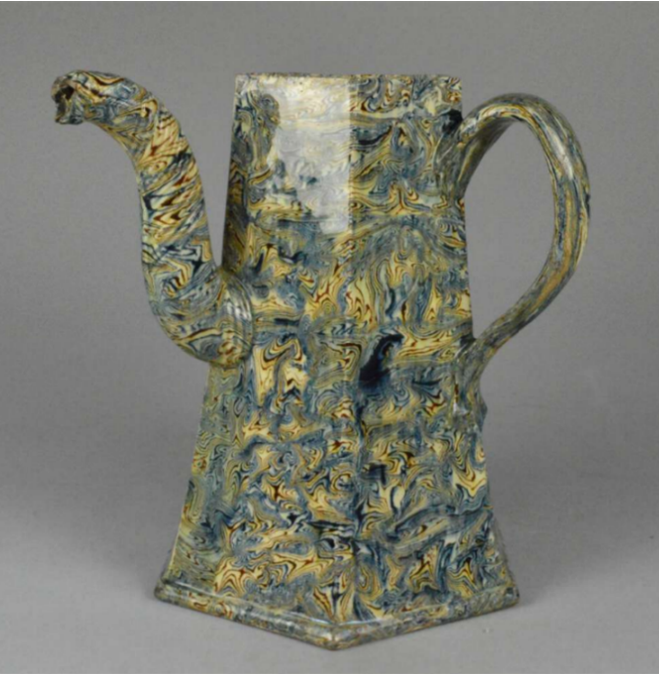
Whieldon agate ware coffee pot. Source: British MuseumWhieldon figurine. Source: The British Museum.
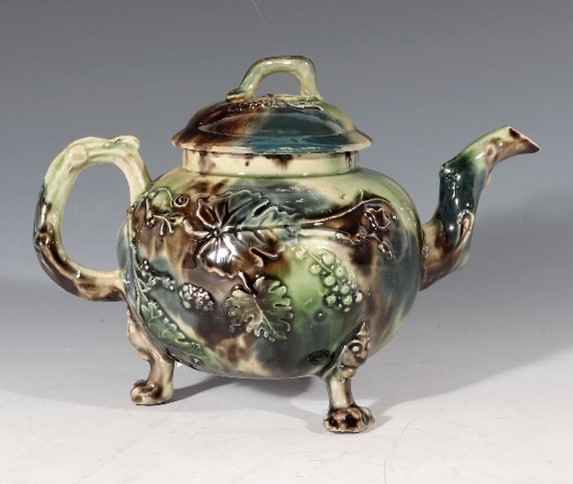
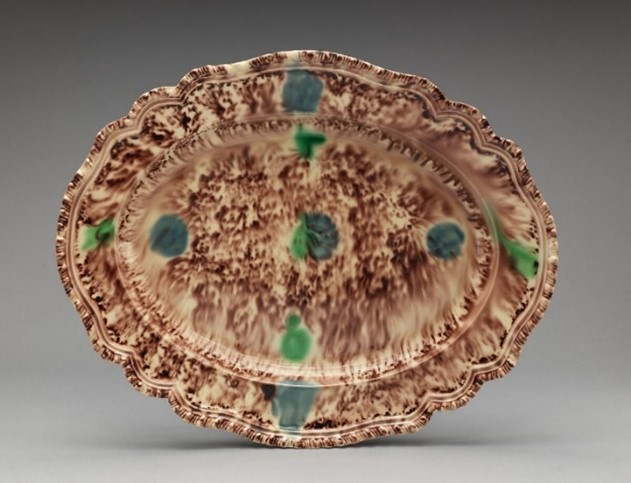
With that said, what we commonly think of when referring to Whieldon Ware is Whieldon’s tortoiseshell or clouded wares. These were created by sponging metal oxides on cream-colored earthenware and then adding a clear lead glaze. The mixing of the metal oxides with the liquid glaze caused the colors to blend and streak, creating splotches of green, yellow, purple, blue, and brown, depending on the types of metal oxides used (Gallagher, 2015). This resulted in a clouded or tortoiseshell decoration. Due to the nature of the technique, no two pieces look exactly the same. For Whieldon lovers like myself, the uniqueness of each piece gives it its charm.
Examples of Whieldon’s tortoiseshell/clouded ware with similar decoration to sherds found at Ferry Farm – Teapot. Source: Earle D. Vandekar of Knightsbridge, IncExamples of Whieldon’s tortoiseshell/clouded ware with similar decoration to sherds found at Ferry Farm – Platter. Source: Met Museum
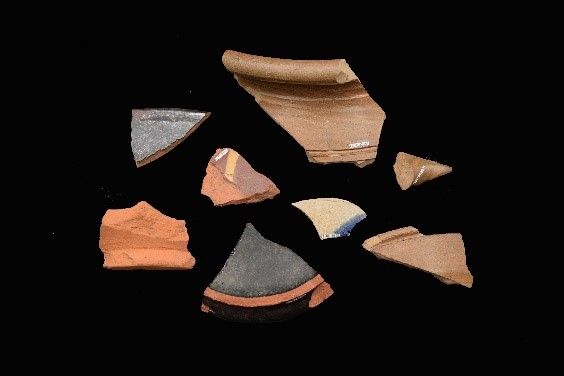
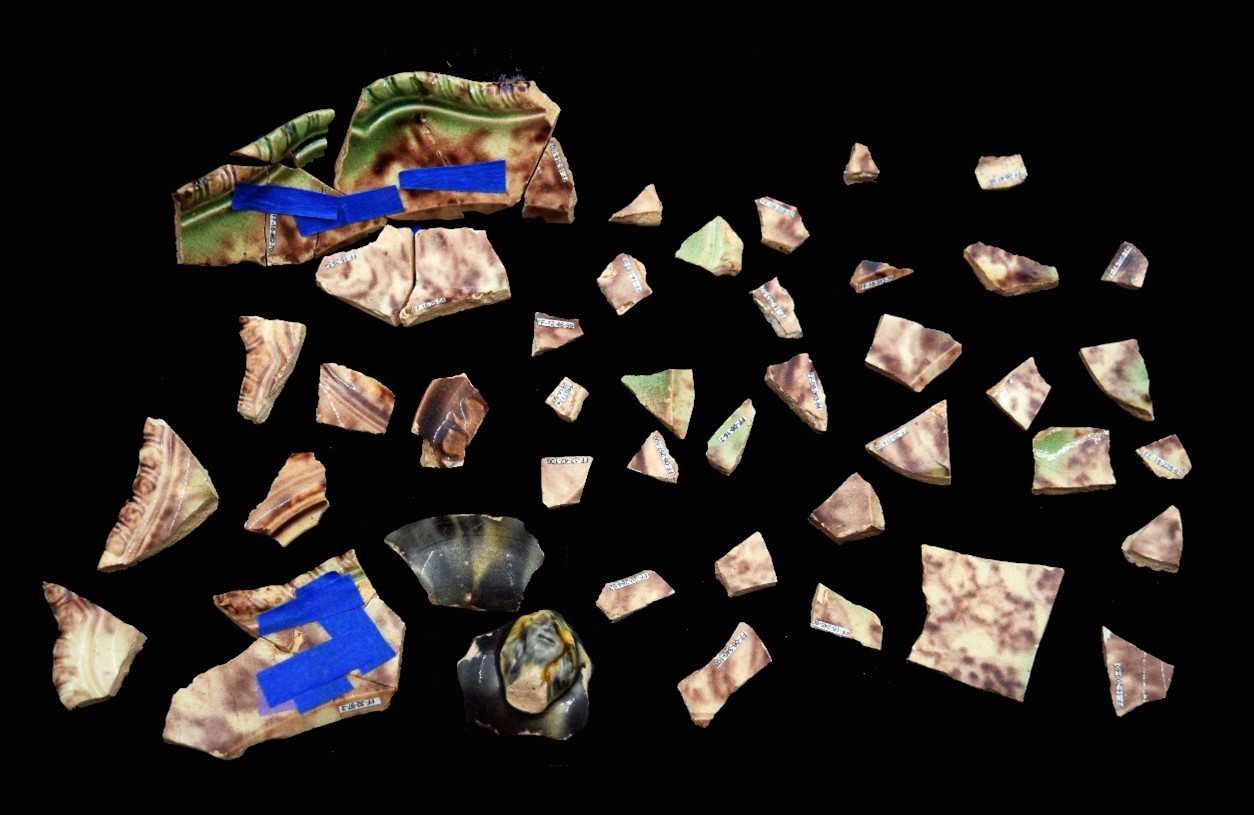
Now that we know more about Whieldon Ware and how some of us feel about it today, let’s talk about how Mary Washington may have felt about it. I firmly believe that she was not team Vomit Ware and instead found the decoration quite desirable. Our excavations have found evidence of at least four Whieldon Ware plates, a teapot, teacup, and other medium-sized holloware vessels at Ferry Farm. Considering the short-lived popularity of the type, lasting only from 1740-1775, we can be quite certain that it was Mary who was buying these items.
Some Whieldon Ware vessel mends and sherds excavated at Ferry Farm
Toward the end of the 1770’s, Whieldon Ware quickly went out of style and was replaced by Wedgwood’s new, improved creamware and its more subtle decoration. While it may have gone out of style, potters continued to replicate the technique for many years, which makes it difficult to attribute all examples of the type to Whieldon himself. After 1780, he retired from the business, demolished his factory, built an ornamental garden in its place, and spent the rest of his years as a sheriff (Hildyard, 2005; The London Gazette, 1785).
So, there you have it, the very brief story of Whieldon and his wares.
While Mary Washington and a couple of us in the lab are Team Whieldon all day, every day (or at least the days concerning Whieldon), the majority are a hard pass. Where do you stand? Are you Team Whieldon or team Whieldout?
Danielle Arens
GWF Archaeologist
References
Gallagher, B. (2015). British Ceramics 1675-1825: The Mint Museum. Charlotte: The Mint Museum.
Hildyard, R. (2005). English Pottery 1620-1840. London: V&A Publications.
The London Gazette. (1785, November 12). The London Gazette(12699), p. 522.
Wedgwood, J., & Ormsbee, T. H. (1947). Staffordshire Pottery. New York: Robert M. McBride & Company.
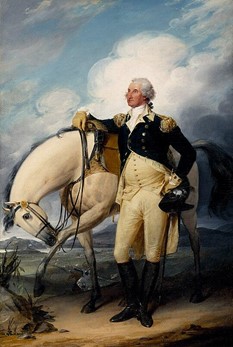
Think about a portrait or painting of George Washington. What is a common element in the paintings? His uniform, yes, he is indeed painted quite a bit in his impressive military uniform. But how about a horse? George is often painted riding beautiful horses with a quiet dignity and noble appearance we expect from the father of our country.
Washington at Verplanck’s Point by John Trumbull, Source: Winterthur
However, the horses in these paintings are not mere symbols of wealth or power. They are depicted with George because, from a tender age, his life has been intertwined with these creatures. As a surveyor, soldier, landowner, farmer, gentry, commander-in-chief, and president, he was inextricably linked with horses, not just as a mode of transportation but as a vital part of his daily life.
And it all started at Ferry Farm…
George moved to Ferry Farm around 1738 at the age of six. His father, Augustine Washington, was a member of the “planter class,” or Colonial American gentry. This meant he was a prominent member of society, involved in politics, and owned lots of land. Augustine purchased 150 acres across the river from Fredericksburg and later added an additional 450-acre parcel. In total, he owned Little Hunting Creek, Pope’s Creek, and the Ferry Farm properties.
The point? Augustine needed help because there were places to be, people to see, and fields to farm. So, horses were a fundamental necessity for the Washington family, and George would have grown up around them, taking care of them and learning to ride.
We have two great sources that give us some understanding of the horse situation at Ferry Farm. First, in 1743, the Washington patriarch died, leaving behind a widow, an 11-year-old George, and a probate inventory. On page two of the inventory, three horses and one mare are listed.
Augustine Washington Probate Inventory, 1743
Secondly, some pretty cool horse tack dating from the Washington occupation has been found during various archeological digs.
The Finds
One of the most universally known horse tack, essential for all horse maintenance – is the horseshoe. The horseshoe was used to protect the hooves because “…being rendered subservient to the use of man…applied to severe and continued labour, and compelled to tread frequently…on the irregular and stony surface of the roads, it became necessary to secure his feet from ruin by strengthening them with the iron band which we call a shoe” (Vial de Saint Bel, 1793). These shoes were handmade with no standardization across makers in shape, narrowness, or thickness. (Hume, 2001). This makes it difficult to pinpoint and assign a time on shape alone.
Our horseshoe was found in the second cellar of the Washington Home. It is quite wide between the branches (the curving sides), and the toe seems to straighten a bit at the center. The crease (the groove that runs down the sides) gives enough depth to allow the shoe to be firmly attached to the hoof with six nails (which we found a few originals). (University of Zurich, 2024) This find illustrates that there was active shoeing and horse maintenance going on at the farm. Additionally, these horses were ridden or used for farm work because shoes were used to protect the hooves from the wear and tear of hard roads, distribute the horse’s weight evenly on uneven ground, and provide traction on various surfaces.
Horseshoe with original nails
Another artifact found in the cellar of the Washington Home, the stirrup, further demonstrates horse riding as a family necessity. (Cofield, 2014)
Stirrup
The stirrups are used as foot support for the rider, and they hang from a saddle on straps known as stirrup leathers. Basic stirrups are made of three parts the eyes for the stirrup leathers to attach the stirrup to the saddle, a platform or base where the rider places their foot, and arms which connect the eye to the base. (Cofield, 2014)
Examples of Stirrup Forms Source: Diagnostic Artifacts in Maryland
Horseback riding master and author VS Littauer described the Forward Seat as a stirrup-centric approach versus traditional riding’s seat-centric. He argued riding without stirrups taught people to grip with the knee, which he considered a dangerous habit and likely to stiffen the rider. With stirrups, you can ride with a looser knee, letting your weight flow PAST your knee and into the stirrup. That is a more secure approach than riding with the thigh and knee. (Littauer, 1962)
Captain Vladimir Littauer – Forward Seat Riding,1947
Stirrups allow the rider’s legs to absorb up/down motion by allowing them to stand in matching balance with the horse, which makes riding longer distances more comfortable. Augustine certainly had to travel a great distance to check on his properties and perform his civic duties, like serving as a justice of the peace and sheriff for the county of Westmoreland.
One final utilitarian bit of horse tack found again in the cellar is a mullen mouth bit or snaffle bit. This bit consists of two rings on each side of a half-moon-shaped bar with no joint. The bit applies even pressure on the horse’s tongue and bars (gums) and allows the horse’s lips to feel the pressure from the bit and side rings. The bit, bridle, and reins function to create communication between the rider and the horse.
Mouth Bit
The Washington children would have used bits to learn to control. They would have learned how to work with the horse in a cooperative way that would create an effortless and seamless ride. George used this skill of communication and intuition to become a great rider. As Thomas Jefferson reminisced in a letter in 1814, “his person, you know, was fine, his stature exactly what one would wish, his deportment easy, erect, and noble; the best horseman of his age, and the most graceful figure that could be seen on horseback.” (National Archives, n.d.)
Lastly, just south of “The Quarter,” we uncovered around twenty leather ornaments. They were used to decorate the leather straps, nosebands, harnesses, and reins of horses. We wrote a post about them earlier explaining their purpose, which was purely aesthetic. Horse tack could be made without these pieces, but where is the fun in that? These flashy accessories were a great way to grab the attention of the public and hint at how fashionable and elegant you were as you trotted through town.
Ferry Farm leather ornaments dating from the 1700sThis copper-alloy mount dates from the mid-to-late 1700s
These artifacts illustrate that not only were horses actively used by the family, but it also fostered an environment where young George would have taken his first steps into learning about horsemanship. This knowledge and skill would help him in his future careers of surveying the Shenandoah Valley, as a lieutenant colonel during the French and Indian War, as a farmer and landowner at Mount Vernon, as a representative in the House of Burgesses, as commander-and-chief of the Continental Army and finally President of the United States.
Come see our new pop-up exhibit at Ferry Farm, where all these wonderful artifacts are displayed and put together with the help of our Fleming-Smith scholar, Sarah Moore.
Spring is in the air. The weather is warming up, flowers are blooming, bees are buzzing, and of course the dig season is about to start here at Ferry Farm, George Washington’s Boyhood Home.
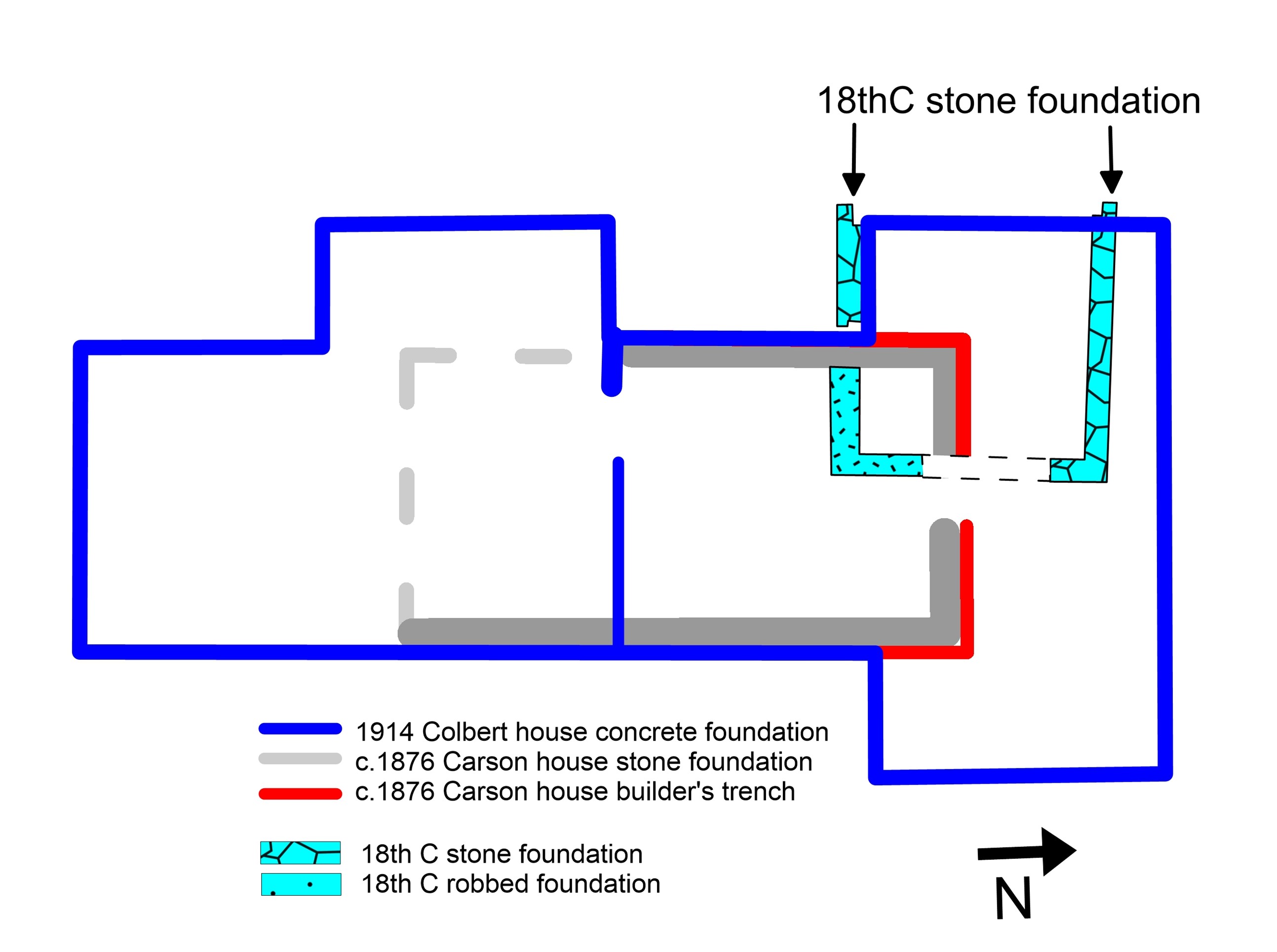
As part of the 2023 dig season, our team revisited the site of a colonial-era kitchen that had experienced a particularly destructive fire sometime in the middle of the 18th century. The kitchen’s foundation, as well as the surrounding landscape, had been compromised by the construction, and subsequent destruction, of two farmhouses that were built directly on top of everything. This site (FF-44) is located about 50 feet from the northeast corner of the Washington House.
Location of this year’s dig at the colonial kitchen site (FF-44)
The 18thC kitchen site was initially explored as part of an archaeological assessment of the Ferry Farm historic property in the early 1990s. The structure and its contents were originally interpreted as a house, but a reevaluation of the excavation notes and artifacts several years later reinterpreted this site as a kitchen, not a primary domestic dwelling. But research queries still exist, such as narrowing down the dates of construction and destruction of the structure, as well as determining the possibility that meaningful artifact deposits and landscape features that might help bolster the interpretation of the building still exist outside of the foundation.
Location of the 18thC kitchen in relation to later 19th and 20thC farmhouses
With these questions in mind, our efforts last summer focused on working out a game plan for reexamining the site for our future excavations. During our dig, we uncovered the southwest corner of the original kitchen as well as the foundation of the 20th-century farmhouse overlaying it. Re-locating the site and evaluating the amount and extent of fill were our primary goals. That completed, this year we will concentrate on investigating the landscape surrounding the foundation and reexamining the burnt fill within.
Last year’s excavation. Red arrow points to area inside of the kitchen, white arrow points to area outside of the building. The stone and concrete wall is part of the 1914 farmhouse foundation, which sits atop the colonial kitchen fill.Lead excavator Sarah on floor of kitchen cellar
An honest question you might ask would be why would we want to learn more about what was outside of the foundation? Isn’t all the important stuff inside? In the archaeological world, a lot of valuable information can be learned from these outlying areas. Eighteenth-century trash middens are often found outside of a building because garbage was being thrown off of the porches and out the doors and windows. Studying this everyday disposal of trash can tell us how and when a building was being used, as well as traffic patterns by those using the building.
Another interesting feature that can be found outside of a foundation is a builder’s trench. These trenches were dug by the individuals building the foundation, and as they worked and backfilled these trenches, items they were currently using were accidentally left behind. These artifacts can be excellent dating material and can really nail down a construction date.
Other items we will be looking for are possible supplementary building features, such as post-in-the ground foundations and fences. Additionally, taking a second look at the site will help us better understand the previous archaeology that was done over thirty years ago.
As for the exciting second site we started excavating last year, Feature 321, we are putting that project on hold for now and concentrating our efforts on the kitchen site. But work continues in the lab on all the interesting artifacts recovered during last summer’s dig.
This year’s dig begins April 29thand ends July 12th. Archaeologists are working on site from 8 am until 4 pm, Monday through Friday, and we gladly welcome questions from our site visitors. So be sure to stop by and see what exciting things we uncover!
A quick refresher from part one of the TD marked pipe saga – Clay tobacco pipes with the mark TD are a ubiquitous item at historical archaeology sites dating from the mid-18th through the 20th century. While at one point the mark represented a specific maker, it later became a mark synonymous with clay tobacco pipes themselves. So, it’s not surprising that archaeologists and historians have been looking to identify the origin of the mark for years. These efforts led to the naming of Thomas Dormer as the maker most likely to have begun the rise of the TD mark, though this identification was less than certain (Walker, 1966).
Now that we are all caught up, let’s pick up the quest once again.
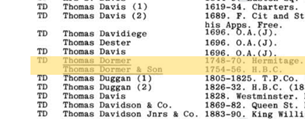
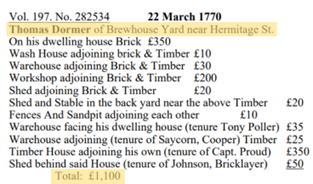
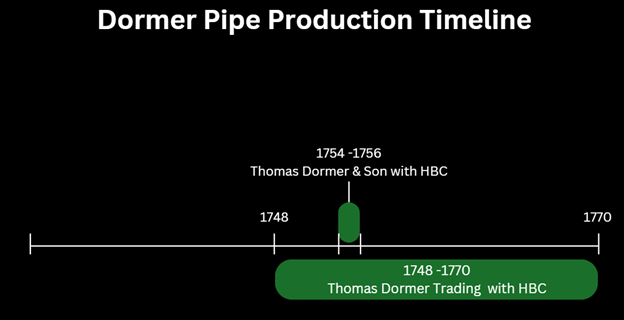
Adrian Oswald’s (1975) index of pipe makers lists Thomas Dormer as one of the only London-based pipe makers with the initials TD trading with the Hudson’s Bay Company (HBC) in the years 1748-1770. HBC records also mention that Dormer went into business with his son for a brief time from 1754-1756. Oswald built on this by looking at the insurance policies of pipe makers of the time, which shows that the value of Thomas Dormer’s estate was nearly five times that of other pipe makers (Alexander, 1978). In the 18th century, pipe makers and the pipe making industry were often relegated to the lower class and the poorer parts of town (Walker, 1981). Dormer’s large estate implies he stood out at the time.
So, we know that Thomas Dormer produced and imported his pipes into North America around the time TD marked pipes started popping up at sites, and that he was doing well for himself. We can call it a day and say Thomas Dormer was the original TD, right? While that does sound pretty enticing, there still needs to be more evidence supporting Dormer’s claim to the TD mark. At the time of the previous research there was very little historical documentation of Dormer and his life available, which left some questions unanswered: Why did Dormer stop exporting pipes in 1770? What is the reason behind the brief mention of this son in the mid 1750’s? And why did these pipes continue to be produced beyond 1770 with the TD mark, if not by Dormer himself? These questions made it difficult to confirm that Thomas Dormer was the TD.
Previous timeline of Dormer pipe production
This opens the door for my research as I attempt to fill in the blanks surrounding Dormer and his life. Since a trip to London to begin my research was off the table, much of my investigation was done through online archival research. Yay for digitization efforts and increased access to information!
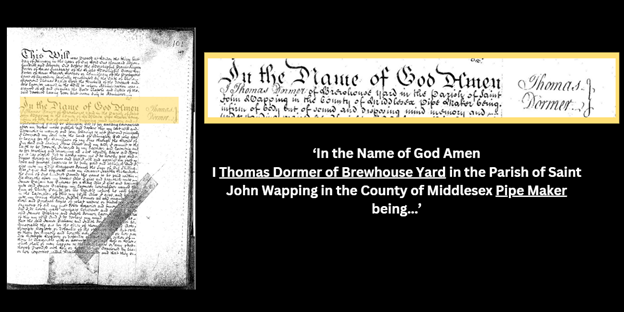
One of the first items identified was Thomas Dormer’s will dated January 1771 (National Archives). It gives his occupation as a pipe maker and his location at Brewhouse Yard, confirming this to be the correct Thomas Dormer. Finding this document provided information that would further the investigation including a probable death date and the names of family members.
Thomas Dormer’s will 1771 (National Archives)
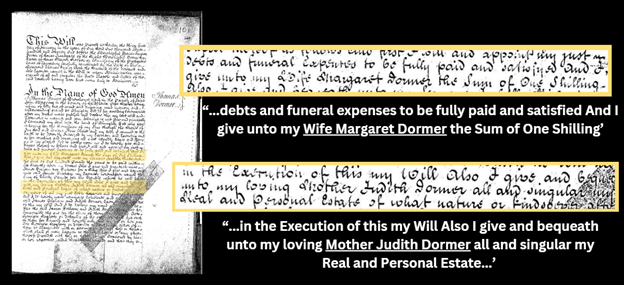
Speaking of family members, Thomas Dormer chose to leave the entirety of his vast estate to his “loving mother Judith.” On the other hand, he left his wife Margaret one single shilling. Hold up, just one shilling? This led me down a mini rabbit hole where I found that Thomas and Margaret had been married for 11 years. Indeed, long enough for her to have a fair share of the estate. Additionally, it wasn’t uncommon for wives to take over their husband’s pipe making business after their death, yet Dormer left things to his mother instead. Ouch!
Dormer’s division of his estate (National Archives)
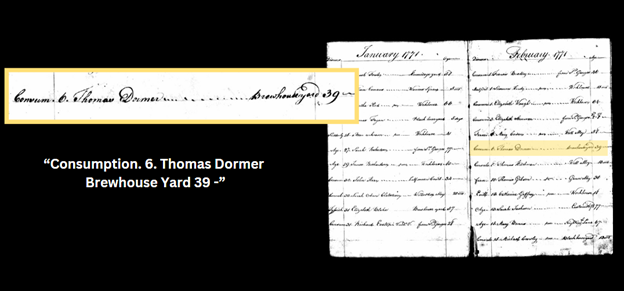
Anyway, back to the investigation. Using 1771 as a probable death date I was able to find a Burial Notice dated February 1771 stating Thomas Dormer died at the age of 39 due to consumption, or tuberculosis as we know it today (London Metropolitan Archives [LMA]). An age at death gave me the ability to estimate his birthday to sometime around 1731 or 1732 and identified a Christening Record for Dormer dated 1731(LMA). It lists his mother as Judith Dormer which fits with previous records, and it also lists his father who is, wait for it, Thomas Dormer, a pipe maker. This uncovers the fact that there were two Thomas Dormers producing pipes in 18th century London, father and son.
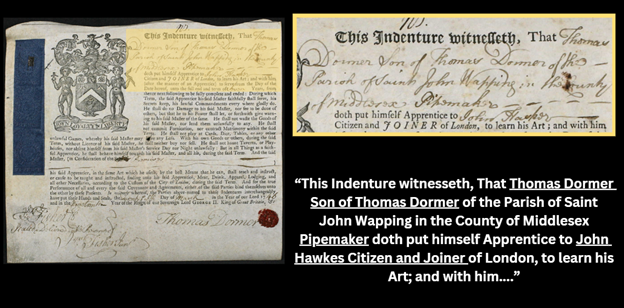
After finding that fun fact I switched gears to see if I could find information about Thomas Dormer Sr. Given the birthdate of Thomas Jr., I figured Thomas Sr. was probably born some time in the early 1700s. Using that date, I identified his Burial Notice dated December 1756. It listed Thomas Dormer Sr. dying at the age of 56 due to asthma (LMA). Additionally, an apprenticeship indenture for Thomas Jr. was located (LMA). Dated 1746, it lists his seven-year apprenticeship under John Hawkes. Now, an apprenticeship in itself isn’t too exciting, but this was an apprenticeship for a joiner, not a pipe maker. Considering Jr. did go on to be a pipe maker, and a popular one at that, makes his previous foray into joinery an unexpected plot twist.
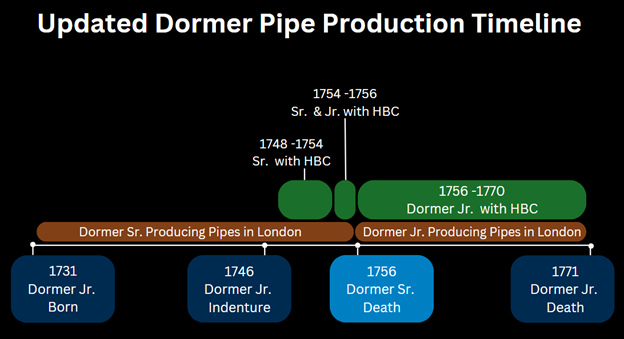
Let’s put all of this information together. Cue the timeline! The newly discovered documentary evidence now allows me to create an updated chronology of the Dormer pipe production. Thomas Dormer Sr. began producing pipes in the London area some time prior to 1731. By 1748 Dormer Sr. was doing well enough in the business to begin exporting pipes into North America. Indenture records suggest that Dormer Jr. was not always intending to take over the business, but perhaps his father’s health prompted this, or the incoming wealth from overseas changed his mind. Nonetheless, sometime in the year 1754, or the years leading up to it, Thomas Dormer Jr. came into the family business. This partnership was short lived due to Thomas Dormer Sr.’s death in 1756, explaining the brief mention of their partnership in the HBC records. Following Dormer Sr.’s death, his son Thomas Dormer Jr., continued to produce and export pipes to North America until his death in 1771.
Updated Dormer pipe production timeline with newinformation
This timeline helps put all the previous information into context and more fully supports Thomas Dormer Sr. and then Jr. as the originators of the TD mark.
But wait there’s more! I also located Judith Dormer’s (Thomas Jr.’s mom) will dated 1782 (LMA). In her will she mentions her properties and its association with Tidy & Evans pipe makers (LMA). During my look into the HBC records I found that Tidy & Evans take over the London pipe export a few years after Dormer Jr.’s death. Now remember, Jr gave her all his estate which included his warehouse and workshop (LMA). Perhaps Tidy & Evans occupied his workshop and continued making TD marked pipes using Dormer’s molds after his death. Using the molds of other pipe makers was not unheard of at the time (Walker, 1981). But why would they want to make pipes with a mark other than their own?
Mention of Tidy & Evans in HBC records and Judith’s will
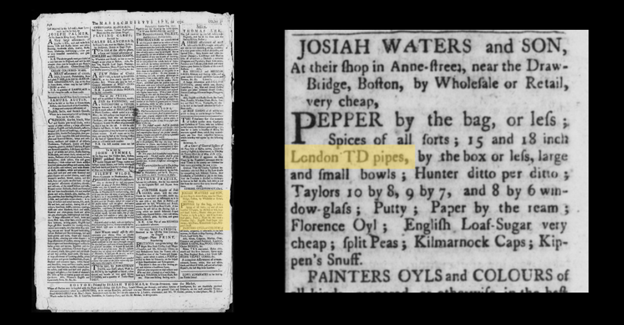
Well, a search on the Library of Congress’s Chronicling America located a 1771 Massachusetts Spy advertisement that specifically lists London TD pipes (LOC). Not only does this solidify that TD pipes were based out of London, it also supports that the popularization of these pipes occurred during the Dormers’ lifetimes. For these pipes to be advertised by name it can be assumed that their popularity had already been established by this point. Whether this popularity had to do with the quality or the quantity of Dormer’s pipes being imported into North America remains unknown. The resulting name recognition may have caused a continued demand for these pipes, leading Tidy & Evans and others to continue producing them.
1771 Massachusetts Spy article (LOC)
These new findings present a solid case for Thomas Dormer being the originator of the TD mark. We can now see that TD pipes were based out of London and popularized during the period when Dormer produced and exported pipes. After 1771 the TD mark stopped representing pipes made by Dormer, and the mark was then used by other makers, perhaps Tidy & Evans, representing tobacco clay pipes themselves rather than a specific maker.
Research such as this illustrates the importance of revisiting past theories. Whether it be trying to answer questions about a mark representing nearly 300 years of tobacco smoking culture, or looking to find interesting insight into the life of the pipe maker that created it, there is more information out there, we just need to keep looking.
So, what do you think? Did I solve the mystery of the man behind the mark?
Danielle Arens
GWF Archaeologist
References
Alexander, L. T. (1978) ‘Clay Tobacco Smoking Pipes from the Caleb Pusey House, The Archaeological Society of Delaware, 9, 35pp.
London Metropolitan Archives; London, England; London Church of England Parish Registers; Reference Number: P69/Gis/A/002/Ms06419/016
London Metropolitan Archives; London, England; London Church of England Parish Registers; Reference Number: P93/JN2/025
London Metropolitan Archives; London, England; London Church of England Parish Registers; Reference Number: P93/JN2/026
London Metropolitan Archives; London, England; London Church of England Parish Registers; Reference Number: P93/JN2/026
London Metropolitan Archive; Reference Number: COL/CHD/FR/02/0778-0-785
National Archives, Kew, Will of Thomas Dormer, Pipe Maker of Saint John Wapping , Middlesex, PROB 11/963/352
Oswald, A. (1975) Clay Pipes for the Archaeologist, British Archaeological Reports, British Series 14, Oxford, 207pp
Walker, I. (1966, June). TD Pipes – A Preliminary Study. Quarterly Bulletin Archeological Society of Virginia, pp. 86-102.
Walker, S. (1981). The Clay Pipe Industry of the Parish of St Olave’s Southwark, in P Davey, The Archaeology of the Clay Tobacco Pipe 6, Pipes and Kilns in the London Region, B97, 173–82
Woollard, P, (2001) Some Clay Tobacco Pipemakers with Fire Insurance Policies in the Sun Assurance Company 1710-1844, The Society for Clay Pipe Research, 62
Because of this, the motifs and marks on tobacco pipes can tell us a lot about the people who used them.
Tobacco pipes can also be valuable tools for dating a site by using pipe bore diameters, typologies, and maker’s marks. This last one helps set the stage for our question of the hour.
Some makers would mark their pipes to indicate a product as theirs. These marks can be found on different parts of a pipe, such as the bowl, heel, or stem. Finding a pipe with a maker’s mark can be very exciting as it allows a pipe to be attributed to a specific pipe maker and, thus, a time period. But that is not always the case. One of the more common maker’s marks in many archaeological sites is the mark “TD.” Remember the two we found during last summer’s dig?
Figure 2: Diagram of a tobacco pipe National Pipe Archive Figure 3: TD pipe bowls in Ferry Farm collection Figure 4: TD pipe bowl from 2023 dig
So, you’re probably thinking, what’s the question again? Just go look up a pipe maker with the initials TD, and you will have your maker. Well, unfortunately, it’s not always that easy.
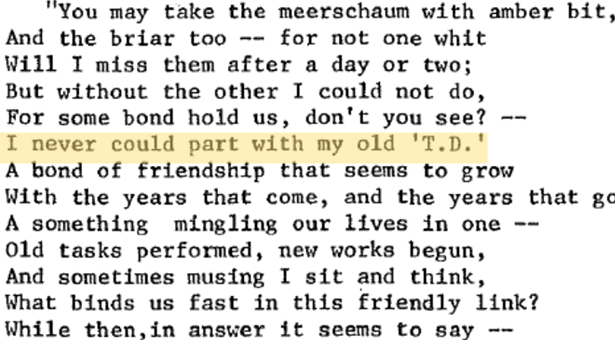
There are multiple pipe makers with those initials, and the pipes with variations of the TD mark have been found at sites with occupation dates suggesting the mark was being produced from the mid-18th century all the way into the 20th century. At some point, the mark stopped representing a single maker and instead became a symbol used on pipes throughout the years, reflecting clay tobacco pipes themselves. Think of it as the Kleenex or Q-tip of its time. TD became synonymous with clay tobacco pipes. This can be seen in written records like a catalog from 1892 that touts their rendition of “the Celebrated “T.D.” pipe” (Zorn). An early 20th-century song referencing “the Old TD” also supports the lasting influence of the mark (Cooper, 1907, as cited by Walker, 1966).
Figure 5: George Zorn & Co.’s “T.D.” pipe advertisement 1892 Figure 6: Early 20th-century smoking song, no known date or author, Cooper 1907 as cited by Walker 1966
Since there is no solid end date to help frame who the possible maker could be, archaeologists and historians have focused on looking at beginning dates to help find the original maker of the TD pipes, settling on a date in the middle of the 18th century. Archaeologists Adrian Oswald and Iain Walker are often cited as laying the foundations of the current TD lore. The combination of their findings identifies 18th-century London-based pipemaker Thomas Dormer as the most likely originator of the TD mark (Walker, 1966). With that said, Walker (1966) states that more information will have to be found to definitively give Dormer credit for originating the mark.
So, that brings us to the start of my research and a revisiting of the foundation of this theory, which was laid out as early as the 1930s. Who is Thomas Dormer, and is he the original TD? Why were TD pipes so popular that they were copied and made for centuries? And can we find new information to crack the case of the elusive TD mark?
The first step of the investigation is reviewing the literature and identifying current thoughts on TD pipes and their maker. One of the earliest deep dives into TD pipe origins can be found in the article “A Theory Regarding TD pipes” in the November 1937 printing of Antiques magazine. In this article, Alfred Hopkins expresses the mystery surrounding the mark and suggests its possible meaning. At the time, Hopkins (1937) and his contemporaries were unable to find potential pipe makers with the initials TD that would indicate the mark was referring to a maker. Instead, he states that it was a trademark of sorts to identify a quality product (Hopkins, 1937). He also mentions that TD may represent the beginning of the Christian hymn Te Deum Laudamus (Hopkins, 1937). Now remember, folks, this was written in the 1930s, and at the time, they didn’t have easy access to information. While more information has since been shared, we now know that there were indeed pipe makers with these initials and look more toward a maker rather than a hymn; Hopkins’ article plays an integral part in our quest by illustrating that there was an interest in the TD mark as early as the 1930s.
Figure 7: 1937 Alfred Hopkins article
Moving away from the 1930s and into the 1960s, Adrian Oswald compiled an index of pipe makers, which Iain Walker (1966) refined to find three possible English pipe makers that could be the originator of the mark: Thomas Dennis, Thomas Darkes, and Thomas Dormer. Walker (1966) continued this search and identified London-based pipemaker Thomas Dormer as the most likely of the three. Nailing down their sources became the next part of the puzzle in an attempt to confirm this information through primary source research and examination of any sources referred to in support of the theory.
This is where the quest to find new information about Thomas Dormer begins. Through this investigation, I was able to identify the “OG TD,” some juicy 18th-century family drama, and the possible first plagiarizers of the TD mark. There are twists, turns, and, unfortunately, too much to tell you in just one blog, so be sure to check out part two, where we get to the bottom of this mystery that began nearly 100 years ago.
Danielle Arens
GWF Archaeologist
References
(2022). Retrieved from George-M-Woodward-mavcor.yale.edu.jpg
The archaeology and curatorial departments for The George Washington Foundation have long worked together to furnish the reproduced Washington house with historically accurate items that resemble as closely as possible the ones that George and his family would have lived with daily. These pieces are not originals, which means visitors touring the house can handle them.
In our latest collaboration we’ve been examining sherds of ceramic vessels owned by the Washington’s to obtain actual eighteenth-century dishes. We want to display these dishes in our gallery to give visitors an idea of what the whole vessels looked like. Four such ceramics have recently been acquired at auctions by the Foundation and you can see them first here along with the excavated remnants they resemble.
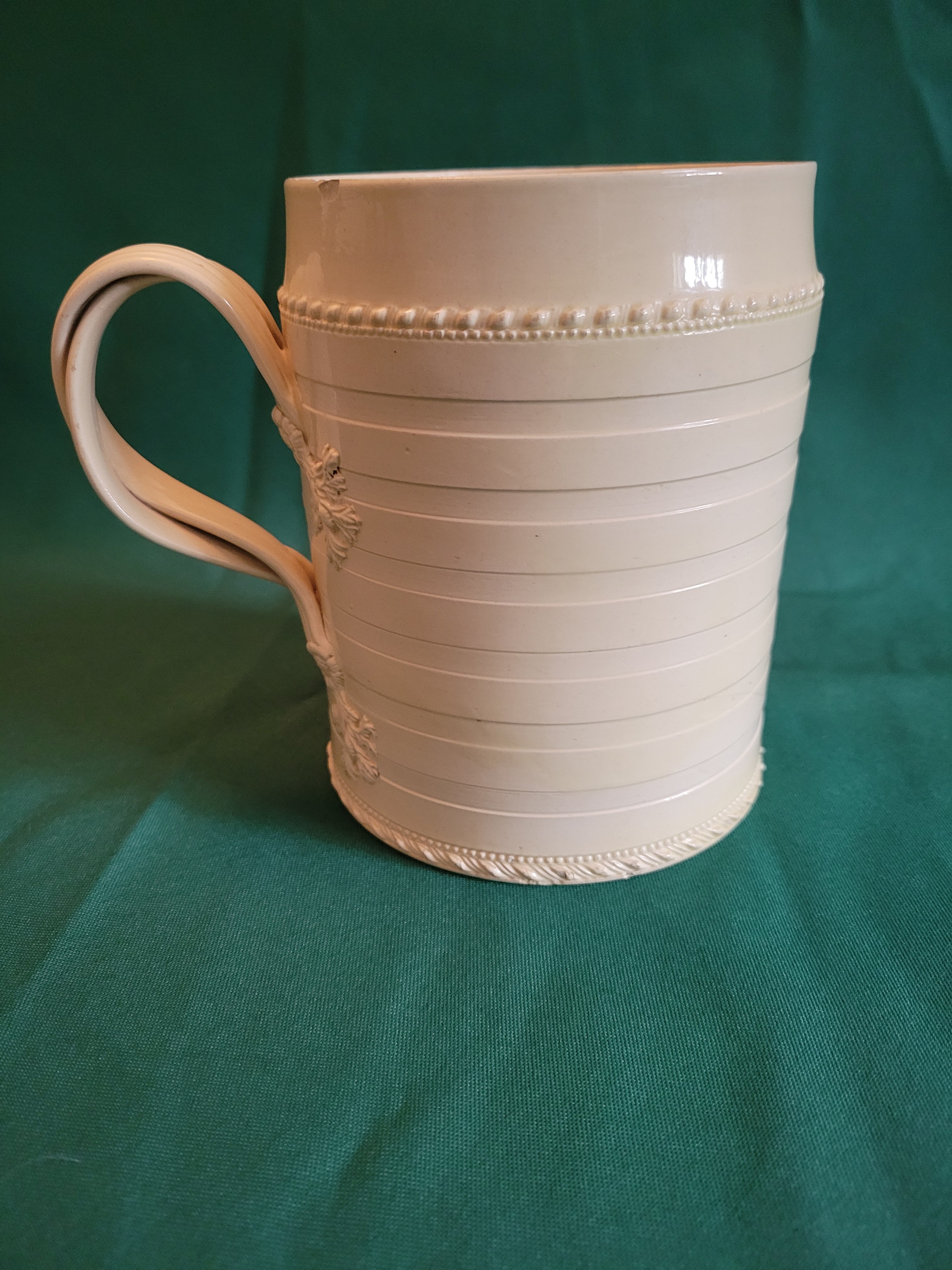
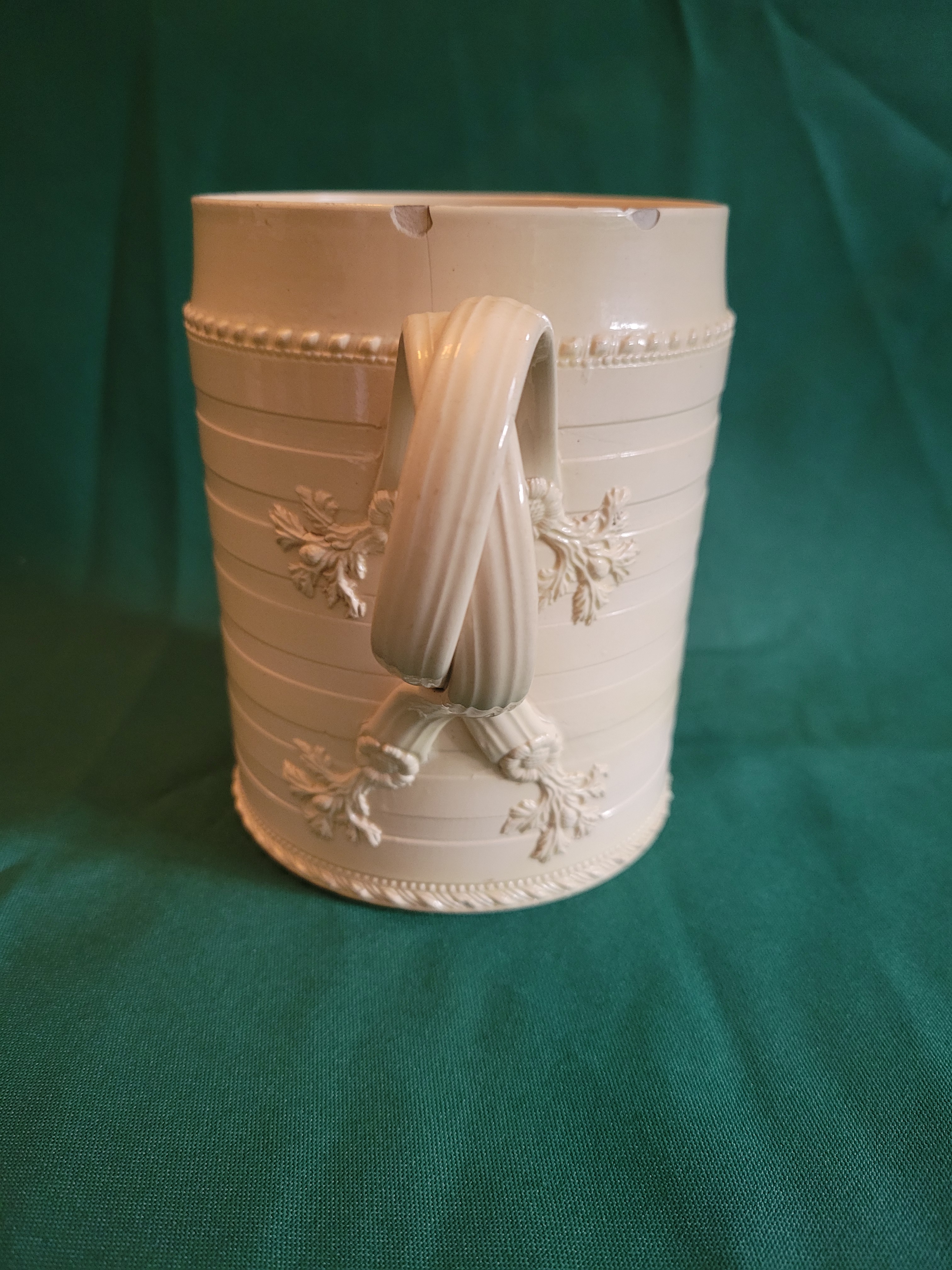
Creamware tankard with strawberry terminals and twisted reeded handles, ca. 1750-1800Creamware tankard with strawberry terminals and twisted reeded handles, ca. 1750-1800Creamware jug with strawberry terminals and twisted reed handles; face below the spout of the jug. ca. 1750-1800 Creamware sauceboat with curved handle which terminate with strawberry flowers. Moulded detail finials
Three of our acquisitions are a type of English ceramic called ‘creamware,’ which was invented in the early 1760’s and was very popular with George’s mother, Mary. Both this lovely pitcher and mug exhibit decorative elements represented by our excavated ceramics. Most prominent are the elegantly curved handles that terminate in delicate strawberry flowers. At least two vessels with these types of handles have been recovered at Ferry Farm. The first is a highly decorative creamware sauce boat and the second a petite teacup, both of which were considered quite fashionable for the time. The jug and teacup also share a common form of decoration called a ‘beaded rim.’
Creamware jug with strawberry terminals and twisted reed handles; face below the spout of the jug, ca. 1750-1800Creamware jug with strawberry terminals and twisted reed handles; face below the spout of the jug. ca. 1750-1800Creamware sherd with “beaded rim”Creamware teacup sherd with “beaded rim”
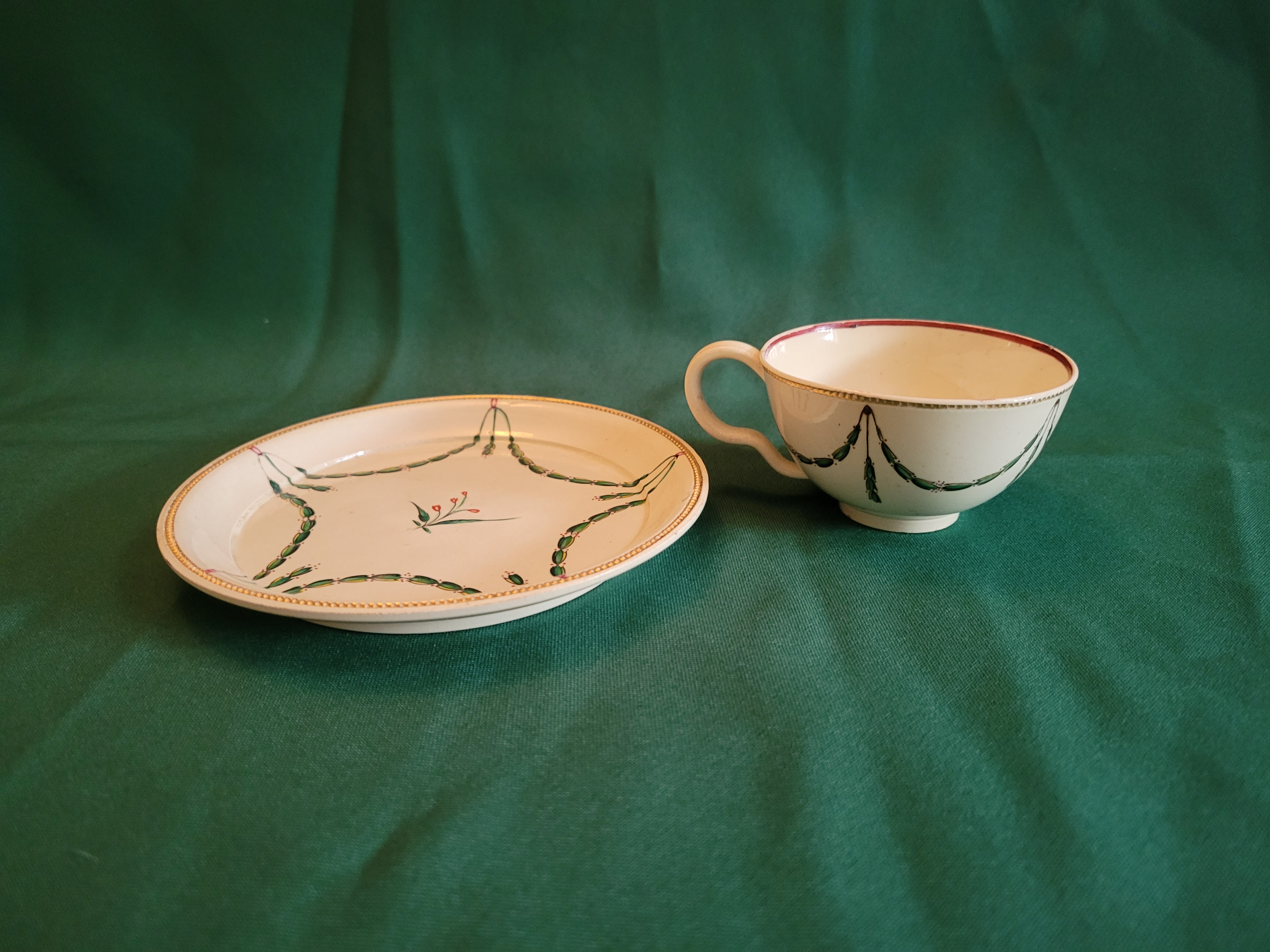
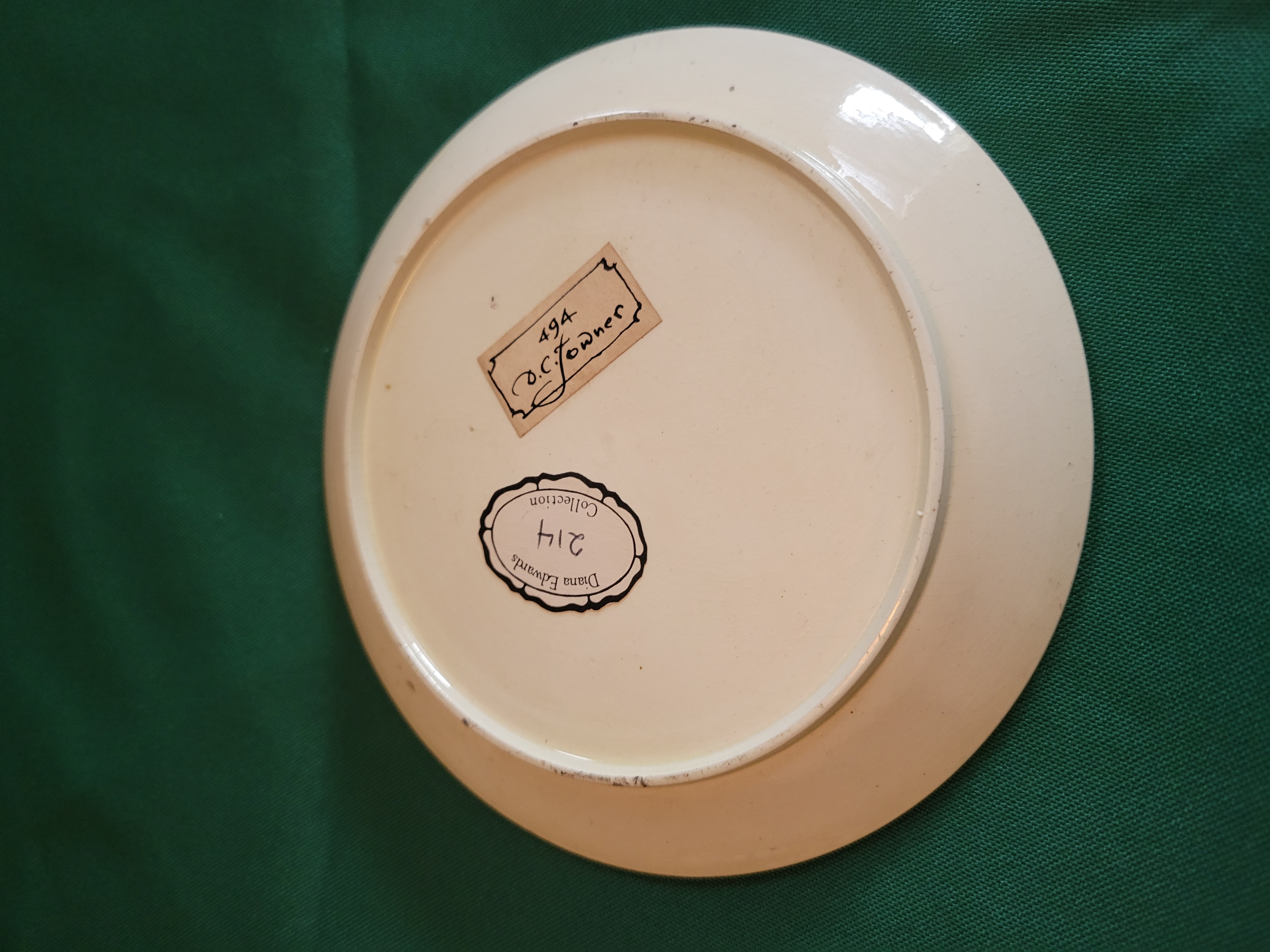
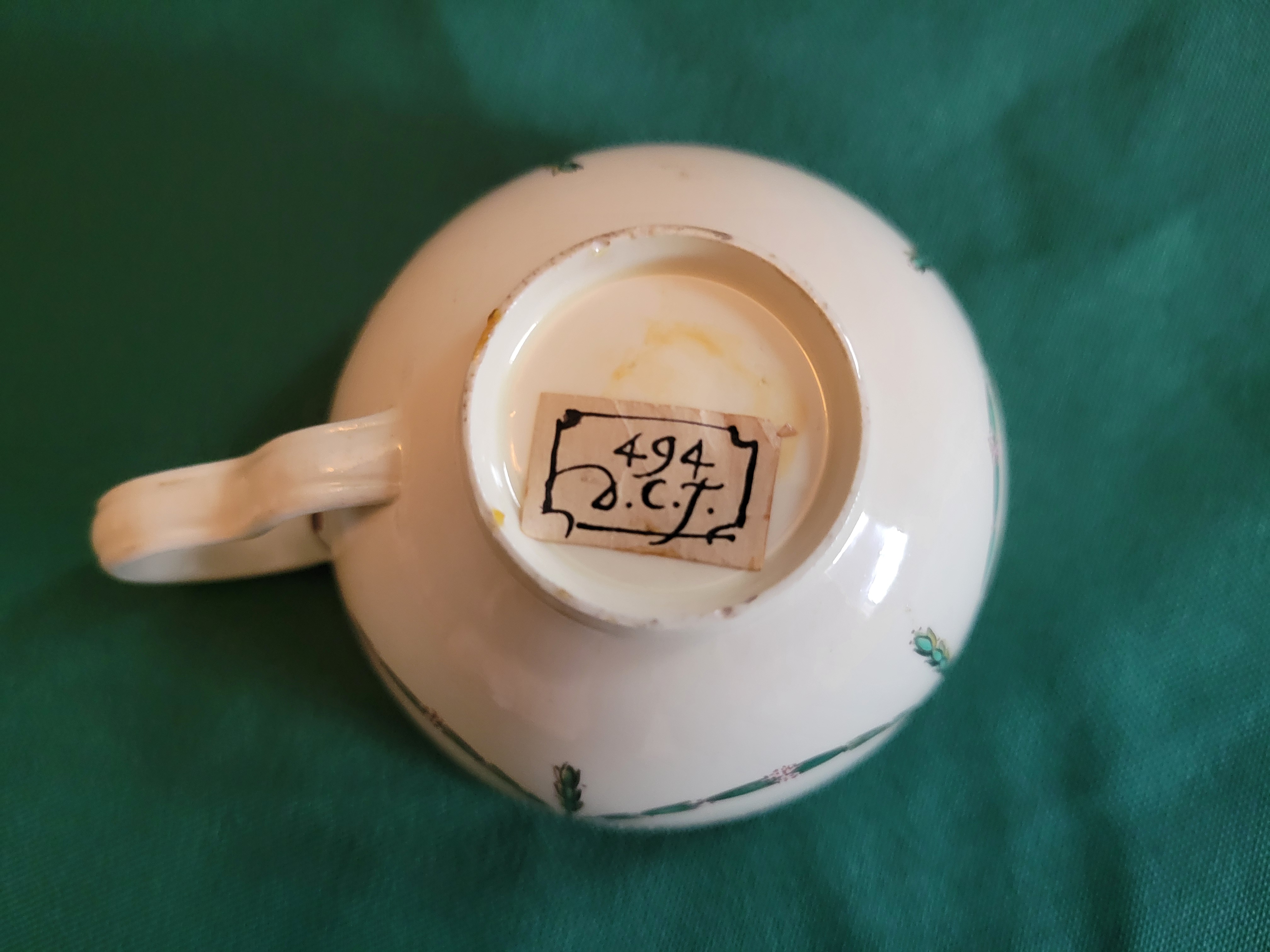
Another teacup owned by Mary was this beautiful piece hand-painted with a detailed swag motif. But from the sherds it’s difficult to really appreciate how graceful this decoration is. Luckily, our curators hunted down a similar cup and saucer with the same decoration, which is unusual. The saucer also features a beaded rim that has been filled in with gold gilding, although we believe the gold to be a later addition to the piece. The cup and saucer also have handwritten tags affixed to the bases which indicate they had the distinction of having been in the collection of a well-known (at least to ceramics geeks like yours truly) collector of creamware. This man by the name of Donald Towner had written extensively on the topic of English ceramics and over his career had amassed a large study collection, of which this was one. His book on the Leeds Pottery in England features a catalogue from the pottery that includes many of the decorative elements and shapes discussed above (Towner, 1965).
English Creamware Cup and Saucer, ca. 1775-1780English Creamware Saucer, ca. 1775-1780. Formerly in Donald Tower Collection, 1968, A Belton, 1988 and Diana Edwards MurnaghanTeacup from Donald Towner Collection, 1968.Teacup sherd with swag motif
But my favorite is this delightfully potbellied creamer with three legs featuring lion’s heads and paws for feet. The ceramic type in question is called Whieldon and started to come on the market in England around 1749. Of note is the raised molded leaf decoration which resembles one sherd from our collection. While we may never know the exact type of vessel our leaf came from, the complete creamer gives one a better idea of how the decoration was placed and looked. Mary’s choice of ceramics played a large part in emphasizing her and her children’s place among the Virginia Gentry and we’re very pleased to have some whole examples now to help illustrate to visitors just how lovely some of these dishes were!
Whieldon ware sherd, ca. 1740-1770Staffordshire Mottled Creamware Milk Jug, c. 1755-1765Staffordshire Mottled Creamware Milk Jug, c. 1755-1765
Mara Kaktins, Archaeologist & Lab Manager
Bibliography
Towner, Donald. The Leeds Pottery, 1965. Taplinger Publishing Co., Inc., New York.
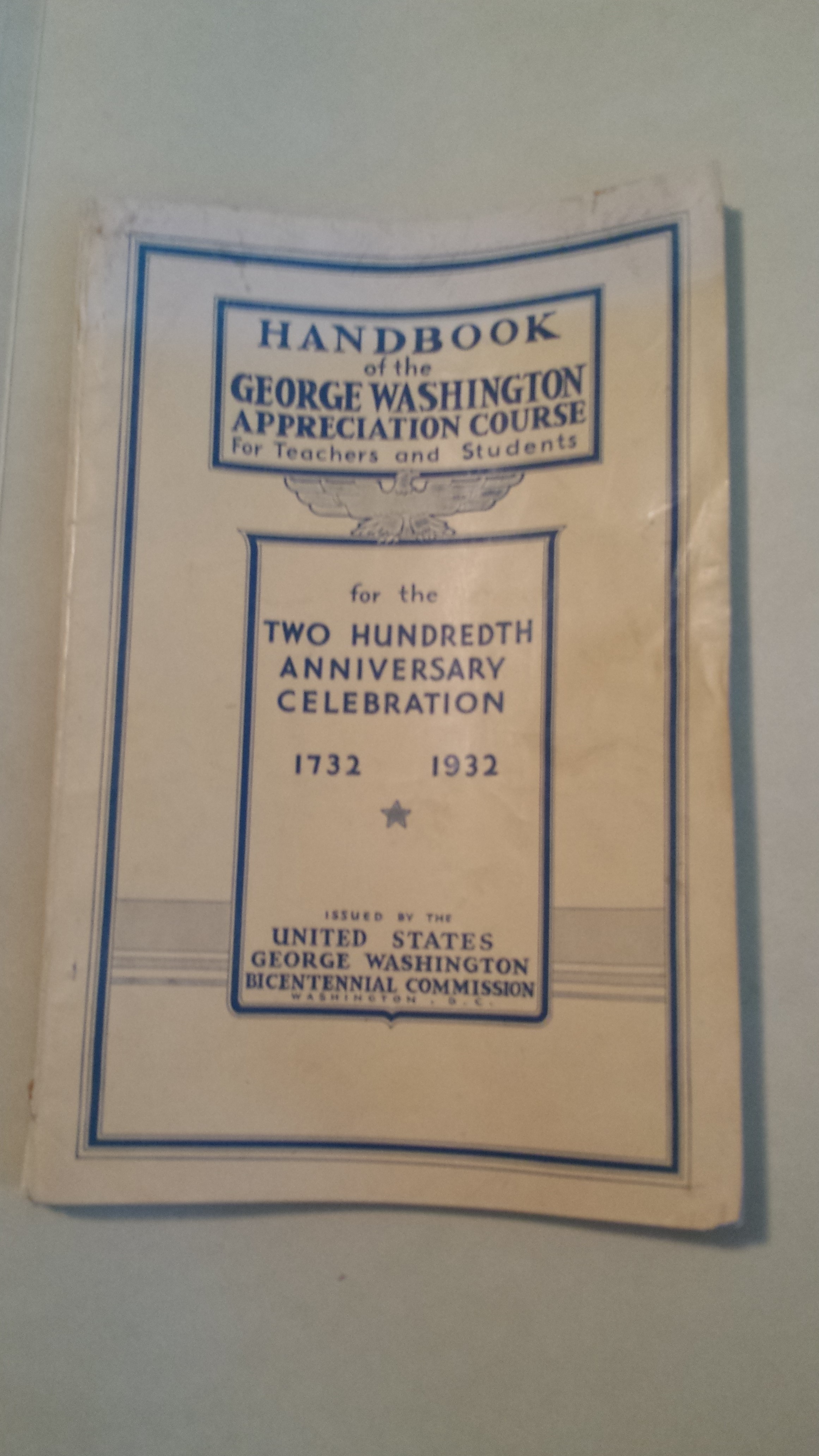
Not every president gets their birthday celebrated every year with a federal holiday, but George Washington, a favorite of his countrymen and the first president, has had that privilege since 1879. But one year was a little different from the others: 1932. It marked Washington’s 200th birthday, and the United States was going to make a big deal about it.
In honor of the upcoming birthday, we decided to look at some of the memorabilia in our collection created to celebrate and educate the American public.
George Washington Bicentennial Commission
The planning for this celebration started early when Calvin Coolidge signed a joint resolution that established a commission to oversee the bicentennial ceremonies on Dec 2, 1924. The resolution was to mark the occasion of the birthday across the country and increase the understanding of Washington. (George Washington Bicentennial Commission, 1932) Under the direction of Representative Sol Bloom, an experienced entertainment promoter who got his start at the 1893 World’s Colombian Exposition, the committee initiated thousands of events, released educational resources for students, and had plays written in honor of Washington. (Larson, 2004)
Handbook of the George Washington Appreciation Course for Teachers and Students“Washington Takes the Risk”, including George Washington, Fielding Lewis, and Betty Washington Lewis
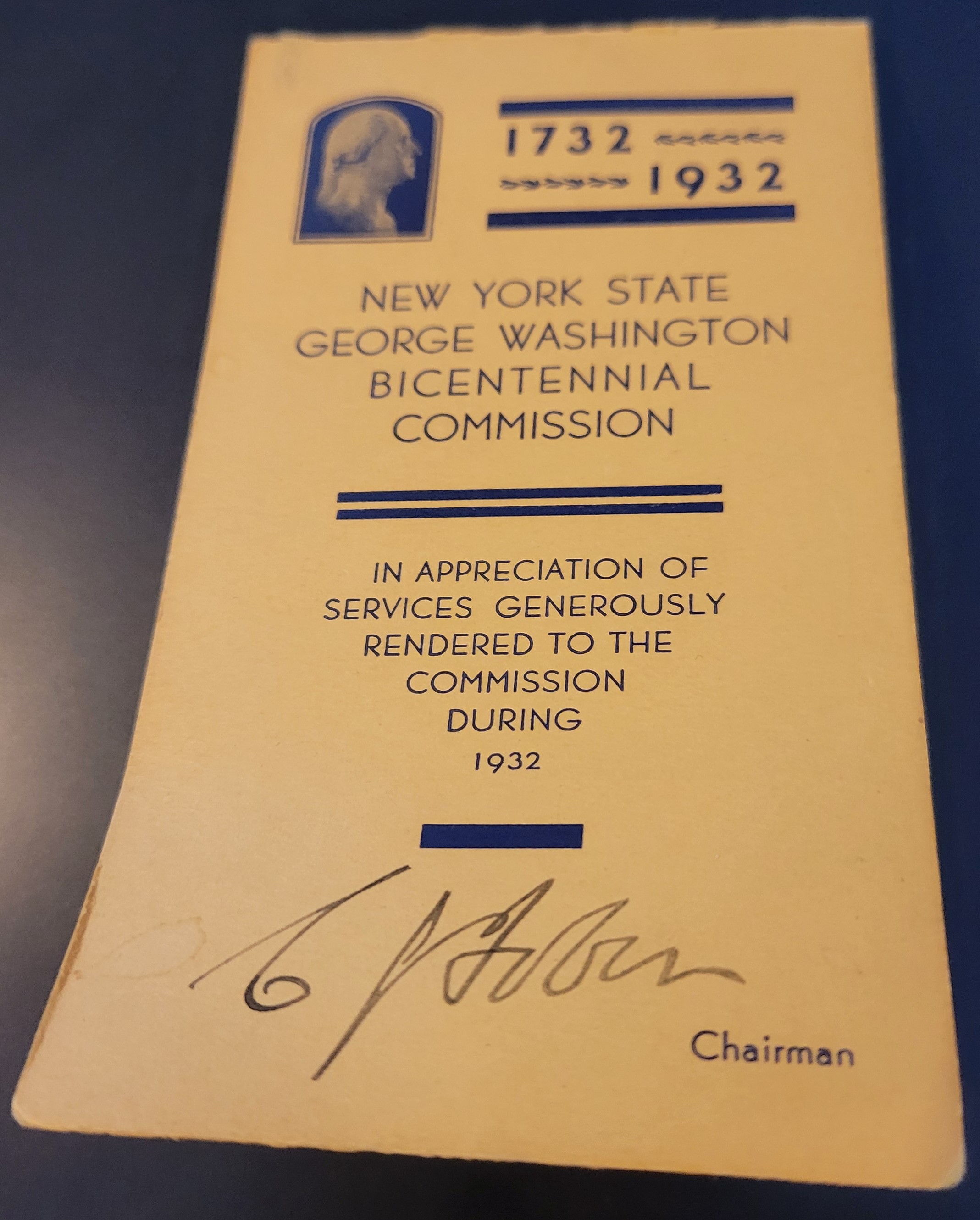
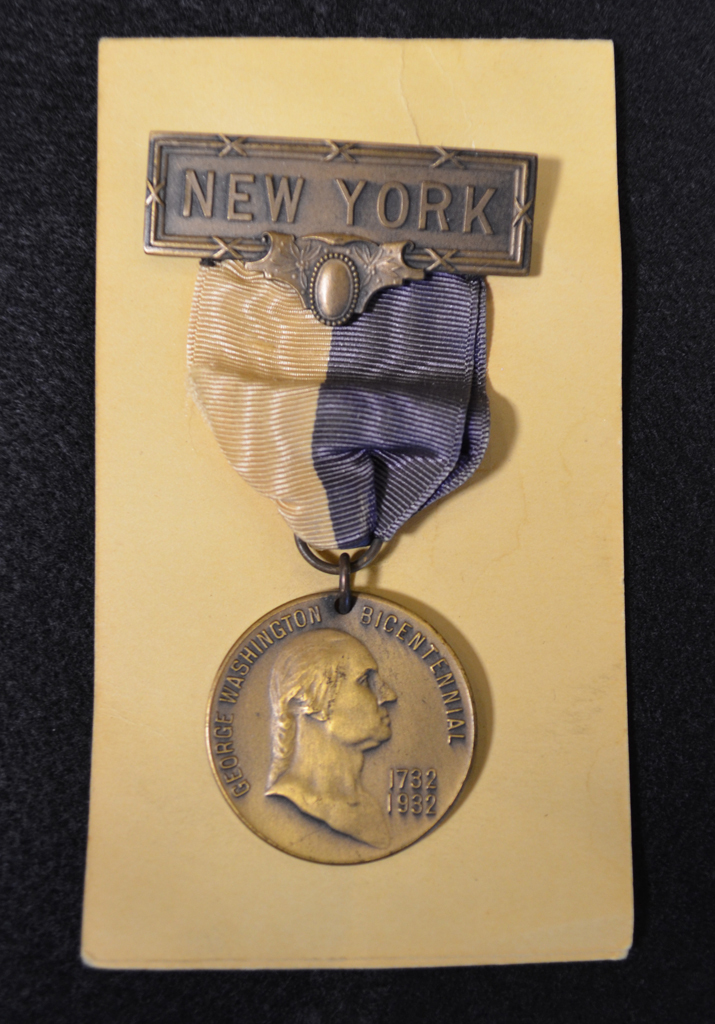
The commission additionally worked with over 250,000 local commissions to organize special events at not only a federal level but a state and city too. (The Washington Post, 1932) Special volunteers and prominent local people were often given commemorative metals as thanks for their service. We have one from the state of New York. It is a circular bronze medal attached to a blue and white ribbon. The back of the medal states, “1779 / Planned Sullivan / Clinton Campaign 1782 / Newburgh Temple Hill / Refused a crown / 1789 April 30th / New York City / Inaugurated first / President of the / United States.”
The medal is encased in a paper envelope with “New York State / George Washington Bicentennial Commission / In appreciation of / Services generously / Rendered to the / Commission / During / 1932” written on the front along with the signature Charles Tobin, chairman representing New York state on the Bicentennial Commission.
New York State George Washington Bicentennial Commission, 1932New York State George Washington Bicentennial Commission Medal, 1932New York State George Washington Bicentennial Commission Medal, 1932
Historical Context Help: The Sullivan-Clinton campaign was ordered by George Washington in response to the 1778 attacks by the Iroquois and British in central New York. Newburgh Temple Hill was a Continental Army encampment near Washington’s headquarters, where he gave a speech to quell the mass of soldiers who were getting ready to mutiny and attack Congress to get their promised back pay and pensions. Finally, in 1789, George was sworn in as President at Federal Hall in New York City.
The U.S. Post Office became involved in the commemoration of George with the release of a dozen stamps celebrating his life. The stamps were incredibly popular, and when they were first released for sale in D.C., there was a crowd of 50,000 people waiting to get their set of stamps. (The Washington Post, 1932)
Commemoration celebrating George Washington’s visit to Kenmore on April 8, 1791, as part of the birthday celebrations. Note the stamps. Commemoration of George Washington’s birth at Wakefield. Note the stamps.
Marketing George
Private companies even got in on Washington-mania by releasing all types of souvenirs like postcards, pins, coins, bottles, calendars, cigar box covers, books and pamphlets, hat stands, billheads, stationary, cartes-de-visite, playing cards, and puzzles. (Subseries 5.8. Washington’s Birthday, Bicentennial Souvenirs, 1931-1932 , 2024)
We have two bottles created for the Bicentennial celebration. The green water bottle has a likeness of George with “Washington/Bicentennial” underneath the image and 1732 and 1932 written on the sides. The water bottle was produced by the Hemingway Glass Company in Muncie, Indiana.
The clear pear-shaped bottle is embossed on one side with a cherry tree and the dates “1732 and 1932”. On the other, with a profile of Washington. It was created by the Owens-Illinois Glass Co. of Huntington, West Virginia.
Bicentennial bottle with George Washington profile. Owens-Illinois Glass Co., 1932. Bicentennial bottle with cherry tree. Owens-Illinois Glass Co., 1932
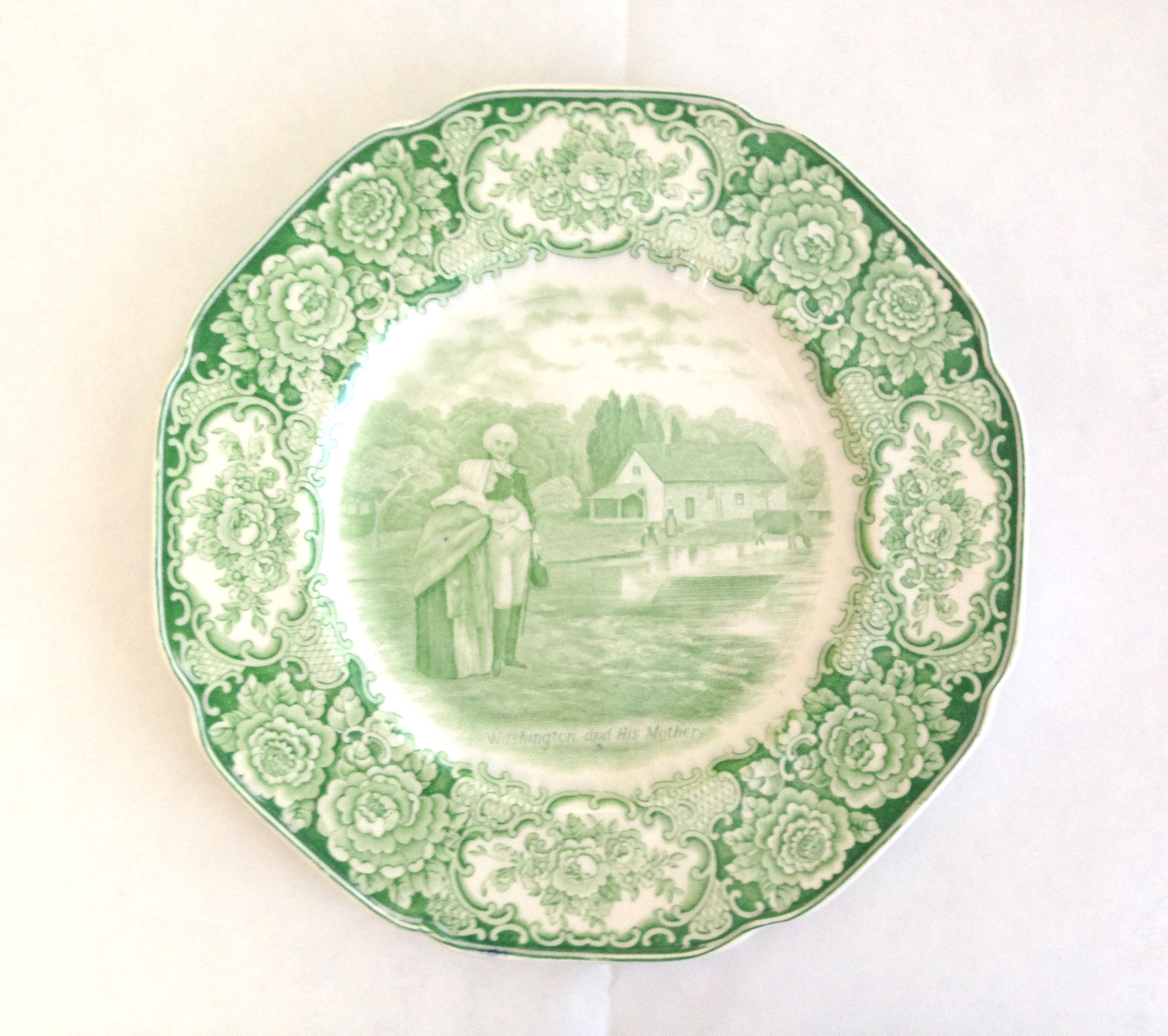
Plates were another big commemorative item. We have three plates issued by Crown Ducal, with the same scene of “Washington and his Mother” based on the print of the same name. On the back with the Crown Ducal crest, it says, “George Washington Bicentenary Memorial Plates / 1732-1932 / First in War / First in Peace / First in the hearts of his countrymen”. Crown Ducal released a series of twelve plates documenting Washington’s life. Of course, we are a little biased and like the one with his mother, Mary Ball Washington, the best.
Some companies even brought in Mrs. Martha Washington, like this set of plates from the Capital Souvenir Company. These are two round commemorative plates depicting George and Martha Washington, both with an elaborate floral gilded border.
George and Martha plate set, Capital Souvenir Company, 1932. George and Martha plate set, Capital Souvenir Company, 1932.
Fun Bicentennial Fact: On the eve of the birthday, Sears Roebuck was awarded a commission by the U.S. government to create a full-scale replica of Mount Vernon at the Exposition Coloniale Internationale in Paris. The agreed-upon price was around $75,000, and every detail of the home was reproduced from brass hardware, mantelpieces, and even cabinets. After the exposition, the house was bought by an American doctor working in Paris, and it was relocated to Vaucresson (a western suburb of Paris). It still stands today as a private residence and was even on the market in 2012 for 27 million dollars.
George Washington’s Mount Vernon in Paris, France,1932George’s Mount Vernon in Vaucresson, France today
Sears Roebuck also built the exact replica in Prospect Park, Brooklyn, NYC for the Bicentennial Commission. However, the house was not taken care of and boarded up and abandoned until it was eventually torn down. (The Brooklyn Daily Eagle, 1933)
Sears’ role in the reconstruction of Mount Vernon led to interest in their kit homes. In 1932, they offered a house in their catalog, loosely based on Mount Vernon. This model was oddly called “The Jefferson”.
Sears Roebuck house kit “The Jefferson” which strangely resembles Mount Vernon.
While we may not have as many George souvenirs, we are still putting on a big birthday party to celebrate George Washington and his time at Ferry Farm.
The party is on Monday, February 19th from 10am – 3 pm. While enjoying the grounds of Ferry Farm, you can take a selfie with “George Washington,” participate in our annual stone-throwing contest, play colonial games, and eat birthday cupcakes (while supplies last).
Additionally, guests can enjoy several educational stations, take an abbreviated Washington House tour, and talk with archaeologists, historians, and other experts to learn about Ferry Farm and the Washington Family.
Heather Baldus
Collections Manager
References
George Washington Bicentennial Commission. (1932). History of the George Washington Bicentennial Celebration. Washington D.C.
Larson, E. (2004). The Devil in the White City: Murder, Magic, and Madness at the Fair That Changed America. New York City: Knopf Doubleday Publishing Group.
One of my favorite historical objects in the collection are photographs. Not particularly for artistic reasons, but as a documentation of a moment, a time, a person, a world that no longer exists. During the Victorian era (1837-1901), there were extraordinary developments in the field of photography. In a span of forty years, photographs went from complicated metal plates, harsh chemicals, and long exposure times to inexpensive images on cardboard that could be taken, processed, and given to the sitter in minutes.
We have many pictures in our collection, and we can trace the development of photography through images of Lewis family descendants.
A Pleasant View of Burgundy
The widely accepted creator of photography as we know it was French inventor Joseph Nicéphore Niépce. He produced the first surviving photograph around 1826 showing the scene from his window in Burgundy. After Niepce’s death, his former associate, Louis-Jacques-Mandé Daguerre, continued improving Niepce’s photographic process, introducing the “daguerreotype” in 1839. (The University of Texas Austin, 2024) To create an early daguerreotype, a polished silver-plated copper sheet was treated with iodine vapor to make it light-sensitive. After exposure, the plate would be developed with mercury vapor and fixed with sodium chloride. This was a tedious and complex process that required the subject to remain entirely still for three to fifteen minutes. (Stewart, 2018) (The Library of Congress, 2024) (Department of Photographs, 2004) The process was amended and, by the 1850s, used large glass-plate negatives, allowing for a crisper picture and a much shorter exposure time. (Department of Photographs, 2004)
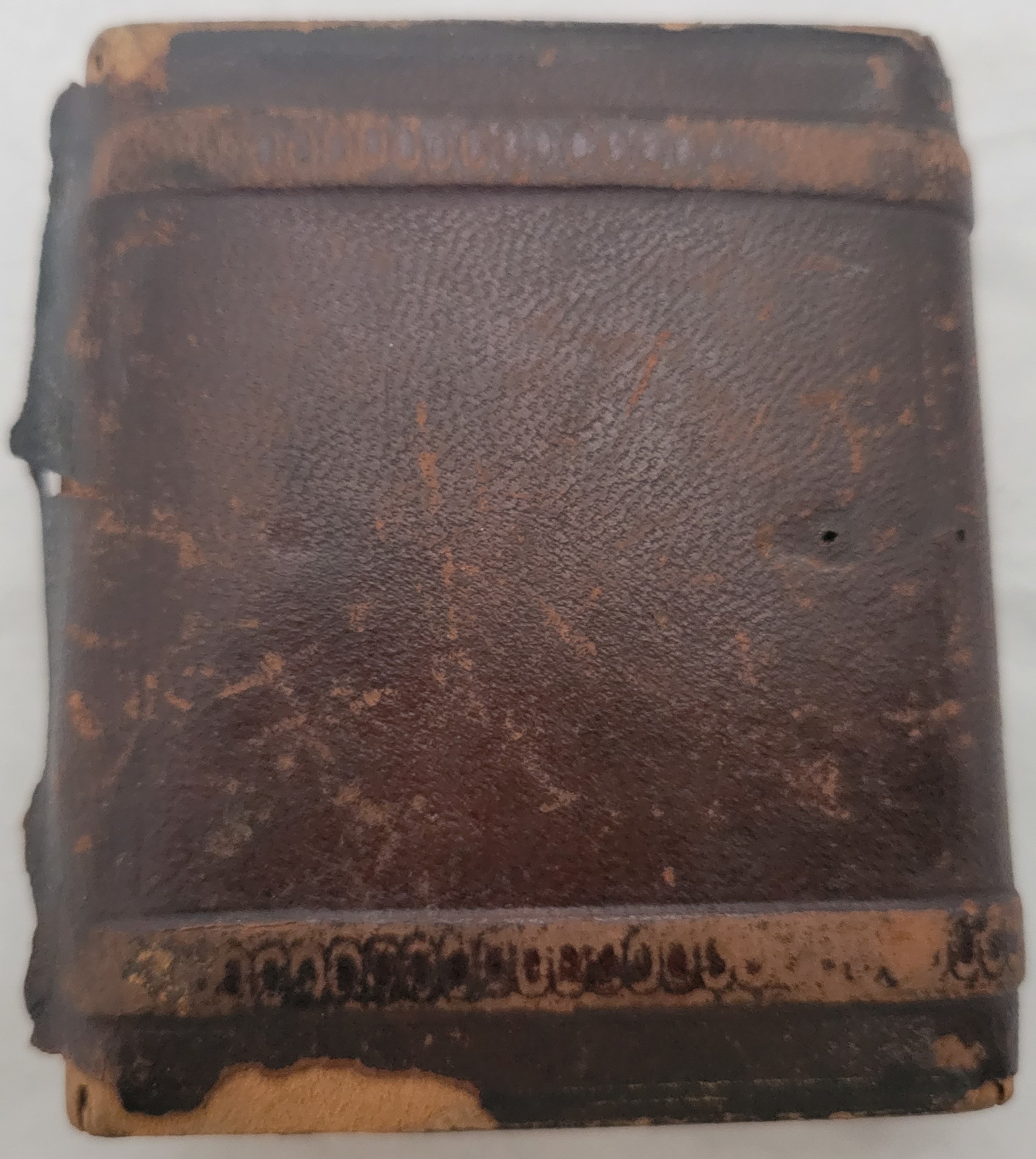
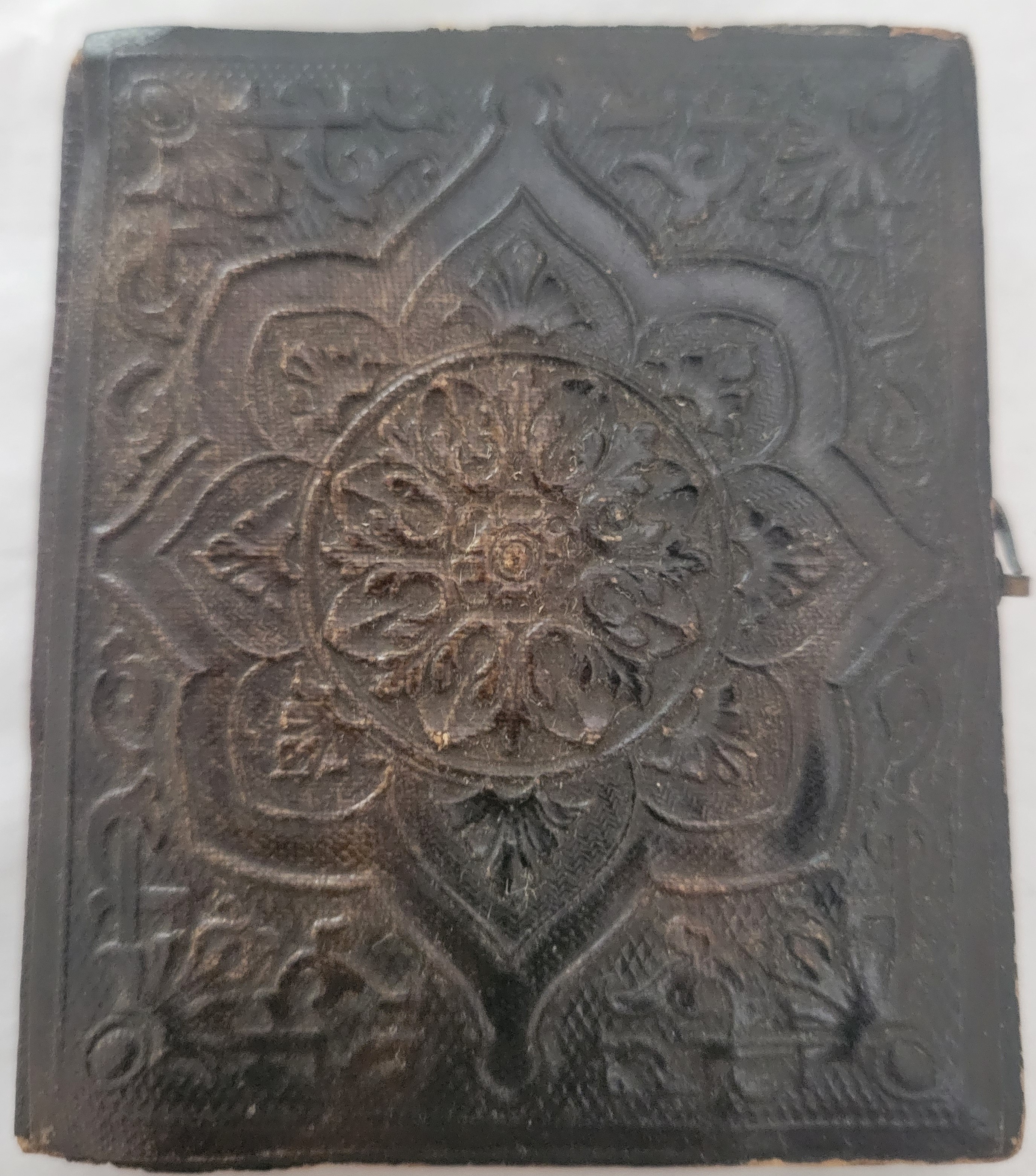
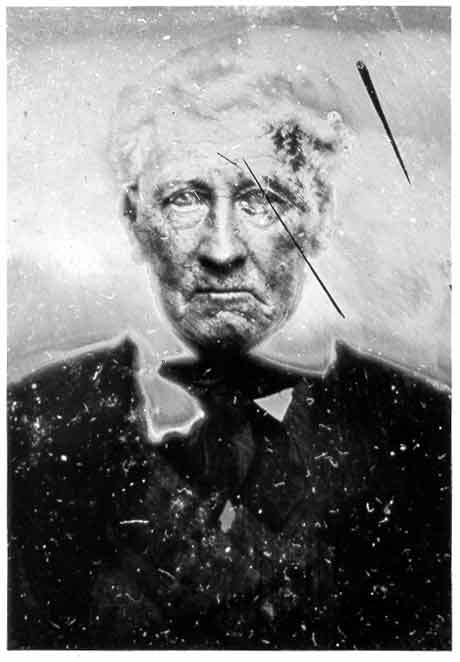
We have three daguerreotypes in the collection dating circa 1850s. They are all portraits housed in elaborate leather cases with gilt-metal frames. The larger photograph is called a sixth-plate daguerreotype portrait of John Taliaferro Lewis (1785-1862), who was the grandson of Charles Lewis, Fielding Lewis’s brother. John was a Methodist minister and lived at “Stepney” near Manassas. Through his wife, Francis Tasker Ball, he became the owner of “Portici,” also near Manassas. The two smaller ninth-plate daguerreotypes are both portraits of Ellen Lewis Nye (1834-1886), the granddaughter of Howell Lewis, the ninth son of Fielding and Betty. She married Anselm Tupper Nye, and they resided in Ohio, where they were both buried.
Daguerreotype of John Taliaferro Lewis, 1840-1862Specular light image of daguerreotype of John Taliaferro Lewis, c. 1840-1862Back of daguerreotype of John Taliaferro Lewis, c. 1840-1862 Normal light image of daguerreotype of Ellen Lewis Nye, c.1859Specular light image of daguerreotype of Ellen Lewis Nye in velvet lined case, c. 1859Leather case for daguerreotype of Ellen Lewis Nye, c.1859Daguerreotype of Ellen Lewis Nye, 1855-1860Specular light image of daguerreotype of Ellen Lewis Nye in velvet lined case, 1855-1860Leather case of daguerreotype of Ellen Lewis Nye, 1855-1860
Images for Loved Ones
The daguerreotype was soon replaced in popularity by the ambrotype and tintype, which were both cheaper and easier to develop. (Harding, 2013).
An ambrotype is comprised of an underexposed glass negative placed against a dark background. The dark backing material creates a positive image. They were sold in either cases or ornate frames to provide an attractive product and to protect the negative with a cover glass and brass mat. (Library of Congress, 2024)
We have three ambrotypes in the collection: a landscape and two portraits. The landscape dates to circa 1855 and shows a group of people gathered around Washington’s tomb at Mount Vernon. Two of the figures were Thomas Coatsworth (1821-1887) and his wife Electra Weller Coatsworth (1832-1869). It is housed in an embossed leather case.
Ambrotype of a group of individuals outside George Washington’s Tomb, c. 1855-1865Leather case housing ambrotype of a group of individuals outside George Washington’s Tomb, c.1855-1865
One portrait is of John Taliaferro Lewis and is almost identical to his daguerreotype. The other portrait is of Daingerfield Lewis (1785-1862). It dates from the same time and is held in a leather case. Daingerfield Lewis was the son of Captain George Lewis, the fourth son of Fielding and Betty, who served in the Continental Army under his uncle George Washington.
Ambrotype of John Taliaferro Lewis, 1854-1865Ambrotype of John Taliaferro Lewis without dark background, c. 1854-1865Back of ambrotype of John Taliaferro Lewis showing loss of dark background, c. 1854-1865Ambrotype of Daingerfield Lewis, c. 1855Ambrotype of Daingerfield Lewis in case, c. 1855Leather case housing ambrotype of Daingerfield Lewis
Tintypes became especially popular because the photographer could take a picture and develop it within just a few minutes. It was called the new “instant photo.” This “instant photo” could be found at fairs, carnivals, and on the boardwalk, not just professional studios. Due to the tintype price, weight, and unbreakable nature, they became extremely popular during the Civil War because soldiers were able to mail them back to loved ones. (Stewart, 2018)
The three tintypes in the collection are a group of siblings, two brothers, and one sister (there were eight total siblings). George Lewis (1832-1883), Fielding Lewis (1839 – 1863) and Betty Fitzhugh Lewis (1847-1920). Their father was Howell Lewis Jr. (1808-1883), the son of Howell Lewis and grandson of Fielding and Betty. Howell Lewis Jr. was one of the earliest settlers of Henry County, Missouri, and established Lewis Station (now called Lewis, Missouri). There is not much information on the siblings besides the basics. George Lewis, the eldest, was born in West Virginia, died in Nevada, and is buried at the Lewis Station Cemetery. Fielding Lewis was born in Missouri and died young during his service with the Confederate army in Texas. Betty Fitzhugh Lewis was born in Missouri as well; he married Milton D Finks, had at least three children, and is buried in Calhoun cemetery.
Tintype of George Lewis, c. 1865Tintype of Fielding Lewis, c. 1860Tintype of Betty Fitzhugh Lewis, c.1870
Paper, Cardboard, and Formality
By the later part of the nineteenth century, paper photos mounted on cardboard became more popular. Carte-de-visite became quite a fad after carte portraits of Queen Victoria with her husband and children were published. (Harding, 2013). Part of why they became popular is they were cheaper to produce because multiple images (eight) could be taken with the same photographic plate, cut into small portraits, and mounted to heavy cardboard. (The Editors of Encyclopedia Britannica, 1998)
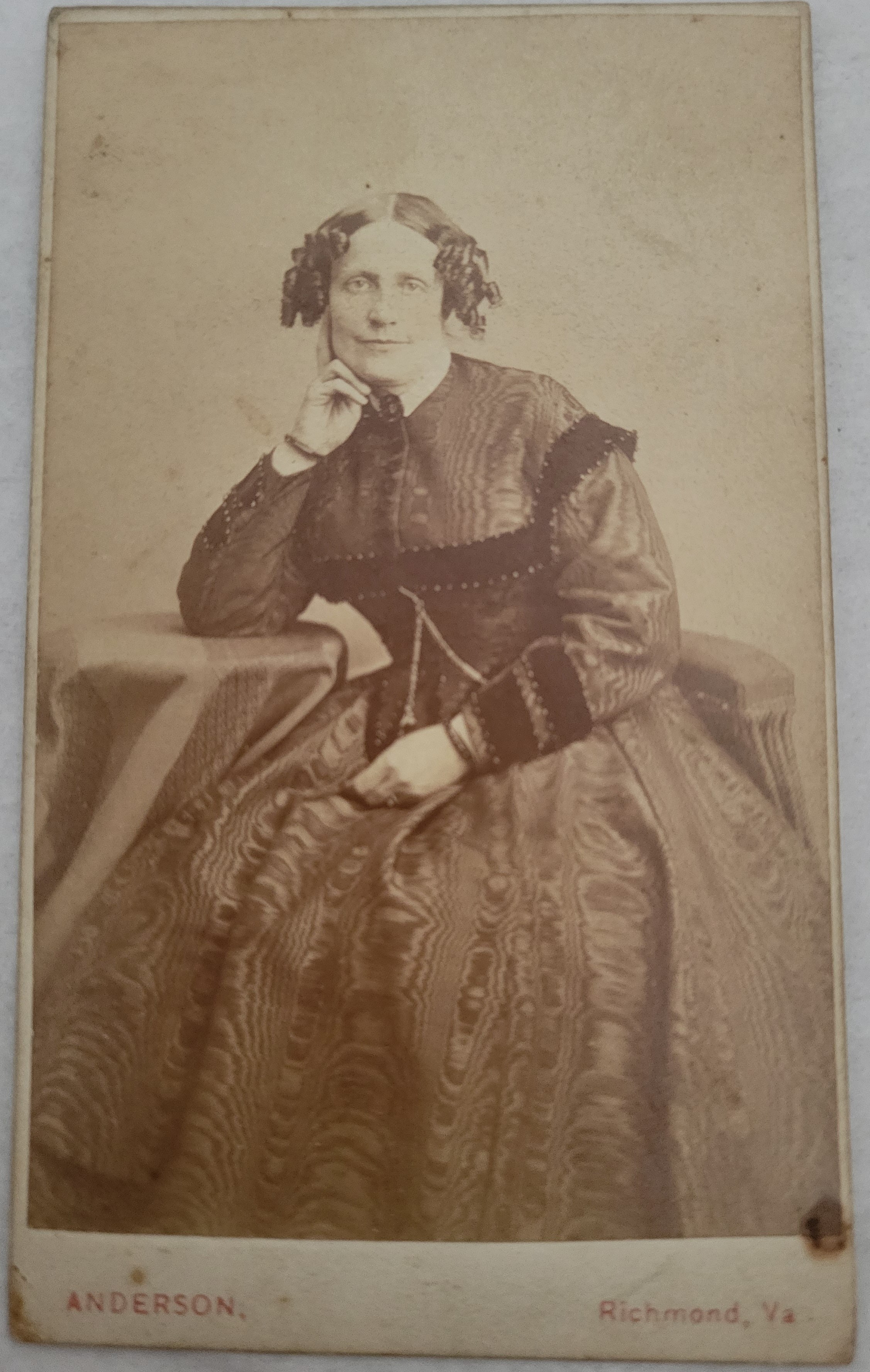
Two of our carte-de-visites are portraits of two young ladies around 1860. One is Ellen Lewis Nye, who previously appeared in daguerreotype around the same time. The second is Mary Ellen Lewis Hogan (1834-1874), who was the daughter of Howell Lewis, Jr. and sister to George, Fielding, and Betty Lewis. She was born in West Virginia, married Robert Henderson Hogan, and is buried in Illinois.
Carte-de-visite of Ellen Lewis Nye, c.1859Back of carte-de-visite of Ellen Lewis NyeCarte-de-visite of Mary Ellen Lewis Hogan, c. 1865
The carte-de-visite was gradually superseded by the cabinet card, which remained popular until the introduction of the Kodak Box Brownie camera in 1900. (City Gallery, 2005) The cabinet card marked a transition from more formal portraiture to amusing, personal, and even candid images. They were taken in studios that were equipped with lights, props, and sometimes even hair and makeup. The average price was around $1.50 for a dozen cards, which is around $45 today. (Salvesen, 2021)
Our cabinet cards date from 1850 to 1897 and are portraits of three females who, like all the others, are descendants of the Lewis family. The oldest is of Francis Fielding Lewis Gwathmey (1808-1888), and it was taken around 1850, putting her in her early forties. Her father was Howell Lewis, son of Fielding and Betty and sister to Howell Lewis Jr. Francis married Rev. John “Parson” Blair and had twelve children, of which only three outlived her. She is buried in Richmond, Virginia.
Cabinet card of Frances Lewis Gwathmey. c.1850Back of cabinet card of Frances Lewis Gwathmey
We have another picture of Ellen Lewis Nye, who has previously been represented in daguerreotype and carte-de-visite. The card was taken in 1885, shortly before her death. The last one is Virginia Tayloe Lewis (1842-1916), taken during the Christmas season of 1897. She was born in Washington, D.C., at The Octagon House. She was the daughter of Captain Henry Howell Lewis and great-granddaughter to Fielding and Betty.
Cabinet Card of Ellen Lewis Nye, c. 1885Back of cabinet Card of Ellen Lewis Nye, c.1885Cabinet Card of Virginia Tayloe Lewis, Christmas 1897Back of cabinet card of Virginia Tayloe Lewis, Christmas 1897
Money and the Magic Lantern
This is a brief history of photography seen through the descendants of the Lewis family. But make no mistake, these are not the only important pictures in our collection. There are still trays of glass slides that belong to a curious device called the “lanterna magica,” which became an invaluable tool that, along with gingerbread, helped restore Kenmore.
Magic lantern glass slide of Kenmore before the restoration
Department of Photographs. (2004, October). The Daguerreian Era and Early American Photography on Paper, 1839–60. Retrieved from The Metropolitan Museum of Art: https://www.metmuseum.org/toah/hd/adag/hd_adag.htm
Stewart, J. (2018, December 31). Tintype Photography: The Vintage Photo Technique That’s Making a Comeback. Retrieved from My Modern Met: https://mymodernmet.com/tintype-photography/
The George Washington Foundation believes the Washington and Lewis families’ story is worth protecting for future generations. We are in contact with many descendants of the Washingtons and Lewises who have assisted the foundation in presenting the families’ legacies by adding to our collections and archives. We decided to explore the ancestors and descendants interesting tales and life accounts, using the artifacts and documents in our collections as a starting point.
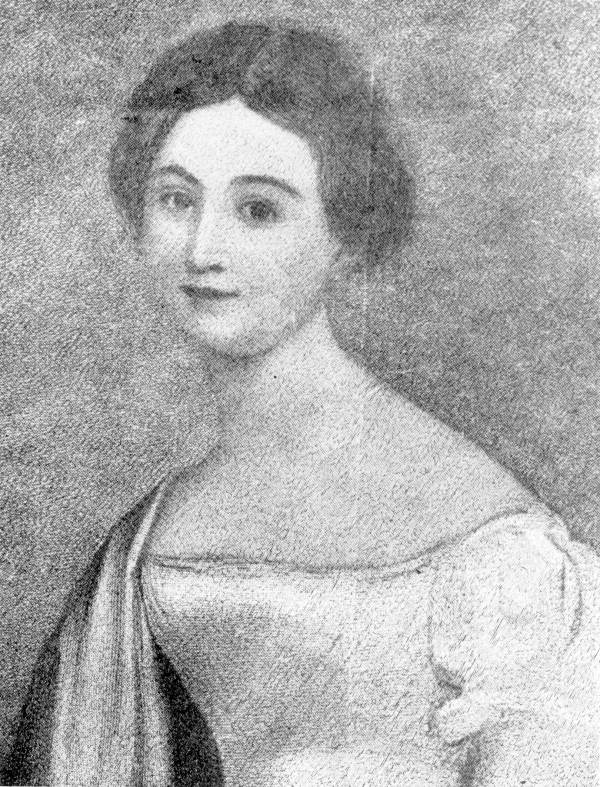
The first person in our spotlight is Catherine Dangerfield Willis, who was born in Virginia, lived on the Florida frontier, became a historic preservationist, and became a Princess of the Second Empire because of her Washington relation.
Virginia Native and Washington Descendant
Catherine Daingerfield Willis was born in Fredericksburg in 1803. She was the daughter of Colonel Byrd Charles Willis and his wife Mary (née Lewis) Willis. From her maternal family side, Catherine was the great-granddaughter of Fielding and Betty Lewis and the great-grandniece of George Washington. (Glenn, 2014)
Catherine married Atcheson Gray at an early age, around 13 to 17 years old; accounts vary. The newlywed couple resided at their father-in-law’s house, Wakefield (yes, George’s birthplace). (Unknown, 2004) Sadly, their marriage was cut short when Atcheson died of malaria less than a year after their union, along with their first child. (Bellet, 1976)
Catherine Daingerfield Willis Gray Murat, watercolor generously donated to GWF by Mrs. Lucy Robb Winston Works and family.
The Florida Frontier
After being widowed, Catherine and her family moved south to Tallahassee, the recently christened capital of the Florida Territory (Florida didn’t become a state until 1845) (Gannon, 2003). It had previously been an important Apalachee settlement which had been abandoned after it was burned to the ground by Andrew Jackson in 1818 during the first part of the Seminole Wars. (Smith, 2023) When Catherine and her family took up residence in Tallahassee in the 1820s, it was a rough place and had a reputation as an outlaw frontier town. Men carried guns and knives to protect themselves from the many duels, brawls, and knife fights that were common in the city. The eminent Ralph Waldo Emerson (a noted friend of Prince Murat) traveled to Tallahassee in 1827 and called it “a grotesque place…rapidly settled by public officers, land speculators, and desperadoes.” (Downes, 1956)
The less-than-stellar reviews of the city didn’t stop the Legislative Council from building three crude log huts for their official meetings. (Gannon, 2003) There was even the establishment of a city police force in 1826 to combat lawlessness. The police force consisted of only one guy, a City Marshal, but it still counts. (Tallahassee Police Department, 2023)
In this primitive but developing city, a love story blossomed between Catherine and an exiled French prince.
Portrait of Prince MuratCatherine Daingerfield Willis Gray Murat
A quick look at the tumultuous life of Charles Louis Napoleon Achille Murat
Achille Murat was born in the Hôtel de Brienne in Paris to Caroline Bonaparte, Grand Duchess of Berg, Queen of Naples, and sister to Napoleon Bonaparte, Emperor of the French By 1815, after his uncle’s second exile and the execution of his father Joachim Murat, the family fled to Austria. (Burnett, 1996)
Hôtel de Brienne, Paris, France where Prince Achille Murat was born.Achille (in uniform), with his brother, sisters and mother Caroline Bonaparte
When Achille turned twenty-one, he emigrated to the United States, landing in New York and immediately applying for naturalization. (Niles, 1823) Additionally, he renounced all European titles and citizenship. (Brandon, 1944) Before long, he made his way down to Florida to get in on some of the land deals in the newly acquired territory. His first stop was St. Augustine, where he purchased land and established a plantation called “Parthenope,” which utilized slave labor to grow oranges, sugar cane, cotton, and tobacco. (Roberts, 2004) (Bellet, 1976)
Prince Murat immediately on arrival in America applied for naturalization and renouncing his European titles.
While in St. Augustine, he developed a reputation for being a little eccentric. He liked to sit naked in the local Moses Creek during the sweltering Florida summers. (Hanna, 1948) He was obsessed with eating all different kinds of animals, like turkey buzzards, owls, alligators, and rattlesnakes. (Roberts, 2004) Finally, he disliked bathing and changing his clothes while living in a humid subtropical climate, and he “washed his feet only after he wore out his shoes.” (Hanna, 1948)
Home of Prince Murat, which was built around 1790 – Saint Augustine, Florida
Shortly before he met and married Catherine, he purchased another plantation named “Lipona,” which would be his primary residence in the US until his death.
A Marriage Between the Bonaparte’s and Washington’s and Entertaining Europe
In 1826, Catherine Daingerfield Willis Gray married the ex-prince of Naples and nephew of Napoleon Bonaparte, Achille Murat. Catherine’s father was initially against the match because of the Bonaparte and Murat families’ opposition to the union. Luckily, the Bonaparte’s and Murat’s were made aware that Caroline was the great-grandniece of George Washington, and the family warmly welcomed her. (Bellet, 1976)
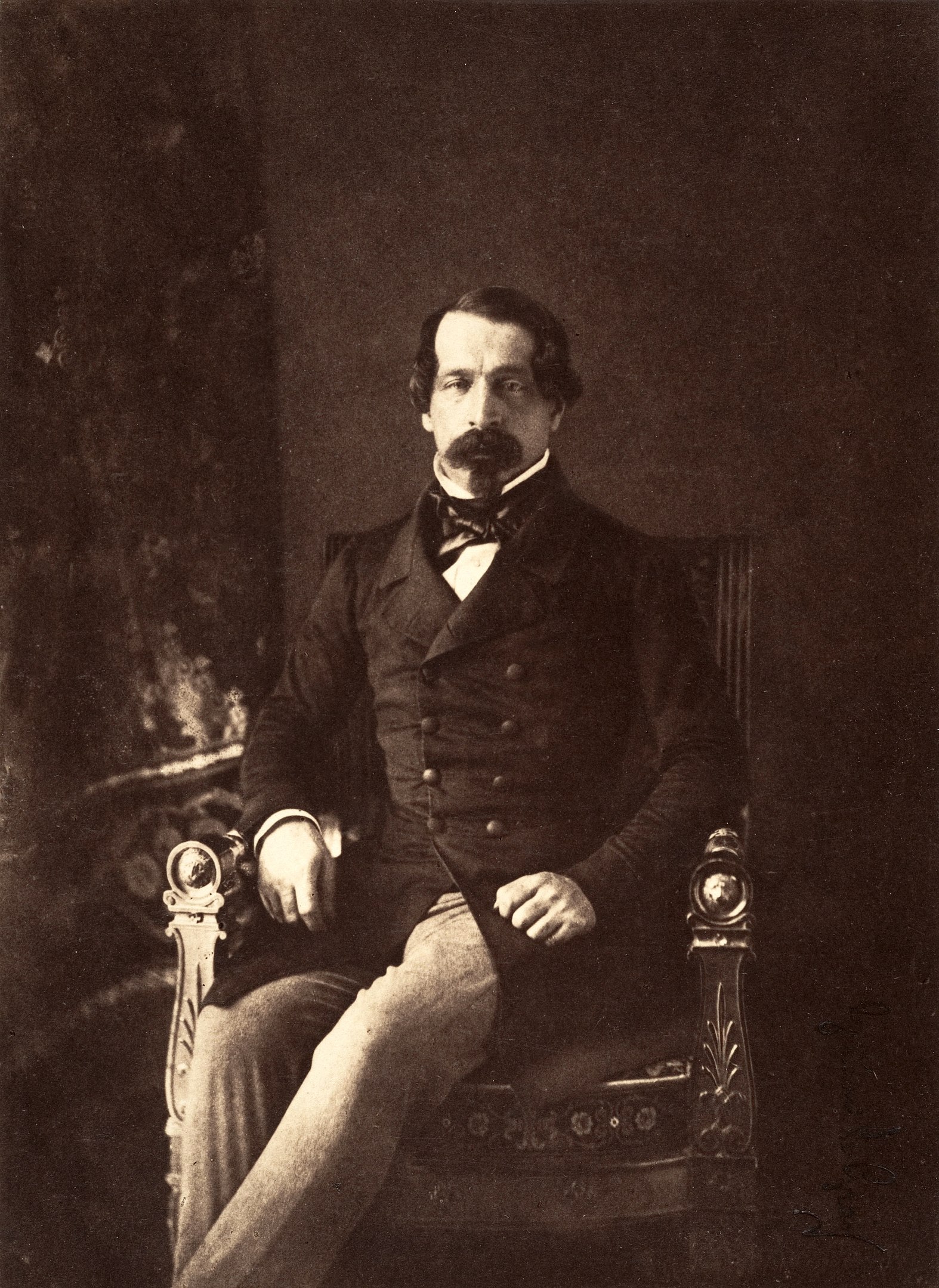
Louis Napoleon Bonaparte (Napoleon III), 1852Portrait of Prince Murat
The couple lived at Lipona outside of Tallahassee until the July Revolution of 1830 in Paris when Charles X abdicated, and Louis Philippe was selected as King. The Murats traveled to Europe as Achille tried to press claims to restore the families’ money and lands, but he failed. (Bellet, 1976) The couple moved to London, where they spent a few years in high society. Catherine became a favorite of Louis Napoleon (who would become the first President and then Emperor of France, Napoleon III). While in London, Catherine even attended and was given a seat in Westminster Abbey for the coronation of William IV of the United Kingdom. (Bellet, 1976)
Coronation of William IV, 8 September 1831
Return to America
Around 1835, the pair returned to America and set up residence just outside New Orleans, where Achille attempted to run a sugarcane plantation and practice law, both of which failed. (Hare, 2002) . They returned to Florida to their plantation Lipona, which he had mortgaged to the bank and subsequently lost due to nonpayment, requiring the couple to move to a smaller property. (Hanna, 1948)
Achille died in 1847, leaving his widow in a precarious financial situation, having acquired massive debt during his life. After the death of her husband, Catherine purchased a cotton plantation named Bellevue (now part of the Tallahassee Museum). She successfully managed the property and, after ten years, had paid all of Achille’s debts. (Sandler, 1999)
Bellevue Plantation
When Napoleon III became Emperor in 1852, Catherine was pronounced French royalty and Princess of the Second Empire, which granted her an annuity from the French government and allowed her to use the livery of France. (Bellet, 1976)
Catherine Daingerfield Willis Gray Murat, Princess of the Second Empire
Preservation and the Mount Vernon Ladies Association
In 1853, Ann Pamela Cunningham founded the Mount Vernon Ladies Association (MVLA) to preserve and restore George Washington’s Mount Vernon. There had been other failed attempts by owner John Augustine Washington to sell the property to the US government and the state of Virginia, and even vile rumors of it being looked at by “speculators” to turn it into a resort hotel. Seeing the state of the property belonging to one of the most beloved founding fathers, Cunningham was able to make a deal with Washington after much discussion to sell the property (house, outbuildings, and 202 acres) to the Association for $200,000 (around 7 to 8 million dollars today). (West, 1999)
Mount Vernon in 1858 before restoration by the MVLARecord of payment from MVLA, 1858
To raise money, Cunningham created a nationwide network of women by appointing one lady from each state as a vice regent to assist in fundraising. (Grabitske, 2004) In Florida, the daughter of the territorial governor, Ellen Call Long, was asked to become the state regent. She declined but suggested Catherine because of her family ties and influence. Catherine enthusiastically took on the role of vice-regent. She raised $3791.25, which was no small feat, with the entire population of Florida in 1860 being 144,424 people. (United States Census Bureau, 2021) The MVLA raised the funds and paid off the purchase price within two years despite The Panic of 1857 and the economic recession just before the beginning of the Civil War. (Casper, 2008) (Huston, 1987) Mount Vernon was saved and continues to be owned and maintained by the Association, as it is overseen by a board of regents of ladies from 27 states. (George Washington’s Mount Vernon, 2024)
Princess Catherine Murat died in August 1867 at her plantation, Bellevue. She is buried beside her husband, Prince Achille Murat, in the Tallahassee Episcopal Cemetery. They had no children.
Close up view of a plaque on the Prince and Princess Murat tombs – Tallahassee, Florida, ca 1900Graves of Prince and Princess Murat, 1949
Heather Baldus
Collections Manager
References
Bellet, L. P. (1976). Some Prominent Virginia Families, Volumes 1-2. Clearfield.
Brandon, E. E. (1944). A Pilgrimage of Liberty. Lawhead Press.
Burnett, G. (1996). Florida’s Past: People and Events That Shaped the State. Pineapple Press.
Casper, S. E. (2008). Sarah Johnson’s Mount Vernon : the forgotten history of an American shrine. New York: Hill and Wang.
Downes, A. J. (1956). The Legendary Visit of Emerson to Tallahassee. The Florida Historical Quarterly, 334-338.
Gannon, M. (2003). Florida A Short History. University Press of Florida.
George Washington’s Mount Vernon. (2024). About Mount Vernon. Retrieved from George Washington’s Mount Vernon: https://www.mountvernon.org/about/
Glenn, J. (2014). The Washingtons. Volume 1: Seven Generations of the Presidential Branch. Savas Publishing.
Grabitske, D. M. (2004). First Lady of Preservation: Sarah Sibley and the Mount Vernon Ladies Association. Minnesota History, 407-416.
Hanna, A. J. (1948). A Prince in Their Midst: The Adventurous Life of Achille Murat on the American Frontier. University of Oklahoma Press.
Hare, J. (2002). Tallahassee: A Capital City History. Arcadia Publishing.
Huston, J. L. (1987). The panic of 1857 and the coming of the Civil War. Baton Rouge: Louisiana State University Press.
Niles, H. (1823). Niles’ Weekly Register, p. 272.
Roberts, D. (2004). Dream state : eight generations of swamp lawyers, conquistadors, Confederate daughters, banana Republicans, and other Florida wildlife. New York City: New York: Free Press.
Sandler, R. (1999, October 23). The Princess Who Saved Mount Vernon. The Free-Lance Star, pp. 3-4.