Lives and Legacies

Category: George Washington

  • Camp George v. George: A Summer Camp to Travel Back to Colonial Virginia

    School is out for summer…almost! Students are counting down the days until they are free from homework, but the learning does not have to stop!. The George Washington Foundation has been busy preparing fun-filled summer camps to encourage critical thinking through exploring the past.

    In our Camp George v. George, students will be asked, “Would you be an American patriot or a British loyalist?” as they learn about George Washington and his family’s experience living under the rule of King George III.

    The camp will alternate between George Washington’s Ferry Farm, his boyhood home, and Historic Kenmore, his sister’s later-in-life house. George lived at Ferry Farm from six years old until 22 years old. This was where George learned how to survey, dance, and petitioned for his first military office at Ferry Farm. His time at Ferry Farm shaped him into the man who navigated the battlefield and the political arena to pursue the American cause.

    Similarly, George’s sister, Betty Washington Lewis, was shaped by her time at Ferry Farm. She was instructed in the customs of gentility, which included the tea ceremony.[1] While at Ferry Farm, her uncle, Joseph Ball, gifted a silver tea set and other tools so Betty could refine her skills as a future lady of the house. During this time, Betty was taught the expectations for young women in colonial Virginia.
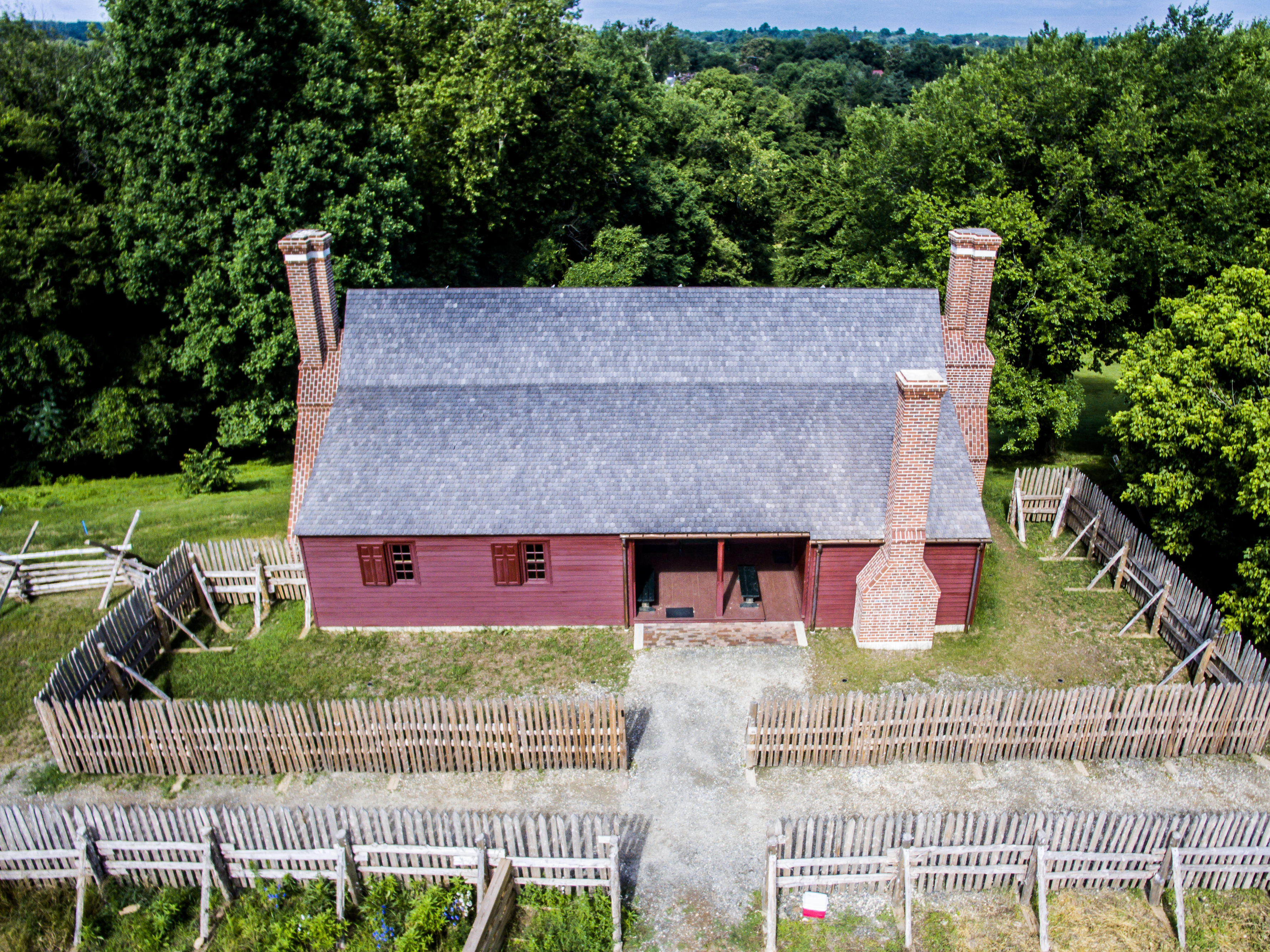
    Washington’s Ferry Farm

    While Betty’s experience at Ferry Farm was significant, her story does not end there. The skills she acquired at Ferry Farm equipped her to marry Fielding Lewis, a wealthy merchant in town. Twenty-five years later, they moved into their new home at Kenmore in 1775. Fielding and Betty envisioned the mansion as the site of lavish social events filled with tea, dancing, and awe from their guests. However, that dream was never realized, and the couple sacrificed greatly for the American cause. Betty managed the household and attended to the needs of the Washington family, including her mother, Mary. Fielding could not fight in the war, but he voluntarily gave up his trading business with British merchants, donated supplies to the war effort, and financially supported a gunnery in Fredericksburg.[2] Fielding also collected debts and handled several land deals for his brother-in-law.[3] The stress of the financial strain took its toll on Fielding, and he passed on December 7, 1781. Betty struggled financially for the rest of her life due to Lewis’ sacrifices for the Patriot cause.

    Historic Kenmore and Ferry Farm will be the sites where campers will learn about life in colonial America. Archaeologists, socialites, dancers, surveyors, and soldiers are just a few of the roles that the campers will embody as they explore the cultural, social, and military life of colonists during the Revolutionary War era. Activities will include a mock archaeological dig, a surveying hike, dancing lessons, militia drills, and more! This experience will provide insight into life before, during, and after the American Revolution. George, Betty, and Fielding, along with many others, had their lives transformed by society, government, and friendships. What would you do in such instances? That is the question campers will think about during their experiences, but don’t worry, plenty of fun, games, and activities will be included!

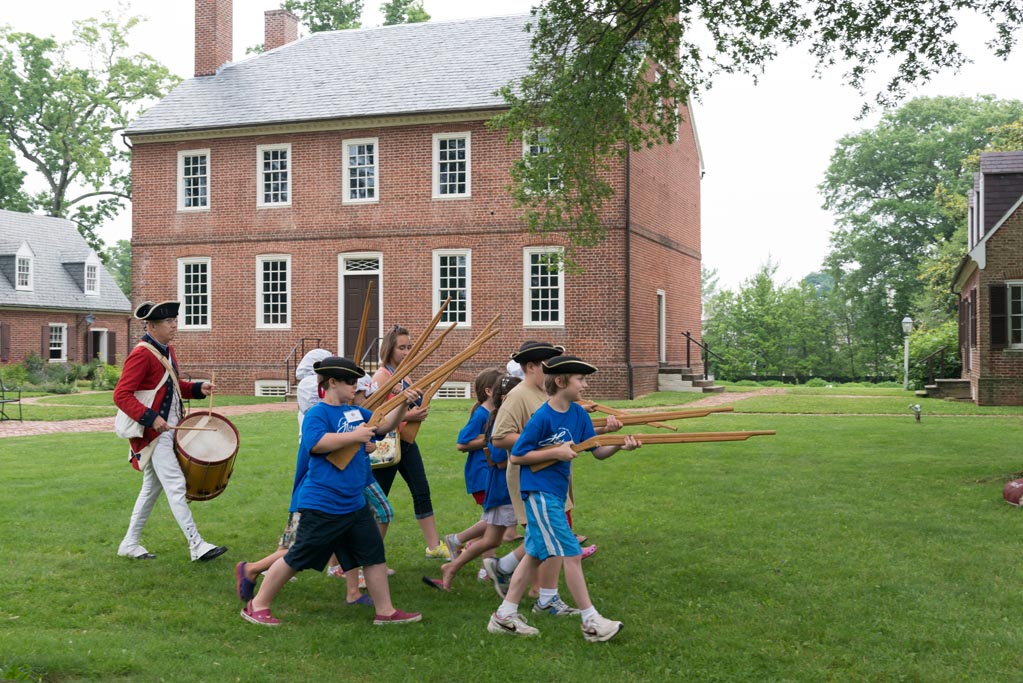
    Camp George v. George will be offered in two sessions for families’ convenience. Session A will be June 13 – 17 from 9 am to 12 pm, and Session B will be from July 25 – 29 from 9 am to 12 pm. Please see our events page at Kenmore.org/events for more information!

    Kaylie E. Schunk

    Manager of School & Youth Programs


    [1] Laura J. Galke, “The Mother of the Father of Our Country: Mary Ball Washington’s Genteel Domestic Habits,” in Northeast Historical Archaeology 38 (2009): 33.

    [2] “Fielding Lewis;” Palmer, and McRae, eds. Calendar of Virginia State Papers, 456, 502-3; Duke, Kenmore and the Lewises, 94-96; Fleming, Story of Kenmore, 9; “To George Washington from Fielding Lewis, 14 November 1775,” Founders Online, National Archives, Source: The Papers of George Washington, Revolutionary War Series, vol. 2, 16 September 1775?–?31 December 1775, ed. Philander D. Chase (Charlottesville: University Press of Virginia, 1987), 371–373.

    [3] “From George Washington to Fielding Lewis, 20 April 1773,” Founders Online, National Archives, Source: The Papers of George Washington, Colonial Series, vol. 9, 8 January 1772?–?18 March 1774, ed. W. W. Abbot and Dorothy Twohig (Charlottesville: University Press of Virginia, 1994), 221–224; “To George Washington from Fielding Lewis, 8–9 May 1773,” Founders Online, National Archives, Source: ibid., 229–230. “To George Washington from Fielding Lewis, 24 May 1773,” Founders Online, National Archives, Source: ibid., 235.

  • Happy Birthday, George!

    We are excited to be celebrating George Washington’s 290th birthday (although it’s the day before his actual birth date) on President’s Day! On February 22, 1732, George was born in Westmoreland County, Virginia. Some interesting facts are associated with his birth-date and the subsequent birthday celebrations he would have as an adult. For instance, did you know that he technically has two birthdays? It’s true! Under the Julian calendar, his birth date would have been February 11, 1731. This means that his birthday was actually earlier in the month until the calendar switched to the Gregorian calendar in 1752. The Gregorian calendar added 11 days and one year to his date of birth!

    Just when did his birthday become so popular to celebrate? The earliest known date of his birthday being recognized (beyond his family) was actually during the American Revolution. It was the winter of 1778, and the soldiers were desperate to keep warm at their headquarters in Valley Forge, Pennsylvania. General Henry Knox planned the event. Clearly, General Knox did more than coordinate the movement of cannons from Canada to Boston; he apparently could also list “party planner” upon his resume.

    General Henry Knox aka “Party Planner”. Source: Wikimedia Commons

    The festivities of this inaugural birthday bash included a parade from an artillery band consisting of drums and fifes. Around this time, George was also becoming known as the “Father of his Country,” replacing King George III at every chance. For instance, the King’s birthday would no longer be listed in the Almanac. Instead, you would find the birth-date of George Washington. However, that doesn’t quite answer the question of when his birthday became an annual event on a broader scale.

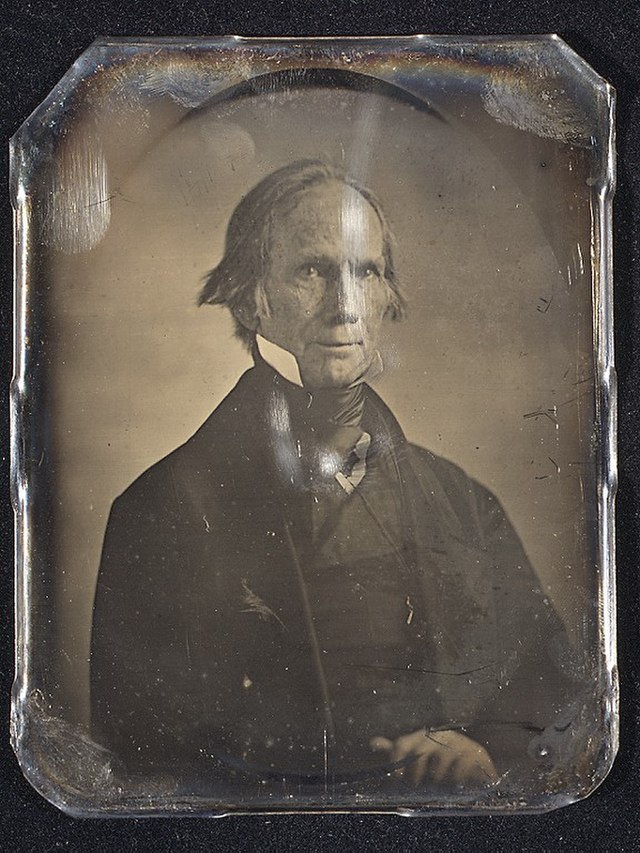
    For that, we turn to everyone’s favorite statesman, whose most significant accomplishment was never being elected President of the United States despite the number of times he ran for that office. The one, the only…Henry Clay. Senator Clay was part of a joint Congressional committee that wanted to recognize the centennial of George’s birth. They decided to do this by giving themselves the day off and adjourning Congress on February 22, 1832. While not the celebration you might have imagined, it did get the ball rolling for an expanded holiday that we celebrate today.

    Senator Henry Clay. Source: Wikimedia Commons

    As the years went by, cities, states, and even Congress realized they had to do more to commemorate George’s contribution to the Nation. In 1862, yes, in the midst of the Civil War, the Senate began to read Washington’s Farewell Address each year on his birthday. In 1879, Congress made the date a federal holiday for federal employees ONLY IN DC. Though this caused confusion among those employees as some were paid for that holiday and others were not… This discrepancy was amended in 1885 when the holiday became a paid one for all DC federal workers.

    Almost 100 years after the Senate began their annual tradition of reading the Farewell Address on February 22, Congress passed the Monday Holiday law to make federal holidays more uniform. So instead of celebrating George’s birthday on February 22, it was recognized on the third Monday of the month. There are two interesting things about this law when applied to George’s birthday. First, because of February’s shortened number of days, there is no possible way for the federally observed holiday to fall on his actual birthday. Second, the holiday we all know as “President’s Day” doesn’t actually exist. It has yet to be formally changed by Congress or the President from being first recognized as “Washington’s Birthday,” which is pretty fascinating!

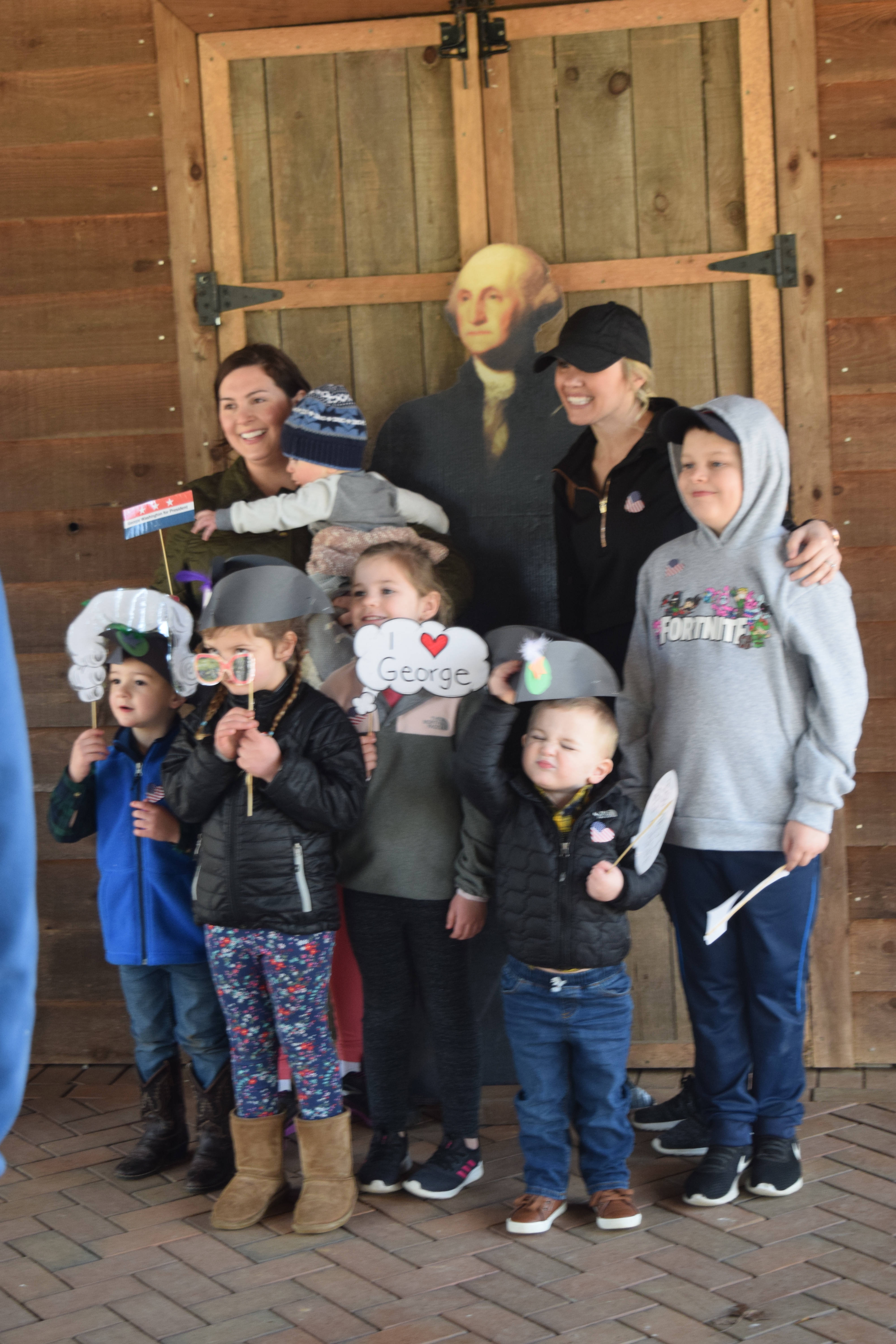
    If you’re looking for a fun way to celebrate George’s birthday this year, I encourage you to check out our event at Ferry Farm. For the event, we are offering tours of the reconstructed Washington House, new (and returning) crafts, a chance to meet real archeologists and learn about what they’ve found at the site, the opportunity to see if you can throw a stone as far as George supposedly could, and obviously, we’re having cupcakes because it’s a birthday party!

    This year’s event will be held on Monday, February 21, from 10 am to 3 pm, and tickets can be purchased by visiting our website. Tickets are $5 per adult (age 18+) and FREE for children (17 & unders). We encourage you to purchase your tickets in advance.

    -Amy N. Durbin, Director of Education

  • What in the World is Twelfth Night?: A Visit with the Ghost of Twelfth Night Past

    Usually, at this time of year preparations are well underway for our annual Twelfth Night at Kenmore: A Dramatic Performance.  The play takes place in January 1776, during the first Christmas season celebrated at Kenmore. Unfortunately, this year’s celebration of Twelfth Night at Kenmore is canceled due to winter weather.  However, if you are familiar with the performance, or have read some of our past blog posts, you might already know a thing or two about this once popular Christmastide holiday. While traces of Twelfth Night still exist today, the celebration is much diminished, if not entirely eclipsed, by Christmas and New Year’s. Why is this, exactly? When did we stop celebrating Twelfth Night?

    There is no single, short answer as to why Twelfth Night celebrations fell out of fashion. Rather, attitudes surrounding the Christmas season changed throughout history, and old traditions were often absorbed or re-imagined into something new. A very brief look into the history of the season sheds some light on why today’s Christmas traditions rose in popularity, while Twelfth Night celebrations became part of Christmas Past.

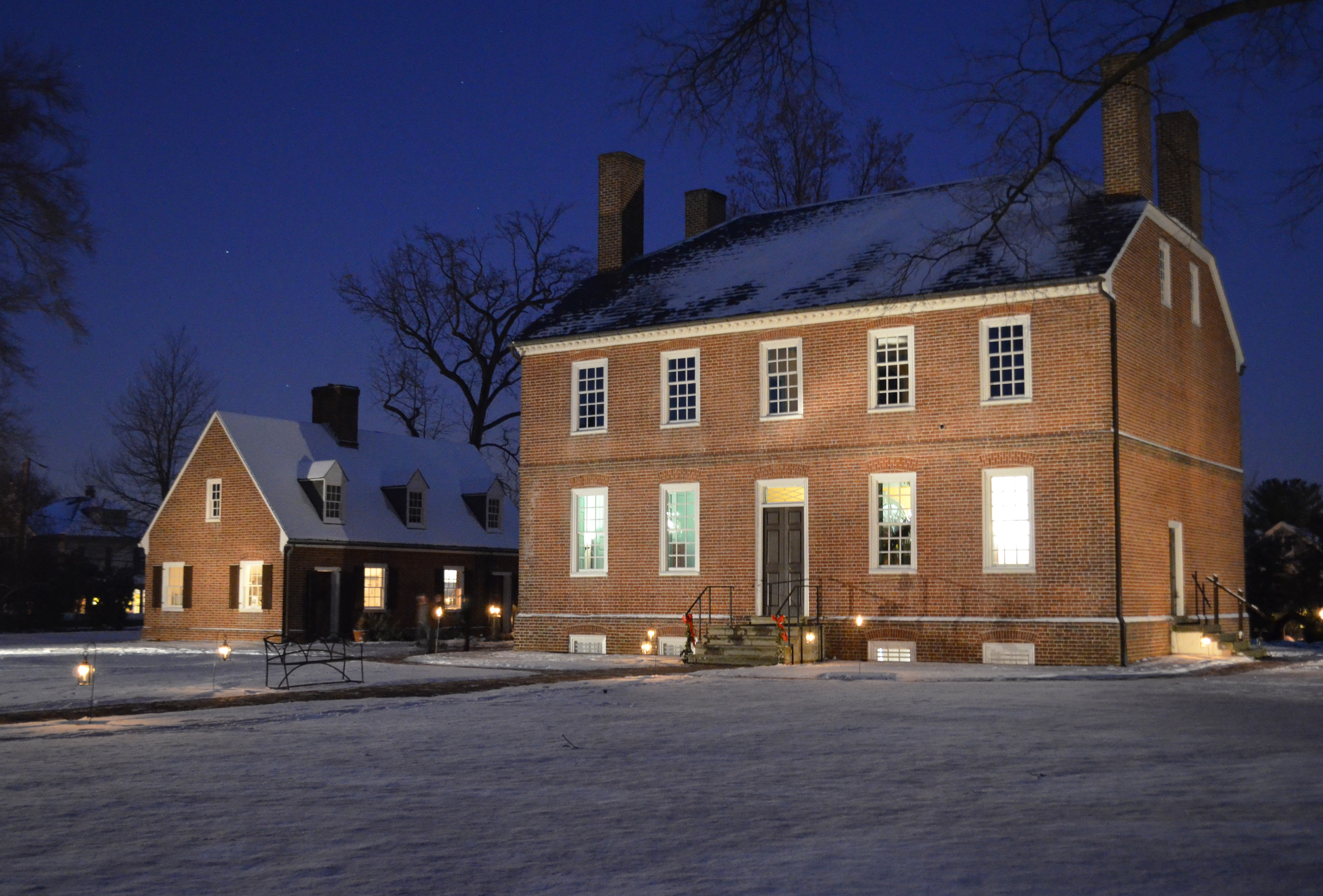
    Historic Kenmore on the eve of Twelfth Night. Credit: GWF Photo

    Many Christmas and Twelfth Night traditions are rooted in holidays celebrating the winter solstice. For example, Saturnalia, a holiday honoring the Roman god Saturn, took place in mid-December. During Saturnalia, the normal social order was temporarily overturned. Romans closed schools and businesses, held grand feasts, and in some families, a king or “Lord of Misrule” was chosen to rule over the household’s festivities.[1] In Scandinavia, people celebrated the winter solstice during the Nordic festival, Yule. Festivities included bonfires (or yule logs), evergreen decorations, and feasts. It wasn’t until the 4th century that the Roman church officially observed December 25th as Jesus’s birth date. Historians speculate that church officials chose this date precisely because so many popular winter celebrations occurred around that same time.[2]

    Saturnalia by Antoine Callet. Credit: Wikipedia

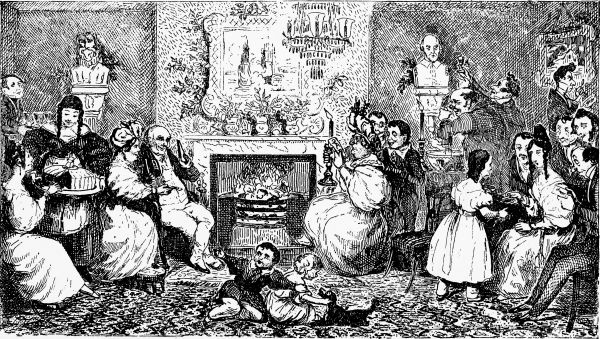
    If we fast forward in time, we see how some of these winter rituals were absorbed into the festivities of Twelfth Night. But first- what exactly is Twelfth Night? Typically celebrated on either January 5th or 6th, Twelfth Night, or Epiphany, is a Christian holiday that marks the end of the Twelve Days of Christmas and commemorates the Magi’s visit to Jesus. During the colonial era, the holiday season kicked off on December 25th and culminated on Twelfth Night. The twelve days after Christmas were full of games, music, dancing, feasts, and visiting with family and friends. Families often celebrated the season with a Twelfth Night Cake. Recipes called for a dried bean and pea to be baked into an elaborately decorated fruit filled cake. The man who found the bean was declared King for the night, while the woman who found the pea was declared Queen.

    Illustration of a Twelfth Night party by Robert Seymour. The woman on the far left serves pieces of a large Twelfth Cake. Credit: The Project Gutenberg

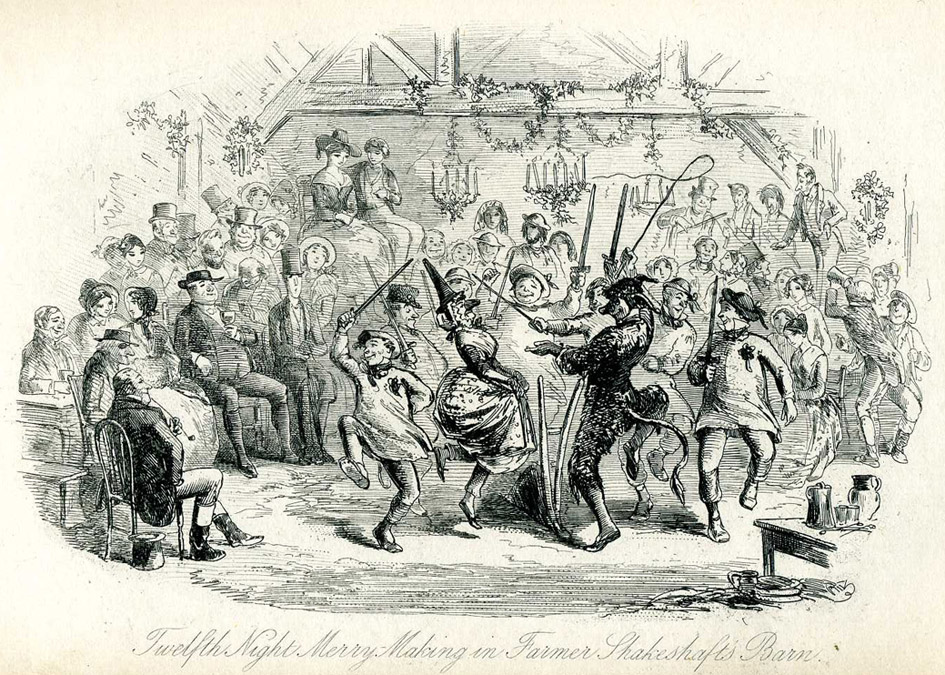
    Of course, there has always been debate surrounding how the Christmas season should be celebrated, and practices varied from place to place and person to person. In the 17th century, New England Puritans (echoing sentiments from Cromwellian England) viewed Christmastime celebrations as rowdy, excessive, and downright bacchanalian. Massachusetts went as far as to outlaw celebrations between 1659 and 1691.[3]

    The Twelfth Night party’s “King” and “Queen” sit on chairs overlooking the crowd. Dancing, drinking, and mumming (costumed acting) are in full swing. Puritans disapproved of these festive antics. Credit: Wikipedia

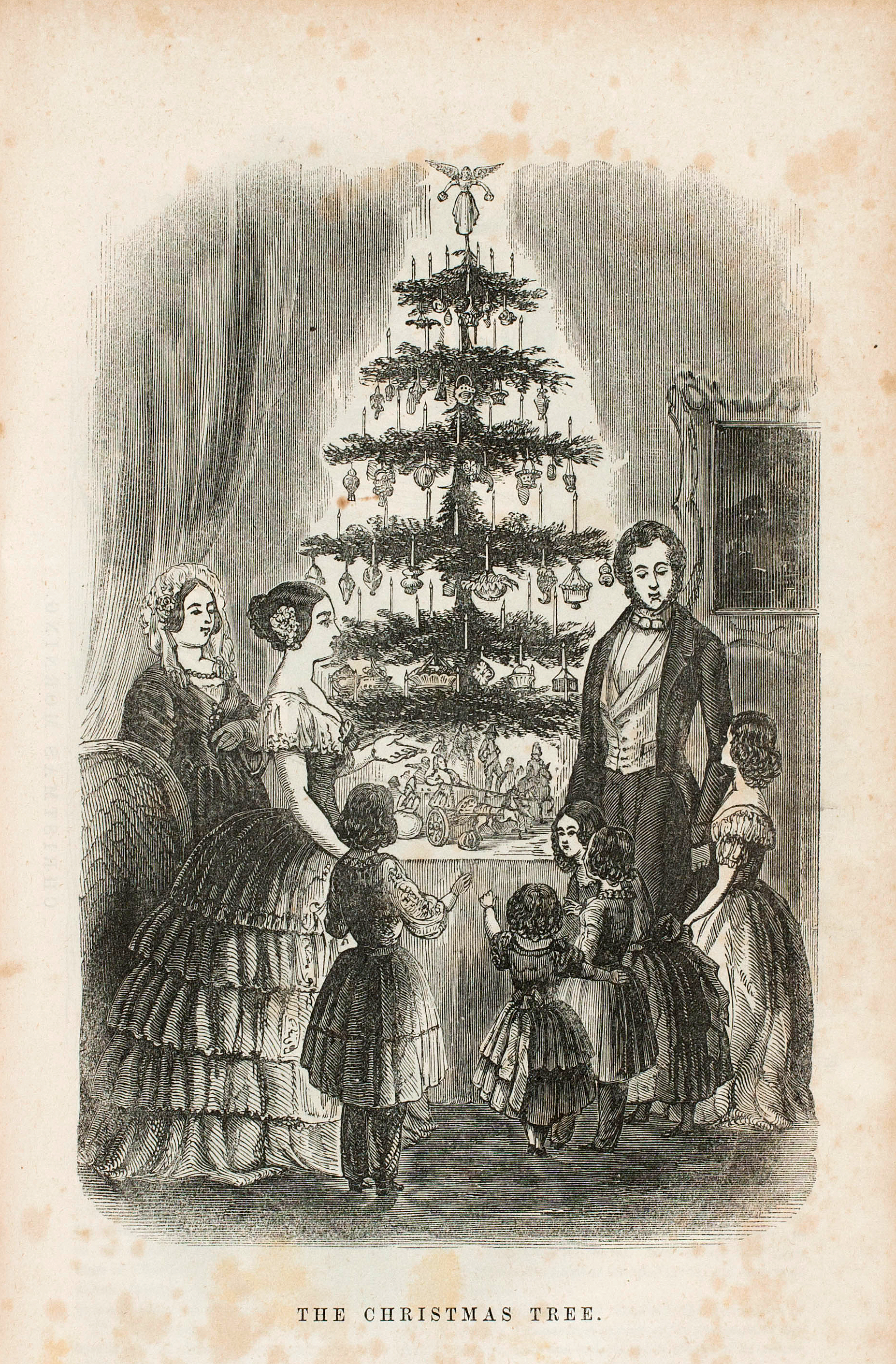
    During the 19th century, Queen Victoria influenced a shift in popular opinion towards a more family-focused Christmas season. In 1850, Godey’s Lady’s Book, a popular American magazine, published an image of the royal family gathered around a Christmas tree. While German immigrants had already introduced the Christmas tree tradition to America, this image fascinated the English and American public alike, and it further popularized the practice. In the American version of the print, editors removed Victoria’s tiara and Albert’s royal sash, and the group came to embody the ideal American family at Christmas.[4]

    Godey’s Lady’s Book illustration. Credit: Wikimedia Commons

    These changing ideals shaped the Christmas season during the Victorian era, and combined with rapid industrialization and commercialization, they sparked the beginning of a number of now familiar traditions. For example, improvements in mass printing technology popularized the practice of sending Christmas cards. In 1843, Charles Dickens published A Christmas Carol, a tale promoting charity, good will, and the virtues of a domestic family Christmas. Thomas Nast, who made popular the modern image of Santa Claus, published his first Santa cartoons in the 1863 edition of Harper’s Weekly.

    You might be asking, where then, does this leave the Twelve Days of Christmas and our Twelfth Night celebrations? As we’ve seen, changing ideals during the 19th century promoted a holiday season focused on children and family. Modern industry and commercialization further bolstered shopping and gift giving habits, and a twelve day holiday certainly didn’t fit within the parameters of the new industrialized era. The once twelve day celebration now culminated on one, and it was celebrated with visits from Santa and gifts for children, rather than with feasts and parties for adults.

    However, some Twelfth Night traditions live on during the modern Christmas season, albeit under new guises. Between Christmas and New Year’s, people may decorate their homes with greenery, raise a toast with a glass of wassail, or host extravagant parties with family and friends. If you visit New Orleans during the carnival season (beginning with Epiphany and ending on Mardi Gras) you might celebrate by eating “King Cake,” where the lucky person who finds the plastic baby figurine inside their piece of cake is crowned “king” for the day! That sounds a little familiar, doesn’t it?

    Ann Waters

    Manager of Interpretation and Visitor Services


    [1]“Saturnalia,” HISTORY, A&E Television Networks, Last modified December 18, 2020, Accessed December 22, 2021, https://www.history.com/topics/ancient-rome/saturnalia

    [2] Stephen Nissenbaum, The Battle for Christmas (New York: Knopf Doubleday Publishing Group, 2010), 4.

    [3] Bruce David Forbes,“Christmas,” In America’s Favorite Holidays: Candid Histories, 1st ed. (University of California Press, 2015), 28.http://www.jstor.org/stable/10.1525/j.ctv1wxrr3.5

    [4] Ibid., 34.

  • Dig These Dishes! We Recreate an 18th Century Table Setting Using Only Artifacts.

    Dig These Dishes! We Recreate an 18th Century Table Setting Using Only Artifacts.

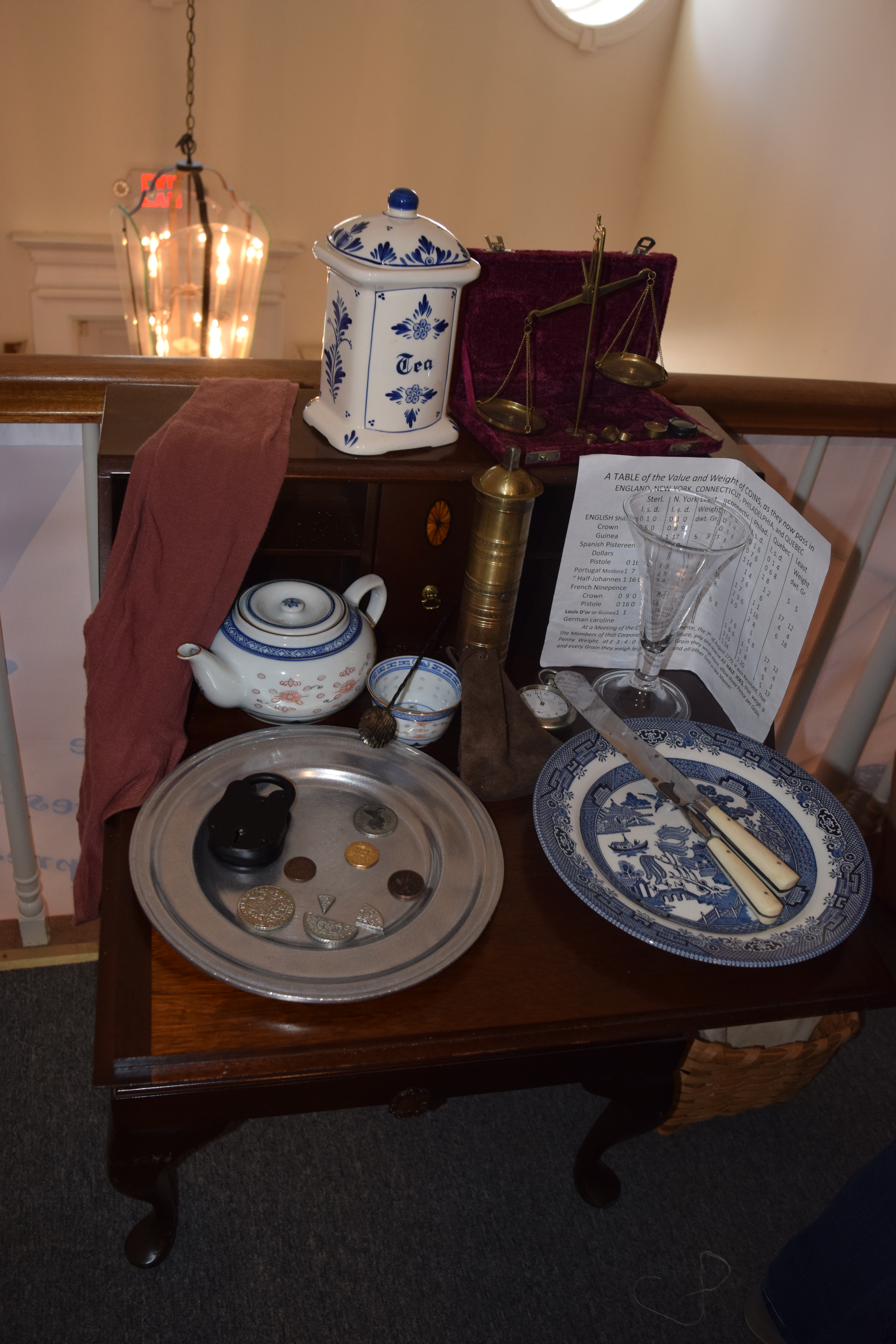
    On a typical day at George Washington’s Boyhood Home at Ferry Farm, visitors experiencing the house tour are ushered into the main hall upon which a dining table is set out before them with 18th-century reproductions of plates, glassware, wine bottles, and serving dishes. This setting creates an interactive experience for our visitors, transporting them back in time to the mid-18th century when the Washington family lived here on site.

    Last month, however, an unexpected sight greeted a tour group as they entered the hall. The dining table was set, not with reproductions, but actual plates, jugs, and serving dishes that could very well have graced the Washington family’s dinner table over 250 years ago.  The principal difference is that nothing on the table was complete – all were fragmented versions of the originals. 

    Dining table in Hall set up for dinner.

    The setting was a special photoshoot for The George Washington Foundation and an occasion to display and highlight the array of vessels, many mended, residing in the Archaeology Department’s collection.  Everything on the table was archaeologically recovered from either Ferry Farm or Historic Kenmore and represent vessels that date to the Washington family’s occupation of Ferry Farm or Betty Washington Lewis’ time at Kenmore. 

    The Archaeology Department at Ferry Farm has been mending vessels over the past couple of years for our museum displays at the Ferry Farm and Kenmore Visitor Centers. This mending was also done for research purposes as the curatorial department worked to furnish the replica house with accurate, period-relevant household items.

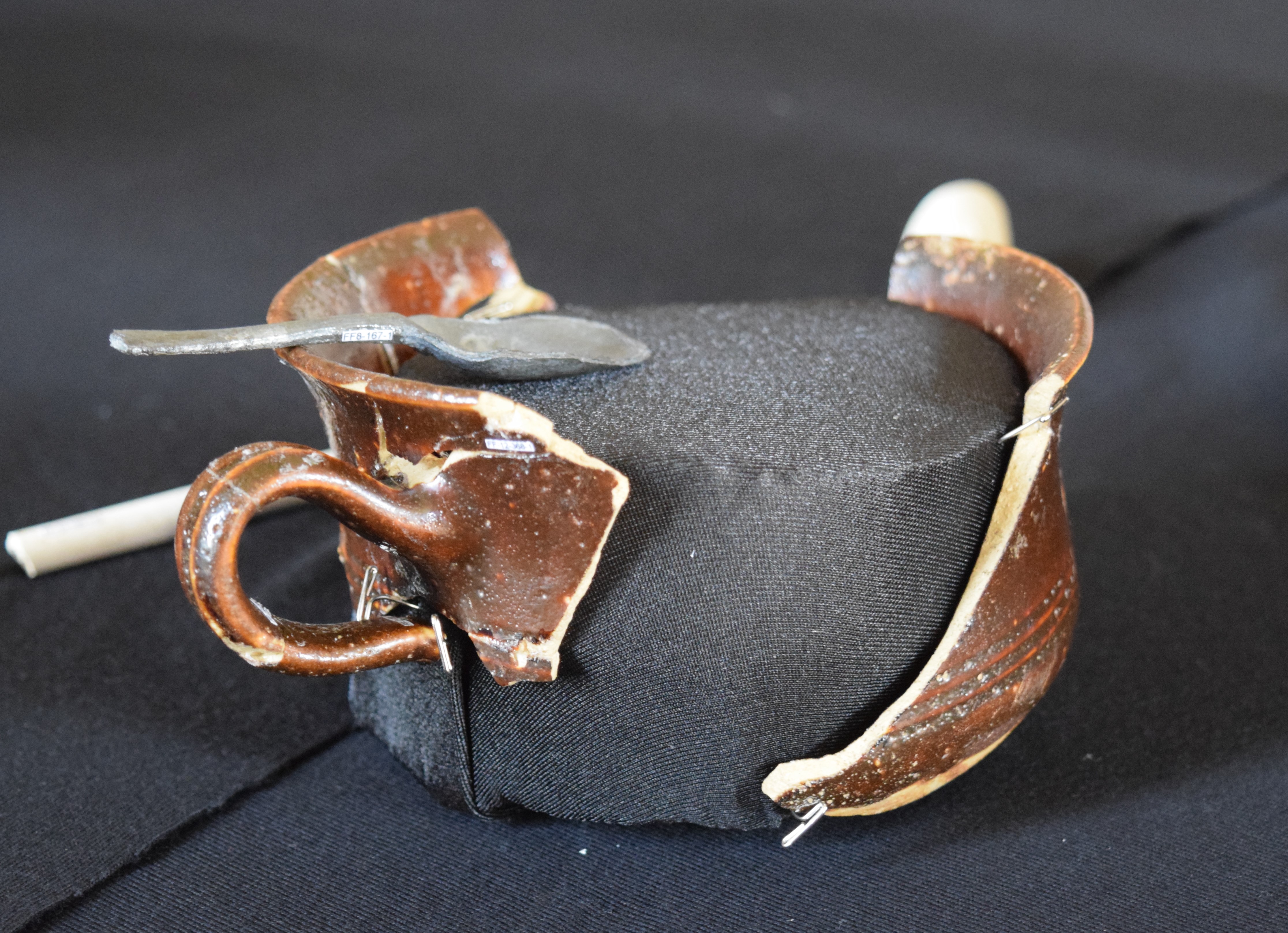
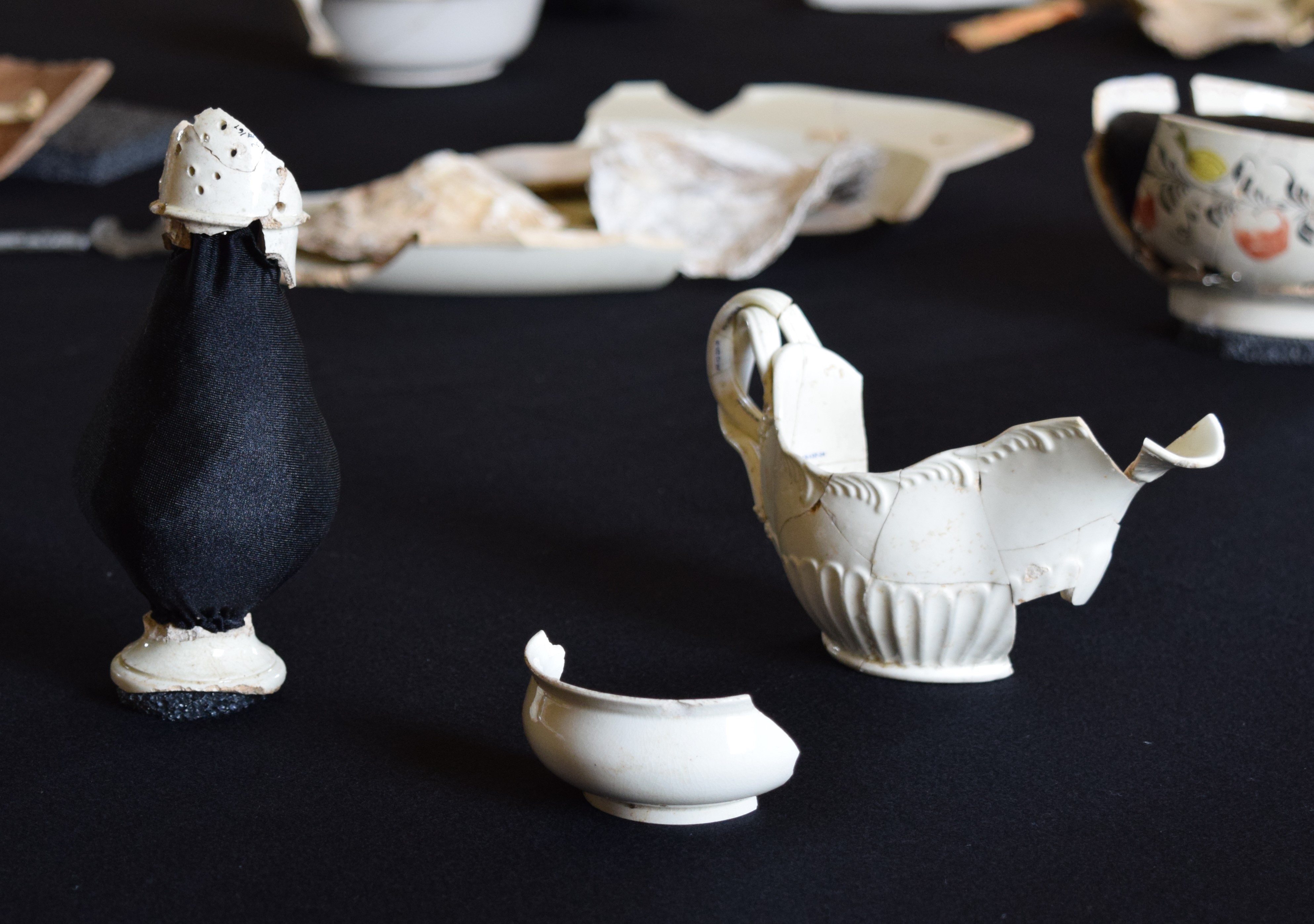
    So what is on the table? Creamware and white salt-glazed plates and serving dishes, glass tumblers and wine glasses, German stoneware jugs, dark green glass wine bottles, a porcelain teacup, coarse earthenware porringers, forks and knives with bone handles, silver spoons, and Mary Washington’s creamware enamel-painted punch bowl.  Many of the ceramic tablewares and a few of the glass tumblers were mended using archival glue.  Some of the objects were able to stand on the table unaided, while others needed mounts for support, such as the wine glass.

    Fragments of dinner and glasswares

    To help envisage the original shape of some of the fragmented vessels and make them recognizable, we first sculpted their shapes out of foam, covered them with fabric, and then attached the incomplete vessel fragments in their correct positions. This process allowed us to present a more “complete” and familiar view of some of the tablewares, such as the two large stoneware jugs, the creamware pepper pot, the glass tumbler, and the two wine bottles. All of these items would have been very difficult to display simply using the fragments themselves. 

    Having such an array of different ceramic styles on the table is more a function of what we have mended in our collection versus what Mary might have actually had on her table.  But for our purposes, we are happy showcasing all of the different ceramic types presently in our possession.

    Welcome to the Washington dining table! Enjoy!

    Judy Jobrack, Archaeologist
    Co-Field Director

  • Agreeable Amusements: Music & Dancing in the Life of George Washington

    On September 10, 1748, sixteen-year-old George Washington paid 3 shillings, 9 pence to a “musick master for my entrance.” Young Washington recorded these sparse details in Ledger Book Zero, a personal account ledger listing credits and debits with family, friends, and business associates between 1747 and 1750. This, as far as we can tell, is the first reference to music in the life of George Washington. By no means, would it be the last. Music was an important part of Washington’s life, just as it is with many of us today.

    Ledger Book Zero, young George Washington’s personal account book, shows payment to a “musick master for my entrance.”

    What was teenage age George paying for when he paid the “musick master for . . . entrance”?  Well, the lack of details makes it impossible to say with certainty.  The most obvious possibility is that he was paying for music lessons.  However, letters written by George himself and a friend indicate that Washington had little to no musical talent. Francis Hopkinson, a colleague during the war, composed a series of songs for harpsichord or piano and dedicated them to Washington. In a letter to George dated December 1, 1788, Hopkins explained his dedication even though George could “neither play Musick nor sing Songs.”  In a reply on February 5, 1789, Washington agreed, writing “I can neither sing one of the songs, nor raise a single note on any instrument.” Despite a professed musical inability, it is still possible young George was paying for music lessons in 1748. Often, you might pursue lessons only to discover that you do not have the aptitude.

    Regardless, while apparently not musical himself, music surrounded Washington. As Mount Vernon research historian Mary V. Thompson notes, “Washington was the head of a household where his wife, her two children, and her four grandchildren (two of whom were raised by the Washingtons) all studied music.” In particular, granddaughter Eleanor (Nelly) Parke Custis became fairly skilled at the harpsichord, despite an apparent reluctance to learn. In the summer of 1798, a visiting Polish nobleman enthusiastically claimed that Nelly “plays the harpsichord, sings, draws better than any woman in America or even in Europe.”

    Another Washington family member with an interest in music was George’s niece Harriot Washington, daughter of Samuel. The first letter in the record between Harriot and her guardian and uncle George was written on April 2, 1790.  Harriot was 14-years-old and living at Mount Vernon while President Washington was in New York. The niece asked her uncle to send her a guitar since she wanted to take lessons for “all the young Ladyes are a learning musick.”  Harriot was confident “that five or six lessons would be sufficient for any body to learn.”  The records consulted reveal no response from Washington. Eventually, Harriot would come to Historic Kenmore to live with her aunt Betty Washington Lewis. She again asked uncle George for a guitar in May of 1792. About a month later, he paid $17 for one. Harriot’s capabilities with the instrument are unknown.

    Besides family, another major source of music in Washington’s life was the Continental Army. Music was crucial to 18th century militaries. Fifes and drums issued commands during battle and put a spring in the step during weary marches. Much like the army’s initially amateur soldiers, its fifers and drummers (who were often boys serving with their soldier-fathers) took time to practice and professionalize.

    On June 4, 1777, General Washington issued a set of orders. One order dealt with the army’s music, which the General bluntly lamented was “very bad.” He ordered “that the drum and fife Majors exert themselves to improve it, or they will be reduced, and their extraordinary pay taken from them: Stated hours to be assigned, for all the drums and fifes, of each regiment, to attend them, and practice.” Washington concluded, “Nothing is more agreeable, and ornamental, than good music; every officer, for the credit of his corps, should take care to provide it.”

    A notable musical moment in the army’s history was the birthday serenade for General Washington on February 22, 1778 at Valley Forge. The musicians of Proctor’s Artillery played outside the General’s headquarters. Washington’s expense account lists a payment of 1 pound, 5 shillings to Proctor’s band. Joseph Lee Boyle, longtime historian at Valley Forge, explains that “Colonel Proctor commanded an artillery regiment, and this was one of the few, perhaps the only, unit to have musicians besides fifers and drummers. In 1779 ten ‘musicians’ are listed in the band, but not what instruments they played.” Mount Vernon scholars note that this was “the first public recognition of [Washington’s] birthday.”

    We’ve seen that music was definitely a part of Washington’s life but it was played by others mostly. George could not play an instrument nor sing. He may have paid for music lessons only to discover his inability. Another reasonable theory, however, is that he paid the “musick master for my entrance” to dancing lessons. Later in life, Washington uses similar phrasing – “Mr McKay entrance to Dancing” – to record a payment of 10 shillings for lessons for stepson John Parke Custis.

    Dancing was the leisure time obsession of most Virginians but especially those in the wealthy gentry. For the upper class, explains Amy Stallings, “ being a skilled dancer was an indication of good breeding” and allowed one to “put one’s gentility, accomplishment, beauty, and economic means on display in hopes of impressing—or, in some cases, intimidating—”others. As Philip G. Smucker adds, “Dexterity on the dance floor maintained social status.”

    Maintaining social status and the appearance of good breeding skyrocketed in importance to George and the Washington family after the death of father Augustine in 1743. His death created financial hardship and jeopardized the family’s social standing. Without a father, George’s life changed radically. Assisted and supported by both mother Mary and half-brother Lawrence, George was forced to acquire the refined skills and customs of the upper class in Fredericksburg instead of in England while at boarding school.

    One of those skills was dancing and the mystery “musick master” perhaps taught teenage George that skill.  Over the course of the 18th century, as Stallings notes, “a market developed for professional instructors, or dance masters, who were expected to know the latest dances from Europe.”  Virginia’s urban centers with their greater populations and high number of visitors “often boasted multiple dancing schools . . . Dancing masters operated in at least Yorktown, Williamsburg, and Hampton by 1739.” Traveling dance instructors served Virginia’s far-flung rural population. These masters usually “taught the sexes separately, at different hours or different days of the week.”

    If Washington was schooled in dancing by the “musick master,” he probably learned the era’s popular minuets, allemandes, and hornpipes. These fancy dances typically began any ball and were the best opportunities to show off one’s dancing abilities and good breeding. The minuet was the most important. As Stallings explains, “A man’s prowess at the minuet—an especially complicated dance, requiring excellent balance and coordination with one’s partner—could buoy his social position, whereas a poor minuet might leave him out of favor.”

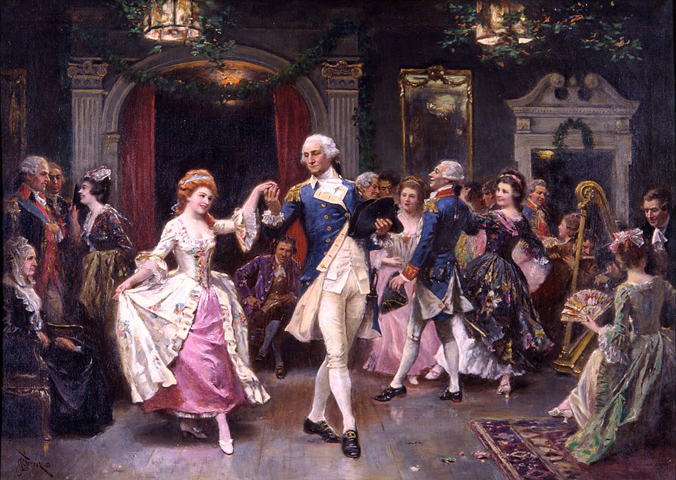
    A fanciful early 20th century painting by Jean Leon Gerome Ferris titled “The Victory Ball, 1781.” While Washington was a life-long and avid dancer, it is unlikely he attended any such “victory ball” or “peace ball” traditionally said to have taken place in Fredericksburg after the British defeat at Yorktown.

    Whether he was paying for dancing lessons in 1748 or not, young Washington learned to dance in some fashion, discovering both an extraordinary natural talent and life-long passion for it.  Numerous contemporaries recorded instances of Washington dancing and praised his abilities.

    “His Excellency . . .  and Mrs. Greene . . . danced upwards of three hours without once sitting down.” – General Nathanael Greene to Colonel Jeremiah Wadsworth, Middle Brook, New Jersey, March 19, 1779.

    “His Excellency General Washington was unusually cheerful. He attended the ball in the evening, and with a dignified and graceful air, having Mrs. Knox for his partner, carried down a dance of twenty couples in the arbor on the green grass.” – General Nathanael Greene to Joseph Reed, Morristown, New Jersey, Tuesday, February 29, 1780.

    “The General danced every set, that all the ladies might have the pleasure of dancing with him, or as it has since been handsomely expressed, get a touch of him.” – James Tilton to Gunning Bedford Jr., Annapolis, Maryland, December 25, 1783.

    “He . . . attended the ball of the 22nd of February; opened it by dancing a minuet with some lady, and then danced cotillions and country dances; was very gallant, and always attached himself, by his attentions, to some one or more of the most beautiful and attractive ladies at the balls.” – Judge Francis T. Brooke (1784).

    And finally a word on his dancing from George Washington himself, written on November 12, 1799, just a month prior to his death and turning down an invitation from to a grand function in Alexandria. He wrote,

    Gentlemen

    Mrs Washington and myself have been honoured with your polite invitation to the Assemblies in Alexandria, this Winter; and thank you for this mark of your attention. But alas! our dancing days are no more; we wish, however, all those whose relish for so agreeable, & innocent an amusement [emphasis added], all the pleasure the Season will afford them. and I am Gentlemen Your Most Obedient and Obliged Humble Servant

    Go: Washington

    George saw music and dancing both as “agreeable.” From the mostly taciturn Washington, this is high praise indeed.

    Join us on Saturday, April 10 for The Arts at Kenmore: Music on the Lawn and hear 18th century music group Colonial Faire performs music from all walks of colonial society – the music of the taverns, the manor houses, on the streets and on the battlefields. The evening’s opening act will include a short talk exploring the importance of music to George Washington and a theater scene depicting Washington’s first dancing lesson. For more information and tickets, visit kenmore.org/events.

    Zac Cunningham
    Manager of Educational Programs

  • Five International Influences on George Washington’s Early Life

    An Essay of a New and Compact Map, Containing the Known Parts of the Terrestrial Globe by Jacques-Nicolas Bellin was published in 1750 when George Washington was 18-years-old. Credit: Wikipedia.

    Ferry Farm was a unique place to live in the mid-1700s. Situated where farm, frontier, city, river, and road converged on the edge of English empire, young George Washington, his family, and the farm’s enslaved community found their daily lives governed by Britain’s global economy and imperial culture.  Ferry Farm, nearby Fredericksburg, and the colonies more broadly were international places made up of a host of different European, African, and Native American ethnicities and nationalities in the 18th century.  Accordingly, we present a list of “Five International Influences on George Washington’s Youth.” This is by no means an exhaustive list but each influence helped shape young Washington into a man capable of commanding the Continental Army and serving as the new nation’s first president.

    1) The Rappahannock River

    The Rappahannock River as viewed from a window in the Washington house replica at Ferry Farm.
    Voyages of British ships in the last half of the 18th century. Created by Geographer James Cheshire, PhD, on his Spatial.ly blog and used with permission.

    Young George could look from a window in the family home at Ferry Farm down the bluff to the Rappahannock River. He saw ocean-going, sailing vessels being loaded and unloaded at the wharves and warehouses of Fredericksburg. These vessels were part of a global trade network, which we’ve written about here and here, that stretched to Europe, Africa, the Caribbean, India and China. These vessels were not large but traveled the world nonetheless.  They took the corn, wheat, and timber of places like Ferry Farm to Europe or the Caribbean and returned with Westerwald mugs from Germany, tea from India, porcelain from China, and enslaved laborers from Africa. The sailors on these ships probably represented numerous ethnicities and nations. One easily can imagine young George, so prone to a thirst for adventure, finding any excuse he could to visit the docks and ships down on the river and, by doing so, traveling the world without leaving the Rappahannock.

    2) Westerwald stoneware

    Those ships carried numerous manufactured goods from all over the world to Ferry Farm. Westerwald ceramics were one such import. Produced in the Westerwald region of what is now Germany beginning in the 1500s, archaeologists have excavated numerous bits of decorated stoneware tankards, jugs, and other drinking vessels used in the 1700s at Ferry Farm.  Several of these excavated vessels sported the initials ‘G.R.’, meaning Georgius Rex, the Latin for King George. The three British kings of the 18th century were all named George and came from the House of Hanover, a German royal family placed on the British throne in 1714. A gentleman sporting a ‘G.R.’ on his Westerwald tankard or jug advertised his loyalty to the Crown with every draught of ale. The presence of these initialed drinking vessels at Ferry Farm show that, until the Revolution, Washington, like most Americans, viewed himself as a loyal subject of the British Crown (ironically worn by a German head).

    G.R. medallion on a Westerwald jug fragment.
    A nearly complete Westerwald drinking vessel in the collection at Historic Kenmore.

    3) Venetian glass

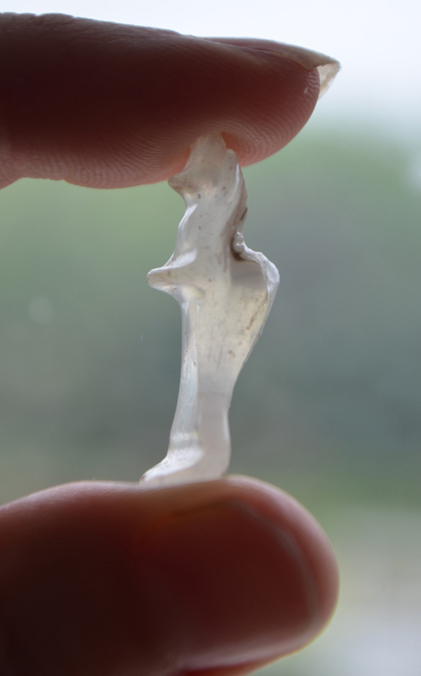
    The vast majority of ceramics in the Washington household came from England. The same can be said about the family’s table glass, but the fanciest glassware owned by the Washington family actually came from Venice, Italy.  Found by our archaeologists, this piece of a pincered and buttressed handle is likely part of an elaborate hand-blown Venetian piece, made of finely crafted colorless soda lime glass with a barely visible bead of opaque glass running through the center.  A Venetian glass goblet such as this was a show piece displayed prominently within the house to emphasize that, despite their colonial location, the Washington family strived to maintain a level of European refinement appropriate to their gentry status.

    Archaeologists excavated this small fragment of Venetian glass at Ferry Farm.
    Wine goblet made in the 16th century in Venice, Italy. Credit: The Metropolitan Museum of Art

    4) Barbados

    In 1751, George Washington made his only trip off the North American continent, traveling with his half-brother Lawrence to Barbados. Visiting the island’s fortifications and meeting members of its military garrison fed George’s growing desire for a military career. As Jack Warren concludes, “After returning to Virginia, he dedicated himself to advancement in the military more completely than any of his Virginia contemporaries. And unlike most of the prominent colonial militia officers of the 1750s, he sought a commission in the regular British military establishment – an ambition that was probably prompted, and undoubtedly stimulated, by his experience in Barbados.”

    Needham’s Point, Barbados. Credit: Reinhard Link.

    5) The Frontier

    Military service eventually took George into the frontier wilderness of the vast Ohio country. Tasked by Governor Dinwiddie with delivering a demand to the French to leave lands claimed by Virginia and the British Crown, young Major George Washington embarked on a thousand-mile, ten-week trek to and from Fort LeBoeuf on Lake Erie. He was accompanied by the Dutchman Jacob Van Braam, who served as his French interpreter, and by Tanacharison, known as Half-King, as well as other men from Native American nations. Along the way, he met several French officers and soldiers. Although confined to North America, this trip in late 1753 and early 1754 was, in reality, a foreign trip that exposed Washington to different peoples and cultures. It provided vital diplomatic, military, and intelligence gathering experience to the future Continental Army commander and first president. Washington, notes Paul Royster, “practiced diplomacy to keep the Native leaders allied to the English cause; he interviewed French deserters and reported on the extent of French military posts between New Orleans and the Great Lakes; he reconnoitered the Forks of the Ohio with an eye to the proper site for building a fort; and he inspected and reported on the construction of the new French forts and made estimates of their strength . . . .”

    Portrait of George Washington, 1772 by Charles Willson Peale. Credit: National Portrait Gallery
    The Ohio region from Cumberland to Fort LeBoeuf through which Washington journeyed, overlayed onto the famed map in Thomas Jefferson’s Notes on the State of Virginia (1787). Credit: Paul Royster / University of Nebraska.

    Conclusion

    Although a fourth generation American, George Washington grew up in a time and place – 18th century Ferry Farm and British North America — where international economic and cultural influences on his life were quite numerous. Through the five international influences we’ve briefly examined, we’ve seen how these influences helped Washington maintain his gentry status, which ultimately set him on a path to military and political greatness.

    Zac Cunningham
    Manager of Educational Programs

    Mara Kaktins, Archaeologist
    Ceramics & Glass Specialist

  • “Dined at the City Tavern”

    Christmas in the 18th century was celebrated quite differently than it is today. Unlike today, one of  the most important (and wildest) celebrations of the season took place on January 6th, or Epiphany. Also known as Twelfth Night, this holiday is more comparable to our present-day New Year’s celebrations in style and entertainment. Our stereotypical views of a supposedly refined time period perhaps conjure up images of classy champagne toasts and highly intellectual conversations. However, much like the Christmas season itself, 18th century parties and dinners any time of the year were actually quite different from that stereotype.

    On September 14, 1787 George Washington wrote in his journal:

    “Friday 14th.  Attended Convention. Dined at the City Tavern, at an entertainmt. given on my acct. by the City light Horse. Spent the evening at Mr. Meridiths.”

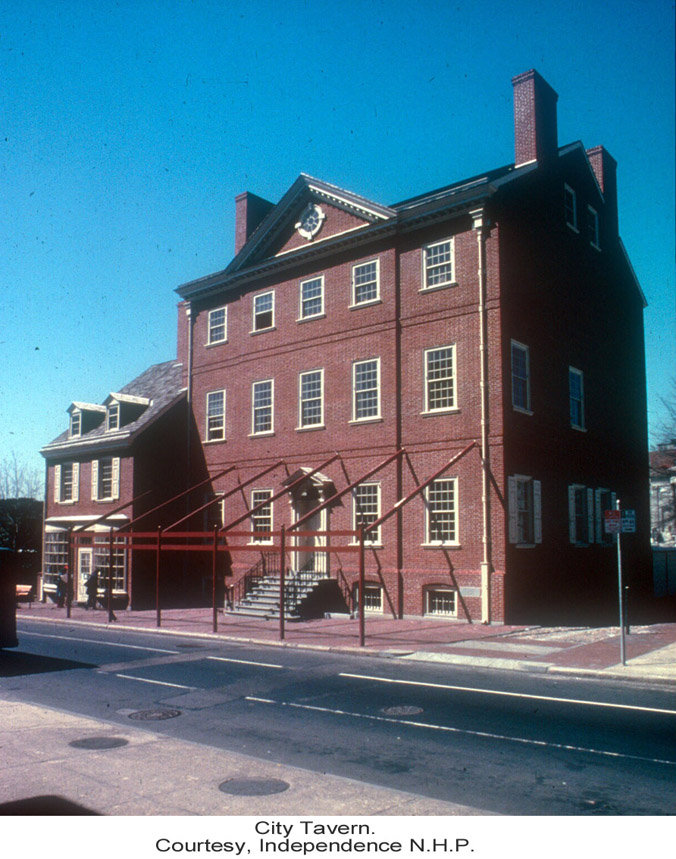
    It appears he enjoyed a simple enough dinner at City Tavern in Philadelphia after a day of Constitutional planning, right? Washington was famous; certainly everywhere he went, people provided “an entertainment” in his honor. As you look more into this event, you find that Washington’s simple diary entries may not always reveal the whole story of what happened.

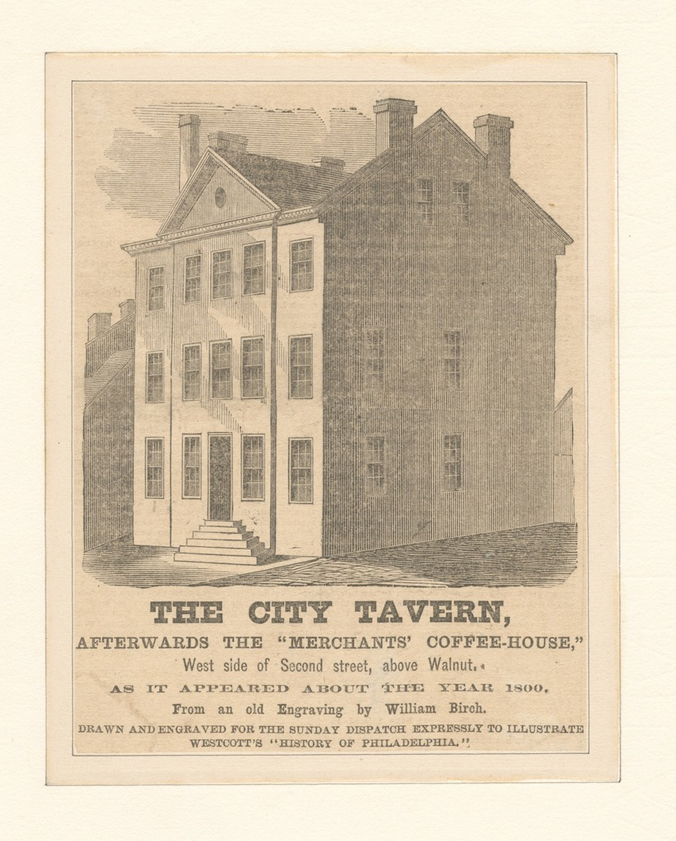
    City Tavern as it appeared about 1800 from an engraving by William Birch. This print dates from 1850. Credit: New York Public Library.

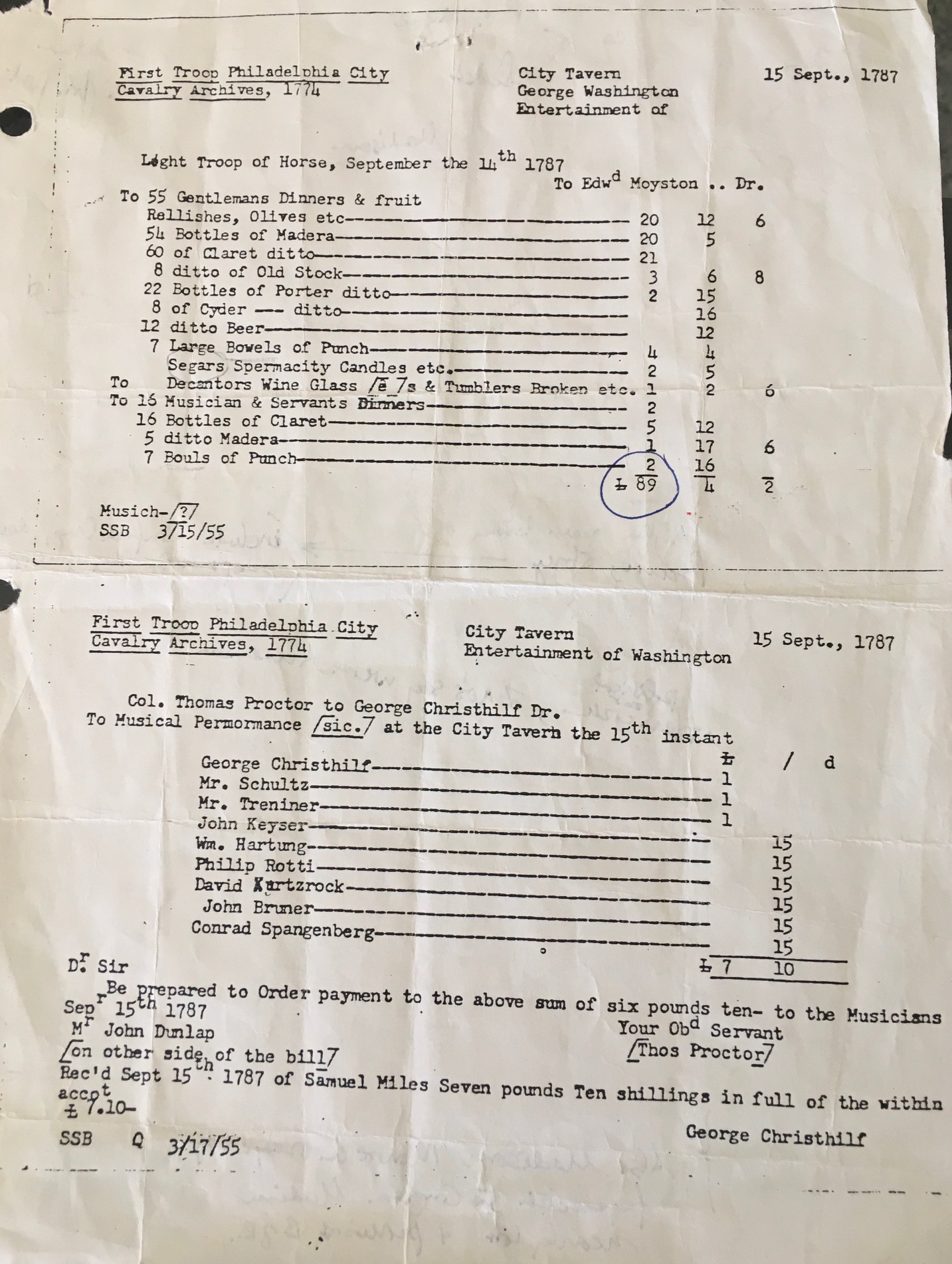
    In this entry, he notes the City Light Horse honoring him at the tavern. The Light Horse of the City of Philadelphia was founded in 1774. They fought with General Washington throughout the war, including at the battles of Trenton, Princeton, and Brandywine.  They were part of the icy-cold crossing of the Delaware and the snow-covered winter at Valley Forge. In fact, although operating under a new name, the First Troop Philadelphia City Cavalry remains intact today as a private military organization whose members all must serve in the Pennsylvania National Guard. Due to its close relationship with George Washington, the troop jumped at the chance to show him its appreciation at the tavern as the Constitutional Convention drew to a close. According to Dr. Gordon Lloyd, the Robert and Katheryn Dockson Professor of Public Policy at Pepperdine University, the bar tab sent to the City Light Horse remains in the First Troop, Philadelphia City Cavalry Archives. Here is the transcription of the bill:

    Courtesy of Dr. Gordon Lloyd, the Robert and Katheryn Dockson Professor of Public Policy at Pepperdine University.

    As you can see, the total comes to 89 pounds, 4 shillings, and 2 pence. According to the Bank of England, given inflation and changes over time, today this would be approximately £14,083 or around $18,471.

    While that sticker price is shocking enough, as we inspect the bill a little more, we notice what all was purchased for the gathering. There are four separate categories on the bill. The bottom section is the fee for the musicians to play. The next section up lists 16 bottles of claret, 5 bottles of madeira, and 7 bowls of punch drunk by the 16 servants and musicians.  Next, comes a line for items broken at the gathering.

    Finally, the top section of the bill deals with 55 guests, all men, who were the main party at City Tavern. The men ordered dinner and several different beverages. First, fifty-four bottles of madeira, probably Washington’s drink of choice. Throughout his life, Washington was said to favor this type of fortified wine from the Madeira islands, an archipelago off the coast of Portugal and a frequent stop for merchant ships travelling between Europe and America in the 18th century. Many prominent families in America took a liking to the wine, as it was relatively easy to obtain. According to records at Mount Vernon, Washington ordered Madeira by the pipe, a large, elongated barrel that held about 126 gallons of wine. Often, he ordered multiple pipes at a time. Today, you can still purchase Madeira wine, but be cautious as it runs 18-20 percent alcohol by volume. Similar to its brother, Port, Madeira is often used in cooking and is a staple of French cuisine today.

    Next, the sixty bottles of Claret were a French-style wine also popular in America in the 18th century. While Madeira came in both sweet and dry varieties, Claret was typically a dry, dark red. Claret is not a fortified wine like Madeira, meaning it is lighter and only around 13-15 percent alcohol by volume.

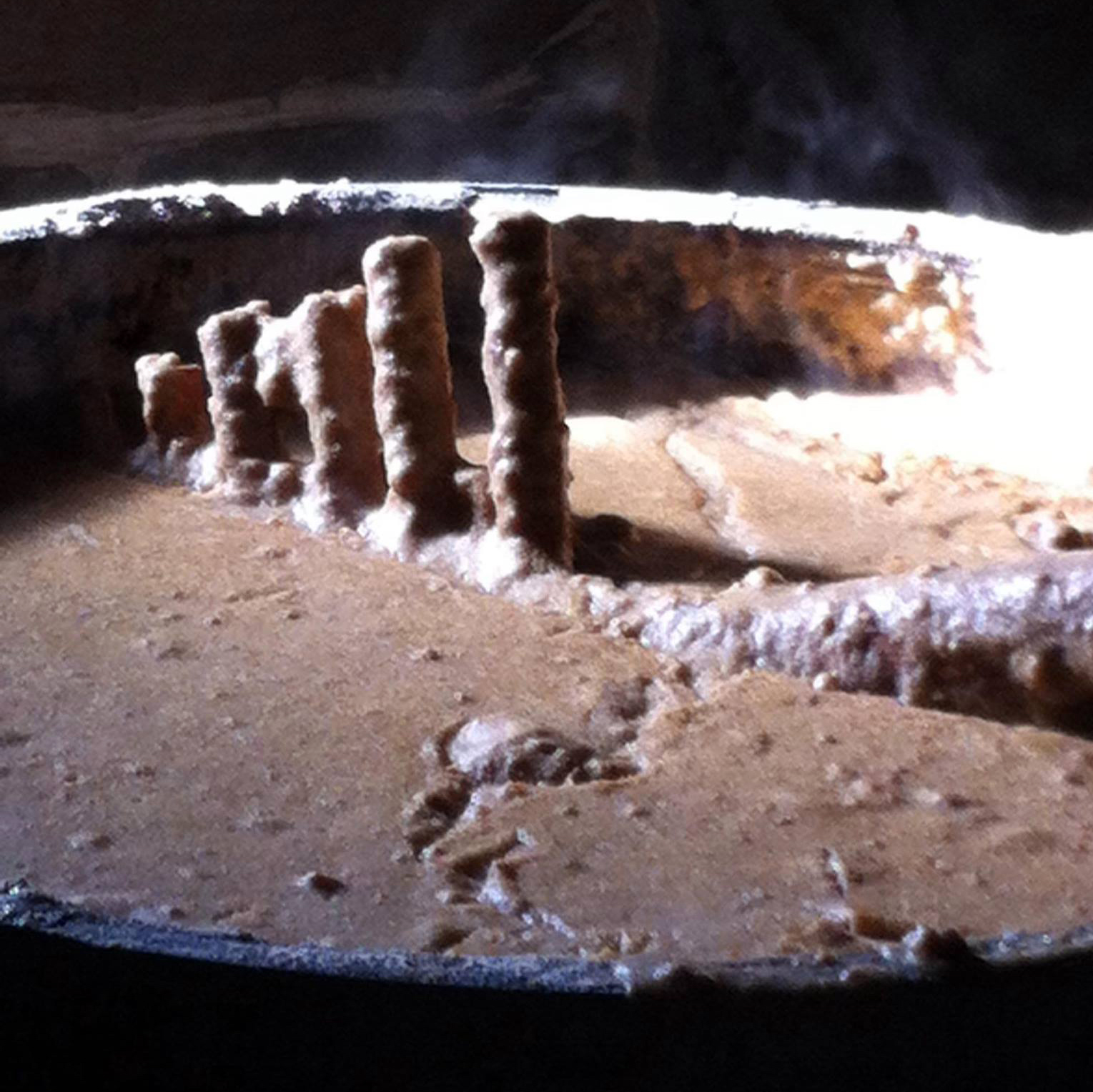
    The list notes that the gentlemen also consumed eight bottles of “Old Stock”, a term used for whiskey at the time. Perhaps throughout his time as General and President, nights like September 14, 1787 convinced Washington to create his own whiskey distillery later in life. By 1799, the distillery at Mount Vernon was one of the most profitable in the country. During the colonial era, it was not customary to age whiskey. The spirits produced at Mount Vernon, as well as, that served at City Tavern were practically straight from the still.

    Whiskey mash in the reconstructed distillery at Mount Vernon. Credit: Elizabeth Hosier.

    The porter, cider, and beer listed on the bill are all similar to the alcohols we call porter, cider, and beer today. Porter was a very popular style of beer in both England and America. In fact, the style was so popular, Washington had his own recipe for it to be produced at Mount Vernon.

    Lastly, the list claims the gentlemen also went through seven large bowls of punch. Punch recipes varied from tavern to tavern and from house to house in colonial days, but they were typically rum or whiskey-based and often contained more than one type of alcohol. You can read much more about punch and how it was served here and about Mary Washington’s punch bowl here.

    With all this drink flowing, we might conclude this was quite a raucous party, but these were rather typical evenings for the people of the 18th century. Keep in mind that water was not always drinkable due to bacteria, they didn’t always have access to fruit to make fresh juice, and certainly soda wasn’t around yet! They were left with few options: tea, coffee, or booze.

    Washington returned to the Convention and by the end of the day after the party, the delegates had finished. Copies of the document were ordered, and just two days later, they signed the Constitution of the United States on Monday, September 17, 1787. Washington stated in his journal:

    “The business being thus closed, the Members adjourned to the City Tavern, dined together and took a cordial leave of each other.”

    What happened that night at City Tavern? Unfortunately, no bill from this night survives to give us any clarification, but Washington provides a hint of just how much steam the delegates needed to blow off. The entry in his journal continued that he returned to his lodgings and:

    “retired to meditate on the momentous wk. which had been executed, after not less than five, for a large part of the time Six, and sometimes 7 hours sitting every day, sundays & the ten days adjournment to give a Comee. opportunity & time to arrange the business for more than four Months.”

    Momentous work, indeed.

    Elizabeth Hosier
    Manager of Interpretation and Visitor Services

  • [Infographic] Ten Pivotal Moments of George Washington’s Boyhood

    You can also read the original blog post with a few more details here.

  • General Likability: Eisenhower and Washington

    Left – Dwight D. Eisenhower on horseback in his later years. Credit: Eisenhower National Historic Site | Right – George Washington receiving the salute on the field at Trenton (1899) by John Faed. Credit: Public Domain.

    “Who did I think I was, running against George Washington?” – Adlai Stevenson, 1952 [1]

    This future president was born into a large family, had a mother who wasn’t a big fan of his military career, first served his country as a general in the military before becoming president, and ended his presidency with a warning against partisanship. No, I am not talking about George Washington. This time, I am talking about Dwight D. Eisenhower, the 34th President of the United States, born 130 years ago today on October 14, 1890.

    With voting underway in the 2020 presidential election, it is impossible not to reflect on some of our past leaders and, of course, here at The George Washington Foundation, we would be remiss if we didn’t look at the leadership qualities of George Washington. As a young boy living at Ferry Farm, no one could have possibly known what would become of George. With our hindsight, we can look to the influence of his mother and older half-brother, who both molded him. Washington’s leadership qualities are difficult to quantify, but we can certainly say that his commanding presence (he was 6’3” and quite athletic from all that horseback riding) was a good first step.

    Eisenhower also possessed a commanding presence as a young man. At 5’11” he wasn’t the tallest of his contemporaries nor did he rival Washington’s height, but he was an exceptional athlete, who played football at West Point. His presence was felt in a room. It was a presence certainly felt by his bride, Mamie Doud, daughter of a meatpacking executive, and considered quite out of Ike’s league when they met. Similar to George and Martha, Ike and Mamie were mismatched financially but had a strong marriage despite war, politics, and long periods of separation.

    Early in Eisenhower and Washington’s military careers, they both found their roads blocked. Washington, initially hoping to join the Royal Navy, was shot down by his mother. Only later did he join the Virginia militia, experiencing combat for the first time during the French and Indian war. Eisenhower went to work straight out of high school, helping to support his family and allowing his older brother to attend school first. With the financial stability of his family in question, Ike wasn’t sure he’d even get the chance to go to college at all until a friend pointed out that the United States Naval Academy in Annapolis was tuition-free. He decided to request consideration for both the Naval Academy and for the United States Military Academy at West Point. He was too old for Annapolis but got into West Point. His mother, a pacifist, was disappointed, but understood Ike’s decision.  Here we see one differentiation in our parallel men; Eisenhower did not see any combat experience during World War I. Instead, he frustratingly found himself stuck stateside.

    Left – General of the Army Dwight D. Eisenhower (1947) by Thomas Edgar Stevens. Credit: National Portrait Gallery | Right – Commander in Chief of the Continental Army General George Washington (1776) by Charles Willson Peale. Credit: Brooklyn Museum

    As to learning military leadership, Washington had first-hand experience while Eisenhower spent several years training others for a war he missed. However, both Washington and Eisenhower served as aides to generals from whom they learned much. Washington, even at the end of his life, credited British General Edward Braddock with giving him his first command opportunity and teaching him the knowledge he needed to succeed in his military career. Similarly, Eisenhower spent four years of the 1930s in the Philippines with General Douglas MacArthur. While theirs wasn’t a mentor/mentee relationship like Washington and Braddock, Eisenhower’s time with MacArthur taught him skills that would prove vital when he encountered difficult personalities throughout the rest of his career.

    Indeed, both Eisenhower and Washington had their fair share of thorns in their sides. For Washington, during the American Revolution, people like Charles Lee left him fuming. During the presidency, his constant disagreements with Thomas Jefferson were infuriating. Eisenhower faced similar issues. During World War II, he struggled with generals like George Patton and British Bernard Montgomery who refused to follow orders. Later, in his presidency, Ike faced the likes of Nikita Khrushchev. Ike and George handled these challenges with poise and delicacy.

    When given the opportunity to choose their own staff, both men had a knack for picking good ones. Washington’s reliance on Henry Knox, Nathaniel Greene, Daniel Morgan, and others was a big part of what led to our victory in the Revolution. Eisenhower surrounded himself with Walter Bedell Smith, Omar Bradley, and Matthew Ridgway – generals who all helped execute the victory in World War II.

    After the Revolution, Washington desired nothing else but retirement at Mount Vernon. At the end of World War II, Ike expressed his desire to do the same, purchasing a farm in Gettysburg, Pennsylvania to serve as his retirement home. All the same, both men found their country was yet not finished with them. Washington and Eisenhower were each approached and convinced by others to stand for president. Having spent his entire adult life in the military, Eisenhower lacked political party affiliation but eventually decided to run as a Republican. Non-partisanship was something Washington officially maintained throughout his presidency. With immense popularity assured by their monumental military victories, the generals won electoral landslides.

    Throughout their presidencies, George and Ike struggled with deepening clashes between political parties, an overly powerful military, and a nation recovering from tragedy and loss. Both men focused much of their administration on domestic issues. Washington helped build a victorious but infant nation while Eisenhower helped move forward a victorious but war-weary nation. George created the role of president, setting standards for the future, the most important of which was the two-term limit. He brought together several states that had once viewed themselves as individual nations into one nation of many states. Ike established the Interstate Highway System, used the National Guard and the 101st Airborne Division to enforce desegregation in Arkansas, and admitted Alaska and Hawaii into the Union. However, as leaders of a nation in the world, neither man could ignore foreign affairs either. Washington focused on remaining neutral and chose not to help the French during their own revolution. Eisenhower ended the Korean War and sought to contain Communism without breaking the federal budget through an increased reliance on nuclear deterrence.

    Left- President Dwight D. Eisenhower (1967) by James Anthony Wills. Credit: The White House Historical Association. | Right – President George Washington (1803-5) by Gilbert Stuart. Credit: National Portrait Gallery.

    At the conclusion of their time in office, both men gave memorable Farewell Addresses. In fact, both speeches are considered two of the greatest given in our nation’s history. As part of his legacy, Washington warned against political parties as paths to division. He expressed worry about creating too close of an alliance with another country, fearing it could drag the nation into conflict. He stated that “overgrown military establishments” were a threat, and stressed the need for “peace and harmony”. For Eisenhower’s part, he warned against a too powerful “military industrial complex”, discussed the need to cultivate positive foreign relations, and said that “America’s prestige” would be defined by “how we use our power in the interests of world peace”. These two great men who gained their fame from war and had seen war’s horrors up close both hoped the country would not have to face another conflict.

    While their lives certainly contain many parallels, perhaps the greatest similarity between Washington and Eisenhower was their leadership style. Both men were optimistic in the face of adversity, lead with exemplary character and morality, and were willing to accept the blame for failure entirely on themselves. They both respected and admired the soldiers who fought under them. They were able to control their emotions and exhibit remarkably strong will. But, in the end, perhaps the one quality that allowed both of them such success was their general likability.

    Beth Hosier
    Manager of Interpretation & Visitor Services


    [1] Cooke, Alistair, “Adlai Stevenson: The Failed Saint” in Six Men. London: Penguin, 2008.

  • Washington and the Culper Spy Ring

    At George Washington’s Ferry Farm, we largely focus on George’s youth but also eagerly research and learn as much as we can about all periods of his life. During our unexpected closure due to COVID-19, some of our interpretive staff had the chance to study a little more about Washington and the Culper Spy Ring for a reading group we created.

    Early on during the American Revolution, it was apparent to George Washington that he would need a way to get information about British troop movements and, hopefully, their overall plans. The Siege of Boston was a huge success for Washington and his Continentals, but capturing New York proved to be much tougher. In fact, New York remained occupied by the British for the entire war but Washington continued to hope that he could liberate the city. And in that hope, he knew he needed intelligence from inside the city. Everyone who crossed the border, however, was searched by British soldiers and any direct letters were confiscated and the bearer convicted of treason.

    After a failed attempt by a young solider named Nathan Hale, Washington knew the intelligence would be very difficult to gather, and even more difficult to transmit. He called upon another young Yalie named Benjamin Tallmadge to help him with his goal. In November of 1778, Tallmadge began The Culper Spy Ring. He contacted operatives in New York City and they developed a complex system of routes to pass along information. The operatives in Manhattan passed the information to a carrier in Long Island and then eventually a second carrier brought the information to Tallmadge in Connecticut.

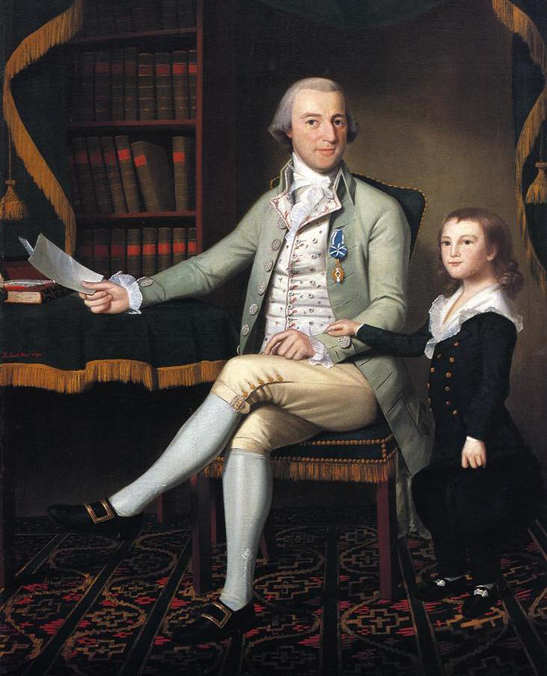
    Benjamin Tallmadge (1790) by Ralph Earl
    Portrait of Benjamin Tallmadge along with his son William painted after the war in 1790 by Ralph Earl. Credit: Wikipedia

    The identity of the spies was so restricted that of the five operatives known to have helped, at least one of their identities is still highly debated by historians. Washington himself did not want to know their real names thus the agents were given nicknames. For example, Benjamin Tallmadge was called John Bolton, Abraham Woodhull went by Samuel Culper, and Robert Townsend was referred to as Samuel Culper, Jr.

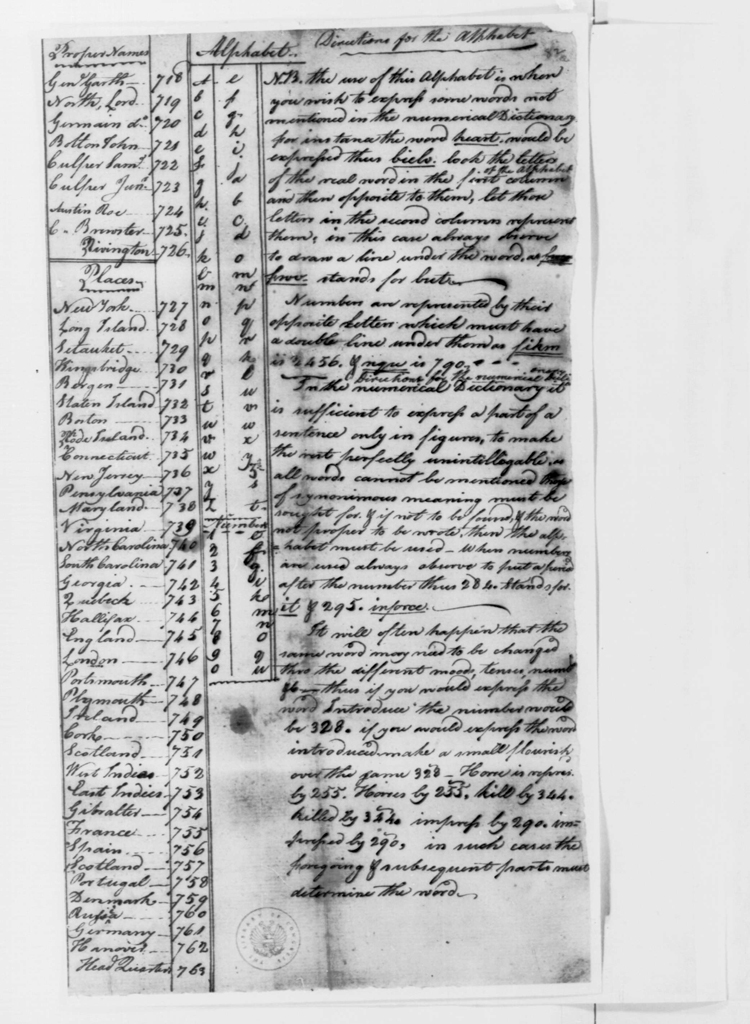
    The spy ring also developed a code that used over 760 combinations of numbers to represent people, places, and things. For example, Washington was 711, New York City was 727, and the lone female spy was referred to as 355. Of course, randomly filling a letter with numbers was a sure way to get caught, so they also used invisible ink and ciphers.

    Culper Code
    A page from the key to the Culper code. Credit: Library of Congress

    Even with all these precautions, the work was dangerous and risky. The news traveled to Washington too slowly to be of much use, and he pressured Tallmadge to speed up the process. The spies were constantly in danger of being found out.

    However, the Culper Spy Ring is credited with several key achievements. In 1780, the French Army arrived to reinforce Washington’s men and their ships landed in Rhode Island. The British knew they were coming and the spy ring passed that information along to Washington. He arranged a ruse to distract the British and allow the French to land without conflict. The Culper Spy Ring also unearthed some of the information that would lead to the discovery of Benedict Arnold’s treason as well as the capture of a major British intelligence officer, John André.

    So, after reading about the Culper Spy Ring, one historic interpreter who leads tours of the Washington house was happy to share the part of the story that made them most interested in the intricate spy ring that helped win the Revolution.

    Thanks to modern depictions, when I think of a spy the image that immediately comes to mind is someone with all the newest technology and an expensive taste in cars and clothes. Those that made up the Culper Spy Ring couldn’t be farther from the glamorized and romanticized depiction of spies that we have come so used to seeing. Though the five that made up the ring were from different walks of life and social statuses, they worked together (not always seamlessly) for a cause they believed to be worth more than their own lives. Through rather mundane means and careful exchanges, they were able to provide the key information for Washington under the nose of the enemy. The daring escapes across water by Caleb Brewster in a rowboat while taunting the most powerful naval force in the world were both hilarious and unbelievable. Brewster’s personality and general lifestyle makes him the odd one out in my mind. However, he also seems to be one of the most willing in many cases and jokes about the British not being able to catch him. Brewster’s personality more closely matches that classic spy image but his means are what really catch your attention. – Hunter Robinson

    Elizabeth Hosier
    Manager of Interpretation and Visitor Services