Whilst I costume actors, living historians, and myself from time to time in 18th century clothing, I find myself puzzled about the stark difference between the closures and attachments of ladies’ and men’s garb. I have to lace myself into my stays, tie on layers of padding and petticoats around my waist, and finally pin my gown closed. Men have the enjoyment of a few buttons on their breeches and waistcoat, but that is it. It frequently makes me grumpy how long it takes me to dress in comparison to my male counterpart. I did not understand this phenomenon, until recently.
To put 18th century clothing closures into perspective, you had hooks and eyes, buttons, and ties/laces. Thomas Hancock created elastic for gloves, suspenders, and stockings in the 1820s, but it struggled to withstand heat and last through time. The elastic we know and love in our garments today did not come around until the early 1900s.[1] The modern zipper was patented in 1917 and was used mainly on boots and tobacco pouches. It took another 20 years before the technology even made it to mass produced clothing.[2] By comparison, the button first becomes functional over decorative around 1,000 BCE in Asia. Buttons would eventually travel the Mediterranean during the crusades into European territories around the late 11th century CE.[3] So George Washington did not have a zipper on his pants or elastic on his socks, but he definitely had buttons on his coat.

Hooks and eyes were sometimes used for gown closures for women in the 18th century. They were not used as much as pins were because of the rigidity in size it created for the garment.
We have buttons from men’s garments in the archaeological collections here at Ferry Farm. We also see buttons all around male portraiture in our curatorial collection. The ladies, however, are stuck with laces, ribbons, and pins. And boy, do we have the pins to prove it in the archaeology collections.
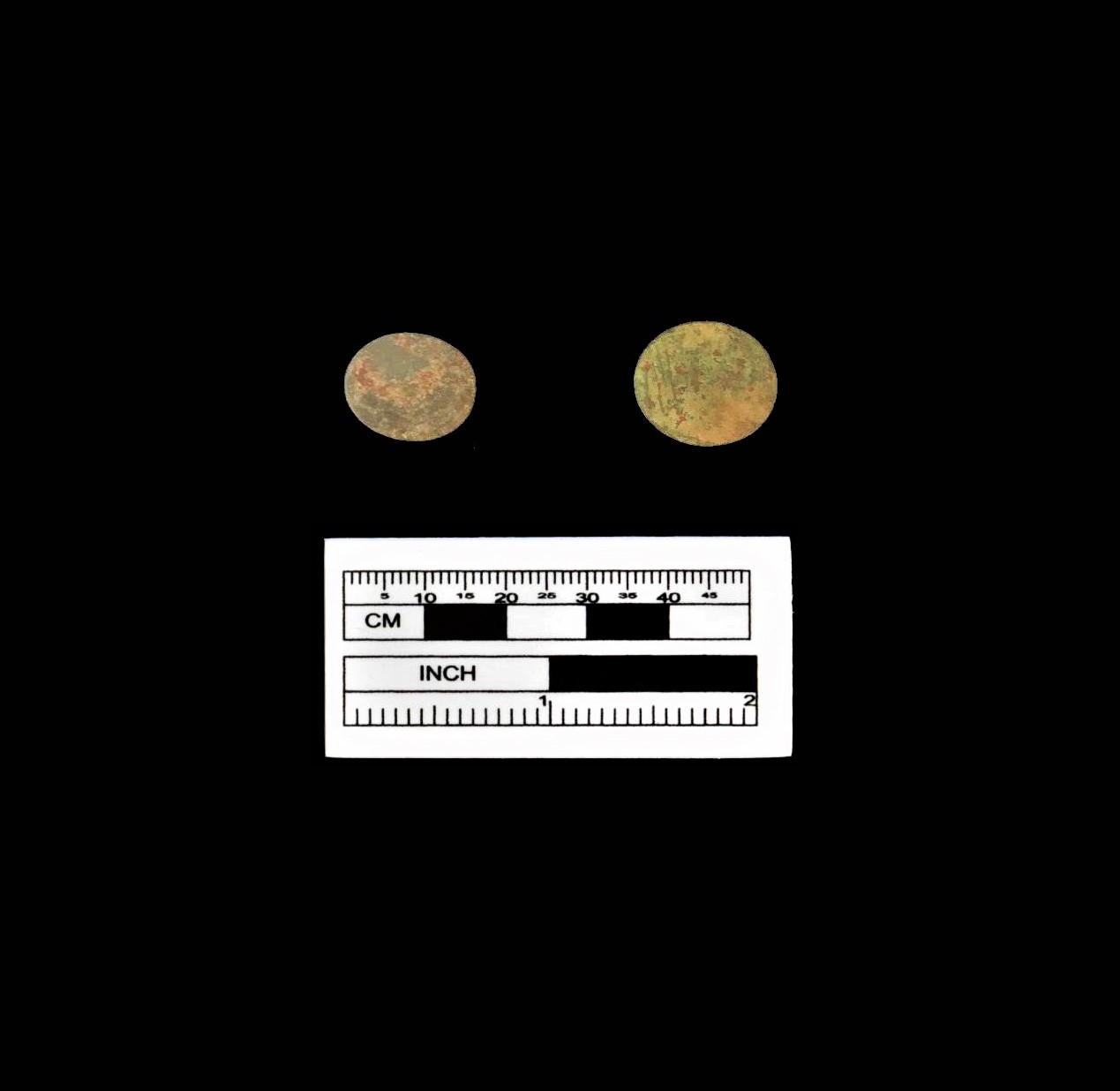


A small sample of the large collection of brass dress pins found at Ferry Farm. Pins were not used for sewing, as basting before sewing was the regular practice. Pins were used for pinning jackets closed and keeping caps pinned to your hair. They were a necessary part of dressing.
The answer to why this phenomenon is how it is hit me one day after rewatching a lecture given by a former staff member entitled “Betty Washington Lewis and Women’s Health.” Dr. Kelly Brennen Arehart spoke about maternity wardrobes and how women wore their everyday clothing throughout pregnancy. For my contemporary mind, this was shocking, but the more I thought about it the more it made sense.
Women go through a lot of fluctuations in body shape, weight, and proportions in their lifetime. Between hitting puberty and development of curves, to many pregnancies, to the changes of menopause, women’s bodies go through so much. Of course in between all of the big changes, there are also changes to the female body based on time in her menstrual cycle, metabolism fluctuations, or periods of eating more or less or different types of food that all change the body’s shape and size. Unlike today, women of the past could not just go to the shop and buy a pair of pants in the size up. Clothing was incredibly expensive and time consuming to make before sewing machines and mass production come into play. In the 18th century, even the highest classes of women did not have the money or the time to go buy or have new clothing made when they gained a few pounds or got pregnant. It was a matter of adjusting the clothing they already had. And that is exactly what ties, pins, and laces allowed women to do.
The lacing, pinning, and tying made clothing far more adjustable compared to the rigidity of buttons. Women tied their petticoats looser and simply covered the wider gap in the side with their jacket or gown. Stays were either loosened significantly by the laces or they were left unlaced at the bottom entirely, especially in cases of late term pregnancies. On top of the stays, jackets could be pinned further out to allow for more room in the bust and waist, or a stomacher could be added in the center opening of the jacket to expand the top even further.
Whether these closures were intentionally created to be adjustable or if it was just a byproduct of lacking clothing technology, I am not entirely sure. But the idea that buttons were only used on men’s not so fluctuating bodies (for the most part) says something. A button is sewn down and cannot be easily moved or adjusted on a regular basis. Once a button is sewn into place, there is no room for variation in body shape, unless one wanted to move the buttons every time he ate a large meal the previous day.
Even though Betty Washington Lewis had Charlotte, who we believe to be an enslaved woman acting as the seamstress of the Lewis household, Betty was pregnant on and off for twenty years. If Charlotte or another enslaved seamstress had to make a maternity wardrobe for Betty every time she was with child, the seamstress would have no time to do any other tasks whatsoever. It was not economical with precious time or expensive cloth for women to need new clothes every few weeks.
So to tie all this together, I am still not happy that it is so inconvenient for me to dress myself in 18th century clothing, but I understand why getting dressed was this way. The adjustability of women’s clothing was so intentionally created to conform to their bodies in any season it was in. It also opens my eyes to why pins were so important. Without them, a woman could not dress.
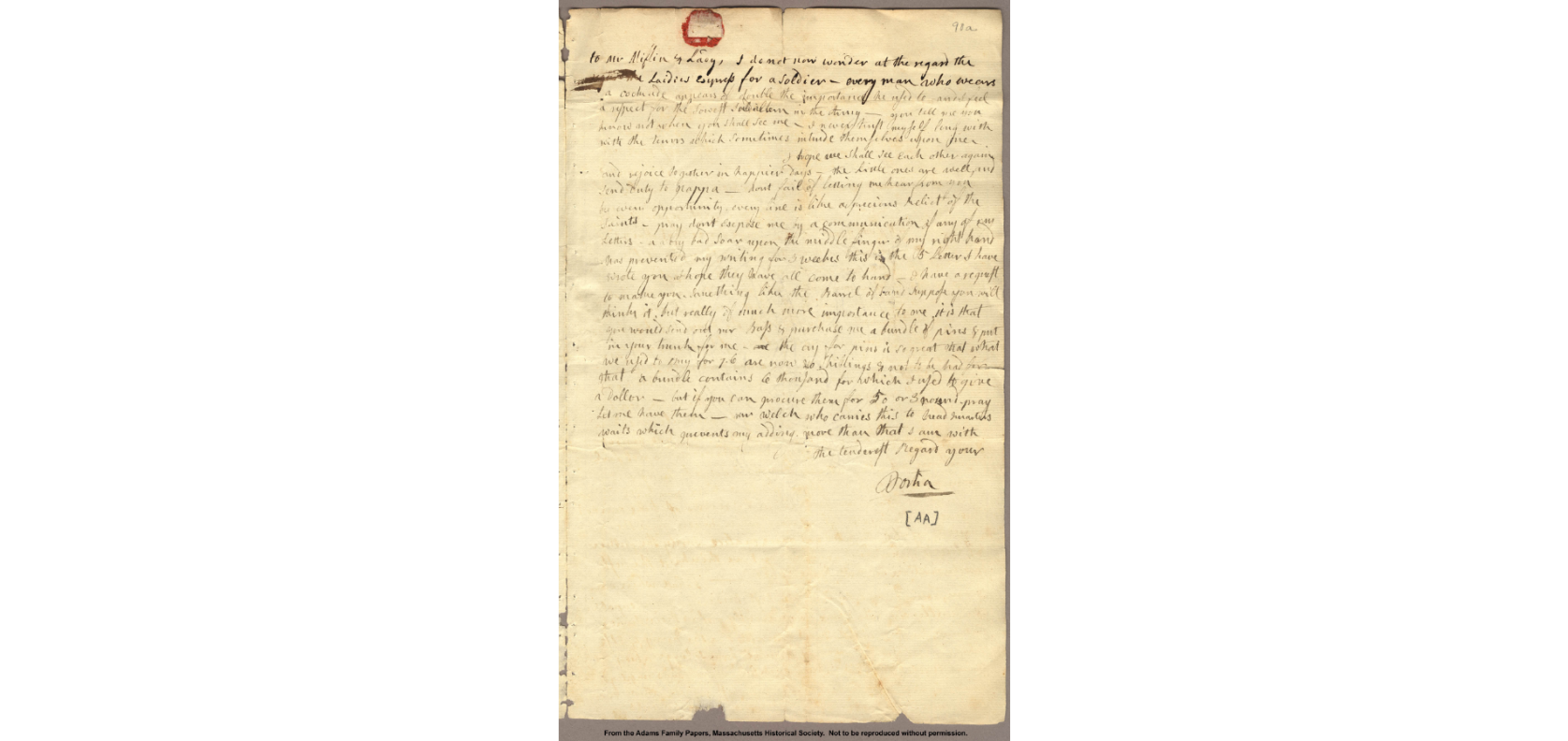
…I have a request to make you. Something like the Barrel of Sand suppose you will think it, but really of much more importance to me. It is that you would send out Mr. Bass and purchase me a bundle of pins and put in your trunk for me. The cry for pins is so great that what we used to Buy for 7.6 are now 20 Shillings and not to be had for that. A bundle contains 6 thousand for which I used to give a Dollor, but if you can procure them for 50 [shillings] or 3 pound, pray let me have them. Mr. Welch who carries this to head Quarters waits which prevents my adding more than that I am with the tenderest Regard
your
Portia
Allison Ellis
Manager of Public Programs
[1] “Questions About Elastic,” Maggie May Clothing, Accessed July 10, 2023, https://maggiemayfashions.com/questions-about-elastic-2/.
[2] Ninette Dean, “The Up and Down History of the Zipper,” The Smithsonian Libraries and Archives, Accessed July 10, 2023, https://blog.library.si.edu/blog/2010/05/03/the-up-an-down-history-of-the-zipper/.
[3] Caroline Stone, “The Westward Journeys of Buttons,” AramcoWorld, Accessed July 10, 2023, https://www.aramcoworld.com/Articles/November-2020/The-Westward-Journeys-of-Buttons.
 Lives & Legacies